
IB Diploma · Biology · SL / HL · Worksheets
Theme B Worksheet
Need more than one subject? All-notes pass: unlimited downloads of every note for a year: unlimited downloads of every note on the site, PKR 999 a year. All packs and courses.
Opens inside this page. Prefer your own PDF app? Open the PDF.
Check yourself
5 quick questions on B Form and function
Tap an answer to see if you are right, and why. Free, no sign-up.
Start the free test👍 16 students found these notes useful
Was this note useful?
Full text of Theme B Worksheet
IB DP BIOLOGY Theme B · Form and Function TOPICAL WORKSHEET
B1 Molecules & Metabolism · B2 Cell Structure
B3 Gas Exchange & Transport · B4 Ecology
Standard and Higher Level · Syllabus 2025
Fahad H. Ahmad
Original exam-style questions written for the IB Diploma Programme Biology course (first assessment 2025)
Free notes, practice tests and live classes Back to megalecture.com
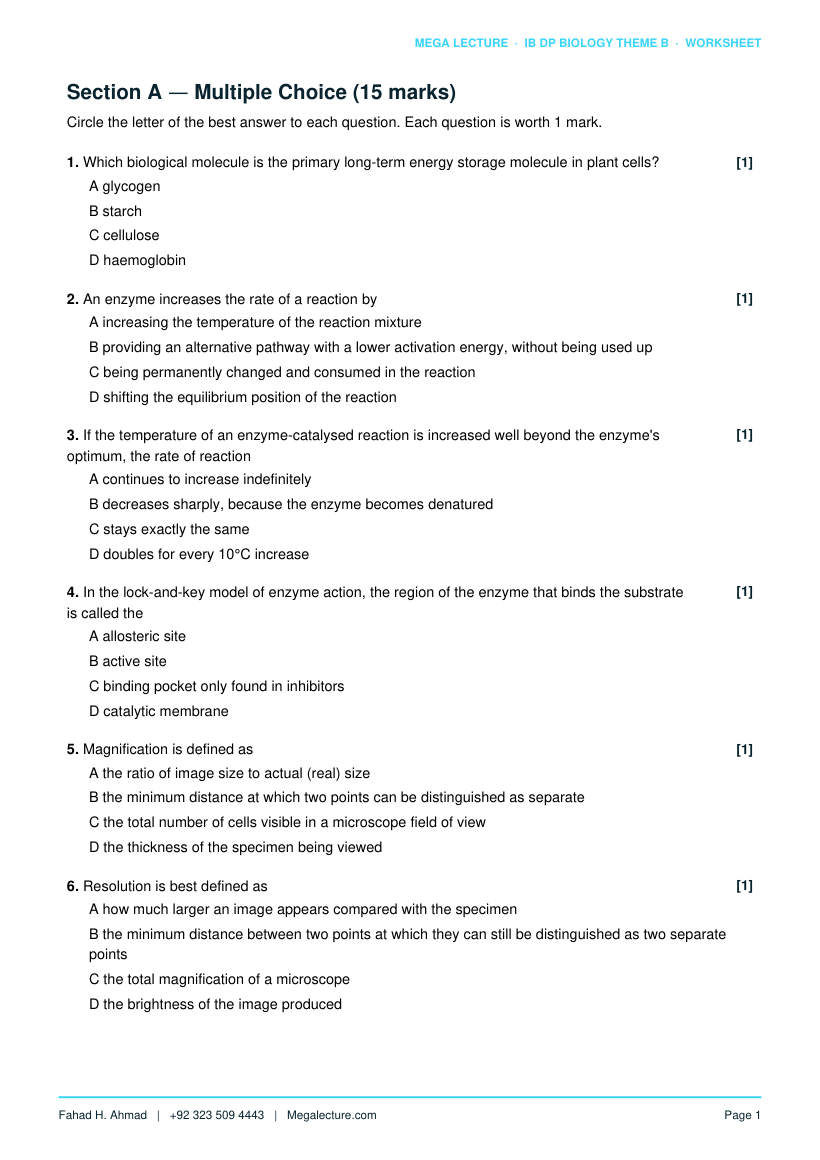
Section A — Multiple Choice (15 marks)
Circle the letter of the best answer to each question. Each question is worth 1 mark.
- Which biological molecule is the primary long-term energy storage molecule in plant cells? [1]
A glycogen
B starch
C cellulose
D haemoglobin
- An enzyme increases the rate of a reaction by [1]
A increasing the temperature of the reaction mixture
B providing an alternative pathway with a lower activation energy, without being used up
C being permanently changed and consumed in the reaction
D shifting the equilibrium position of the reaction
- If the temperature of an enzyme-catalysed reaction is increased well beyond the enzyme's optimum, the rate of reaction
[1]
A continues to increase indefinitely
B decreases sharply, because the enzyme becomes denatured
C stays exactly the same
D doubles for every 10°C increase
- In the lock-and-key model of enzyme action, the region of the enzyme that binds the substrate is called the
[1]
A allosteric site
B active site
C binding pocket only found in inhibitors
D catalytic membrane
- Magnification is defined as [1]
A the ratio of image size to actual (real) size
B the minimum distance at which two points can be distinguished as separate
C the total number of cells visible in a microscope field of view
D the thickness of the specimen being viewed
- Resolution is best defined as [1]
A how much larger an image appears compared with the specimen
B the minimum distance between two points at which they can still be distinguished as two separate points
C the total magnification of a microscope
D the brightness of the image produced
- Which organelle is mainly responsible for synthesizing proteins in a cell? [1]
A Golgi apparatus
B mitochondrion
C ribosome
D lysosome
- A cell specialized for absorption, such as an epithelial cell lining the small intestine, typically shows which adaptation?
[1]
A a thick, impermeable cell wall
B numerous microvilli, increasing surface area for absorption
C the complete absence of mitochondria
D a single large permanent vacuole
- The alveoli are adapted for efficient gas exchange because they have [1]
A a small surface area and thick walls
B a large surface area, thin (one cell thick) walls, and a good blood supply
C no blood supply, to avoid gas loss
D a permanently constant partial pressure of oxygen
- On the oxyhaemoglobin dissociation curve, at low partial pressures of oxygen (the steep part of the curve),
[1]
A a small increase in pO2 causes a large increase in % saturation
B haemoglobin is already 100% saturated
C % saturation is completely independent of pO2 D a small increase in pO2 causes % saturation to decrease
- Deoxygenated blood returning to the heart from the body first enters the [1]
A left atrium
B right atrium
C left ventricle
D right ventricle
- The maximum population size that a particular environment can sustain indefinitely is called the
[1]
A exponential growth rate
B carrying capacity
C population density
D biotic potential
- During the exponential (early) growth phase of a population, growth rate is limited primarily by [1]
A the reproductive rate of the organisms, since resources are not yet limiting
B the carrying capacity of the environment
C intense competition for resources
D the presence of predators only
- Which of the following is a density-dependent factor that can limit population growth? [1]
A a sudden volcanic eruption
B an unusually cold winter
C availability of food and other resources
D a random flood
- In the carbon cycle, which process returns carbon dioxide to the atmosphere from living organisms?
[1]
A photosynthesis
B respiration
C sedimentation
D combustion of fossil fuels only
Section B — Structured Questions (65 marks)
Answer all questions in the space provided. Working must be shown for full marks.
B1 Molecules & Metabolism
Question 1 [7 marks]
The graph shows how the rate of an enzyme-catalysed reaction changes with temperature (given data).
Rate of an enzyme-catalysed reaction vs temperature (given data).
- Using the graph, identify the optimum temperature for this enzyme. [2]
- Describe and explain the shape of the curve between 10°C and the optimum temperature. [2]
- Explain, in terms of protein structure, why the rate of reaction drops sharply above the optimum temperature.
[3]
Question 2 [6 marks]
Enzymes are highly specific biological catalysts.
- Describe how enzymes increase the rate of a reaction. [2]
- Explain why enzymes are described as specific, in terms of the shape of their active site. [2]
- Distinguish between the lock-and-key model and the induced-fit model of enzyme action. [2]
Question 3 [7 marks]
The graph shows how the rate of an enzyme-catalysed reaction changes with substrate concentration, at a fixed enzyme concentration (computed).
Rate of reaction vs substrate concentration (computed).
- Using the graph, describe the relationship between substrate concentration and rate of reaction at low substrate concentrations.
[2]
- Explain why the rate of reaction plateaus (reaches a maximum, Vmax) at high substrate concentrations.
[2]
- Suggest what would happen to this graph if more enzyme were added, with substrate remaining in excess.
[3]
B2 Cell Structure
Question 4 [6 marks]
Eukaryotic cells contain many different membrane-bound organelles, each with specific functions.
- State the function of the mitochondrion and the function of a ribosome. [2]
- Describe the role of the rough endoplasmic reticulum and the Golgi apparatus in processing a protein destined for secretion.
[2]
- Explain why cells that secrete large amounts of protein (e.g. pancreatic cells) contain many mitochondria and an extensive rough endoplasmic reticulum.
[2]
Question 5 [7 marks]
The graph (on a logarithmic scale) compares the resolution achievable with a light microscope, a scanning electron microscope (SEM), and a transmission electron microscope (TEM) (given data).
Resolution of different types of microscope (given data, log scale; smaller value = better resolution).
- Using the graph, identify which type of microscope has the best (smallest) resolution. [2]
- Define resolution, and explain why electron microscopes can reveal more detail than light microscopes.
[2]
- An image of a cell organelle taken with an electron microscope has a width of 40 mm on the printed page, at a magnification of ×20,000. Calculate the actual width of the organelle, in micrometres (μm).
[3]
Question 6 [6 marks]
Multicellular organisms contain many types of specialized (differentiated) cells.
- Define 'cell differentiation'. [2]
- Describe two structural adaptations of a named specialized cell, related to its function. [2]
- Explain, in terms of gene expression, why differentiated cells generally cannot change into a different cell type.
[2]
B3 Gas Exchange & Transport
Question 7 [7 marks]
The graph shows the oxyhaemoglobin dissociation curve: the percentage saturation of haemoglobin with oxygen at different partial pressures of oxygen (given data).
Oxyhaemoglobin dissociation curve (given data).
- Using the graph, state the percentage saturation of haemoglobin at the partial pressure of oxygen found in respiring tissue (~4 kPa) and in the alveoli (~13.3 kPa).
[2]
- Using the graph, explain why haemoglobin readily loads oxygen in the lungs and readily unloads it in respiring tissues.
[2]
- Explain the physiological significance of the steep, S-shaped (sigmoid) middle portion of the curve.
[3]
Question 8 [6 marks]
Efficient gas exchange depends on the structure of the gas exchange surface and the mechanics of ventilation.
- State three general features of an efficient gas exchange surface. [2]
- Describe how the alveoli of the lungs are specifically adapted for efficient gas exchange. [2]
- Describe the role of the diaphragm and the intercostal muscles during inspiration (breathing in).
[2]
B4 Ecology
Question 9 [7 marks]
The graph shows the logistic growth of a population introduced into a new habitat over time (computed model).
Logistic population growth curve (computed model).
- Using the graph, identify the carrying capacity, K, of this population, and describe how the population growth rate changes over time.
[2]
- Explain why population growth slows as the population size approaches the carrying capacity. [2]
- Suggest two density-dependent factors that could limit further population growth as the population nears K.
[3]
Question 10 [6 marks]
Carbon is cycled between the atmosphere, living organisms, and the physical environment.
- Describe two processes that remove carbon dioxide from the atmosphere. [2]
- Describe two processes that release carbon dioxide into the atmosphere. [2]
- Explain how the combustion of fossil fuels has disrupted the natural balance of the carbon cycle.
[2]
