
IB Diploma · Biology · SL / HL · Theme B: Form and Function
B4.2 Ecological Niches
Need more than one subject? All-notes pass: unlimited downloads of every note for a year: unlimited downloads of every note on the site, PKR 999 a year. All packs and courses.
Opens inside this page. Prefer your own PDF app? Open the PDF.
Check yourself
5 quick questions on B Form and function
Tap an answer to see if you are right, and why. Free, no sign-up.
Start the free test👍 16 students found these notes useful
Was this note useful?
Full text of B4.2 Ecological Niches
IB DP BIOLOGY Theme B: Form and Function B4.2 Ecological Niches
Revision Notes · Standard and Higher Level Fahad H. Ahmad
Original notes prepared for the IB Diploma Programme Biology course (first assessment 2025)
Free notes, practice tests and live classes Back to megalecture.com
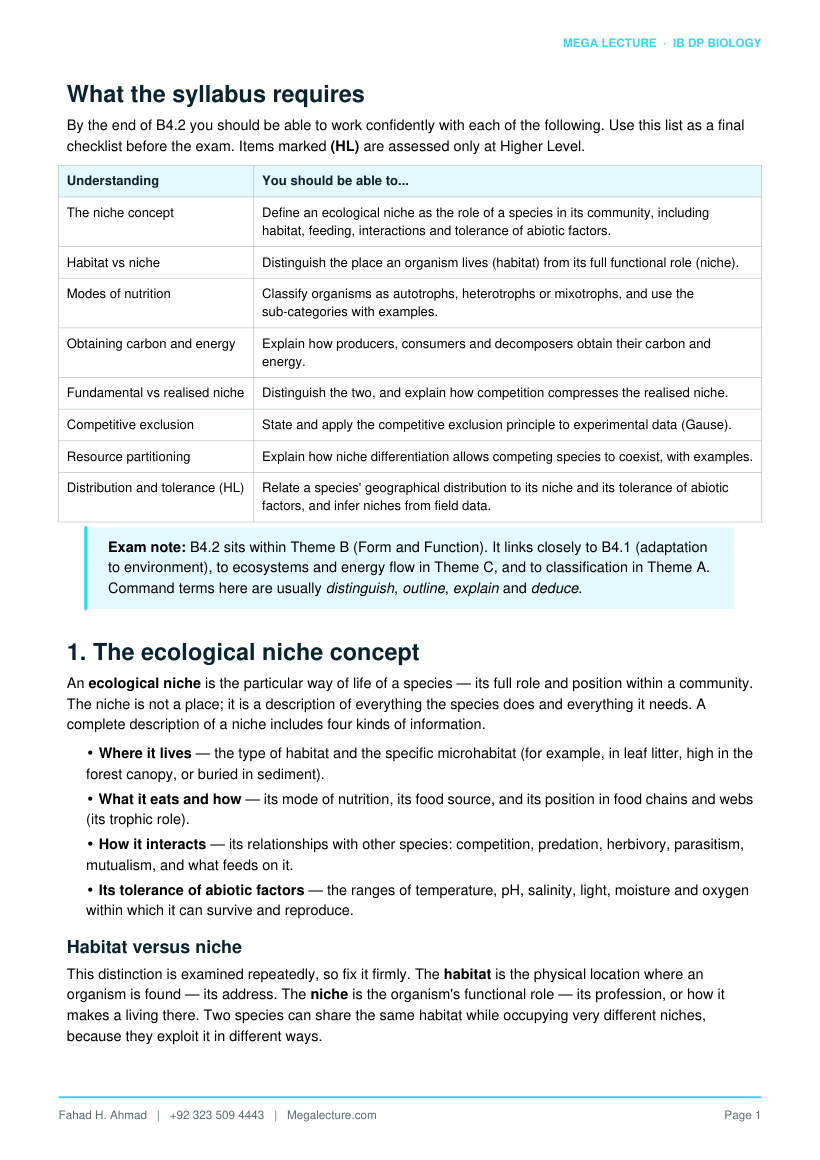
What the syllabus requires
By the end of B4.2 you should be able to work confidently with each of the following. Use this list as a final checklist before the exam. Items marked (HL) are assessed only at Higher Level.
Understanding You should be able to...
The niche concept Define an ecological niche as the role of a species in its community, including habitat, feeding, interactions and tolerance of abiotic factors.
Habitat vs niche Distinguish the place an organism lives (habitat) from its full functional role (niche).
Modes of nutrition Classify organisms as autotrophs, heterotrophs or mixotrophs, and use the sub-categories with examples.
Obtaining carbon and energy Explain how producers, consumers and decomposers obtain their carbon and energy.
Fundamental vs realised niche Distinguish the two, and explain how competition compresses the realised niche.
Competitive exclusion State and apply the competitive exclusion principle to experimental data (Gause).
Resource partitioning Explain how niche differentiation allows competing species to coexist, with examples.
Distribution and tolerance (HL) Relate a species' geographical distribution to its niche and its tolerance of abiotic factors, and infer niches from field data.
Exam note: B4.2 sits within Theme B (Form and Function). It links closely to B4.1 (adaptation to environment), to ecosystems and energy flow in Theme C, and to classification in Theme A. Command terms here are usually distinguish, outline, explain and deduce.
1. The ecological niche concept
An ecological niche is the particular way of life of a species — its full role and position within a community. The niche is not a place; it is a description of everything the species does and everything it needs. A complete description of a niche includes four kinds of information.
- Where it lives — the type of habitat and the specific microhabitat (for example, in leaf litter, high in the forest canopy, or buried in sediment).
- What it eats and how — its mode of nutrition, its food source, and its position in food chains and webs (its trophic role).
- How it interacts — its relationships with other species: competition, predation, herbivory, parasitism, mutualism, and what feeds on it.
- Its tolerance of abiotic factors — the ranges of temperature, pH, salinity, light, moisture and oxygen within which it can survive and reproduce.
Habitat versus niche
This distinction is examined repeatedly, so fix it firmly. The habitat is the physical location where an organism is found — its address. The niche is the organism's functional role — its profession, or how it makes a living there. Two species can share the same habitat while occupying very different niches, because they exploit it in different ways.
Feature Habitat Niche
What it describes The place where the organism lives The role the organism plays and all it requires
Analogy An organism's address An organism's profession or job
Scope Physical and geographical Physical, biotic and abiotic combined
Can two species share it?
Yes — many species share one habitat No two species can occupy an identical niche for long (see Section 6)
Example An oak woodland A caterpillar eating oak leaves in spring; a woodpecker taking insects from oak bark
Key idea: “Niche” includes the habitat but is much broader. If an exam answer only names where the organism lives, it has described the habitat, not the niche — marks for the niche require the feeding, interactions and abiotic tolerances as well.
2. Fundamental and realised niches
Ecologists separate the niche a species could occupy in theory from the niche it actually occupies in practice once other species are present.
- The fundamental niche is the full range of conditions and resources in which a species is able to survive and reproduce in the absence of competition, predation or other biological limits — the potential niche set only by the organism's own tolerances and requirements.
- The realised niche is the part of the fundamental niche that a species actually occupies when other species are present. It is the fundamental niche minus the parts lost to competition and other interactions, so it is always the same size as, or smaller than, the fundamental niche.
How competition restricts the realised niche
When two species require overlapping resources, each performs less well where the overlap is greatest. The stronger competitor tends to dominate part of the shared resource, forcing the weaker competitor out of that part. The weaker species is then confined to the portion of its fundamental niche where it either faces no competitor or holds a local advantage. In this way competition compresses the realised niche relative to the fundamental niche.
The classic evidence comes from two barnacle species on rocky shores. One (Chthamalus) can physiologically survive across almost the whole shore, from the high to the low zone — that is its fundamental niche. But on the lower shore a faster-growing barnacle (Balanus) crowds it out. As a result Chthamalus is found only on the upper shore: its realised niche is a small part of its fundamental niche, and the boundary is set by competition, not by its own tolerance.
Common misconception: The realised niche is not simply “where the species happens to be.” It is the part of the fundamental niche left available after interactions with other species. Remove the competitor and the species can expand back towards its fundamental niche.
Figure 1. A performance curve along a pH gradient. The fundamental niche (pH 4.5 to 8.0, width 3.5) is the full range the species tolerates alone; competition removes the acidic part, leaving a narrower realised niche (pH 6.5 to 8.0, width 1.5).
Realised width ≤ fundamental width.
3. Modes of nutrition
A central part of any niche is how the organism obtains its carbon and energy. Organisms are grouped by their mode of nutrition. The first division is between autotrophs, which build their own organic molecules from inorganic sources, and heterotrophs, which take in ready-made organic molecules from other organisms.
Autotrophs (self-feeders)
Autotrophs synthesise their own carbon compounds from simple inorganic raw materials, above all carbon dioxide. They differ in their energy source.
- Photoautotrophs use light energy to fix CO2 into organic compounds by photosynthesis — plants, algae and cyanobacteria.
- Chemoautotrophs use the energy released by oxidising inorganic chemicals (such as H2S, ammonia or Fe2+) to fix CO2 — for example nitrifying bacteria in soil and the bacteria at deep-sea hydrothermal vents.
Heterotrophs (other-feeders)
Heterotrophs obtain both their carbon and their energy from organic compounds made by other organisms. They are subdivided by how they take in that food.
- Holozoic feeders ingest solid food, then digest it internally and absorb the products — most animals, from mammals to insects.
- Saprotrophs (decomposers) secrete digestive enzymes onto dead organic matter and absorb the soluble products of external digestion — most fungi and many bacteria.
- Detritivores ingest non-living organic matter (detritus) as particles and digest it internally — earthworms, woodlice and dung beetles.
- Parasites obtain nutrients from a living host, harming it — tapeworms, ticks, and fungi that cause plant disease.
Mixotrophs
Some organisms are mixotrophs: they can use both autotrophic and heterotrophic nutrition. Euglena, a single-celled protist, photosynthesises in the light but can also absorb organic matter from its surroundings in the dark. Mixotrophs may be obligate (they must combine both modes) or facultative (they switch between modes as conditions require).
Obligate versus facultative
These two terms describe how fixed a mode of nutrition is. An obligate organism has no alternative — it can only live in that one way. A facultative organism has a choice — it uses that mode when suitable but can switch to another. For example, an obligate parasite cannot complete its life cycle without a host, whereas a facultative parasite can also live independently.
Mode Carbon source Energy source Example
Photoautotroph Inorganic (CO2) Light Oak tree, spirogyra, cyanobacteria
Chemoautotroph Inorganic (CO2) Oxidation of inorganic chemicals
Nitrifying bacteria; vent bacteria
Holozoic heterotroph Organic (ingested) Organic compounds Lion, human, grasshopper
Saprotroph / decomposer
Organic (dead matter) Organic compounds Bread mould (Rhizopus); many bacteria
Detritivore Organic (detritus) Organic compounds Earthworm, woodlouse, dung beetle
Parasite Organic (living host) Organic compounds Tapeworm, head louse, potato blight
Mixotroph Both inorganic and organic
Light and/or organic Euglena; Venus flytrap
Vocabulary trap: Autotroph means “self-feeding,” not “plant.” A photoautotroph and a chemoautotroph are both autotrophs but differ in energy source. A decomposer is a heterotroph, even though it digests externally — do not confuse it with an autotroph.
4. Obtaining carbon and energy: producers, consumers and decomposers
Every organism must solve two problems: where to get carbon to build organic molecules, and where to get the energy to drive its metabolism. Ecologists use three functional groups, defined by how they solve these problems, to describe an organism's role in energy flow through an ecosystem.
Group Also called Carbon and energy Role in the ecosystem
Producers Autotrophs Fix inorganic carbon; energy from light (or inorganic chemicals)
Convert inorganic carbon into organic compounds, forming the base of food chains
Consumers Heterotrophs (holozoic)
Organic carbon and energy from eating other organisms
Transfer energy and matter along the food chain (herbivores, carnivores, omnivores)
Decomposers Saprotrophs / detritivores
Organic carbon and energy from dead matter and waste
Break down dead organisms and waste, recycling nutrients back to producers
Producers capture an external energy source and lock it into carbon compounds, supplying every other organism in the community. Consumers pass that energy and matter along the chain but lose much of the energy as heat at each step. Decomposers close the loop: by breaking down dead tissue and waste they release mineral nutrients (such as nitrogen and phosphorus) back into the soil or water, where producers can absorb them again. Without decomposers, nutrients would stay locked in dead matter and the ecosystem would run down.
The overall picture is that energy flows one way through the ecosystem (entering as light, leaving as heat) while matter is recycled. An organism's mode of nutrition therefore fixes its place in both of these processes, and so is central to defining its niche.
Exam link: The photosynthesis summary — CO2 + H2O → glucose + O2 — shows a producer fixing inorganic carbon using light energy. Respiration in a consumer reverses this, releasing the stored energy as ATP.
5. Abiotic conditions and the adaptations that define a niche
The abiotic (non-living) part of the niche is the set of physical and chemical conditions a species can tolerate. Each species survives only within a certain range of each abiotic factor, and is best adapted to a narrower optimum within that range. These tolerances, and the adaptations behind them, help set where a species can and cannot live — the link to B4.1.
Abiotic factor Why it matters Example of an adaptation that sets tolerance
Temperature Controls the rate of enzyme-catalysed metabolism
Antifreeze proteins in polar fish; heat-stable enzymes in vent bacteria pH Affects enzyme shape and ion availability
Acidophilic bacteria with proteins stable at low pH
Salinity Drives osmotic water movement Salt glands in mangroves; osmoregulation in estuarine fish
Light Energy source and cue for photosynthesis
Shade-tolerant leaves with extra chlorophyll on a forest floor
Oxygen availability Required for aerobic respiration Haemoglobin with high O2 affinity in mud-dwelling worms
Abiotic factor Why it matters Example of an adaptation that sets tolerance
Water / moisture Needed for all metabolism; risk of desiccation
Waxy cuticles and water storage in desert plants
A species with a wide tolerance of a factor can occupy many environments (a generalist); a species with a narrow tolerance is restricted to a specific set of conditions (a specialist), and is often more vulnerable to environmental change. The abiotic tolerances define the fundamental niche; biotic interactions then trim it to the realised niche.
Link to B4.1: Adaptations of form and function — structural, physiological and behavioural — are what allow a species to tolerate its abiotic conditions. The adaptations and the tolerances together fix the abiotic dimensions of the niche.
6. Interspecific competition and the competitive exclusion principle
Interspecific competition occurs between individuals of different species that require the same limited resource — food, light, water, space or nesting sites. Because the resource is limited, use by one species reduces the amount available to the other, so both are harmed. (Competition within a single species is intraspecific and is usually more intense, because the needs overlap completely.)
The competitive exclusion principle
The competitive exclusion principle, associated with G. F. Gause, states that two species cannot coexist indefinitely if they occupy the same niche — that is, if they compete for exactly the same resources in the same way. The more efficient competitor will, over time, use the resource more effectively, reproduce faster and eventually eliminate the other species locally. One species excludes the other.
Gause tested this with two species of the protist Paramecium. Grown separately in tubes with a fixed food supply, each population grew and levelled off. Grown together in the same tube, competing for the same bacteria, one species (P. aurelia) increased while the other (P. caudatum) declined and died out. Because their niches were effectively identical, the two could not coexist — exactly as the principle predicts.
Condition Outcome Interpretation
P. aurelia grown alone Population grows, then stabilises Resources support the species on its own
P. caudatum grown alone Population grows, then stabilises Resources support the species on its own
Both grown together P. aurelia thrives; P. caudatum declines to extinction
Identical niches → one competitor excludes the other
Figure 2. Competitive exclusion (Gause). Grown alone, each Paramecium stabilises at its carrying capacity (200). Grown together for the same food, P. aurelia approaches 196 while P. caudatum peaks near 49 then is driven to extinction (final
2.95).
Careful wording: The principle says species with identical niches cannot coexist. Species with overlapping but different niches can coexist — that is the basis of resource partitioning in the next section. Do not overstate the principle.
7. Resource partitioning and niche differentiation
If identical niches lead to exclusion, how do so many similar species live side by side? The answer is niche differentiation: over evolutionary time, competing species diverge so that each uses the shared resource slightly differently. Dividing the resource in this way is called resource partitioning. It reduces the overlap in their realised niches, weakens competition, and allows the species to coexist.
Warblers in one tree
A well-known study of North American warblers found five insect-eating species feeding in the same species of conifer. They avoided direct competition by concentrating their feeding in different zones of the tree — some near the outer tips of high branches, others on the inner lower branches, others in between. By partitioning the tree, each species occupied a distinct realised niche and competitive exclusion was avoided.
Darwin's finches
On the Galápagos Islands, several finch species descended from a common ancestor differ in beak size and shape. Large, deep beaks crush big hard seeds; small, fine beaks handle small soft seeds; still others probe for insects or feed on cactus. Because each beak is suited to a different food, the species partition the food supply and reduce competition — a textbook case of niche differentiation linked to structural adaptation.
Resource partitioning can be by food type (finch beaks), by feeding location (warblers in the tree), or by time of activity (for example hawks hunting by day and owls by night in the same wood). In every case the
Figure 3. Resource partitioning. Three similar species use different parts of a resource gradient (utilisation peaks at prey sizes
4, 8 and 12). Because the realised niches overlap only slightly (adjacent overlap ≈ 0.18), competition is reduced and the species coexist.
Big picture: Competitive exclusion and resource partitioning are two sides of one idea. Where niches are identical, one species is excluded; where selection drives niches apart, species coexist. Resource partitioning is a major reason communities can hold high biodiversity.
8. Distribution, tolerance and biodiversity (HL)
(HL) At Higher Level you are expected to connect a species' geographical distribution to its niche, and in particular to its tolerance of abiotic factors. A species is present only where conditions fall within its tolerance range and where interactions with other species still leave a viable realised niche. Distribution data therefore carry information about the niche.
Inferring niches from data
(HL) The niche cannot be observed directly, but it can be inferred from field measurements.
- Transects and abiotic gradients. Recording where a species occurs along a gradient (for example up a rocky shore, or up a mountain) against measured abiotic factors reveals the range it tolerates — an estimate of its niche limits.
- Tolerance curves. Plotting a performance measure (growth, survival or abundance) against a factor such as temperature gives a curve with an optimum in the middle and limits at each end, mapping one abiotic dimension of the niche.
- Removal and transplant experiments. Removing a competitor and seeing a species expand its range demonstrates the difference between the fundamental and realised niche, as in the barnacle example.
- Comparing fundamental and realised limits. Where a species is physiologically able to live but is nonetheless absent, a biotic factor such as competition or predation is implicated.
Niche and biodiversity
(HL) Niche differentiation is a key reason ecosystems can support high biodiversity: the more finely the available resources are partitioned, the more species can coexist without excluding one another. Habitats that are structurally complex (such as coral reefs or tropical rainforest) offer many distinct niches and so tend to hold more species than simple, uniform habitats. Conversely, when an invasive species with a broad, overlapping niche arrives, it may out-compete native species and reduce biodiversity through competitive exclusion.
HL exam skill: When given a distribution map or a tolerance graph, state the tolerated range of the abiotic factor, then consider whether absence outside a physiologically suitable zone points to a biotic factor (competition or predation) narrowing the realised niche.
9. Worked examples and skills
Worked example 1 — classifying mode of nutrition
For each organism, state its mode of nutrition (be as specific as possible): (a) a mushroom growing on a rotting log, (b) an earthworm eating fallen leaves in soil, (c) a bacterium at a hydrothermal vent that oxidises H2S to make organic compounds, (d) a tapeworm in a mammal's gut.
- Saprotroph (decomposer) — a fungus that digests dead wood externally and absorbs the products.
- Detritivore — it ingests dead organic matter as particles and digests it internally.
- Chemoautotroph — an autotroph that fixes CO2 using energy from oxidising an inorganic chemical, not light.
- Parasite (heterotroph) — it absorbs nutrients from a living host, harming it.
Worked example 2 — fundamental versus realised niche
A plant species can grow in soils of pH 4.5 to 8.0 when grown alone in pots. In the wild it is found only in soils of pH 6.5 to 8.0, where a competing plant is absent from the more acidic soils. Identify its fundamental and realised niches (for pH), and explain the difference.
Fundamental niche (pH): 4.5 to 8.0 — the full range it can physiologically tolerate without competitors.
Realised niche (pH): 6.5 to 8.0 — the part it actually occupies in the field.
Explanation: in acidic soils (pH 4.5–6.5) a competitor out-competes it, so it is excluded there. Competition has compressed the realised niche to a subset of the fundamental niche.
Worked example 3 — applying competitive exclusion to data
Two protist species were grown separately and together in identical tubes with the same food. Alone, both reached a stable population of about 200 cells cm-3. Grown together, species X rose to 250 cells cm-3 while species Y fell steadily to zero over 18 days. Explain the result.
Grown alone, each species had enough resources, so both stabilised. Grown together they competed for the same food — effectively the same niche.
By the competitive exclusion principle, two species with the same niche cannot coexist: the more efficient competitor (X) used the food more effectively and increased, while the weaker competitor (Y) was excluded and died out. The extinction of Y in the mixed culture, but not in isolation, is the signature of competitive exclusion.
Worked example 4 — explaining resource partitioning
Three similar wading-bird species feed on the same mudflat yet coexist. Their bill lengths are 3 cm, 7 cm and 12 cm. Suggest how they avoid competitive exclusion.
Bill length determines how deep in the mud each bird can reach, so each species takes prey (worms, molluscs) from a different depth: short bills take surface prey, long bills take deep prey.
This is resource partitioning by feeding depth. Because their realised niches differ, competition is reduced and the three species can coexist on the same mudflat — an example of niche differentiation.
10. Common pitfalls
- Habitat ≠ niche. Describing only where an organism lives answers “habitat,” not “niche.” The niche also needs feeding, interactions and abiotic tolerances.
- Overstating competitive exclusion. It applies to identical niches. Species with partly overlapping but different niches coexist by resource partitioning.
- Autotroph vs heterotroph terms. “Autotroph” means self-feeding, not “plant”; a chemoautotroph is still an autotroph. A decomposer is a heterotroph despite digesting externally.
- Realised niche wording. The realised niche is what remains after interactions, not merely wherever the species is seen. It is always ≤ the fundamental niche.
- Saprotroph vs detritivore. Saprotrophs digest dead matter externally and absorb it; detritivores ingest detritus and digest it internally.
- Competition types. Interspecific competition is between different species; intraspecific competition is within one species — keep the prefixes straight.
11. Quick reference
Term One-line definition
Ecological niche The role of a species in its community: habitat, feeding, interactions and abiotic tolerances
Term One-line definition
Habitat The physical place where an organism lives (its “address”)
Fundamental niche Full range of conditions a species could occupy without competition or other biotic limits
Realised niche The part of the fundamental niche actually occupied once other species are present
Autotroph Makes organic compounds from inorganic sources (photo- or chemo-)
Heterotroph Obtains carbon and energy from ready-made organic compounds
Mixotroph Uses both autotrophic and heterotrophic nutrition
Saprotroph / detritivore Decomposers: external digestion of dead matter / ingestion of detritus
Competitive exclusion Two species with identical niches cannot coexist (Gause)
Resource partitioning Competing species divide a resource, differentiating their niches so they coexist
12. Test yourself
Attempt these without notes; full answers follow.
- Distinguish clearly between the habitat and the ecological niche of a species. [2]
- Define the terms fundamental niche and realised niche, and state how they are related. [3]
- A hydrothermal-vent bacterium oxidises H2S to obtain energy and fixes CO2. State and justify its mode of nutrition. [2]
- State the competitive exclusion principle and outline the experimental evidence from Paramecium. [3]
- Explain how resource partitioning allows five warbler species to feed in the same tree without one excluding the others. [3]
- Distinguish between a saprotroph and a detritivore. [2]
- Explain why a decomposer is classed as a heterotroph and not an autotroph. [2]
- (HL) A plant tolerates soils of pH 4–8 in the laboratory but is found only at pH 6–8 in the field. Explain what this shows about its niche and what factor is likely responsible. [3]
Answers
- The habitat is the physical place where the organism lives (its location); the niche is its full functional role — where it lives, what and how it eats, how it interacts with other species and its tolerance of abiotic factors. The niche includes the habitat but is much broader.
- The fundamental niche is the full range of conditions and resources in which a species could survive and reproduce in the absence of competition and other biotic limits. The realised niche is the part it actually occupies when other species are present. The realised niche is a subset of (≤) the fundamental niche, reduced by competition and other interactions.
- Chemoautotroph. It is autotrophic because it fixes inorganic carbon (CO2) into organic compounds, and “chemo” because its energy comes from oxidising an inorganic chemical (H2S), not from light.
- The principle: two species cannot coexist indefinitely if they occupy the same niche (compete for the same resources in the same way). Evidence: grown separately, two Paramecium species each formed a stable population; grown together with the same food, one species increased while the other declined to extinction — the more efficient competitor excluded the weaker one.
- Each warbler species concentrates its feeding in a different part of the tree (for example outer high branches versus inner low branches). This resource partitioning gives each a distinct realised niche, reduces the overlap in resources used, and so weakens competition enough for all five to coexist without competitive exclusion.
- A saprotroph secretes digestive enzymes onto dead organic matter and absorbs the soluble products (external digestion). A detritivore ingests particles of dead organic matter and digests them internally.
- A decomposer obtains its carbon and energy from ready-made organic compounds in dead matter, which is the definition of a heterotroph. An autotroph makes its own organic compounds from inorganic sources; a decomposer does not, so it is heterotrophic (even though it digests externally).
- (HL) The laboratory range (pH 4–8) is the fundamental niche for pH; the narrower field range (pH 6–8) is the realised niche. Because the plant can physiologically tolerate pH 4–6 but is absent there, a biotic factor — most likely competition from another species better suited to acidic soils — is excluding it and compressing its realised niche.
