
IB Diploma · Biology · SL / HL · Theme A: Unity and Diversity
A2.1 Origins of Cells (HL)
Opens inside this page. Prefer your own PDF app? Open the PDF.
Full text of A2.1 Origins of Cells (HL)
IB DP BIOLOGY Theme A: Unity and Diversity A2.1 Origins of Cells
Revision Notes · Higher Level only Fahad H. Ahmad
+92 323 509 4443 | Megalecture.com
Original notes prepared for the IB Diploma Programme Biology course (first assessment 2025)
What the syllabus requires
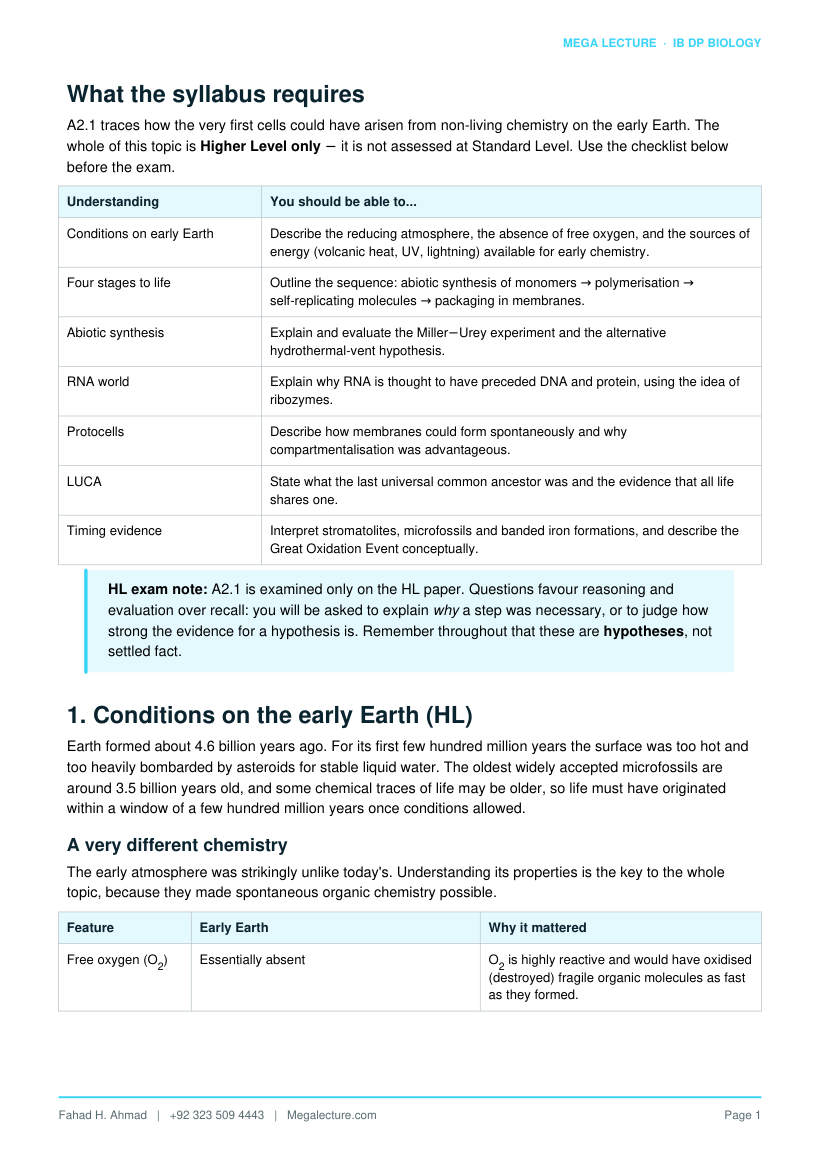
A2.1 traces how the very first cells could have arisen from non-living chemistry on the early Earth. The whole of this topic is Higher Level only − it is not assessed at Standard Level. Use the checklist below before the exam.
Understanding You should be able to...
Conditions on early Earth Describe the reducing atmosphere, the absence of free oxygen, and the sources of energy (volcanic heat, UV, lightning) available for early chemistry.
Four stages to life Outline the sequence: abiotic synthesis of monomers → polymerisation → self-replicating molecules → packaging in membranes.
Abiotic synthesis Explain and evaluate the Miller−Urey experiment and the alternative hydrothermal-vent hypothesis.
RNA world Explain why RNA is thought to have preceded DNA and protein, using the idea of ribozymes.
Protocells Describe how membranes could form spontaneously and why compartmentalisation was advantageous.
LUCA State what the last universal common ancestor was and the evidence that all life shares one.
Timing evidence Interpret stromatolites, microfossils and banded iron formations, and describe the Great Oxidation Event conceptually.
HL exam note: A2.1 is examined only on the HL paper. Questions favour reasoning and evaluation over recall: you will be asked to explain why a step was necessary, or to judge how strong the evidence for a hypothesis is. Remember throughout that these are hypotheses, not settled fact.
1. Conditions on the early Earth (HL)
Earth formed about 4.6 billion years ago. For its first few hundred million years the surface was too hot and too heavily bombarded by asteroids for stable liquid water. The oldest widely accepted microfossils are around 3.5 billion years old, and some chemical traces of life may be older, so life must have originated within a window of a few hundred million years once conditions allowed.
A very different chemistry
The early atmosphere was strikingly unlike today's. Understanding its properties is the key to the whole topic, because they made spontaneous organic chemistry possible.
Feature Early Earth Why it mattered
Free oxygen (O2) Essentially absent O2 is highly reactive and would have oxidised (destroyed) fragile organic molecules as fast as they formed.
Feature Early Earth Why it mattered
Atmosphere type Reducing (electron-rich): thought to contain gases such as CO2, N2, water vapour, and some CH4, NH3 and H2
A reducing environment favours the build-up of complex carbon compounds rather than their breakdown.
Energy sources Intense UV radiation (no ozone layer), lightning, and heat from volcanoes and meteorite impacts
Supplied the activation energy needed to drive reactions that build organic molecules from simple gases.
Water Hot oceans, hydrothermal vents, and shallow pools that could evaporate
Provided the solvent for reactions and, through drying, a way to concentrate reactants.
Two features do most of the work in every explanation: the absence of free oxygen (so organic molecules were not destroyed) and the abundance of energy (so reactions that are non-spontaneous today could be driven forward). Note the modern oxygen-rich atmosphere is itself a product of life − it could not have existed before life began.
Exam tip: If asked why life could not originate on Earth today, give two reasons: (1) today's atmosphere is oxidising, so O2 would destroy any organic molecules formed; (2) existing organisms would immediately consume any free organic molecules as food.
2. Four stages needed for life to originate (HL)
The origin of life is not a single event but a sequence of chemical steps, each of which must be shown to be plausible. The IB expects you to know four stages, in order. Learn them as a chain − each stage supplies the raw material for the next.
Stage What happens Key requirement
- Abiotic synthesis of monomers
Simple organic molecules (amino acids, sugars, nucleotide bases, fatty acids) form from inorganic precursors without any living thing.
Energy source + reducing conditions; no oxygen.
- Polymerisation Monomers join into polymers (short peptides, nucleic-acid strands) by condensation reactions.
A surface to concentrate monomers and remove water (e.g. clay, mineral, drying pool).
- Self-replicating molecules
A molecule appears that can copy itself, so information can be inherited and can vary − the start of heredity and natural selection.
A molecule that is both a template and (ideally) a catalyst − thought to be RNA.
- Packaging in membranes
Molecules become enclosed in a membrane-bound compartment, forming a protocell (protobiont).
Phospholipids or fatty acids that self-assemble into vesicles in water.
Only when all four stages are combined − a bounded compartment containing a self-replicating, heritable molecule built from abiotically produced parts − do we have something that can undergo natural selection and be called alive.
Why order matters: You cannot have heredity (stage c) without polymers (stage b), and polymers need monomers (stage a). Membranes (stage d) can form independently but only become a cell once they enclose replicating molecules. Examiners like you to justify the sequence, not just list it.
Figure 1. The proposed 4-stage sequence from non-living chemistry to the first cell: monomers → polymers → a self-replicating molecule → packaging in a membrane. Each stage supplies the raw material for the next.
3. Abiotic synthesis of carbon compounds (HL)
The first stage − making organic monomers from inorganic gases − is the best-supported experimentally. Two locations are proposed.
The Miller−Urey experiment (1953)
Stanley Miller and Harold Urey built a sealed glass apparatus to simulate the early Earth and test whether organic molecules could form abiotically.
Part of apparatus Represented Purpose
Flask of boiling water The early ocean Produced water vapour that circulated the gases.
Mixture of CH4, NH3, H2 and water vapour
The reducing early atmosphere Supplied the inorganic raw materials (C, N, H).
Electrodes giving sparks Lightning Supplied energy to drive the reactions.
Condenser and collecting trap Cooling rain and the ocean Cooled the products and collected them in solution.
After running for about a week the water turned brown. Analysis showed it contained several amino acids − the monomers of proteins − together with other organic compounds, all formed from purely inorganic starting materials.
Significance: the experiment showed that the building blocks of life can form spontaneously under conditions resembling the early Earth, using only inorganic precursors and an energy source. Re-analysis of Miller's sealed samples decades later found more than 20 amino acids, strengthening the result.
The hydrothermal vent hypothesis
An influential alternative is that life began at deep-sea hydrothermal vents, especially warm, alkaline vents on the ocean floor. Here mineral-rich water rich in hydrogen and simple carbon compounds meets cooler seawater. Proposed advantages:
- A continuous supply of chemical energy and reactive molecules, independent of sunlight.
- Steep temperature and chemical gradients that could drive reactions and concentrate molecules.
- Tiny mineral pores in the rock that act as natural compartments, mimicking cells before membranes existed.
- Protection from the destructive UV radiation and meteorite impacts at the surface.
Evaluate, don't just describe: Miller−Urey proves monomers can form abiotically, but its gas mixture may not exactly match the real early atmosphere. The vent hypothesis fits the geology and offers energy and compartments, but is harder to reproduce in the laboratory. Neither is proven − they are competing, testable hypotheses.
4. Polymerisation of monomers (HL)
Making monomers is not enough; they must join into polymers. This is a genuine difficulty, because condensation reactions that link monomers release water, and in the open ocean the huge excess of water drives the reaction the other way (hydrolysis), pulling polymers apart. Two things are needed: a way to concentrate the monomers, and an input of energy.
Surfaces solve the problem
The favoured solution is that polymerisation happened on mineral or clay surfaces rather than free in solution:
- Charged clay surfaces adsorb (bind) monomers, holding them close together and at high local concentration.
- Ordering monomers on a surface lowers the activation energy for them to link.
- Repeated wetting and drying in shallow pools removes water, pushing condensation reactions forward each time the pool dries.
Laboratory experiments confirm the principle: nucleotides placed on certain clays (such as montmorillonite) link into short RNA-like strands, and amino acids on hot mineral surfaces form short peptides. Surfaces therefore act as primitive catalysts and scaffolds, bridging the gap between monomers and the first polymers.
5. The RNA world hypothesis (HL)
For natural selection to begin, some molecule had to store information and copy itself. Today that job is split: DNA stores information while proteins (enzymes) do the catalysis. This creates a chicken-and-egg problem − DNA needs protein enzymes to be copied, but proteins are built using the information in DNA. Which came first?
RNA can do both jobs
The RNA world hypothesis resolves this by proposing that RNA came first and did both jobs at once, before DNA and protein specialised. RNA is uniquely suited because it can:
- Store information in its base sequence, and act as a template for making a copy, just as DNA does.
- Act as a catalyst: RNA molecules that speed up reactions are called ribozymes. Some ribozymes can even join nucleotides together, i.e. help copy RNA.
A single molecule that is both gene and enzyme could therefore replicate itself, mutate, and be selected − everything needed to start evolution − without needing DNA or protein first.
Evidence that RNA came first
Observation What it suggests
Ribozymes exist in living cells today RNA really can act as a catalyst, so an RNA-only metabolism is plausible.
The ribosome's catalytic core is RNA (a ribozyme)
Protein synthesis itself is fundamentally catalysed by RNA − a 'molecular fossil' of the RNA world.
Key coenzymes (ATP, NAD, coenzyme A) contain RNA nucleotides
Modern metabolism is built around RNA-derived parts, hinting at an RNA-based ancestor.
RNA can be made abiotically and can self-replicate in the lab
Each required step of an RNA world has been demonstrated experimentally.
Later, DNA (more chemically stable, so a safer long-term store) and proteins (more varied and efficient catalysts) took over the two roles, leaving RNA as the intermediate messenger and translator it mainly is today.
Exam phrasing: A common question is 'Explain why RNA is proposed to have existed before DNA and proteins.' Score the marks by stating that RNA can both store genetic information and catalyse reactions (as a ribozyme), so one molecule could both carry heredity and replicate itself.
6. Formation of protocells (HL)
A replicating molecule floating freely in the ocean would have its products diluted and lost. Life needs a boundary. A protocell (protobiont) is a membrane-bound droplet containing molecules − a simple precursor to a true cell.
Membranes assemble themselves
Phospholipids and fatty acids are amphipathic: each molecule has a water-attracting (hydrophilic) head and water-repelling (hydrophobic) tails. In water they spontaneously arrange so the tails hide from water and the heads face it, forming bilayer sheets that close into hollow spheres called vesicles. This needs no enzymes and no energy input − it is driven purely by the properties of water. Miller−Urey-type experiments and vent conditions can both yield fatty acids, so the raw materials were available.
Why compartments were a huge advantage
Advantage of a membrane Consequence for early life
Concentrates molecules Reactants (monomers, catalysts, replicators) are held together, so reactions run faster and products are not lost by diffusion.
Selective retention / separation Useful molecules are kept inside while unwanted ones stay out, creating an internal chemistry different from the surroundings.
Advantage of a membrane Consequence for early life
Keeps replicators with their products
A molecule's 'offspring' and any beneficial molecules it makes stay in the same compartment − so improvements benefit that protocell.
Units for selection Each protocell is a separate individual; those that grow and divide faster increase in number − natural selection can now act on whole compartments.
Experimentally, fatty-acid vesicles can grow by taking up more fatty acids and can split into daughter vesicles when agitated − a primitive form of growth and division, without any genes controlling it.
Key idea: Compartmentalisation is what turns a soup of reacting molecules into distinct individuals that can compete. Only once replicators are packaged inside membranes can natural selection favour one protocell over another − this is the bridge from chemistry to biology.
7. LUCA − the last universal common ancestor (HL)
LUCA stands for the last universal common ancestor: the single population of early cells from which every organism alive today − bacteria, archaea and eukaryotes − is descended. LUCA was not the first cell, but the most recent ancestor common to all surviving lineages; earlier lineages existed but left no descendants.
Evidence that all life shares one ancestor
Shared feature of all life Why it points to a common ancestor
The (nearly) universal genetic code The same codons specify the same amino acids in almost every organism − easiest to explain if all inherited one code from a shared ancestor.
DNA as the genetic material All cellular life stores information in DNA and copies it in the same basic way.
Core biochemistry is shared Ribosomes, ATP as the energy currency, and many central metabolic pathways are common to all cells.
Same chirality of molecules All life uses left-handed (L) amino acids and right-handed (D) sugars, an arbitrary choice most simply explained by common descent.
From these shared, otherwise-arbitrary features, biologists infer LUCA already had DNA, RNA, a genetic code, ribosomes and membrane-based metabolism. Comparative genomics suggests LUCA may have lived in a hot, anaerobic, chemically rich setting ≈ 3.5−4 billion years ago, consistent with a hydrothermal-vent origin.
Careful distinction: LUCA is not the origin of life and not the first cell. It is the common ancestor of all present-day life. Saying 'LUCA was the first living thing' loses marks.
8. First cells and the road to eukaryotes (HL)
The earliest cells were prokaryotic: small, without a nucleus or membrane-bound organelles. They gave rise to the two prokaryotic domains, Bacteria and Archaea. Among the most ancient and simplest bacterial groups known are the Patescibacteria (also called the CPR group) − tiny cells with very small genomes and minimal metabolism, often living attached to other microbes. Their extreme simplicity makes them useful for thinking about what early cells might have been like, though they are modern organisms, not literal survivors of the first cells.
Endosymbiosis and the origin of eukaryotes
Eukaryotic cells arose much later. The leading explanation is endosymbiosis: one prokaryote engulfed another, and instead of digesting it, kept it as an internal partner. An aerobic bacterium became the mitochondrion, and (in the line leading to plants and algae) a photosynthetic cyanobacterium became the chloroplast. Over time the engulfed cells lost independence and became organelles. This is examined in detail in A2.2 Cell structure; here you only need the outline that eukaryotes evolved from prokaryotes by acquiring organelles through endosymbiosis.
Figure 3. Endosymbiosis: a host prokaryote engulfs an aerobic bacterium that becomes the mitochondrion; the plant/algal lineage additionally engulfs a cyanobacterium that becomes the chloroplast. Each keeps a double membrane, its own circular
DNA and 70S ribosomes.
Milestone Roughly when Significance
First prokaryotic cells ≈ 3.5+ billion years ago Earliest cellular life; anaerobic, uses chemistry of the early ocean.
Photosynthetic prokaryotes (cyanobacteria)
≈ 3.0−2.5 billion years ago Begin releasing O2, eventually changing the atmosphere.
First eukaryotic cells ≈ 2.0−1.5 billion years ago Larger, compartmentalised cells arising by endosymbiosis.
Figure 2. Timeline of key events in the history of early life, in billions of years ago (Gya). Time runs from Earth's formation (4.6
Gya, left) to the present day (right).
9. Evidence for the timing of early life (HL)
How do we date events that happened billions of years ago? Three lines of physical evidence in ancient rocks let us place the origin and spread of life on a timeline.
Evidence What it is What it tells us
Stromatolites Layered mounds of rock built up by mats of microbes (mainly cyanobacteria) trapping sediment; fossil examples are billions of years old, and living ones still form today.
Direct evidence that microbial communities existed very early − some stromatolites are ≈ 3.5 billion years old.
Microfossils Microscopic remains of individual prokaryotic cells preserved in very old rock (chert).
Show that cellular life − prokaryotes − existed by ≈ 3.5 billion years ago.
Banded iron formations (BIFs)
Rock layers alternating iron oxide and iron-poor bands, formed in the sea as dissolved iron reacted with newly produced O2.
Mark the first appearance of free O2 from photosynthesis, which precipitated iron out of the oceans.
The Great Oxidation Event
Once cyanobacteria had produced enough oxygen to use up the dissolved iron in the oceans (recorded by the banded iron formations), O2 began to build up in the atmosphere ≈ 2.4 billion years ago. This Great Oxidation Event permanently changed the planet: it was toxic to many anaerobic organisms but made aerobic respiration possible and, much later, allowed an ozone layer and complex life. Conceptually, it is the clearest example of life transforming the whole Earth, and it explains why an oxygen-rich origin of life is impossible − the oxygen came from life, not before it.
Link back: Notice the loop: no O2 at the start allowed organic molecules to form (Section 1); life then produced the O2 (banded iron formations, Great Oxidation Event) that makes an origin of life impossible today.
10. Worked explanations, pitfalls and practice (HL)
Many A2.1 marks come from extended explanations and evaluation. Study the model answers below, then test yourself.
Worked explanation 1 − Evaluate the Miller−Urey experiment
Strengths. It showed experimentally that amino acids and other organic monomers can form from inorganic gases (CH4, NH3, H2, water vapour) given only an energy source (sparks modelling lightning). This supports the first stage of the origin of life − abiotic synthesis − and it is reproducible.
Limitations. The gas mixture used may not match the true early atmosphere, which many now think was less strongly reducing (more CO2 and N2). It produced monomers, not polymers or self-replicating molecules, so it explains only the first step. It also cannot prove this is how life actually began, only that it was possible.
Conclusion. Strong evidence that the building blocks of life can arise abiotically, but not a complete account of the origin of life.
Worked explanation 2 − Why an RNA world before DNA and proteins?
Modern cells split two jobs: DNA stores information; protein enzymes catalyse reactions. But copying DNA needs protein enzymes, and making proteins needs DNA − neither can come first. RNA escapes this trap because a single RNA molecule can do both jobs: its base sequence stores information and acts as a template (like DNA), while ribozymes (RNA catalysts) can speed up reactions, including joining nucleotides to copy RNA.
So an RNA molecule could store heredity and replicate itself, allowing variation and natural selection to begin with one type of molecule. DNA (more stable) and proteins (more varied catalysts) could then take over the two roles later. Supporting evidence: ribozymes exist today, and the ribosome's catalytic core is RNA.
Worked explanation 3 − Advantage of packaging in a membrane
A self-replicating molecule free in the ocean loses its products and catalysts to diffusion, and any improvement it makes benefits everything around it equally. Enclosing it in a phospholipid/fatty-acid membrane (a protocell) concentrates the reactants together, so reactions run faster, and retains useful molecules while excluding others.
Crucially, a replicator's copies and any beneficial molecules it produces stay in the same compartment, so a protocell that replicates better keeps that advantage. Each protocell becomes a separate individual, so natural selection can now favour one over another − the step from chemistry to living, evolving units.
Common pitfalls
- Abiotic synthesis is not 'spontaneous generation'. It means simple molecules forming by ordinary chemistry over long times − not whole organisms appearing from mud, which Pasteur disproved.
- These are hypotheses, not proven fact. Write 'may have', 'is thought to', 'the evidence suggests' − never state the origin of life as certain.
- LUCA is not the first cell and not the origin of life − it is the common ancestor of all life alive today.
- Don't say the early atmosphere had 'no gases' − it had no free oxygen; it was rich in other, reducing gases.
- Miller−Urey made monomers, not proteins or life. Don't overstate what it showed.
- Membranes forming is not 'life' by itself − a vesicle only becomes a protocell of interest once it encloses replicating molecules.
Quick reference
Term / event One-line summary
Reducing atmosphere Early air with no free O2; electron-rich gases that allowed organics to build up.
Four stages Monomers → polymers → self-replicating molecule → membrane packaging.
Miller−Urey Sparks through CH4/NH3/H2/water vapour made amino acids − abiotic synthesis is possible.
Hydrothermal vents Alternative origin site: energy, gradients, and mineral compartments on the sea floor.
Polymerisation Monomers join on clay/mineral surfaces; drying pools drive condensation.
RNA world RNA stored information and catalysed reactions (ribozymes), so it preceded DNA/protein.
Protocell Membrane vesicle enclosing molecules; compartmentalisation concentrates and retains them.
LUCA Last universal common ancestor of all life today; shown by shared code and biochemistry.
Stromatolites / microfossils Fossil evidence of microbial life by ≈ 3.5 billion years ago.
Banded iron formations Record the first free O2 reacting with dissolved iron in the sea.
Great Oxidation Event ≈ 2.4 billion years ago; O2 from cyanobacteria built up in the atmosphere.
Test yourself
Attempt these without notes; full answers follow.
- State two ways the atmosphere of the early Earth differed from today's, and explain why each mattered for the origin of life. [3]
- List, in order, the four stages required for life to originate from non-living matter. [4]
- Describe what the Miller−Urey experiment demonstrated, and give one limitation of it as evidence for the origin of life. [3]
- Explain why polymerisation of monomers is thought to have required a mineral or clay surface. [3]
- Explain why RNA, rather than DNA or protein, is proposed as the first self-replicating molecule. [3]
- Outline two advantages that packaging molecules inside a membrane gave to early protocells. [2]
- Define LUCA and state two pieces of evidence that all life has a common ancestor. [3]
- Explain how banded iron formations and the Great Oxidation Event provide evidence about early life. [3]
Answers
- (a) It had essentially no free oxygen − so organic molecules were not oxidised/destroyed as they formed. (b) It was reducing, rich in gases such as CH4, NH3 and H2 − favouring the build-up of complex carbon compounds. (Also acceptable: abundant UV/lightning/volcanic energy to drive reactions.)
- (i) Abiotic synthesis of simple organic monomers; (ii) polymerisation of monomers into polymers; (iii) formation of self-replicating molecules that can be inherited; (iv) packaging of molecules inside membranes to form protocells.
- It showed that organic monomers, notably amino acids, can form abiotically from inorganic gases given an energy source, supporting stage one of the origin of life. Limitation: it produced only monomers (not polymers or life), and the gas mixture may not match the true early atmosphere − so it shows possibility, not proof.
- Condensation reactions release water, so in open water hydrolysis dominates and polymers break apart. A clay/mineral surface adsorbs and concentrates monomers, holds them in an ordered arrangement that lowers activation energy, and (with drying) removes water − so monomers can link into polymers.
- Because a single RNA molecule can both store genetic information (in its base sequence, acting as a template) and catalyse reactions as a ribozyme, including copying RNA. It can therefore replicate itself and be inherited without needing DNA or proteins to already exist, avoiding the chicken-and-egg problem.
- Any two: it concentrates reactants so reactions are faster; it retains useful molecules and keeps replicators with their products; it makes each protocell a separate unit of selection on which natural selection can act.
- LUCA is the last universal common ancestor − the population of cells from which all life alive today descends. Evidence (any two): the near-universal genetic code; use of DNA and ribosomes by all cells; shared core metabolism/ATP; the same chirality (L-amino acids, D-sugars) throughout life.
- Banded iron formations formed when the first free O2 (from cyanobacterial photosynthesis) reacted with dissolved iron in the sea, so they date the appearance of oxygen-producing life. The Great Oxidation Event (≈ 2.4 billion years ago) records O2 then accumulating in the atmosphere − evidence that life had transformed the planet and that an origin of life must predate free oxygen.
