
IB Diploma · Biology · SL / HL · Theme A: Unity and Diversity
A1.1 Water
Need more than one subject? All-notes pass: unlimited downloads of every note for a year: unlimited downloads of every note on the site, PKR 999 a year. All packs and courses.

Opens inside this page. Prefer your own PDF app? Open the PDF.
Check yourself
5 quick questions on A Unity and diversity
Tap an answer to see if you are right, and why. Free, no sign-up.
Start the free test👍 16 students found these notes useful
Was this note useful?
Full text of A1.1 Water
IB DP BIOLOGY Theme A: Unity and Diversity A1.1 Water
Revision Notes · Standard and Higher Level Fahad H. Ahmad
Original notes prepared for the IB Diploma Programme Biology course (first assessment 2025)
Free notes, practice tests and live classes Back to megalecture.com
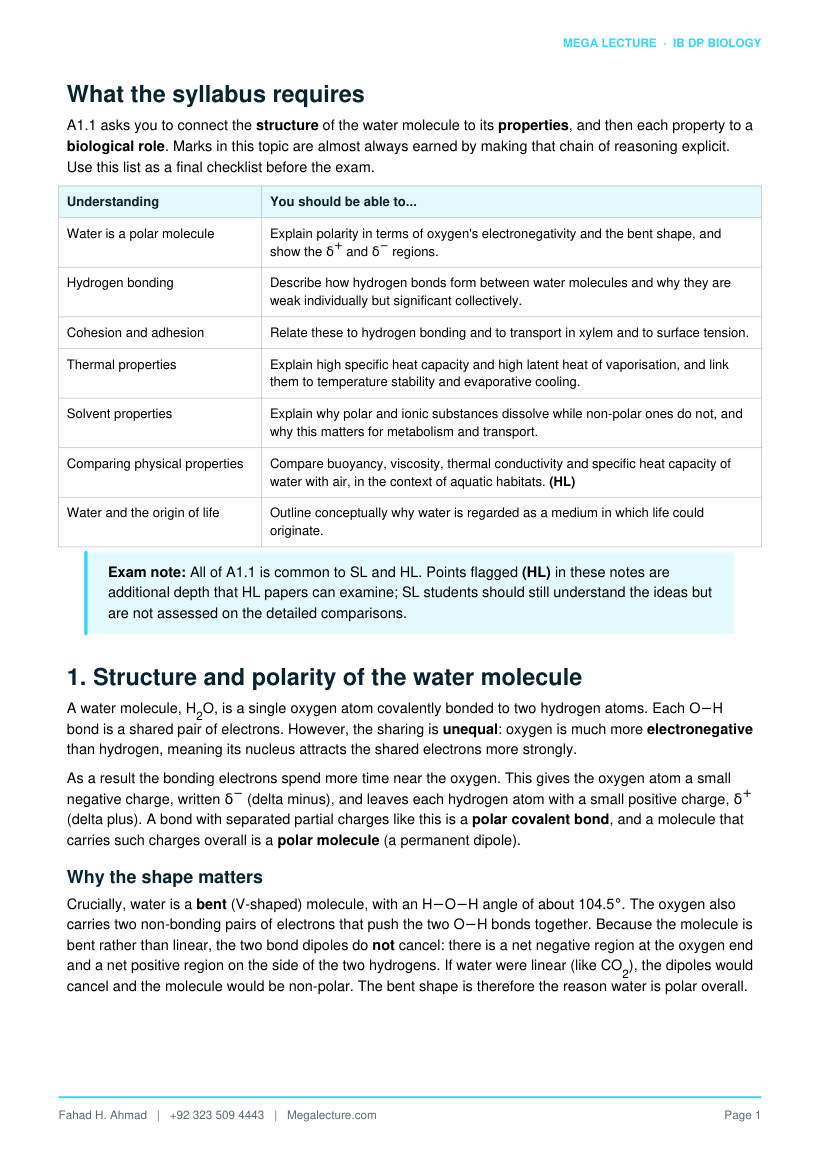
What the syllabus requires
A1.1 asks you to connect the structure of the water molecule to its properties, and then each property to a biological role. Marks in this topic are almost always earned by making that chain of reasoning explicit. Use this list as a final checklist before the exam.
Understanding You should be able to...
Water is a polar molecule Explain polarity in terms of oxygen's electronegativity and the bent shape, and show the δ+ and δ− regions.
Hydrogen bonding Describe how hydrogen bonds form between water molecules and why they are weak individually but significant collectively.
Cohesion and adhesion Relate these to hydrogen bonding and to transport in xylem and to surface tension.
Thermal properties Explain high specific heat capacity and high latent heat of vaporisation, and link them to temperature stability and evaporative cooling.
Solvent properties Explain why polar and ionic substances dissolve while non-polar ones do not, and why this matters for metabolism and transport.
Comparing physical properties Compare buoyancy, viscosity, thermal conductivity and specific heat capacity of water with air, in the context of aquatic habitats. (HL)
Water and the origin of life Outline conceptually why water is regarded as a medium in which life could originate.
Exam note: All of A1.1 is common to SL and HL. Points flagged (HL) in these notes are additional depth that HL papers can examine; SL students should still understand the ideas but are not assessed on the detailed comparisons.
1. Structure and polarity of the water molecule
A water molecule, H2O, is a single oxygen atom covalently bonded to two hydrogen atoms. Each O−H bond is a shared pair of electrons. However, the sharing is unequal: oxygen is much more electronegative than hydrogen, meaning its nucleus attracts the shared electrons more strongly.
As a result the bonding electrons spend more time near the oxygen. This gives the oxygen atom a small negative charge, written δ− (delta minus), and leaves each hydrogen atom with a small positive charge, δ+
(delta plus). A bond with separated partial charges like this is a polar covalent bond, and a molecule that carries such charges overall is a polar molecule (a permanent dipole).
Why the shape matters
Crucially, water is a bent (V-shaped) molecule, with an H−O−H angle of about 104.5°. The oxygen also carries two non-bonding pairs of electrons that push the two O−H bonds together. Because the molecule is bent rather than linear, the two bond dipoles do not cancel: there is a net negative region at the oxygen end and a net positive region on the side of the two hydrogens. If water were linear (like CO2), the dipoles would cancel and the molecule would be non-polar. The bent shape is therefore the reason water is polar overall.
Feature Description Consequence
Covalent O−H bonds Two shared electron pairs Holds the molecule together
Electronegativity difference
O pulls electrons more than H Bond dipoles: O is δ−, H is δ+
Bent shape (~104.5°) Two lone pairs on O force a V-shape Dipoles do not cancel → molecule is polar
Key term: Polarity is an uneven distribution of charge within a molecule producing partial charges (δ+ / δ−). It is this polarity, not full ionic charge, that underlies almost every property of water.
2. Hydrogen bonding between water molecules
Because water is polar, the δ+ hydrogen of one molecule is attracted to the δ− oxygen of a neighbouring molecule. This electrostatic attraction between molecules is a hydrogen bond. Hydrogen bonds form specifically where a hydrogen atom that is bonded to a very electronegative atom (O, N or F) is attracted to a lone pair on the electronegative atom of another molecule.
Each water molecule can form up to four hydrogen bonds: two through its two hydrogens and two through the lone pairs on its oxygen. In liquid water these bonds are constantly breaking and re-forming, billions of times per second, giving water an ever-changing three-dimensional network.
Figure 1. The polar, bent water molecule (H-O-H angle 104.5°). The δ− oxygen and δ+ hydrogens let each molecule form up to four hydrogen bonds (dashed) with neighbours.
Weak individually, strong collectively
A single hydrogen bond is weak ≈ roughly one-twentieth the strength of the O−H covalent bond within the molecule. On its own it is easily broken by thermal motion. The importance of hydrogen bonding comes from numbers: because every molecule forms several, an enormous number act together. Collectively they hold the liquid together and are responsible for nearly all of water's unusual properties.
Critical distinction: Hydrogen bonds form between separate water molecules (intermolecular). The O−H bonds within a molecule are covalent (intramolecular) and far stronger. Confusing the two is one of the most common and costly errors in this topic.
Worked example 1 − explaining a property from structure
Explain, in terms of bonding, why water is a liquid at room temperature. (3 marks)
- Water molecules are polar, with δ+ hydrogens and δ− oxygen.
- Hydrogen bonds form between the δ+ H of one molecule and the δ− O of another, holding molecules together.
- Energy is needed to break these many hydrogen bonds, so the molecules stay associated as a liquid rather than escaping as a gas at room temperature.
3. Cohesion, adhesion and surface tension
Cohesion is the attraction of water molecules to one another, caused directly by hydrogen bonding. Adhesion is the attraction of water molecules to other polar or charged surfaces (for example cellulose in plant cell walls or glass), because water can hydrogen bond to those surfaces too.
Cohesion and transport in xylem
In a transpiring plant, water evaporating from leaf cells pulls on the water column in the xylem. Because water molecules are cohesive, the whole column behaves as a continuous thread that can be pulled up from the roots without breaking − this is the cohesion-tension theory of water transport. Adhesion of water to the hydrophilic walls of the narrow xylem vessels helps support the column against gravity. Together, cohesion and adhesion allow water to reach the top of tall trees.
Figure 3. Cohesion is water-to-water hydrogen bonding (giving surface tension); adhesion is water-to-polar-surface hydrogen bonding (giving capillary rise up xylem or glass).
Surface tension
At the surface of a body of water, molecules cannot form hydrogen bonds with air above, so they are pulled inward and sideways by their neighbours. This creates surface tension − the surface behaves like a thin elastic skin. Biologically, surface tension lets small organisms such as pond skaters (water striders) walk on water, and allows some insects to rest on the surface without sinking. Surface tension is also important inside the alveoli of the lungs, where it must be reduced by surfactant to prevent the air sacs collapsing.
Property Cause Biological importance
Cohesion H-bonding water-to-water Continuous xylem water column (cohesion-tension); surface tension
Adhesion H-bonding water-to-polar surface Water clings to xylem walls; capillary action in narrow spaces
Surface tension Net inward pull on surface molecules Habitat/support for surface-dwelling organisms (e.g. pond skaters)
Common pitfall: Cohesion is water-to-water; adhesion is water-to-something-else. Both arise from hydrogen bonding, but examiners want the correct term for the correct interaction.
4. Thermal properties of water
Hydrogen bonding also gives water two thermal properties of huge biological value: a high specific heat capacity and a high latent heat of vaporisation.
Figure 2. Water (red) has an anomalously high specific heat capacity and latent heat of vaporisation compared with other common liquids — the energy cost of breaking its hydrogen bonds.
High specific heat capacity
Specific heat capacity is the energy needed to raise the temperature of 1 kg of a substance by 1°C. Water's value (about 4200 J kg−1 °C−1) is unusually high because much of the added energy goes into breaking hydrogen bonds rather than increasing molecular motion (temperature). Water therefore heats up and cools down slowly.
High latent heat of vaporisation
The latent heat of vaporisation is the energy needed to evaporate a liquid without a change in temperature. For water this is large because many hydrogen bonds must be broken to free a molecule from the liquid into vapour. When water evaporates, the escaping molecules carry away a great deal of energy, so the surface left behind cools markedly − this is evaporative cooling.
Why so much energy? Both thermal properties trace back to the same cause: energy must be spent breaking hydrogen bonds before the temperature rises or the molecule escapes. Always name hydrogen bonds in your explanation.
Worked example 2 − explaining evaporative cooling
Explain how sweating helps to cool the human body. (3 marks)
- Sweat (mostly water) lies on the skin surface; evaporating it requires a large amount of energy because water has a high latent heat of vaporisation.
- This energy is taken from the skin and blood, so heat is removed from the body as the water evaporates (many hydrogen bonds are broken).
- The loss of this heat lowers the body's temperature, helping to maintain a stable internal temperature (thermoregulation).
5. Water as a solvent
Water is often called the universal solvent because it dissolves a wider range of substances than any other common liquid. Its polarity is the reason. Because so many substances dissolve in it, water is the medium in which metabolic reactions occur (cytoplasm is mostly water) and the medium in which solutes are transported around organisms (blood plasma, xylem sap, phloem sap).
How ionic solids dissolve
Consider sodium chloride, NaCl, an ionic compound of Na+ and Cl− ions. When placed in water, the δ− oxygen ends of water molecules surround and attract the Na+ ions, while the δ+ hydrogen ends surround the Cl− ions. These attractions pull the ions away from the crystal lattice and each ion becomes surrounded by a shell of water molecules (it is hydrated). The lattice dissolves.
How polar molecules dissolve
Polar covalent substances such as glucose, amino acids and other sugars carry their own δ+ / δ− regions (often O−H and N−H groups). Water forms hydrogen bonds with these groups, surrounds the molecules and carries them into solution. Substances that dissolve in or mix well with water are described as hydrophilic (water-loving).
Why non-polar substances do not dissolve
Non-polar substances such as fats, oils and other lipids have no partial charges, so water molecules are not attracted to them and cannot pull them apart. Water molecules prefer to hydrogen bond with each other, effectively excluding the non-polar molecules, which cluster together. Such substances are hydrophobic
(water-fearing/water-hating). Note that hydrophobic substances are not repelled by a force; they are simply left out because water bonds preferentially to itself.
Substance Nature Behaviour in water How it is transported in the body
Sodium chloride (Na+, Cl−)
Ionic Dissolves (ions hydrated) As dissolved ions in blood plasma
Glucose Polar Dissolves (hydrophilic) Dissolved in blood plasma
Amino acids Polar Dissolve (hydrophilic) Dissolved in blood plasma
Oxygen Non-polar Only slightly soluble Mostly bound to haemoglobin, not dissolved
Lipids / fats Non-polar Insoluble (hydrophobic) Carried in lipoproteins; fats emulsified/packaged
Cholesterol Non-polar Insoluble (hydrophobic) Transported in lipoproteins (e.g. LDL, HDL)
Notice the biological consequence: hydrophilic solutes dissolve directly in blood plasma and move easily, but hydrophobic substances such as lipids and oxygen cannot be carried in solution in sufficient amounts. They require carriers − oxygen binds to haemoglobin, and lipids and cholesterol are packaged into lipoproteins whose outer surface is hydrophilic. This is a direct result of water being a polar solvent.
Memory hook: “Like dissolves like.” Polar/ionic solutes dissolve in polar water; non-polar solutes dissolve in non-polar solvents (such as lipid membranes), not in water.
Worked example 3 − explaining dissolving
Explain why sodium chloride dissolves readily in water but oil does not. (4 marks)
- Water is polar, with δ+ hydrogens and a δ− oxygen.
- In NaCl the δ− oxygens are attracted to Na+ and the δ+ hydrogens to Cl−; these attractions pull ions from the lattice and hydrate them, so the salt dissolves.
- Oil is non-polar and has no partial charges, so water molecules are not attracted to it.
- Water molecules hydrogen bond preferentially to each other and exclude the oil, so it does not dissolve (it is hydrophobic).
6. Further biological roles of water
Beyond its thermal and solvent behaviour, several other consequences of water's structure are directly useful to living things.
A medium and a reactant for metabolism
Cytoplasm is around 70-80% water, so almost every reaction inside a cell takes place in aqueous solution: dissolved reactants can move, meet and collide. Water is not just the solvent, however − it is also a reactant and a product. In hydrolysis reactions a water molecule is added to split a larger molecule (for example digesting a disaccharide into monosaccharides), while in condensation reactions water is released when monomers are joined (as in building polypeptides or polysaccharides). Water is therefore
Support, turgor and hydrostatic skeletons
Water is almost incompressible, so a fluid-filled compartment can provide rigidity and support. In plants, water entering a cell by osmosis presses the cell membrane against the cell wall, generating turgor pressure that keeps non-woody tissues firm and leaves held out to the light; loss of turgor causes wilting. In many soft-bodied animals (earthworms, sea anemones) a water-filled body cavity acts as a hydrostatic skeleton against which muscles work to produce movement.
Transparency and other roles
Structure at a glance: Picture the molecule as O at the centre with two H atoms angled below it: the O corner is δ− and the two H corners are δ+. Each δ+ H reaches out to the δ− O of a neighbour − that single reach, multiplied by billions, is the hydrogen-bond network behind every property in these notes.
7. Physical properties in aquatic habitats (HL)
(HL) Water is a very different physical environment from air, and organisms are adapted to it. The syllabus asks you to compare four physical properties of water and air and to link them to life in water.
Property Water vs air Relevance to aquatic organisms
Buoyancy Water is far denser than air, giving much greater upthrust
Supports the body against gravity; large aquatic animals need little skeleton to hold shape; many organisms float or hover
Viscosity Water is much more viscous than air Greater drag on movement; streamlined body shapes reduce resistance when swimming
Thermal conductivity Water conducts heat far better than air
Body heat is lost quickly to water; small or warm-blooded aquatic animals need insulation (e.g. blubber, feathers)
Specific heat capacity Water's is very high (see Section 4) Water temperature is stable, so aquatic habitats change temperature slowly and predictably
A useful illustration is a diving bird such as the black-throated loon (diver). It must overcome the high buoyancy and viscosity of water to dive and swim after fish: it has dense bones and a streamlined body to reduce upthrust and drag, and its feet are set far back for powerful propulsion. Because water has high thermal conductivity, the bird loses heat rapidly and relies on dense, waterproof plumage for insulation. The high specific heat capacity of its lake habitat means the water temperature stays relatively constant, a stable environment its physiology is adapted to. These trade-offs show how each physical property of water shapes the adaptations of the organisms living in it.
HL exam tip: When comparing water and air, always state the direction of the difference (“water is denser/more viscous/conducts heat better”) and then the biological consequence. A bare property with no consequence earns no marks.
8. Water and the origin of life
Water is widely regarded as essential to the origin and continuation of life, and the search for life elsewhere is largely a search for liquid water. Several of the properties above explain why.
Where Earth's water originally came from is still debated − ideas include release from the planet's interior by volcanic outgassing and delivery by icy comets and asteroids − but for A1.1 the key idea is conceptual: liquid water provided a stable, solvent medium in which the chemistry of life could begin. This is why liquid water is treated as a marker of potential habitability on other worlds.
9. Comparing water with methane
A powerful way to see how important polarity and hydrogen bonding are is to compare water, H2O, with methane, CH4, a molecule of very similar size and mass (methane's molar mass, 16, is close to water's 18).
Feature Water (H2O) Methane (CH4)
Shape Bent (~104.5°) Tetrahedral, symmetrical
Polarity Polar (dipoles do not cancel) Non-polar (bonds nearly non-polar; dipoles cancel)
Hydrogen bonding Yes − strong network between molecules
No
Boiling point 100°C about −162°C
State at room temperature
Liquid Gas
Despite their similar sizes, water is a liquid at room temperature while methane is a gas that only liquefies far below freezing. The difference is hydrogen bonding. Carbon and hydrogen have almost equal electronegativities, so C−H bonds are essentially non-polar and methane forms no hydrogen bonds − its molecules are held together only by very weak forces, so little energy separates them and it boils at a very low temperature. Water's molecules, in contrast, are held together by many hydrogen bonds that require far more energy to break, raising its melting and boiling points enormously. Without hydrogen bonding, water would be a gas at Earth's surface temperatures and life as we know it could not exist.
Big idea: It is not size or mass that makes water special, but its polarity and the hydrogen bonding that polarity allows. Methane is the perfect control: same size, no hydrogen bonds, completely different properties.
10. Common exam pitfalls 11. Quick reference
Property Cause (all trace to...) Biological importance
Polarity O more electronegative + bent shape Basis of all other properties; makes water a solvent
Cohesion H-bonding water-to-water Continuous xylem column (cohesion-tension); surface tension
Adhesion H-bonding water-to-polar surface Water clings to xylem walls; capillary action
High specific heat capacity Energy breaks H-bonds before temp rises
Temperature stability of habitats and of organisms
High latent heat of vaporisation
Many H-bonds broken to evaporate Evaporative cooling: sweating, transpiration, panting
Solvent (universal) Polarity hydrates ions and polar molecules
Medium for metabolism; transport of solutes in blood/sap
High density / buoyancy (HL)
Denser than air Supports aquatic bodies against gravity
12. Test yourself
Attempt these without notes; full answers follow.
- Explain why the water molecule is polar. (3)
- Describe how a hydrogen bond forms between two water molecules, and state why hydrogen bonds are described as weak yet collectively important. (3)
- Using the property of cohesion, explain how water is transported up the xylem of a tall tree. (3)
- Explain how the high specific heat capacity of water benefits aquatic organisms. (2)
- Explain why oxygen and glucose must be transported differently in the blood. (3)
- Distinguish between hydrophilic and hydrophobic substances, giving one example of each. (3)
- (HL) Water has a much higher thermal conductivity than air. Suggest one adaptation this requires in a warm-blooded diving animal. (2)
- Methane (CH4) and water (H2O) are similar in size, yet methane is a gas and water a liquid at room temperature. Explain this difference. (3)
Answers
- Oxygen is more electronegative than hydrogen, so it attracts the shared electrons more strongly (1); this makes oxygen δ− and each hydrogen δ+ (1); because the molecule is bent these dipoles do not cancel, leaving an overall polar molecule (1).
- The δ+ hydrogen of one molecule is attracted to the δ− oxygen of a neighbouring molecule, forming a hydrogen bond (1). A single hydrogen bond is weak, much weaker than a covalent bond, and easily broken (1); but each molecule forms several, so the very large number acting together makes them collectively strong and responsible for water's properties (1).
- Water evaporates from the leaves (transpiration), creating tension that pulls the water column upward (1); cohesion from hydrogen bonding holds the water molecules together so the column does not break (1);
- Water needs a lot of energy to change temperature, so large bodies of water warm and cool slowly (1); this keeps the habitat temperature stable, providing a constant environment and helping keep enzymes near their optimum (1).
- Glucose is polar/hydrophilic, so it dissolves directly in the water of the blood plasma and is carried in solution (1). Oxygen is non-polar and only slightly soluble in water (1), so it cannot be carried in sufficient amount dissolved and is instead bound to haemoglobin in red blood cells (1).
- Hydrophilic substances are attracted to and dissolve in water because they are polar or charged, e.g. glucose or Na+/Cl− (1+1); hydrophobic substances are non-polar and do not dissolve in water, e.g. lipids/fats (1).
- Water conducts heat away from the body quickly, so a warm-blooded diver loses heat rapidly (1); it needs good insulation, such as a layer of blubber or dense waterproof feathers/fur, to reduce heat loss (1).
- Water is polar and its molecules form many hydrogen bonds with each other, which need considerable energy to break (1); methane is non-polar (C−H bonds are essentially non-polar) and forms no hydrogen bonds, only very weak forces between molecules (1); so far less energy separates methane molecules, giving it a much lower boiling point − a gas, while water is a liquid (1).
