
IB Diploma · Physics · SL / HL · Worksheets
Theme D Worksheet
Need more than one subject? All-notes pass: unlimited downloads of every note for a year: unlimited downloads of every note on the site, PKR 999 a year. All packs and courses.
Opens inside this page. Prefer your own PDF app? Open the PDF.
Check yourself
5 quick questions on Fields
Tap an answer to see if you are right, and why. Free, no sign-up.
Start the free test👍 15 students found these notes useful
Was this note useful?
Full text of Theme D Worksheet
IB DP PHYSICS Theme D · Fields TOPICAL WORKSHEET
D.1 Gravitational Fields · D.2 Electric and Magnetic Fields
D.3 Motion in Electromagnetic Fields · D.4 Induction (HL)
Standard and Higher Level · Syllabus 2025
Fahad H. Ahmad
Original exam-style questions written for the IB Diploma Programme Physics course (first assessment 2025)
Free notes, practice tests and live classes Back to megalecture.com
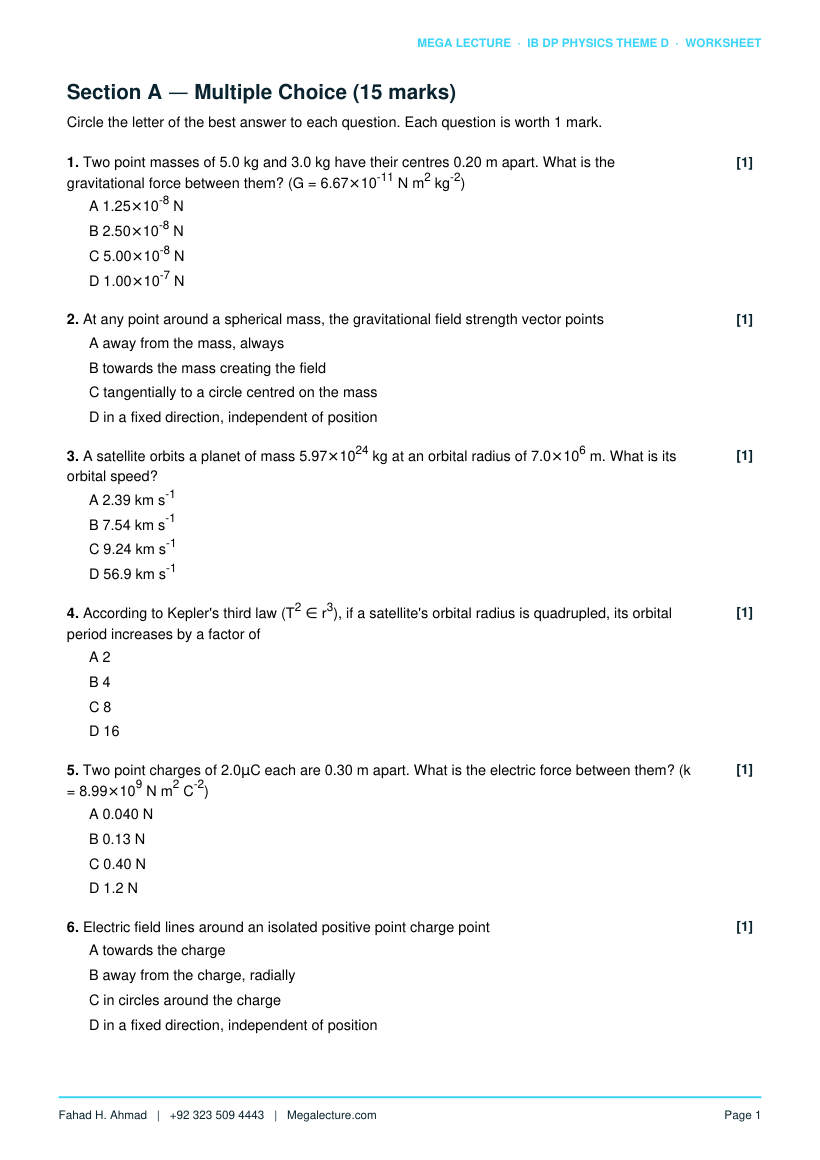
Section A — Multiple Choice (15 marks)
Circle the letter of the best answer to each question. Each question is worth 1 mark.
- Two point masses of 5.0 kg and 3.0 kg have their centres 0.20 m apart. What is the gravitational force between them? (G = 6.67×10⁻¹¹ N m2 kg-2)
[1]
A 1.25×10⁻⁸ N
B 2.50×10⁻⁸ N
C 5.00×10⁻⁸ N
D 1.00×10⁻⁷ N
- At any point around a spherical mass, the gravitational field strength vector points [1]
A away from the mass, always
B towards the mass creating the field
C tangentially to a circle centred on the mass
D in a fixed direction, independent of position
- A satellite orbits a planet of mass 5.97×1024 kg at an orbital radius of 7.0×10⁶ m. What is its orbital speed?
[1]
A 2.39 km s-1
B 7.54 km s-1
C 9.24 km s-1
D 56.9 km s-1
- According to Kepler's third law (T2 ∈ r3), if a satellite's orbital radius is quadrupled, its orbital period increases by a factor of
[1]
A 2
B 4
C 8
D 16
- Two point charges of 2.0μC each are 0.30 m apart. What is the electric force between them? (k = 8.99×10⁹ N m2 C-2)
[1]
A 0.040 N
B 0.13 N
C 0.40 N
D 1.2 N
- Electric field lines around an isolated positive point charge point [1]
A towards the charge
B away from the charge, radially
C in circles around the charge
D in a fixed direction, independent of position
- A charged particle (q = 1.6×10⁻¹⁹ C) moves at 2.0×10⁶ m s-1 perpendicular to a 0.50 T magnetic field. What magnetic force does it experience?
[1]
A 1.6×10⁻¹³ N
B 3.2×10⁻¹³ N
C 1.6×10⁻¹⁴ N
D 6.4×10⁻¹³ N
- A current-carrying wire experiences a force in a magnetic field. This force is greatest when the angle between the current and the field is
[1]
A 0° (parallel)
B 45°
C 90° (perpendicular)
D the force is independent of this angle
- An electron (m = 9.11×10⁻³¹ kg, q = 1.6×10⁻¹⁹ C) moves at 3.0×10⁶ m s-1 perpendicular to a 0.20 T field. What is the radius of its circular path?
[1]
A 4.3×10⁻⁵ m
B 8.5×10⁻⁵ m
C 1.7×10⁻⁴ m
D 3.4×10⁻⁴ m
- In a velocity selector, a charged particle travels straight through undeflected when the electric field is 1.0×10⁵ V m-1 and the perpendicular magnetic field is 0.40 T. What is the speed of this particle?
[1]
A 2.5×10⁴ m s-1
B 4.0×10⁴ m s-1
C 2.5×10⁵ m s-1
D 4.0×10⁵ m s-1
- The period of circular motion of a charged particle in a uniform magnetic field (T = 2πm/(qB)) is independent of
[1]
A the mass of the particle
B the charge of the particle
C the strength of the magnetic field
D the speed of the particle
- A coil of 200 turns experiences a change in magnetic flux of 0.050 Wb through it over a time of 0.20 s. What average EMF is induced?
[1]
A 0.25 V
B 2.5 V
C 25 V
D 50 V
- A transformer has 500 turns on its primary coil and 100 turns on its secondary coil. If the primary voltage is 230 V, what is the secondary voltage (assume an ideal transformer)?
[1]
A 23 V
B 46 V
C 115 V
D 1150 V
- By Lenz's law, the direction of an induced current in a circuit is always such that it [1]
A reinforces the change in magnetic flux that produced it
B opposes the change in magnetic flux that produced it
C is independent of the change in magnetic flux
D flows only while the flux itself (not its rate of change) is non-zero
Section B — Structured Questions (65 marks)
Answer all questions in the space provided. Working must be shown for full marks.
D.1 Gravitational Fields
Question 1 [7 marks]
The graph shows how the gravitational field strength g varies with distance r from the centre of a planet of radius R, for points on or above its surface.
Gravitational field strength g against distance from the planet's centre (surface value and radius are given data).
- Using the surface value g = 9.8 N kg-1 at R = 6.4×10⁶ m (marked on the graph), calculate the mass of the planet.
[3]
- Calculate the field strength at a distance of 2R from the centre of the planet. [2]
- State how the gravitational field strength of a point (or spherical) mass varies with distance from its centre.
[2]
Question 2 [6 marks]
A planet has mass 6.0×1024 kg and radius 6.4×10⁶ m.
- Calculate the escape velocity from the surface of the planet. [2]
- Calculate the gravitational potential at the surface of the planet. [2]
- A 500 kg satellite is launched from the surface to completely escape the planet's gravity. Calculate the minimum kinetic energy it must be given.
[2]
Question 3 [7 marks]
A satellite orbits Earth (mass 5.97×1024 kg) in a circular orbit of radius 7.20×10⁶ m.
- By equating the gravitational force to the required centripetal force, show that the orbital speed is v = √(GM/r), and calculate its value.
[3]
- Calculate the orbital period of the satellite. [2]
- State, using Kepler's third law, how the orbital period would change if the satellite were moved to a larger orbital radius.
[2]
D.2 Electric and Magnetic Fields
Question 4 [7 marks]
Two point charges, Q1 = +3.0 μC and Q2 = −5.0 μC, are fixed 0.25 m apart, as shown.
The two point charges and the electric field between them.
- Calculate the magnitude of the electric force between the two charges. [2]
- State the direction of the force on each charge, and explain your reasoning. [2]
- Calculate the magnitude of the net electric field at the midpoint between the two charges. [3]
Question 5 [6 marks]
A straight wire of length 0.40 m carries a current of 5.0 A, oriented perpendicular to a uniform magnetic field of flux density 0.30 T.
- Calculate the magnitude of the force on the wire. [2]
- State how the direction of this force can be determined. [2]
- State and explain the force on the wire if it were instead oriented parallel to the magnetic field. [2]
Question 6 [6 marks]
A charge of +2.0 μC is moved from a point in an electric field where the potential is 500 V to a point where the potential is 200 V.
- Calculate the work done by the electric field on the charge as it moves between these points, and state whether this work is positive or negative.
[3]
- Calculate the change in electric potential energy of the charge, and state whether it increased or decreased.
[3]
D.3 Motion in Electromagnetic Fields
Question 7 [7 marks]
An electron (mass 9.11×10⁻³¹ kg, charge magnitude 1.6×10⁻¹⁹ C) enters a uniform magnetic field of flux density 0.50 mT, directed into the page, moving at 4.0×10⁶ m s-1 perpendicular to the field, as shown.
The electron follows a circular path while in the field.
- Calculate the radius of the electron's circular path. [3]
- Calculate the period of the circular motion. [2]
- State how the radius of the path would change if the electron's speed were doubled, with all other quantities unchanged.
[2]
Question 8 [6 marks]
In a velocity selector, charged particles pass through a region containing a uniform electric field of magnitude 2.0×10⁴ V m-1 and a perpendicular uniform magnetic field of magnitude 0.25 T.
- Calculate the speed of particles that pass straight through the selector undeflected. [2]
- Explain why particles travelling at a different speed do not pass straight through the selector. [2]
- State how the magnetic field strength would need to be changed, with the electric field kept fixed, to select particles moving at twice this speed.
[2]
D.4 Induction (HL)
Question 9 [7 marks]
A conducting rod of length 0.40 m slides at a constant speed of 2.0 m s-1 along horizontal frictionless rails, in a region of uniform magnetic field of flux density 0.60 T directed into the plane of the rails, as shown. The rails are connected to a resistor of resistance 2.0 Ω.
A conducting rod sliding on rails generates a motional EMF.
- Calculate the EMF induced in the rod. [2]
- Calculate the current in the circuit, and the force required to keep the rod moving at constant speed.
[3]
- State the direction of the induced current predicted by Lenz's law, and explain your reasoning. [2]
Question 10 [6 marks]
A transformer has 800 turns on its primary coil and 100 turns on its secondary coil. The primary is connected to a 230 V AC supply, and the secondary delivers a current of 12 A to a resistive load. Assume the transformer is 100% efficient.
- Calculate the secondary voltage. [2]
- Using conservation of power (assuming 100% efficiency), calculate the current in the primary coil.
[2]
- State whether this is a step-up or step-down transformer, and explain how you know. [2]
