
IB Diploma · Physics · SL / HL · Worksheets
Theme B Worksheet
Need more than one subject? All-notes pass: unlimited downloads of every note for a year: unlimited downloads of every note on the site, PKR 999 a year. All packs and courses.
Opens inside this page. Prefer your own PDF app? Open the PDF.
Check yourself
5 quick questions on The particulate nature of matter
Tap an answer to see if you are right, and why. Free, no sign-up.
Start the free test👍 15 students found these notes useful
Was this note useful?
Full text of Theme B Worksheet
IB DP PHYSICS Theme B · The Particulate Nature of Matter TOPICAL WORKSHEET
B.1 Thermal Energy Transfers · B.2 The Greenhouse Effect · B.3 Gas Laws
B.4 Thermodynamics (HL) · B.5 Current and Circuits
Standard and Higher Level · Syllabus 2025
Fahad H. Ahmad
Original exam-style questions written for the IB Diploma Programme Physics course (first assessment 2025)
Free notes, practice tests and live classes Back to megalecture.com
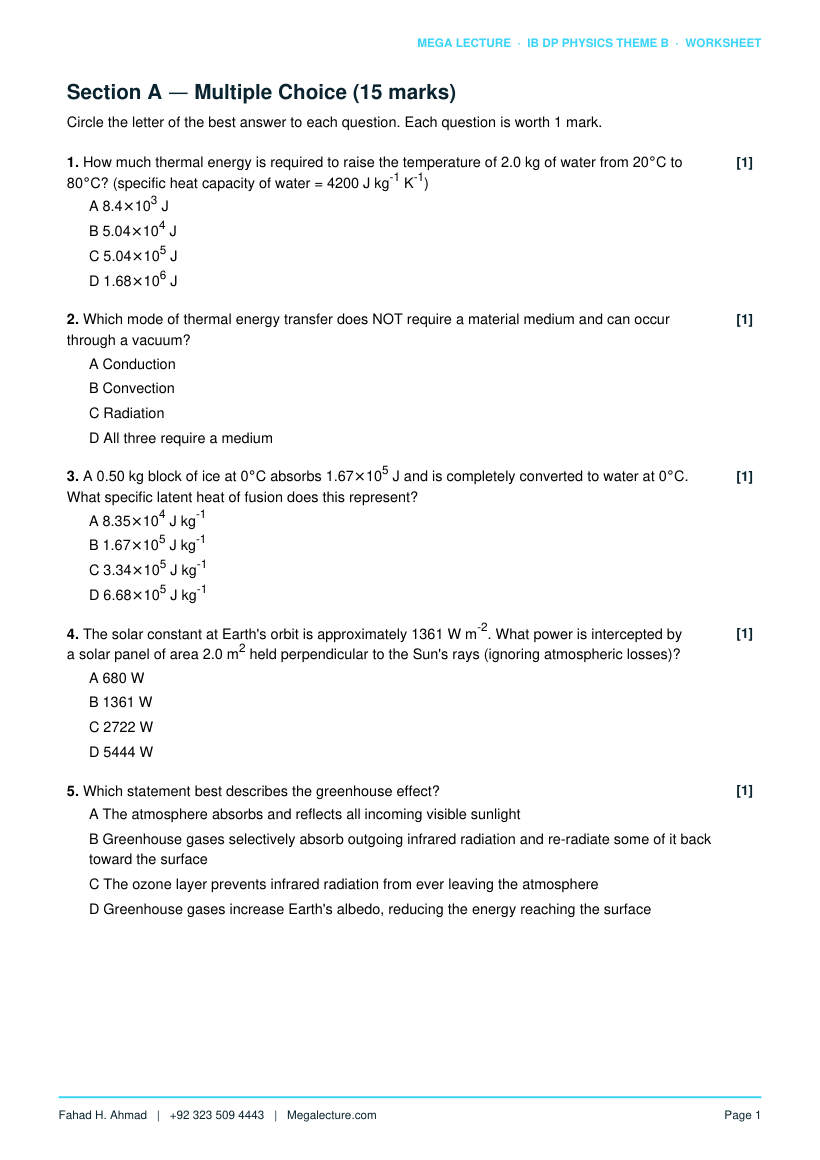
Section A — Multiple Choice (15 marks)
Circle the letter of the best answer to each question. Each question is worth 1 mark.
- How much thermal energy is required to raise the temperature of 2.0 kg of water from 20°C to 80°C? (specific heat capacity of water = 4200 J kg-1 K-1)
[1]
A 8.4×10³ J
B 5.04×10⁴ J
C 5.04×10⁵ J
D 1.68×10⁶ J
- Which mode of thermal energy transfer does NOT require a material medium and can occur through a vacuum?
[1]
A Conduction
B Convection
C Radiation
D All three require a medium
- A 0.50 kg block of ice at 0°C absorbs 1.67×10⁵ J and is completely converted to water at 0°C. What specific latent heat of fusion does this represent?
[1]
A 8.35×10⁴ J kg-1
B 1.67×10⁵ J kg-1
C 3.34×10⁵ J kg-1
D 6.68×10⁵ J kg-1
- The solar constant at Earth's orbit is approximately 1361 W m-2. What power is intercepted by a solar panel of area 2.0 m2 held perpendicular to the Sun's rays (ignoring atmospheric losses)?
[1]
A 680 W
B 1361 W
C 2722 W
D 5444 W
- Which statement best describes the greenhouse effect? [1]
A The atmosphere absorbs and reflects all incoming visible sunlight
B Greenhouse gases selectively absorb outgoing infrared radiation and re-radiate some of it back toward the surface
C The ozone layer prevents infrared radiation from ever leaving the atmosphere
D Greenhouse gases increase Earth's albedo, reducing the energy reaching the surface
- Earth's albedo is approximately 0.30. What fraction of the incoming solar radiation is absorbed by the Earth system (surface + atmosphere)?
[1]
A 0.30
B 0.50
C 0.70
D 1.00
- A fixed mass of ideal gas at pressure 2.0×10⁵ Pa and volume 3.0×10⁻³ m3 is compressed at constant temperature to a volume of 1.0×10⁻³ m3. What is the new pressure?
[1]
A 0.67×10⁵ Pa
B 2.0×10⁵ Pa
C 3.0×10⁵ Pa
D 6.0×10⁵ Pa
- According to the kinetic theory of gases, the absolute temperature of an ideal gas is a direct measure of
[1]
A the total internal energy of the gas
B the average translational kinetic energy of its molecules
C the pressure exerted by the gas on its container
D the total momentum of the gas molecules
- A fixed mass of gas at 300 K and pressure 1.0×10⁵ Pa is heated at constant volume until its pressure doubles. What is the new temperature?
[1]
A 150 K
B 300 K
C 450 K
D 600 K
- A gas absorbs 500 J of thermal energy and does 200 J of work on its surroundings as it expands. What is the change in internal energy of the gas?
[1]
A −300 J
B 200 J
C 300 J
D 700 J
- Which statement correctly expresses the second law of thermodynamics for an isolated system?
[1]
A Energy can never be created or destroyed
B The total entropy of an isolated system never decreases over time
C Heat always flows from a colder to a hotter body spontaneously
D The internal energy of an isolated system is always constant
- A gas expands at a constant pressure of 1.5×10⁵ Pa from a volume of 2.0×10⁻³ m3 to 5.0×10⁻³ m3. How much work is done BY the gas?
[1]
A 150 J
B 300 J
C 450 J
D 750 J
- A resistor of resistance 15 Ω carries a current of 0.40 A. What is the potential difference across it?
[1]
A 0.027 V
B 6.0 V
C 15 V
D 37.5 V
- Two identical resistors, first connected in series and then in parallel, are each connected across the same battery in turn. Compared with the series combination, the parallel combination has
[1]
A a higher total resistance and draws less current from the battery
B a lower total resistance and draws more current from the battery
C the same total resistance and current in both cases
D a higher total resistance but draws more current from the battery
- An electric heater rated at 2.0 kW operates from a 230 V mains supply. What current does it draw?
[1]
A 0.12 A
B 4.6 A
C 8.7 A
D 460 A
Section B — Structured Questions (68 marks)
Answer all questions in the space provided. Working must be shown for full marks.
B.1 Thermal Energy Transfers
Question 1 [7 marks]
A 0.20 kg block of ice, initially at −10°C, is heated at a constant rate by a 45 W heater. The graph shows how its temperature changes with time as it warms, melts, and the resulting water warms further.
Temperature−time graph for the heated ice/water sample (values on the axes are the given data for this question).
- Use the first 2.0 minutes of data (solid ice warming from −10°C to 0°C) to calculate the specific heat capacity of ice.
[2]
- Use the 25-minute plateau (from t = 2.0 min to t = 27.0 min, during which the ice melts at constant temperature) to calculate the specific latent heat of fusion of the ice.
[3]
- Given that the specific heat capacity of liquid water is 4200 J kg-1 K-1, use the final 3.0 minutes of data to calculate the temperature reached at t = 30.0 min.
[2]
Question 2 [6 marks]
A tungsten filament in an incandescent light bulb behaves approximately as a black body. It has a surface area of 8.0×10⁻⁵ m2 and operates at a temperature of 2500 K. (Stefan−Boltzmann constant σ = 5.67×10⁻⁸
W m-2 K-4; Wien's law constant b = 2.898×10⁻³ m K.)
- Calculate the total power radiated by the filament, assuming it radiates as an ideal black body. [2]
- Use Wien's displacement law to calculate the peak wavelength emitted by the filament. [2]
- State the region of the electromagnetic spectrum in which this peak wavelength lies, and hence explain why an incandescent bulb is an inefficient source of visible light.
[2]
B.2 The Greenhouse Effect
Question 3 [7 marks]
The Sun delivers a solar constant of S = 1361 W m-2 at Earth's orbit. Earth has a mean radius of 6.37×10⁶ m and an average albedo of 0.30, as shown in the schematic.
Earth's radiation energy balance: incoming solar radiation is partly reflected (albedo) and partly absorbed; the planet also emits outgoing infrared radiation.
- Show that Earth presents a cross-sectional area of about 1.27×10¹⁴ m2 to the incoming solar radiation, and hence calculate the total power intercepted, Pin.
[3]
- Calculate the total power absorbed by the Earth system, Pabs, given the albedo of 0.30. [2]
- Explain, in terms of radiative equilibrium, the condition required for Earth's average surface temperature to remain stable over long timescales.
[2]
Question 4 [6 marks]
Treating the Earth as a black body radiating uniformly from its entire surface (total surface area 4πr2), and using the absorbed power Pabs found in Question 3(b).
- Calculate the equilibrium black-body temperature of the Earth's surface, assuming all absorbed power is re-radiated as a black body over the full surface area 4πr2 = 5.099×10¹⁴ m2.
[3]
- Earth's actual average surface temperature is about 15°C. Explain, in terms of the greenhouse effect, the difference between this calculated equilibrium temperature and the actual surface temperature.
[3]
B.3 Gas Laws
Question 5 [7 marks]
A fixed mass of an ideal gas is held at a constant pressure of 1.0×10⁵ Pa in a cylinder with a frictionless piston. The graph shows how its volume varies with absolute temperature.
Volume−temperature graph for the gas at constant pressure (given data).
- Use the two labelled points on the graph to show that the gas obeys V/T = constant (Charles's law).
[2]
- Using one of the graph points and the ideal gas equation pV = nRT (R = 8.31 J mol-1 K-1), calculate the amount of gas present, in moles.
[3]
- Calculate the number of gas molecules present (Avogadro constant NA = 6.02×10²³ mol-1). [2]
Question 6 [7 marks]
A sample of oxygen gas (molar mass M = 0.032 kg mol-1) is at a temperature of 300 K. (Boltzmann constant k = 1.38×10⁻²³ J K-1; NA = 6.02×10²³ mol-1.)
- Calculate the average translational kinetic energy of a single oxygen molecule. [2]
- Hence calculate the root-mean-square (rms) speed of the oxygen molecules. [3]
- State and explain, in terms of kinetic theory, what happens to the rms speed of the molecules if the absolute temperature is doubled.
[2]
B.4 Thermodynamics (HL)
Question 7 [6 marks]
A fixed mass of ideal gas undergoes an isobaric (constant-pressure) expansion at P = 2.0×10⁵ Pa, from V1 = 1.0 dm3 to V2 = 3.0 dm3, while absorbing 800 J of thermal energy, as shown on the p−V graph.
Pressure−volume graph for the isobaric expansion; the shaded area equals the work done by the gas.
- Calculate the work done BY the gas during the expansion (the shaded area on the graph). [2]
- Using the first law of thermodynamics, calculate the change in internal energy of the gas. [2]
- State whether the temperature of the gas increases, decreases, or stays the same during this process, and justify your answer.
[2]
Question 8 [8 marks]
A 25 g ice cube at 0°C (273 K) is left in a room held at a constant 20°C and completely melts, absorbing thermal energy from the room. (Specific latent heat of fusion of ice = 3.34×10⁵ J kg-1.)
- Calculate the thermal energy absorbed by the ice as it melts. [2]
- Calculate the entropy change of the ice as it melts at a constant temperature of 273 K. [3]
- As it supplies this heat, the entropy of the room decreases by 28.5 J K-1. Calculate the total entropy change of the (ice + room) system, and state what this shows about whether the process obeys the second law of thermodynamics.
[3]
B.5 Current and Circuits
Question 9 [8 marks]
In the circuit shown, a cell of emf ε = 12 V and internal resistance r = 0.50 Ω drives current through a 4.0 Ω resistor R1 connected in series with a parallel combination of R2 = 6.0 Ω and R3 = 3.0 Ω.
R1 in series with the parallel combination of R2 and R3.
- Calculate the combined resistance of the parallel section (R2 and R3). [2]
- Calculate the current drawn from the cell. [3]
- Calculate the terminal potential difference of the cell (the p.d. across the external circuit). [3]
Question 10 [6 marks]
A nichrome wire (resistivity ρ = 1.10×10⁻⁶ Ω m) has length 2.5 m and cross-sectional area 2.0×10⁻⁷ m2. It is connected across a 12 V supply.
- Calculate the resistance of the wire. [2]
- Calculate the current in the wire. [2]
- Calculate the power dissipated as heat in the wire. [2]
