
IB Diploma · Physics · SL / HL · Theme B: The Particulate Nature of Matter
B.2 Greenhouse Effect
Opens inside this page. Prefer your own PDF app? Open the PDF.
Full text of B.2 Greenhouse Effect
IB DP PHYSICS Theme B: The Particulate Nature of Matter B.2 Greenhouse Effect
Revision Notes · Standard and Higher Level Fahad H. Ahmad
+92 323 509 4443 | Megalecture.com
Original notes prepared for the IB Diploma Programme Physics course (first assessment 2025)
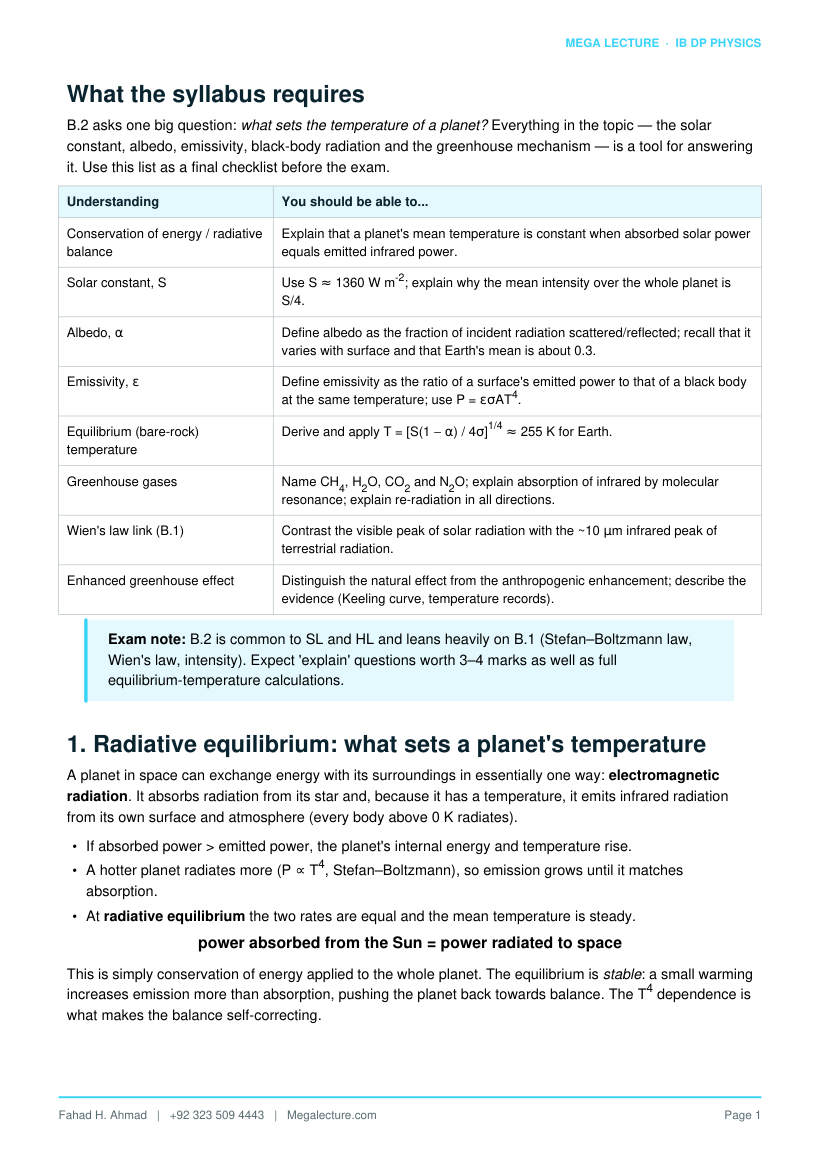
What the syllabus requires
B.2 asks one big question: what sets the temperature of a planet? Everything in the topic — the solar constant, albedo, emissivity, black-body radiation and the greenhouse mechanism — is a tool for answering
- Use this list as a final checklist before the exam.
Understanding You should be able to...
Conservation of energy / radiative balance
Explain that a planet's mean temperature is constant when absorbed solar power equals emitted infrared power.
Solar constant, S Use S ≈ 1360 W m-2; explain why the mean intensity over the whole planet is S/4.
Albedo, α Define albedo as the fraction of incident radiation scattered/reflected; recall that it varies with surface and that Earth's mean is about 0.3.
Emissivity, ε Define emissivity as the ratio of a surface's emitted power to that of a black body at the same temperature; use P = εσAT4.
Equilibrium (bare-rock) temperature
Derive and apply T = [S(1 − α) / 4σ]1/4 ≈ 255 K for Earth.
Greenhouse gases Name CH4, H2O, CO2 and N2O; explain absorption of infrared by molecular resonance; explain re-radiation in all directions.
Wien's law link (B.1) Contrast the visible peak of solar radiation with the ~10 μm infrared peak of terrestrial radiation.
Enhanced greenhouse effect Distinguish the natural effect from the anthropogenic enhancement; describe the evidence (Keeling curve, temperature records).
Exam note: B.2 is common to SL and HL and leans heavily on B.1 (Stefan–Boltzmann law, Wien's law, intensity). Expect 'explain' questions worth 3–4 marks as well as full equilibrium-temperature calculations.
1. Radiative equilibrium: what sets a planet's temperature
A planet in space can exchange energy with its surroundings in essentially one way: electromagnetic radiation. It absorbs radiation from its star and, because it has a temperature, it emits infrared radiation from its own surface and atmosphere (every body above 0 K radiates).
- If absorbed power > emitted power, the planet's internal energy and temperature rise.
- A hotter planet radiates more (P ∝ T4, Stefan–Boltzmann), so emission grows until it matches absorption.
- At radiative equilibrium the two rates are equal and the mean temperature is steady.
power absorbed from the Sun = power radiated to space
This is simply conservation of energy applied to the whole planet. The equilibrium is stable: a small warming increases emission more than absorption, pushing the planet back towards balance. The T4 dependence is what makes the balance self-correcting.
Key phrase for explain questions: “The planet's temperature is constant because the rate of absorption of solar radiation equals the rate of emission of infrared radiation; if they were unequal the temperature would change until they balanced.”
2. The solar constant and the factor of 4
The solar constant S is the intensity of solar radiation arriving at the top of Earth's atmosphere, measured on a surface facing the Sun directly:
S ≈ 1360 W m-2
It follows from the Sun's luminosity spread over a sphere of radius equal to the Earth–Sun distance: S = L / 4πd2. For a planet at a different orbital distance, S scales as 1/d2 (inverse-square law).
Why intercepted power uses πR2
Seen from the Sun, the Earth blocks out a flat disc of radius R (the planet's radius). The power intercepted is therefore the intensity times the disc area:
Pintercepted = S × πR2
Why the average received intensity is S/4
That intercepted power is spread, on average, over the planet's entire spherical surface of area 4πR2 — the planet rotates, and at any instant half of it is in darkness while the illuminated half receives sunlight mostly at a slant. The time-averaged intensity over the whole globe is mean incident intensity = SπR2 / 4πR2 = S/4 ≈ 340 W m-2
The factor of 4 is purely geometric: the ratio of a sphere's surface area to the area of its shadow disc. It has nothing to do with albedo or the atmosphere.
Worked example 1 — mean absorbed intensity
Using S = 1360 W m-2 and a global mean albedo of 0.30, calculate the average intensity (a) arriving at, and (b) absorbed by, each square metre of Earth.
- Mean arriving intensity = S/4 = 1360 / 4 = 340 W m-2.
- A fraction α = 0.30 is scattered back to space, so the absorbed fraction is 0.70:
absorbed intensity = (1 − α)S/4 = 0.70 × 340 = 238 W m-2 ≈ 240 W m-2.
This 238 W m-2 is the number the outgoing infrared must match at equilibrium.
3. Albedo
Not all radiation reaching a planet is absorbed. The albedo α is defined as
α = (total scattered or reflected power) / (total incident power)
It is a dimensionless number between 0 (perfect absorber) and 1 (perfect reflector). Much of the reflection is diffuse scattering — clouds, snow and rough surfaces scatter light in all directions rather than reflecting it like a mirror — but the definition only counts what fraction goes back to space, not in which direction.
Surface Typical albedo Comment
Fresh snow / ice 0.75–0.90 Excellent reflector; melting it exposes darker ground
Thick cloud 0.6–0.9 Clouds dominate the reflective side of Earth's budget
Desert sand ≈ 0.4 Bright, dry surfaces reflect well
Grassland / soil 0.2–0.3 Intermediate
Forest 0.1–0.15 Dark canopy absorbs strongly
Ocean (high Sun) 0.05–0.1 Very absorbing; covers ~70% of the globe
Earth, global annual mean ≈ 0.3 The value to use in calculations unless told otherwise
Albedo varies with season (snow cover), cloudiness, time of day (Sun angle over water), latitude and land use. Quoting Earth's albedo as a single number is already a modelling simplification — a point worth making in evaluate-the-model questions.
Common misconception: Albedo is a ratio of powers (or intensities), not a ratio of temperatures, and it applies to the incoming short-wavelength radiation. The infrared the Earth emits is a separate story handled by emissivity.
4. Emissivity and grey bodies
A black body is a perfect absorber and therefore also a perfect emitter; at temperature T it emits the maximum possible power, σAT4, where σ = 5.67 × 10⁻⁸ W m-2 K-4. Real surfaces emit less. The emissivity compares the two:
ε = (power emitted per unit area by the surface) / (power emitted per unit area by a black
body at the same temperature)
P = εσAT4 0 ≤ ε ≤ 1
A body with constant ε < 1 across all wavelengths is called a grey body. Emissivity can be estimated by comparing the measured radiated power from a sample (using a thermopile or IR sensor) with the theoretical black-body value at the same measured surface temperature and area — the ratio of the two powers is ε.
For a planet, an effective emissivity can be defined the same way: the ratio of the infrared power actually escaping to space to the power a black body at the surface temperature would emit. Earth's surface radiates about 390 W m-2 (black body at 288 K) but only about 240 W m-2 escapes, giving an effective emissivity of about 0.6 — the atmosphere retains the rest. This is one compact way to quantify the greenhouse effect.
Worked example 2 — grey-body radiator
A sphere of radius 15 cm has a surface temperature of 400 K and emissivity 0.80. Calculate the power it radiates.
Surface area A = 4πr2 = 4π(0.15)2 = 0.283 m2.
P = εσAT4 = 0.80 × 5.67 × 10-8 × 0.283 × 4004
P = 0.80 × 5.67 × 10-8 × 0.283 × 2.56 × 1010 = 3.3 × 10² W.
(A net-power question would also subtract absorption from the surroundings: Pnet = εσA(T4 − Tsurr
4).)
5. The bare-rock model: 255 K vs 288 K
Model the Earth with no atmosphere: a sphere of albedo α that absorbs sunlight and radiates to space as a black body (ε = 1). At equilibrium:
absorbed: (1 − α) S πR2 = emitted: σT4 × 4πR2
The planet radius cancels — the answer is the same for any size of planet. Solving for T:
T = [ S(1 − α) / 4σ ]1/4
Worked example 3 — Earth's bare-rock temperature
Calculate the equilibrium temperature of the Earth with S = 1360 W m-2, α = 0.30, treating it as a black-body emitter.
Absorbed mean intensity = S(1 − α)/4 = 1360 × 0.70 / 4 = 238 W m-2.
Set σT4 = 238: T4 = 238 / (5.67 × 10⁻⁸) = 4.20 × 10⁹ K4.
T = (4.20 × 10⁹)1/4 = 255 K ≈ −18 °C.
The observed global mean surface temperature is about 288 K (+15 °C). The model is 33 K too cold.
Figure 3. Radiative balance fixes Earth's effective temperature: the outgoing σT4 curve meets the absorbed intensity S(1 −
α)/4 = 238 W m-2 (dashed) at Te ≈ 255 K.
The 33 K gap is the natural greenhouse effect
The bare-rock model gets the physics of absorption and emission right but omits the atmosphere. The 33 K discrepancy is not an error to be embarrassed about — it is a measurement of the natural greenhouse effect: the warming produced by atmospheric gases that let sunlight in but impede the escape of infrared. Without it, Earth's oceans would largely be frozen.
Worked example 4 — the Moon and Venus as controls
- The Moon (same distance from the Sun, albedo 0.11, no atmosphere): absorbed intensity = 1360 × 0.89 / 4 = 303 W m-2; T = (303 / 5.67 × 10⁻⁸)1/4 = (5.34 × 10⁹)1/4 = 270 K — close to the Moon's actual mean, because with no atmosphere the bare-rock model is the right model.
- Venus (0.72 AU, so SV = 1360/0.722 = 2620 W m-2; albedo 0.75): absorbed = 2620 × 0.25 / 4 = 164 W m-2; T = (164 / 5.67 × 10⁻⁸)1/4 = 232 K. Venus's actual surface is about 735 K — a spectacular 500 K greenhouse warming from its dense CO2 atmosphere.
Comparing the three worlds shows the greenhouse contribution cleanly: Moon ≈ 0 K, Earth ≈ 33 K, Venus ≈ 500 K.
6. The mechanism: how greenhouse gases work
The four greenhouse gases named in the syllabus are water vapour (H2O), carbon dioxide (CO2), methane (CH4) and nitrous oxide (N2O). Together they make up well under 1% of the atmosphere, yet they control its infrared behaviour.
Absorption by molecular resonance
A molecule can store energy in vibrations of its bonds (stretching, bending) and in rotation. These modes have natural frequencies, and quantum mechanics restricts them to discrete energy levels. The energy spacing of the vibrational levels of H2O, CO2, CH4 and N2O happens to match the photon energies of infrared radiation (wavelengths of a few μm to tens of μm). When an infrared photon of matching energy arrives, the molecule absorbs it and is set into resonant vibration — exactly the resonance idea used elsewhere in physics: energy transfer is efficient when the driving frequency matches a natural frequency.
Re-radiation in all directions
The excited molecule quickly loses the energy again, either by colliding with neighbouring molecules (sharing the energy as random thermal motion, warming the air) or by re-emitting an infrared photon. Crucially, re-emission occurs in a random direction: roughly half of the re-radiated infrared heads back downwards. The surface therefore receives energy from two sources — the Sun and the atmosphere — and must warm up until its (larger) emission again balances the books.
Why N2 and O2 are not greenhouse gases
Nitrogen and oxygen, 99% of the atmosphere, are symmetric diatomic molecules. Their vibration does not change the molecule's electric charge distribution (they have no dipole moment, and stretching a symmetric bond creates none), so they cannot interact with the oscillating electric field of an infrared photon. Greenhouse molecules, with three or more atoms, have bending and asymmetric stretching modes that do shift charge around — these are the modes infrared light can drive.
Gas Main sources Notes for exams
H2O Evaporation (natural) The largest contributor to the natural effect; its concentration responds to temperature (feedback) rather than being emitted directly in significant amounts
CO2 Respiration, volcanoes; combustion of fossil fuels, deforestation (anthropogenic)
The key anthropogenic gas; long atmospheric lifetime
CH4 Wetlands; livestock, rice paddies, gas leaks, landfill
Far stronger absorber per molecule than CO2, but less abundant
N2O Soil processes; fertilisers, some industry Strong absorber; long-lived
3-mark answer skeleton (“explain the greenhouse effect”): (1) Surface absorbs visible sunlight and emits infrared. (2) Greenhouse gas molecules absorb infrared because photon energies match their vibrational energy-level spacing (resonance). (3) They re-radiate in all directions, so some infrared returns to the surface, raising the equilibrium surface temperature.
Figure 1. Earth's energy balance. Short-wave solar radiation (S/4 ≈ 340 W m-2) arrives; a fraction α ≈ 0.3 is reflected, leaving
238 W m-2 absorbed. The warm surface emits long-wave infrared, which greenhouse gases absorb and re-radiate in all directions, returning some to the surface.
7. Incoming sunlight vs outgoing infrared (Wien's law)
Why does the atmosphere let the Sun's energy in but hinder the Earth's energy on the way out? Because the two radiation streams occupy different parts of the spectrum, set by the temperatures of their sources through Wien's displacement law (from B.1):
λmax = 2.9 × 10⁻³ / T (m K)
Worked example 5 — the two peak wavelengths
Find the peak emission wavelength of (a) the Sun (surface ≈ 5800 K), (b) the Earth (surface ≈ 288 K).
- λmax = 2.9 × 10⁻³ / 5800 = 5.0 × 10⁻⁷ m = 500 nm — green visible light; the solar spectrum spans the near-UV, visible and near-IR.
- λmax = 2.9 × 10⁻³ / 288 = 1.0 × 10⁻⁵ m ≈ 10 μm — far infrared, about 20 times longer than the solar peak.
Figure 2. Black-body spectra (each normalised to its own peak). Wien's law λmax = b/T shifts the peak with temperature: the
Sun (~5800 K) peaks near 500 nm (visible), while the Earth (~255 K) peaks near 11 μm (infrared).
The atmosphere is largely transparent at visible wavelengths (no abundant gas has energy-level spacings matching visible photons, apart from some scattering), so sunlight reaches the surface. But the surface re-emits at ~4–50 μm, squarely in the absorption bands of H2O, CO2, CH4 and N2O. The atmosphere is therefore opaque to much of the outgoing infrared: it acts like a one-way filter, and that asymmetry is the greenhouse effect.
Exam technique: Always describe the radiation streams as “short-wavelength (visible) solar radiation” and “long-wavelength (infrared) terrestrial radiation”. Writing “heat gets trapped” earns nothing; naming the wavelength contrast and the absorption mechanism earns the marks.
8. A one-layer atmosphere model
The simplest energy-balance model that reproduces greenhouse warming adds a single atmospheric layer above the surface with two properties: it is transparent to solar radiation but absorbs all infrared from the surface, re-emitting as a black body at its own temperature Ta — upwards to space and downwards to the ground.
Setting up the balances (per square metre, with I = S(1 − α)/4 = 238 W m-2):
- Top of atmosphere: only the layer radiates to space, so σTa 4 = I. Hence Ta = 255 K: the bare-rock temperature now belongs to the atmosphere, not the ground.
- Surface: it receives sunlight I plus back-radiation σTa 4 = I, a total of 2I, and emits σTs
- So σTs 4 = 2I.
Ts = 21/4 Ta = 1.19 × 255 K ≈ 303 K
The model predicts a surface roughly 48 K warmer than bare rock — an overestimate (observed warming is 33 K) because the real atmosphere is not a perfect infrared absorber: some surface infrared escapes directly through the “atmospheric window” around 8–13 μm. A partial-absorption layer lands between 255 K and 303 K, which is exactly where 288 K sits. The lesson examiners want: adding infrared absorption above the surface raises the surface equilibrium temperature, and better absorption means more warming.
Strengths and limitations of the model
- Captures energy conservation, the T4 law and the role of back-radiation.
- Ignores convection, evaporation, clouds, latitude variation, and treats absorption as all-or-nothing.
- Uses a single albedo and a single layer; real atmospheres need many layers and wavelength-dependent absorption.
9. The enhanced greenhouse effect
The natural greenhouse effect (33 K) makes Earth habitable. The enhanced greenhouse effect is the additional warming caused by human activity increasing the concentration of greenhouse gases — chiefly CO2 from burning fossil fuels and deforestation, plus CH4 and N2O from agriculture and industry.
The evidence
- The Keeling curve: continuous measurements of atmospheric CO2 at Mauna Loa since 1958 show a steady rise from about 315 ppm to well above 420 ppm, with a small annual zig-zag superimposed (northern-hemisphere vegetation absorbs CO2 in summer and releases it in winter). Ice cores extend the record: pre-industrial levels were about 280 ppm for thousands of years.
- Temperature records: global mean surface temperature has risen by more than 1 K since the late 19th century, and the rise correlates with the CO2 record.
- Mechanism + correlation: correlation alone never proves causation, but here the correlation is backed by an independently verified physical mechanism (infrared absorption by CO2, measurable in the laboratory) and by satellite observations of reduced outgoing infrared in CO2 absorption bands. That combination makes the causal case.
Feedback loops (qualitative)
- Ice–albedo feedback (positive): warming melts snow and ice → exposed ocean/land is darker → albedo falls → more solar radiation absorbed → further warming.
- Water-vapour feedback (positive): warmer air holds more water vapour → H2O is itself a greenhouse gas → more infrared absorbed → further warming. This roughly doubles the direct effect of CO2.
- Clouds produce both signs: more low cloud raises albedo (cooling), more high cloud absorbs infrared (warming); the net effect is a major modelling uncertainty.
Language check: Distinguish carefully between the greenhouse effect (natural, beneficial, explains the 33 K), the enhanced greenhouse effect (anthropogenic addition) and global warming (the resulting temperature rise). Muddling them costs marks.
10. Common pitfalls
- Forgetting the factor 4: using S instead of S/4 (or πR2 on one side and 4πR2 on the other without cancelling correctly).
- Applying the albedo to the emitted infrared. Albedo reduces absorbed sunlight only; use emissivity for emission.
- Taking the fourth root incorrectly — evaluate T4 first, then use the x1/4 button (or square-root twice).
- Using °C in σT4. Stefan–Boltzmann demands kelvin, always.
- Saying greenhouse gases “reflect” infrared. They absorb and re-radiate it, in all directions — reflection is the wrong physics.
- Claiming the atmosphere “traps heat like a blanket/greenhouse glass” with no mechanism. Name the resonance absorption and re-radiation.
- Listing N2 or O2 as greenhouse gases, or forgetting that water vapour is one.
- Treating the 255 K result as “wrong”. It is the correct answer to the no-atmosphere question; the 33 K difference is the physics.
11. Quick reference
Result Statement
Solar constant S ≈ 1360 W m-2 at Earth; S ∝ 1/d2
Intercepted power SπR2 (planet presents a disc to the Sun)
Mean incident intensity S/4 ≈ 340 W m-2 (sphere has 4× the disc area)
Albedo α = scattered power / incident power; global mean ≈ 0.3
Mean absorbed intensity (1 − α)S/4 ≈ 238 W m-2
Emissivity ε = emitted power / black-body power at same T; P = εσAT4
Bare-rock temperature T = [S(1 − α)/4σ]1/4 ≈ 255 K for Earth
Natural greenhouse effect 288 K − 255 K = 33 K of warming from H2O, CO2, CH4, N2O
Wavelength contrast Solar peak ≈ 500 nm (visible); terrestrial peak ≈ 10 μm (infrared)
Mechanism IR photon energy matches molecular vibrational levels (resonance); re-radiation in all directions
One-layer model σTa
4 = I and σTs 4 = 2I, so Ts = 21/4Ta ≈ 303 K
Enhanced effect Anthropogenic rise in greenhouse gases (Keeling curve: 315 → 420+ ppm since 1958)
12. Test yourself
Attempt these without notes; full answers below. Use S = 1360 W m-2, σ = 5.67 × 10⁻⁸ W m-2 K-4, Wien constant 2.9 × 10⁻³ m K.
- Define (a) the solar constant, (b) albedo, (c) emissivity.
- Show that the average intensity absorbed per square metre of the Earth's surface is about 240 W m-2. Explain the origin of the factor of 4 in your working.
- Mars orbits at 1.52 AU and has albedo 0.25. Calculate its expected bare-rock equilibrium temperature.
- Explain why carbon dioxide absorbs infrared radiation but nitrogen does not.
- The human body has a surface temperature of about 310 K. (a) Find its peak emission wavelength. (b) State why this radiation interacts strongly with the atmosphere's greenhouse gases.
- A planet's measured surface temperature exceeds the value predicted by T = [S(1 − α)/4σ]1/4. Outline three assumptions of the bare-rock model and identify which one fails.
- In the one-layer model, the atmosphere absorbs all surface infrared and radiates equally up and down. Show that the surface temperature is 21/4 times the bare-rock temperature, and comment on why the real factor is smaller.
- Describe the ice–albedo feedback and explain why it is classified as a positive feedback.
Answers
- (a) The intensity of solar radiation incident on a surface placed perpendicular to the Sun's rays at the mean Earth–Sun distance, just outside the atmosphere (≈ 1360 W m-2). (b) The ratio of total scattered/reflected power to total incident power for a surface or planet. (c) The ratio of the power emitted per unit area by a surface to that emitted by a black body at the same temperature.
- The Earth intercepts SπR2 (it presents a disc of area πR2 to the Sun), but this power is shared over the full rotating sphere of area 4πR2; the ratio of the two areas gives the factor 4. Mean incident intensity = 1360/4 = 340 W m-2; with α = 0.30, absorbed intensity = 0.70 × 340 = 238 ≈ 240 W m-2.
- SMars = 1360 / 1.522 = 589 W m-2. Absorbed intensity = 589 × 0.75 / 4 = 110 W m-2. T4 = 110 / (5.67 × 10⁻⁸) = 1.95 × 10⁹, so T ≈ 210 K. (Mars's thin CO2 atmosphere adds only a few kelvin.)
- CO2 has bending and asymmetric stretching vibrational modes whose quantised energy-level spacings match infrared photon energies; these vibrations shift the charge distribution, so the molecule couples to the photon's oscillating electric field and absorbs resonantly. N2 is a symmetric diatomic molecule: its single vibration produces no change in charge distribution (no dipole), so it cannot absorb infrared photons.
- (a) λmax = 2.9 × 10⁻³ / 310 = 9.4 μm. (b) This lies in the infrared, where the vibrational energy-level spacings of H2O, CO2, CH4 and N2O match the photon energies, so absorption is strong.
- Assumptions: the planet (i) has no atmosphere (all emitted radiation escapes directly to space), (ii) emits as a black body (ε = 1), (iii) is in radiative equilibrium with a single uniform temperature and constant albedo. Assumption (i) fails for a planet with greenhouse gases: the atmosphere absorbs outgoing infrared and re-radiates part of it back to the surface, so the surface must sit hotter than the bare-rock value for the planet as a whole to stay in balance.
- Top of atmosphere: σTa 4 = I (only the layer radiates to space), where I = S(1 − α)/4, so Ta equals the bare-rock temperature. Surface: receives I from the Sun plus σTa
4 = I back-radiated from the layer, so σTs
= 2I = 2σTa
4, giving Ts = 21/4Ta ≈ 1.19 × 255 = 303 K. The real factor is smaller because the atmosphere is only a partial infrared absorber — some surface radiation escapes directly through the atmospheric window — so the observed surface temperature (288 K) lies between 255 K and 303 K.
- Warming melts highly reflective snow and sea ice, exposing darker ocean or land. The albedo falls, so a larger fraction of the incident solar radiation is absorbed, which raises the temperature further and melts more ice. Because the initial change (warming) produces an effect that reinforces itself rather than opposing it, the loop is a positive feedback: it amplifies the original disturbance.
