
IB Diploma · Physics · SL / HL · Theme B: The Particulate Nature of Matter
B.1 Thermal Energy Transfers
Need more than one subject? All-notes pass: unlimited downloads of every note for a year: unlimited downloads of every note on the site, PKR 999 a year. All packs and courses.
Opens inside this page. Prefer your own PDF app? Open the PDF.
Check yourself
5 quick questions on The particulate nature of matter
Tap an answer to see if you are right, and why. Free, no sign-up.
Start the free test👍 15 students found these notes useful
Was this note useful?
Full text of B.1 Thermal Energy Transfers
IB DP PHYSICS Theme B: The Particulate Nature of Matter B.1 Thermal Energy Transfers
Revision Notes · Standard and Higher Level Fahad H. Ahmad
Original notes prepared for the IB Diploma Programme Physics course (first assessment 2025)
Free notes, practice tests and live classes Back to megalecture.com
What the syllabus requires
B.1 is common to SL and HL. By the end of the topic you should be able to do all of the following. Use this list as a final checklist before the exam.
Understanding You should be able to...
Molecular theory Describe solids, liquids and gases in terms of molecular spacing, intermolecular forces and motion; use density ρ = m / V.
Temperature Convert between Celsius and Kelvin; state that Kelvin temperature is proportional to the average translational kinetic energy of molecules: Ek = (3/2)kBT.
Internal energy Define internal energy as the total intermolecular potential energy plus the total random kinetic energy of the molecules; distinguish heat, temperature and internal energy.
Specific heat capacity Apply Q = mcΔT and describe how c is measured.
Phase change Apply Q = mL for fusion and vaporisation; interpret heating and cooling curves.
Conduction, convection Describe the mechanisms qualitatively; apply the conduction equation ΔQ/Δt = kAΔT/Δx.
Thermal radiation Apply Stefan-Boltzmann L = σAT4 (with emissivity for grey bodies), Wien's law λmaxT = 2.9 × 10⁻³ m K, and apparent brightness b = L / (4πd2).
Exam note: B.1 supplies the language for the whole of Theme B and links directly to the greenhouse effect (B.2 context questions) and to stellar physics. The radiation laws here are examined with astrophysics-style data.
1. The molecular (kinetic) model of matter
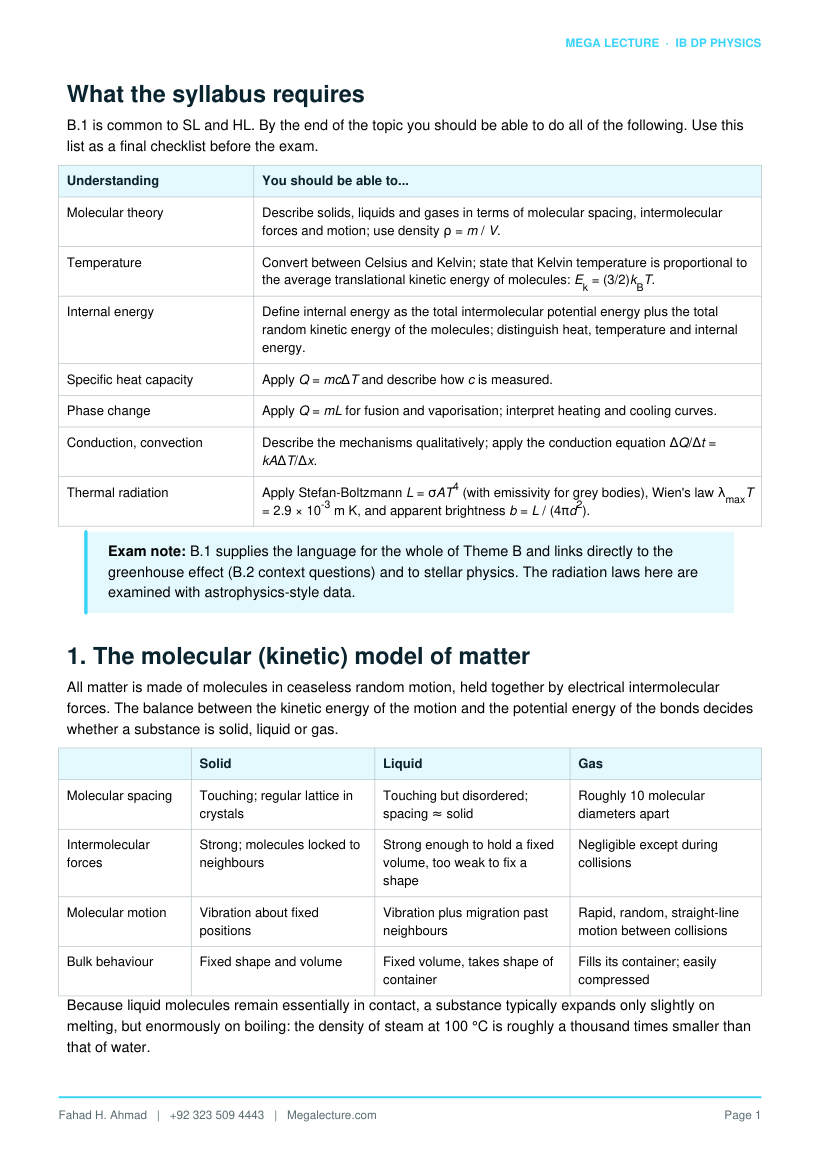
All matter is made of molecules in ceaseless random motion, held together by electrical intermolecular forces. The balance between the kinetic energy of the motion and the potential energy of the bonds decides whether a substance is solid, liquid or gas.
Solid Liquid Gas
Molecular spacing Touching; regular lattice in crystals
Touching but disordered; spacing ≈ solid
Roughly 10 molecular diameters apart
Intermolecular forces
Strong; molecules locked to neighbours
Strong enough to hold a fixed volume, too weak to fix a shape
Negligible except during collisions
Molecular motion Vibration about fixed positions
Vibration plus migration past neighbours
Rapid, random, straight-line motion between collisions
Bulk behaviour Fixed shape and volume Fixed volume, takes shape of container
Fills its container; easily compressed
Because liquid molecules remain essentially in contact, a substance typically expands only slightly on melting, but enormously on boiling: the density of steam at 100 °C is roughly a thousand times smaller than that of water.
Density
ρ=m/V
Density is mass per unit volume, unit kg m-3. It is a property of the material, not of the object: half a gold bar has the same density as the whole bar. Useful magnitudes to carry into the exam: water 1000 kg m-3, air about 1.2 kg m-3, common metals 2700 (aluminium) to 11 300 (lead) kg m-3.
Unit trap: 1 g cm-3 = 1000 kg m-3. Converting cm3 to m3 means dividing by 106, not 102 — the most common density error in Paper 1.
Worked example 1 — density of a metal block
A rectangular block measures 5.0 cm × 4.0 cm × 2.0 cm and has mass 108 g. Find its density and suggest what metal it is.
V = 5.0 × 4.0 × 2.0 = 40 cm3 = 4.0 × 10⁻⁵ m3; m = 0.108 kg.
ρ = 0.108 / (4.0 × 10⁻⁵) = 2700 kg m-3 — the density of aluminium.
2. Temperature and the Kelvin scale
Two bodies placed in thermal contact exchange energy until they reach thermal equilibrium, after which there is no net energy transfer. Temperature is the property that decides which way thermal energy flows: it always flows spontaneously from the body at higher temperature to the body at lower temperature, whatever their sizes or internal energies.
Celsius and Kelvin T (K) = t (°C) + 273
A change of 1 K equals a change of 1 °C, so temperature differences are the same on both scales — which is why ΔT in Q = mcΔT may be left in °C. But any formula in which T appears alone (Ek = (3/2)kBT, L = σAT4, the gas laws of B.3) demands kelvin.
Temperature and molecular kinetic energy Ek(average) = (3/2) kB T
The absolute (Kelvin) temperature of a substance is a measure of the average translational kinetic energy of its molecules; kB = 1.38 × 10⁻²³ J K-1 is the Boltzmann constant. Two consequences are examined constantly:
- Doubling the kelvin temperature doubles the average molecular kinetic energy — doubling the Celsius temperature does not.
- At a given temperature all gases have the same average molecular kinetic energy, so lighter molecules move faster on average.
Absolute zero
Absolute zero (0 K = -273 °C) is the temperature at which the average kinetic energy of the molecules would fall to its minimum possible value: molecular motion is at its minimum and no further internal energy
Worked example 2 — molecular kinetic energy
- Find the average translational kinetic energy of a gas molecule at 300 K. (b) Estimate the typical speed of a nitrogen molecule (mass 4.65 × 10⁻²⁶ kg) at this temperature.
- Ek = (3/2) × 1.38 × 10-23 × 300 = 6.2 × 10⁻²¹ J.
- Ek = ½mv2 gives v = √(2Ek / m) = √(2 × 6.2 × 10-21 / 4.65 × 10⁻²⁶) ≈ 520 m s-1 — comparable to the speed of sound, as expected.
Common misconception: A temperature of 40 °C is not "twice as hot" as 20 °C. In kelvin the ratio is 313 / 293 ≈ 1.07: the average molecular kinetic energy rises by only about 7%.
3. Internal energy, heat and temperature
These three words are deliberately confused in exam questions; keep the definitions razor sharp.
Quantity Definition Notes
Internal energy, U The total intermolecular potential energy + the total random kinetic energy of all the molecules of a system
Depends on mass, temperature and phase. An extensive property: 2 kg of water at 50 °C has twice the internal energy of 1 kg at 50 °C.
Temperature, T A measure of the average translational kinetic energy per molecule
Independent of the amount of substance. Determines the direction of thermal energy flow.
Heat (thermal energy), Q
Energy in transfer from a hotter body to a colder body, driven by the temperature difference
A process, not a store: bodies do not "contain heat"; they contain internal energy.
The two components of internal energy behave differently:
- The random kinetic component rises when temperature rises.
- The intermolecular potential component rises when molecules are pulled further apart against attractive forces — chiefly during melting and boiling, when the temperature does not change at all.
A classic comparison: a spark from a firework is at well over 1000 °C but holds so little internal energy that it cannot burn you, while a bath of water at 40 °C holds an enormous internal energy at a harmless temperature. High temperature does not mean large internal energy.
Exam language: Write "thermal energy is transferred" rather than "heat flows into the object and is stored". Energy transferred thermally becomes internal energy — kinetic if the temperature rises, potential if the phase changes.
4. Specific heat capacity
Q = mcΔT
The specific heat capacity c of a substance is the energy required to raise the temperature of 1 kg of it by 1 K, unit J kg-1 K-1. It applies while no phase change is occurring. Representative values: water 4200, ice about 2100, aluminium about 900, copper about 390 J kg-1 K-1.
Why water matters
Water's specific heat capacity is exceptionally high. This is why water is used as a coolant (car engines, power stations) and as a heat store (central-heating radiators), and why coastal climates are milder than continental ones: the sea absorbs and releases huge amounts of energy with only small temperature changes, moderating the air temperature nearby.
Measuring c: the electrical method
A block of the material (or an insulated container of the liquid) is fitted with an immersion heater and a thermometer. The heater delivers energy Q = Pt = VIt, measured with a voltmeter, ammeter and stopwatch, and the temperature rise ΔT is recorded. Then c = VIt / (mΔT). Key precautions: insulate the block (lagging), start the timing only when readings are steady, and use a little oil or water in the thermometer hole for good thermal contact. Energy escaping to the surroundings makes the measured c an overestimate, because more energy is supplied than actually warms the sample.
Method of mixtures (alternative)
A hot sample is transferred quickly into a known mass of cold water. Assuming a perfectly insulated container, energy lost by the sample equals energy gained by the water, and the unknown c follows from the common final temperature. A continuous-flow variant for liquids passes the liquid steadily over a heater and uses the steady inlet and outlet temperatures; its advantage is that the apparatus itself stays at constant temperature, so its heat capacity drops out.
Worked example 3 — electrical heating
A 50 W immersion heater warms 0.80 kg of water (c = 4200 J kg-1 K-1) for 5.0 minutes in an insulated container. Find the temperature rise.
Q = Pt = 50 × 300 = 1.5 × 10⁴ J.
ΔT = Q / (mc) = 15 000 / (0.80 × 4200) = 4.5 K.
In a real experiment the measured rise would be slightly smaller because of losses to the surroundings.
Worked example 4 — method of mixtures
A 0.30 kg metal block is heated to 100 °C and dropped into 0.20 kg of water at 20.0 °C. The final steady temperature is 25.0 °C. Find the specific heat capacity of the metal, stating the assumption made.
Energy gained by water = 0.20 × 4200 × 5.0 = 4200 J.
Energy lost by metal = 0.30 × c × (100 - 25.0) = 22.5c.
Setting them equal: c = 4200 / 22.5 ≈ 190 J kg-1 K-1.
Assumption: no energy is transferred to the container or the surroundings. Any real loss means the true c is larger than the value calculated.
5. Phase changes and specific latent heat
Q = mL
The specific latent heat L is the energy required to change the phase of 1 kg of a substance without any change of temperature, unit J kg-1. Two kinds appear:
Latent heat Phase change Value for water
Fusion, Lf solid → liquid (melting); released again on freezing 3.34 × 10⁵ J kg-1
Vaporisation, Lv liquid → gas (boiling / evaporating); released again on condensing
2.26 × 10⁶ J kg-1
Why the temperature stays constant
During melting or boiling, all of the energy supplied goes into increasing the intermolecular potential energy — separating molecules against the attractive forces — and none into kinetic energy. Since temperature measures the average kinetic energy, the temperature is constant while the phase change lasts. This is exactly what the flat sections of a heating curve show. Note that Lv is much larger than Lf: boiling must separate the molecules almost completely (and push back the atmosphere), whereas melting only loosens the lattice.
Heating curve for water (constant power supplied)
Stage What is happening Energy equation Graph shape
Ice warms from -10 °C to 0 °C Q = mciceΔT Rising line
Ice melts at 0 °C Q = mLf Flat (plateau)
Water warms from 0 °C to 100 °C Q = mcwaterΔT Rising line (less steep than 1, since cwater > cice)
Water boils at 100 °C Q = mLv Long flat plateau
Steam warms above 100 °C Q = mcsteamΔT Rising line
A cooling curve is the mirror image: flat sections appear while the substance freezes or condenses, because latent heat is then released to the surroundings.
Worked example 5 — ice to steam (full heating curve)
Find the total energy needed to convert 0.500 kg of ice at -10 °C into steam at 100 °C. (cice = 2100, cwater = 4200 J kg-1 K-1; Lf = 3.34 × 10⁵, Lv = 2.26 × 10⁶ J kg-1.)
Warm the ice: Q1 = 0.500 × 2100 × 10 = 1.05 × 10⁴ J
Melt the ice: Q2 = 0.500 × 3.34 × 105 = 1.67 × 10⁵ J
Warm the water: Q3 = 0.500 × 4200 × 100 = 2.10 × 10⁵ J
Boil the water: Q4 = 0.500 × 2.26 × 106 = 1.13 × 10⁶ J
Total: Q = 1.05 × 10⁴ + 1.67 × 10⁵ + 2.10 × 10⁵ + 1.13 × 106 = 1.52 × 10⁶ J.
Notice that boiling alone takes almost three-quarters of the total — a favourite "comment on your answer" mark.
Figure 1. Heating curve for 1 kg of water: the two flat plateaus (melting, Lf; boiling, Lv) hold temperature constant while latent heat is added, and the sloped segments obey Q = mcΔT. Boiling absorbs 2.26 MJ, far more than melting (0.334 MJ).
Evaporation vs boiling: Evaporation happens at any temperature, from the surface only, as the fastest molecules escape; the average kinetic energy of those left behind falls, so the liquid cools. Boiling happens at one fixed temperature, with bubbles of vapour forming throughout the liquid.
6. Conduction, convection and radiation
Thermal energy moves from hot to cold by three distinct mechanisms; most real situations involve all three at once.
Conduction
Conduction is the transfer of energy through matter without bulk movement of the matter. In all solids, molecules vibrating vigorously in the hot region jostle their neighbours and pass kinetic energy along the lattice — a slow process. Metals conduct far better because their free (delocalised) electrons travel quickly through the lattice, carrying kinetic energy from hot to cold regions directly. This is why metals feel cold to the touch: they conduct thermal energy away from your hand rapidly. Liquids conduct poorly and gases very poorly, because their molecules are further apart and collisions are less frequent — trapped air is the working principle of most insulation (wool, foam, double glazing).
The conduction (thermal conductance) equation
ΔQ / Δt = kA ΔT / Δx
The rate of energy flow by conduction through a slab is proportional to the thermal conductivity k (W m-1
K-1, a property of the material), the cross-sectional area A, and the temperature gradient ΔT / Δx — the temperature difference across the slab divided by its thickness. Typical conductivities: copper ≈ 400, glass ≈ 0.8, brick ≈ 0.6, air ≈ 0.025 W m-1 K-1.
Worked example 6 — heat loss through a window
A single-glazed window has area 1.5 m2 and glass of thickness 6.0 mm (k = 0.80 W m-1 K-1). The inner surface is at 18 °C and the outer surface at 3 °C. Find the rate of thermal energy loss.
ΔQ/Δt = kAΔT/Δx = 0.80 × 1.5 × 15 / 0.0060 = 3.0 × 10³ W.
The answer is huge because the glass is thin. In reality the surface temperatures of the glass are much closer together than the room and outdoor air temperatures — thin insulating air layers cling to each face — so the true loss is far smaller. Double glazing works by trapping a layer of air or argon, whose conductivity is about thirty times lower than that of glass.
Convection
Convection is the transfer of energy by the bulk movement of a fluid (liquid or gas); it cannot occur in solids or in a vacuum. Fluid warmed near a hot surface expands, its density falls, and it rises; cooler, denser fluid sinks to replace it, setting up a convection current. Examples worth quoting: sea breezes (land heats faster than the sea by day, so air rises over the land and cooler sea air flows in), domestic radiators and heating elements placed low in a room or kettle, gliders and birds circling in thermals, and convection in the Earth's mantle and in stellar interiors.
Thermal radiation
All bodies above absolute zero emit electromagnetic radiation, mostly infrared at everyday temperatures. Radiation needs no medium — it is how the Sun's energy reaches Earth — and travels at the speed of light. The rate of emission depends strongly on temperature (Section 7) and on the nature of the surface: matt black surfaces are the best emitters and the best absorbers, while shiny silvered surfaces are poor emitters and good reflectors (hence survival blankets and the silvering inside a vacuum flask).
Mechanism Medium needed? Carrier Speed
Conduction Yes (best in solids, esp. metals) Molecular collisions; free electrons in metals
Slow
Mechanism Medium needed? Carrier Speed
Convection Yes (fluids only) Bulk movement of hot fluid Moderate
Radiation No — works in vacuum Electromagnetic waves (mainly infrared)
3 × 10⁸ m s-1
Figure 2. The three thermal-energy transfer mechanisms: conduction (energy passed through matter, fastest in metals via free electrons), convection (bulk motion of a heated fluid) and radiation (electromagnetic waves that need no medium).
7. Black-body radiation and the radiation laws
A black body is an idealised surface that absorbs all electromagnetic radiation falling on it, at every wavelength — and is therefore also the most efficient possible emitter. Stars are excellent approximations to black bodies. A black body emits a continuous spectrum whose shape depends only on its temperature.
Stefan-Boltzmann law
L = σ A T4
The total power L (luminosity) radiated by a black body of surface area A at kelvin temperature T, where σ = 5.67 × 10⁻⁸ W m-2 K-4. The fourth power is ferocious: doubling T multiplies the radiated power by 16. For a sphere (a star), A = 4πR2, so
L = 4πR2σT4
Emissivity and grey bodies
Real surfaces emit less than a black body at the same temperature. The emissivity ε is the ratio of the power radiated per unit area by the surface to the power radiated per unit area by a black body at the same temperature, so 0 ≤ ε ≤ 1 and
P = ε σ A T4
A grey body has the same emissivity at all wavelengths. Matt black paint has ε ≈ 0.97; polished aluminium ε ≈ 0.05; the Earth (averaged) about 0.6 in B.2 climate models. A body at temperature T in surroundings at Ts also absorbs radiation, so its net rate of loss is εσA(T4 - Ts
4).
Worked example 7 — radiation from a person
Estimate the net rate at which a person (surface area 1.7 m2, skin temperature 310 K, emissivity 0.97) loses energy by radiation in a room at 293 K.
Pnet = εσA(T4 - Ts
- = 0.97 × 5.67 × 10-8 × 1.7 × (3104 - 2934)
3104 = 9.24 × 10⁹; 2934 = 7.37 × 10⁹; difference = 1.87 × 10⁹ K4.
Pnet ≈ 170 W — larger than the body's resting metabolic rate, which is why we wear clothes.
Figure 3. Radiated power P = εσAT4 for a body of area 1.7 m2 and ε = 0.97. The fourth-power law is steep: at 310 K, P ≈ 864
W, and doubling T multiplies P by 16.
Wien's displacement law
λmax T = 2.9 × 10⁻³ m K
The wavelength at which a black body emits most intensely is inversely proportional to its kelvin temperature. Hotter bodies therefore glow at shorter wavelengths: a poker heats from dull red through orange to white; cool stars look red, very hot stars blue-white. Measuring λmax in a star's spectrum gives its surface temperature immediately.
Apparent brightness
b = L / (4πd2)
At distance d from a source of luminosity L, the radiated power is spread over a sphere of area 4πd2. The apparent brightness b (W m-2) is the power received per square metre of detector, and obeys an inverse-square law: b ∝ 1/d2. The solar constant, b ≈ 1360 W m-2 above Earth's atmosphere, is the Sun's apparent brightness at 1 AU.
Worked example 8 — luminosity of the Sun
The Sun has radius 6.96 × 10⁸ m and surface temperature 5800 K. Treating it as a black body, estimate its luminosity.
A = 4πR2 = 4π × (6.96 × 108)2 = 6.09 × 10¹⁸ m2.
T4 = 58004 = 1.13 × 10¹⁵ K4.
L = σAT4 = 5.67 × 10-8 × 6.09 × 1018 × 1.13 × 1015 ≈ 3.9 × 1026 W — in excellent agreement with the accepted 3.8 × 1026 W.
Worked example 9 — temperature and brightness of a star
A star's spectrum peaks at 400 nm, and its luminosity is 3.9 × 1026 W. Find (a) its surface temperature, (b) its apparent brightness from a distance of 9.46 × 10¹⁶ m (10 light-years).
- T = 2.9 × 10⁻³ / (4.00 × 10⁻⁷) = 7250 K — hotter than the Sun, consistent with its bluer peak.
- b = L / (4πd2) = 3.9 × 1026 / (4π × (9.46 × 1016)2) ≈ 3.5 × 10⁻⁹ W m-2.
Worked example 10 — comparing star radii
Star X has luminosity 100 times that of the Sun and surface temperature twice that of the Sun. How does its radius compare with the Sun's?
From L = 4πR2σT4: R ∝ √L / T2.
RX / RSun = √100 / 22 = 10 / 4 = 2.5. Star X is 2.5 times the Sun's radius.
This ratio method — writing the law twice and dividing — avoids ever needing σ and is the fastest route in Paper 1.
Stellar toolkit: Given any two of {λmax, b, d, L, R, T} you can usually find the rest: Wien gives T; b and d give L; then L = 4πR2σT4 gives R. This chain is the standard synoptic question linking B.1 to astrophysics.
8. Common pitfalls
- Using Celsius in Ek = (3/2)kBT, L = σAT4 or Wien's law. These need kelvin; only ΔT may stay in °C.
- Saying temperature measures the total energy of molecules. It measures the average translational kinetic energy; internal energy is the total (kinetic + potential).
- Claiming the temperature rises during melting or boiling, or that latent heat increases molecular kinetic energy — it increases potential energy only.
- Forgetting to add every stage in a heating-curve calculation (warming and phase changes), or using cwater for ice.
- Applying L = σAT4 with the temperature difference: the net radiated power uses T4 - Ts 4, never (T - Ts)4.
- Squaring instead of fourth-powering: doubling T multiplies radiated power by 16, not 4; and R ∝ √L / T2, so a cool star can be very luminous only if it is huge (red giants).
- Mixing up luminosity (total power output, W) with apparent brightness (received power per unit area, W m-2).
- In experiments, ignoring energy transferred to the container/surroundings, then being unable to say whether the result is an over- or underestimate.
9. Quick reference
Result Statement
Density ρ = m / V (water: 1000 kg m-3)
Kelvin conversion T (K) = t (°C) + 273; ΔT identical on both scales
Molecular KE Ek(avg) = (3/2)kBT, kB = 1.38 × 10⁻²³ J K-1
Internal energy total intermolecular PE + total random KE of the molecules
Heating (no phase change) Q = mcΔT
Phase change Q = mL (water: Lf = 3.34 × 10⁵, Lv = 2.26 × 10⁶ J kg-1)
Conduction ΔQ/Δt = kAΔT/Δx
Stefan-Boltzmann L = σAT4 (black body); P = εσAT4 (grey body); σ = 5.67 × 10⁻⁸ W m-2 K-4
Wien's law λmaxT = 2.9 × 10⁻³ m K
Apparent brightness b = L / (4πd2) (inverse-square law)
Star radius L = 4πR2σT4 → R ∝ √L / T2
10. Test yourself
Attempt these without notes; full answers below. Take cwater = 4200 J kg-1 K-1, Lf = 3.34 × 10⁵ J kg-1, σ = 5.67 × 10⁻⁸ W m-2 K-4, kB = 1.38 × 10⁻²³ J K-1.
- 200 cm3 of oil (density 800 kg m-3) is mixed with 300 cm3 of water. Assuming no volume change on mixing, find the density of the mixture.
- Convert body temperature, 37 °C, to kelvin. At what Celsius temperature would the average molecular kinetic energy of a gas be exactly half its value at 37 °C?
- Calculate the average translational kinetic energy of a helium atom at 500 K. Would the value differ for a xenon atom at the same temperature?
- A 2.0 kW kettle contains 1.5 kg of water at 20 °C. Assuming no losses, how long does it take to reach 100 °C?
- Find the energy needed to melt 40 g of ice at 0 °C and warm the resulting water to 20 °C.
- 0.150 kg of water at 80.0 °C is poured into 0.250 kg of water at 20.0 °C in an insulated cup. Find the final temperature.
- A copper rod (k = 400 W m-1 K-1) of length 0.50 m and cross-section 1.0 cm2 connects a boiler at 100 °C to melting ice at 0 °C. Find the rate of energy conduction along the rod.
- The Sun's surface temperature is 5800 K. At what wavelength does its spectrum peak, and in which part of the electromagnetic spectrum does this lie?
- A star has apparent brightness 2.5 × 10⁻⁸ W m-2 at a distance of 4.0 × 10¹⁷ m. Find its luminosity.
- The star in question 9 has surface temperature 10 000 K. Estimate its radius (take L = 6.0 × 1028 W).
Answers
- m = 0.800 × 2.0 × 10-4 + 1000 × 3.0 × 10-4 kg... more directly: m = 0.160 + 0.300 = 0.460 kg; V = 5.0 × 10⁻⁴ m3; ρ = 0.460 / 5.0 × 10-4 = 920 kg m-3.
- 37 °C = 310 K. Average KE ∝ T, so half the KE means T = 155 K = 155 - 273 = -118 °C (not 18.5 °C — the halving must be done in kelvin).
- Ek = (3/2) × 1.38 × 10-23 × 500 = 1.04 × 10⁻²⁰ J. Identical for xenon: average molecular KE depends only on temperature, so the heavier xenon atom simply moves more slowly.
- Q = mcΔT = 1.5 × 4200 × 80 = 5.04 × 10⁵ J; t = Q / P = 5.04 × 10⁵ / 2000 = 252 s ≈ 4.2 min.
- Melt: Q1 = 0.040 × 3.34 × 105 = 1.34 × 10⁴ J. Warm: Q2 = 0.040 × 4200 × 20 = 3.4 × 10³ J. Total ≈ 1.7 × 10⁴ J.
- Energy lost = energy gained: 0.150(80 - T) = 0.250(T - 20) (the common c cancels). 12.0 - 0.150T = 0.250T - 5.0, so 0.400T = 17.0 and T = 42.5 °C.
- ΔQ/Δt = kAΔT/Δx = 400 × 1.0 × 10-4 × 100 / 0.50 = 8.0 W.
- λmax = 2.9 × 10⁻³ / 5800 = 5.0 × 10⁻⁷ m = 500 nm — in the middle of the visible spectrum (green), matching the peak sensitivity of the human eye.
- L = 4πd2b = 4π × (4.0 × 1017)2 × 2.5 × 10-8 = 5.0 × 1028 W — about 130 000 times the Sun's luminosity.
- R = √[L / (4πσT4)] = √[6.0 × 1028 / (4π × 5.67 × 10-8 × (104)4)] = √(8.4 × 10¹⁸) ≈ 2.9 × 10⁹ m — roughly four times the Sun's radius.
