
IB Diploma · Physics · SL / HL · Theme B: The Particulate Nature of Matter
B.4 Thermodynamics (HL)
Opens inside this page. Prefer your own PDF app? Open the PDF.
Full text of B.4 Thermodynamics (HL)
IB DP PHYSICS Theme B: The Particulate Nature of Matter B.4 Thermodynamics
Revision Notes · Higher Level only Fahad H. Ahmad
+92 323 509 4443 | Megalecture.com
Original notes prepared for the IB Diploma Programme Physics course (first assessment 2025)
What the syllabus requires
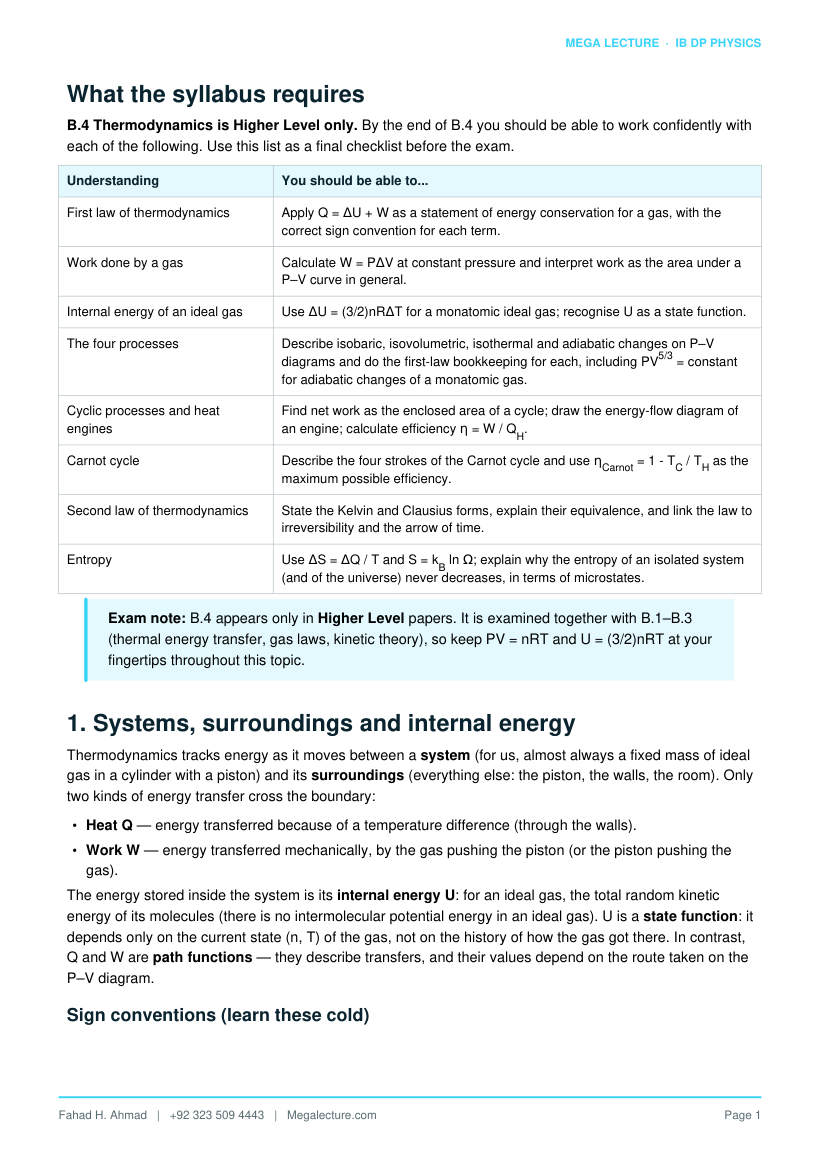
B.4 Thermodynamics is Higher Level only. By the end of B.4 you should be able to work confidently with each of the following. Use this list as a final checklist before the exam.
Understanding You should be able to...
First law of thermodynamics Apply Q = ΔU + W as a statement of energy conservation for a gas, with the correct sign convention for each term.
Work done by a gas Calculate W = PΔV at constant pressure and interpret work as the area under a P–V curve in general.
Internal energy of an ideal gas Use ΔU = (3/2)nRΔT for a monatomic ideal gas; recognise U as a state function.
The four processes Describe isobaric, isovolumetric, isothermal and adiabatic changes on P–V diagrams and do the first-law bookkeeping for each, including PV5/3 = constant for adiabatic changes of a monatomic gas.
Cyclic processes and heat engines
Find net work as the enclosed area of a cycle; draw the energy-flow diagram of an engine; calculate efficiency η = W / QH.
Carnot cycle Describe the four strokes of the Carnot cycle and use ηCarnot = 1 - TC / TH as the maximum possible efficiency.
Second law of thermodynamics State the Kelvin and Clausius forms, explain their equivalence, and link the law to irreversibility and the arrow of time.
Entropy Use ΔS = ΔQ / T and S = kB ln Ω; explain why the entropy of an isolated system (and of the universe) never decreases, in terms of microstates.
Exam note: B.4 appears only in Higher Level papers. It is examined together with B.1–B.3 (thermal energy transfer, gas laws, kinetic theory), so keep PV = nRT and U = (3/2)nRT at your fingertips throughout this topic.
1. Systems, surroundings and internal energy
Thermodynamics tracks energy as it moves between a system (for us, almost always a fixed mass of ideal gas in a cylinder with a piston) and its surroundings (everything else: the piston, the walls, the room). Only two kinds of energy transfer cross the boundary:
- Heat Q — energy transferred because of a temperature difference (through the walls).
- Work W — energy transferred mechanically, by the gas pushing the piston (or the piston pushing the gas).
The energy stored inside the system is its internal energy U: for an ideal gas, the total random kinetic energy of its molecules (there is no intermolecular potential energy in an ideal gas). U is a state function: it depends only on the current state (n, T) of the gas, not on the history of how the gas got there. In contrast, Q and W are path functions — they describe transfers, and their values depend on the route taken on the P–V diagram.
Sign conventions (learn these cold)
Quantity Positive means... Negative means...
Q heat flows into the gas heat flows out of the gas
W work done by the gas on the surroundings (gas expands) work done on the gas (gas is compressed)
ΔU internal energy rises (temperature rises, for an ideal gas) internal energy falls (temperature falls)
Warning: IB Physics writes the first law as Q = ΔU + W with W the work done by the gas. Chemistry (and many textbooks) use ΔU = Q + W with W done on the gas. Mixing the two conventions is the single most common source of sign errors in this topic — commit to the IB form and state your signs explicitly.
2. Work done by a gas
When a gas at pressure P pushes a piston of area A outward through a small distance d, the force is F = PA and the work done by the gas is W = Fd = PAd = PΔV. So at constant pressure:
W = PΔV (constant pressure only)
- Expansion: ΔV > 0, so W > 0 — the gas does work on the surroundings.
- Compression: ΔV < 0, so W < 0 — the surroundings do work on the gas.
- No volume change: W = 0, however much the pressure changes. A gas does no work unless its volume changes.
If the pressure varies during the change, the same argument applied to each small step gives the general result:
W = area under the P–V curve between the initial and final volumes
This is why the P–V diagram is the natural picture for thermodynamics: different paths between the same two states enclose different areas, so the work done — and, by the first law, the heat exchanged — depends on the path, even though ΔU does not.
Worked example 1 — work and the first law at constant pressure
A gas held at a constant pressure of 2.0 × 10⁵ Pa expands from 3.0 × 10⁻³ m3 to 5.0 × 10⁻³ m3 while 1000 J of heat is supplied. Find (a) the work done by the gas, (b) the change in its internal energy.
- W = PΔV = 2.0 × 105 × (5.0 - 3.0) × 10-3 = +400 J.
- First law: ΔU = Q - W = 1000 - 400 = +600 J. The gas warms up: of the 1000 J supplied, 400 J leaves again as work on the piston and 600 J is stored as molecular kinetic energy.
3. The first law of thermodynamics
The first law is conservation of energy written for a gas: the heat supplied to a gas either raises its internal energy or is passed on as work done by the gas.
Q = ΔU + W
Every term is in joules and every term carries its own sign from the table in Section 1. A reliable routine: (1) decide the sign of W from whether the volume grows or shrinks; (2) decide the sign of ΔU from whether the temperature rises or falls; (3) let the first law tell you Q — do not guess the direction of heat flow from intuition.
Figure 2. The first law as energy bookkeeping for a gas. Heat Q = +1000 J flowing in splits into a rise in internal energy ΔU =
+600 J and work W = +400 J done by the gas: Q = ΔU + W, i.e. 1000 = 600 + 400 J.
Internal energy of a monatomic ideal gas
From kinetic theory (B.3), the average kinetic energy per molecule is (3/2)kBT, so for n moles:
U = (3/2) nRT ΔU = (3/2) nRΔT = (3/2) NkBΔT
Because U depends only on T (for a fixed amount of ideal gas), ΔU = 0 whenever ΔT = 0 — the key fact behind isothermal processes. Using PV = nRT, you can also write U = (3/2)PV, which is often the fastest route in P–V diagram problems.
Worked example 2 — heating at constant volume
0.50 mol of a monatomic ideal gas is heated in a rigid, sealed container from 300 K to 400 K. Find the work done by the gas, the change in internal energy, and the heat supplied.
Rigid container: ΔV = 0, so W = 0.
ΔU = (3/2)nRΔT = 1.5 × 0.50 × 8.31 × 100 = +620 J (623 J unrounded).
First law: Q = ΔU + W = 623 + 0 = +620 J. At constant volume, every joule of heat goes into internal energy.
4. The four processes
Exam questions build almost everything from four idealised processes. For each one, know (i) what is constant, (ii) the shape on a P–V diagram, and (iii) how the first law simplifies.
Process Constant P–V shape First-law bookkeeping Key relation
Isobaric pressure horizontal line Q = ΔU + PΔV (all three terms non-zero)
V / T = const
Process Constant P–V shape First-law bookkeeping Key relation
Isovolumetric (isochoric) volume vertical line W = 0, so Q = ΔU P / T = const
Isothermal temperature hyperbola (isotherm)
ΔU = 0, so Q = W PV = const
Adiabatic no heat exchanged steeper-than-isoth erm curve
Q = 0, so ΔU = -W PV5/3 = const (monatomic)
Isothermal changes in practice
To stay at constant temperature the change must be slow, in a thin-walled container in good thermal contact with a constant-temperature bath, so heat can leak in or out and keep T fixed. In an isothermal expansion the gas does work while ΔU = 0, so an equal amount of heat must flow in (Q = W > 0); in an isothermal compression the same amount of heat flows out.
Adiabatic changes in practice
Adiabatic means no heat is exchanged (Q = 0): the change is fast (no time for heat flow) and/or the container is well insulated. The gas is thrown back on its own resources: in an adiabatic expansion the work done by the gas comes entirely from internal energy, so the gas cools (ΔU = -W < 0); an adiabatic compression heats the gas — this is why a bicycle pump warms up. For a monatomic ideal gas the path obeys PV5/3 = constant (the exponent γ = 5/3 applies to monatomic gases only).
Why adiabats are steeper than isotherms P V
same start point isothermal: PV = constant
(shallower; T constant) adiabatic: PV5/3 = constant
(steeper; T falls on expansion)
Starting from the same state and expanding by the same amount, the isothermal gas keeps its temperature (heat flows in to replace the energy lost as work), but the adiabatic gas cools. At the same final volume the adiabatic gas is colder, so by PV = nRT its pressure is lower: the adiabat drops away more steeply. Mathematically, PV = constant falls like 1/V while PV5/3 = constant falls like 1/V5/3.
Worked example 3 — isothermal expansion
An ideal gas expands isothermally at 300 K to twice its original volume, doing 500 J of work in the process. State ΔU, find Q, and describe what happens to the pressure.
Isothermal, ideal gas: ΔT = 0, so ΔU = 0.
First law: Q = ΔU + W = 0 + 500 = +500 J — heat flows into the gas at exactly the rate energy leaves as work.
PV = constant and V doubles, so the pressure halves.
Worked example 4 — adiabatic compression (monatomic)
A monatomic ideal gas at 1.0 × 10⁵ Pa, 300 K, volume 4.0 × 10⁻³ m3, is compressed rapidly (adiabatically) to 1.0 × 10⁻³ m3. Find the new pressure and temperature.
P1V1
5/3 = P2V2 5/3, so P2 = P1(V1/V2)5/3 = 1.0 × 105 × 45/3 = 1.0 × 105 × 10.1 ≈ 1.0 × 10⁶ Pa.
Ideal gas law across the change: T2 = T1 × (P2V2)/(P1V1) = 300 × (10.1 × 0.25) = 760 K (756 K unrounded).
Check with the first law: Q = 0, the surroundings do work on the gas (W < 0), so ΔU = -W > 0 and the temperature must rise. It does — by a factor of about 2.5.
Exam technique: “Rapid” or “well insulated” in a question means adiabatic (Q = 0). “Slow, in thermal contact with surroundings at constant temperature” means isothermal (ΔU = 0). “Rigid container” means isovolumetric (W = 0). Translate the words into the zero term first.
5. Cyclic processes
In a cycle the gas returns to its starting state, so every state function returns to its starting value. In particular, over one complete cycle:
ΔUcycle = 0, so Qnet = Wnet = area enclosed by the loop
- Clockwise loop on a P–V diagram: the expansion happens at higher pressure than the compression, so positive work outweighs negative work — net work is done by the gas. This is a heat engine.
- Anticlockwise loop: net work is done on the gas, which pumps heat from cold to hot — a refrigerator or heat pump.
Worked example 5 — full bookkeeping for a rectangular cycle
A monatomic ideal gas is taken clockwise around the rectangular cycle A→B→C→D→A: A (4.0 × 10⁵ Pa, 1.0 × 10⁻³ m3) → B (4.0 × 10⁵ Pa, 3.0 × 10⁻³ m3) → C (1.0 × 10⁵ Pa, 3.0 × 10⁻³ m3) → D (1.0 × 10⁵ Pa, 1.0 × 10⁻³ m3) → back to A. Complete the energy table and find the efficiency of the cycle.
Use U = (3/2)PV at each corner: UA = 600 J, UB = 1800 J, UC = 450 J, UD = 150 J.
Leg Type W = PΔV / J ΔU / J Q = ΔU + W / J
A → B isobaric expansion +800 +1200 +2000
B → C isovolumetric cooling -1350 -1350
C → D isobaric compression -200 -300 -500
D → A isovolumetric heating +450 +450
Cycle total +600 +600
Checks: ΔU sums to zero (state function); net work +600 J equals the enclosed area (3.0 × 10⁵
Pa) × (2.0 × 10⁻³ m3) = 600 J; and Qnet = Wnet.
Heat is absorbed on legs D→A and A→B: Qin = 450 + 2000 = 2450 J. Efficiency η = Wnet / Qin = 600 / 2450 = 0.24 (24%).
Figure 1. The rectangular cycle A→B→C→D of Worked example 5, traversed clockwise. Net work done by the gas equals the enclosed area, (3.0 × 10⁵ Pa)(2.0 × 10⁻³ m3) = 600 J, which also equals Qnet since ΔUcycle = 0.
Exam technique: In any cycle table, three checks must all pass: each row obeys Q = ΔU + W; the ΔU column sums to zero; and the W and Q columns sum to the same number (the enclosed area). Examiners deliberately leave gaps that only these checks can fill.
6. Heat engines
A heat engine is any device that runs a gas around a cycle to convert heat into useful work: petrol and diesel engines, jet engines, steam turbines in power stations. Every engine has the same energy-flow architecture:
HOT RESERVOIR temperature TH
COLD RESERVOIR temperature TC
ENGINE
QH in
QC rejected useful work W = QH - QC efficiency = W / QH
Per cycle, the engine takes heat QH from the hot reservoir, delivers useful work W, and — unavoidably — dumps waste heat QC into the cold reservoir. Energy conservation gives W = QH - QC, and the thermal efficiency is the fraction of the input heat converted to work:
η = W / QH = (QH - QC) / QH = 1 - QC / QH
Because some heat must always be rejected (Section 8), QC > 0 and η < 1 for every real engine. Typical values: petrol engine ≈ 0.25–0.30, diesel ≈ 0.35–0.40, combined-cycle power station ≈ 0.60.
Worked example 6 — engine bookkeeping and power
In each cycle an engine absorbs 500 J from its hot reservoir and rejects 350 J to its cold reservoir. It completes 20 cycles per second. Find the efficiency and the output power.
W = QH - QC = 500 - 350 = 150 J per cycle.
η = W / QH = 150 / 500 = 0.30 (30%).
Power = 150 J × 20 s-1 = 3.0 kW.
Figure 3. Energy accounting for the engine of Worked example 6. Of QH = 500 J drawn from the hot reservoir each cycle, W =
150 J becomes useful work and QC = 350 J is rejected to the cold reservoir. The efficiency is η = W/QH = 1 − QC/QH = 0.30 (30%).
7. The Carnot cycle — the best any engine can do
The Carnot cycle is the idealised, reversible cycle of an engine working between just two temperatures, TH and TC. Its four strokes alternate isothermal and adiabatic processes:
Stroke Process What happens
Isothermal expansion at TH Gas absorbs QH from the hot reservoir and does work; T constant, so ΔU = 0.
Adiabatic expansion No heat flows; the gas keeps doing work at the expense of internal energy and cools from TH to TC.
Isothermal compression at TC Work is done on the gas; it rejects QC to the cold reservoir; ΔU = 0.
Adiabatic compression No heat flows; work done on the gas warms it from TC back to TH, closing the loop.
Because every step is carried out reversibly (infinitesimally slowly, with no friction and no heat flow across a finite temperature difference), the Carnot cycle wastes nothing that the second law does not force it to waste. No engine operating between the same two reservoirs can beat it; any real engine, with its friction and its rapid, irreversible strokes, does worse. For the Carnot cycle the heat ratio equals the temperature ratio (QC/QH = TC/TH), so:
ηCarnot = 1 - TC / TH (temperatures in kelvin!)
Read the formula like an engineer: efficiency improves by running the hot reservoir hotter or the cold reservoir colder. It reaches 1 only if TC = 0 K (unattainable) — so even a perfect engine cannot convert heat entirely into work.
Worked example 7 — real vs Carnot efficiency
A coal-fired power station runs its turbines with steam at 800 K and rejects heat to a river at 300 K. Its measured overall efficiency is 0.36. (a) Find the Carnot efficiency. (b) What fraction of the theoretical maximum does the plant achieve? (c) A student uses Celsius temperatures (527 °C and 27 °C) directly in the Carnot formula — show why the result is absurd.
- ηCarnot = 1 - 300/800 = 0.625.
- 0.36 / 0.625 = 0.58 — the plant achieves about 58% of the Carnot limit; the rest is lost to friction, turbulence and heat transfer across finite temperature differences.
- 1 - 27/527 = 0.95, which would claim near-perfect conversion of heat to work — and the formula would give a different answer again in Fahrenheit. Only the kelvin scale starts at absolute zero, so only kelvin temperatures may be used.
Common pitfall: Using Celsius in ηCarnot = 1 - TC/TH is the classic B.4 error. Convert to kelvin first (add 273), every single time. Also note the Carnot efficiency uses reservoir temperatures, not heats — for a real engine you may only use η = W/QH.
8. The second law of thermodynamics
The first law forbids energy from appearing or disappearing, but it would happily allow a ship to power itself by cooling the ocean, or heat to flow from ice into your warm hand. The second law rules out these never-observed processes by giving energy flow a direction. Two equivalent statements are required:
Statement In words
Kelvin (Kelvin–Planck) form No process is possible whose sole result is the complete conversion of heat into work. (Every engine must reject waste heat to a cold reservoir: η < 1.)
Clausius form No process is possible whose sole result is the transfer of heat from a colder body to a hotter body. (Refrigerators need a work input.)
Entropy form The entropy of an isolated system — and of the universe as a whole — never decreases: ΔS ≥ 0. Real processes increase it.
Why the two statements are equivalent
Violate one and you can violate the other. If a Kelvin-violating engine existed (turning heat entirely into work), its work output could drive an ordinary refrigerator, and the combined machine would move heat from cold to hot with no outside help — violating Clausius. Conversely, a Clausius-violating device could quietly return an engine's waste heat back to the hot reservoir, leaving a machine whose only net effect is turning heat into work — violating Kelvin. Each statement stands or falls with the other.
Irreversibility and the arrow of time
Macroscopic processes are irreversible: gases mix but never unmix, hot coffee cools but never reheats itself, a dropped egg never reassembles. Nothing in Newton's laws forbids the reversed motion of every molecule — what forbids it in practice is statistics: the reversed process would take the system from overwhelmingly probable arrangements to fantastically improbable ones. The relentless increase of entropy is what distinguishes past from future — the thermodynamic arrow of time.
9. Entropy
Entropy S is the state function that makes the second law quantitative. It has two faces, and the syllabus requires both.
Macroscopic (thermodynamic) definition
When heat ΔQ enters a system reversibly at constant kelvin temperature T, the system's entropy changes by:
ΔS = ΔQ / T (unit: J K-1)
Heat in: ΔS > 0. Heat out: ΔS < 0. The same joule of heat carries more entropy at low temperature than at high temperature — which is exactly why heat flowing from hot to cold raises total entropy: the cold body gains more entropy (Q/TC) than the hot body loses (Q/TH).
Microscopic (statistical) definition
A macrostate is what you can measure from outside (P, V, T). A microstate is one complete microscopic arrangement — the position and velocity of every molecule — consistent with that macrostate. If a macrostate can be realised in Ω ways, Boltzmann's formula gives its entropy:
S = kB ln Ω
Systems drift toward the macrostate with the most microstates simply because there are overwhelmingly more ways to be there. Toss 4 labelled coins: there is only Ω = 1 way to get four heads, but Ω = 6 ways to get two heads and two tails. With 1023 molecules instead of 4 coins, the most probable macrostate is not just favoured — departures from it are never observed. A gas released into a doubled volume spreads out because the spread-out macrostate has vastly more microstates, not because any force pushes it.
The entropy of the universe never decreases
For any real (irreversible) process, ΔSsystem + ΔSsurroundings > 0; only for a perfectly reversible process is the total change zero. Entropy of a subsystem can fall — a freezer turns water into low-entropy ice — but only by exporting more than the difference: the compressor dumps enough heat into the kitchen that the entropy of (food + kitchen) rises. Local order is always paid for with greater disorder elsewhere.
Free expansion — entropy rise without heat
A gas bursts through a valve into an insulated vacuum: no heat enters (Q = 0) and the gas pushes against nothing (W = 0), so ΔU = 0 and, for an ideal gas, T is unchanged. Yet the process is violently irreversible and entropy increases: each molecule now has twice the volume available, so Ω is enormously larger. To calculate ΔS you must use ΔQ/T along an imaginary reversible isothermal path between the same two states — never ΔQ/T with the actual Q = 0.
Worked example 8 — melting ice raises the entropy of the universe
A 2.0 kg block of ice at 0 °C (273 K) melts in a room held at 290 K. Specific latent heat of fusion of ice L = 3.34 × 10⁵ J kg-1. Find the entropy change of (a) the ice, (b) the room, (c) the universe.
Heat absorbed by ice: Q = mL = 2.0 × 3.34 × 105 = 6.68 × 10⁵ J, transferred at the constant melting temperature 273 K.
- ΔSice = +6.68 × 10⁵ / 273 = +2450 J K-1.
- The room loses the same heat at 290 K: ΔSroom = -6.68 × 10⁵ / 290 = -2300 J K-1.
- ΔSuniverse = 2450 - 2300 = +150 J K-1 > 0, as the second law demands. The transfer is irreversible because it crosses a finite temperature gap (290 K → 273 K); the closer the two temperatures, the closer the total change is to zero.
Link: S = kB ln Ω explains ΔS = ΔQ/T: adding heat increases the molecules' kinetic energy spread, multiplying the number of available microstates. The same ΔQ multiplies Ω by a bigger factor when the gas is cold than when it is already hot.
10. Common pitfalls
- Writing the first law with the wrong convention. In IB physics W is work done by the gas: Q = ΔU + W. If the gas is compressed, W is negative.
- Using Celsius temperatures in ηCarnot = 1 - TC/TH or in ΔS = ΔQ/T. Both demand kelvin.
- Claiming ΔU = 0 for an adiabatic process. Adiabatic means Q = 0; it is the isothermal process that has ΔU = 0.
- Using W = PΔV when the pressure is changing — it only holds for isobaric steps. Otherwise use the area under the curve.
- Using ΔU = (3/2)nRΔT for a diatomic gas, or PV5/3 = constant for a non-monatomic gas. Both are monatomic-only results.
- Forgetting that efficiency uses only the heat absorbed: η = Wnet/Qin, not Wnet divided by the total heat moved.
- Saying entropy of a system can never decrease. It can (freezer); it is the entropy of the universe (system + surroundings) that cannot.
- Applying ΔS = ΔQ/T to a free expansion with Q = 0 and concluding ΔS = 0. The formula needs a reversible path.
11. Quick reference
Result Statement
First law Q = ΔU + W (Q into gas positive; W by gas positive)
Work (constant P) W = PΔV; in general W = area under the P–V curve
Internal energy (monatomic) U = (3/2)nRT = (3/2)NkBT = (3/2)PV; ΔU = (3/2)nRΔT
Result Statement
Isobaric / isovolumetric W = PΔV / W = 0 so Q = ΔU
Isothermal ΔU = 0, Q = W, PV = constant
Adiabatic (monatomic) Q = 0, ΔU = -W, PV5/3 = constant; adiabats steeper than isotherms
Cycle ΔU = 0; Wnet = Qnet = enclosed area; clockwise = engine
Engine efficiency η = W/QH = 1 - QC/QH
Carnot limit ηCarnot = 1 - TC/TH (kelvin only; maximum possible)
Second law Kelvin: heat cannot be converted wholly into work. Clausius: heat cannot flow from cold to hot unaided. Entropy: ΔSuniverse ≥ 0
Entropy ΔS = ΔQ/T (reversible, T in kelvin); S = kB ln Ω
12. Test yourself
Attempt these without notes; full answers below.
- A gas at a constant pressure of 2.5 × 10⁵ Pa is compressed from 6.0 × 10⁻³ m3 to 2.0 × 10⁻³ m3 while releasing 1500 J of heat. Find the work done by the gas and the change in internal energy.
- 1.2 mol of a monatomic ideal gas in a rigid container cools from 350 K to 290 K. Find W, ΔU and Q.
- During a slow isothermal expansion a gas does 240 J of work. State ΔU and find Q, explaining the direction of heat flow.
- A monatomic ideal gas at 6.4 × 10⁵ Pa and 400 K expands adiabatically to twice its volume. Find the new pressure and the new temperature.
- An engine of efficiency 0.28 absorbs 900 J from its hot reservoir each cycle. Find the work output and the heat rejected per cycle.
- An inventor claims an engine operating between 600 K and 300 K with an efficiency of 0.55. Assess the claim.
- An engine must achieve an efficiency of 0.40 while rejecting heat at 290 K. Find the minimum possible hot-reservoir temperature.
- 0.50 kg of water is boiled away at 373 K (Lv = 2.26 × 10⁶ J kg-1). Find the entropy change of the water.
- A freezer turns water at 0 °C into ice at 0 °C, decreasing the water's entropy. Explain why this does not violate the second law.
- An insulated container is divided in two; one half holds an ideal gas, the other is a vacuum. The partition is removed. State Q, W, ΔU and ΔT, and explain — using microstates — why the entropy nevertheless increases.
Answers
- W = PΔV = 2.5 × 105 × (2.0 - 6.0) × 10-3 = -1000 J (work done on the gas). Q = -1500 J (heat released). ΔU = Q - W = -1500 - (-1000) = -500 J: the gas cools despite being compressed, because it loses more heat than it gains as work.
- Rigid: W = 0. ΔU = (3/2)nRΔT = 1.5 × 1.2 × 8.31 × (-60) = -900 J (-898 J unrounded). Q = ΔU = -900 J (heat flows out).
- Isothermal ideal gas: ΔU = 0, so Q = W = +240 J. Heat flows into the gas: it must absorb energy to keep its temperature (and internal energy) constant while doing work.
- P2 = P1/25/3 = 6.4 × 10⁵ / 3.17 = 2.0 × 10⁵ Pa. Then T2 = T1(P2V2)/(P1V1) = 400 × (2.0/6.4) × 2 = 250 K (252 K unrounded) — adiabatic expansion cools the gas.
- W = ηQH = 0.28 × 900 = 252 J; QC = QH - W = 900 - 252 = 648 J.
- ηCarnot = 1 - 300/600 = 0.50. The claimed 0.55 exceeds the Carnot limit for these reservoirs, so the claim violates the second law and must be rejected.
- 0.40 = 1 - 290/TH gives TH = 290/0.60 = 480 K (483 K unrounded). Any real engine would need TH hotter still, since it cannot reach the Carnot limit.
- Q = mLv = 0.50 × 2.26 × 106 = 1.13 × 10⁶ J at constant 373 K, so ΔS = 1.13 × 10⁶ / 373 = +3.0 × 10³ J K-1.
- The freezer is not isolated. Its compressor does work and ejects heat (the extracted latent heat plus the electrical work) into the warmer room; the room's entropy gain exceeds the water's entropy loss, so ΔSuniverse > 0. Local entropy decreases are always allowed when paid for elsewhere.
- Q = 0 (insulated), W = 0 (expansion into vacuum — nothing to push against), so ΔU = 0 and, for an ideal gas, ΔT = 0. But each molecule can now be in twice as many places, so the number of microstates Ω rises enormously and S = kB ln Ω increases. The reverse — all molecules spontaneously gathering in one half — is not impossible, merely so improbable that it never happens.
