
IB Diploma · Physics · SL / HL · Worksheets
Theme A Worksheet
Need more than one subject? All-notes pass: unlimited downloads of every note for a year: unlimited downloads of every note on the site, PKR 999 a year. All packs and courses.
Opens inside this page. Prefer your own PDF app? Open the PDF.
Check yourself
5 quick questions on Space, time and motion
Tap an answer to see if you are right, and why. Free, no sign-up.
Start the free test👍 15 students found these notes useful
Was this note useful?
Full text of Theme A Worksheet
IB DP PHYSICS Theme A · Space, Time and Motion TOPICAL WORKSHEET
A.1 Kinematics · A.2 Forces and Momentum · A.3 Work, Energy and Power
A.4 Rigid Body Mechanics (HL) · A.5 Relativity (HL)
Standard and Higher Level · Syllabus 2025
Fahad H. Ahmad
Original exam-style questions written for the IB Diploma Programme Physics course (first assessment 2025)
Free notes, practice tests and live classes Back to megalecture.com
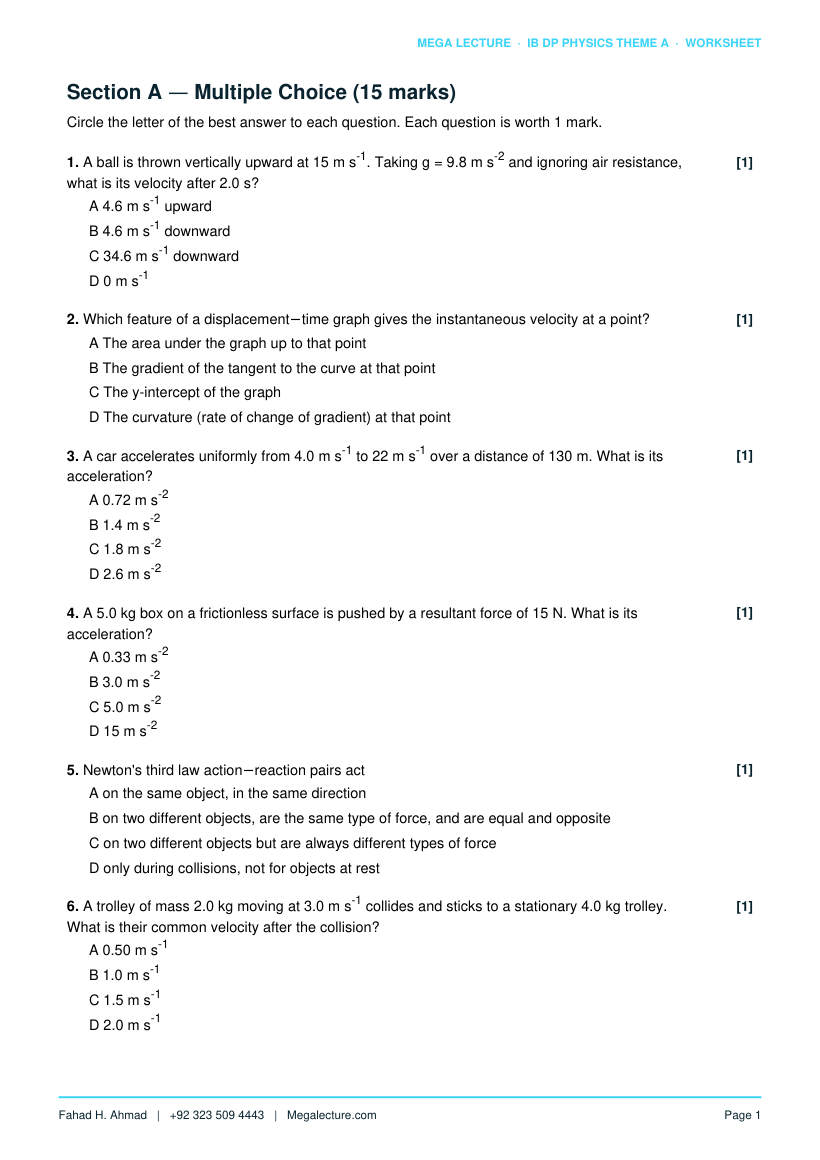
Section A — Multiple Choice (15 marks)
Circle the letter of the best answer to each question. Each question is worth 1 mark.
- A ball is thrown vertically upward at 15 m s-1. Taking g = 9.8 m s-2 and ignoring air resistance, what is its velocity after 2.0 s?
[1]
A 4.6 m s-1 upward
B 4.6 m s-1 downward
C 34.6 m s-1 downward
D 0 m s-1
- Which feature of a displacement−time graph gives the instantaneous velocity at a point? [1]
A The area under the graph up to that point
B The gradient of the tangent to the curve at that point
C The y-intercept of the graph
D The curvature (rate of change of gradient) at that point
- A car accelerates uniformly from 4.0 m s-1 to 22 m s-1 over a distance of 130 m. What is its acceleration?
[1]
A 0.72 m s-2
B 1.4 m s-2
C 1.8 m s-2
D 2.6 m s-2
- A 5.0 kg box on a frictionless surface is pushed by a resultant force of 15 N. What is its acceleration?
[1]
A 0.33 m s-2
B 3.0 m s-2
C 5.0 m s-2
D 15 m s-2
- Newton's third law action−reaction pairs act [1]
A on the same object, in the same direction
B on two different objects, are the same type of force, and are equal and opposite
C on two different objects but are always different types of force
D only during collisions, not for objects at rest
- A trolley of mass 2.0 kg moving at 3.0 m s-1 collides and sticks to a stationary 4.0 kg trolley. What is their common velocity after the collision?
[1]
A 0.50 m s-1
B 1.0 m s-1
C 1.5 m s-1
D 2.0 m s-1
- A crane lifts a 500 kg mass at a constant 2.0 m s-1. What power must the crane's motor deliver (ignoring losses)?
[1]
A 0.98 kW
B 4.9 kW
C 9.8 kW
D 19.6 kW
- Which quantity is conserved in a perfectly elastic collision but not in an inelastic collision? [1]
A Momentum
B Total kinetic energy
C Total energy
D Mass
- A spring of force constant k = 200 N m-1 is compressed by 0.15 m. How much elastic potential energy is stored?
[1]
A 1.5 J
B 2.25 J
C 3.0 J
D 4.5 J
- A force of 20 N is applied perpendicular to a spanner at a distance of 0.30 m from the pivot bolt. What torque does it produce?
[1]
A 3.0 N m
B 6.0 N m
C 9.0 N m
D 12 N m
- What is the moment of inertia of a uniform solid sphere of mass 3.0 kg and radius 0.20 m about an axis through its centre (I = I⁄Imr2)?
[1]
A 0.012 kg m2
B 0.024 kg m2
C 0.048 kg m2
D 0.096 kg m2
- Angular momentum of a system is conserved whenever [1]
A the net external torque on the system is zero
B the net external force on the system is zero
C the total kinetic energy is constant
D it is always conserved, with no condition
- A spaceship moves at v = 0.60c relative to Earth. What is the Lorentz factor γ? [1]
A 0.80
B 1.00
C 1.25
D 1.67
- According to an observer on Earth, a clock moving at high speed relative to them runs [1]
A faster than an identical clock at rest on Earth
B slower than an identical clock at rest on Earth
C at exactly the same rate
D faster or slower depending only on its direction of motion
- The “proper length” of an object is the length measured [1]
A by an observer for whom the object is moving
B in the rest frame of the object itself
C by any observer, since length is invariant
D only when the object moves at v = c
Section B — Structured Questions (70 marks)
Answer all questions in the space provided. Working must be shown for full marks.
A.1 Kinematics
Question 1 [7 marks]
A sprinter accelerates uniformly from rest to a maximum speed, holds that speed, then decelerates uniformly to rest. The graph below shows her velocity during the run.
Velocity−time graph for the sprint (values on the axes are the given data for this question).
- Calculate the sprinter's acceleration during the first 3.0 s. [2]
- Show that the total distance covered during the 10 s run is about 68 m. [3]
- Calculate her average velocity for the whole 10 s run. [2]
Question 2 [7 marks]
A stone is kicked horizontally at 12 m s-1 from the top of a cliff of height 20 m. Air resistance is negligible; take g = 9.8 m s-2.
- Calculate the time taken for the stone to reach the ground. [2]
- Calculate the horizontal distance travelled before landing. [2]
- Calculate the stone's speed as it hits the ground. [3]
A.2 Forces and Momentum
Question 3 [7 marks]
A 12 kg box rests on a rough incline at 25° to the horizontal, as shown. The coefficient of static friction between the box and the incline is 0.40. Take g = 9.8 m s-2.
Forces on the box: weight mg, normal force N, and friction f acting up the slope.
- Calculate the component of the box's weight acting along the incline (down the slope). [2]
- Calculate the normal force acting on the box. [2]
- Determine, showing your reasoning, whether the box remains stationary or begins to slide. [3]
Question 4 [6 marks]
A 0.50 kg ball is struck by a bat. The graph shows how the force on the ball varies during the 8.0 ms contact time.
Force−time graph for the bat−ball impact (given data).
- Calculate the impulse delivered to the ball during the impact. [2]
- Calculate the change in the ball's velocity, assuming it was at rest just before impact. [2]
- Calculate the average force exerted on the ball during the impact. [2]
A.3 Work, Energy and Power
Question 5 [8 marks]
A skier of mass 65 kg starts from rest at the top of a slope of vertical height 40 m. Take g = 9.8 m s-2.
- Calculate the loss in gravitational potential energy as the skier descends to the bottom. [2]
- Assuming no energy is lost to friction or air resistance, calculate the skier's speed at the bottom of the slope.
[3]
- In reality the skier's speed at the bottom is measured to be 24 m s-1. Calculate the energy transferred to thermal energy by friction and air resistance.
[3]
Question 6 [6 marks]
An electric motor lifts a 15 kg load a vertical height of 6.0 m in 8.0 s, moving at constant speed. The electrical energy supplied to the motor during this time is 1500 J. Take g = 9.8 m s-2.
- Calculate the useful work done in lifting the load. [2]
- Calculate the efficiency of the motor. [2]
- Calculate the useful power output of the motor. [2]
A.4 Rigid Body Mechanics (HL)
Question 7 [8 marks]
A uniform beam of length 4.0 m and mass 20 kg is pivoted (hinged) at one end and held horizontal by a vertical cable attached at its far end, as shown. Take g = 9.8 m s-2.
Uniform beam in rotational equilibrium about the pivot.
- Calculate the torque produced about the pivot by the beam's own weight. [2]
- Hence calculate the tension T in the cable, which acts vertically at the far end of the beam, 4.0 m from the pivot.
[3]
- An additional 10 kg mass is now hung from the far end of the beam. Calculate the new tension in the cable.
[3]
Question 8 [8 marks]
A solid cylinder of mass 2.0 kg and radius 0.10 m (I = ½mr2 for a solid cylinder about its central axis) rolls without slipping from rest down a slope, reaching the bottom with a linear speed of 4.0 m s-1. Take g = 9.8 m s-2.
- Calculate the cylinder's angular velocity at the bottom of the slope. [2]
- Show that the cylinder's total kinetic energy at the bottom is about 24 J. [3]
- Assuming no energy is lost to friction, calculate the vertical height of the slope. [3]
A.5 Relativity (HL)
Question 9 [7 marks]
A muon is created in the upper atmosphere and travels toward the Earth's surface at v = 0.98c. In the muon's own rest frame, its (proper) lifetime is 2.2 μs. The graph below shows how the Lorentz factor γ varies with speed v/c.
γ as a function of v/c (reference curve — read off approximately, then verify by calculation in part (a)).
- Calculate the Lorentz factor γ for the muon. [2]
- Calculate the muon's lifetime as measured by an observer on the ground. [2]
- Using this dilated lifetime, calculate the distance (in the Earth's frame) that the muon travels before it decays.
[3]
Question 10 [6 marks]
A spacecraft has a proper length of 120 m. It travels past the Earth at v = 0.80c.
- Calculate the Lorentz factor γ for the spacecraft's motion. [2]
- Calculate the spacecraft's length as measured by an observer on Earth. [2]
- The crew measure a journey time of 100 s using the spacecraft's own clock. Calculate the time for the same journey as measured by an observer on Earth.
[2]
