
IGCSE · Physics · Past papers · Paper 2 (Theory)
Worked Solutions
Need more than one subject? All-notes pass: unlimited downloads of every note for a year: unlimited downloads of every note on the site, PKR 999 a year. All packs and courses.
Opens inside this page. Prefer your own PDF app? Open the PDF.
Check yourself
5 quick questions on IGCSE Physics
Tap an answer to see if you are right, and why. Free, no sign-up.
Start the free testNew · free
O Level Physics written answers, marked like a real examiner
Answer a Paper 2 style question by typing or speaking. You get your mark point by point, what the examiner was looking for that you missed, and a model answer. 5 free answers a day with a free account.
Try a written question👍 33 students found these notes useful
Was this note useful?
Full text of Worked Solutions
www.megalecture.com · www.youtube.com/@megalecture
Fahad H. Ahmad
M.Eng NUS Singapore · B.Eng NUST · 15+ years of teaching experience in Singapore, UAE & Pakistan · 60,000+ subscribers and 20 million+ video lecture views.
IGCSEPHYSICS0625·TOPICALPASTPAPERS
Turning Effect of Forces — Paper 2
Worked Solutions (Theory / Structured)
Free notes, practice tests and live classes Back to megalecture.com
Turning Effect of Forces — Paper 2 · Worked Solutions
Megalecture worked solutions — model answers with working; please verify before classroom use.
These solutions cover the theory / structured (Paper 2) topical compilation on the Turning Effect of
Forces (IGCSE Physics 0625). Every part was solved from first principles by the Megalecture team, using the data given in each question and taking the gravitational field strength g = 10 N/kg unless a question states otherwise. The core ideas used throughout are the moment of a force (moment = force
× perpendicular distance from the pivot) and the principle of moments (for equilibrium, total clockwise moment = total anticlockwise moment).
Worked Solutions Question 1 · May/June 2008 · Paper 2 · Q2 — paper punch
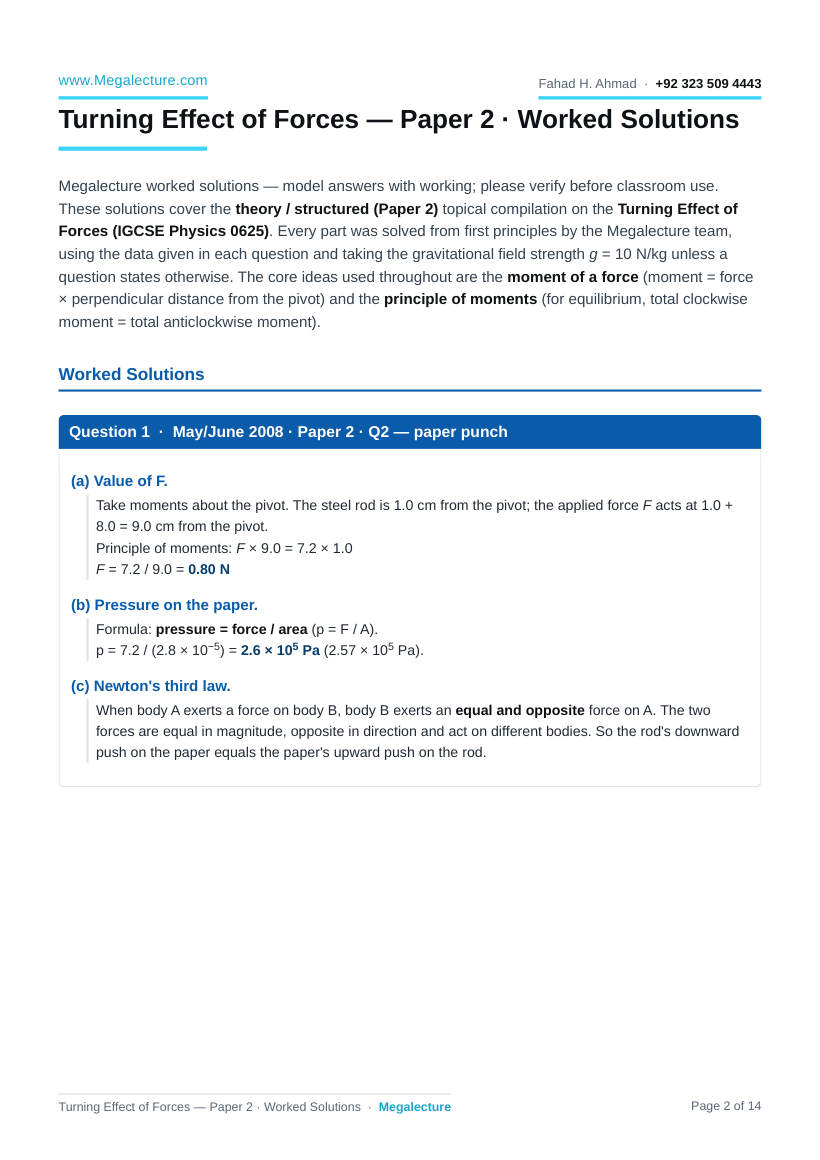
- Value of F.
Take moments about the pivot. The steel rod is 1.0 cm from the pivot; the applied force F acts at 1.0 +
8.0 = 9.0 cm from the pivot.
Principle of moments: F × 9.0 = 7.2 × 1.0
F = 7.2 / 9.0 = 0.80 N
- Pressure on the paper.
Formula: pressure = force / area (p = F / A).
p = 7.2 / (2.8 × 10⁻⁵) = 2.6 × 10⁵ Pa (2.57 × 10⁵ Pa).
- Newton's third law.
When body A exerts a force on body B, body B exerts an equal and opposite force on A. The two forces are equal in magnitude, opposite in direction and act on different bodies. So the rod's downward push on the paper equals the paper's upward push on the rod.
Turning Effect of Forces — Paper 2 · Worked Solutions · Megalecture
Question 2 · May/June 2013 · Paper 21 · Q2 — metre rule and newton meter
- Principle of moments.
For a body in equilibrium, the sum of the clockwise moments about any point equals the sum of the anticlockwise moments about the same point.
- Reading on the newton meter.
The rule is pivoted at its centre, so the weight of the rule acts through the pivot and has no moment.
Moments about the pivot: reading × 20 = 4.0 × 40 reading = 160 / 20 = 8.0 N
- Force exerted by the pivot.
The vertical forces must balance. Acting downwards: the 4.0 N weight, the weight of the rule 1.2 N, and the newton-meter pull of 8.0 N (the meter is above the rule and pulls it down).
pivot force (up) = 4.0 + 1.2 + 8.0 = 13.2 N
Question 3 · May/June 2013 · Paper 22 · Q2 — raising a metal beam
- Meaning of the moment of a force.
The moment of a force is the turning effect of the force about a point; it equals the force multiplied by the perpendicular distance from the point (pivot) to the line of action of the force.
(b)(i) Calculate T by taking moments about A.
The rope force T is horizontal and acts 8.0 m above A; the weight 2000 N acts at a horizontal distance of 2.0 m from A.
Moments about A: T × 8.0 = 2000 × 2.0
T = 4000 / 8.0 = 500 N
(b)(ii) Relationship between the forces.
By Newton's third law the forces are equal in magnitude and opposite in direction: the rope pulls on the man with the same size of force as the man pulls on the rope.
Turning Effect of Forces — Paper 2 · Worked Solutions · Megalecture
Question 4 · May/June 2014 · Paper 22 · Q2 — hydraulic jack
(a)(i) Pressure in the oil caused by the small piston.
Small-piston area = 1.5 cm² = 1.5 × 10⁻⁴ m²; force on it = 50 N.
p = F / A = 50 / (1.5 × 10⁻⁴) = 3.3 × 10⁵ Pa (333 000 Pa).
(a)(ii) Value of F (force on the large piston).
The fluid transmits the same pressure to the large piston (area = 5.0 cm² = 5.0 × 10⁻⁴ m²).
F = p × A = (3.33 × 105) × (5.0 × 10−4) = 170 N (167 N).
- Why the large piston moves a shorter distance.
The (incompressible) oil pushed across has a fixed volume. The large piston has a bigger cross- sectional area, so the same volume of oil gives it a smaller distance of movement (volume = area × distance).
- Meaning of efficiency.
Efficiency is the fraction (or percentage) of the energy input that is usefully transferred: efficiency = useful energy output / total energy input (× 100%). A 75% efficient jack delivers 75% of the work put in as useful work, the rest being wasted (mainly as heat from friction).
Question 5 · May/June 2015 · Paper 21 · Q2 — press-up
(a)(i) Why the student does work.
A force (from his hands/muscles) acts on his body and moves it through a distance in the direction of the force (his centre of mass rises), so work is done = force × distance moved.
(a)(ii) Form of energy used.
Chemical energy (stored in his muscles / from food).
(b)(i) Moment of the weight about his toes.
The weight 600 N acts at the centre of mass, 0.80 m from the toes.
moment = 600 × 0.80 = 480 N m
(b)(ii) Value of the force F.
The hands are 0.40 + 0.80 = 1.20 m from the toes. Taking moments about the toes:
F × 1.20 = 600 × 0.80 = 480
Turning Effect of Forces — Paper 2 · Worked Solutions · Megalecture
Question 6 · May/June 2017 · Paper 21 · Q2 — student on a tilting chair
- How the pressure on the floor differs.
In Fig. 2.2 the tilted chair touches the floor on only two legs (a smaller contact area) instead of four. The total force (weight) on the floor is the same, but pressure = force / area, so with a smaller contact area the pressure is greater in the tilted position.
- Why it falls over if tilted further.
When the chair is tilted more, the centre of mass moves until its vertical line passes outside the base
(beyond the rear legs). The weight then produces a moment about the rear legs that turns the chair further over instead of bringing it back, so it topples.
Question 7 · May/June 2017 · Paper 22 · Q3 — brake pedal and cylinder
- Define moment.
The moment of a force = force × perpendicular distance from the pivot to the line of action of the force. (It is the turning effect of the force.)
- Force F applied to the brake pedal.
Take moments about the pivot. F acts 18 cm from the pivot; the 80 N push on the piston acts 4.0 cm from the pivot.
F × 18 = 80 × 4.0
F = 320 / 18 = 18 N (17.8 N).
- Pressure exerted by the piston on the fluid.
p = F / A = 80 / 0.0012 = 6.7 × 10⁴ Pa (66 700 Pa).
Turning Effect of Forces — Paper 2 · Worked Solutions · Megalecture
Question 8 · May/June 2020 · Paper 21 · Q2 — finding centre of mass; stability
- Method to draw the two lines.
Extra apparatus: a plumb-line (a thread with a small mass), and a pin/nail to hang the card from.
- Hang the card freely from a pin through the first hole so it can swing.
- Hang the plumb-line from the same pin; when both are still, draw a line along the plumb-line on the card.
- Repeat with the card hung from the second hole and draw a second plumb-line.
The two lines cross at the centre of mass C.
(b)(i) Why the card falls anticlockwise when θ is large.
The card pivots about the lower edge resting on the bench. When θ is large, the vertical line of the weight from C falls to the left of (outside) the pivot edge, so the weight produces an anticlockwise moment that turns the card over (instead of clockwise back to the upright position).
(b)(ii) One change that makes the card more stable.
Lower its centre of mass (e.g. add mass near the bottom edge) — or make the base/contact edge wider. Either lets it be tilted further before the weight line passes outside the base.
Question 9 · Oct/Nov 2003 · Paper 2 · Q2 — pedal positions; leg in plaster
- Position of largest moment.
Position A. The 200 N force is the same in each case, so the largest moment occurs where the perpendicular distance from the pivot to the line of action of the force is greatest. In A the vertical force acts at the full length of the crank from the pivot, giving the largest perpendicular distance and so the largest moment.
- Force F to hold the leg horizontal.
Take moments about the hip joint (pivot). The weight 120 N acts at its centre of gravity, 34 cm from the pivot; F acts at 34 + 46 = 80 cm from the pivot.
F × 80 = 120 × 34
Turning Effect of Forces — Paper 2 · Worked Solutions · Megalecture
Question 10 · Oct/Nov 2008 · Paper 2 · Q2 — balanced walking-stick
- Distance of the centre of mass from the rubber foot.
A body balances when the pivot is directly below its centre of mass. The stick balances on the pencil placed 0.50 m from the rubber foot, so the centre of mass is 0.50 m from the end of the rubber foot.
- Effect of moving the pencil toward the rubber foot.
The pivot is then on the rubber-foot side of the centre of mass. The weight (acting at the centre of mass, now on the metal-head side of the pivot) produces an unbalanced moment, so the stick is no longer balanced: the metal-head end falls / tips down (the rubber-foot end rises).
Question 11 · Oct/Nov 2009 · Paper 2 · Q7 — concrete bus-shelter slab
- Perpendicular distance from the wall to the centre of mass.
The slab is 3.0 m deep; the wall is 2.5 m from the front. The centre of mass of the uniform slab is at its middle, 1.5 m from the front. Distance from wall to centre of mass = 2.5 − 1.5 = 1.0 m.
(b)(i) Principle of moments.
For a body in equilibrium, the sum of the clockwise moments about a point equals the sum of the anticlockwise moments about that point.
(b)(ii) Total downward force exerted by the cables.
The wall edge acts as the pivot. The cables are 0.50 m from the back = 2.5 m from the front, i.e. 2.5 m from the wall; the weight 18 000 N acts 1.0 m from the wall (on the front side). The cables hold the slab down on the far side, so take moments about the wall:
force × 2.5 = 18 000 × 1.0 force = 18 000 / 2.5 = 7200 N
Geometry note: with the cables 0.5 m from the back of a 3.0 m slab and the wall 2.5 m from the front, the cables lie
2.5 m from the wall. This gives 7200 N for the cable tension balancing the slab's weight about the wall edge.
Turning Effect of Forces — Paper 2 · Worked Solutions · Megalecture
Question 12 · Oct/Nov 2010 · Paper 22 · Q3 — firefighter on a ladder
(a)(i) Moment M of the firefighter's weight about P.
The weight 840 N acts vertically; the perpendicular (horizontal) distance from P to its line of action is
5.0 m.
M = 840 × 5.0 = 4200 N m
(a)(ii) Size of the horizontal force R from the water jet.
The horizontal force R acts 12 m above P. For equilibrium its moment must cancel the weight's moment about P:
R × 12 = 840 × 5.0 = 4200
R = 4200 / 12 = 350 N
(a)(iii) A third force with a turning effect about P.
The force from the ground / support of the fire-engine on the ladder at the far end (or the weight of the ladder itself acting at its own centre of mass). Any force whose line of action does not pass through
P gives a moment about P.
- Why the suit keeps the firefighter cool.
The shiny (silvered) outer jacket reflects most of the infra-red (thermal) radiation from the fire, so little is absorbed. The loosely-woven mesh T-shirt traps a layer of air, which is a poor conductor of heat
(a good insulator), so conduction of heat to the body is reduced. Together they keep the firefighter cool near the intense source of heat.
Question 13 · Oct/Nov 2011 · Paper 22 · Q1 — density of a wooden cube
- Mass of the cube.
The rule is pivoted at its centre (50 cm). The 0.050 kg mass at the 10 cm mark is 40 cm from the pivot;
the cube at the 75 cm mark is 25 cm from the pivot.
Moments: mcube × 25 = 0.050 × 40 mcube = 2.0 / 25 = 0.080 kg (80 g).
- Density of the wood.
density = mass / volume = 0.080 / (1.6 × 10⁻⁴) = 500 kg/m³.
Turning Effect of Forces — Paper 2 · Worked Solutions · Megalecture
Question 14 · Oct/Nov 2012 · Paper 22 · Q1 — verifying the principle of moments; spanner
- Experiment to verify the principle of moments.
Balance a uniform metre rule on a knife-edge pivot at its centre (50 cm) so it rests horizontally. Hang a known weight W1 on one side at distance d1 from the pivot and a different weight W2 on the other side, adjusting its distance d2 until the rule balances horizontally again. Measure d1 and d2 with the rule's scale. Show that W1 × d1 = W2 × d2 (anticlockwise moment = clockwise moment). Repeat with different weights and distances to confirm the relationship.
- Moment of the force on the nut.
moment = force × perpendicular distance = 8.0 × 0.15 = 1.2 N m.
Question 15 · Oct/Nov 2013 · Paper 21 · Q3 — see-saw
- Calculate W (the brother's weight).
Take moments about the balance point. Girl: 550 N at 0.86 m. Brother: W at 1.1 m.
550 × 0.86 = W × 1.1
W = 473 / 1.1 = 430 N
- Sliding equal distances apart.
The girl's moment increases by 550 × d while the brother's increases by 430 × d (with W ≈ 430 N <
550 N). The girl now has the larger moment, so the moments are no longer balanced — the girl's side goes down and the brother's side rises; the see-saw is no longer in equilibrium.
Question 16 · Oct/Nov 2014 · Paper 21 · Q2 — density of oil by balancing
(a)(i) Weight of the oil in the cylinder.
The rule is pivoted at the 50 cm mark. The added 0.39 N weight sits on the block at the 10 cm mark,
40 cm from the pivot; the oil's weight acts at the 80 cm mark, 30 cm from the pivot.
Moments: Woil × 30 = 0.39 × 40
Woil = 15.6 / 30 = 0.52 N
(a)(ii) Mass of the oil.
m = W / g = 0.52 / 10 = 0.052 kg (52 g).
- Density of the oil.
Volume = 60 cm³ = 60 × 10−6 m³.
density = mass / volume = 0.052 / (60 × 10−6) = 870 kg/m³ (867 kg/m³). Equivalently 0.87 g/cm³.
Turning Effect of Forces — Paper 2 · Worked Solutions · Megalecture
Question 17 · Oct/Nov 2014 · Paper 22 · Q2 — hospital tap
(a)(i) Maximum moment about the axis.
The maximum moment occurs when the 2.5 N force acts at the full perpendicular distance 0.18 m.
moment = 2.5 × 0.18 = 0.45 N m
(a)(ii) Why the actual moment is less.
The force is not applied exactly at right angles to the handle (or not at the very end), so the perpendicular distance of the force from the axis is less than 0.18 m, giving a smaller moment.
- Effect of handle length on the force needed.
A longer handle gives a larger perpendicular distance, so a smaller force is needed to produce the same turning moment (moment = force × distance).
Question 18 · Oct/Nov 2015 · Paper 21 · Q4 — screwdriver in equilibrium
- Mark the centre of mass C.
C should be marked directly above the pivot (the object balances when its centre of mass is over the pivot — in the thicker handle region just to the screwdriver side of the pivot tip).
(b)(i) Weight of the screwdriver.
mass = 64 g = 0.064 kg. weight = mg = 0.064 × 10 = 0.64 N.
(b)(ii) Arrow for the weight.
Draw a vertical arrow pointing straight down from C, labelled W (weight always acts vertically downwards through the centre of mass).
- Two conditions for equilibrium.
- The resultant force is zero (forces in any direction balance).
- The resultant moment about any point is zero (clockwise moments = anticlockwise moments).
Turning Effect of Forces — Paper 2 · Worked Solutions · Megalecture
Question 19 · Oct/Nov 2016 · Paper 21 · Q2 — fold-away bed
- Weight W of the bed.
W = mg = 26 × 10 = 260 N.
(b)(i) Principle of moments.
For a body in equilibrium, the sum of the clockwise moments about a point equals the sum of the anticlockwise moments about that point.
(b)(ii) Total upward force from the two legs.
Take moments about the hinge (pivot). The weight 260 N acts 0.35 m from the hinge; the legs act at
0.35 + 0.30 = 0.65 m from the hinge.
Flegs × 0.65 = 260 × 0.35
Flegs = 91 / 0.65 = 140 N
Question 20 · Oct/Nov 2016 · Paper 22 · Q3 — freezer lid
(a)(i) Weight of the lid.
W = mg = 2.0 × 10 = 20 N.
(a)(ii)1. Moment of the weight about the hinge (lid closed).
The lid is uniform, so its weight acts at the centre, 0.70 / 2 = 0.35 m from the hinge.
moment = 20 × 0.35 = 7.0 N m
(a)(ii)2. Why a greater moment is needed to open it.
There is an extra resisting moment to overcome, e.g. friction at the hinge (or a rubber seal/suction holding the lid down), so the opening moment must exceed the moment of the weight alone.
- Why a vertical force is the smallest possible.
The handle is 0.70 m from the hinge. A vertically upward force is perpendicular to the line from the hinge to the handle, so it has the largest possible perpendicular distance (0.70 m) and gives the largest moment per newton. A force in any other direction has a smaller perpendicular distance, so a larger force would be needed to give the same opening moment.
Turning Effect of Forces — Paper 2 · Worked Solutions · Megalecture
Question 21 · Oct/Nov 2017 · Paper 21 · Q1 — painter on a plank
- Density of the wood.
Volume = 3.6 × 0.35 × 0.025 = 0.0315 m³. Mass = 23 kg.
density = mass / volume = 23 / 0.0315 = 730 kg/m³ (730.2 kg/m³).
(b)(i) Weight of the plank.
W = mg = 23 × 10 = 230 N.
(b)(ii) Moment of the plank about the right-hand support.
The plank's weight 230 N acts at its centre of mass, 1.3 m from the right-hand support.
moment = 230 × 1.3 = 299 N m
- Why the plank rotates as the painter moves right.
As the painter moves beyond the right-hand support, his weight produces a clockwise moment about that support. When this clockwise moment exceeds the anticlockwise moment of the plank's weight (about the right-hand support), the moments are unbalanced, so the plank tips and rotates about the right-hand support.
Question 22 · Oct/Nov 2017 · Paper 22 · Q3 — concrete block: pressure and stability
- Pressure on the ground.
Largest side on the ground: area = 0.44 × 0.21 = 0.0924 m². Weight = 240 N.
p = F / A = 240 / 0.0924 = 2600 Pa (2597 Pa).
- Why the total pressure is larger than in (a).
The atmospheric pressure also pushes down on the block, so the total pressure on the ground is the pressure due to the block's weight plus atmospheric pressure.
(c)(i) Height of the centre of mass above the ground.
The block is uniform, so the centre of mass is at the middle of the 0.13 m height: 0.13 / 2 = 0.065 m.
(c)(ii) Why work is done as the block is rotated.
To tip the block onto its small end the centre of mass must be raised (it rises as the block pivots up onto an edge). Work is done against gravity = weight × gain in height, increasing the block's gravitational potential energy.
Turning Effect of Forces — Paper 2 · Worked Solutions · Megalecture
Question 23 · Oct/Nov 2018 · Paper 22 · Q2 — centre of mass and stability
- Meaning of centre of mass.
The centre of mass is the point through which the whole weight of the body appears to act (the point where the mass may be taken to be concentrated).
- Two design features that make the car stable.
- A low centre of mass (the centre of mass is low/near the ground).
- A wide wheelbase / wide base (wheels set wide apart). Both allow the car to tilt further before the weight line passes outside the wheels, so it is less likely to topple when cornering.
- Finding the centre of mass of the card.
Make a small hole near the edge and hang the card freely from a pin so it can swing. Hang a plumb-line from the same pin and, when both are still, draw the vertical line of the plumb-line on the card. Repeat from a second (different) hole. The two lines cross at the centre of mass.
Question 24 · Oct/Nov 2020 · Paper 21 · Q3 — door with a door-closer
(a)(i) Moment of force P about the hinge.
P is perpendicular to the door and acts 0.72 m from the hinge.
moment = 25 × 0.72 = 18 N m
(a)(ii) Work done on the door by force P (90° rotation).
Point X moves along a quarter of a circle of radius 0.72 m. A full circumference is 4.5 m, so the distance moved = 4.5 / 4 = 1.125 m. P stays perpendicular to the door (along the direction of motion).
work = force × distance = 25 × 1.125 = 28 J (28.1 J).
- Why the door still rotates although F > P.
The moment depends on the perpendicular distance, not just the size of the force. Force F from the door-closer bar acts close to the hinge (small perpendicular distance), so even though it is larger than
P, its moment about the hinge is smaller than the moment of P. The girl's force therefore produces the larger turning effect and the door opens.
Turning Effect of Forces — Paper 2 · Worked Solutions · Megalecture
Question 25 · Oct/Nov 2020 · Paper 22 · Q1 — beaker, density and balancing a rule
- Total mass of the beaker and its contents.
mass of liquid = density × volume = 1.8 × 200 = 360 g.
total mass = 50 + 360 = 410 g.
(b)(i) Meaning of centre of mass.
The point through which the whole weight of the body appears to act.
(b)(ii) Mass of the rule.
The pivot is at the 80 cm mark. The rule's weight acts at its centre of mass (50 cm mark), 80 − 50 =
30 cm from the pivot. The beaker's weight acts at its centre, midway between the 84 cm and 92 cm marks = 88 cm, i.e. 88 − 80 = 8 cm from the pivot. The beaker (410 g) is on one side and the rule's mass on the other.
Moments about the pivot: mrule × 30 = 410 × 8 mrule = 3280 / 30 = 110 g (109 g).
These are original Megalecture worked solutions prepared for revision use. Answers are rounded sensibly to 2–3 significant figures; full unrounded values are shown in brackets where useful. Always check the working against the data given in your own copy of the question paper before classroom use.
Turning Effect of Forces — Paper 2 · Worked Solutions · Megalecture
