
IGCSE · Physics · Past papers · Paper 1 (Multiple Choice)
Answer Key
Need more than one subject? All-notes pass: unlimited downloads of every note for a year: unlimited downloads of every note on the site, PKR 999 a year. All packs and courses.
Opens inside this page. Prefer your own PDF app? Open the PDF.
Check yourself
5 quick questions on IGCSE Physics
Tap an answer to see if you are right, and why. Free, no sign-up.
Start the free testNew · free
O Level Physics written answers, marked like a real examiner
Answer a Paper 2 style question by typing or speaking. You get your mark point by point, what the examiner was looking for that you missed, and a model answer. 5 free answers a day with a free account.
Try a written question👍 33 students found these notes useful
Was this note useful?
Full text of Answer Key
www.megalecture.com · www.youtube.com/@megalecture
Fahad H. Ahmad
M.Eng NUS Singapore · B.Eng NUST · 15+ years of teaching experience in Singapore, UAE & Pakistan · 60,000+ subscribers and 20 million+ video lecture views.
IGCSEPHYSICS0625·TOPICALPASTPAPERS
Physical Quantities & Measurement — Paper 1
Worked Answer Key (Multiple Choice)
Free notes, practice tests and live classes Back to megalecture.com
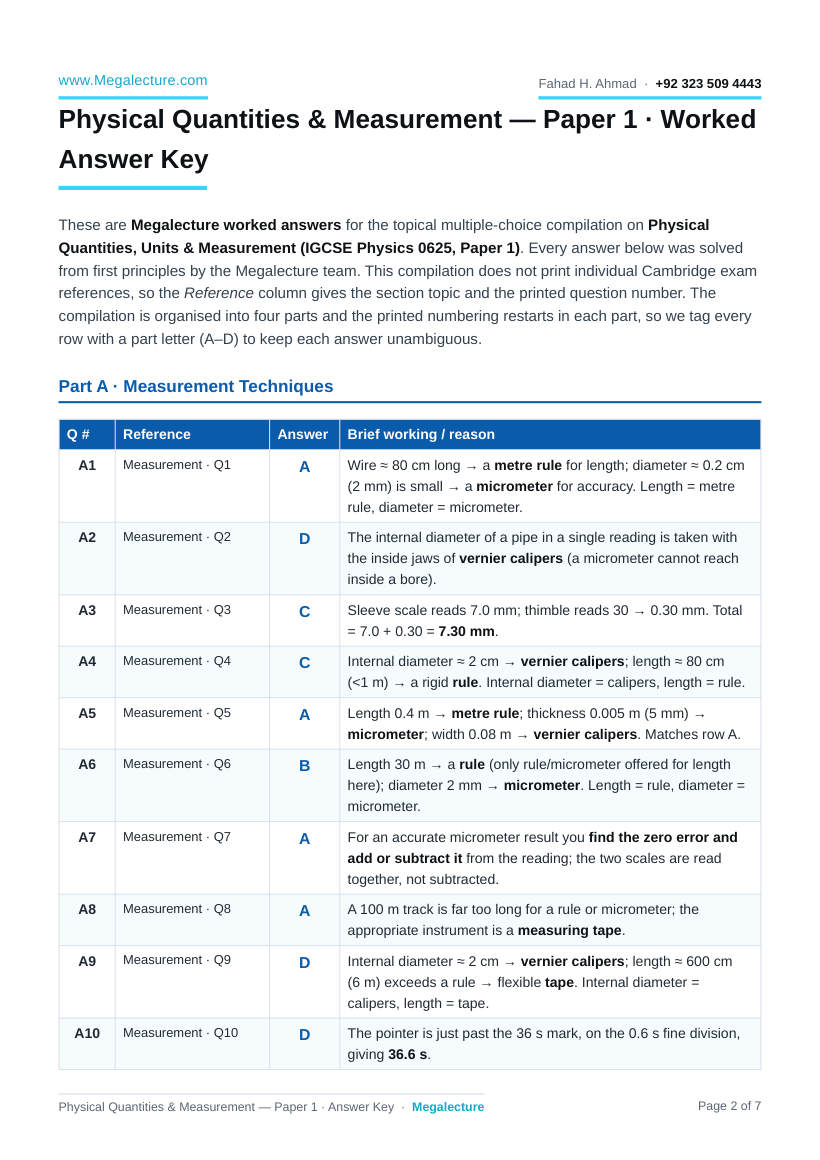
Physical Quantities & Measurement — Paper 1 · Worked Answer Key
These are Megalecture worked answers for the topical multiple-choice compilation on Physical
Quantities, Units & Measurement (IGCSE Physics 0625, Paper 1). Every answer below was solved from first principles by the Megalecture team. This compilation does not print individual Cambridge exam references, so the Reference column gives the section topic and the printed question number. The compilation is organised into four parts and the printed numbering restarts in each part, so we tag every row with a part letter (A–D) to keep each answer unambiguous.
Part A · Measurement Techniques Q # Reference Answer Brief working / reason A1
Measurement · Q1
A
Wire ≈ 80 cm long → a metre rule for length; diameter ≈ 0.2 cm
(2 mm) is small → a micrometer for accuracy. Length = metre rule, diameter = micrometer.
A2
Measurement · Q2
D
The internal diameter of a pipe in a single reading is taken with the inside jaws of vernier calipers (a micrometer cannot reach inside a bore).
A3
Measurement · Q3
C
Sleeve scale reads 7.0 mm; thimble reads 30 → 0.30 mm. Total
= 7.0 + 0.30 = 7.30 mm.
A4
Measurement · Q4
C
Internal diameter ≈ 2 cm → vernier calipers; length ≈ 80 cm
(<1 m) → a rigid rule. Internal diameter = calipers, length = rule.
A5
Measurement · Q5
A
Length 0.4 m → metre rule; thickness 0.005 m (5 mm) → micrometer; width 0.08 m → vernier calipers. Matches row A.
A6
Measurement · Q6
B
Length 30 m → a rule (only rule/micrometer offered for length here); diameter 2 mm → micrometer. Length = rule, diameter = micrometer.
A7
Measurement · Q7
A
For an accurate micrometer result you find the zero error and add or subtract it from the reading; the two scales are read together, not subtracted.
A8
Measurement · Q8
A
A 100 m track is far too long for a rule or micrometer; the appropriate instrument is a measuring tape.
A9
Measurement · Q9
D
Internal diameter ≈ 2 cm → vernier calipers; length ≈ 600 cm
(6 m) exceeds a rule → flexible tape. Internal diameter = calipers, length = tape.
A10
Measurement · Q10
D
The pointer is just past the 36 s mark, on the 0.6 s fine division, giving 36.6 s.
Physical Quantities & Measurement — Paper 1 · Answer Key · Megalecture
Q # Reference Answer Brief working / reason A11
Measurement · Q11
A
Diameter of a thin wire → micrometer; length ≈ 50 cm → a rule.
Diameter = micrometer, length = rule.
A12
Measurement · Q12
D
A tape can be wrapped around the ball, so its reading is directly the circumference (a rule gives only a straight chord).
A13
Measurement · Q13
B
To measure the circumference of a football directly, wrap a flexible measuring tape around it.
A14
Measurement · Q14
A
0.15 mm is very small, so only a micrometer can measure it accurately. Length 0.15 mm / micrometer is the correct pairing → row A.
A15
Measurement · Q15
C
A micrometer measures small lengths (thicknesses/diameters), not area, current or mass.
A16
Measurement · Q16
B
Winner 00:57.76 s, other 01:03.84 s. Difference = 63.84 − 57.76
= 6.08 s.
A17
Measurement · Q17
D
Sleeve scale shows 7.5 mm (past 7, half-mark exposed); thimble reads 14 → 0.14 mm. Total = 7.5 + 0.14 = 7.64 mm.
A18
Measurement · Q18
B
To reduce timing error, time 20 oscillations and divide by 20 — this averages out the reaction-time error.
A19
Measurement · Q19
C
The blocks touch the beaker at 2.0 cm and 7.5 cm on the ruler, so diameter = 7.5 − 2.0 = 5.5 cm.
A20
Measurement · Q20
C
A curved track ≈ 0.5 m long is best followed with a flexible tape measure; a rigid rule cannot follow the curve.
A21
Measurement · Q21
B
Vernier calipers read to 0.1 mm = 0.01 cm, so a reading to that precision is 3.31 cm (2 d.p. in cm).
A22
Measurement · Q22
D
The stone displaces its own volume of water: new level = 75 + 20
= 95 cm³.
A23
Measurement · Q23
D
Volume of copper needs the length (several metres → tape) and the diameters (a few cm → calipers). Tape and calipers.
A24
Measurement · Q24
B
A single sheet of paper is far too thin for a rule; its thickness is measured with a micrometer.
A25
Measurement · Q25
B
The rise in water level equals the stone’s volume, so the
difference between the readings gives the volume of the
stone (density also needs the mass, which is not measured here).
A26
Measurement · Q26
A
Two revolutions span the 1.0 cm to 9.8 cm marks = 8.8 cm for 2 turns. Circumference = 8.8 ÷ 2 = 4.4 cm.
Part B · Units
Physical Quantities & Measurement — Paper 1 · Answer Key · Megalecture
Q # Reference Answer Brief working / reason B1
Units · Q1
D
“Millions” = mega = M (capital); watt = W (capital). Millions of watts = MW.
B2
Units · Q2
B
Latent heat is an energy, measured in joules. Correct quantity– unit pair is latent heat / J (e.m.f. → V, pressure → Pa, weight →
N).
B3
Units · Q3
C
“m” = milli = 10−3, so mW = milliwatt = 10−3 W.
B4
Units · Q4
B
One tenth of a millimetre is 0.01 cm, so the reading ends at the
0.01 cm place: 3.31 cm.
B5
Units · Q5
B
Sizes: 1 MC = 106 C > 1 kC = 103 C > 1 mC = 10−3 C.
Largest→smallest = 1 MC → 1 kC → 1 mC.
B6
Units · Q6
D
“ms” means milliseconds (10−3 s), so 6.2 ms is measured in milliseconds.
B7
Units · Q7
C
Correct units: frequency → Hz, acceleration → m/s², latent heat
→ J, power → W. The row linking all four correctly is C.
B8
Units · Q8
B
A normal adult has a mass of roughly 75 kg (7.5 kg is a baby;
750 kg+ is impossible).
B9
Units · Q9
B
Latent heat is an energy → joule (J). Correct pair is latent heat /
J (e.m.f. → V, pressure → Pa, weight → N).
Part C · Scalars and Vectors Q # Reference Answer Brief working / reason C1
Scalars/Vectors · Q1
D
Scalars have magnitude only. Mass, speed, time are all scalars;
the other lists contain vectors (acceleration, force, velocity).
C2
Scalars/Vectors · Q2
B
Both force and velocity have a direction, so both are vectors.
C3
Scalars/Vectors · Q3
B
Energy (scalar) with force (vector) is the only row holding exactly one scalar and one vector → row B.
C4
Scalars/Vectors · Q4
B
A scalar has magnitude only, so the correct statement is “a scalar has size but no direction” → option B. (A vector has both size and direction.)
C5
Scalars/Vectors · Q5
B
Vectors need direction. Statement 1 (due East) and statement 3
(straight line towards a lettuce) have direction → 1 and 3.
C6
Scalars/Vectors · Q6
C
Temperature is a scalar and velocity is a vector, so the pair with one of each is temperature & velocity.
C7
Scalars/Vectors · Q7
D
Physical Quantities & Measurement — Paper 1 · Answer Key · Megalecture
Q # Reference Answer Brief working / reason
(scalar) fit → row D. (Row C fails because acceleration is a vector, not a scalar.)
C8
Scalars/Vectors · Q8
C
The magnitude of velocity equals the speed, so velocity of a car
(vector) and speed of the car (scalar) are equal in size → row
C.
C9
Scalars/Vectors · Q9
B
Mass is a scalar; acceleration is a vector → row B.
C10
Scalars/Vectors · Q10
C
Of the choices, temperature is the only scalar (acceleration, force and velocity are vectors).
C11
Scalars/Vectors · Q11
A
Acceleration, displacement, velocity all have direction, so all three are vectors.
C12
Scalars/Vectors · Q12
B
Underlined quantities: acceleration, speed, mass, force. The vectors are acceleration and force (speed and mass are scalars) → 2.
C13
Scalars/Vectors · Q13
B
Displacement, velocity and acceleration are vectors; only a time of 4.0 s is a scalar.
C14
Scalars/Vectors · Q14
C
Mass, temperature and average speed are scalars; only a weight of 15 N is a vector (a force).
C15
Scalars/Vectors · Q15
D
Velocity and acceleration are both vectors (length and distance are scalars).
C16
Scalars/Vectors · Q16
A
Of the four, only acceleration is a vector (distance, speed and time are scalars).
C17
Scalars/Vectors · Q17
D
Terms in the equations: power, work, time, force, mass, acceleration, velocity, displacement. The vector quantities are force, acceleration, velocity, displacement → 4.
C18
Scalars/Vectors · Q18
C
“Velocity = change in displacement / change in time.” The vectors are velocity and displacement (time is a scalar) → 2.
C19
Scalars/Vectors · Q19
D
Length, mass and speed are all scalars, so the list of only scalars is length, mass, speed.
C20
Scalars/Vectors · Q20
B
Density, energy and speed are scalars; displacement is the vector.
Part D · Resultant of Vectors Q # Reference Answer Brief working / reason D1
Resultant · Q1
A
By the parallelogram rule, R is the diagonal drawn from the common tail of the 3 N and 4 N forces to the far corner (pointing up-right) → diagram A.
Physical Quantities & Measurement — Paper 1 · Answer Key · Megalecture
Q # Reference Answer Brief working / reason D2 B
X points up-left, Y points right. Their resultant lies between them, tilted up and just right of vertical → arrow B.
D3
Resultant · Q3
D
F1 points up-right, F2 straight down. Their sum points down and to the right → arrow D.
D4
Resultant · Q4
C
Perpendicular 3.0 N and 4.0 N: R = √(3² + 4²) = √25 = 5.0 N.
D5
Resultant · Q5
B
Vertical: 2 N up − 2 N down = 0. Horizontal: 8 N − 4 N = 4 N.
Resultant = 4 N.
D6
Resultant · Q6
D
One vector points up-right, the other horizontally right. The parallelogram diagonal from the common tail gives R pointing right and slightly up → diagram D.
D7
Resultant · Q7
D
For 3.0 N and 4.0 N, R ranges from 1 N (180°) up to 7 N (0°). For angles only between 0° and 90° the resultant is below 7 N, so
7.0 N is not possible.
D8
Resultant · Q8
B
4.0 N and 2.0 N give a resultant of exactly 4.0 N only when the angle between them is obtuse (≈104°). Diagram B shows the
2.0 N angled back, giving a 4.0 N diagonal.
D9
Resultant · Q9
C
Using the tip-to-tail (triangle) method, X then Y, R joins the start of X to the tip of Y → diagram C.
D10
Resultant · Q10
D
For 3 N and 4 N, R lies between 1 N and 7 N. 8 N is outside this range, so it cannot be the resultant.
D11
Resultant · Q11
A
Perpendicular 9 N (OR) and 12 N (OP): magnitude = √(9² + 12²)
= √225 = 15 N; direction along the diagonal OQ. Magnitude 15 N, direction OQ → row A.
D12
Resultant · Q12
A
30 N and 50 N give R between 20 N and 80 N. 10 N is below
20 N, so it cannot be the resultant.
D13
Resultant · Q13
C
Existing horizontal forces: 11 N right − 3 N left − 2 N left = 6 N right. To get a 3 N resultant to the left we add 9 N to the left (6 −
9 = −3 N).
D14
Resultant · Q14
A
Engine 20 m/s due North, wind 12 m/s towards the East. Tip-to- tail North then East gives R up-and-to-the-right → diagram A.
D15
Resultant · Q15
A
25 N up-right and 40 N straight down combine to a resultant pointing up and to the right of horizontal → arrow A.
D16
Resultant · Q16
C
Net force: A = 30 − 20 = 10 N; B = 0; C = (5 + 5) − 30 = 20 N; D =
15 N. Largest is C (20 N).
D17
Resultant · Q17
C
3.0 N up and 4.0 N right; the rectangle diagonal R runs from the common origin up-and-right → diagram C.
D18
Resultant · Q18
D
Physical Quantities & Measurement — Paper 1 · Answer Key · Megalecture
Q # Reference Answer Brief working / reason
The resultant of X and Y points up-right; the balancing force Z must be equal and opposite (down-left along the same line) → diagram D.
D19
Resultant · Q19
A
Adding 4.0 N (right) and 3.0 N (up) tip-to-tail gives the 5.0 N hypotenuse from the tail of the 4 N to the tip of the 3 N → diagram A.
D20
Resultant · Q20
B
Walking X→Y→Z→X returns to the start, so total displacement =
0; total distance = 5.0 + 12.0 + 13.0 = 30 m → row B.
Note from Megalecture. This compilation prints only “QUESTION # n” headers (no Cambridge session references), and the numbering restarts in each of the four sections, so we tag every row with a part letter (A–D) and the section name. These are original Megalecture worked solutions prepared for revision use.
Physical Quantities & Measurement — Paper 1 · Answer Key · Megalecture
