
O Level · Pakistan Studies 2059 · Topic Notes (chronological)
The Round Table Conferences 1930-32
Opens inside this page. Prefer your own PDF app? Open the PDF.
New: small group classes for O Level Pakistan Studies are opening, at a lower fee than one-to-one. Join the waiting list
Check yourself
5 quick questions on The emergence of Pakistan: 1905 to 1939
Tap an answer to see if you are right, and why. Free, no sign-up.
Start the free test4 of 5 students found these notes useful
Was this note useful?
Full text of The Round Table Conferences 1930-32
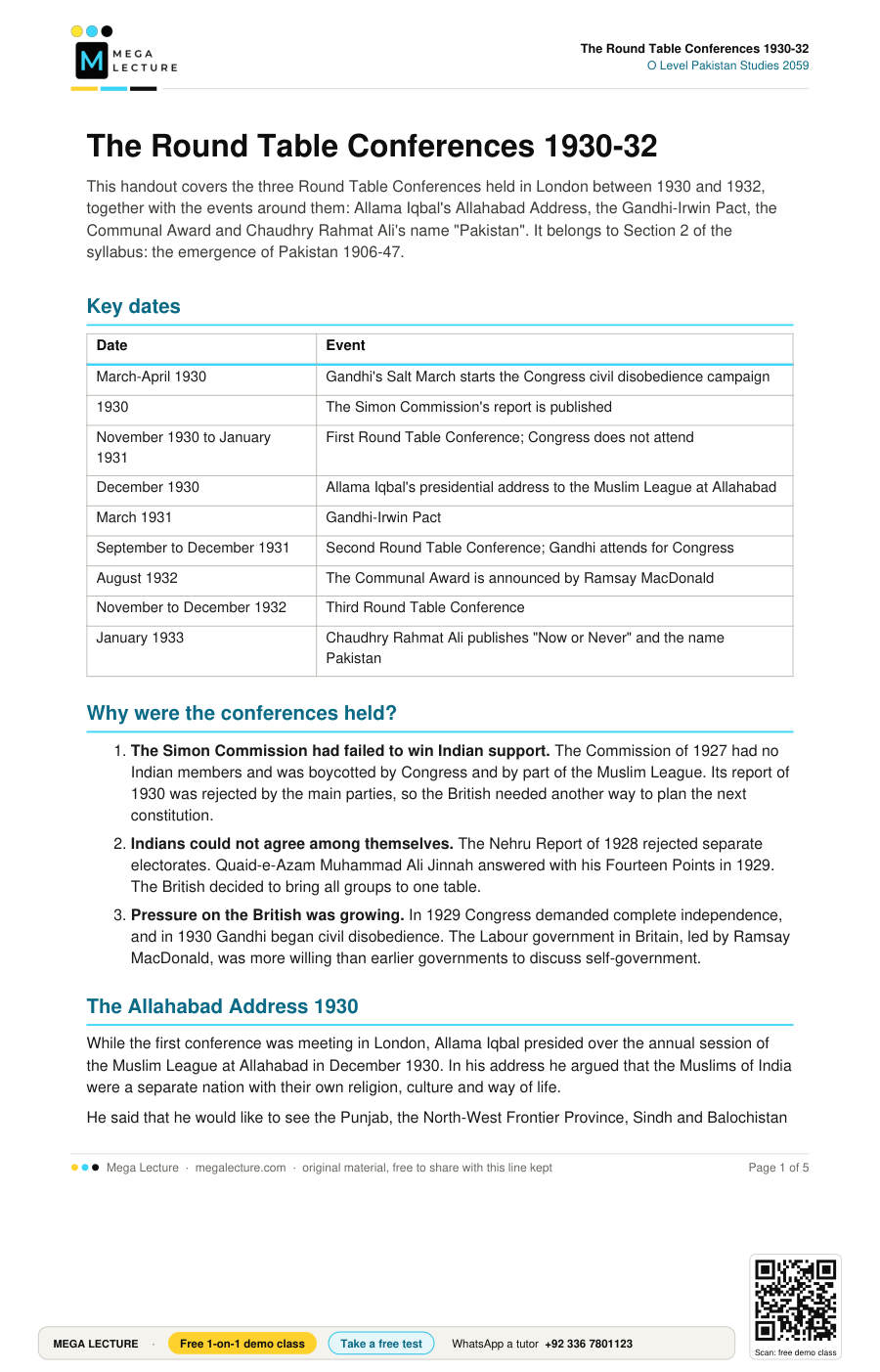
This handout covers the three Round Table Conferences held in London between 1930 and 1932, together with the events around them: Allama Iqbal's Allahabad Address, the Gandhi-Irwin Pact, the Communal Award and Chaudhry Rahmat Ali's name "Pakistan". It belongs to Section 2 of the syllabus: the emergence of Pakistan 1906-47.
Key dates
| Date | Event |
|---|---|
| March-April 1930 | Gandhi's Salt March starts the Congress civil disobedience campaign |
| 1930 | The Simon Commission's report is published |
| November 1930 to January 1931 | First Round Table Conference; Congress does not attend |
| December 1930 | Allama Iqbal's presidential address to the Muslim League at Allahabad |
| March 1931 | Gandhi-Irwin Pact |
| September to December 1931 | Second Round Table Conference; Gandhi attends for Congress |
| August 1932 | The Communal Award is announced by Ramsay MacDonald |
| November to December 1932 | Third Round Table Conference |
| January 1933 | Chaudhry Rahmat Ali publishes "Now or Never" and the name Pakistan |
Why were the conferences held?
- The Simon Commission had failed to win Indian support. The Commission of 1927 had no Indian members and was boycotted by Congress and by part of the Muslim League. Its report of 1930 was rejected by the main parties, so the British needed another way to plan the next constitution.
- Indians could not agree among themselves. The Nehru Report of 1928 rejected separate electorates. Quaid-e-Azam Muhammad Ali Jinnah answered with his Fourteen Points in 1929. The British decided to bring all groups to one table.
- Pressure on the British was growing. In 1929 Congress demanded complete independence, and in 1930 Gandhi began civil disobedience. The Labour government in Britain, led by Ramsay MacDonald, was more willing than earlier governments to discuss self-government.
The Allahabad Address 1930
While the first conference was meeting in London, Allama Iqbal presided over the annual session of the Muslim League at Allahabad in December 1930. In his address he argued that the Muslims of India were a separate nation with their own religion, culture and way of life.
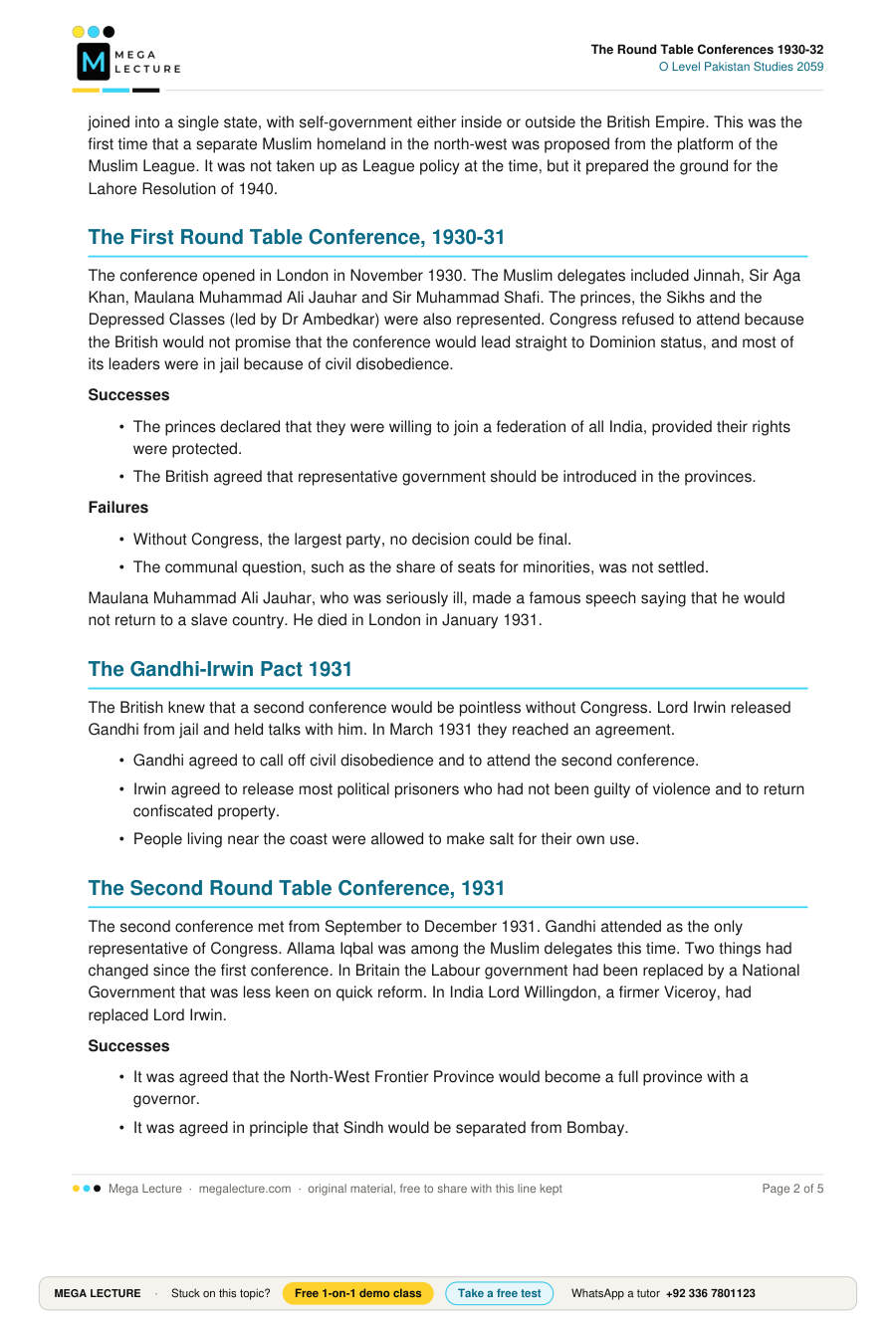
He said that he would like to see the Punjab, the North-West Frontier Province, Sindh and Balochistan joined into a single state, with self-government either inside or outside the British Empire. This was the first time that a separate Muslim homeland in the north-west was proposed from the platform of the Muslim League. It was not taken up as League policy at the time, but it prepared the ground for the Lahore Resolution of 1940.
The First Round Table Conference, 1930-31
The conference opened in London in November 1930. The Muslim delegates included Jinnah, Sir Aga Khan, Maulana Muhammad Ali Jauhar and Sir Muhammad Shafi. The princes, the Sikhs and the Depressed Classes (led by Dr Ambedkar) were also represented. Congress refused to attend because the British would not promise that the conference would lead straight to Dominion status, and most of its leaders were in jail because of civil disobedience.
Successes
- The princes declared that they were willing to join a federation of all India, provided their rights were protected.
- The British agreed that representative government should be introduced in the provinces.
Failures
- Without Congress, the largest party, no decision could be final.
- The communal question, such as the share of seats for minorities, was not settled.
Maulana Muhammad Ali Jauhar, who was seriously ill, made a famous speech saying that he would not return to a slave country. He died in London in January 1931.
The Gandhi-Irwin Pact 1931
The British knew that a second conference would be pointless without Congress. Lord Irwin released Gandhi from jail and held talks with him. In March 1931 they reached an agreement.
- Gandhi agreed to call off civil disobedience and to attend the second conference.
- Irwin agreed to release most political prisoners who had not been guilty of violence and to return confiscated property.
- People living near the coast were allowed to make salt for their own use.
The Second Round Table Conference, 1931
The second conference met from September to December 1931. Gandhi attended as the only representative of Congress. Allama Iqbal was among the Muslim delegates this time. Two things had changed since the first conference. In Britain the Labour government had been replaced by a National Government that was less keen on quick reform. In India Lord Willingdon, a firmer Viceroy, had replaced Lord Irwin.
Successes
- It was agreed that the North-West Frontier Province would become a full province with a governor.
- It was agreed in principle that Sindh would be separated from Bombay.
Failures
- Gandhi claimed that Congress spoke for all Indians and that there was no real minority problem. He refused to accept the Muslim demands in the Fourteen Points or separate electorates for the Depressed Classes.
- The Minorities Committee could reach no agreement, so the conference ended in deadlock on the communal question.
Gandhi returned to India and restarted civil disobedience. He was arrested early in 1932 and Congress was banned.
The Communal Award 1932
Because the Indian leaders could not agree, the British Prime Minister, Ramsay MacDonald, announced his own decision in August 1932.
- Separate electorates were kept for Muslims and were given to the other minorities as well, including Sikhs, Indian Christians and the Depressed Classes.
- The principle of weightage was applied, so minorities received more seats than their numbers alone would give in provinces where they were few.
- In the Punjab and Bengal the Muslims, although a majority of the population, received fewer than half of the seats.
The Muslim League was unhappy about Punjab and Bengal but accepted the Award, because it kept separate electorates. Congress rejected it. Gandhi began a fast against separate electorates for the Depressed Classes. This led to the Poona Pact with Dr Ambedkar in September 1932, which replaced their separate electorates with reserved seats.
The Third Round Table Conference, 1932
The last conference met in November and December 1932. Congress was absent again because its leaders were in jail. The British Labour Party also stayed away. Jinnah, who had by then settled in England, was not invited, and the Muslims were led by the Aga Khan. Only 46 delegates attended. It decided very little. The British government then set out its own proposals in a White Paper in 1933, and these became the basis of the Government of India Act 1935.
Chaudhry Rahmat Ali and the name Pakistan, 1933
Chaudhry Rahmat Ali was a student at Cambridge. In January 1933 he and a few friends issued a pamphlet called "Now or Never". He argued that the Muslims of the north-west should have a fully separate state and should not join any Indian federation. He called it Pakistan: P for Punjab, A for Afghania (the North-West Frontier Province), K for Kashmir, S for Sindh and "tan" from Balochistan. The name also means "land of the pure".
Rahmat Ali went further than Iqbal, who had spoken of a state that might remain within a looser India. The Muslim delegates in London did not take his scheme seriously in 1933, but his name for the country was adopted after the Lahore Resolution of 1940.
How successful were the Round Table Conferences?
Points for success
- The idea of a federation and of responsible government in the provinces was agreed, and both were written into the Government of India Act 1935.
- Sindh and the North-West Frontier Province gained provincial status, two of the demands in Jinnah's Fourteen Points.
- The Communal Award, which followed the deadlock, kept separate electorates for Muslims.
Points for failure
- Congress missed two of the three conferences, so there was never a full agreement.
- Hindus and Muslims could not settle the communal question, and the British had to impose a decision.
- The third conference was small and achieved almost nothing.
Judgement. The conferences failed in their main aim, which was to produce a constitution agreed by all Indian parties. Their real importance was indirect. They fixed the outline of the 1935 Act, and they showed Muslim leaders that Congress would not accept them as a separate community with its own rights. That lesson helped to move Muslim opinion from asking for safeguards towards asking for a separate homeland.
Key terms and people
- Dominion status: self-government within the British Empire, as in Canada or Australia.
- Communal Award: the British decision of 1932 on how seats would be shared among the communities.
- Weightage: giving a minority more seats than its share of the population.
- Chaudhry Rahmat Ali: Cambridge student who coined the name Pakistan in 1933.
Exam practice
- What was the Gandhi-Irwin Pact? [4]
- Why was the Second Round Table Conference of 1931 unsuccessful? [7]
- "The First Round Table Conference was the most successful of the three conferences held between 1930 and 1932." How far do you agree? Explain your answer. [14]
Outline answers
1. An agreement of March 1931 between Gandhi and the Viceroy, Lord Irwin. Gandhi called off civil disobedience and agreed to attend the Second Round Table Conference. Irwin agreed to release non-violent political prisoners and return confiscated property. Salt could be made by people living near the coast.
2. (i) Gandhi insisted that Congress alone represented all of India and refused to recognise the minorities' demands, so no agreement on seats and electorates was possible. (ii) The Labour government had been replaced by a National Government with many Conservatives, which was less willing to make concessions, and Lord Willingdon was a stricter Viceroy than Irwin. (iii) The Muslims, Sikhs and Depressed Classes held to their own demands, so the Minorities Committee ended in deadlock and Gandhi returned to restart civil disobedience.
3. Agree: at the first conference the princes accepted federation, the British accepted representative government in the provinces, and many groups attended. Disagree: Congress was absent so nothing could be settled; the second conference had Congress present and agreed provincial status for Sindh and the Frontier province, though it failed on minorities; the third was the weakest, with 46 delegates and neither Congress nor Jinnah. Judgement: the first achieved the most agreed principles, but none fully succeeded because the communal question was left for the British to decide in the Communal Award.
