
O Level & IGCSE · Physics 5054 / 0625 · Revision & Reference
Physics Summary
Typed from the teacher’s handwritten class notes. The original pages are one tap away.
Opens inside this page. Prefer your own PDF app? Open the PDF.
Check yourself
5 quick questions on O Level Physics
Tap an answer to see if you are right, and why. Free, no sign-up.
Start the free test👍 48 students found these notes useful
Was this note useful?
Full text of Physics Summary
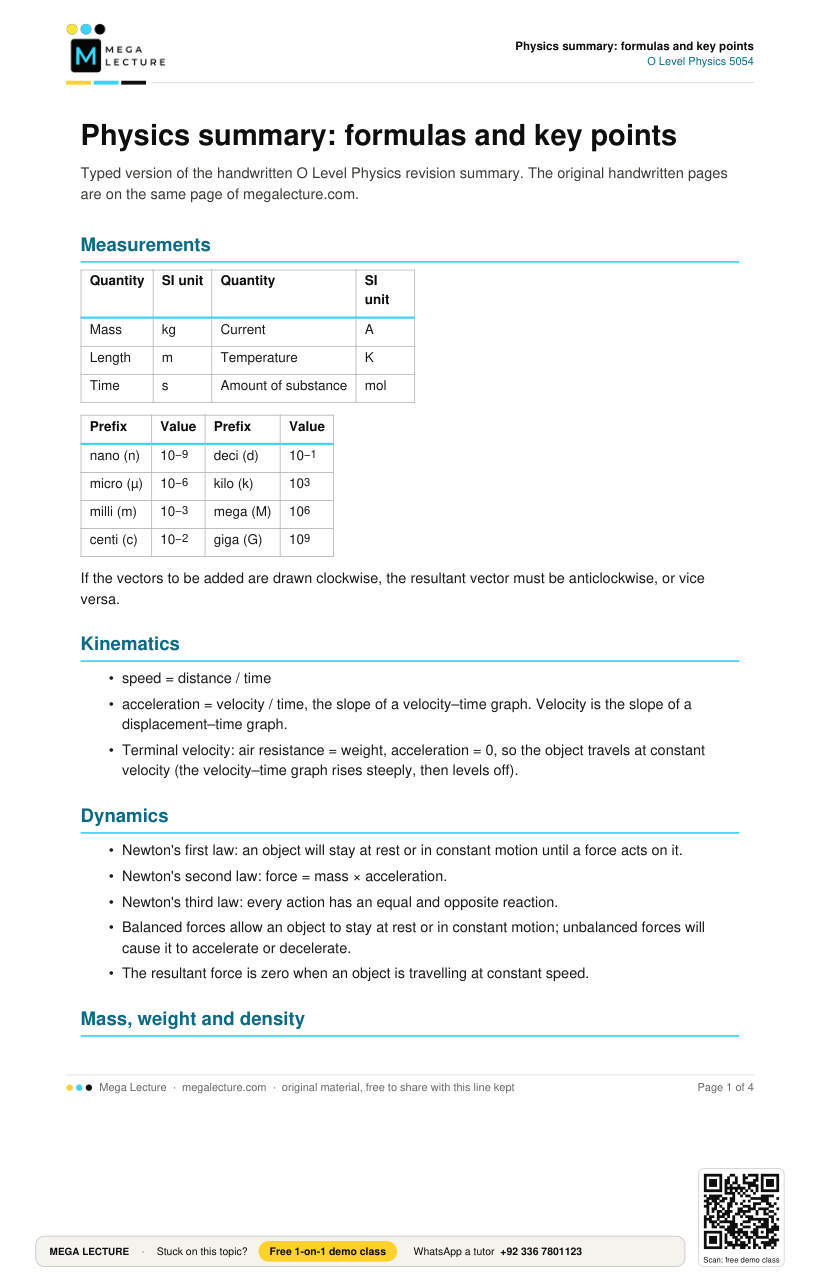
Typed version of the handwritten O Level Physics revision summary. The original handwritten pages are on the same page of megalecture.com.
Measurements
| Quantity | SI unit | Quantity | SI unit |
|---|---|---|---|
| Mass | kg | Current | A |
| Length | m | Temperature | K |
| Time | s | Amount of substance | mol |
| Prefix | Value | Prefix | Value |
|---|---|---|---|
| nano (n) | 10−9 | deci (d) | 10−1 |
| micro (µ) | 10−6 | kilo (k) | 103 |
| milli (m) | 10−3 | mega (M) | 106 |
| centi (c) | 10−2 | giga (G) | 109 |
If the vectors to be added are drawn clockwise, the resultant vector must be anticlockwise, or vice versa.
Kinematics
- speed = distance / time
- acceleration = velocity / time, the slope of a velocity–time graph. Velocity is the slope of a displacement–time graph.
- Terminal velocity: air resistance = weight, acceleration = 0, so the object travels at constant velocity (the velocity–time graph rises steeply, then levels off).
Dynamics
- Newton's first law: an object will stay at rest or in constant motion until a force acts on it.
- Newton's second law: force = mass × acceleration.
- Newton's third law: every action has an equal and opposite reaction.
- Balanced forces allow an object to stay at rest or in constant motion; unbalanced forces will cause it to accelerate or decelerate.
- The resultant force is zero when an object is travelling at constant speed.
Mass, weight and density
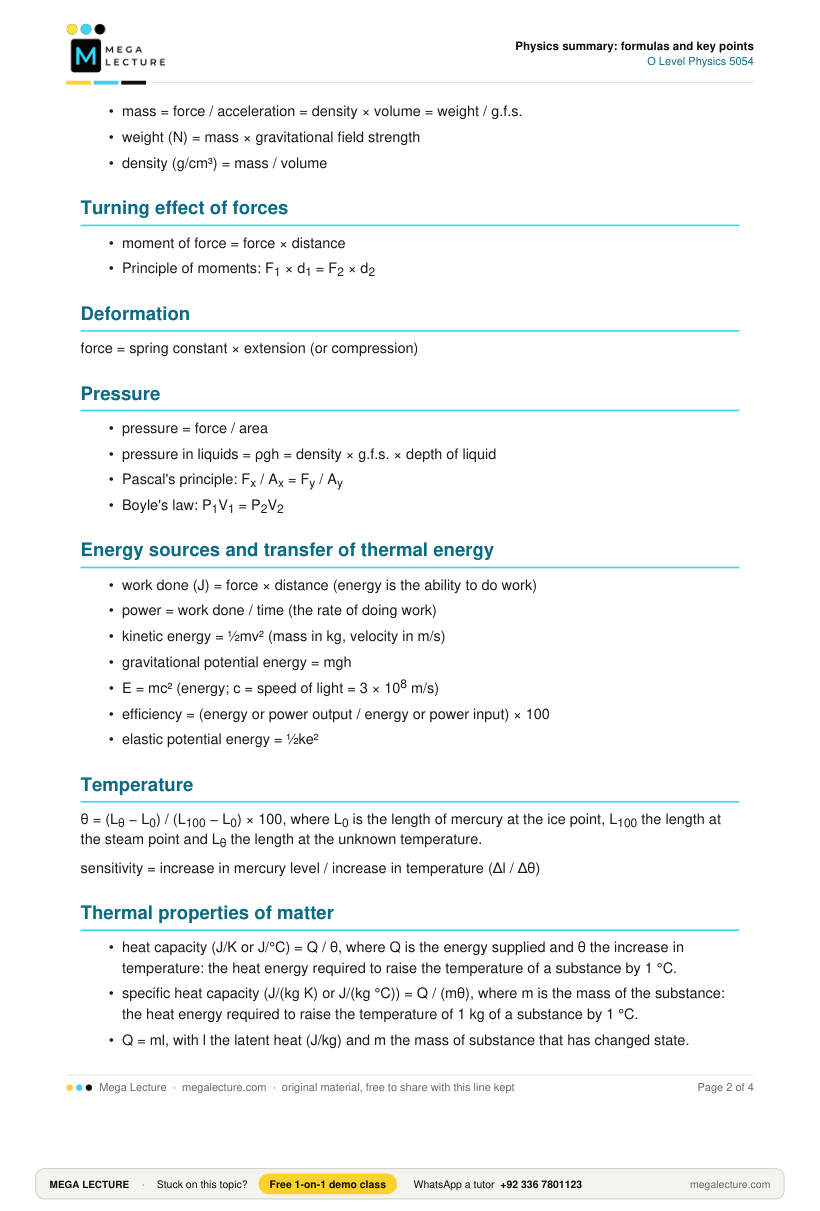
- mass = force / acceleration = density × volume = weight / g.f.s.
- weight (N) = mass × gravitational field strength
- density (g/cm³) = mass / volume
Turning effect of forces
- moment of force = force × distance
- Principle of moments: F1 × d1 = F2 × d2
Deformation
force = spring constant × extension (or compression)
Pressure
- pressure = force / area
- pressure in liquids = ρgh = density × g.f.s. × depth of liquid
- Pascal's principle: Fx / Ax = Fy / Ay
- Boyle's law: P1V1 = P2V2
Energy sources and transfer of thermal energy
- work done (J) = force × distance (energy is the ability to do work)
- power = work done / time (the rate of doing work)
- kinetic energy = ½mv² (mass in kg, velocity in m/s)
- gravitational potential energy = mgh
- E = mc² (energy; c = speed of light = 3 × 10⁸ m/s)
- efficiency = (energy or power output / energy or power input) × 100
- elastic potential energy = ½ke²
Temperature
θ = (Lθ − L0) / (L100 − L0) × 100, where L0 is the length of mercury at the ice point, L100 the length at the steam point and Lθ the length at the unknown temperature.
sensitivity = increase in mercury level / increase in temperature (Δl / Δθ)
Thermal properties of matter
- heat capacity (J/K or J/°C) = Q / θ, where Q is the energy supplied and θ the increase in temperature: the heat energy required to raise the temperature of a substance by 1 °C.
- specific heat capacity (J/(kg K) or J/(kg °C)) = Q / (mθ), where m is the mass of the substance: the heat energy required to raise the temperature of 1 kg of a substance by 1 °C.
- Q = ml, with l the latent heat (J/kg) and m the mass of substance that has changed state.
General wave properties
- velocity = frequency × wavelength: v = fλ (λ is "lambda")
- frequency = 1 / T
Light
- refractive index n = sin i / sin r = c / v (speed of light in a vacuum / speed of light in the medium) = real depth / apparent depth
- critical angle: C = sin−1(1 / n)
Electromagnetic spectrum
| Wave | Typical frequency (Hz) | Uses |
|---|---|---|
| Radio waves | 104 | television, radio |
| Microwaves | 1010 | satellites |
| Infra-red | 1013 | remote-control devices, grills and toasters |
| Visible light | 1014 | optic fibres for transmission of signals (and fluorescent tubes) |
| UV rays | 1015 | sun-beds, sterilising medical equipment |
| X-rays | 1017 | 2-dimensional images in medicine, scanners |
| Gamma rays | 1020 | killing cancerous cells and tumours, finding cracks in metals |
Sound
- Higher pitch = higher frequency; larger amplitude = louder.
- Speed of sound: solid > liquid > gas. Speed of sound in air ≈ 330 m/s.
Electromagnetism
- Right-hand grip rule gives the direction of the field around a current.
- ⊙ = current out of the page; ⊗ = current into the page.
- Two wires carrying current in the same direction attract each other; in opposite directions they repel.
- Fleming's left-hand rule: first finger = magnetic field, thumb = force, second finger = direction of current.
- Split-ring commutators are used in d.c. motors; slip rings in a.c. generators.
Current electricity
- current (amperes) = charge / time; 1 A = 1 C / 1 s
- voltage (volts) = energy / charge = work done / charge; 1 V = 1 J / 1 C
- V = IR; resistance (ohms) = voltage / current
- V–I and I–V graphs: filament lamp (curve bending over), thermistor (curve bending up), diode (no current until a forward voltage, then a straight rise).
- Series resistors: I1 = I2 = I3; V = V1 + V2 + V3; R = R1 + R2 + R3
- Parallel resistors: I = I1 + I2 + I3; V1 = V2 = V3; 1/R = 1/R1 + 1/R2 + 1/R3
- E = Pt = IVt = I²Rt (joules); power = VI (watts)
- e.m.f. and p.d. are both voltages. Cells in series: E = E1 + E2 + E3. Cells in parallel: E1 = E2 = E3; if one fails the others keep working, they last longer, lower resistance, less energy loss.
- Energy = power × time: joules = watts × seconds; kilowatt-hours = kilowatts × hours.
Electronics
Potential divider: V1 = (R1 / (R1 + R2)) × V, and V2 = (R2 / (R1 + R2)) × V, where V is the supply across R1 and R2 in series and V1, V2 are the voltages across each.
Radioactivity
Unstable nuclei emit:
- α particles (helium nuclei, 42α): higher mass, so greatest ionisation power and least penetration; stopped by paper or 8–10 cm of air; speed about 10% of c; deflected (less) in electric and magnetic fields.
- β particles (electrons, 0−1β): ionisation power less than α, penetration greater than α; stopped by a few mm of aluminium; speed about 90% of c; deflected most in electric and magnetic fields.
- γ rays (electromagnetic waves): no charge, no mass; greatest penetration, stopped by a lead block; least ionisation; not deflected because they carry no charge; c = 3 × 10⁸ m/s.
- AZX → 42α + A−4Z−2Y
- AZX → 0−1β + AZ+1Y
- AZX → γ + AZX
In every half-life, the number of atoms, the mass and the activity halve.
Still to add (from the last page's to-do list): the vertical-row / horizontal-line notation, melting point, boiling point, scale, periscope image properties, and a comparison of distance–time and speed–time graphs.
