
O Level & IGCSE · Physics 5054 / 0625 · Forces, Dynamics & Deformation
Mass Weight And Density
Typed from the teacher’s handwritten class notes. The original pages are one tap away.
Opens inside this page. Prefer your own PDF app? Open the PDF.
New: small group classes for O Level Physics are opening, at a lower fee than one-to-one. Join the waiting list
Check yourself
5 quick questions on O Level Physics
Tap an answer to see if you are right, and why. Free, no sign-up.
Start the free test5 of 6 students found these notes useful
Was this note useful?
Full text of Mass Weight And Density
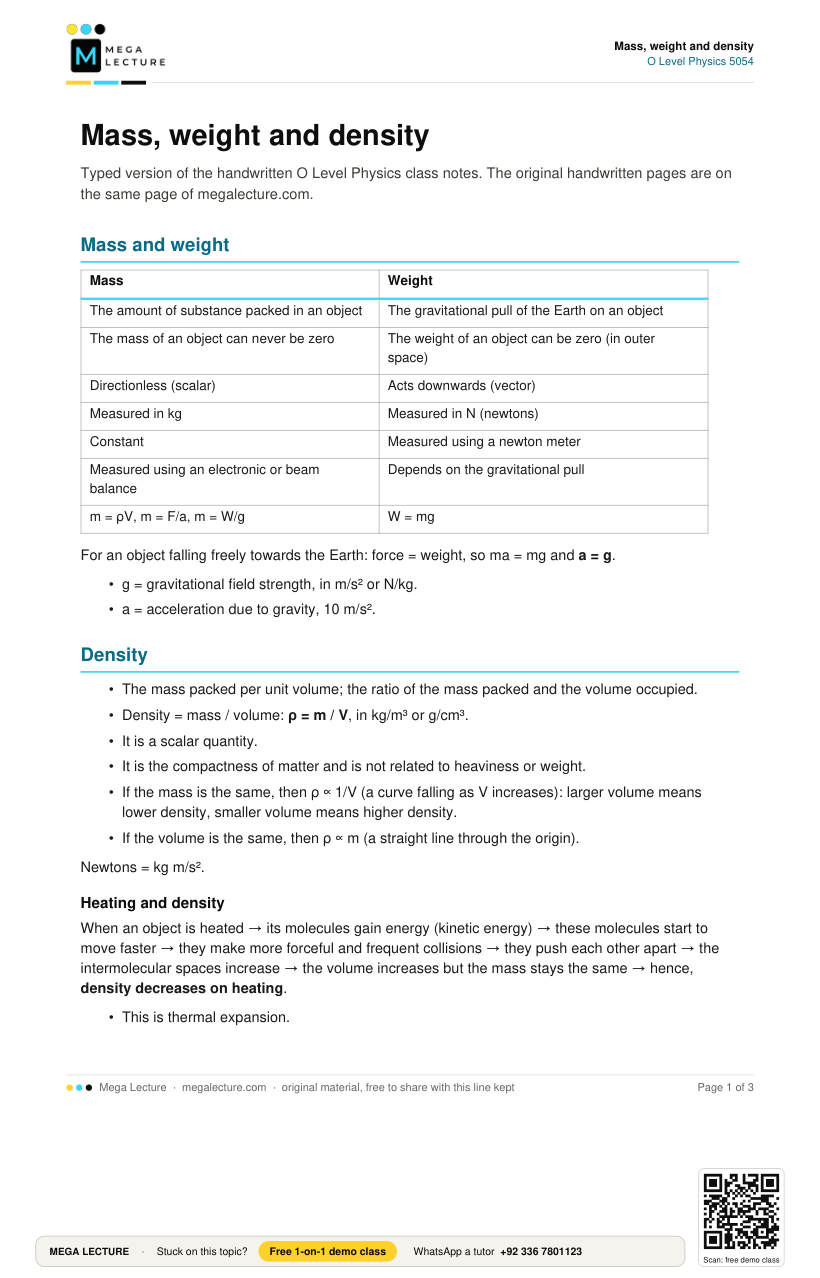
Typed version of the handwritten O Level Physics class notes. The original handwritten pages are on the same page of megalecture.com.
Mass and weight
| Mass | Weight |
|---|---|
| The amount of substance packed in an object | The gravitational pull of the Earth on an object |
| The mass of an object can never be zero | The weight of an object can be zero (in outer space) |
| Directionless (scalar) | Acts downwards (vector) |
| Measured in kg | Measured in N (newtons) |
| Constant | Measured using a newton meter |
| Measured using an electronic or beam balance | Depends on the gravitational pull |
| m = ρV, m = F/a, m = W/g | W = mg |
For an object falling freely towards the Earth: force = weight, so ma = mg and a = g.
- g = gravitational field strength, in m/s² or N/kg.
- a = acceleration due to gravity, 10 m/s².
Density
- The mass packed per unit volume; the ratio of the mass packed and the volume occupied.
- Density = mass / volume: ρ = m / V, in kg/m³ or g/cm³.
- It is a scalar quantity.
- It is the compactness of matter and is not related to heaviness or weight.
- If the mass is the same, then ρ ∝ 1/V (a curve falling as V increases): larger volume means lower density, smaller volume means higher density.
- If the volume is the same, then ρ ∝ m (a straight line through the origin).
Newtons = kg m/s².
Heating and density
When an object is heated → its molecules gain energy (kinetic energy) → these molecules start to move faster → they make more forceful and frequent collisions → they push each other apart → the intermolecular spaces increase → the volume increases but the mass stays the same → hence, density decreases on heating.
- This is thermal expansion.
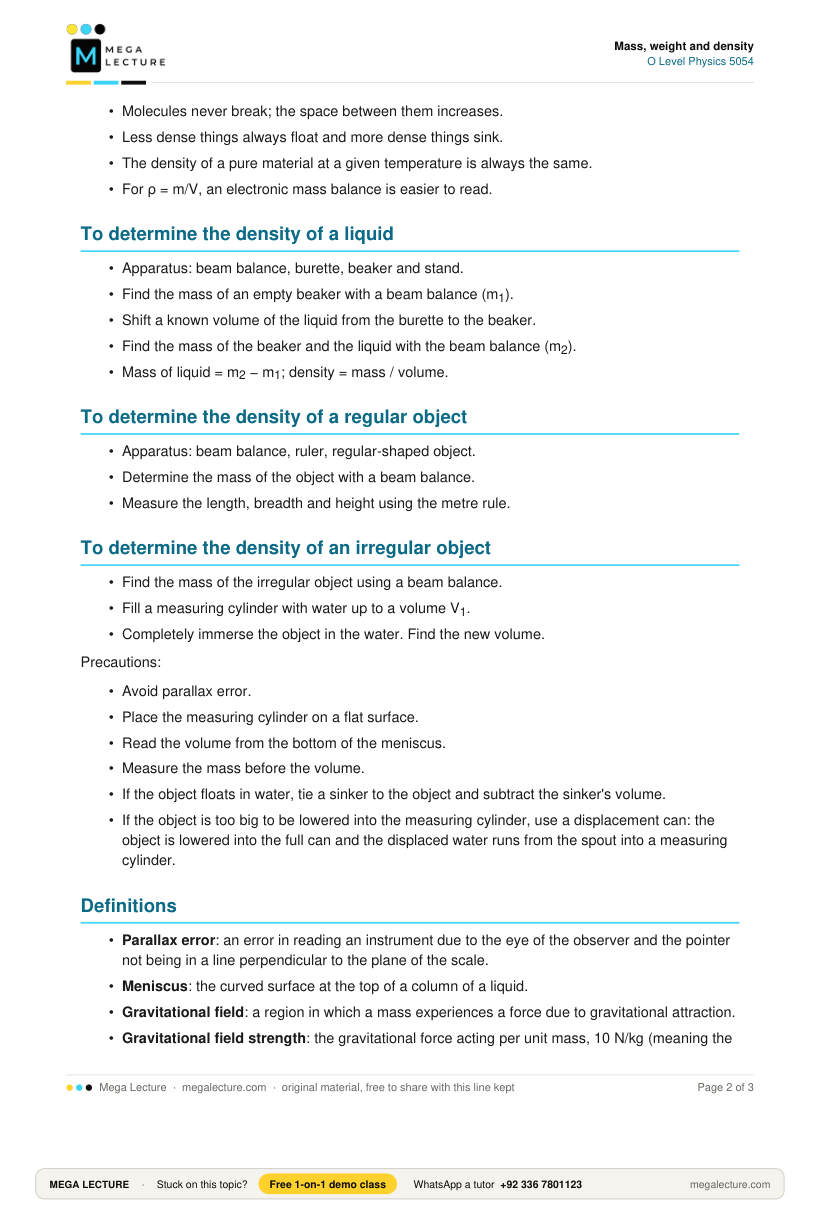
- Molecules never break; the space between them increases.
- Less dense things always float and more dense things sink.
- The density of a pure material at a given temperature is always the same.
- For ρ = m/V, an electronic mass balance is easier to read.
To determine the density of a liquid
- Apparatus: beam balance, burette, beaker and stand.
- Find the mass of an empty beaker with a beam balance (m1).
- Shift a known volume of the liquid from the burette to the beaker.
- Find the mass of the beaker and the liquid with the beam balance (m2).
- Mass of liquid = m2 − m1; density = mass / volume.
To determine the density of a regular object
- Apparatus: beam balance, ruler, regular-shaped object.
- Determine the mass of the object with a beam balance.
- Measure the length, breadth and height using the metre rule.
To determine the density of an irregular object
- Find the mass of the irregular object using a beam balance.
- Fill a measuring cylinder with water up to a volume V1.
- Completely immerse the object in the water. Find the new volume.
Precautions:
- Avoid parallax error.
- Place the measuring cylinder on a flat surface.
- Read the volume from the bottom of the meniscus.
- Measure the mass before the volume.
- If the object floats in water, tie a sinker to the object and subtract the sinker's volume.
- If the object is too big to be lowered into the measuring cylinder, use a displacement can: the object is lowered into the full can and the displaced water runs from the spout into a measuring cylinder.
Definitions
- Parallax error: an error in reading an instrument due to the eye of the observer and the pointer not being in a line perpendicular to the plane of the scale.
- Meniscus: the curved surface at the top of a column of a liquid.
- Gravitational field: a region in which a mass experiences a force due to gravitational attraction.
- Gravitational field strength: the gravitational force acting per unit mass, 10 N/kg (meaning the force of gravity acting on an object of mass 1 kg is about 10 N on the Earth's surface).
- Inertia: the ability of a body to resist when its state of rest or uniform motion tends to be changed. It depends on the mass of the body: massive bodies have more resistance when their state of rest or motion is changed, i.e. they have higher inertia than lighter bodies.
