
O Level & IGCSE · Physics 5054 / 0625 · Kinematics & Motion
Kinematics Dynamics
Typed from the teacher’s handwritten class notes. The original pages are one tap away.
Opens inside this page. Prefer your own PDF app? Open the PDF.
New: small group classes for O Level Physics are opening, at a lower fee than one-to-one. Join the waiting list
Check yourself
5 quick questions on O Level Physics
Tap an answer to see if you are right, and why. Free, no sign-up.
Start the free test5 of 6 students found these notes useful
Was this note useful?
Full text of Kinematics Dynamics
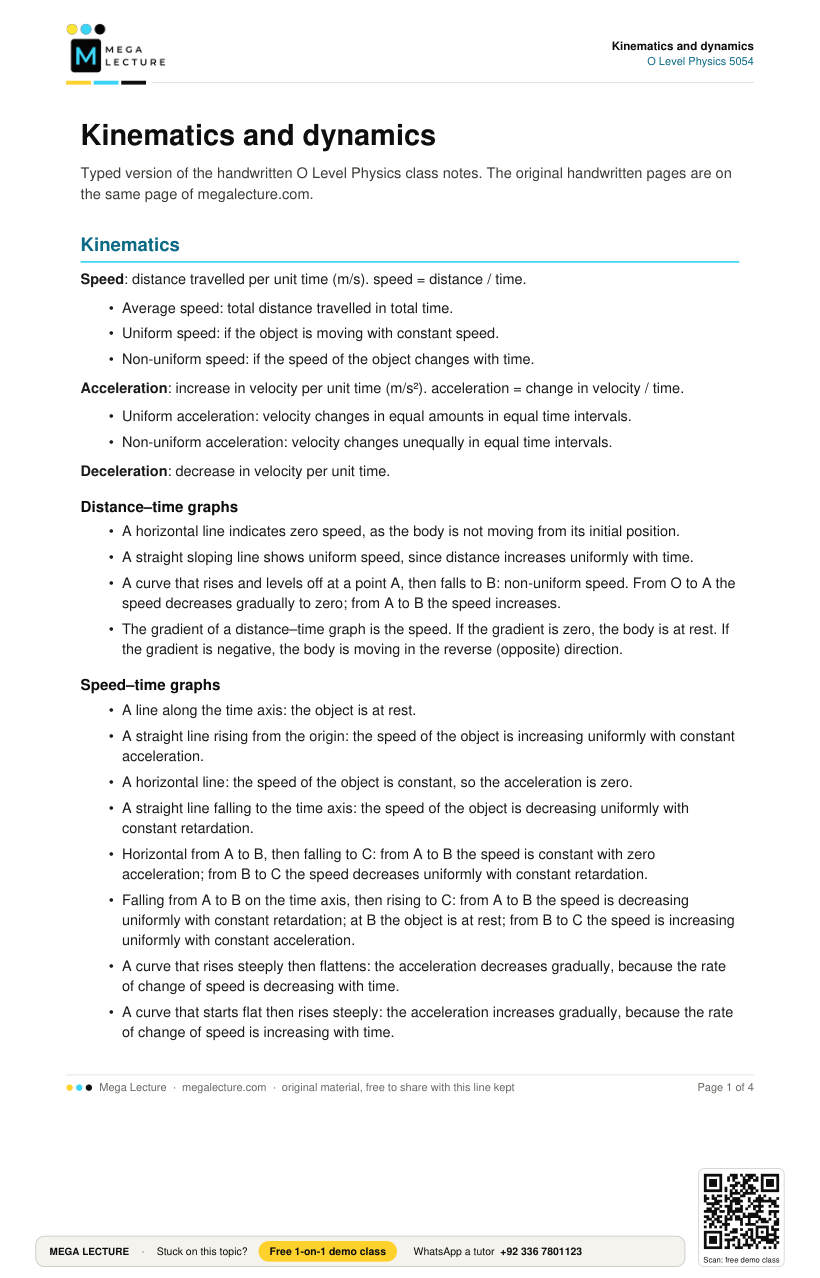
Typed version of the handwritten O Level Physics class notes. The original handwritten pages are on the same page of megalecture.com.
Kinematics
Speed: distance travelled per unit time (m/s). speed = distance / time.
- Average speed: total distance travelled in total time.
- Uniform speed: if the object is moving with constant speed.
- Non-uniform speed: if the speed of the object changes with time.
Acceleration: increase in velocity per unit time (m/s²). acceleration = change in velocity / time.
- Uniform acceleration: velocity changes in equal amounts in equal time intervals.
- Non-uniform acceleration: velocity changes unequally in equal time intervals.
Deceleration: decrease in velocity per unit time.
Distance–time graphs
- A horizontal line indicates zero speed, as the body is not moving from its initial position.
- A straight sloping line shows uniform speed, since distance increases uniformly with time.
- A curve that rises and levels off at a point A, then falls to B: non-uniform speed. From O to A the speed decreases gradually to zero; from A to B the speed increases.
- The gradient of a distance–time graph is the speed. If the gradient is zero, the body is at rest. If the gradient is negative, the body is moving in the reverse (opposite) direction.
Speed–time graphs
- A line along the time axis: the object is at rest.
- A straight line rising from the origin: the speed of the object is increasing uniformly with constant acceleration.
- A horizontal line: the speed of the object is constant, so the acceleration is zero.
- A straight line falling to the time axis: the speed of the object is decreasing uniformly with constant retardation.
- Horizontal from A to B, then falling to C: from A to B the speed is constant with zero acceleration; from B to C the speed decreases uniformly with constant retardation.
- Falling from A to B on the time axis, then rising to C: from A to B the speed is decreasing uniformly with constant retardation; at B the object is at rest; from B to C the speed is increasing uniformly with constant acceleration.
- A curve that rises steeply then flattens: the acceleration decreases gradually, because the rate of change of speed is decreasing with time.
- A curve that starts flat then rises steeply: the acceleration increases gradually, because the rate of change of speed is increasing with time.
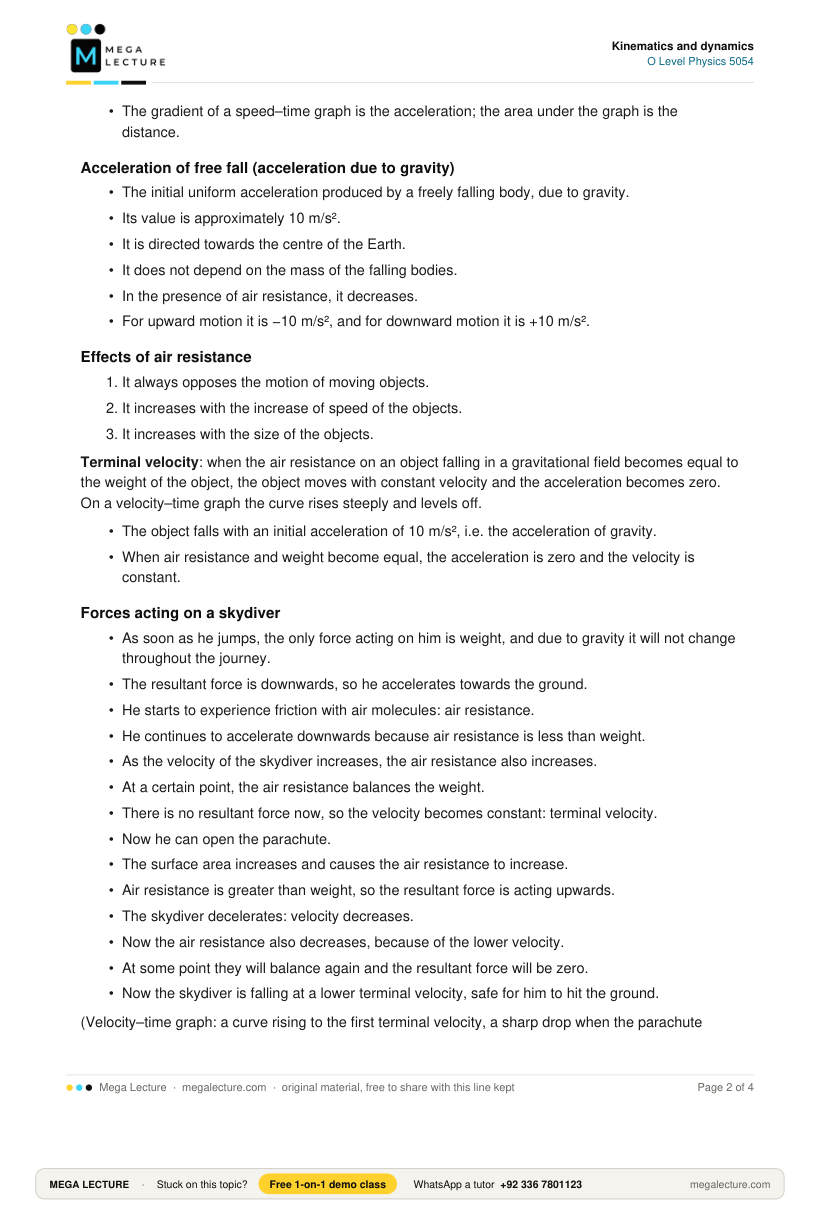
- The gradient of a speed–time graph is the acceleration; the area under the graph is the distance.
Acceleration of free fall (acceleration due to gravity)
- The initial uniform acceleration produced by a freely falling body, due to gravity.
- Its value is approximately 10 m/s².
- It is directed towards the centre of the Earth.
- It does not depend on the mass of the falling bodies.
- In the presence of air resistance, it decreases.
- For upward motion it is −10 m/s², and for downward motion it is +10 m/s².
Effects of air resistance
- It always opposes the motion of moving objects.
- It increases with the increase of speed of the objects.
- It increases with the size of the objects.
Terminal velocity: when the air resistance on an object falling in a gravitational field becomes equal to the weight of the object, the object moves with constant velocity and the acceleration becomes zero. On a velocity–time graph the curve rises steeply and levels off.
- The object falls with an initial acceleration of 10 m/s², i.e. the acceleration of gravity.
- When air resistance and weight become equal, the acceleration is zero and the velocity is constant.
Forces acting on a skydiver
- As soon as he jumps, the only force acting on him is weight, and due to gravity it will not change throughout the journey.
- The resultant force is downwards, so he accelerates towards the ground.
- He starts to experience friction with air molecules: air resistance.
- He continues to accelerate downwards because air resistance is less than weight.
- As the velocity of the skydiver increases, the air resistance also increases.
- At a certain point, the air resistance balances the weight.
- There is no resultant force now, so the velocity becomes constant: terminal velocity.
- Now he can open the parachute.
- The surface area increases and causes the air resistance to increase.
- Air resistance is greater than weight, so the resultant force is acting upwards.
- The skydiver decelerates: velocity decreases.
- Now the air resistance also decreases, because of the lower velocity.
- At some point they will balance again and the resultant force will be zero.
- Now the skydiver is falling at a lower terminal velocity, safe for him to hit the ground.
(Velocity–time graph: a curve rising to the first terminal velocity, a sharp drop when the parachute opens, then a lower flat line.)
Dynamics
Force: a pull or push on an object that changes, or tends to change, the state of rest or uniform motion of that object.
Effects of a force: it can change the shape of a body, stop a moving body, set a body into motion, accelerate the body, decelerate the body, or change the direction of a moving body.
Friction: a constant force that slows down moving objects.
- Negative effects of friction: the force of friction causes wear and tear in the moving parts of a machine; it reduces the engine power.
- Positive effects of friction: it helps in holding objects and walking on the ground; it helps in stopping moving vehicles.
- Methods of reducing friction: using a highly polished surface for moving parts; using a layer of lubricant between moving parts; using ball bearings to enable surfaces to roll over; making moving objects aerodynamic in shape.
Effects of friction on the motion of a vehicle
- Tyre surface. If the tyre surface is in good condition, there is more friction between the tyre and the road, and the vehicle can be stopped easily within the stopping distance.
- Road condition. If the road is wet, the friction between the tyres and road reduces, resulting in an increase in the stopping distance; the vehicle can also skid at turns.
- Braking force. If the brake pads and discs are in good condition, the braking force causes more friction and the stopping distance reduces.
- Braking distance: the distance travelled by a moving vehicle during the time that the brakes are applied.
- Thinking distance: the distance travelled by a moving vehicle during the reaction time of the driver, before applying the brakes.
- Stopping distance: the total distance travelled by a moving vehicle between the driver thinking and the vehicle stopping. stopping distance = thinking distance + braking distance.
Q. Why can't they all be equal? They depend on the road condition, the tyre condition, the brakes' condition, the speed of the moving vehicle, whether the vehicle is loaded or unloaded, and the human reaction of the driver.
Circular motion
If the distance of an object from a fixed point remains constant throughout its motion, then the object is in circular motion.
- The resultant force on an object in circular motion is towards the centre.
- If the speed of the object in the circle is constant, its direction keeps changing, so the velocity is not constant.
- The direction of velocity at any instant in circular motion is determined by the tangent to the circle at that point.
- The force which keeps the object moving in a circular path is called the centripetal force, always directed towards the centre of the circle.
Examples: the electrostatic force exerted by the nucleus on an electron provides the centripetal force, so electrons keep orbiting the nucleus in circular motion. The force of gravity of the Earth provides the centripetal force, so a satellite keeps orbiting the Earth in circular motion. The planets move around the Sun due to gravitational force: the gravitational force provides the centripetal force to the planets, and each planet in the solar system is directed towards the Sun and keeps moving in a fixed orbit.
Balanced and unbalanced forces
- Balanced forces: two equal forces acting in opposite directions cancel each other out. They produce two effects: the object is either at rest, or moving at a steady speed.
- Unbalanced forces: two forces of different values acting in opposite directions on an object. They produce two effects: they either accelerate the object or decelerate it.
Newton's laws of motion
- First law: a body continues in its state of rest or uniform motion until an external force acts on it.
- Second law: when a force acts on a body, an acceleration is produced such that the acceleration is directly proportional to the force applied, and inversely proportional to the mass of the body. Force = mass × acceleration, F = ma. Force is measured in newtons.
- Third law: to every action there is an equal and opposite reaction.
- Contact forces: the two objects are physically touching, e.g. tension in a rope, friction, air resistance, a lamp on a table (the lamp exerts a downward force and the table exerts an upward force).
- Non-contact forces: the two objects are physically separate, e.g. gravitational force, electrostatic forces, magnetic force.
Study vector diagrams. When the speed of an object is constant, the resultant force is zero.
