
O Level & IGCSE · Chemistry 5070 / 0620 · Metals
Metals & the Reactivity Series — O Level & IGCSE
Need more than one subject? All-notes pass: unlimited downloads of every note for a year: unlimited downloads of every note on the site, PKR 999 a year. All packs and courses.
Opens inside this page. Prefer your own PDF app? Open the PDF.
Chemistry batch classes: coming soon. Small live classes at a lower fee than one-to-one. Join the waiting list
Check yourself
5 quick questions on Metals
Tap an answer to see if you are right, and why. Free, no sign-up.
Start the free testNew · free
O Level Chemistry written answers, marked like a real examiner
Answer a Paper 2 style question by typing or speaking. You get your mark point by point, what the examiner was looking for that you missed, and a model answer. 5 free answers a day with a free account.
Try a written question👍 27 students found these notes useful
Was this note useful?
Full text of Metals & the Reactivity Series — O Level & IGCSE
Metals and the Reactivity Series Fahad Hameed Ahmad www.youtube.com/megalecture www.megalecture.com
Giant Metallic Lattice Structure and Properties Alloys and Pure Metals Transition Metals and Properties Rusting of Iron
Free notes, practice tests and live classes Back to megalecture.com
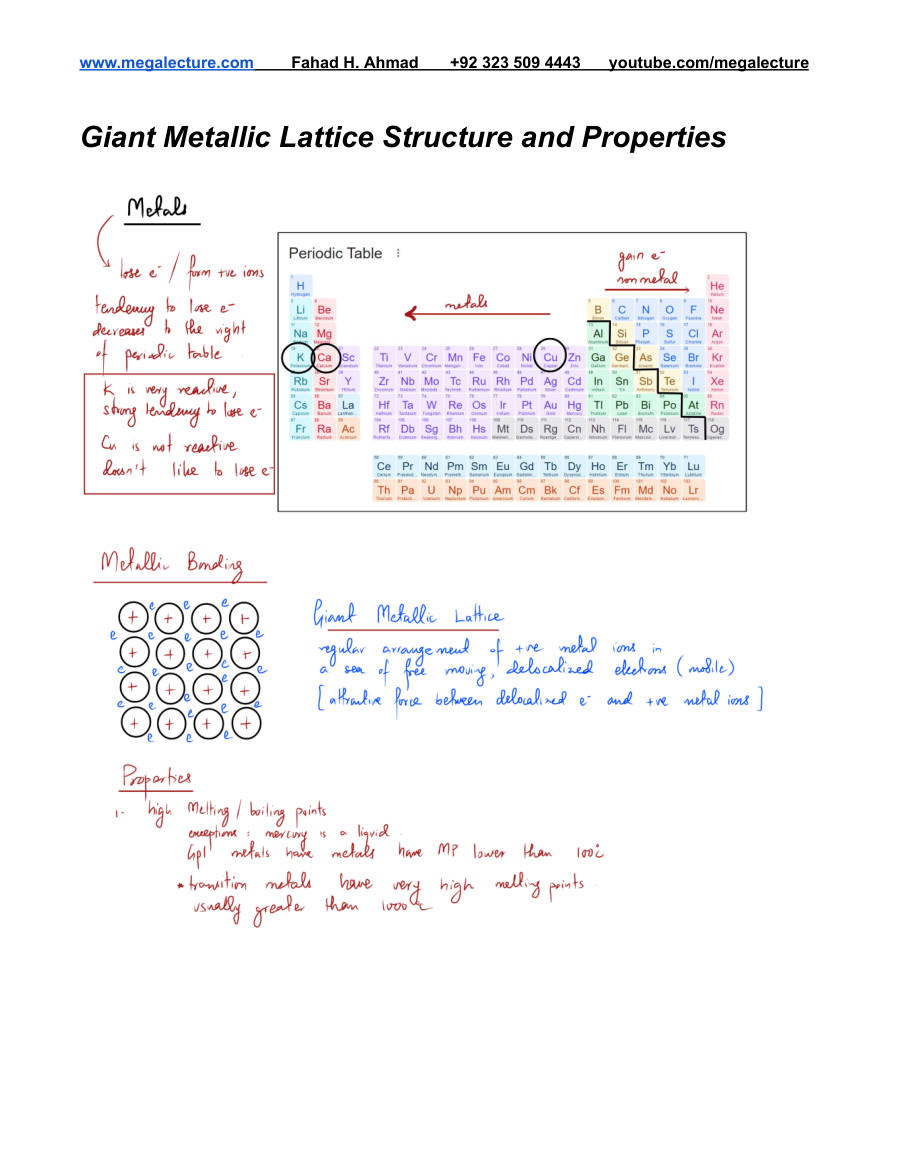
Giant Metallic Lattice Structure and Properties Alloys and Pure Metals
Alloys are produced when →Mixture of Metals or Metal + Impurity. Adding impurity to the metallic lattice disrupts the layered arrangement and creates an irregular metallic lattice as added impurity atoms and metal atoms don’t have the same size. Due to an Irregular Metallic Lattice the ions will not slip and slide easily now which makes Alloys a lot stronger and less malleable and ductile.
Example of Alloys →Iron + Carbon = Steel, Copper + Tin = Bronze, Copper + Zinc = Brass
Transition Metals and Properties Group 1 Metals
Group 1 metals also tend to be very soft and can be cut with a knife. Their compounds are white in color and when they dissolve their solution is colorless. NaCl for example are white crystals and when they dissolve they form colorless solutions.
Reactivity Series : Reactions with Water Rusting of Iron
The above or short-term and small scale uses which prevent iron or steel from getting in touch with air/water. But layer of paint / oil / or gold plated surface will eventually wear off and the metal gets easily exposed and rusting starts.
Zinc is more reactive and will lose electrons / get oxidized more easily compared to iron. Those electrons travel from Zinc to Iron. So, if Oxygen or Water will try to gain electrons from Iron then those electrons indirectly come from Zinc. Hence Zinc is the one that reacts and gets oxidized in preference to Iron.
Iron keeps getting electrons from cathode. So if oxygen or water try to gain electrons from iron then those electrons will be coming from the battery and iron will not lose electrons or get oxidized or turn into ions. Hence Iron remains protected and does not react.
Reactions with Acids Extraction of Metals
Unreactive Metals (below H in the reactivity series) are normally found in their native or original states. They don’t normally react. Gold would form pure gold nuggets so no chemical reactions are needed to extract them. They can be purified using electrolysis and if they do form compounds, those compounds can be dissolved in acids and electrolysis can be done to extract them at cathode.
Metals below Carbon in reactivity series can be reduced from their compounds using Carbon. Carbon is more reactive so it will displace the metal from its compounds. For example Carbon can remove all the oxygens from Fe2O3 and leave pure Fe behind.
Very Reactive Metals, above carbon form compounds, and cannot be displaced with carbon as carbon is less reactive. They can only be produced by electrolysis of molten metal compounds which makes them very expensive as electricity and high temperatures are needed.
Raw Materials : Limestone (CaCO3) + Haematite (Fe2O3 + Sand SiO2) + Coke (Carbon)
- Heat is produced by burning coke / carbon - Fe2O3 is reduced by carbon as shown above, make sure to write those equations - Limestone is used to remove impurities. It decomposes to produce basic CaO which then reacts with the acidic SiO2 forming a low density slag CaSiO3 which floats on top of molten iron. - Slag prevents the reaction of Iron with air as it provides a coating on top. - Atmosphere of Argon is sometimes provided so that hot iron does not react with air
Bauxite is very abundant in the earth’s crust. Basic NaOH will dissolve the amphoteric Al2O3 and will not dissolve other basic metal oxides like Fe2O3 which can then be filtered off.
Molten Alumina is electrolysed. Al+3 ions get attracted to cathode (-ve container) where they get reduced and turn into molten Al. O-2 ions get attracted to anode where they get oxidized and turn into O2 gas.
Zinc ore is Zinc Blende. Carbon being more reactive reduces ZnO to Zn.
