
O Level & IGCSE · Chemistry 5070 / 0620 · Acids, Bases & Salts
Acids Bases And Salts — Marking scheme
Opens inside this page. Prefer your own PDF app? Open the PDF.
Chemistry batch classes: coming soon. Small live classes at a lower fee than one-to-one. Join the waiting list
Check yourself
5 quick questions on O Level & IGCSE Chemistry
Tap an answer to see if you are right, and why. Free, no sign-up.
Start the free test👍 23 students found these notes useful
Was this note useful?
Full text of Acids Bases And Salts — Marking scheme
5070/0620 CIE CHEMISTRY O’ LEVELS – GCE & iGCSE Acids, Bases & Salts www.fahadsacademy.com •
Past papers compiled from 2002-2014
MCQs: Acids, Bases & Salts (iGCSE)
0620_w/14/qp13
0620_w/14/qp13
0620_w/14/qp13
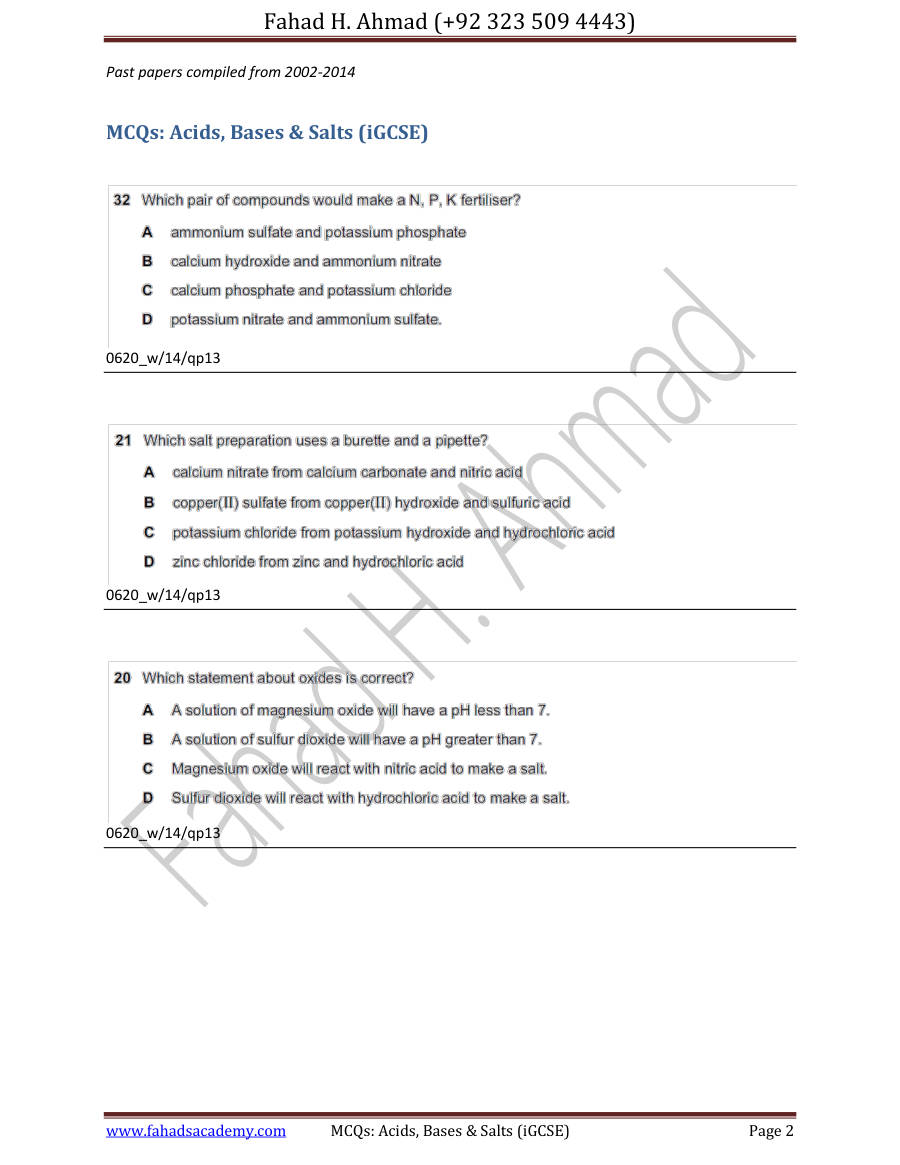
32 Which pair of compounds would make a N, P, K fertiliser?
A ammonium sulfate and potassium phosphate
B calcium hydroxide and ammonium nitrate
C calcium phosphate and potassium chloride
D potassium nitrate and ammonium sulfate.
21 Which salt preparation uses a burette and a pipette?
A calcium nitrate from calcium carbonate and nitric acid
B copper(H) sulfate from copper(TT) hydroxide and sulfuric acid
C potassium chloride from potassium hydroxide and hydrochloric acid
D zinc chloride from zinc and hydrochloric acid
20 Which statement about oxides is correct?
A A solution of magnesium oxide will have a pH less than 7.
B A solution of sulfur dioxide will have a pH greater than 7.
C Magnesium oxide will react with nitric acid to make a salt.
D Sulfur dioxide will react with hydrochloric acid to make a salt.
0620_w/14/qp13
0620_w/14/qp11
0620_w/14/qp11
0620_w/14/qp11
19 A colourless solution is tested by the following reactions.
Which reaction is not characteristic of an acid?
A A piece of magnesium ribbon is added. Bubbles are seen and the magnesium disappears.
B A pungent smelling gas is produced when ammonium carbonate is added.
C Copper oxide powder is added and the mixed is warmed. The solution turns blue.
D The solution turns blue litmus red.
32 Which method can be used to obtain ammonia from ammonium sulfate?
A Heat it with an acid.
B Heat it with an alkali.
C Heat it with an oxidising agent.
D Heat it with a reducing agent.
22 The graph shows how the pH of soil in a field changes over time.
At which point was the soil neutral?
pH of ?-+----"'
soil
A time
D
21 How many different salts could be made from a supply of dilute sulfuric acid, dilute hydrochloric acid, copper, magnesium oxide and zinc carbonate?
A 3 B 4 C D 6
0620_w/14/qp11
0620_w/14/qp11
0620_w/13/qp13
20 The positions of elements W, X, Y and Zin the Periodic Table are shown.
= w
y
x
z
Which elements form basic oxides?
A W, X and Y B W and X only C Y only D Z only
19 Which substance is the most acidic?
substance pH
A calcium hydroxide
B lemon juice
c
milk
D washing up liquid
31 A sample of fertiliser is tested by warming it with aqueous sodium hydroxide.
A colourless gas is produced which turns red litmus paper blue.
Which element, essential for plant growth, must be present?
A nitrogen
B phosphorus
C potassium
D sulfur
0620_w/13/qp13
0620_w/13/qp13
30 Carbon dioxide is produced when
X reacts with ethanol.
Y reacts with sodium carbonate.
What are X and Y?
x
y
A H2
HCl
B H2 Na OH
c HCl
D Na OH
20 The cations shown are identified by the colour of the precipitates formed when an excess of an aqueous solution of X is added.
cations present effect of adding an excess of aqueous X iron( IT) (Fe2+) green precipitate copper(! I) (Cu2+) light blue precipitate iron(II I) (Fe3+) red-brown precipitate
What is X?
A ammonia
B limewater
C silver nitrate
D sodium hydroxide
0620_w/13/qp13
0620_w/13/qp11
18 Which are properties of an acid?
reacts with ammonium sulfate to form ammonia turns red litmus blue
A ,/ ,/
B ,/
x
c
x
,/
D
x x
35 The diagram shows a kiln used to heat limestone.
i 呸air
product
What is the product and what waste gas is formed?
product waste gas
A lime. Cao carbon monoxide
B lime. Cao carbon dioxide
c
slaked lime, Ca(OHh carbon monoxide
D slaked lime, Ca(OHh carbon dioxide
0620_w/13/qp11
0620_w/13/qp11
0620_w/13/qp11
Farmers add calcium oxide (lime) and ammonium salts to their fields.
The compounds are not added at the same time because they react with each other.
Which gas is produced in this reaction?
A ammonia
B carbon dioxide
C hydrogen
D nitrogen
20 Compound Xis tested and the results are shown in the table.
test result aqueous sodium hydroxide is gas given off which turns damp added, then heated gently red litmus paper blue dilute hydrochloric acid is added effervescence, gas given off which turns limewater milky
Which ions are present in compound X?
A ammonium ions and carbonate ions
B ammonium ions and chloride ions
C calcium ions and carbonate ions
D calcium ions and chloride ions
19 Which of the following are properties of the oxides of non-metals?
property 1 property 2
A acidic covalent
B acidic ionic
c
basic covalent
D basic ionic
0620_w/13/qp11
0620_w/12/qp13
0620_w/12/qp13
18 Which are properties of an acid?
reacts with ammonium sulfate to form ammonia turns red litmus blue
A ./ ./
B ./
x
c
x
./
D x
x
34 Two industrial processes that involve heating are
- extracting iron from its ore using a blast furnace,
- making lime.
In which of these processes is calcium carbonate used?
extracting iron making lime
A ./ ./
B ./
x
c
x
./
D
x x
33 Which process does not produce carbon dioxide?
A combustion of petrol
B reaction between an acid and a metal hydroxide
C reaction between an acid and a carbonate
D respiration
0620_w/12/qp13
0620_w/12/qp13
0620_w/12/qp13
32 What are X and Y in the reaction shown?
ammonium chloride + solution X 呸 alkaline gas Y
x
y
A hydrochloric acid ammonia
B hydrochloric acid chlorine
c
sodium hydroxide ammonia
D sodium hydroxide chlorine
17 Some reactions involving sodium are shown.
Which reaction does not involve the formation of a base?
sodium oxide
B sodium sodium chloride
16 Salts X and Y are separately dissolved in water.
sodium hydroxide
Samples of the solutions obtained are separately tested with dilute hydrochloric acid and with aqueous sodium hydroxide.
In two of the tests, a gaseous product is formed. No precipitate is formed in any of the tests.
What are salts X and Y?
x
y
A AgN03 BaS04
B BaS04 Na2C03
c
Na2C03
NH4Cl
D
NH4Cl
AgN03
0620_w/12/qp11
0620_w/12/qp11
34 A student is asked to draw a diagram showing the uses of limestone.
making cement limestone making lime added, with hematite, to a blast furnace
Which numbered lines show a correct use of limestone?
A 1 and 2 only
B 1 and 3 only
C 2 and 3 only
D
1,2and3
33 Carbon dioxide is produced when dilute hydrochloric acid reacts with
A calcium sulfate.
B carbon.
C copper(TI) carbonate.
D limewater.
0620_w/12/qp11
0620_w/12/qp11
32 The diagram shows two substances, X and Y, being heated together.
substances X and Y
t
heat
The Universal Indicator paper turns blue during the experiment.
What are substances X and Y?
A ammonium nitrate and hydrochloric acid
B ammonium nitrate and sodium hydroxide
C sodium carbonate and hydrochloric acid
D sodium carbonate and sodium hydroxide
27 Pieces of copper, iron, magnesium and zinc are added to separate test-tubes containing dilute hydrochloric acid.
Which test-tube contains iron and dilute hydrochloric acid?
A
_-§ ..5_-
B
c
D
0620_w/12/qp11
0620_w/12/qp11
0620_w/12/qp11
0620_w/12/qp11
18 Barium hydroxide is an alkali. It reacts with hydrochloric acid.
How does the pH of the hydrochloric acid change as an excess of aqueous barium hydroxide is added?
A The pH decreases from 14 and becomes constant at 7.
B The pH decreases from 14 to about 1.
C The pH increases from 1 and becomes constant at 7.
D The pH increases from 1 to about 14.
19 A compound is a salt if it
A can neutralise an acid.
B contains more than one element.
C dissolves in water.
D is formed when an acid reacts with a base.
17 Element X forms an acidic, covalent oxide.
Which row shows how many electrons there could be in the outer shell of an atom of X?
A ./ ./
x x
B ./
x
./
x
c
x x
./ ./
D
x
./
x
./
16 Which of these pairs of aqueous ions both react with dilute sulfuric acid to give a visible result?
A
Ba2+ and Cl
B
Ba2+ and co,>
C
NH/ and er
o
NH/ and co/
0620_w/12/qp11
0620_w/11/qp11
13 Separate samples of anhydrous and hydrated copper(l l) sulfate are heated.
呸 t
anhydrous copper(Il) sulfate heat
Which shows the correct colour changes?
呸 t
hydrated copper(II) sulfate heat anhydrous copper(ll) sulfate hydrated coppertll) sulfate
A blue to white white to blue
B no change blue to white
c
white to blue blue to white
D white to blue no change
34 Which combination of chemical compounds could be used to produce the fertiliser shown?
N P K 21 : 16 : 8
A NH4N03, Ca3(P04)2
B NH4N03, CO(NH2)2
C NH4N03, K2S04, {NH4)2S04
D (NH4)JP04, KCL
0620_w/11/qp11
0620_w/11/qp11
0620_w/11/qp11
20 The results of three tests on a solution of compound X are shown.
test result aqueous sodium white precipitate formed, hydroxide added soluble in excess aqueous ammonia added white precipitate formed, soluble in excess dilute hydrochloric bubbles of gas acid added
What is compound X?
A aluminium carbonate
B aluminium chloride
C zinc carbonate
D zinc chloride
17 Which type of reaction always forms a salt and water?
A exothermic
B neutralisation
C oxidation
D polymerisation
18 Which property is not characteristic of a base?
A It reacts with a carbonate to form carbon dioxide.
B It reacts with an acid to form a salt.
C It reacts with an ammonium salt to form ammonia.
D It turns universal indicator paper blue.
0620_w/11/qp11
0620_w/10/qp11
0620_w/10/qp11
19 An alloy contains copper and zinc.
Some of the zinc has become oxidised to zinc oxide.
What is the result of adding an excess of dilute sulfuric acid to the alloy?
A A blue solution and a white solid remains.
B A colourless solution and a pink/brown solid remains.
C The alloy dissolves completely to give a blue solution.
D The alloy dissolves completely to give a colourless solution.
35 A bag of fertiliser 'Watch it grow' contains ammonium sulfate and potassium sulfate.
Which of the three elements N, P and K does 'Watch it grow' contain?
N p K
A ./ ./
x
B ./
x
./
c
x
./
x
D
x x
./
22 A salt is made by adding an excess of an insoluble metal oxide to an acid.
How can the excess metal oxide be removed?
A chromatography
B crystallisation
C distillation
D filtration
0620_w/10/qp11
0620_w/10/qp11
20 Which reaction will result in a decrease in pH?
A adding calcium hydroxide to acid soil
B adding citric acid to sodium hydrogen carbonate solution
C adding sodium chloride to silver nitrate solution
D adding sodium hydroxide to hydrochloric acid
21 The oxide of element X was added to an acid. It reacted to form a salt and water.
呸eof
element X acid
What is the pH of the acid before the reaction and what type of element is X?
pH type of element X
A greater than 7 metal
B greater than 7 non-metal
c
less than 7 metal
D less than 7 non-metal
0620_w/10/qp11
0620_w/09/qp11
0620_w/09/qp11
19 Some barium iodide is dissolved in water.
Aqueous lead(II) nitrate is added to the solution until no more precipitate forms.
This precipitate, X, is filtered off.
Dilute sulfuric acid is added to the filtrate and another precipitate, Y, forms.
What are the colours of precipitates X and Y?
x
y
A white white
B white yellow
c
yellow white yellow yellow
36 Fertilisers are used to provide three of the elements needed for plant growth.
Which two compounds would give a fertiliser containing all three of these elements?
A Ca(N03)2 and (NH4)2S04
B
Ca(N03h and (NH4)JP04
C KN03 and (NH4)2S04
O KN03 and (N H4)3P04
20 An aqueous solution Y contains both barium ions and silver ions.
In separate experiments, dilute sulfuric acid and dilute hydrochloric acid are added to solution Y.
Which of these acids causes a precipitate to form in solution Y?
dilute dilute sulfuric acid hydrochloric acid
A ./ ./
B ./
x c
x ./
x x
0620_w/09/qp11
0620_w/09/qp11
21 The diagram shows the pH values of four solutions.
r
p
t
Q
t
R
i s
Which of these solutions are alkaline?
A P only
B P and Q only
C Q, R and S only
D
Rand Sonly
16 When an acid is added to an alkali the temperature rises.
Which words describe this reaction?
A decomposition and endothermic
B decomposition and exothermic
C neutralisation and endothermic
D neutralisation and exothermic
0620_w/09/qp11
0620_w/08/qp1
A student carries out an experiment to prepare pure magnesium sulfate crystals.
The diagram shows the first stage of the preparation.
ma>
carbonate stirrer
'-=-=-=
-=-=-=- =-=- .;,--
dilute sulfuric acid
He adds magnesium carbonate until no more reacts.
Which process should he use for the next stage?
A crystallisation
B evaporation
C filtration
D neutralisation
37 When added in turn to four solutions, aqueous sodium carbonate gives the following results.
Which solution is acidic?
solution result
A a blue precipitate forms
B a white precipitate forms
c
bubbles of gas form
D no visible reaction occurs
0620_w/08/qp1
0620_w/08/qp1
20 Dilute hydrochloric acid is added to aqueous barium nitrate in a test-tube.
What happens?
the pH of the liquid a precipitate forms in the test-tube
A decreases yes
B decreases no
c
increases yes
D increases no
21 A colourless liquid in an unlabelled bottle is tested as shown.
- Litmus paper turns red.
- Magnesium ribbon fizzed.
- Reaction with aqueous barium nitrate produced a white precipitate.
What is the colourless liquid?
A aqueous sodium hydroxide
B aqueous sodium sulphate
C dilute hydrochloric acid
D dilute sulphuric acid
0620_w/08/qp1
0620_w/08/qp1
22 The diagrams show two experiments.
experiment 1 experiment 2
blue呸 呸red
litmus paper aqueous _ ammonium chtortde >" -_-
+ litmus paper
t
heat litmus paper
blue呸呸red
aqueous ammonium chloride
+ dilute sulphuric acid litmus paper
t
heat aqueous sodium hydroxide
What happens to the pieces of litmus paper?
experiment 1 experiment 2
A blua-» red both pieces bleached
B
blue-> red
no change
c red-> blue
both pieces bleached
D red呸 blue no change
23 Which substances react with dilute sulphuric acid to form a salt?
magnesium magnesium magnesium magnesium oxide carbonate chloride
A ./ ./ ./
x
B ./ ./
x
./
c
./
x
./ ./
D
x
./ ./ ./
0620_w/08/qp1
0620_s/12/qp11
0620_s/12/qp11
An aqueous solution contains barium iodide.
It is possible to obtain a solution that contains Ba2+(aq) but no l(aq) by adding
until no more precipitate forms.
Which words correctly complete gaps 1 and 2?
A aqueous lead(II) nitrate white
B aqueous lead(II) nitrate yellow
c
dilute sulphuric acid white dilute sulphuric acid yellow
15 A gas is escaping from a pipe in a chemical plant.
A chemist tests this gas and finds that it is alkaline.
What is this gas?
A ammonia
B chlorine
C hydrogen
O sulfur dioxide
16 The results of three tests on a solution of compound X are shown in the table.
test result aqueous sodium hydroxide added white precipitate formed, soluble in excess aqueous ammonia added white precipitate formed, insoluble in excess acidified silver nitrate added white precipitate formed
What is compound X?
A aluminium bromide
a
aluminium chloride
C zinc bromide
D zinc chloride
0620_s/12/qp11
0620_s/11/qp11
0620_s/11/qp11
12 The diagram shows the reaction between zinc oxide and dilute hydrochloric acid.
呸zinc oxide powder
dilute hydrochloric acid
20°C pH 1 aqueous zinc chloride 22°C pH7 before
Which terms describe the reaction?
endothermic neutralisation
A ,/ ,/
B ,/
x
c
x
,/
D
x x
after
34 Which two substances, when reacted together, would form a salt that contains two of the essential elements provided by fertilisers?
A potassium hydroxide and nitric acid
B potassium hydroxide and sulfuric acid
C sodium hydroxide and nitric acid
D sodium hydroxide and sulfuric acid
19 A solution contains barium ions and silver ions.
What could the anion be?
A chloride only
B nitrate only
C sulfate only
D chloride or nitrate or sulfate
0620_s/11/qp11
0620_s/11/qp11
0620_s/11/qp11
20 A mixture containing two anions was tested and the results are shown below.
test result dilute nitric acid added effervescence of a gas which turned limewater milky dilute nitric acid added, followed yellow precipitate formed by aqueous silver nitrate
Which anions were present?
A carbonate and chloride
B carbonate and iodide
C sulfate and chloride
D sulfate and iodide
17 Carbon dioxide is an acidic oxide that reacts with aqueous calcium hydroxide.
Which type of reaction takes place?
A decomposition
B fermentation
C neutralisation
D oxidation
18 Which is not a typical property of an acid?
A They react with alkalis producing water.
B They react with all metals producing hydrogen.
C They react with carbonates producing carbon dioxide.
D They turn litmus paper red.
0620_s/10/qp11
0620_s/10/qp11
35 To grow roses, a fertiliser containing nitrogen, phosphorus and potassium is needed.
For the best flowers, the fertiliser should contain a high proportion of potassium.
Which fertiliser is best for roses?
fertiliser proportion by mass
N p K
A
B
c
D
22 An excess of copper(II) oxide is added to dilute sulfuric acid to make crystals of hydrated copper(II) sulfate.
The processes listed may be used to obtain crystals of hydrated copper(II) sulfate.
concentrate the resulting solution filter heat the crystals wash the crystals
Which processes are needed and in which order?
A
1,2,3and4
B 1, 2, 4 and 3
C 2, 1, 2 and 3
D 2, 1, 2 and 4
0620_s/10/qp11
0620_s/10/qp11
0620_s/09/qp11
19 Aqueous sodium hydroxide is added to a solid, X, and the mixture is heated.
A green precipitate is formed and an alkaline gas is given off.
Which ions are present in X?
A
B
c
D
NH+ and Fe2+
NH+ and Fe3+
OW and Fe2+
OW and Fe3+
20 An aqueous solution of the organic compound methylamine has a pH greater than 7.
Which statement about methylamine is correct?
A It neutralises an aqueous solution of sodium hydroxide.
B It reacts with copper(II) carbonate to give carbon dioxide.
C It reacts with hydrochloric acid to form a salt.
D It turns blue litmus red.
36 Which element is not added to a fertiliser?
A aluminium
B nitrogen
C phosphorus
D potassium
0620_s/09/qp11
0620_s/09/qp11
0620_s/09/qp11
32 Substance K reacts with sodium carbonate to form a gas.
The gas turns limewater cloudy.
What is substance K and which process takes place in the reaction?
K process
A ethanol combustion
B ethanol neutralisation
c
hydrochloric acid combustion
D hydrochloric acid neutralisation
23 Some reactions of a substance, R, are shown in the diagram.
magnesium hydrogen substance R reacts with dl b t
________ s_o_
u_m_c_a_ r
_o_n_a_e carbon dioxide copper(II) oxide
What type of substance is R?
A an acid
B a base
C an element
D a salt
22 An element Eis burned in air. A white solid oxide is formed.
The oxide is tested with damp red litmus paper. The paper turns blue.
What is element E?
A calcium
B carbon
C iodine
D sulfur copper(II) sulfate
0620_s/09/qp11
0620_s/09/qp11
20 Aqueous sodium hydroxide is added to a solution of a salt. A blue precipitate is formed which does not dissolve in excess.
Aluminium foil is added to the mixture and the mixture is warmed. A gas is produced that turns damp red litmus paper blue.
What is the name of the salt?
A ammonium nitrate
B ammonium sulfate
C copper(II) nitrate
D copper(II) sulfate
21 The graph shows how the pH of soil in a field changed over time.
At which point was the soil neutral?
pH of ?-+-----
soil
A time
D
0620_s/08/qp1
0620_s/08/qp1
35 The diagrams show four sacks which a farmer has in his barn.
calcium oxide
NITRE potassium nitrate
NI TRAM ammonium nitrate
I SUPER I
superphosphate
Which sacks should be mixed to make a complete fertiliser, containing all the essential elements needed by plants?
A 1 and 2 B 1 and 4 C 2 and 3 D 3 and 4
36 Which of the following does not produce carbon dioxide?
A adding hydrochloric acid to carbon
B adding hydrochloric acid to potassium carbonate
C burning coke
D burning petrol
0620_s/08/qp1
0620_s/08/qp1
0620_s/08/qp1
0620_s/08/qp1
21 Which statement describes a test for carbon dioxide gas?
A It bleaches damp litmus paper.
B It relights a glowing splint.
C It turns cobalt(ll} chloride paper pink.
D It turns limewater cloudy.
22 A solution of zinc sulphate can be made by adding an excess either of zinc carbonate or of zinc hydroxide to dilute sulphuric acid.
In which forms are these zinc compounds added to the acid?
zinc carbonate zinc hydroxide
A aqueous aqueous
B aqueous solid
c
solid aqueous
D solid solid
23 Which aqueous ion causes a white precipitate to form when acidified aqueous silver nitrate is added to it?
A chloride
B iodide
C nitrate
D sulphate
20 An oxide of element X dissolves in water to form a solution of pH 5.
Which line in the table is correct?
type of element type of oxide
A metallic acidic
B metallic basic
c
non-metallic acidic
D non-metallic basic
0620_s/08/qp1
0620_s/08/qp1
19 The equation explains the colour change that occurs when aqueous potassium hydroxide is added to aqueous potassium dichromate{VI).
K2Cr201 + potassium dichromate{VI) orange
2KOH 呸 2K2Cr04 + potassium chromate{VI) yellow
As a result of adding an excess of aqueous potassium hydroxide to aqeous potassium dichromate{VI), what happens to the oxidation state of the chromium and the pH of the reaction mixture?
oxidation state of the pH of the mixture chromium
A decreases decreases
B decreases increases
c
stays the same decreases stays the same increases
15 The diagram shows an experiment.
呸zinc oxide powder
dilute hydrochloric acid
20°C pH2 aqueous zinc chloride 22°C pH7 before
Which terms describe the experiment?
endothermic neutralisation
A ./ ./
B ./
x
c
x
./
x
x after
0620_s/07/qp1
0620_s/07/qp1
36 When limestone is heated very strongly in air, lime is made.
What is the formula of limestone and of lime?
limestone lime
A CaC03 Cao
B CaC03 Ca(OHh
c
CaO CaC03
D Ca(OH)2 CaC03
34 The diagram shows an experiment in which ammonia is released.
呸damp V
litmus paper ammonia mixture of solution X and aqueous ammonium sulphate
t
heat
Which line in the table is correct?
solution X final colour of litmus paper
A aqueous sodium hydroxide blue
B aqueous sodium hydroxide red
c
dilute sulphuric acid blue
D dilute sulphuric acid red
0620_s/07/qp1
0620_s/07/qp1
0620_s/07/qp1
35 A bag of fertiliser 'Watch it grow' contains ammonium sulphate and potassium sulphate.
Which of the three elements N, P and K does 'Watch it grow' contain?
N p K
A ,/ ,/
x
B ,/
x
,/
c
x x .r
D
x
,/
x
21 Two indicators, bromophenol blue and Congo red, show the following colours in acidic solutions and in alkaline solutions.
indicator acid alkali bromophenol blue yellow blue
Congo red violet red
A few drops of each indicator are added to separate samples of a solution of pH 2.
What are the colours of the indicators in this solution?
in a solution of pH 2 bromophenol blue is Congo red is
A blue red
B blue violet
c
yellow red
D yellow violet
22 Aqueous lead(l 1) nitrate is added to a solution containing iodide ions. Lead(II) iodide is formed.
Which type of reaction takes place?
A neutralisation
B oxidation
C precipitation
D reduction
0620_s/07/qp1
0620_s/07/qp1
18 Aqueous sodium hydroxide and aqueous ammonia each give a white precipitate when added to aqueous zinc sulphate.
What happens when an excess of each of these reagents is added?
excess NaOH(aq) excess NHJ(aq)
A precipitate dissolves precipitate dissolves
B precipitate dissolves precipitate does not dissolve
c
precipitate does not dissolve precipitate dissolves
D precipitate does not dissolve precipitate does not dissolve
19 Aqueous sodium hydroxide is added to two different solutions with the results shown.
x
y green precipitate formed light blue precipitate formed
What are the cations present in X and Y?
x
y
A copper(II) iron(ll)
B copper(II) iron(III)
c
iron(II) copper(II)
D iron( II I) copper(II)
0620_s/07/qp1
In which experiment does the limewater not turn milky?
A B acid magnesium carbonate
c
acid iron filings limewater limewater
ethanol呸
D limewater limewater
- - - -
0620_s/06/qp1
0620_s/06/qp1
33 The diagram shows an experiment.
damp
litmus呸
paper
<:»
t
heat gas given off mixture of ammonium chloride and sodium hydroxide
What is the name of the gas and the final colour of the litmus paper?
gas colour
A ammonia blue
B ammonia red
c
chlorine white chlorine red
34 The diagram shows the pH values of the soil in X and Y, two parts of the garden of a house.
x
pH 7.0 y pH 5.5
The house owner wishes to use lime to neutralise the soil in one part of the garden.
To which part should the lime be added, and why?
part of garden because lime is
A
x
acidic
B
x
basic
c
y
acidic y basic
0620_s/06/qp1
0620_s/06/qp1
31 Which metallic element is needed in a complete fertiliser?
A calcium
B magnesium
C potassium
D sodium
19 The diagrams show three experiments using dilute sulphuric acid. Three different powders are added to the acid.
呸owder
The mixtures are stirred.
呸H),powder 呸03powder
Which test-tubes then contain Cu2+(aq) ions?
A 1 and 2 only
B 1 and 3 only
C 2 and 3 only
D 1, 2 and 3
0620_s/06/qp1
0620_s/06/qp1
16 Barium hydroxide is an alkali. It reacts with hydrochloric acid.
aqueous barium hydroxide pH meter
What happens to the pH of a solution of hydrochloric acid as an excess of aqueous barium hydroxide is added?
A The pH decreases from 14 but becomes constant at 7.
B The pH decreases from 14 to about 1.
C The pH increases from 1 but becomes constant at 7.
D The pH increases from 1 to about 14.
17 Element Xis at the left-hand side of the Periodic Table.
Which line in the table shows the correct type and property of the oxide of X?
type of oxide property of oxide
A metallic acidic
B metallic basic
c
non-metallic acidic non-metallic basic
0620_s/06/qp1
0620_s/05/qp1
0620_s/05/qp1
12 The diagram shows an experiment in which magnesium oxide powder is added to dilute hydrochloric acid.
呸magnesium oxide powder
dilute hydrochloric acid
20°C pH2 before
Which terms describe the experiment?
exothermic neutralisation
A ,/ ,/
B ,/ x
c x
,/
D x x after aqueous magnesium chloride 22°C pH?
-----
34 The presence of nitrates in soil can be shown by warming the soil with aqueous sodium hydroxide and aluminium foil.
Which gas is given off?
A ammonia
B carbon dioxide
C nitrogen
D nitrogen dioxide
19 Which property does hydrochloric acid have?
A It gives a pale blue precipitate with aqueous copper(J J) sulphate.
B It gives a white precipitate with aqueous barium nitrate.
C It releases ammonia from aqueous ammonium sulphate.
D It releases hydrogen with zinc powder.
0620_s/05/qp1
0620_s/05/qp1
20 Hydrochloric acid is used to clean a metal surface by removing the oxide layer on the metal.
This is because hydrochloric acid has a ..... X ..... pH and the metal oxide is ..... Y .....
What are X and Y?
x
y
A high acidic
B high basic
c
low acidic
D low basic
21 The apparatus shown can be used to prepare aqueous copper(l 1) sulphate.
--- stirrer
,.
_ - _ - _ 1 t-_-
-
-=+-- aqueous Y t
heat
What are substances X and Y?
substance X substance Y
A copper iron(II) sulphate
B copper(II) chloride sulphuric acid
c
copper(II) oxide sulphuric acid
D sulphur copper(II) chloride filter paper
--- excess of solid X
aqueous copper(II) sulphate
0620_s/05/qp1
In the experiment shown, the dilute sulphuric acid is run into the flask of aqueous barium hydroxide until the reaction is complete.
dilute
-+--- sulphuric
acid aqueous barium hydroxide
Which processes occur in this reaction?
neutralisation precipitation
A ./ ./
B ./
x
c
x
./
D
x
x
0620_s/04/qp1
34 The diagrams show the growth of four plants.
before treatment after treatment
Which element is acting as a fertiliser?
A
Cl
B N C Na D S
0620_s/04/qp1
0620_s/04/qp1
30 The pH of some aqueous sodium hydroxide is measured. The solution is then distilled as shown.
t
heat
r
distillate
G-- collected
How do the pH values of the distillate and of the solution left in the flask compare with the original?
pH of the distillate pH of the solution left in the flask
A higher higher
B higher lower
c
lower higher
D lower lower
21 Aqueous sodium hydroxide is added to two different solutions with the results shown.
x
green precipitate
formed]
Which cation is present in X and in Y?
x
y
A ammonium iron(II)
B copper(II) ammonium
c
iron( II) copper(II)
D iron{II) ammonium y 呸 light blue precipitate formed
0620_s/04/qp1
0620_s/04/qp1
0620_s/04/qp1
19 An aqueous solution contains either aluminium sulphate or zinc sulphate.
Which aqueous reagent can be used to confirm which salt is present?
A ammonia
B barium chloride
C sodium hydroxide
D sulphuric acid
20 Compound X
- does not dissolve in water,
- does not react with water,
- is used to control soil acidity.
What is X?
A calcium carbonate
B calcium chloride
C calcium hydroxide
D calcium oxide
The oxide Pb304 reacts with dilute nitric acid to form lead(ll) nitrate, lead(IV) oxide and another product.
What is the equation for this reaction?
B Pb304 + 2HN03 呸 2PbN03 + Pb04 + H2
C Pb304 + 4HN03 呸 Pb(N03)4 + 2Pb0 + 2H20
D 2Pb304 + 2HN03 呸 2Pb2N03 + 2Pb02 + H2
0620_s/03/qp1
0620_s/03/qp1
35 The diagram shows how the pH of an industrial waste changes when substance X is added to it.
7 ------------------- -- --------- pH
-
What is substance X?
A coal
B lime
c
salt
D water before X is added after X is added
34 A newspaper article claims that carbon dioxide is formed as follows.
during respiration when calcium carbonate reacts with hydrochloric acid when methane burns in air
Which statements are correct?
A
1, 2 and 3
B 1 and 2 only
C 1 and 3 only
D 2 and 3 only
0620_s/03/qp1
0620_s/03/qp1
0620_s/03/qp1
0620_s/03/qp1
33 A student heats a mixture of ammonium chloride and calcium hydroxide. She tests the gas given off with damp red litmus paper.
What is the name of the gas and the final colour of the litmus paper?
gas colour
A ammonia blue
B ammonia red
c
chlorine red
D chlorine white
20 Which test method and gas are correctly linked?
test method gas
A a lighted splint oxygen
B a glowing splint hydrogen
c damp litmus paper
chlorine
D limewater ammonia
21 Water is added to a test-tube containing dilute sulphuric acid of pH 4.
What could be the pH of the resulting solution?
A 8 B 6 C D
19 Which substance does not form copper(II} sulphate with warm, dilute sulphuric acid?
A copper
B copper(ll} carbonate
C copper(ll} hydroxide
D copper(ll} oxide
0620_s/03/qp1
0620_w/07/qp1
16 When hydrated copper(II} sulphate is heated in the apparatus shown, solid X and liquid Y produced.
hydrated copper(II) sulphate
t
heat
-+--+---liquid Y
Which changes are noticed when liquid Y is added to cold solid X?
colour change heat change
A blue to white heat given out
B blue to white heat taken in
c
white to blue heat given out
D white to blue heat taken in
34 To grow roses, a fertiliser containing nitrogen, phosphorus and potassium is needed. For a good yield, the fertiliser should contain a high proportion of potassium.
Which fertiliser is best for roses?
fertiliser proportion by mass
N p K
A
B
c
D
0620_w/07/qp1
0620_w/07/qp1
21 Two tests are carried out on a solution containing both copper(II) sulphate and sodium chloride. A student records results as shown.
test reagent result aqueous barium chloride blue precipitate aqueous silver nitrate white precipitate
Which results are correctly recorded?
A ,/ ,/
B ,/ x
c
x
,/
D
x x
22 Aqueous solution S is added to aqueous ammonium chloride. The mixture is heated. Ammonia gas is given off.
What could solution S contain?
A aluminium
B ammonium sulphate
C sodium chloride
D sodium hydroxide
0620_w/07/qp1
0620_w/07/qp1
0620_w/07/qp1
19 Gas X is passed into water as shown.
gas X -
======呸
water
- 0
""ll" 0 --0<>,I>- _-_-
- = e"> - -
-----
The pH of the water changes from 7 to 10.
What is gas X?
A ammonia
B carbon dioxide
C nitrogen
D sulphur dioxide
18 Dilute sulphuric acid is added to a mixture of copper, magnesium and zinc in a beaker. The beaker is left for about 10 minutes and its contents are then filtered.
What does the filtrate contain?
A copper(II} sulphate, magnesium sulphate and zinc sulphate
B copper(II} sulphate and zinc sulphate only
C magnesium sulphate and zinc sulphate only
D magnesium sulphate only
16 The mass of a beaker and its contents is plotted against time.
Which graph represents what happens when sodium carbonate reacts with an excess of dilute hydrochloric acid in an open beaker?
A B
c
D mass mass mass mass time time time time
0-------
o..._ __ o..._ __
0------
0620_w/06/qp1
0620_w/06/qp1
0620_w/06/qp1
21 The statements are about metals and their oxides.
Metals ... X ... electrons to form ions. The oxides of metals are ... Y ....
Which words correctly complete the statements?
x
y
A gain acidic
B gain basic
c
lose acidic
D lose basic
17 Acids react with bases, carbonates and metals.
Which of these reactions produce a gas?
reaction of acid with a base carbonate metal
A ../ ../ ../
B ../
x x c x
../ ../
D
x
../
x
18 Which properties does an acid have?
reacts with ammonium sulphate to form ammonia turns red litmus blue
A ../ ../
B ../
x
c
x
../
D
x
x
0620_w/06/qp1
0620_w/05/qp1
19 The diagrams show two experiments, one to make barium chloride and the other to make barium sulphate.
aqueous barium hydroxide
呸 呸
aqueous barium hydroxide
In each experiment, the acid is run into the conical flask until the resulting liquid has pH?.
What are the next steps to obtain samples of the solid salts?
barium chloride barium sulphate
A crystallisation crystallisation
B crystallisation filtration
c
filtration crystallisation
D filtration filtration
33 The diagram shows the results of a pH test on a sample of garden soil.
soil reading
I
I 呸 pH
What could be added to the soil to change its pH to 7?
A ammonium nitrate
B lime
C sand
D sodium chloride
I I
0620_w/05/qp1
0620_w/05/qp1
31 The diagrams show three experiments.
aqueous aqueous
aqueous --
呸··
ammonium ammonium ammonium sulphate nitrate chloride + + + dilute aqueous aqueous sulphuric
t
sodium
t
sodium
t
acid nitrate hydroxide heat heat heat
In which experiments is ammonia formed?
A 1 only B 2 only C 3 only D 1, 2 and 3
19 Pure zinc sulphate can be prepared by adding an excess of either zinc carbonate or an excess of zinc hydroxide to dilute sulphuric acid.
In which form are these zinc compounds used?
zinc carbonate zinc hydroxide
A
B
c
D
l_J aqueous 呸
solution
W-solid W-solid LJ__,olid L___j aqueous 呸
solution
LJ__,olid
0620_w/05/qp1
0620_w/05/qp1
0620_w/05/qp1
0620_w/05/qp1
20 Which aqueous ion causes a yellow precipitate to form when acidified aqueous lead(II) nitrate is added to it?
A chloride
B iodide
C nitrate
D sulphate
16 An excess of acid in the stomach causes indigestion that can be cured by an anti-indigestion tablet.
What should the tablet contain to decrease the acidity?
A an acidic substance
B an alkaline substance
C a neutral substance
D Universal Indicator
17 A solution is made by adding sodium oxide to water.
Which pH change can occur?
pH change
A >
B 呸
c
呸
D
->
18 Which element has an oxide that forms a salt with an alkali?
A N
B Na C Ne D Ni
0620_w/05/qp1
0620_w/04/qp1
Bottles of sodium hydroxide, sodium chloride and sugar have lost their labels.
Students test a sample from each bottle. Their results are shown in the table.
bottle addition of water conductivity of solution forms an alkaline solution conducts electricity forms a neutral solution conducts electricity forms a neutral solution does not conduct electricity
What are the correct labels for each bottle?
bottle 1 bottle 2 bottle 3
A sodium hydroxide sodium chloride sugar
B sodium hydroxide sugar sodium chloride
c
sodium chloride sugar sodium hydroxide
D sugar sodium hydroxide sodium chloride
34 A sample of acid rainwater (pH= 4) is passed down a glass column packed with marble chippings (calcium carbonate). The water coming from the bottom of the column is collected in a beaker. The pH is now 6.
rainwater
呸
marble --.-.-,-呸
chippings
water-bf
What causes the change in pH?
A The acid has been filtered.
B The acid has been neutralised.
C The acid is made more concentrated.
D The acid is precipitated.
0620_w/04/qp1
0620_w/04/qp1
0620_w/04/qp1
29 What is used to test for the presence of water?
A anhydrous copper(II) sulphate
B aqueous barium chloride
C aqueous sodium hydroxide
D Universal indicator paper
19 Aqueous ammonia is added to a solution of a metal sulphate.
A green precipitate that is insoluble in excess of the aqueous ammonia forms.
Which metal ion is present?
A Ca2+ B Cu2+ C Fe3+ D Fe2+
20 The chart shows the colour ranges of four different indicators.
Which indicator is blue in an acidic solution?
pH value indicator 10 11 12 13 14
A
yellow...-
blue
B
- red
blue .....- yellow
c
red blue
D colourless
::- 呸blue
0620_w/04/qp1
0620_w/03/qp1
21 An ion X in solution is identified as shown.
solution X solution X + NaOH(aq) + NaOH(aq) metal powder
t t
heat heat
What is ion X?
A Al3+ (aq) B
NH/(aq) c
N03-(aq) D
so/-(aq)
33 An NPK fertiliser contains three elements required for plant growth.
Which two compounds, when mixed, provide the three elements?
A ammonium phosphate + potassium nitrate
B ammonium sulphate + potassium nitrate
C ammonium sulphate + sodium nitrate
D sodium phosphate + potassium chloride
0620_w/03/qp1
0620_w/03/qp1
20 The diagram shows the result of testing an aqueous solution Z.
呸 damp litmus 呸aper goes blue solution Z---+- o
+ aqueus o sodium O O hydroxide o
t
gentle heat
Which ion is present in solution Z?
A carbonate
B chloride
C nitrate
D sulphate
The pH values of four solutions are shown.
t p t
Q
t
R
t s
Mixing combinations of these solutions can give a solution of pH 6.
Which combination of solutions could not do this?
A P and R
B P and S
C Q and R
D
Rand S
0620_w/03/qp1
0620_w/03/qp1
0620_w/02/qp1
19 Which two processes are involved in the preparation of magnesium sulphate crystals from dilute sulphuric acid and an excess of magnesium oxide?
A decomposition and filtration
B decomposition and oxidation
C neutralisation and filtration
D neutralisation and oxidation
15 Potassium nitrate is a salt and dissolves in water in an endothermic process.
What happens to the temperature and pH of the water as the salt dissolves?
temperature pH falls increases
A ./ ./
B ./
x
c
x
./
D
x x
Lime is used to treat an industrial waste.
untreated----
waste lime treated waste
Which pH change occurs in the treatment?
untreated waste
呸
treated waste
A acidic
呸
neutral
B alkaline
呸
acidic
c
alkaline
呸
neutral
D neutral
呸
acidic
0620_w/02/qp1
0620_w/02/qp1
0620_w/02/qp1
0620_w/02/qp1
33 Which two other compounds should be added to ammonium sulphate to make a complete NPK fertiliser?
A KN03, Na2HP04
B K2S04, KN03
c NaCl, Ca3(P04)2
D NH4CL. Na2HP04
20 Which element reacts with dilute sulphuric acid to produce hydrogen?
A carbon
B chlorine
c
copper
D zinc
For which pH change is there the largest increase in acidity?
initial pH final pH
A
B
c
D
19 Aqueous lead(II) nitrate is added to a solution containing iodide ions. Lead(II) iodide is tormed.
Which type ot reaction takes place?
A neutralisation
B oxidation
C precipitation
D reduction
0620_w/02/qp1
0620_s/14/qp12
0620_s/14/qp11
One method of producing carbon dioxide is to react calcium carbonate with dilute hydrochloric acid.
What is the balanced chemical equation for the reaction?
A CaC03 +
HCl 呸 Cao
+ co2
+ HCl
B CaC03
+ 2HCl 呸 CaC'2 + C02
+ H20
c
CaC03
+ 4HCl 呸 CaC/4 + C02
+ H2 + H20
D Ca(HC03)2 +
HCl 呸 CaCl + 2C02 + H20
32 Which compound would not be an effective fertiliser?
A ammonium nitrate, NH4N03
B calcium oxide, Cao
C calcium phosphate, Ca3(P04)2
D potassium nitrate, KN03
20 Copper carbonate reacts with dilute sulfuric acid to make copper sulfate.
Which row gives the correct order of steps for making copper sulfate crystals?
step 1 step 2 step 3 step 4
A add excess acid to filter evaporate filtrate to leave to cool the copper carbonate point of crystallisation
B add excess acid to filter evaporate to leave to cool the copper carbonate dryness
c
add excess copper evaporate to point leave to cool filter carbonate to the acid of crystallisation
D add excess copper filter evaporate filtrate to leave to cool carbonate to the acid point of crystallisation
0620_s/14/qp12
0620_s/14/qp12
0620_s/14/qp11
19 Element X forms an oxide, XO, that neutralises sulfuric acid.
Which row describes X and XO?
element X nature of oxide, XO
A metal acidic
B metal basic
c
non-metal acidic
D non-metal basic
17 Different plants grow best under different pH conditions.
Which plant grows best in alkaline soil?
plant grows best in soil at pH
A cabbage 6-8
B potato 4-7
c
strawberry 5-7
D wheat 6-7
32 Which compound contains two of the three essential elements needed for a complete fertiliser?
A ammonium chloride
B ammonium nitrate
C ammonium phosphate
D ammonium sulfate
0620_s/14/qp11
0620_s/14/qp11
0620_s/14/qp11
0620_s/14/qp11
21 Which acid reacts with ammonia to produce the salt ammonium sulfate?
A hydrochloric
B nitric
C phosphoric
D sulfuric
22 Aqueous sodium hydroxide is added to solid X and the mixture is heated.
A green precipitate is formed and an alkaline gas is given off.
Which ions are present in X?
A
NH/ and Fe2•
B
NH/ and Fe3•
C OW and Fe2•
D OW and Fe3•
20 Only two elements are liquid at 20°C. One of these elements is shiny and conducts electricity.
This suggests that this element is a and therefore its oxide is .
Which words correctly complete gaps 1 and 2?
A metal acidic
B metal basic
c
non-metal acidic
D non-metal basic
19 Which statements about alkalis are correct?
When reacted with an acid, the pH of the alkali increases.
When tested with litmus, the litmus turns blue.
When warmed with an ammonium salt, ammonia gas is given off.
A
1,2and3
B 1 and 2 only C 1 and 3 only D 2 and 3 only
0620_s/14/qp11
0620_s/13/qp11
0620_s/13/qp11
A compound contains one atom of calcium, two atoms of hydrogen and two atoms of oxygen.
What is the correct chemical formula of the compound?
B HOCaOH D Ca(OH)i
33 Nitrogen, phosphorus and potassium are essential elements for plant growth.
Which mixture provides all three essential elements?
mixture formula
A ammonium phosphate (NH4)JP04 + + potassium chloride
KCl
B ammonium phosphate (NH4)JP04 + + ammonium nitrate NH4N03
c
ammonium phosphate (NH4)JP04 + + ammonium chloride
NH4Cl
D ammonium nitrate NH4N03 + + potassium chloride KCZ
19 The diagram shows one period of the Periodic Table.
Which two elements form acidic oxides?
A carbon and lithium
B carbon and neon
C carbon and nitrogen
D nitrogen and neon
F Ne
0620_s/13/qp11
0620_s/13/qp12
0620_s/13/qp12
18 Ant stings hurt because of the methanoic acid produced by the ant.
Which substance could, most safely, be used to neutralise the acid?
substance pH
A baking soda
B car battery acid
c
lemon juice
D oven cleaner
33 Which substance would make the best general fertiliser?
relative amount solubility in water p K N
A soluble
B insoluble
c
soluble
D insoluble
19 Which statement about the reaction of acids is correct?
A They react with ammonium salts to form a salt and ammonia only.
B They react with metal carbonates to give a salt and carbon dioxide only.
C They react with metal hydroxides to give a salt and water only.
D They react with metals to give a salt, hydrogen and water only.
0620_s/13/qp12
0620_s/13/qp12
20 The diagram shows an experiment.
blue呸呸red
litmus paper aqueous ammonium chloride
+ aqueous
t
sodium hydroxide heat
What happens to the pieces of litmus paper?
litmus paper blue litmus paper red litmus paper
A changes colour changes colour
B changes colour no colour change
c
no colour change changes colour
D no colour change no colour change
21 Two indicators, bromophenol blue and Congo red, show the following colours in acidic solutions and in alkaline solutions.
indicator acid alkali bromophenol blue yellow blue
Congo red violet red
A few drops of each indicator are added to separate samples of a solution of pH 2.
What are the colours of the indicators in this solution?
in a solution of pH 2 bromophenol blue is Congo red is
A blue red
B blue violet
c
yellow red
D yellow violet
0620_s/13/qp12
0620_s/12/qp11
0620_s/12/qp11
16 Two oxides, X and Y, are added separately to dilute sulfuric acid and dilute sodium hydroxide.
X reacts with dilute sulfuric acid but Y does not react.
Y reacts with aqueous sodium hydroxide but X does not react.
Which type of oxide are X and Y?
acidic oxide basic oxide metallic oxide
A
x
y
x
B
x
y y
c
y
x x
D y
x
y
33 Air containing an acidic impurity was neutralised by passing it through a column containing substance X.
substance X
acidic air-
What is substance X?
A calcium oxide
B sand
C sodium chloride
D concentrated sulfuric acid
30 Fertilisers need to supply crops with three main elements.
Which compound contains all three of these elements?
0620_s/12/qp11
0620_s/12/qp11
17 The graph shows how the pH changes as an acid is added to an alkali.
acid + alkali 呸 salt + water
Which letter represents the area of the graph where both acid and salt are present?
14 A pH
D
18 Dilute hydrochloric acid is added to a solid, S.
A flammable gas. G, is formed. Gas G is less dense than air.
What are S and G?
solid S gas G
A copper hydrogen
B copper carbonate carbon dioxide
c
zinc hydrogen
D zinc carbonate carbon dioxide
THEORY: Acids, Bases & Salts (iGCSE)
0620/w14/qp33
- Describe how cobalt chloride paper can be used to test for the presence of water .
.............................................................................................................................................. [2]
- Complete the description of the preparation of crystals of the soluble salt, cobalt(II)
chloride-6-water, CoCZ2.6Hp, from the insoluble base, cobalt(II) carbonate.
CoC03(s) + 2HCZ(aq) 呸 CoCZi{aq) + COi(g) + Hp(I)
50 cm3 of dilute hydrochloric acid, concentration 2.2 mol I dm3, was heated and cobalt(II) carbonate was added in small amounts until .
.............................................................................................................................................. [4]
0620/w14/qp33
0620/w14/qp32
Rubidium and strontium are very reactive metals at the top of the reactivity series. Because their ions have different charges, their compounds behave differently when heated.
- The formulae of the ions of these two elements are Rb+ and Sr2+.
Explain why these metals, which are in different groups, form ions which have different charges.
·············································································································································· (2)
- Strontium carbonate is similar to calcium carbonate. It is insoluble in water and it decomposes when heated. Rubidium carbonate is soluble in water and does not decompose when heated.
(I) Describe a method to prepare a pure sample of the insoluble salt, strontium carbonate, by precipitation .
....................................................................................................................................... (4)
- When a mixture of sulfur and potassium nitrate is burned and the products are dissolved in water, sulfuric acid is formed.
- The sulfuric acid formed by this method is not pure. It contains another acid.
Deduce the identity of this acid.
. . . . .. . . . . . . . . . . . . . . . . . . . . . . . . . . . . . . . . . . . . . .. .. . .. .. .. . . . . . . . . . . . . . . . .. . . . . . . . . . . .. . . . . . . . .. . . . . ... .. . . . .. .. . . . . . . . . . . . . . . . . .. . . . . . . . .. (1]
- The heat causes some of the potassium nitrate to decompose. Write the equation for the action of heat on potassium nitrate .
....................................................................................................................................... [2]
0620/w14/qp31
- Match the following pH values to the solutions given below.
The solutions all have the same concentration.
solution aqueous ammonia, a weak base dilute hydrochloric acid, a strong acid aqueous sodium hydroxide, a strong base aqueous sodium chloride, a salt dilute ethanoic acid, a weak acid pH
[5]
- Explain why solutions of hydrochloric acid and ethanoic acid with the same concentration, in
mol/dm3, have a different pH.
.............................................................................................................................................. [2]
- Measuring pH is one way of distinguishing between a strong acid and a weak acid.
Describe another method.
method .
results .
[2]
(Total: 9]
- Sulfonic acids are made from alkanes and oleum, H2S207.
0620/w13/qp33
- The formula of the hexanesulfonate ion is C6H13S03-.
The formula of the barium ion is Ba2•. What is the formula of barium hexanesulfonate?
. . . . . . . . . . . . . . . . . . . . . . . . . . . . . . . . . . . . . . . . . . . . . . . . . . . . . . . . . . . . . . . . . . . . . . . . . . . . . . . . . . . . . . . . . . . . . . . . . . . . . . . . . . . . . . . . . . . . . . . . . . . . . . . . . . . . . [1]
- Complete the following equations.
(I) magnesium + hexanesulfonic 呸 acid
- calcium + hexanesulfonic 呸 +
+ .
[1] oxide acid [1]
(Ill) + + [2]
- (I) Sulfuric acid is a strong acid.
You are given aqueous sulfuric acid, concentration 0.1 mol/dm3, and aqueous
hexanesulfonic acid, concentration 0.2 mol I dm3. Describe how you could show that hexanesulfonic acid is also a strong acid .
.............................................................................................................................. [2]
- Deduce why, for a fair comparison, the two acid solutions must have different concentrations.
. . . . . . . . . . . . . . . . . . . . . . . . . . . . . . . . . . . . . . . . . . . . . . . . . . . . . . . . . . . . . . . . . . . . . . . . . . . . . . . . . . . . . . . . . . . . . . . . . . . . . . . . . . . . . . . . . . . . . . . . . . . . . . [1]
(Ill) Explain the terms strong acid and weak acid .
.............................................................................................................................. [2]
0620/w13/qp33
0620/w13/qp32
- It is possible to determine whether zirconium(IV) oxide is acidic, neutral, basic or amphoteric using an acid and an alkali. Complete the table of possible results. If the oxide is predicted to react write 'R', if it is predicted not to react write 'NR'.
if the oxide is predicted result with predicted result with aqueous hydrochloric acid sodium hydroxide acidic neutral basic amphoteric
(4]
Silver(!) chromate(VI) is an insoluble salt. It is prepared by precipitation. 20 cm3 of aqueous silver(!) nitrate, concentration 0.2 mol I dm3, was mixed with 20 cm3 of
aqueous potassium chromate(Vl), concentration 0.1 mol/dm3. After stirring, the mixture was
filtered. The precipitate was washed several times with distilled water. The precipitate was then left in a warm oven for several hours.
- What difficulty arises if the name of a compound of a transition element does not include its oxidation state, for example iron oxide?
..................................................................................................................................... [2]
- These questions refer to the preparation of the salt.
(I) Why is it necessary to filter the mixture after mixing and stirring?
. . . .. . . . .. . . . . .. . . . . . . .. . .. .. . . .. . . . . . . . . [1 J
- What is the purpose of washing the precipitate?
. . . . . . . . . . . . . . . . . . . . . . . . . . . . . . . . . . . . . . . . . . . . . . . . . . . . . . . . . . . . . . . . . . . . . . . . . . . . . . . . . . . . . . . . . . . . . . . . . . . . . . . . . . . . . . . . . . . . . . . . . . . . . . [1 J
(iii) Why leave the precipitate in a warm oven?
. . . . . . . . . . . . .. . . . . . . . . . . . . . . . . . . . . . . . . . . . . . . . . . . . . . . . . . . . . . . . . . . . . .. . . . . . . . . . . . . . . . . . . . . . .. . . . . . . . . . . . . . . . . . . . . . .. . . . . . . . . . . . . [1 J
- (I)
Explain why the concentrations of sllvertl) nitrate and potassium chromate(VI) are
different.
. . . . . . . . . . . . . . . . . . . . . . . . . . . . . . . . . . . . . . . . . . . . . . . . . . . . . . . . . . . . . . . . . . . . . . . . . . . . . . . . . . . . . . . . . . . . . . . . . . . . . . . . . . . . . . . . . . . . . . . . . . . . .. (1]
0620/w13/qp31
- Basic lead(II) carbonate is heated in the apparatus shown below. Water and carbon dioxide are produced.
basic lead carbonate
t
heat
U-tube filled with silica gel to absorb water soda lime, carbon dioxide reacts here
(I) Silica gel absorbs water. Silica gel often contains anhydrous cobalt(II) chloride.
When this absorbs water it changes from blue to pink. Suggest a reason.
. . . . . . . . . . . . . . . . . . . . . . . . . . . . .. . . . . . . . . . . . . . .. . . . . . .. . . . . . .. . . . . . . . . . . . . . .. . . . . . . . . . . . . . . . . . . . . . . . . . . . .. . . .. . . .. . . . . . . . . . . . . . .. [1]
- Soda lime is a mixture of sodium hydroxide and calcium oxide. Why do these two substances react with carbon dioxide?
............... ···················································· ················································· [2]
(Iii) Name two substances formed when soda lime reacts with carbon dioxide .
............... [2]
0620/w12/qp33
- Zinc metal is made by the reduction of zinc oxide. The major ore of zinc is zinc blende,
ZnS. Zinc blende contains silver and lead compounds as well as zinc sulfide. Zinc blende is converted into impure zinc oxide by heating it in air.
2ZnS + 302 呸 2Zn0 + 2802
(I) Describe how zinc oxide is reduced to zinc.
. . . . . . . . . . . . . . . . . . . . . . . . . . . . . . . . . . . . . . . . . . . . . . . . . . . . . . . . . . . . . . . . . . . . . . . . . . . . . . . . . . . . . . . . . . . . . . . . . . . . . . . . . . . . . . . . . . . . . . . . . . . . . . [1]
- Some of the zinc oxide is dissolved in sulfuric acid to make aqueous zinc sulfate.
Write a balanced symbol equation for this reaction .
.......... ·········· ······· ············ [2]
(iii) This impure solution of zinc sulfate contains zinc ions, silver(!) ions and lead ions.
Explain why the addition of zinc powder produces pure zinc sulfate solution.
Include at least one ionic equation in your explanation .
.............................................................................................................................. [4]
0620/w12/qp31
- Strontium chloride-6-water can be made from the insoluble compound, strontium carbonate, by the following reactions.
SrC03(s) + 2HCZ(aq) ----) SrCZi(aq) + COi(g) + Hp(I)
The following method was used to prepare the crystals.
Add excess strontium carbonate to hot hydrochloric acid.
Filter the resulting mixture. Partially evaporate the filtrate and allow to cool. Filter off the crystals of SrCZ2.6H20. Dry the crystals between filter papers.
- How would you know when excess strontium carbonate had been added in step 1?
.............................................................................................................................. [1]
- Why is it necessary to filter the mixture in step 2?
.............................................................................................................................. [1]
(Ill) In step 3, why partially evaporate the filtrate rather than evaporate to dryness?
.............................................................................................................................. [1]
0620/w12/qp31
Silicon(IV) oxide, Si02, and zirconium(IV) oxide, Zr02, are both macromolecules.
They have similar physical properties but silicon(IV) oxide is acidic and zirconium(IV) oxide is amphoteric.
- Define the term macromolecule .
..................................................................................................................................... [1]
- (I) Predict three physical properties of these two oxides .
.............................................................................................................................. [3]
- Name an element which has the same physical properties as these two oxides .
.......... .. .. [1]
- (I) Name a reagent that reacts with the oxides of both elements .
........ .. .. .. [1]
- Name a reagent that reacts with only one of the oxides.
reagent .
oxide which reacts [2]
0620/s13/qp31
The hydroxides of the Group I metals are soluble in water. Most other metal hydroxides are insoluble in water.
- (I) Crystals of lithium chloride can be prepared from lithium hydroxide by titration.
burette filled with hydrochloric acid of
concentration 2.20mol/dm3
conical flask
25.0 cm3 of aqueous lithium hydroxide and indicator
25.0 cm3 of aqueous lithium hydroxide is pipetted into the conical flask. A few drops of an indicator are added. Dilute hydrochloric acid is added slowly to the alkali until the indicator just changes colour. The volume of acid needed to neutralise the lithium hydroxide is noted.
A neutral solution of lithium chloride, which still contains the indicator, is left. Describe how you could obtain a neutral solution of lithium chloride which does not contain an indicator.
.............................................................................................................................. [2]
- You cannot prepare a neutral solution of magnesium chloride by the same method.
Describe how you could prepare a neutral solution of magnesium chloride .
...... ··································· [3]
0620/s13/qp31
0620/s13/qp31
Ammonia is a compound which only contains the elements nitrogen and hydrogen. It is a weak base.
- (i) Define the term base.
. .. ... . . . . .. .. . . . ... . . . . .. ... . . .. ... .. ..... .. . .. .. .. . . .. . . . .. .. .. . . . . ... . . . .. .. . .. ..... .. .. ... . . .. .. . . . . . ... .. . . . .. .. . . .. .. . .. [11
- Given aqueous solutions of ammonia and sodium hydroxide, both having a concentration of 0.1 mol I dm3, how could you show that ammonia is the weaker base?
.............................................................................................................................. [2]
- Hydrazine is a weak base and it removes dissolved oxygen from water. It is added to water in steel boilers to prevent rusting.
- One way it reduces the rate of rusting is by changing the pH of water.
What effect would hydrazine have on the pH of water?
. . . . . . . . . . . . . . . . . . . . . . . . . . . . . . . . . . . . . . .. . . . . . . . . . . . . . . . . . . . . . . . . . . . . . . . . . . . . . . . . . . . . . . . . . . . . . . . . . . . . . . . . . . . . . . . . . . . . . . . . . . . . .. [1]
- Give a reason, other than pH, why hydrazine reduces the rate of rusting .
.............................................................................................................................. [1]
- The equation for the reaction in experiment 1 is:
Complete the following ionic equation.
CaCOis) + 2H+(aq) --)
+ +
[1]
0620/s13/qp31
0620/s12/qp31
- The hydroxide of M is a white powder which is insoluble in water.
Describe how you could show that this hydroxide is amphoteric .
...... .. .. .. .. .. . .. . (2)
Three ways of making salts are
- titration using a soluble base or carbonate • neutralisation using an insoluble base or carbonate • precipitation.
- Complete the following table of salt preparations.
method titration neutralisation precipitation reagent 1 reagent 2 nitric acid salt sodium nitrate
copper(II) nitrate
silver(!) chloride neutralisation sulfuric acid
zinc(II) carbonate
(6)
(b) (i) Write an ionic equation with state symbols for the preparation of suvertl) chloride .
.............................................................................................................................. (2)
- Complete the following equation.
ZnC03 + H2SO 4 --> . .. . . .. . . . .. .. . +
+ ·· · ·· · ·· · ·· · ·· ·
(2)
(Total: 1 OJ
0620/s11/qp32
- Phosphorus trichloride reacts with water to form two acids.
- Balance the equation for this reaction.
[1]
(ii) Describe how you could show that phosphorus acid, H3P03, is a weaker acid than
hydrochloric acid .
.............................................................................................................................. [3]
(iii) Two salts of phosphorus acid are its sodium salt, which is soluble in water, and its calcium salt which is insoluble in water. Suggest a method of preparation for each of these salts from aqueous phosphorus acid. Specify any other reagent needed and briefly outline the method.
sodium salt .
.... .. .. .. .. [2] calcium salt .
.... .. .. .. .. .. .. [2]
[Total: 10]
Hydriodic acid, HI(aq), is a strong acid. Its salts are iodides.
- It has the reactions of a typical strong acid. Complete the following equations.
- Li + HI --) + . (1 J
- zinc hydriodic carbonate + acid > + + .
(1 J
{Iii) MgO +
HI
> + . (1 J
- Two of the reactions in (a) are acid /base and one is redox. Which one is redox? Explain your choice .
...... .. .. .. .. ······· ··························· (2)
0620/s11/qp31
0620/s11/qp31
- 20.0 cm3 of aqueous sodium hydroxide, 2.00 mol I dm3, was placed in a beaker. The temperature of the alkali was measured and 1.0 cm3 portions of hydriodic acid were added. After each addition, the temperature of the mixture was measured. Typical results are shown on the graph.
temperature
18.0cm3 volume of acid added
NaOH(aq) + HI(aq) 呸 NaI(aq) + H20(I)
(I) Explain why the temperature increases rapidly at first then stops increasing .
.............................................................................................................................. [2]
(Ii) Suggest why the temperature drops after the addition of 18.0cm3 of acid.
. .. . . . . . . . . . . . . . . . . . . . . . . . . . . . . . . . . . . . . . . . . . . . . . . . . . . .. . . . . . . . . . . . . . . . . . . . . . . . . . . . . . . . . . . . . . . . . . . . . .. . . . . . . . . . . . . . . . . . . . . . . . .. [1]
(iii) In another experiment, it was shown that 15.0 cm3 of the acid neutralised 20.0 cm3 of
aqueous sodium hydroxide, 1.00 moll dm3. Calculate the concentration of the acid .
...... .. .. .. .. .. .. [2]
- The selenide ion reacts with water.
Se2- + HO 呸 Hse- + OH-
What type of reagent is the selenide ion in this reaction? Give a reason for your choice .
..................................................................................................................................... [3]
0620/s10/qp32
- Thallium(!) hydroxide is an alkali. It has similar properties to sodium hydroxide.
- Complete the following word equation.
thallium(!) hydroxide + ammonium sulfate + +
[1 J
- Complete the equation .
............ TZOH + H2S04 呸 + .
[2]
(iii) Aqueous thallium(!) hydroxide was added to aqueous iron(II) sulfate. Describe what you would see and complete the ionic equation for the reaction.
observation .
. .. . . . . .. . . . . . . . . . . . . . . . . . . . . . . . . . . .. . .. .. . .. . . . . . . . . . .. . . . . . . . . . . . . . . . . . . . . . . . . .. .. . . . . . . . .. . . . .. . . . . . . . . . . . . . . . . . . . . . . . . .. . . [1] equation Fe2• + OH- 呸 . [1 J
0620/s10/qp32
Thallium is a metal in Group Ill. It has oxidation states of +1 and +3.
- Give the formula for the following thallium compounds.
- thallium(!) sulfide .. .. . .. .
[1]
(ii)
thallium(ill) chloride .
.. . . . . . . .. . . . .. . . . ..
.. .. . .. . [1]
- Thallium(!) chloride is insoluble in water. Complete the description of the preparation of a pure sample of this salt.
Step 1 Mix a solution of sodium chloride with thallium(!) sulfate solution. A white precipitate
forms.
Step 2
. . . . . . . . . . . . . . . . . . . . . .. . . . . . . . ... . . . . . . . . . . . . . . . . . . . . . . . . . . . . . . . . . . . . . . . . . . . . . . . . . . . . . . . . . . . . . . . . . . . . . . . . .. . . ... . . . . ... . . . . . . .. . . . . . . [1]
Step 3
. . . . . . . . . . . . . . . . . . . . . .. . . . . . . . ... . . . . . . . . . .. . . . . . . . . . . . . . . . . . . . . . . . . . . . . . . . . . . . . . . . . . . . . . . . . . . . . . . . . . . . . . . . . . ... . . . . ... . . . . . . .. . . . . . . [1]
Step4
. . . . . . . . . . . . . . . . . . . . . .. . . . . . . . . .. . . . . . .. . . . . . . . . . . . . . . . . . . . . . . . . . . . . . . . . . . . . . . . . . . . . . . . . . . . . . . . . . . . . . . . . . . . . . ... . . . . ... . . . . . . .. . . . . . . [1]
- When thallium(!) chloride is exposed to light, a photochemical reaction occurs. It changes from a white solid to a violet solid.
- Name another metal halide which changes colour when exposed to light. Give the major use of this metal halide.
name .
use [2]
0620/s09/qp31
- They react with water to form acidic solutions.
- Explain why water behaves as a base in both of these reactions.
.................•.•...........•..•........•....................................................•..............•................•.. [2]
- At equilibrium, only 1 % of the hydrogen chloride exists as molecules, the rest has formed ions. In the other equilibrium, 97% of the hydrogen fluoride exists as molecules, only 3% has formed ions.
What does this tell you about the strength of each acid?
[2]
(iii) How would the pH of these two solutions differ?
[1]
[Total: 8]
Insoluble salts are made by precipitation.
- A preparation of the insoluble salt calcium fluoride is described below.
To 15 cm3 of aqueous calcium chloride, 30 cm3 of a呸ueous sodium fluoride is added. The concentration of both solutions is 1.00 mol I dm . The mixture is filtered and the precipitate washed with distilled water. Finally, the precipitate is heated in an oven.
- Complete the equation.
Ca2• + F [2]
- Why is the volume of sodium fluoride solution double that of the calcium chloride solution?
[1]
(iii) Why is the mixture washed with distilled water?
................................................................................................................................... [1]
- Why is the solid heated?
[1]
0620/s09/qp31
- The formulae of insoluble compounds can be found by precipitation reactions.
To 12.0 cm3 of an aqueous solution of the nitrate of metal Twas added 2.0 cm3 of
aqueous sodium phosphate, Na3P04. The concentration of both solutions was
1.00mol/dm3. When the precipitate had setUed, its height was measured.
precipitate of the phosphate of metal T solution
The experiment was repeated using different volumes of the phosphate solution. The results are shown on the following graph.
height of precipitate /mm volume of phosphate solution I cm3
What is the formula of the phosphate of metal T? Give your reasoning.
[3]
[Total: 8)
0620/s08/qp31
Crystals of sodium sulphate-10-water, Na2S04.1 OH20, are prepared by titration.
burette filled with sulphuric acid conical flask
25.0 cm3 of sodium hydroxide(aq) concentration 2.24 mol I dm3
- 25.0cm3 of aqueous sodium hydroxide is pipetted into a conical flask.
A few drops of an indicator are added. Using a burette, dilute sulphuric acid is slowly added until the indicator just changes colour. The volume of acid needed to neutralise the alkali is noted.
Suggest how you would continue the experiment to obtain pure, dry crystals of sodium sulphate-10-water.
[4]
0620/s08/qp31
- Carbonyl chloride reacts with water to fonn two acidic compounds.
Suggest which acidic compounds are formed.
1.
2.
- The structural formula of carbonyl chloride is given below.
/Cl O=C -;
[2]
Draw a diagram that shows the arrangement of the valency electrons in one molecule of this covalent compound. Use x for an electron from a chlorine atom. Use o for an electron from a carbon atom. Use e for an electron from an oxygen atom.
[4]
0620/s08/qp31
Sulphuric acid is a typical strong acid.
- Change the equations given into a different format.
- Mg + H2S04 --+- MgS04 + H2 Change into a word equation.
..................................................................................................................................
[1]
- lithium oxide + sulphuric acid --+- lithium sulphate + water Change into a symbol equation.
.....•..•.............•..............•..............•........•.......•..............•...........•........•..............•....•..•. [2]
(iii) CuO + 2W --+- Cu2+ + H20
Change the ionic equation into a symbol equation.
.................................................................................................................................. [2]
- Na2C03 + H2S04 --+- Na2S04 + C02 + H20 Change into a word equation.
....... .•.. •..• .... •.. •. .•..•..• ..•..•. .... •..• ..•..•..•.. •..• .. •..• .•..•... ..•.... .•.. •..• ..•.. •..• ..•..• ..... •..• .....•.• ..•..•. [1 ]
- When sulphuric acid dissolves in water, the following reaction occurs.
H2S04 + H20 --+- HSO/ + H30+
Explain why water is behaving as a base in this reaction.
......................................................................................................................................... (2)
- Sulphuric acid is a strong acid, ethanoic acid is a weak acid.
Explain the difference between a strong acid and a weak acid.
[2]
[Total: 10)
0620/s07/qp3
There are three methods of preparing salts.
Method A - use a burette and an indicator.
Method B - mix two solutions and obtain the salt by precipitation.
Method C - add an excess of base or a metal to a dilute acid and remove the excess by
filtration.
For each of the following salt preparations, choose one of the methods A, B or C, name any additional reagent needed and then write or complete the equation.
- the soluble salt, zinc sulphate, from the insoluble base, zinc oxide method reagent word equation .................................................................................................... [3]
- the soluble salt, potassium chloride, from the soluble base, potassium hydroxide method reagent equation (3)
(iii) the insoluble salt, lead(ll) iodide, from the soluble salt, lead(ll) nitrate
method reagent equation Pb2• + ............................................... ._. [4)
(Total: 10)
- Four bottles were known to contain aqueous ammonia, dilute hydrochloric acid, sodium hydroxide solution and vinegar, which is dilute ethanoic acid. The bottles had lost their labels. The pH values of the four solutions were 1, 4, 10 and 13.
Complete the table.
solution pH aqueous ammonia dilute hydrochloric acid sodium hydroxide solution vinegar
[2]
- When nitric acid is added to water the following reaction occurs.
+
Give the name and the formula of the particle which is transferred from nitric acid to water.
name
formula 1,, ,,,11,,, ,111,............................................................... [2]
0620/s06/qp3
0620/s05/qp3
- This question is concerned with the following oxides.
aluminium oxide A/203 calcium oxide Cao carbon dioxide C02 carbon monoxide co magnesium oxide MgO sulphur dioxide S02
- Which of the above oxides will react with hydrochloric acid but not with aqueous sodium hydroxide?
................................................................................................................................... [1]
- Which of the above oxides will react with aqueous sodium hydroxide but not with hydrochloric acid?
.........................•......•......................•...............•..•...................•....................................
[1]
(iii) Which of the above oxides will react both with hydrochloric acid and with aqueous sodium hydroxide?
[ 1]
- Which of the above oxides will react neither with hydrochloric acid nor with aqueous sodium hydroxide?
[1]
- Complete the following table by writing "reaction" or "no reaction" in the spaces provided.
oxide type of oxide reaction with acid reaction with alkali magnesium basic
....................................
.....................................
aluminium amphoteric
....................................
.....................................
[2]
0620/s05/qp3
0620/s05/qp3
The Carlsbad caverns in New Mexico are very large underground caves. Although the walls of these caves are coated with gypsum (hydrated calcium sulphate), the caves have been formed in limestone.
- It is believed that the caves were formed by sulphuric acid reacting with the limestone.
- Complete the word equation.
calcium carbonate
+ sulphuric acid
呸 calcium
sulphate
+ +
[1]
- Describe how you could test the water entering the cave to show that it contained sulphate ions.
test result [2]
(iii) How could you show that the water entering the cave has a high concentration of hydrogen ions?
[1]
- To show that the polymer contains silver the following test was carried out.
The polymer fibres were chopped into small pieces and warmed with nitric acid. The silver atoms were oxidised to silver(!) ions. The mixture was filtered. Aqueous sodium
chloride was added to the filtrate and a white precipitate formed.
- Why was the mixture filtered?
................................................................................................................................... [1]
- Explain why the change of silver atoms to silver ions is oxidation.
[1]
(iii) Give the name of the white precipitate.
...................................................................................................................................
[1]
0620/s05/qp3
The following apparatus was used to measure the rate of the reaction between zinc and iodine.
--+--- 100 cm3 of aqueous iodine, 0.1 moll dm3 at 25 °C
mixture stirred by magnetic stirrer
The mass of the zinc plate was measured every minute until the reaction was complete.
- Write an ionic equation for the redox reaction that occurred between zinc atoms and iodine molecules.
. .....•. [2]
- Describe how you could show by adding aqueous sodium hydroxide and aqueous ammonia that a solution contained zinc ions.
result with sodium hydroxide ..
excess sodium hydroxide , ,,,,,,,,,,,,,,,,,,,,,,,,,,,,,,,,,,,,,,,,,,,,,,,,,,,,,,,,,,,,,,,,,,,,,,,,,,,,,,,,,,,,,,,,,,,,,,,,,,,, result with aqueous ammonia ..
excess aqueous ammonia [3]
- Insoluble compounds are made by precipitation.
- Complete the word equation for the preparation of zinc carbonate.
+ sodium carbonate > zinc carbonate +
(2)
- Complete the following symbol equation.
NaCl
+ (2)
(iii) Write an ionic equation for the precipitation of the insoluble salt, silver(!) chloride .
................................................................................................................................... (2)
- 2.0 cm3 portions of aqueous sodium hydroxide were added to 4.0 cm3 of aqueous
iron(III) chloride. Both solutions had a concentration of 1.0 mol/dm3. After each
addition, the mixture was stirred, centrifuged and the height of the precipitate of iron(ll 1) hydroxide was measured. The results are shown on the following graph.
height of precipitate of metal hydroxide /mm
呸呸
呸 呸 呸 呸
volume of aqueous sodium hydroxide I cm3
- Complete the ionic equation for the reaction.
+ ..... OH- 11 I
- On the same grid, sketch the graph that would have been obtained if iron(II)
chloride had been used instead of iron(III) chloride?
(2)
0620/s04/qp3
0620/s04/qp3
(iii)
If aluminium chloride had been used instead of iron(III) chloride, the shape of the
graph would be different. How are the shapes of these two graphs different and why?
difference in shape reason for difference
[2]
- About one third of this production of acid is used to make nitrogen and phosphorus- containing fertilisers.
- Name the third element that is essential for plant growth and is present in most fertilisers.
................................................................................................................................... [ 1]
- Name a nitrogen-containing fertiliser that is manufactured from sulphuric acid.
................................................................................................................................... [ 1]
(iii) Rock phosphate (calcium phosphate) is obtained by mining. It reacts with concentrated sulphuric acid to form the fertiliser, superphosphate. Predict the formula of each of these phosphates.
fertiliser calcium phosphate ions
Ca2+ and Po/-
formula calcium superphosphate Ca2+ and H2P04- [2]
- The ionic equation for the reaction between the phosphate ion and sulphuric acid is shown below.
Explain why the phosphate ion is described as acting as a base in this reaction .
................................................................................................................................... [2]
0620/s03/qp3
0620/s03/qp3
- Nitrogen dioxide, oxygen and water react to form dilute nitric acid.
Describe how lead(II) nitrate crystals could be prepared from dilute nitric acid and lead(II) oxide .
...................................................................................................................................... (3)
- Describe the reactions, if any, of zinc and copper(II) ions with an excess of aqueous sodium hydroxide.
- zinc ions addition of aqueous sodium hydroxide excess sodium hydroxide .
- copper(II) ions addition of aqueous sodium hydroxide excess sodium hydroxide .
............................................................................................................................... (4)
0620/w07/qp3
Methylamine, CH3NH2, is a weak base. Its properties are similar to those of ammonia.
- When methylamine is dissolved in water, the following equilibrium is set up.
CH3NH2 + H20 呸 CH3NH3 + OW
base acid
- Suggest why the arrows are not the same length.
I 1 I
- Explain why water is stated to behave as an acid and methylamine as a base.
................................................................................................................................... (2)
- An aqueous solution of the strong base, sodium hydroxide, is pH 12. Predict the pH of an aqueous solution of methylamine which has the same concentration. Give a reason for your choice of pH.
.......................................................................................................................................... (2)
- Methylamine is a weak base like ammonia.
- Methylamine can neutralise acids.
2CHJNH2 + H2SO, --+ (CH3NH3)2 SO, methylammonium sulphate
Write the equation for the reaction between methylamine and hydrochloric acid.
Name the salt formed .
.... .. It O I I 10 I I 000 01 0, IOO IOOO I I IOI 10000000000 001 0000 IOI 10 I I .. ,oo 0, 11 00 I ...... I 01,0101000000001 .. 101010000 II IOOOI 00 .. 0 I I 10 I I IOt 01 001 000000
................................................................................................................................... (2)
- When aqueous methylamine is added to aqueous iron(ll) sulphate, a green
precipitate is formed. What would you see if iron(lll) chloride solution had been used instead of iron(ll) sulphate?
I 1 I
(iii) Suggest the name of a reagent that will displace methylamine from one of its salts, for example methvtarnmoruum sulphate.
[ 1 J
[Total: 9]
0620/w06/qp3
0620/w05/qp3
- Calcium carbonate is used to control soil acidity.
- Why is it important to control soil acidity?
[1]
- Both calcium carbonate, insoluble in water, and calcium oxide, slightly soluble, are used to increase soil pH. Suggest two advantages of using calcium carbonate.
[2]
(iii) Give one use of calcium carbonate other than for making calcium oxide and controlling soil pH.
[ 1]
- In the above method, a soluble salt was prepared by neutralising an acid with an insoluble base. Other salts have to be made by different methods.
- Give a brief description of how the soluble salt, rubidium sulphate could be made from the soluble base, rubidium hydroxide.
[3]
- Suggest a method of making the insoluble salt, calcium fluoride.
[3]
0620/w05/qp3
0620/w04/qp3
- Complete the word equations for the reactions of ethanoic acid.
calcium + ethanoic acid ---+-
+
+ ethanoic acid ---+- zinc ethanoate + water [2]
- Write the symbol equation for the reaction between ethanoic acid and sodium hydroxide.
[2]
The salt copper{II} sulphate can be prepared by reacting copper(II} oxide with sulphuric acid.
Complete the list of instructions for making copper(I I) sulphate using six of the words below.
blue cool dilute filter saturated sulphate white oxide
Instructions
Add excess copper(I I) oxide to beaker and boil it.
,__
_.
sulphuric acid in a
....._
_.
to remove the unreacted copper(ll} oxide.
Heat the solution until it is !._
__.
I coloured crystals of copper (II} [6] the solution to form
0620/w03/qp3
0620/w03/qp3
0620/w02/qp3
Sulphur dioxide, S02, and sulphur trioxide, S03, are the two oxides of sulphur.
- Sulphur dioxide can kill bacteria and has bleaching properties. Give a use of sulphur dioxide that depends on each of these properties.
- ability to kill bacteria
[1]
- bleaching properties
[1]
- Ammonia is a base.
- Name a particle that an ammonia molecule can accept from an acid.
- Write an equation for ammonia acting as a base .
............................................................................................................................... [3]
- Given aqueous solutions, 0.1 mol/dm3, of sodium hydroxide and ammonia, describe how you could show that ammonia is the weaker base .
...................................................................................................................................... (21
- It has several oxides, three of which are shown below.
Manganese(II) oxide, which is basic.
Manganese(ill) oxide, which is amphoteric.
Manganese(I\T) oxide, which is acidic.
(I) Complete the word equation.
manganese(II) + hydrochloric ---? oxide acid
+ ..
[2]
- Which, if any, of these oxides will react with sodium hydroxide?
............................................................................................................................... (11
0620/w02/qp3
- There are three ways of making salts from sulphuric acid.
titration using a burette and indicator precipitation by mixing the solutions and filtering neutralisation of sulphuric acid using an excess of an insoluble base
Complete the following table of salt preparations.
method reactant 1 reactant 2 salt titration sulphuric sodium acid sulphate neutralisation sulphuric zinc acid sulphate precipitation sulphuric barium acid sulphate sulphuric copper(II) copper(II) acid oxide sulphate [4]
- The results of an investigation into the action of heat on copper(II) sulphate-5-water, a blue crystalline solid, are given below.
The formula is CuS04.5H20 and the mass of one mole is 250 g
A 5.0 g sample of the blue crystals is heated to form 3.2 g of a white powder. With further heating this decomposes into a black powder and sulphur trioxide.
(I) Name the white powder .
. . . . . . . . . . . . . . . . . . . . . . . . . . . . . . . . . . . . . . . . . . . . . . . . . . . . . . . . . . . . . . . . . . . . . . . . . . . . . . . . . . . . . . . . . . . . . . . . . . . . . . . . . . . . . . . . . . . . . . . . . . . . . . . [1]
- What is observed when water is added to the white powder?
.. ····· ····· [1]
(iii)
Name the black powder .
.. .. .. [1]
(Iv) Calculate the mass of the black powder. Show your working .
............................................................................................................................... (3)
0620/s10/qp31
Methanoic acid is the first member of the homologous series of carboxylic acids.
- Give two general characteristics of a homologous series .
. ...................................................... [2]
- In some areas when water is boiled, the inside of kettles become coated with a layer of calcium carbonate. This can be removed by adding methanoic acid.
- Complete the equation .
............ HCOOH + CaC03 呸 Ca(HC00)2 + + .
[2]
(II) Methanoic acid reacts with most metals above hydrogen in the reactivity series. Complete the word equation.
zinc + methanoic acid 呸 . . . . . . . . . . . . . . . . . . . . . . . . . . . . . . . . . . . . . . . . . . . . + .
[2]
(iii) Aluminium is also above hydrogen in the reactivity series.
Why does methanoic acid not react with an aluminium kettle?
.............................................................................................................................. [1]
- Give the name, molecular formula and empirical formula of the fourth acid in this series.
name [1] molecular formula [1] empirical formula . . . . . . . . . . . . . . . . . . . . . . . . . . . . . . . . . . . . . . . .. . . . . . . . . . . . . . . . . . . . . . . . .. . . . . .. . . . . . . . . . . . . . . . . . . . . . . .. . . . ... . . [1]
[Total: 10]
0620/s14/qp32
0620/s14/qp32
The soluble salt hydrated lithium sulfate is made by titration from the soluble base lithium hydroxide.
burette filled with sulfuric acid
- The sulfuric acid is added slowly from the burette until the indicator just changes colour. The volume of sulfuric acid needed to just neutralise the lithium hydroxide is noted. Describe how you would continue the experiment to obtain pure dry crystals of hydrated lithium sulfate .
.............................................................................................................................................. [5]
- Scandium oxide is insoluble in water. Describe how you could show that it is an amphoteric oxide.
·············································································•································································ [3]
0620/s14/qp32
0620/s14/qp32
- Complete the following equations for some of the reactions of propanoic acid.
The salts of this acid are called propanoates.
- zinc + propanoic acid 呸 + hydrogen (1)
(Ii) calcium + propanoic 呸 . . .. . . . . . . . . . .. . . . . . .. . . . . . . . . . . . .. . . . . . . . . . . . . . . . . .. . + . oxide acid (1]
(iii) LiOH + CH3CH2COOH 呸 + (1)
- Fertilisers contain nitrogen. Name the other two elements essential for plant growth commonly found in fertilisers.
······································································································································· (2)
- Crops do not grow well if the soil is too acidic.
(I) One cause of acidity in soil is acid rain. Explain how acid rain is formed .
....................................................................................................................................... (3)
- Name two bases which are used to increase the pH of acidic soils.
······································································································································· (2)
0620/s13/qp33
(b) (i) Suggest why a solution of malonic acid, concentration 0.2 mol/dm3, has a higher pH
than one of sulfuric acid of the same concentration.
. . . . . . . . . . . . . . . . . . . . . . . . . . . . . . . . . . . . . . . . . . . . . . . . . . . . . . . . . . . . . . . . . . . . . . . . . . . . . . . . . . . . . . . . . . . . . . . . . . . . . . . . . . . . . . . . . . . . . . . . . . . . .. [1]
- Describe a test, other than measuring pH, which can be carried out on both acid solutions to confirm the explanation given in (b)(i) for the different pH values of the two acids.
............... .. .. [2]
- Complete the following equations for reactions of these two acids.
(I) sodium hydroxide + malonic acid 呸 + ···················· [1]
(II) CuO + H2S04 呸 ..•••.•..•.•••.•...• +
(Iii) Mg + CH2(COOH)2 呸 .. .. .. . .. .. .. . .. . + .
(iv) K2C03 + H2S04 呸 ..••..•....•.•...... +
+ .
[2]
[2]
[2]
[Total: 16]
Fertilisers are used to promote plant growth. Two fertilisers are ammonium phosphate, (NH,)3P04, and calcium d1hydrogenphosphate, Ca(H2P0,)2.
- Describe a test to distinguish between these two fertilisers.
test .
···························································································•········································· [2] result .
........ .. ···············································
(1]
- Many fertilisers are manufactured from ammonia. Describe how ammonia is made in the
Haber process. Give the essential conditions and an equation for the process.
................... ........................................•..... [4]
- State the essential plant nutrient not supplied by ammonium phosphate.
... .. .. . . . . . . . . . . . .. . . . . . . . . . . . . . . . . .. . . . . . . .. . .. . . . . .. . . . . .. . .. . .. . .. . .. .. .
.. . .. . . . . . . . (1]
- The soluble compound, calcium dihydrogenphosphate is made by heating the insoluble mineral rock phosphate, Ca3(P0,)2, with sulfuric acid.
- Why would rock phosphate not be effective as a fertiliser?
................................................................................................ ·····. .. . .. . (1]
(II) The phosphate ion, PO,,,_, from the rock phosphate is changed into the
dihydrogenphosphate ion, H2PO,-.
PO/· + 2H2SO, -+ H2PO, + 2HS04
What type of reagent is the phosphate ion? Give a reason for your choice .
.............................................................................................................................. (2]
- The extensive use of fertilisers and possibly the effect of acid rain tend to increase the acidity of the soil. State why it is necessary to control soil acidity and explain how this can be done .
..................................................................................................................................... [2]
(Total: 13]
0620/w11/qp33
0620/w11/qp32
Soluble salts can be made by the neutralisation of an acid by a base. Insoluble salts can be made by precipitation.
- The following is a brief description of the preparation of the soluble salt,
nickel(ll) chloride-6-water, from the insoluble base nickel(ll) carbonate.
Nickel(II) carbonate is added in small amounts to hot dilute hydrochloric acid until it is in excess. The mixture is filtered. The filtrate is partially evaporated and then allowed to cool until crystals of nickel(II) chloride-6-water form.
(I) Why is it necessary to use excess carbonate?
. . . . . . . . . . . . . . . . . . . . . . . . . . . . . . . . . . . . . . . .. . . . . . . . . .. .. . ... . . . . . ... . . . . . . . . . . . . . . . . . . . . . . . . . . . . . . . . .. . . . . . . . . . . . . . .. I 1 J
- Explain why it is necessary to filter.
. . . .. . . . . . . . . . . . . . . . . . . . . . . . . . . . . . . . . . . . . . . . . .. . . . . . . .. . . . . . . . .. . ... . . . . . . .. . . .. . . . . . . . . . . . . . . . . . . . . . . . . . . .. .. . . . . . . . . . . . . . . .. I 1 J
(Iii) Why partially evaporate rather than evaporate to dryness?
. . . . . . . . . . . . . . . . . . . . . . . . . . . . . . . . . . . . . . . . . .. . . . . . . . . . . . . . . . . . . ... . . .. . . . . . . . . . . . . . . .. . . . . . . . . . . . . . . . . . . . . . . . . . . . . . . . . . . . . . . . . .. I 1 J
(Iv) What additional steps are needed to obtain dry crystals?
........................... ··································································· (2]
- Potassium chloride can be made from hydrochloric acid and potassium carbonate.
- Why must a different experimental method be used for this preparation?
... . .. . . .. .. .. . . .. . .. .. .. . . .. (1]
(II) Give a description of the different method used for this salt preparation.
·······•····•··················•·······················································•················· .. ··················· (4]
0620/w11/qp32
- Antimony oxide is a white powder which is insoluble in water.
Describe how you would find out if it is a basic, an acidic or an amphoteric oxide .
..................................................................................................................................... [4]
0620/w11/qp31
This question is concerned with the following oxides.
sulfur dioxide
carbon monoxide lithium oxide aluminium oxide nitrogen dioxide strontium oxide
- (i) Which of the above oxides will react with hydrochloric acid but not with aqueous sodium hydroxide?
.. .. .. .. .. .. .. .. .. .. . . .. .. .. .. .. .. .. .. .. .. .. .. .. .. .. .. .. .. . . . . . . .. .. .. .. .. . . .. .. .. .. [1]
(Ii) Which of the above oxides will react with aqueous sodium hydroxide but not with hydrochloric acid?
.... .. .. .. .. (1]
(111) Which of the above oxides will react with both hydrochloric acid and aqueous sodium hydroxide?
.. .. .. .. .. .. .. .. .. . . . . .. .. .. .. .. .. . . . . .. .. .. .. .. .. .. .. .. .. .. .. .. .. .. . . .. . . .. .. .. .. .. .. .. .. .. .. (1]
- Which of the above oxides will not react with hydrochloric acid or with aqueous sodium hydroxide?
.. .. .. .. .. .. .. .. .. .. .. .. .. .. . . . . .. .. .. .. .. .. .. .. .. .. .. .. . . .. .. .. .. .. .. .. . . . . .. .. .. [1]
- Two of the oxides are responsible for acid rain.
Identify the two oxides and explain their presence in the atmosphere.
····································································································································· (5]
0620/w10/qp31
0620/w10/qp31
Soluble salts can be made using a base and an acid.
- Complete this method of preparing dry crystals of the soluble salt cobalt(II) chloride-6-water from the insoluble base cobalt(II) carbonate.
Step 1
Add an excess of cobalt(II) carbonate to hot dilute hydrochloric acid.
Step 2 Step 3 Step 4
..................................................................................................................................... (4)
- Beryllium hydroxide, a white solid, is an amphoteric hydroxide.
(I) Name another metal which has an amphoteric hydroxide.
. . . . . . . . . . . . . . . . . . . . . . . . . . . . . . . . . . . . .. . . . . . . . . . . . . . . . . . . . . . . . . . . . . . . . . . . . . . . . . . . . . . . . . . .. . . . . . . . . . . . . . . . . . . . . . . . . . . . . . . . . . . . . . (1]
- Suggest what you would observe when an excess of aqueous sodium hydroxide is added gradually to aqueous beryllium sulfate.
······························································································································ [2]
0620/w10/qp32
0620/w10/qp32
0620/w10/qp33
- (i) Define the term acid.
... . .. . .. .. . . . . . .. .. .. .. .. . .. .. .. . .. . . .. . . . . .. . .. .. . .. . .. .. . .. .. .. . . .. .. [1]
- Sulfuric acid is a strong acid. Ethanedioic acid is a weak acid.
Given solutions of both acids, how could you show that sulfuric acid is a strong acid and ethanedioic acid is a weak acid?
method .
. . . . .. . .. . .. .. .. . . .. . . . .. .. . . . .. .. . . . .. .. . . . .. .. . . . . .. .. .. .. . .. .. .. . . .. .. . . .. .. [1] result for each acid .
. . . .. . . .. ... .. . . . . .. .. . ... .... ... .. .. . ·······. .. .. .. . . .. .. . .. .. .. . .. . ... .. . .. .. .. . .... .. .... .. . ... .... .. . .. .. .. . ... .. . . .. ... . . [1]
(II) Carbon dioxide is acidic and methane is neutral.
Suggest another way of measuring the volume of methane in the sample .
.............................................................................................................................. [2]
- Two of the oxidation states of vanadium are +3 and +4.
(i) Write the formula of vanadium{ill} oxide and of vanadium(IV) oxide.
vanadium{Ill} oxide
.
vanadium(IV) oxide [2]
(Ii) Vanadium(Ill} oxide is basic and vandium(IV) oxide is amphoteric.
Describe how you would obtain a sample of vanadium{ill} oxide from a mixture of
these two oxides .
.............................................................................................................................. [3]
0620/w09/qp31
Oxides are classified as acidic, basic, neutral and amphoteric.
- Complete the table.
type of oxide pH of solution of oxide example acidic basic neutral
[6]
- (i) Explain the term amphoteric.
................................................................................................................................... [1]
- Name two reagents that are needed to show that an oxide is amphoteric.
................................................................................................................................... [2]
[Total: 9)
0620/w08/qp3
Across the world, food safety agencies are investigating the presence of minute traces of
the toxic hydrocarbon, benzene, in soft drinks. It is formed by the reduction of sodium
benzoate by vitamin C.
INGREDIENTS
Orange Juice, sodium benzoate, vitamin C
- Sodium benzoate is a salt, it has the formula C6H5C00Na. It can be made by the neutralisation of benzoic acid by sodium hydroxide.
- Deduce the formula of benzoic acid.
[1]
- Write a word equation for the reaction between benzoic acid and sodium hydroxide.
[ 11
(iii) Name two other compounds that would react with benzoic acid to form sodium benzoate.
[2]
32a 19b 20a 30c 18d 31a 18d 32c 34d 32b 21c 32b 19b 20d 35b 20a 34a 17c 33c 27a 20c 22b 31a 19a 33b 16c 21b
18d 13b 20c 19b 20b 19c 21d 2c 20b 22d 19d 34d 17b 35b 21c 36d 16d 37c 21d 23a 17c 18a 22d 20a 16b
3b 12c 20b 35b 19a 32d 20c 35d 21d 19d 15a 34a 17c 22c 20c 23a 21b 36a 22d 15c 16b 19b 18b 36a 22a 23a 20c
36b 35b 18a 20c 33a 31c 16d 12a 20d 22a 34a 21d 19c 34d 19c 17b 34a 21c 22c 19d
34b 30c 19a 35b 33a 16c 21c 19a 21d 19b 21c 20a 34a 20c 34c 22d 18c 17c 33b 9a 21c 16b 18d 19a
31c 20b 7a 29a 21c 20c 19c 33a 9b 19b 19d 16b 34b 19d 33a 21d 15d 20d 32b 17a 17c 20a 35a 21d 20d 32c 18a 19c
21a 9d 18a 20c 16c 17d 22a 33a 33c 21d 33a 18c 20b 19c 19c 30c 19d
8 (a) (changes from) blue (1) to pink (1) [2]
- no more (solid) dissolves or no more cobalt(II) carbonate dissolves or no more effervescence or bubbling or fizzing [1] filter(residue)/centrifuge/decant [1] evaporate/heat/warm/boil/leave in sun AND until most of the water has gone/some water is left/until it is concentrated/saturation (point)/crystallisation point/crystals form on glass rod or microscope slide/crystals start to form [1] Leave/allow to cool/allow to crystallise/filter (off crystals)/wash(with distilled water)/dry crystals with filter paper/dry crystals in warm place or dry in oven or dry on windowsill [1]
6 (a) Rb loses 1 electron/1 electron in outer shell/1 valency or valence electron [1] Sr loses 2 electrons/2 electrons in outer shell/2 valency or valence electrons [1]
- (i) (mix solutions of) rubidium carbonate/Rb2CO3 [1] strontium chloride/SrCl2 or strontium nitrate/Sr(NO3)2 or strontium sulfate/SrSO4 or strontium hydroxide/Sr(OH)2 [1] COND (on two correct reactants) filter or centrifuge or decant (the residue) [1] wash with water and dry/press between filter paper/put in (low) oven/put on a (sunny) windowsill/put in sun/heat [1]
- (i) nitric acid or nitric(V) acid or HNO3 [1]
- 2KNO3 = 2KNO2 + O2 [2] Species (1) Balance (1)
1 (a) Match the following pH values to the solutions given below. 1 3 7 10 13 The solutions all have the same concentration. solution pH aqueous ammonia, weak base 10 dilute hydrochloric acid, a strong acid 1 aqueous sodium hydroxide, a strong base aqueous sodium chloride, a salt 7 dilute ethanoic acid, a weak acid 3 [5]
- Hydrochloric acid strong acid or ethanoic acid weak acid [1] OR: hydrochloric acid completely ionised or ethanoic acid partially ionised hydrochloric acid greater concentration of/more H+ ions (than ethanoic acid) [1]
- Rate of reaction with Ca, Mg, Zn, Fe [1] Strong (hydrochloric) acid bubbles faster or more bubbles or dissolves faster [1] OR: rate of reaction with (metal) carbonate [1] strong (hydrochloric) acid faster or more bubbles or dissolves faster (only if carbonate insoluble) [1] OR: electrical conductivity [1] strong (hydrochloric) acid better conductor [1] [Total: 9]
- Ba(C6H13SO3)2 / (C6H13SO3)2Ba [1]
- (i) _ magnesium hexanesulfonate + hydrogen [1]
- _ calcium hexanesulfonate + water [1] (iii) 2C6H13SO3H + Na2CO3 _ 2C6H13SO3Na + CO2 + H2O C6H13SO3Na = (1) [1] remaining species correct and equation balanced = (1) [1]
- (i) measure pH / add universal indicator [1] both acids have a low value / pH 0–2 / same colour / red [1] or measure rate with named reactive metal, Mg, Zn (1) both fast reactions (1) or measure rate using piece of insoluble carbonate, CaCO3 (1) both fast reactions (1) NOTE: must be insoluble for first mark or measure electrical conductivity (1) both good conductors (1)
- to have same concentration of H+ / one acid is H2SO4, the other is C6H13SO3H / sulfuric acid is dibasic, hexanesulfonic is monobasic [1] (iii) a strong acid is completely ionised, [1] a weak acid is partially ionised [1]
5 (a) because they have more than one oxidation state or valency / form ions with different charges [1] there are two iron oxides (iron(III) oxide and iron(II) oxide) / iron forms Fe2+ and Fe3+ compounds / iron forms iron(II) and iron(III) compounds [1]
- (i) to remove the precipitate / remove the silver(I) chromate(VI) / remove the residue [1]
- to remove soluble impurities / remove named soluble salt e.g. potassium nitrate / remove reactants [1] (iii) to dry solid / to remove water [1]
- (i) need one mole of potassium chromate(VI) for two moles of silver(I) nitrate / correct references to mole ratio [1]
- (i) anhydrous cobalt chloride becomes hydrated [1] ACCEPT: hydrous
- carbon dioxide is acidic [1] sodium hydroxide and calcium oxide are bases / alkalis [1] (iii) Any two of:
water, calcium carbonate and sodium carbonate [2] ACCEPT: sodium bicarbonate
- (i) heat with carbon or coke or carbon monoxide; [1]
- ZnO + H2SO4 _ ZnSO4 + H2O [2] [1] for correct reactants [1]for correct products
(iii) zinc (not: ions) more reactive than silver and lead; [1] zinc displaces both metals / silver and lead produced / ions become atoms / zinc reduces silver ions and lead ions; [1] (silver and lead) can be removed by filtering / centrifugation / decanting; [1] an ionic equation; i.e. Zn + 2 Ag+ _ Zn2+ + 2Ag or Zn + Pb2+ _ Zn2+ + Pb [1] allow: any two correct half equations
- (i) strontium carbonate does not dissolve / no effervescence; [1] note: not just reaction is complete
- to remove excess / unreacted / undissolved strontium carbonate; [1] (iii) water of crystallisation needed / 6H2O in crystals / would get anhydrous salt / would not get hydrated salt / crystals dehydrate; [1] not: just to obtain crystals
7 (a) (i) add carbon / animal charcoal [1] filter [1] OR
- if the oxde is p,edded retul with predcted re&JI with 8Q'-*>IA hydrochbnc ood •qu80UI IOd1Jm 呸JOd9 ocidc NR R neu:ral NR NR botlc R NR
IIT'lphcteric R R
(1)porlre 1-41 repeat experiment without indicator [1] using same quantity / volume of acid [1]
- add magnesium metal / carbonate / oxide / hydroxide to (hot) (hydrochloric) acid [1] cond: until in excess or no more dissolves or reacts [1] cond: filter (to remove unreacted solid) [1]
6 (a) (i) proton or H+ acceptor [1]
- (measure) pH or (use) UI indicator [1] note: can be implied need not be explicit sodium hydroxide has higher pH / ammonia(aq) has lower pH [1] (this sentence would score 2 marks) or appropriate colours with UI / appropriate numerical values [1] ammonia is closer to green, blue-green, turquoise or lighter blue sodium hydroxide is darker blue / purple / violet [1] or measure electrical conductivity [1] can be implied need not be explicit ammonia (aq) is the poorer conductor/ sodium hydroxide is the better conductor [1]
- (i) pH increases [1]
- oxygen needed for rusting / removes oxygen / reacts with oxygen [1]
- experiment 1 Ca2+ + CO2 + H2O
- it would react with/dissolves in a named strong acid [1] it would react with/dissolves in a named alkali [1] it shows both basic and acid properties =1 [1] it reacts with both acids and bases/alkalis =1 [1] [max 2]
2 (a) nitric acid; [1] sodium hydroxide / carbonate / hydrogen carbonate; [1] copper(II) oxide / hydroxide / carbonate; [1] any named soluble chloride; [1] accept: hydrochloric acid / hydrogen chloride silver(I) nitrate / ethanoate / sulfate; [1] must be soluble silver salt not silver oxide / carbonate zinc(II) sulfate [1]
- (i) Ag+(aq) + Cl
–(aq) → AgCl(s) [2] equation correct state symbols missing [1]
- ZnCO3 + H2SO4 → ZnSO4 + CO2 + H2O [2] correct formula for zinc sulfate = 1 [Total: 10]
- (i) PCl3 + 3H2O → 3HCl + H3PO3 [1]
- acid solutions same concentration [1] measure pH/pH paper/Universal indicator [1] hydrochloric acid lower pH [1] colours of Universal indicator can be given as red<orange<yellow ignore precise pH values as long as HCl is lower than H3PO3 OR Acid solutions same concentration [1] add magnesium or any named metal above Hydrogen in reactivity series but not above magnesium calcium carbonate or any insoluble carbonate [1] hydrochloric acid react faster/shorter time [1] OR acid solutions same concentration [1] measure electrical conductivity [1] hydrochloric acid better conductor/bulb brighter [1] OR acid solutions same concentration [1] add sodium thiosulphate [1] hydrochloric acid forms precipitate faster/less time [1] (iii) sodium hydroxide/sodium carbonate [1] titration cond on correct reagent [1] second mark scores for mention of titration /burette/pipette/indicator. experimental detail not required any named soluble calcium salt e.g. calcium chloride/nitrate/hydroxide [1] precipitation/filter/decant/centrifuge [1]
5 (a) (i) 2Li + 2HI → 2LiI + H2 [1]
- zinc carbonate + hydriodic acid → zinc iodide + carbon dioxide + water [1] (iii) MgO + 2HI → MgI2 + H2O [1]
- reaction 1 is redox / Li/2HI reaction [1] cond reason either oxidation number/state / electron transfer [1]
- (i) the reaction is exothermic / reaction produces heat/energy [1] all the sodium hydroxide used up/neutralised / reaction has stopped [1]
- adding colder acid / no more heat produced [1] if not given in (d)(i) any comments such as “reaction has stopped” can gain mark (iii) 1.33 / 1.3 / 1.3333 (mol/dm3) scores both marks [2] not 1.34 for a correct method – M1 V1 / moles of NaOH = 0.02 with an incorrect answer only [1]
- base [1] not alkali accepts a proton [2] accepts hydrogen ion / H+ only [1] proton and H+ [2]
- (i) thalium sulfate + ammonia + water [1]
- 2TlOH + H2SO4 _ Tl2SO4 + 2H2O [2] not balanced = [1] incorrect formula = [0] (iii) green precipitate or solid (ignore shades of green but not bluey green etc.) [1] Fe2+ + 2OH– _ Fe(OH)2 accept multiples [1]
6 (a) (i) Tl 2S [1]
- TlCl 3 [1]
- filter / centrifuge / decant wash the precipitate dry the solid / heat the solid (in oven) / press between filter paper [3] all three stated but not in correct order = [2] two out of three stated in any order = [1]
- (i) silver chloride / silver bromide [1] photography / cameras / films / photo chromic lenses / sunglasses [1]
- increase distance between lamp and paper or put lamp far away / put a screen or translucent or semi-opaque material between them / use a less powerful or low voltage or dim lamp / lower the temperature any two [2]
- (i) because it accepts a proton [2] accepts hydrogen ion or H+ ONLY [1] proton and H+ [2]
- hydrogen chloride is a strong acid [1] hydrogen fluoride is a weak acid [1] weaker or stronger correctly applied for [2]
(iii) hydrogen chloride (aqueous) would have lower pH [1] OR hydrogen fluoride (aqueous) would have higher pH If values suggested, not over 7 [Total: 8]
5 (a) (i) Ca2+ + 2F– → CaF2 [2] Not balanced ONLY [1] Both species must be correct for first mark. Second mark is for correct balancing.
- Mole ratio Ca2+: F– is 1:2 [1] Answer must mention moles accept argument based on charges or number of ions accept 2 moles of NaF react with 1 mole of CaCl2 NOT just “2” in equation If fluorine must specify atoms or ions (iii) to remove traces of solutions or to remove soluble impurities or to remove a named salt sodium chloride or sodium fluoride or calcium chloride [1] To remove impurities is not enough
- to dry (precipitate) or to remove water or to evaporate water [1] NOT to evaporate some of water NOT to crystallise salt
- T3(PO4)2 allow correct example [1] explain why 8 cm3 react fully [1] comment about mole ratio [1] [Total: 8]
7 (a) repeat experiment without indicator or use carbon to remove indicator [1] (partially) evaporate or boil or heat [1] allow to cool or crystallise or crystals [1] dry crystals [1] MUST be in correct order
NB evaporate to dryness, marks one and two ONLY
- hydrogen chloride or hydrochloric acid [1] carbon dioxide or carbonic acid or hydrogen carbonate [1]
- 8e around both chlorine atoms [1] 4e between carbon and oxygen atoms [1] 8e around carbon atom [1] 8e around oxygen [1] if a bond contains a line with no electrons, no marks for atoms joined by that line ignore keying
4 (a) (i) magnesium + sulphuric acid = magnesium sulphate + hydrogen [1] ACCEPT hydrogen sulphate
- Li2O + H2SO4 _ Li2SO4 + H2O [2] formulae correct but not balanced [1] (iii) CuO + H2SO4 _ CuSO4 + H2O [2] OR CuO + 2HCl _ CuCl2 + H2O OR CuO + 2HNO3 _ Cu(NO3)2 +H2O formulae correct but not balanced [1]
- sodium carbonate + sulphuric acid _ sodium sulphate + carbon dioxide + water [1]
- it accepts a proton [2] it accepts a hydrogen ion [1] ONLY
- sulphuric acid is completely ionised [1] or few molecules and many ions ethanoic acid is partially ionised [1] or many molecules and few ions [Total: 10]
3 (i) method C [1] sulphuric acid (allow if given in equation) [1] zinc oxide + sulphuric acid = zinc sulphate + water [1]
- method A [1] hydrochloric acid [1] KOH + HCl = KCl + H2O [1] (iii) method B [1] potassium iodide or any soluble iodide [1] Pb2+ + 2I- = PbI2 accept a correct equation even if soluble iodide is wrong [2] Not balanced - Pb2+ + I- = PbI2 ONLY [1] [Total: 10]
3 (a) ammonia 10 hydrochloric acid 1 sodium hydroxide 13 ethanoic acid 4 All correct [2] Two correct [1]
- With strong acid bulb brighter [1] faster rate of bubbles [1] OR corresponding comments for weak acid
- proton NOT hydrogen ion [1] H+ not conditional on proton [1] Only way for [2] is proton and H+
- (i) CaO and MgO [1]
- CO2 and SO2 [1] (iii) Al2O3 [1]
- CO [1] [TOTAL = 10]
- reaction no reaction [1] reaction reaction [1]
4 (a) (i) correct word equation (carbon dioxide and water) [1] Accept correct symbol equation
- Must have a correct reagent otherwise wc = add (acidified) barium chloride(aq) or nitrate or add barium ions [1] COND white precipitate [1] NOT lead(II) compounds (iii) low pH or universal indicator turns red(aq) [1] pH 3 or less
- (i) to remove fibres or remove solid NOT precipitate, NOT impurities, NOT to obtain a filtrate [1]
- because silver atoms have lost electrons [1] OR oxidation number increased (iii) silver chloride [1]
2 (a) Zn + I2 = Zn2+ + 2I - [2] For having either reactants or products correct ONLY [1]
- for zinc and sodium hydroxide white precipitate [1] dissolves in excess (only if precipitate mentioned) [1] for zinc and ammonia same results [1] Mark either first (sodium hydroxide or aqueous ammonia), if completely correct, then an additional [1] can be awarded for stating that the other has the same results.
4 (a) (i) Named soluble zinc salt [1] corresponding sodium salt [1] If hydroxide or oxide then 0/2
- Correct equation [2] not balanced [1] only (iii) Correct equation [2]
- (i) Fe3+ + 3OH = Fe(OH)3 [1]
- Max at 8cm3 [1] Same shape of graph
Just the above shape, the height of the precipitate and the volume of sodium hydroxide are irrelevant [1]
(iii) Maximum then height of precipitate decreases [1] or graph slopes down to x axis or comes to zero hydroxide dissolves in excess or it is amphoteric [1]
- (i) potassium [1]
- ammonium sulphate [1] (iii) Ca3(PO4)2 [1] Ca(H2PO4)2 [1]
- only acceptable responses are: accepts a proton [2] accepts H+ [1] only
- Add excess lead oxide to nitric acid can imply excess filter NOT if residue is lead nitrate evaporate or heat solution
- (i) white precipitate COND upon a precipitate dissolves in excess or forms solution [1] [1]
- blue precipitate COND upon a precipitate does not dissolve in excess [1]
[1] 5 (a) (i) equilibrium to left or many molecules and few ions or partially ionised or reverse reaction favoured [1]
- Water donates proton [1] methylamine accepts a proton [1] NOTE If hydrogen ion then ONLY [1] provided both are correct
- less than 12 more than 7 [1] smaller concentration of hydroxide ions or partially dissociated or poor proton acceptor or poor H+ acceptor [1] NOT it is a weak base
- (i) CH3NH2 + HCl = CH3NH3Cl [1] methylammonium chloride [1] NOTE the equation must be as written, the equation with sulphuric acid has been given as guidance.
- brown precipitate [1] ACCEPT orange or red/brown or brick red or brown/red (iii) sodium hydroxide or any named strong base [1] [Total: 9]
- (i) Any reasonable explanation Plants prefer soil pH about 7 Plants do not grow (well) in acidic soils/plants grow better To increase crop yields Any ONE [1] Do NOT accept in acidic soils plants die
- With calcium carbonate, pH cannot go above 7 [1] It is not washed away by the rain/remains longer in the soil It is not absorbed by the plant [1] OR With calcium oxide, pH can go above 7 [1] It is washed away by the rain [1] (iii) Any correct use - making steel/iron, making cement, making glass, [1] disposing of acid wastes, removing sulphur dioxide from flue gases, (stone in) building, indigestion tablets, toothpaste, cosmetics etc (b)(i) sulphuric acid COND description of titration repeat without indicator or with carbon evaporation any TWO [3]
- suitable reactants calcium chloride and sodium fluoride [1] COND upon correct reagents filter [1] wash and dry precipitate [1] OR Accept synthesis calcium [1] fluorine [1] burn or heat [1] [3] (b)(i) calcium ethanoate + hydrogen [1]
- zinc oxide or hydroxide [1]
(c) CH3COOH + NaOH º CH3COONa + H2O
[2] reactants [1] products [1] 2 dilute filter saturated cool blue sulphate [6]
8 (a) same general formula same chemical properties same functional group physical properties vary in predictable way common methods of preparation consecutive members differ by CH2 any two [2] mark first two ignore others unless it contradicts a point which has been awarded a mark
- (i) 2HCOOH + CaCO3 _ Ca(HCOO)2 + CO2 + H2O [2] not balanced = [1]
- zinc + methanoic acid _ zinc methanoate + hydrogen [2] [1] for each product (iii) protected by oxide layer [1]
- butanoic acid [1] CH3-CH2-CH2-COOH / C4H8O2 / C3H7COOH / C4H7OOH [1] C2H4O [1] mark ecf to molecular formula 7 (a) repeat without indicator / repeat using same volumes of acid and alkali or use carbon / charcoal to remove indicator (1) evaporate / heat / warm / boil / leave in sun (1) until most of the water has gone / some water is left / saturation (point) / crystallisation point (1) leave / allow to cool / allow to crystallise (1) filter (off crystals) / wash(with distilled water) / dry crystals with filter paper / dry crystals in warm place / oven / windowsill (1) [5]
- name or formula of strong acid and alkali (1) reacts with or neutralises both acid and base or alkali (then amphoteric) (1) it dissolves / soluble in both(acid and alkali) or form solutions in both (1) [3]
- (i) zinc + propanoic acid → zinc propanoate (+ hydrogen) (1) [1]
- (i) preserve food or sterilising
- making paper
( c) (i) proton hydrogen ion or W ONLY [I]
- correct equation molecular or ionic
NH3 + HCI = NH4Cl NH3 + H'" = Nl-l, ... accept 呸OH
- measure pH or add universal indicator 01· pH meter ammonia has lower pH if numerical values given
- (i) manganese chloride water
- manganese(III) and (IV) oxides
- sodium hydroxide or carbonate or hydrogencarbonate zinc oxide or hydroxide or carbonate NOT zinc barium nitrate or chloride or hydroxide or barium ions neutralisation NOT acid/base
- (i) copper sulphate or anhydrous copper sulphate accept "unhydrated" NOT formula
- goes blue or becomes hot or steam
(iii) copper oxide
- calcium oxide + propanoic acid → calcium propanoate + water (1) [1] (iii) LiOH + CH3CH2 COOH → CH3CH2COOLi + H2O
- [1]
- potassium / K (1) phosphorus / P (1) [2]
- (i) burn fossil fuels / burn fuels containing sulfur / burn compounds containing sulfur / burn ores containing sulfur / roast metal sulfides / burn metal sulfides (1) sulfur dioxide / SO2 (formed) (1) (form) sulfuric / H2SO4 / sulfurous acid / H2SO3 (1) OR nitrogen and oxygen (in air) react at high temperatures / in jet engines / car engines / lightning. (1) (form) oxides of nitrogen (1) (form) nitric acid / HNO3 / nitrous acid / HNO2 (1) [3]
- (i) malonic is a weaker acid/less dissociated OR sulfuric acid is a stronger acid/more dissociated [1] NOT sulfuric acid is a strong acid
- add piece of suitable metal, e.g. Mg ALLOW Al, Ca NOT K, Na, Cu [1] sulfuric acid reacts faster OR malonic reacts slower [1] OR as above add a piece of CaCO3, if soluble carbonate then [1] only OR measure electrical conductivity [1] sulfuric acid is the better conductor OR malonic acid poorer conductor [1] NOT sulfuric acid is a good conductor
- (i) sodium malonate and water [1]
- CuSO4 H2O [2] (iii) CH2(COO)2 Mg H2 [2]
- K2SO4 CO2 and H2O NOT H2CO3 [2] 3 (a) sodium hydroxide solution [1] warm [1] (only) ammonium phosphate gives off ammonia / gas (which will turn red litmus paper blue) [1] or: sodium hydroxide solution [1] dissolve fertiliser in water [1] Ca2+ gives (white) ppt [1] or: flame test [1] Ca2+ brick red / orange / orange-red [1] NH4
+ no colour [1]
- iron catalyst [1] pressure 150–300 atmospheres [1] temperature 370–470 °C [1] N2 + 3H2 ⇌ 2NH3 [1] note: units required for temperature and pressure
- potassium / K [1]
- (i) needs to be soluble / in solution (to be absorbed by plants) [1]
- base [1] proton acceptor [1]
- plant growth depends on soil acidity or pH / plants have optimum pH (for growth) [1] add Ca(OH)2 / CaO / CaCO3 / lime / slaked lime / quicklime / limestone [1] 6 (a) (i) to neutralise all the acid / so all acid reacts [1] not: reaction goes to completion
- remove excess carbonate / removes unreacted carbonate [1] not: remove solid (iii) need water of crystallisation / hydrated crystals / to get crystals [1]
- filter / decant / wash crystals [1] dry with filter paper or tissues etc. [1] accept: in warm oven / warm place / in sun not: just heat
- (i) potassium carbonate is soluble / both salts soluble [1]
- use potassium carbonate solution [1] accept: implication of solution – in pipette / burette / 25 cm3 titrate / titration term required [1] use an indicator accept: any named acid/base indicator [1] repeat without indicator / use carbon to remove indicator [1]
- test it with both hydrochloric acid and sodium hydroxide(aq) [1] accept: any named strong acid and any strong alkali if only acid and alkali given then max = 3 basic oxide reacts with acid [1] acidic oxide reacts with alkali/base [1] amphoteric reacts with both [1] accept: for react – form salt and water 1 (a) (i) lithium oxide / strontium oxide [1]
- sulfur dioxide / nitrogen dioxide [1] (iii) aluminium oxide [1]
- carbon monoxide [1] accept: correct formulae
- sulfur dioxide [1] burn (fossil) fuel containing sulfur / volcanoes [1] nitrogen dioxide [1] reaction of nitrogen and oxygen [1] high temperatures / in car engine [1] not: exhaust 8 (a) filter / centrifuge / decant [1] (partially) evaporate / heat / boil [1] allow to crystallise / cool / let crystals form [1] dry crystals / dry between filter paper / leave in a warm place to dry [1] “dry” on its own must be a verb evaporate to dryness only marks 1 and 2 note if discuss residue only mark 1
- (i) zinc / aluminium / lead / tin / chromium [1]
- white precipitate [1] precipitate dissolves / colourless solution forms / forms a clear solution / soluble in excess [1]
- (i) proton donor [1]
- measure pH / use pH paper [1] sulfuric acid has the lower pH [1] accept colours / appropriate numerical values OR measure electrical conductivity [1] sulfuric acid is the better conductor [1] OR add magnesium / named fairly reactive metal [1] ethanedioic acid gives the slower reaction [1] NOTE result must refer to rate not amount OR add a carbonate [1] ethanedioic acid gives the slower reaction [1] NOTE result must refer to rate not amount
- add sodium hydroxide(aq) / alkali [1] carbon dioxide dissolves, leaving methane [1]
- (i) V2O3 [1] VO2 [1]
- add sodium hydroxide(aq) or other named alkali [1] not ammonia cond vanadium(IV) oxide dissolves / reacts [1] filter (to remove vanadium(III) oxide) [1] 2 (a) pH < 7 [1] example [1] pH > 7 [1] example [1] NOT amphoteric oxides Be, Al, Zn, Pb, Sn etc pH = 7 [1] example H2O, CO, NO [1] the two marks are not linked, mark each independently NOT amphoteric oxides Be, Al, Zn, Pb, Sn etc.
- (i) shows both basic and acidic properties [1]
- a named strong acid [1] a named alkali [1] 4 (a) (i) C6H5COOH or C6H5CO2H [1] NOT C7H6O2 /C6H6COO
- sodium hydroxide + benzoic acid = sodium benzoate + water [1] correct spelling needed NOT benzenoate ACCEPT correct symbol equation (iii) sodium carbonate or oxide or hydrogencarbonate any TWO [2] NOT Na
