
IGCSE · Physics · Past papers · Paper 2 (Theory)
Worked Solutions (Part 1)
Need more than one subject? All-notes pass: unlimited downloads of every note for a year: unlimited downloads of every note on the site, PKR 999 a year. All packs and courses.
Opens inside this page. Prefer your own PDF app? Open the PDF.
Check yourself
5 quick questions on IGCSE Physics
Tap an answer to see if you are right, and why. Free, no sign-up.
Start the free testNew · free
O Level Physics written answers, marked like a real examiner
Answer a Paper 2 style question by typing or speaking. You get your mark point by point, what the examiner was looking for that you missed, and a model answer. 5 free answers a day with a free account.
Try a written question👍 33 students found these notes useful
Was this note useful?
Full text of Worked Solutions (Part 1)
www.megalecture.com · www.youtube.com/@megalecture
Fahad H. Ahmad
M.Eng NUS Singapore · B.Eng NUST · 15+ years of teaching experience in Singapore, UAE & Pakistan · 60,000+ subscribers and 20 million+ video lecture views.
IGCSEPHYSICS0625·TOPICALPASTPAPERS
Thermal Properties of Matter — Paper 2
Worked Solutions (Theory / Structured) — Part 1 of 2
Free notes, practice tests and live classes Back to megalecture.com
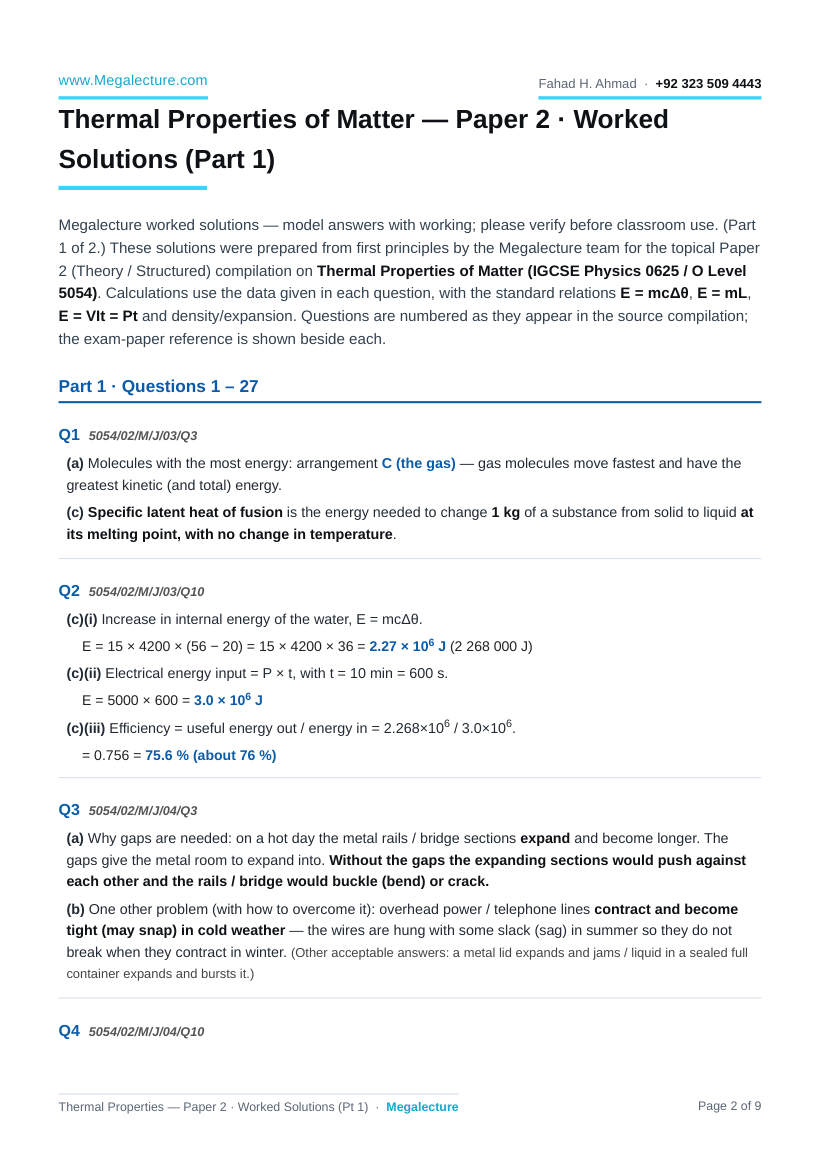
Thermal Properties of Matter — Paper 2 · Worked Solutions (Part 1)
Megalecture worked solutions — model answers with working; please verify before classroom use. (Part
1 of 2.) These solutions were prepared from first principles by the Megalecture team for the topical Paper
2 (Theory / Structured) compilation on Thermal Properties of Matter (IGCSE Physics 0625 / O Level
5054). Calculations use the data given in each question, with the standard relations E = mcΔθ, E = mL,
E = VIt = Pt and density/expansion. Questions are numbered as they appear in the source compilation;
the exam-paper reference is shown beside each.
Part 1 · Questions 1 – 27 Q1 5054/02/M/J/03/Q3
- Molecules with the most energy: arrangement C (the gas) — gas molecules move fastest and have the greatest kinetic (and total) energy.
- Specific latent heat of fusion is the energy needed to change 1 kg of a substance from solid to liquid at its melting point, with no change in temperature.
Q2 5054/02/M/J/03/Q10
(c)(i) Increase in internal energy of the water, E = mcΔθ.
E = 15 × 4200 × (56 − 20) = 15 × 4200 × 36 = 2.27 × 10⁶ J (2 268 000 J)
(c)(ii) Electrical energy input = P × t, with t = 10 min = 600 s.
E = 5000 × 600 = 3.0 × 10⁶ J
(c)(iii) Efficiency = useful energy out / energy in = 2.268×10⁶ / 3.0×10⁶.
= 0.756 = 75.6 % (about 76 %)
Q3 5054/02/M/J/04/Q3
- Why gaps are needed: on a hot day the metal rails / bridge sections expand and become longer. The gaps give the metal room to expand into. Without the gaps the expanding sections would push against each other and the rails / bridge would buckle (bend) or crack.
- One other problem (with how to overcome it): overhead power / telephone lines contract and become tight (may snap) in cold weather — the wires are hung with some slack (sag) in summer so they do not break when they contract in winter. (Other acceptable answers: a metal lid expands and jams / liquid in a sealed full container expands and bursts it.)
Q4 5054/02/M/J/04/Q10
Thermal Properties — Paper 2 · Worked Solutions (Pt 1) · Megalecture
- Determining density of the bar: (i) take the mass of the bar, and its length, width and thickness (or breadth and depth); (ii) instruments: a balance for the mass and a ruler / vernier callipers / micrometer for the lengths; (iii) calculate volume = length × width × thickness, then density = mass / volume.
(b)(i) Between t = 600 s and 1000 s the graph is flat — the temperature stays constant while the aluminium melts (changes from solid to liquid).
(b)(ii) Between t = 0 and 1000 s the molecules vibrate / move faster and with greater energy; during melting the energy goes into breaking the bonds and separating the molecules rather than raising their speed.
(b)(iii) Energy to warm the solid from 0 to 600 s. From the graph the temperature rises from about 0 °C to about 600 °C, so Δθ ≈ 600 °C. E = mcΔθ.
E = 0.030 × 880 × 600 = ≈ 1.6 × 10⁴ J (15 840 J)
Q5 5054/02/M/J/06/Q9
- Effect of each change on the amount of water evaporated each day:
- change 1 (heater raises temperature) → increases — molecules have more energy, more escape;
- change 2 (sheet of plastic covering half the surface) → decreases — smaller exposed surface area;
- change 3 (fan blowing air over the top) → increases — removes the humid air / evaporated molecules above the surface;
- change 4 (outside painted white) → decreases — white reflects sunlight so the water absorbs less heat / stays cooler.
(b)(i) Volume of water that evaporates = area × depth = 3.0 × 0.005 = 0.015 m3.
(b)(ii) Mass = density × volume = 1000 × 0.015 = 15 kg.
(b)(iii) Energy required = mL = 15 × 2.2×106 = 3.3 × 10⁷ J (33 000 000 J).
(b)(iv) Average rate = energy / time = 3.3×10⁷ / 40 000 = 825 W (≈ 830 J/s).
Q6 5054/02/M/J/07/Q2
(a)(i) At 80 °C the water molecules have more kinetic energy and move faster, so more molecules near the surface have enough energy to escape from the liquid — so more evaporates.
(a)(ii) One other change that speeds evaporation: increasing the surface area of the water (or a draught / wind blowing across the surface, or lower humidity / drier air above it).
Q7 5054/02/M/J/08/Q4
- Two changes of state:
- the nitrogen boils (liquid → gas) at −196 °C — the first flat part of the graph;
- the oxygen boils (liquid → gas) at −183 °C — the second flat part of the graph.
- Formula: E = mcΔθ, applied to each liquid (Δθ = −196 − (−205) = 9 °C), using masses in grams.
oxygen: 200 × 1.7 × 9 = 3060 J nitrogen: 800 × 2.0 × 9 = 14 400 J
Thermal Properties — Paper 2 · Worked Solutions (Pt 1) · Megalecture
Q8 5054/21/M/J/10/Q9
(e)(i) Energy supplied = P × t, with t = 5.0 min = 300 s.
E = 80 × 300 = 24 000 J (2.4 × 10⁴ J)
(e)(ii) Rise in temperature from E = mcΔθ ⇒ Δθ = E / (mc).
Δθ = 24 000 / (1.8 × 390) = 24 000 / 702 = 34 °C (34.2 °C)
Q9 5054/22/M/J/10/Q3
- Heat travels from the Sun to the Earth by radiation (infrared / electromagnetic waves). Conduction and convection need a material medium (particles), but space between the Sun and Earth is a vacuum, so only radiation can cross it.
- Through the metal roof heat passes by conduction: the heated surface molecules / free electrons gain energy, vibrate more and pass energy on to neighbouring particles; free electrons in the metal carry the energy quickly through to the cooler side.
- Mass from E = mcΔθ ⇒ m = E / (cΔθ).
m = (1.2 × 10⁶) / (400 × 20) = 1.2×10⁶ / 8000 = 150 kg
Q10 5054/22/M/J/10/Q4
- Two atmospheric changes that make the puddles evaporate faster: 1. higher temperature (warmer / sunnier); 2. more wind / a draught (and/or lower humidity — drier air).
- During evaporation, the faster (more energetic) molecules at the surface escape from the liquid into the air; this happens at any temperature, and it leaves the slower, lower-energy molecules behind so the remaining water cools.
Q11 5054/21/M/J/11/Q4
(b)(i) Energy is needed to change ice into water because it is used to break the bonds / pull apart the fixed lattice of molecules so they can move past one another (the molecules gain potential energy, not speed).
(b)(ii) Less energy is needed to melt ice than to boil the same mass of water because, in boiling, the molecules must be separated completely (fully pulled apart against attractive forces) to form a gas, whereas in melting they only need to be loosened slightly from the solid lattice — so far more energy (a larger latent heat) is required for boiling.
Q12 5054/22/M/J/11/Q11
(a)(i) From the graph: change in temperature between t = 0 and 100 s ≈ about 35 °C (e.g. 22 → 57 °C);
between t = 100 s and 200 s ≈ about 22 °C (e.g. 57 → 79 °C). The first interval has the larger rise.
(a)(ii) The values differ because, as the water gets hotter, it loses more heat to the surroundings (the beaker and air), so a smaller fraction of the heater's energy is left to raise the water's temperature — the rise per 100 s gets less.
Thermal Properties — Paper 2 · Worked Solutions (Pt 1) · Megalecture
(a)(iii) If heating continues the water reaches its boiling point (100 °C) and then the temperature stays constant while the water boils (turns to steam), because the energy supplied is used as latent heat to change state.
(b)(i) Specific heat capacity, c = E / (mΔθ), m = 72 g, Δθ = 23 °C.
c = 7400 / (72 × 23) = 7400 / 1656 = 4.5 J/(g °C) (≈ 4500 J/(kg °C))
(b)(ii) Kinetic energy = ½mv², m = 0.072 kg, v = 450 m/s.
KE = 0.5 × 0.072 × 450² = 0.5 × 0.072 × 202 500 = 7290 J (≈ 7.3 × 10³ J)
(b)(iii) Water: the molecules vibrate / move faster (gain random kinetic energy) — the internal energy and temperature rise. Bullet: all its molecules move together in the same direction with the same extra speed
— ordered motion, the bullet gains kinetic energy of the whole body (not a temperature rise).
Q13 5054/21/M/J/12/Q4
- The melting point is the temperature at which a substance changes from solid to liquid (and stays constant while it melts).
(b)(i) Between t = 0 and 4 min the energy makes the solid wax warmer — its temperature rises
(molecules vibrate faster).
(b)(ii) Between t = 4 min and 8 min the temperature is constant: the wax is melting, and the energy supplied is used to break the bonds and separate the molecules (latent heat) rather than raise the temperature.
- It expands more between t = 8 and 9 min because then the wax is liquid, and a liquid expands much more than a solid for the same temperature rise (its molecules are freer to move further apart).
Q14 5054/22/M/J/12/Q4
- Melting point = the constant temperature on the flat part A–B = 80 °C.
- Loss of thermal energy from t = 0 to 20 s. From the graph the liquid cools from 100 °C to about 85 °C, so
Δθ ≈ 15 °C; E = mcΔθ.
E = 60 × 1.7 × 15 = ≈ 1530 J (about 1.5 × 10³ J)
(c)(i) The temperature stays constant during A–B because the substance is solidifying (freezing): as bonds form, the molecules release latent heat, which replaces the energy lost to the surroundings, so the temperature does not fall.
(c)(ii) On going from liquid to solid the molecules become more closely packed, in a regular / fixed pattern
(lattice), and can only vibrate about fixed positions instead of moving around.
Q15 5054/21/M/J/13/Q10
(a)(i) A kilowatt-hour is the energy used by a 1 kW appliance running for 1 hour — i.e. the energy transferred
= power (in kW) × time (in hours). (1 kWh = 3.6 × 10⁶ J.)
(a)(ii) Energy in one week = power × time = 0.080 kW × (7 × 24) h = 0.080 × 168 = 13.44 kWh.
Cost = 13.44 × 25 = 336 cents ($3.36)
(b)(i) Energy removed = mcΔθ, m = 1.5 kg = 1500 g, c = 4.2 J/(g °C), Δθ = 25 °C.
Thermal Properties — Paper 2 · Worked Solutions (Pt 1) · Megalecture
E = 1500 × 4.2 × 25 = 157 500 J (≈ 1.6 × 10⁵ J)
Q16 5054/22/M/J/13/Q11
- Circuit: power supply, with the ammeter in series with the heater and the voltmeter connected in parallel across the heater.
(b)(i) Power = VI = 12 × 4.2 = 50.4 W.
(b)(ii) Energy in 8.0 min in kWh = power(kW) × time(h) = 0.0504 × (8/60).
E = 0.0504 × 0.1333 = 6.72 × 10⁻³ kWh (0.00672 kWh; = 24 192 J)
(c)(i) During evaporation the most energetic molecules at the surface escape into the air; this happens below the boiling point and only at the surface.
(c)(ii) A change that increases evaporation: a draught / wind across the surface — it carries away the escaped molecules so fewer return, increasing the net rate. (Or: larger surface area.)
(c)(iii) Two differences between evaporation and boiling:
- Evaporation happens only at the surface; boiling happens throughout the liquid (bubbles form inside).
- Evaporation occurs at any temperature; boiling occurs only at the (fixed) boiling point.
Q17 5054/21/M/J/14/Q2
- meter 1 (in series with the heater) measures the current; meter 2 (across the heater) measures the voltage (p.d.).
- Specific heat capacity, c = E / (mΔθ), m = 0.85 kg, Δθ = 40 − 18 = 22 °C.
c = 17 000 / (0.85 × 22) = 17 000 / 18.7 = 910 J/(kg °C) (909 J/(kg °C))
(c)(i) The hot air rises by convection: the air next to the block is heated, expands and becomes less dense, so it rises and is replaced by cooler, denser air (a convection current).
(c)(ii) To reduce heat loss: wrap / lag the block in insulation (and use a lid) to cut conduction and convection losses.
Q18 5054/22/M/J/14/Q3
(a)(i) Useful expansion example: a liquid-in-glass thermometer (the liquid expands up the tube), or a bimetallic strip in a thermostat. (ii) Problem example: railway lines / bridges / pipes buckling when they expand on a hot day.
- When a solid is heated the molecules gain energy and vibrate more strongly / with bigger amplitude, so on average they push slightly further apart — the solid expands.
- 1. The expansion of a solid is much smaller than the expansion of a liquid. 2. The expansion of a gas is much larger than the expansion of a liquid.
Q19 5054/22/M/J/14/Q10
Thermal Properties — Paper 2 · Worked Solutions (Pt 1) · Megalecture
(c)(i) Specific heat capacity = the energy needed to raise the temperature of 1 kg of a substance by 1 °C
(1 K).
(c)(ii) Disadvantage of water's high SHC in cooking: it takes a lot of energy / a long time to heat the water up (and to cool it down).
(c)(iii).1 Pan A: total energy lost = 9000 J/min × 8 min = 72 000 J. From the graph pan A cools 94 → 60 °C, so Δθ = 34 °C. m = E / (cΔθ).
m = 72 000 / (4200 × 34) = 72 000 / 142 800 = 0.50 kg
(c)(iii).2 Pan B has the same mass (0.50 kg). From the graph pan B cools 94 → 40 °C, so Δθ = 54 °C. E = mcΔθ.
E = 0.50 × 4200 × 54 = ≈ 1.1 × 10⁵ J (113 400 J)
Q20 5054/21/M/J/15/Q10
(b)(i) During evaporation the more energetic molecules at the surface escape from the liquid and become vapour (at any temperature).
(b)(ii) Evaporation cools the liquid because the fastest molecules leave, so the average energy (and therefore the temperature) of the molecules left behind decreases.
(c)(iii).1 Energy from heater = P × t = 200 × 120 = 24 000 J (2.4 × 10⁴ J).
(c)(iii).2 Energy to warm the water = mcΔθ, m = 100 g, c = 4.2 J/(g °C), Δθ = 20 °C.
E = 100 × 4.2 × 20 = 8400 J
(The difference, 24 000 − 8400 = 15 600 J, is lost as latent heat of vaporisation and to the surroundings.)
Q21 5054/22/M/J/15/Q4
- Energy released, E = mcΔθ, m = 330 g, c = 4.2 J/(g °C), Δθ = 15 − 2 = 13 °C.
E = 330 × 4.2 × 13 = 18 018 J (≈ 1.8 × 10⁴ J)
- Cooling is faster with water at 0 °C only than with melting ice because the melting ice also absorbs latent heat as it melts (extra energy taken from the liquid to change the ice from solid to liquid), so it removes more energy and cools the liquid more.
- The liquid in the metal can cools faster because metal is a much better conductor of heat than plastic, so heat passes out through the can walls more quickly.
Q22 5054/21/M/J/16/Q4
- For equal volumes heated through the same rise: "expands the most" → air (gas); "expands the least"
→ copper (solid). (Water, a liquid, lies in between.)
Q23 5054/22/M/J/16/Q4
- Inside each bubble in the boiling water is water vapour (steam) — not air.
Thermal Properties — Paper 2 · Worked Solutions (Pt 1) · Megalecture
- Evaporation cools the water because the most energetic (fastest) molecules escape from the surface, leaving the slower, lower-energy molecules behind, so the average kinetic energy — and hence the temperature — of the remaining water falls.
Q24 5054/22/M/J/17/Q4
- Specific heat capacity, c = E / (mΔθ), m = 850 g, Δθ = 38 − 16 = 22 °C.
c = 17 000 / (850 × 22) = 17 000 / 18 700 = 0.91 J/(g °C) (≈ 910 J/(kg °C))
- Heat capacity of the block = E / Δθ = mc = 850 × 0.91.
= 17 000 / 22 = 770 J/°C (≈ 773 J/°C)
- In the metal, conduction occurs as free (delocalised) electrons gain kinetic energy at the hot end, move through the metal and pass energy to cooler atoms; the vibrating atoms also pass energy on to their neighbours.
Q25 5054/21/M/J/18/Q10
(a)(i) Two differences between boiling and evaporation:
- Boiling happens throughout the liquid (bubbles of vapour form inside); evaporation happens only at the surface.
- Boiling occurs only at the fixed boiling point; evaporation occurs at any temperature below it.
(a)(ii) Energy is needed to boil a liquid because it is used to completely separate the molecules — pulling them apart against the forces of attraction to form a gas (latent heat of vaporisation).
(b)(i) Mass leaving in 1.0 s. In 1.0 min, volume = 4.6×10⁻³ m3, so mass = ρV = 1000 × 4.6×10−3 = 4.6 kg per minute. Per second = 4.6 / 60.
m = 0.0767 kg (≈ 7.7 × 10⁻² kg in 1.0 s)
(b)(ii) Thermal energy gained per 1.0 s = mcΔθ, m = 0.0767 kg, c = 4200 J/(kg °C), Δθ = 37 − 16 = 21 °C.
E = 0.0767 × 4200 × 21 = ≈ 6760 J (about 6.8 × 10³ J per second)
(b)(iii).1 The other quantity needed: the electrical power input to the heater (or the electrical energy supplied in the same time).
(b)(iii).2 Efficiency = (useful thermal energy given to the water) ÷ (electrical energy supplied to the heater), × 100 % — both taken over the same time (here 1.0 s).
(b)(iv) The metal pipe is earthed so that, if a fault makes the live wire touch the metal, a large current flows safely to earth and blows the fuse / trips the breaker, cutting off the supply — this stops the metal becoming live and giving the user an electric shock.
Q26 5054/21/M/J/19/Q2
- Renewable sources used to produce electricity: solar, tides, wave, wind (coal and oil are not renewable).
(b)(i) The hot underground water turns to steam; the steam (at high pressure) is forced past / pushes against the turbine blades, making the turbine spin (which drives the generator).
(b)(ii) Energy to heat the cooling-tower water = mcΔθ, m = 90 kg, c = 4200 J/(kg °C), Δθ = 160 − 30 = 130 °C.
Thermal Properties — Paper 2 · Worked Solutions (Pt 1) · Megalecture
E = 90 × 4200 × 130 = 4.9 × 10⁷ J (49 140 000 J)
Q27 5054/22/M/J/19/Q10
- Suitable melting points (must each be above the 380 °C working temperature for the tip, but the solder must melt at the tip):
- metal of the metal tip → 1000 °C (so the tip does not melt at 380 °C);
- solder → 200 °C (so it melts when touched to the 380 °C tip).
(b)(i) Electrical energy = VIt = 24 × 3.3 × 10.
E = 792 J (≈ 7.9 × 10² J)
(b)(ii) Thermal energy gained by the tip = mcΔθ, m = 2.3 g, c = 0.39 J/(g °C), Δθ = 320 − 20 = 300 °C.
E = 2.3 × 0.39 × 300 = 269 J (≈ 2.7 × 10² J)
Note from Megalecture. These are original Megalecture worked solutions prepared for revision use; graph readings
(Q4, Q12, Q14, Q19) are taken to the nearest sensible value, so accept small variations. Calculation answers were checked numerically. Part 2 of 2 continues with the remaining questions of this compilation.
Thermal Properties — Paper 2 · Worked Solutions (Pt 1) · Megalecture
