
IB Diploma · Chemistry · SL / HL · Structure 2: Models of Bonding and Structure
Structure 2.2 The Covalent Model
Need more than one subject? All-notes pass: unlimited downloads of every note for a year: unlimited downloads of every note on the site, PKR 999 a year. All packs and courses.
Opens inside this page. Prefer your own PDF app? Open the PDF.
Chemistry batch classes: coming soon. Small live classes at a lower fee than one-to-one. Join the waiting list
Check yourself
5 quick questions on Structure 2: Models of bonding and structure
Tap an answer to see if you are right, and why. Free, no sign-up.
Start the free testWas this note useful?
Full text of Structure 2.2 The Covalent Model
IB DP CHEMISTRY Structure 2: Models of Bonding and Structure Structure 2.2 The Covalent Model
Revision Notes · Standard and Higher Level Fahad H. Ahmad
Original notes prepared for the IB Diploma Programme Chemistry course (first assessment 2025)
Free notes, practice tests and live classes Back to megalecture.com
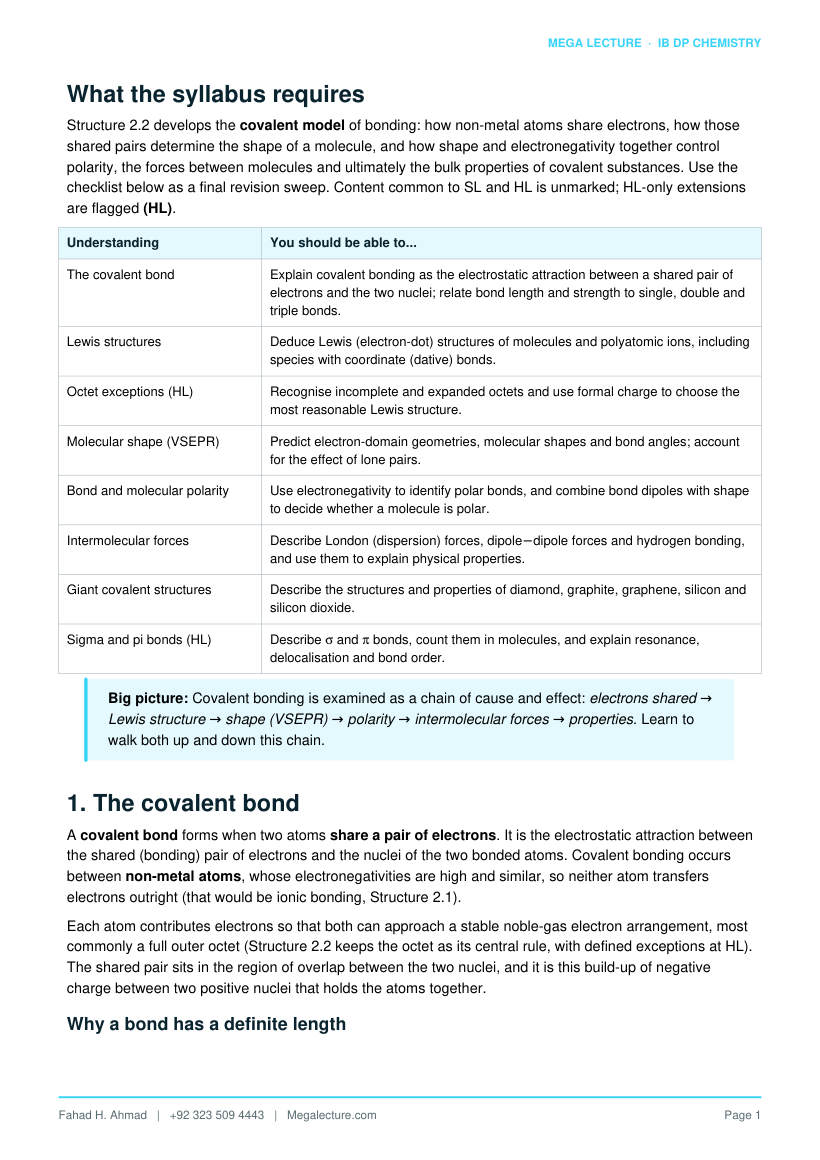
What the syllabus requires
Structure 2.2 develops the covalent model of bonding: how non-metal atoms share electrons, how those shared pairs determine the shape of a molecule, and how shape and electronegativity together control polarity, the forces between molecules and ultimately the bulk properties of covalent substances. Use the checklist below as a final revision sweep. Content common to SL and HL is unmarked; HL-only extensions are flagged (HL).
Understanding You should be able to...
The covalent bond Explain covalent bonding as the electrostatic attraction between a shared pair of electrons and the two nuclei; relate bond length and strength to single, double and triple bonds.
Lewis structures Deduce Lewis (electron-dot) structures of molecules and polyatomic ions, including species with coordinate (dative) bonds.
Octet exceptions (HL) Recognise incomplete and expanded octets and use formal charge to choose the most reasonable Lewis structure.
Molecular shape (VSEPR) Predict electron-domain geometries, molecular shapes and bond angles; account for the effect of lone pairs.
Bond and molecular polarity Use electronegativity to identify polar bonds, and combine bond dipoles with shape to decide whether a molecule is polar.
Intermolecular forces Describe London (dispersion) forces, dipole−dipole forces and hydrogen bonding, and use them to explain physical properties.
Giant covalent structures Describe the structures and properties of diamond, graphite, graphene, silicon and silicon dioxide.
Sigma and pi bonds (HL) Describe σ and π bonds, count them in molecules, and explain resonance, delocalisation and bond order.
Big picture: Covalent bonding is examined as a chain of cause and effect: electrons shared → Lewis structure → shape (VSEPR) → polarity → intermolecular forces → properties. Learn to walk both up and down this chain.
1. The covalent bond
A covalent bond forms when two atoms share a pair of electrons. It is the electrostatic attraction between the shared (bonding) pair of electrons and the nuclei of the two bonded atoms. Covalent bonding occurs between non-metal atoms, whose electronegativities are high and similar, so neither atom transfers electrons outright (that would be ionic bonding, Structure 2.1).
Each atom contributes electrons so that both can approach a stable noble-gas electron arrangement, most commonly a full outer octet (Structure 2.2 keeps the octet as its central rule, with defined exceptions at HL). The shared pair sits in the region of overlap between the two nuclei, and it is this build-up of negative charge between two positive nuclei that holds the atoms together.
Why a bond has a definite length
As two atoms approach, attraction between each nucleus and the other's electrons lowers the energy; but if they come too close, nucleus−nucleus and electron−electron repulsions rise steeply. The bond length is the internuclear separation at the energy minimum, and the depth of that minimum is a measure of the bond strength (bond enthalpy).
Figure 1. Potential energy of two atoms versus their separation. The curve has a minimum at the bond length (74 pm); its depth below the zero of separated atoms equals the bond enthalpy (436 kJ mol−1), the energy released on bond formation and required for dissociation.
Single, double and triple bonds
Atoms can share more than one pair. A single bond shares one pair, a double bond two pairs and a triple bond three pairs. Sharing more pairs pulls the nuclei closer and holds them more tightly.
Bond Shared pairs
Example Relative length Relative strength
Single (C−C) ethane, H3C−CH3 longest weakest
Double (C=C) ethene, H2C=CH2 shorter stronger
Triple (C≡C) ethyne, HC≡CH shortest strongest
The trends run in opposite directions: bond length decreases triple < double < single, while bond strength increases in the reverse order, single < double < triple. For carbon−carbon bonds the approximate lengths are 154, 134 and 120 pm, and the approximate bond enthalpies are 346, 614 and 839 kJ mol−1. Note that a double bond is stronger than a single bond but not twice as strong.
Exam note: Bond polarity aside, shorter bonds between the same pair of atoms are always stronger. You can quote the C−C / C=C / C≡C series from memory as evidence for a length−strength argument.
2. Lewis (electron-dot) structures
A Lewis structure shows every valence electron in a molecule or ion: bonding pairs as lines (or dots) between atoms and non-bonding lone pairs as dots on individual atoms. A good Lewis structure is the essential first step for VSEPR, polarity and (HL) sigma/pi counting, so the method is worth drilling.
A reliable step-by-step method
- 1. Count valence electrons. Add the outer-shell electrons of every atom. For an anion add one electron per negative charge; for a cation subtract one per positive charge.
- 2. Choose the central atom. Usually the least electronegative atom (except H, which is always terminal) — often the single atom of its kind, e.g. C in CO2, N in NH3.
- 3. Join atoms with single bonds, then place remaining electrons as lone pairs on the outer atoms first to complete their octets.
- 4. Give the central atom an octet. If electrons are short, form double or triple bonds by shifting lone pairs into bonding positions.
- 5. Check the total: every electron counted in step 1 must appear exactly once, and (HL) enclose ions in square brackets with the charge outside.
The octet rule
The octet rule states that atoms tend to gain, lose or share electrons to achieve eight electrons in the outer shell. Hydrogen is the obvious exception, being stable with two (a duplet). The octet rule works excellently for period 2 elements (C, N, O, F) and guides most Lewis structures you will meet at SL.
Worked patterns for common species
Species Valence e−
Central atom
Bonding pairs Lone pairs (central)
Description
H2O O 2 single two O−H bonds, 2 lone pairs on O
NH3 N 3 single three N−H bonds, 1 lone pair
CH4 C 4 single four C−H bonds, no lone pairs
CO2 C 2 double two C=O bonds, 2 lone pairs on each O
N2 − 1 triple 1 each N≡N, one lone pair per N
HCN C 1 single + 1 triple H−C≡N, lone pair on N
Polyatomic ions
Remember to adjust the electron count for charge. For the nitrate ion NO3
−: 5 (N) + 3×6 (O) + 1 (charge) = 24 electrons. For the ammonium ion NH4 +: 5 (N) + 4×1 (H) − 1 (charge) = 8 electrons. Always enclose the finished ion in square brackets and write the charge outside, e.g. [NO3]−.
Coordinate (dative) bonds
A coordinate or dative covalent bond is a covalent bond in which both shared electrons come from the same atom. Once formed it is identical to any other covalent bond; it is often drawn as an arrow pointing from the donor atom to the acceptor.
Species Donor → acceptor Comment
NH4
+ lone pair on N → H+ the fourth N−H bond is dative; all four are then equivalent
H3O+ lone pair on O → H+ oxonium ion; O has one remaining lone pair
CO lone pair on O → C carbon monoxide: C≡O, one bond of the triple bond is dative
Al2Cl6 lone pair on Cl → Al bridging Cl atoms donate to electron-deficient Al
Key idea: In NH4
+ the ion carries a single +1 charge overall, but no individual N−H bond is special: all four bonds and bond lengths are identical once the dative bond has formed.
3. (HL) Exceptions to the octet rule
At HL you must recognise molecules whose central atom does not have exactly eight electrons, and use formal charge to decide between competing Lewis structures.
Incomplete octet
Some stable molecules have a central atom with fewer than eight electrons. Beryllium and boron are the classic cases: in BeCl2 the Be atom has only 4 electrons, and in BF3 the B atom has only 6. These electron-deficient molecules are reactive Lewis acids: BF3 readily accepts a lone pair (e.g. from NH3) to form a dative bond and complete boron's octet.
Expanded octet
From period 3 onward, a central atom can accommodate more than eight electrons because it has available d orbitals of similar energy. Common examples:
Molecule Electrons around central atom Domains Shape
PCl5 10 (5 bonding pairs) trigonal bipyramidal
SF6 12 (6 bonding pairs) octahedral
ClF3 10 (3 bonding + 2 lone) T-shaped
XeF4 12 (4 bonding + 2 lone) square planar
SF4 10 (4 bonding + 1 lone) see-saw
Note that expanded octets are impossible for period 2 elements: N, O, C and F never exceed an octet because they have no accessible d orbitals. This is why “NF5” does not exist while PF5 does.
Formal charge
Formal charge (FC) is the charge an atom would carry if all bonding electrons were shared equally. It helps identify the most reasonable Lewis structure when several are possible.
FC = (valence electrons) − (non-bonding electrons) − ½(bonding electrons)
The preferred Lewis structure is the one in which formal charges are closest to zero, and in which any negative formal charge sits on the most electronegative atom. The sum of the formal charges must equal the overall charge of the species.
Worked example — formal charge in CO2 and the sulfate ion
For O=C=O, carbon: FC = 4 − 0 − ½(8) = 0. Each oxygen: FC = 6 − 4 − ½(4) = 0. All formal charges are zero, confirming the double-bonded structure is best.
For the sulfate ion [SO4]2−, the structure using expanded-octet S=O double bonds lowers the formal charges on sulfur and oxygen compared with an all-single-bond model, which is why the expanded-octet drawing is often preferred at HL. Either way the formal charges must sum to −2.
4. Molecular shape: VSEPR theory
Valence Shell Electron Pair Repulsion (VSEPR) theory predicts the shape of a molecule from one simple idea: the electron domains around a central atom arrange themselves as far apart as possible, because regions of negative charge repel. An electron domain is a region of electron density — a single, double or triple bond each counts as one domain, and so does a lone pair.
Method: (1) draw the Lewis structure; (2) count the electron domains on the central atom; (3) place the domains in the geometry that maximises their separation; (4) name the shape from the positions of the atoms only (lone pairs are invisible in the final shape but still push on the bonds).
Two, three and four domains (SL and HL)
Domains Bonding / lone
Shape Ideal angle Example
2 / 0 linear 180° CO2, BeCl2
3 / 0 trigonal planar 120° BF3, CO3
2−
2 / 1 bent (V-shaped) <120° (~118°) SO2, O3
4 / 0 tetrahedral 109.5° CH4, NH4
+
3 / 1 trigonal pyramidal 107° NH3, H3O+
2 / 2 bent (V-shaped) 104.5° H2O, OF2
Figure 2. VSEPR parent shapes and ideal bond angles: linear (180°), trigonal planar (120°), tetrahedral (109.5°), and the lone-pair-distorted trigonal pyramidal (107°) and bent (104.5°) geometries.
The effect of lone pairs on bond angle
A lone pair is held by only one nucleus, so it spreads out closer to the central atom and occupies more angular space than a bonding pair. The order of repulsion is:
So each lone pair squeezes the bonding pairs together and reduces the bond angle below the ideal value. Starting from the tetrahedral 109.5°: methane CH4 (no lone pairs) keeps 109.5°; ammonia NH3 (one lone pair) falls to about 107°; water H2O (two lone pairs) falls further to 104.5°. Each extra lone pair removes roughly 2−3°.
Exam technique: State the reasoning, not just the number: “two lone pairs on oxygen repel more strongly than bonding pairs, compressing the H−O−H angle to 104.5°.” Markschemes reward the cause, not only the value.
(HL) Five and six electron domains
At HL, central atoms with expanded octets give two further parent geometries. Lone pairs preferentially occupy the positions of lowest repulsion — the equatorial sites in a trigonal bipyramid — which generates the see-saw, T-shape and (for six domains) square planar shapes.
Domains Bonding / lone
Shape Ideal angle(s) Example
5 / 0 trigonal bipyramidal 120° (eq), 90° (ax) PCl5
4 / 1 see-saw ~117°, ~89° SF4
3 / 2 T-shaped ~87.5° ClF3
2 / 3 linear 180° XeF2
6 / 0 octahedral 90° SF6
5 / 1 square pyramidal ~90° BrF5
4 / 2 square planar 90° XeF4
Memory hook: For 5 domains lone pairs always go equatorial (more room, only two 90° neighbours). For 6 domains, two lone pairs go opposite each other (trans), giving the flat square planar shape of XeF4.
5. Bond polarity
When two different atoms bond, the more electronegative atom pulls the shared pair towards itself. Electronegativity is the ability of an atom to attract a bonding pair of electrons. The unequal sharing makes the bond polar: the more electronegative atom carries a small negative charge (δ−) and the other a small positive charge (δ+).
The size of the electronegativity difference (ΔEN) tells you the bond type on a continuum:
ΔEN (Pauling) Bond character Example pure (non-polar) covalent H−H, Cl−Cl
0 < ΔEN < ~1.8 polar covalent H−Cl (0.9), O−H (1.4)
ΔEN (Pauling) Bond character Example
> ~1.8 predominantly ionic NaCl (2.1), MgO (2.3)
Figure 3. Pauling electronegativity difference ΔEN for selected bonds. Small ΔEN gives non-polar or slightly polar covalent bonds; larger values give polar covalent bonds; above about 1.8 the bonding is predominantly ionic.
These boundaries are guidelines, not sharp lines: bonding is a continuum from pure covalent through polar covalent to ionic. A polar bond is described by a dipole — a separation of charge with a direction, conventionally drawn as an arrow pointing from δ+ to δ−. For example the hydrogen chloride bond is written Hδ+−Clδ−, the chlorine being more electronegative.
Data booklet: Electronegativity values are provided in the data booklet, so you are never expected to memorise them — but do learn the trend: electronegativity increases across a period and up a group, peaking at fluorine.
6. Molecular polarity
A molecule may contain polar bonds yet be non-polar overall. Whether a molecule is polar depends on two things: the polarity of its bonds and its shape. Each polar bond is a vector dipole; the molecule is polar only if these bond dipoles do not cancel.
- If the polar bonds are arranged symmetrically around the central atom, their dipoles cancel and the molecule is non-polar (no net dipole moment).
- If the arrangement is asymmetric — often because of a lone pair or different terminal atoms — the dipoles do not cancel and the molecule is polar.
Contrasting examples
Molecule Shape Bonds Symmetric? Net dipole?
CO2 linear two polar C=O yes (dipoles opposed) non-polar
H2O bent two polar O−H no (lone pairs) polar
Molecule Shape Bonds Symmetric? Net dipole?
CCl4 tetrahedral four polar C−Cl yes non-polar
CHCl3 tetrahedral C−H and C−Cl differ no polar
BF3 trigonal planar three polar B−F yes non-polar
NH3 trigonal pyramidal three polar N−H no (lone pair) polar
The comparison of CO2 with H2O is the archetype: both contain polar bonds to oxygen, but the linear geometry of CO2 makes the two equal and opposite dipoles cancel exactly, while the bent geometry of water leaves a net dipole pointing from the H atoms towards the O. Likewise CCl4 is non-polar because its four identical C−Cl dipoles point to the corners of a tetrahedron and sum to zero, whereas replacing one Cl with H (CHCl3) breaks the symmetry and produces a polar molecule.
Common pitfall: “Polar bonds” and “polar molecule” are not the same thing. Always check the shape before deciding: CO2 and CCl4 both have polar bonds but zero net dipole because they are symmetric.
7. Intermolecular forces
The covalent bonds within a molecule are strong; the forces between separate molecules — the intermolecular forces (IMF) — are much weaker but they determine the physical properties of molecular substances: melting and boiling points, volatility and solubility. When a molecular substance melts or boils, it is these weak forces that are overcome, not the covalent bonds.
There are three types to know, in increasing strength for molecules of comparable size:
London (dispersion) forces
Present between all molecules. The constant motion of electrons creates a momentary, instantaneous dipole, which induces an opposite dipole in a neighbour; the two attract. They are the only IMF between non-polar molecules (and noble gases). Their strength grows with the number of electrons — that is, with molar mass — and with a molecule's surface area of contact. Straight-chain molecules have stronger dispersion forces than their branched isomers because they touch over a larger area.
Dipole−dipole forces
Present between polar molecules (those with a permanent dipole). The δ+ end of one molecule attracts the δ− end of the next. For molecules of similar size, a polar substance boils higher than a non-polar one because it has dipole−dipole forces in addition to dispersion forces. Compare propane (non-polar, boiling point −42°C) with ethanal (polar, +20°C), both with similar molar mass.
Hydrogen bonding
A hydrogen bond is the strongest intermolecular force. It arises when hydrogen is bonded directly to a small, highly electronegative atom — N, O or F — leaving the H strongly δ+; it is then attracted to a lone pair on an N, O or F atom of a neighbouring molecule. The requirements are strict:
- an H atom covalently bonded to N, O or F, and
- an available lone pair on an N, O or F atom nearby.
Hydrogen bonding explains the anomalously high boiling points of H2O, NH3 and HF compared with the other hydrides in their groups, the fact that ice is less dense than liquid water (an open, hydrogen-bonded lattice), and the solubility of ammonia, alcohols and sugars in water.
Force Present between Relative strength Depends on
London (dispersion) all molecules weakest number of electrons / molar mass; surface area
Dipole−dipole polar molecules intermediate size of the permanent dipole
Hydrogen bond molecules with N−H, O−H or F−H strongest (of the three) presence of N/O/F−H and a lone pair
Using IMF to explain properties
- Boiling / melting point: stronger IMF → more energy needed to separate molecules → higher boiling point.
- Volatility: weaker IMF → molecules escape the liquid easily → more volatile (evaporates readily).
- Solubility: “like dissolves like” — polar and hydrogen-bonding solutes dissolve in polar solvents such as water; non-polar solutes dissolve in non-polar solvents.
Ranking rule: To compare boiling points, first ask which IMF each molecule has (H-bond > dipole−dipole > dispersion). Only if the IMF type is the same do you then compare molar mass / electron count.
8. Giant covalent (network) structures
Some covalent substances are not made of discrete molecules at all. In a giant covalent (covalent network) structure, a virtually unlimited number of atoms is joined by a continuous three-dimensional (or, for graphite, two-dimensional) network of strong covalent bonds. There are no weak intermolecular forces to overcome, so these substances have very high melting points and are typically hard.
Substance Structure Bonding around each atom
Key properties
Diamond 3-D tetrahedral network of C
4 single C−C bonds, 109.5° extremely hard; very high mp; electrical insulator; poor... no free electrons
Graphite layers of hexagonal rings of C
3 σ bonds per C (120°); 4th e delocalised soft/slippery (weak forces between layers); conducts electricity along layers; high mp
Graphene single layer of graphite (one atom thick)
3 bonds per C; delocalised electrons very strong; excellent electrical and thermal conductor; nearly transparent
Silicon (Si) 3-D tetrahedral network like diamond
4 single Si−Si bonds hard; high mp; a semiconductor
Silicon dioxide (SiO2)
3-D network; each Si bonded to 4 O, each O to 2 Si
4 Si−O bonds per Si very hard; very high mp; electrical insulator (quartz, sand)
Comparing diamond and graphite
Both are allotropes of pure carbon, yet their properties differ sharply because of structure. In diamond every carbon forms four single bonds in a rigid tetrahedral lattice, so all four outer electrons are localised in bonds: the result is the hardest natural material and an electrical insulator. In graphite each carbon forms only three bonds within flat layers, so the fourth electron is delocalised; these mobile electrons conduct electricity along the layers, while only weak London forces hold the layers together, letting them slide — which is why graphite is soft and acts as a lubricant.
Property = structure: Whenever you explain a property of a giant covalent solid, trace it back to the bonding: strong covalent network → high mp and hardness; delocalised electrons (graphite, graphene) → electrical conductivity; weak forces between layers (graphite) → softness.
9. (HL) Sigma and pi bonds, resonance and bond order
At HL the covalent bond is refined in terms of how atomic orbitals overlap. Two kinds of overlap give two kinds of bond.
- A sigma (σ) bond forms by end-on (head-on) overlap of orbitals along the internuclear axis. The electron density is concentrated between the two nuclei. Every single bond is a σ bond.
- A pi (π) bond forms by sideways overlap of p orbitals above and below the internuclear axis. It is weaker than a σ bond because the sideways overlap is less effective.
Bond Composition Example σ : π
Single 1 σ C−C in ethane 1 : 0
Double 1σ+1π C=C in ethene 1 : 1
Triple 1σ+2π C≡C in ethyne 1 : 2
Rotation and reactivity
A σ bond is cylindrically symmetrical, so groups joined by a single bond can rotate freely. A π bond locks the two atoms in place: rotating would break the sideways overlap, so a C=C double bond is rigid — this restricted rotation is what makes cis−trans (E/Z) isomerism possible. The exposed π electron density above and below the bond also makes double and triple bonds more reactive (electron-rich sites for electrophilic attack) than single bonds.
Resonance and delocalisation
Sometimes a single Lewis structure cannot describe a molecule properly, because the electrons are actually delocalised — spread over more than two atoms. We draw two or more resonance structures linked by a double-headed arrow (↔); the real species is a single resonance hybrid, an average of them, and does not flick between the structures.
Species Resonance / delocalisation Evidence
Ozone, O3 one π system delocalised over 3 O atoms both O−O bonds equal, intermediate between single and double
Species Resonance / delocalisation Evidence
Carbonate, CO3
2− π electrons delocalised over C and 3 O three identical C−O bonds of equal length
Benzene, C6H6 6 π electrons delocalised in a ring all six C−C bonds equal (~139 pm); ring is unusually stable
Benzene is the classic case: rather than alternating single and double bonds, its six delocalised π electrons form rings of density above and below the planar hexagon, making every carbon−carbon bond identical and the molecule far more stable (and less reactive) than isolated double bonds would be.
Bond order
Bond order is the number of shared electron pairs between two atoms: 1 for a single bond, 2 for a double, 3 for a triple. Where electrons are delocalised the bond order can be fractional. In ozone each O−O bond has a bond order of 1.5 (one σ bond plus half of one delocalised π bond); in carbonate each C−O bond order is about 1.33 (one σ plus one π shared over three bonds). Higher bond order means a shorter, stronger bond.
Counting shortcut: In any molecule, the number of σ bonds equals the number of bonded-atom links (single + double + triple all count once). The number of π bonds equals (double bonds) + 2×(triple bonds).
10. Worked examples
Work through each of these with the notes closed, then check your reasoning against the solution.
Worked example 1 — Lewis structure and shape of NH3
Deduce the Lewis structure of ammonia and predict its shape and bond angle.
Valence electrons = 5 (N) + 3×1 (H) = 8, i.e. 4 pairs. Three pairs bond to H; one is a lone pair on N. Four electron domains → tetrahedral electron geometry.
With three bonding pairs and one lone pair the shape is trigonal pyramidal. The lone pair repels more strongly, compressing the angle from 109.5° to about 107°.
Worked example 2 — shape of the sulfate ion [SO4]2−
Predict the shape and bond angle of the sulfate ion.
Sulfur is the central atom, surrounded by four oxygen atoms and (in the common HL expanded-octet model) no lone pairs: four electron domains.
Four domains, all bonding → tetrahedral, bond angle 109.5°. The 2− charge is spread over the ion and all four S−O bonds are equivalent by resonance.
Worked example 3 — is SO2 polar?
Decide whether sulfur dioxide is a polar molecule.
SO2 has three electron domains on S (two S=O bonds and one lone pair), giving a bent shape (~118°). The two S=O bonds are polar (O more electronegative).
Because the molecule is bent, the two bond dipoles do not cancel: there is a net dipole, so SO2 is polar. (Contrast the linear, non-polar CO2.)
Worked example 4 — rank boiling points by IMF
Rank these in order of increasing boiling point: CH4, HCl, CH3OH, C2H6.
Identify the strongest IMF in each: CH4 and C2H6 are non-polar (dispersion only); HCl is polar (dipole−dipole); CH3OH has O−H, so hydrogen bonding.
Order of IMF strength: dispersion < dipole−dipole < hydrogen bond. Among the two non-polar ones, C2H6 has more electrons than CH4. So boiling point increases: CH4 < C2H6 < HCl < CH3OH.
Worked example 5 — (HL) count σ and π bonds in HCN
How many σ and π bonds are in hydrogen cyanide, H−C≡N?
The H−C single bond = 1 σ. The C≡N triple bond = 1 σ + 2 π.
Total: 2 σ bonds and 2 π bonds. Nitrogen also carries one lone pair, which is not a bond.
Worked example 6 — (HL) formal charge in the thiocyanate ion
For [SCN]−, compare the structure [S=C=N]− with [S≡C−N]− and choose the better one.
In [S=C=N]−: S has FC = 6−4−½(4) = 0; C = 4−0−½(8) = 0; N = 5−4−½(4) = −1. Formal charges are small and the −1 sits on nitrogen.
Nitrogen is more electronegative than sulfur, so placing the negative formal charge on N is favourable: the [S=C=N]− structure is preferred.
Worked example 7 — why does H2O boil higher than H2S?
Explain why water (boiling point 100°C) boils far higher than hydrogen sulfide (−60°C), despite H2S being heavier.
Both are bent, polar molecules, but only water has O−H bonds and lone pairs on a small, highly electronegative O, so water molecules form hydrogen bonds.
Hydrogen bonds are much stronger than the dipole−dipole and dispersion forces in H2S, so far more energy is needed to separate water molecules → much higher boiling point. Molar mass is outweighed by the change in IMF type.
11. Common pitfalls
- Confusing polar bonds with a polar molecule — always check the shape (CO2 and CCl4 have polar bonds but are non-polar).
- Claiming hydrogen bonding for the wrong molecules: it requires H bonded directly to N, O or F. HCl and CH3Cl cannot hydrogen bond.
- Saying “covalent bonds break when a substance melts.” For molecular solids only the intermolecular forces are overcome; the covalent bonds stay intact.
- Counting a double or triple bond as two or three electron domains in VSEPR — a multiple bond is one domain.
- Forgetting to include lone pairs when working out shape, or including them when naming the shape (the name uses atom positions only).
- Giving a bond angle without a reason. Markschemes want the lone-pair repulsion argument, e.g. why H2O is 104.5° not 109.5°.
- (HL) Assigning an expanded octet to a period 2 atom (N, O, F, C never exceed eight electrons).
12. Quick reference: shapes and angles
Total domains
Bond / lone pairs
Shape Ideal angle Example
2 / 0 linear 180° CO2
3 / 0 trigonal planar 120° BF3
2 / 1 bent <120° SO2
4 / 0 tetrahedral 109.5° CH4
3 / 1 trigonal pyramidal 107° NH3
2 / 2 bent 104.5° H2O
5 (HL) 5 / 0 trigonal bipyramidal 120° & 90° PCl5
5 (HL) 4 / 1 see-saw ~117°, ~89° SF4
5 (HL) 3 / 2 T-shaped ~87.5° ClF3
Total domains
Bond / lone pairs
Shape Ideal angle Example
6 (HL) 6 / 0 octahedral 90° SF6
6 (HL) 4 / 2 square planar 90° XeF4
13. Test yourself
Attempt all ten without notes, then check the worked answers that follow.
- Draw the Lewis structure of CO2 and state how many bonding and non-bonding pairs it contains.
- Predict the shape and bond angle of the hydronium ion H3O+.
- Explain why BF3 is non-polar but NF3 is polar, even though both contain three polar bonds.
- Arrange in order of increasing boiling point: Cl2, HCl, CH3CH2OH. Justify with IMF.
- Identify the strongest intermolecular force in (a) CH3F, (b) CH3OH, (c) CH4.
- State and explain the trend in bond length and bond strength for the C−C, C=C and C≡C bonds.
- Explain why graphite conducts electricity and is soft, whereas diamond does not conduct and is hard.
- (HL) Count the σ and π bonds in ethene, H2C=CH2.
- (HL) The carbonate ion has three equal C−O bonds. Explain this using resonance and give the bond order.
- Explain why ice floats on liquid water in terms of hydrogen bonding.
Answers
- O=C=O. Two C=O double bonds (2 bonding pairs at the central C, counted as 2 domains); each oxygen carries two lone pairs, so 4 lone pairs in total, none on carbon. Shape linear, 180°.
- O has 4 domains (3 bonding to H, 1 lone pair) → trigonal pyramidal, angle about 107° (the lone pair compresses it below 109.5°).
- BF3 is trigonal planar and symmetric, so the three B−F dipoles cancel → non-polar. NF3 is trigonal pyramidal (N has a lone pair); the dipoles do not cancel → polar.
- Cl2 (non-polar, dispersion only) < HCl (polar, dipole−dipole) < CH3CH2OH (hydrogen bonding, O−H). Increasing IMF strength → increasing boiling point.
- (a) dipole−dipole (polar C−F, but no O/N/F−H, so no H-bond); (b) hydrogen bonding (O−H); (c) London dispersion only (non-polar).
- Length: C≡C < C=C < C−C (more shared pairs pull the nuclei closer). Strength: C−C < C=C < C≡C (shorter bonds are harder to break). The two trends are opposite.
- In graphite each C forms only 3 bonds, leaving a delocalised electron per atom that conducts along the layers; weak London forces between layers let them slide (soft). In diamond all 4 outer electrons are localised in a rigid tetrahedral network → no free electrons (insulator) and very hard.
- Four C−H single bonds (4 σ) plus the C=C bond (1 σ + 1 π): total 5 σ and 1 π.
- The π electrons are delocalised over the carbon and all three oxygens (three resonance structures), so every C−O bond is identical and intermediate between single and double. Bond order = 1.33 (4/3).
- On freezing, each water molecule forms four hydrogen bonds in a fixed, open tetrahedral lattice with large gaps. This spaced-out arrangement makes ice less dense than liquid water, so ice floats.
