
IB Diploma · Chemistry · SL / HL · Structure 2: Models of Bonding and Structure
Structure 2.1 The Ionic Model
Need more than one subject? All-notes pass: unlimited downloads of every note for a year: unlimited downloads of every note on the site, PKR 999 a year. All packs and courses.
Opens inside this page. Prefer your own PDF app? Open the PDF.
Chemistry batch classes: coming soon. Small live classes at a lower fee than one-to-one. Join the waiting list
Check yourself
5 quick questions on Structure 2: Models of bonding and structure
Tap an answer to see if you are right, and why. Free, no sign-up.
Start the free testWas this note useful?
Full text of Structure 2.1 The Ionic Model
IB DP CHEMISTRY Structure 2: Models of Bonding and Structure Structure 2.1 The Ionic Model
Revision Notes · Standard and Higher Level Fahad H. Ahmad
Original notes prepared for the IB Diploma Programme Chemistry course (first assessment 2025)
Free notes, practice tests and live classes Back to megalecture.com
What the syllabus requires
Structure 2.1 introduces the first of the three bonding models. Use this checklist to confirm you can do each item before the exam. Higher Level material is flagged (HL) throughout these notes.
Understanding You should be able to...
Ionic bonding Explain how the electrostatic attraction between oppositely charged ions, formed by electron transfer from a metal to a non-metal, produces an ionic bond.
Predicting charges Deduce the charge of a monatomic ion from its position in the periodic table, and recall the common polyatomic ions.
Formulae and names Construct formulae of ionic compounds by balancing charge, and name binary and polyatomic compounds (including variable transition-metal charges).
The ionic lattice Describe the giant three-dimensional lattice and relate it to the non-directional nature of ionic bonding.
Physical properties Explain melting point, conductivity, brittleness and solubility using the lattice model.
Lattice enthalpy Discuss how ionic charge and ionic radius affect lattice enthalpy through Coulomb's law.
Born−Haber (HL) Define lattice enthalpy, construct a Born−Haber cycle, and apply Hess's law to determine it; compare experimental and theoretical values as evidence of covalent character.
Exam note: The ionic model is one of a set. Examiners often ask you to contrast ionic, covalent (2.2) and metallic (2.3) bonding, so keep the distinguishing features of each clearly separated in your mind.
1. How the ionic bond forms
An ionic bond typically forms between a metal and a non-metal. Metals have low ionization energies and lose their outer (valence) electrons readily; non-metals have highly negative electron affinities and gain electrons readily. When the two meet, one or more electrons are transferred from the metal atom to the non-metal atom.
Each atom changes into an ion - a charged particle - and both usually attain the stable electron configuration of the nearest noble gas (a full outer shell). The metal becomes a positively charged cation; the non-metal becomes a negatively charged anion.
Electron-transfer diagram: sodium and chlorine
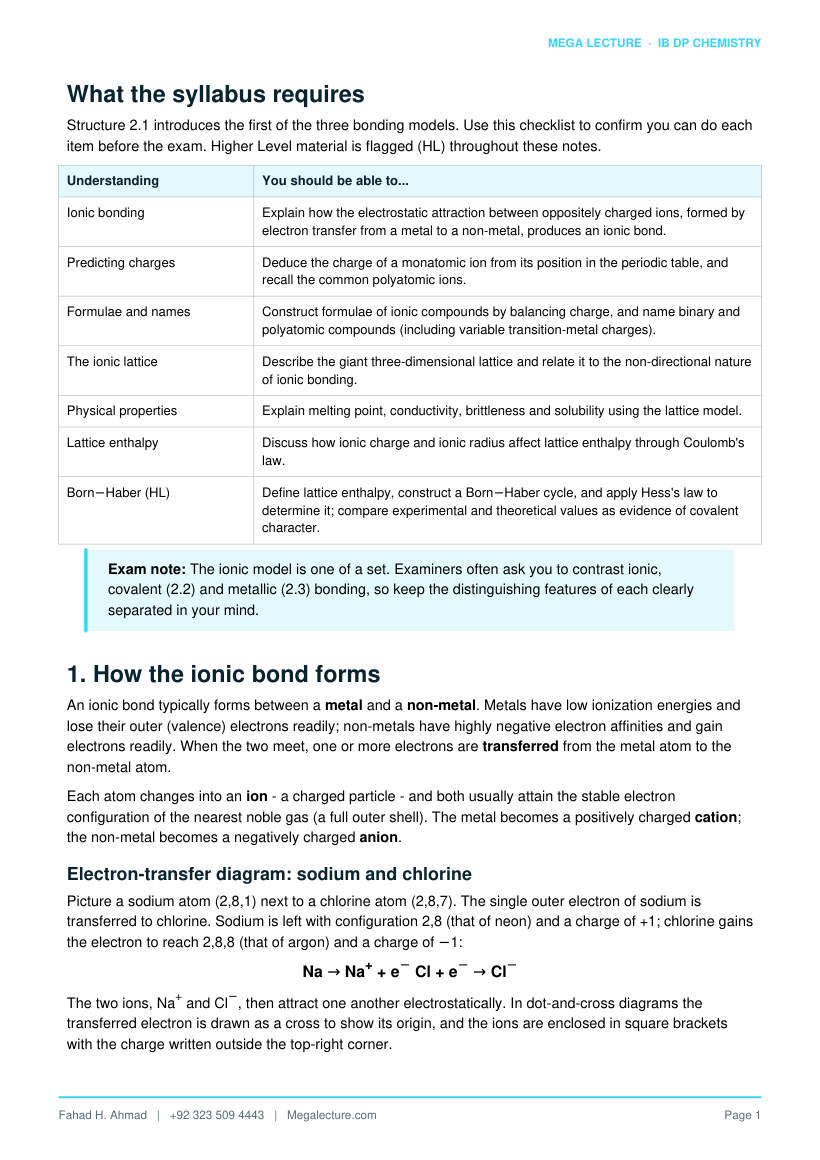
Picture a sodium atom (2,8,1) next to a chlorine atom (2,8,7). The single outer electron of sodium is transferred to chlorine. Sodium is left with configuration 2,8 (that of neon) and a charge of +1; chlorine gains the electron to reach 2,8,8 (that of argon) and a charge of −1:
Na → Na+ + e− Cl + e− → Cl−
The two ions, Na+ and Cl−, then attract one another electrostatically. In dot-and-cross diagrams the transferred electron is drawn as a cross to show its origin, and the ions are enclosed in square brackets with the charge written outside the top-right corner.
Electron-transfer diagram: magnesium and oxygen
Magnesium (2,8,2) loses both outer electrons; oxygen (2,6) gains two. Both reach the neon configuration (2,8), giving Mg2+ and O2−. Because the charges are larger, the attraction is far stronger than in NaCl - a fact we return to under lattice enthalpy.
Mg → Mg2+ + 2e− O + 2e− → O2−
Key idea: The bond is not the transfer itself; the bond is the electrostatic attraction between the oppositely charged ions that result. Transfer creates the ions; attraction holds them together.
Which electrons, and how many?
A metal loses electrons from its outer shell only, and it loses exactly the number that leaves a stable, full-shell configuration - one for group 1, two for group 2, three for group 13. A non-metal gains just enough to complete its outer shell. The number of electrons transferred therefore fixes both the ion charges and the ratio in which the ions combine, which is why the formula of an ionic compound is not arbitrary but follows from the elements involved.
Energetics of ion formation
Forming the ions actually costs energy overall: ionizing the metal always absorbs energy, and although adding the first electron to a non-metal usually releases energy, this rarely repays the ionization cost. The reaction is still strongly exothermic because a third step - the ions coming together into a lattice - releases a very large amount of energy. This lattice-formation energy is the true driving force, and it is quantified at HL by the lattice enthalpy (section 7).
Watch the wording: Atoms do not gain or lose electrons “to become stable” as a goal; they do so because the overall process, dominated by lattice formation, lowers the energy of the system. The noble-gas configuration is the outcome, not the motive.
2. Predicting the charges of ions
For a monatomic ion (a single atom), the charge follows directly from the group number of a main-group element, because atoms gain or lose electrons to reach a full outer shell:
Group
Ion charge +1 +2 +3 3− 2− 1− 0 (none)
Example Na+ Mg2+ Al3+ N3− O2− Cl− Ar
Metals in groups 1, 2 and 13 lose 1, 2 and 3 electrons respectively. Non-metals in groups 15, 16 and 17 gain 3, 2 and 1 electrons. Group 18 elements already have full shells and do not normally form ions.
Transition elements are the important exception: they commonly form more than one stable ion (for example Fe2+ and Fe3+, or Cu+ and Cu2+), so their charge cannot be read from a group number and must be given by a Roman numeral in the name.
Common polyatomic ions
A polyatomic ion is a group of covalently bonded atoms that carries an overall charge and behaves as a single unit in ionic compounds. These must be memorised:
Name Formula Charge Name Formula Charge
Ammonium NH4
+ +1 Hydroxide OH− 1−
Nitrate NO3
− 1− Hydrogen-carbonat e
HCO3
− 1−
Sulfate SO4
2− 2− Carbonate CO3
2− 2−
Phosphate PO4
3− 3− Nitrite NO2
− 1−
Sulfite SO3
2− 2− Hydrogen-sulfate HSO4
− 1−
Memory hook: Only one common positive polyatomic ion appears at this level - ammonium, NH4
+. Every other polyatomic ion in the table is negative. Learn the sulfate/nitrate/carbonate/phosphate set first; the rest are variations on them.
3. Writing formulae and naming ionic compounds
An ionic compound is electrically neutral overall, so its formula is fixed by one rule: total positive charge must equal total negative charge. A quick, reliable method is to cross over the numerical charges to give the subscripts, then cancel to the simplest ratio.
Cation Anion Balance Formula
Na+ Cl− 1 : 1 NaCl
Ca2+ Cl− one 2+ needs two 1− CaCl2
Al3+ O2− cross over → 2 and 3 Al2O3
Mg2+ O2− 2 : 2 cancels to 1 : 1 MgO
NH4
+ SO4
2− two 1+ per 2− (NH4)2SO4
Ca2+ NO3
− one 2+ needs two 1− Ca(NO3)2
Fe3+ OH− one 3+ needs three 1− Fe(OH)3 Note the use of brackets around a polyatomic ion whenever more than one of it is present, as in (NH4)2SO4 and Ca(NO3)2. Without brackets the subscript would wrongly apply to a single atom only.
Naming the compounds
- The cation is named first, keeping the element name unchanged (sodium, calcium, aluminium).
- A monatomic anion takes the ending -ide: chloride, oxide, sulfide, nitride.
- A polyatomic anion keeps its own name: sulfate, nitrate, carbonate, hydroxide.
- For a variable-charge transition metal, give the ion charge as a Roman numeral: FeCl2 is iron(II) chloride, FeCl3 is iron(III) chloride, Cu2O is copper(I) oxide.
Common error: The Roman numeral gives the charge on the metal ion, not the number of atoms. In iron(III) oxide the iron is +3, and balancing +3 against O2− gives the formula Fe2O3.
4. The ionic lattice
Ionic compounds do not exist as separate molecules. Instead the ions pack together into a giant three-dimensional lattice - a regularly repeating arrangement that extends throughout the crystal, held together by electrostatic forces. The chemical formula therefore states only the simplest whole-number ratio of ions, not the number of atoms in a molecule.
Sodium chloride is the standard example. Each Na+ ion is surrounded by six Cl− ions, and each Cl− ion by six Na+ ions, in an alternating cubic arrangement (a coordination number of 6). The formula NaCl reflects the 1 : 1 ratio, even though a single crystal contains a vast number of ions.
The attractions act equally in all directions - the ionic bond is non-directional. This is a crucial contrast with covalent bonding, where shared pairs point in specific directions. The non-directional, extended nature of the lattice is the origin of almost every physical property discussed next.
Exam phrase: Describe the lattice as a “regular repeating three-dimensional arrangement of oppositely charged ions held together by strong electrostatic attractions acting in all directions.” Marks are awarded for strong, electrostatic and all directions.
Figure 1. The sodium chloride lattice (a slice through the giant 3-D array): Na+ and Cl− ions alternate so that each ion is surrounded by six of opposite charge (coordination number 6). The 1 : 1 ratio gives the formula unit NaCl.
Formula units, not molecules
Because the lattice is continuous, there is no discrete NaCl “molecule” to point to. Chemists instead speak of a formula unit - the group of ions given by the empirical formula (one Na+ and one Cl− for NaCl). One mole of the compound contains one mole of formula units, and the molar mass is calculated from that ratio. Keeping this distinction clear prevents the common slip of treating an ionic solid as though it were
5. Physical properties explained by the model
Every property below is a direct consequence of a giant lattice of charged ions. Always explain a property, never just state it.
Property Explanation in terms of the model
High melting and boiling points
Melting requires the many strong electrostatic attractions across the whole lattice to be overcome. This needs a large amount of energy, so ionic solids melt and boil at high temperatures.
Electrical conductivity Conduction needs charged particles free to move. In the solid the ions are fixed in the lattice, so it does not conduct. When molten or dissolved in water the ions become mobile, so the liquid or solution does conduct.
Brittleness A blow shifts one layer of ions. Like charges are then brought next to like charges; the repulsion splits the crystal along a plane, so ionic solids are hard but brittle.
Solubility in water Polar water molecules surround and attract the surface ions (hydration). If the energy released on hydration is comparable to the lattice enthalpy, the lattice breaks up and the compound dissolves. Many, though not all, ionic compounds are water-soluble.
Hardness Strong attractions in every direction resist deformation, so ionic crystals are typically hard.
Conductivity conditions: State all three cases: solid = no (ions fixed), molten = yes (ions mobile), aqueous = yes (ions mobile). Omitting the reason “ions free to move” loses the mark even if the yes/no answer is right.
Why melting points differ between ionic solids
Not all ionic compounds melt at the same temperature. The higher the lattice enthalpy, the more strongly the ions are held and the higher the melting point. Magnesium oxide, with its 2+/2− charges and small ions, melts near 2850 °C, whereas sodium chloride (1+/1−) melts at about 801 °C. A question asking you to compare two ionic melting points is really a lattice-enthalpy question in disguise: compare charges first, then radii.
Not every ionic compound dissolves
Dissolving is a competition between two energy terms: the lattice enthalpy (energy needed to pull the lattice apart) and the hydration enthalpy (energy released as water molecules surround the separated ions). If hydration releases roughly as much as the lattice absorbs, the compound is soluble; if the lattice enthalpy is much larger, the compound is only sparingly soluble. This is why some ionic solids, such as several carbonates and sulfates of 2+ metals, are insoluble despite being ionic.
6. Lattice enthalpy: charge and radius
The strength of an ionic lattice is measured by its lattice enthalpy. The larger the lattice enthalpy, the stronger the lattice and the higher the melting point. Two factors control it, both following from Coulomb's law, which states that the electrostatic force between two ions is proportional to the product of their charges divided by the square of the distance between their centres:
- Ionic charge: larger charges attract more strongly, so lattice enthalpy rises steeply with charge. This is the dominant factor.
- Ionic radius: smaller ions let the centres sit closer together (smaller r), giving a stronger attraction and larger lattice enthalpy.
Figure 2. Coulombic attraction F ∝ q1q2 / r2: larger charges and smaller separation give a far stronger pull. With its 2+/2− charges and small ions, MgO attracts about seven times as strongly as NaCl (1+/1−).
So lattice enthalpy is largest for small, highly charged ions. The trend below (magnitudes, kJ mol−1) shows both effects:
Compound Ion charges Relative ion size Lattice enthalpy (approx.)
NaCl 1+ / 1− - +790
NaF 1+ / 1− F smaller than Cl +930
KCl 1+ / 1− K larger than Na +710
MgO 2+ / 2− both small +3800
CaO 2+ / 2− Ca larger than Mg +3400
Reading the table: doubling both charges (NaCl → MgO) multiplies the lattice enthalpy several-fold - charge dominates. Within the same charge type, the smaller ion always gives the larger value (NaF > NaCl; MgO > CaO).
Figure 3. Lattice enthalpy magnitudes (kJ mol−1): across the 1+/1− sodium halides it falls as the anion grows (NaF > NaCl >
NaBr > NaI), while doubling both charges (MgO) multiplies it several-fold.
Predict-and-justify: To rank lattice enthalpies, compare charges first; only if the charges match do you compare ionic radii. “Higher charge and smaller radius → stronger attraction → larger lattice enthalpy” is the full reasoning examiners want.
Ionic radius: the trends behind r
Since the separation r appears in Coulomb's law, you should know how ionic radius changes across the periodic table:
- A cation is smaller than its parent atom: it has lost its outer shell and the remaining electrons feel a greater effective nuclear charge, so the electron cloud is pulled in.
- An anion is larger than its parent atom: added electrons increase repulsion and the same nuclear charge is shared over more electrons, so the cloud expands.
- Down a group, ions grow larger as extra shells are added: Li+ < Na+ < K+, and F− < Cl− < Br−.
- In an isoelectronic series (ions with equal electron counts, e.g. N3−, O2−, F−, Na+, Mg2+), the radius decreases as nuclear charge rises, because more protons pull the same number of electrons inward.
Combining these radius trends with ion charge is exactly the reasoning needed to rank lattice enthalpies and melting points, as in worked example 4.
7. Lattice enthalpy and the Born−Haber cycle (HL)
(HL) At Higher Level the qualitative idea is made quantitative. The lattice enthalpy, ΔHlat, is defined as the enthalpy change when one mole of a solid ionic compound is separated into its gaseous ions:
NaCl(s) → Na+(g) + Cl−(g) ΔHlat = +790 kJ mol−1
Because bonds are broken, this process is strongly endothermic (positive). Lattice enthalpy cannot be measured directly, so it is found indirectly using a Born−Haber cycle - an application of Hess's law that links it to measurable enthalpy changes.
Steps in a Born−Haber cycle (for NaCl)
Step Process Enthalpy term
Atomisation of metal Na(s) → Na(g) ΔHat = +108
Atomisation of non-metal ½ Cl2(g) → Cl(g) ΔHat = +122
First ionization energy Na(g) → Na+(g) + e− IE1 = +496
First electron affinity Cl(g) + e− → Cl−(g) Eea = −349
Formation (direct route) Na(s) + ½ Cl2(g) → NaCl(s) ΔHf = −411
Lattice enthalpy (unknown) NaCl(s) → Na+(g) + Cl−(g) ΔHlat = ?
All values in kJ mol−1. Applying Hess's law around the cycle, the direct route (formation) must equal the indirect route (atomise, ionise, add electron, then form the lattice):
ΔHf = ΔHat(Na) + ΔHat(Cl) + IE1 + Eea − ΔHlat
Rearranging for the lattice enthalpy:
ΔHlat = 108 + 122 + 496 + (−349) − (−411) = +788 kJ mol−1
This Hess's-law value (from experimental data) is the experimental lattice enthalpy. Note how the sign of each term is handled: reversing a step reverses the sign of its enthalpy change.
Theoretical vs experimental values: covalent character
(HL) A theoretical lattice enthalpy can also be calculated from a purely ionic model, treating the ions as perfect, non-deformable charged spheres and summing the Coulombic attractions. Comparing the two values is revealing:
Compound Theoretical (ionic model)
Experimental (Born−Haber)
% difference
Interpretation
NaCl +770 +790 small close agreement - nearly ideal ionic
AgCl +770 +905 large experimental >> theoretical - covalent character
AgI +736 +889 very large still more covalent character
When the experimental value is much larger than the theoretical value, the real lattice is stronger than a purely ionic model predicts. The extra strength comes from a degree of covalent character: the cation's charge distorts (polarises) the anion's electron cloud, pulling electron density into the region between the ions and adding covalent-like sharing.
Qualitatively (Fajans' ideas), covalent character is greatest when the cation is small and highly charged (strongly polarising) and the anion is large and highly charged (easily polarised). Thus a large, soft anion such as I− with a polarising cation such as Ag+ shows the biggest gap between the two lattice enthalpies. Close agreement, as in NaCl, means the ionic model is a good description.
HL exam link: The comparison of theoretical and experimental lattice enthalpies is itself the evidence that no bond is purely ionic - bonding lies on a continuum from ionic to covalent. Larger positive deviations mean more covalent character.
8. Worked examples
Worked example 1 - formula from ions
Write the formula of aluminium sulfate.
Ions: Al3+ and SO4
2−. Cross over the charges: two Al3+ (total +6) balance three SO4 2− (total 6−).
Because there is more than one sulfate, use brackets: Al2(SO4)3.
Worked example 2 - naming a transition-metal compound
Name CuCO3 and Cu2O.
Carbonate is CO3
2−, so in CuCO3 the copper must be +2: copper(II) carbonate.
In Cu2O, two copper ions balance one O2−, so each copper is +1: copper(I) oxide.
Worked example 3 - explaining a property
Explain why solid magnesium oxide does not conduct electricity but molten magnesium oxide does.
Conduction requires mobile charge carriers. In the solid, the Mg2+ and O2− ions are locked in fixed positions in the lattice, so no charge can flow.
When molten, the lattice has broken down and the ions are free to move to the electrodes, so the liquid conducts. (Note MgO's very high melting point, from its 2+/2− charges, means a very high temperature is needed to melt it.)
Worked example 4 - ranking lattice enthalpies
Place NaCl, MgCl2 and KCl in order of increasing lattice enthalpy, with reasons.
Compare charges first. Mg2+ is 2+, whereas Na+ and K+ are 1+, so MgCl2 has by far the largest lattice enthalpy.
Between NaCl and KCl the charges match, so compare radii: K+ is larger than Na+, giving a greater separation and weaker attraction. Order: KCl < NaCl < MgCl2.
Worked example 5 - Born−Haber calculation (HL)
(HL) Use the data (kJ mol−1) to find the lattice enthalpy of potassium chloride: ΔHat(K) = +89, ΔHat(Cl) = +122, IE1(K) = +419, Eea(Cl) = −349, ΔHf(KCl) = −437.
Hess's law: ΔHlat = ΔHat(K) + ΔHat(Cl) + IE1 + Eea − ΔHf.
ΔHlat = 89 + 122 + 419 + (−349) − (−437) = +718 kJ mol−1.
This is smaller than NaCl's +788, as expected: K+ is larger than Na+, so the attraction is weaker.
Worked example 6 - covalent character (HL)
(HL) For AgCl the theoretical lattice enthalpy is +770 and the experimental value is +905 kJ mol−1. Comment.
The experimental value greatly exceeds the theoretical (ionic-model) value, so the real lattice is stronger than a purely ionic picture predicts.
This indicates significant covalent character: the Ag+ ion polarises the electron cloud of the Cl− ion, adding directional, covalent-like bonding on top of the electrostatic attraction.
9. Common pitfalls
- Saying ionic solids conduct - they do not as solids; only when molten or aqueous, because only then are ions mobile.
- Forgetting brackets around a polyatomic ion, e.g. writing CaNO32 instead of Ca(NO3)2.
- Reading a Roman numeral as the number of atoms rather than the ion charge (iron(III) oxide is Fe2O3, not FeO3).
- Calling the electron transfer the bond. The bond is the electrostatic attraction between the resulting ions.
- Comparing ionic radii before charges when ranking lattice enthalpies - charge is the dominant factor and must be compared first.
- (HL) Sign slips in a Born−Haber cycle: reversing lattice formation to lattice dissociation flips the sign, and electron affinity is negative.
- Describing NaCl as a molecule. It is a lattice; the formula is only the simplest ratio of ions.
10. Quick reference
Idea Summary
Ionic bond Electrostatic attraction between oppositely charged ions formed by electron transfer (metal → non-metal).
Ion charge Main-group monatomic ions: from group number. Transition metals: variable, shown by Roman numeral.
Formula rule Total + charge = total − charge; cross over charges and simplify; bracket repeated polyatomic ions.
Idea Summary
Lattice Giant 3D repeating array; non-directional attraction in all directions.
Properties High m.p./b.p.; conducts only when molten/aqueous; brittle; often water-soluble; hard.
Lattice enthalpy Larger for higher charge and smaller radius (Coulomb: ΔHlat ≈ q1q2/r).
Born−Haber (HL) ΔHlat found by Hess's law from atomisation, ionization energy, electron affinity and formation.
Covalent character (HL) Experimental >> theoretical lattice enthalpy → polarisation of anion by cation.
11. Test yourself
Attempt all eight without notes; full worked answers follow.
- Write the electron-transfer equations for the formation of calcium fluoride from its atoms, and give the formula.
- Deduce the formulae of: (a) potassium oxide, (b) aluminium chloride, (c) ammonium phosphate, (d) iron(III) sulfate.
- Name: (a) MgBr2, (b) Na2CO3, (c) CuSO4, (d) Cr2O3.
- Explain, in terms of structure and bonding, why sodium chloride has a high melting point.
- Explain why solid potassium iodide does not conduct electricity, but a solution of potassium iodide does.
- State and explain which has the larger lattice enthalpy: (a) NaF or NaI, (b) NaCl or CaO.
- (HL) Using ΔHat(Na) = +108, ΔHat(Cl) = +122, IE1(Na) = +496, Eea(Cl) = −349 and ΔHf(NaCl) = −411 kJ mol−1, calculate the lattice enthalpy of NaCl.
- (HL) The theoretical and experimental lattice enthalpies of AgI are +736 and +889 kJ mol−1. What does the difference tell you about the bonding?
Answers
- Ca → Ca2+ + 2e−; F + e− → F− (two fluorine atoms per calcium). Calcium reaches the argon configuration, each fluoride the neon configuration. Formula: CaF2.
- (a) K+ and O2− → K2O. (b) Al3+ and Cl− → AlCl3. (c) NH4 + and PO4
3− → (NH4)3PO4. (d) Fe3+ and SO4
2− → Fe2(SO4)3.
- (a) magnesium bromide; (b) sodium carbonate; (c) copper(II) sulfate (sulfate is 2−, so Cu is +2); (d) chromium(III) oxide (three O2− balance two Cr, so Cr is +3).
- NaCl is a giant lattice of Na+ and Cl− ions held by strong electrostatic attractions acting in all directions. Melting requires many of these strong attractions to be overcome, needing a large amount of energy, hence the high melting point.
- In solid KI the K+ and I− ions are fixed in the lattice and cannot move, so no charge flows. When dissolved, the ions separate and become mobile, so the solution conducts.
- (a) NaF: same charges, but F− is smaller than I−, so the ions are closer and the attraction stronger. (b) CaO: its 2+/2− charges are larger than the 1+/1− of NaCl, and charge is the dominant factor, so CaO has the far larger lattice enthalpy.
- ΔHlat = 108 + 122 + 496 + (−349) − (−411) = +788 kJ mol−1.
- The experimental value (+889) is much larger than the theoretical ionic value (+736), so the real lattice is stronger than the ionic model predicts. This shows appreciable covalent character: Ag+ polarises the large, easily polarised I− ion, drawing electron density between the ions.
