
IB Diploma · Biology · SL / HL · Theme C: Interaction and Interdependence
C1.2 Cell Respiration
Opens inside this page. Prefer your own PDF app? Open the PDF.
Full text of C1.2 Cell Respiration
IB DP BIOLOGY Theme C: Interaction and Interdependence C1.2 Cell Respiration
Revision Notes · Standard and Higher Level Fahad H. Ahmad
+92 323 509 4443 | Megalecture.com
Original notes prepared for the IB Diploma Programme Biology course (first assessment 2025)
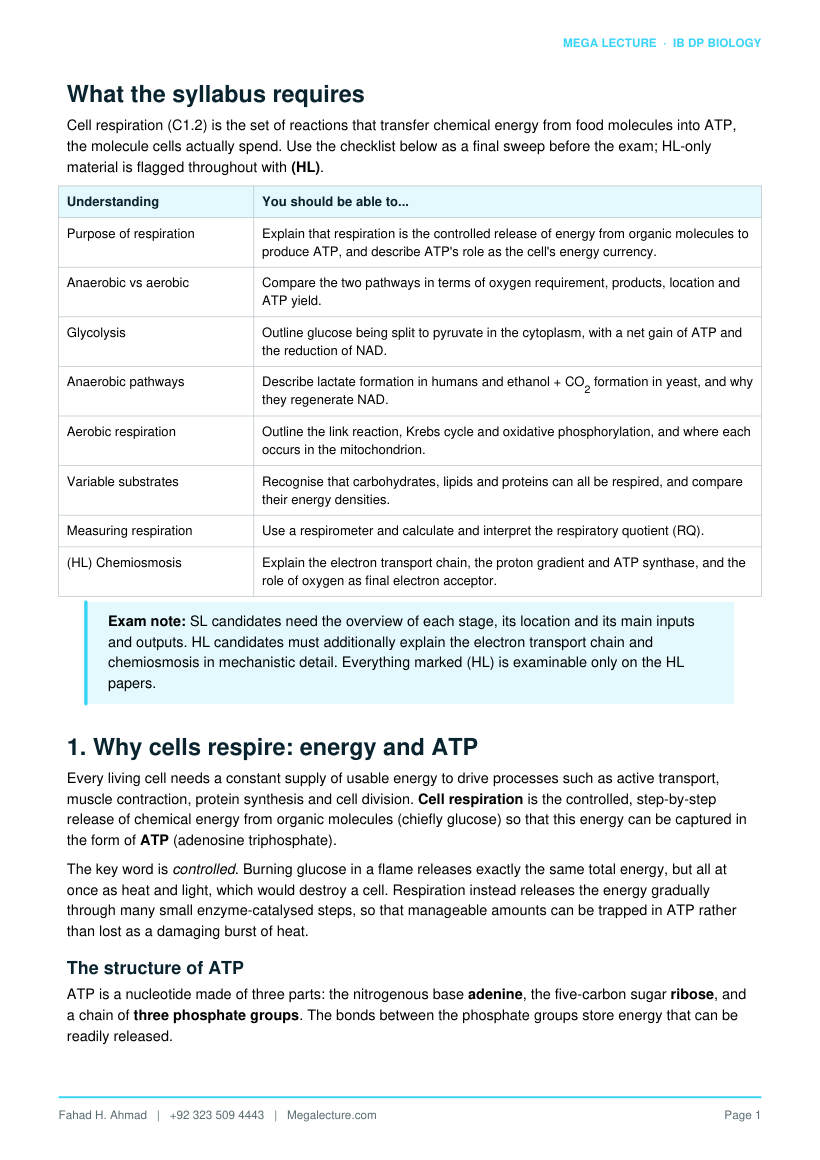
What the syllabus requires
Cell respiration (C1.2) is the set of reactions that transfer chemical energy from food molecules into ATP, the molecule cells actually spend. Use the checklist below as a final sweep before the exam; HL-only material is flagged throughout with (HL).
Understanding You should be able to...
Purpose of respiration Explain that respiration is the controlled release of energy from organic molecules to produce ATP, and describe ATP's role as the cell's energy currency.
Anaerobic vs aerobic Compare the two pathways in terms of oxygen requirement, products, location and ATP yield.
Glycolysis Outline glucose being split to pyruvate in the cytoplasm, with a net gain of ATP and the reduction of NAD.
Anaerobic pathways Describe lactate formation in humans and ethanol + CO2 formation in yeast, and why they regenerate NAD.
Aerobic respiration Outline the link reaction, Krebs cycle and oxidative phosphorylation, and where each occurs in the mitochondrion.
Variable substrates Recognise that carbohydrates, lipids and proteins can all be respired, and compare their energy densities.
Measuring respiration Use a respirometer and calculate and interpret the respiratory quotient (RQ).
(HL) Chemiosmosis Explain the electron transport chain, the proton gradient and ATP synthase, and the role of oxygen as final electron acceptor.
Exam note: SL candidates need the overview of each stage, its location and its main inputs and outputs. HL candidates must additionally explain the electron transport chain and chemiosmosis in mechanistic detail. Everything marked (HL) is examinable only on the HL papers.
1. Why cells respire: energy and ATP
Every living cell needs a constant supply of usable energy to drive processes such as active transport, muscle contraction, protein synthesis and cell division. Cell respiration is the controlled, step-by-step release of chemical energy from organic molecules (chiefly glucose) so that this energy can be captured in the form of ATP (adenosine triphosphate).
The key word is controlled. Burning glucose in a flame releases exactly the same total energy, but all at once as heat and light, which would destroy a cell. Respiration instead releases the energy gradually through many small enzyme-catalysed steps, so that manageable amounts can be trapped in ATP rather than lost as a damaging burst of heat.
The structure of ATP
ATP is a nucleotide made of three parts: the nitrogenous base adenine, the five-carbon sugar ribose, and a chain of three phosphate groups. The bonds between the phosphate groups store energy that can be readily released.
- Hydrolysis of ATP removes the terminal phosphate, giving ADP (adenosine diphosphate) + Pi (inorganic phosphate) and releasing energy for cell work.
- Condensation (phosphorylation) rebuilds ATP from ADP + Pi, which is exactly what respiration pays for.
ATP ⇌ ADP + Pi (reversible; energy released on the forward reaction, invested on the
reverse) Why ATP and not glucose directly?
Cells do not spend glucose directly on their reactions. ATP is a better immediate energy currency for several reasons:
- It releases a small, standard quantity of energy in a single step, well matched to the needs of individual reactions, so little is wasted.
- Its hydrolysis is quick and needs only one enzyme, so energy is available instantly on demand.
- It is soluble and can be used anywhere in the cytoplasm, coupling energy-releasing reactions to energy-requiring ones.
- Glucose, by contrast, holds far more energy in a form that must be released gradually; spending it whole would be like paying for a coffee with a gold bar.
Common misconception: ATP is not a long-term energy store. Cells hold only a few seconds' worth at any moment and continually recycle it (an adult may turn over their body mass in ATP each day). Long-term energy is stored as glycogen, starch or fat, then respired to remake ATP as needed.
2. Aerobic and anaerobic respiration
Respiration can proceed with or without oxygen. The complete aerobic oxidation of glucose can be summarised by a single overall equation:
C6H12O6 + 6O2 → 6CO2 + 6H2O (+ energy for ≈ 30−38 ATP)
In words: glucose reacts with oxygen to produce carbon dioxide and water, releasing energy that is used to make ATP. Anaerobic respiration takes place without oxygen, does not fully break glucose down, and yields only a small amount of ATP. The two are compared below.
Feature Aerobic respiration Anaerobic respiration
Oxygen Required Not required
Location Cytoplasm (glycolysis) then mitochondrion Cytoplasm only
Glucose breakdown Complete, to CO2 and H2O Incomplete (partial)
Final products (humans)
CO2 + H2O Lactate
Final products (yeast/plant)
CO2 + H2O Ethanol + CO2
ATP yield per glucose ≈ 30−38
Feature Aerobic respiration Anaerobic respiration
Duration it can sustain Long-term, efficient Short bursts only
Exam tip: Both pathways begin with the same first stage, glycolysis. What happens to the pyruvate afterwards is what differs. If oxygen is present, pyruvate enters the mitochondrion; if not, it is converted to lactate or ethanol in the cytoplasm.
3. Glycolysis: the shared first stage
Glycolysis (literally 'sugar splitting') takes place in the cytoplasm and does not require oxygen, so it is common to both aerobic and anaerobic respiration. A single glucose molecule (6 carbons) is converted into two molecules of pyruvate (3 carbons each).
glucose (6C) → 2 pyruvate (3C each)
The pathway has two phases:
- Investment phase: 2 ATP are used to phosphorylate glucose, making it more reactive and 'trapping' it in the cell. This is an energy cost paid up front.
- Payoff phase: as the sugar is split and oxidised, 4 ATP are produced by substrate-level phosphorylation and 2 NAD are reduced to 2 NADH.
Net yield of glycolysis
Item Used Produced Net
ATP +2 ATP
NADH +2 NADH
Pyruvate +2 pyruvate
So the net gain is 2 ATP and 2 NADH per glucose. NAD is a coenzyme that acts as a hydrogen (electron) carrier: when it accepts hydrogen it is reduced to NADH. In aerobic respiration this NADH is later 'cashed in' at the electron transport chain to make much more ATP; in anaerobic respiration it must be recycled another way (Section 4).
Key point: Glycolysis alone gives only a net 2 ATP, yet it happens whether or not oxygen is present. This is why it is the emergency energy supply during intense exercise, and why it is thought to be one of the most ancient metabolic pathways, predating the oxygen-rich atmosphere.
4. Anaerobic respiration and fermentation
Glycolysis can keep making ATP only while there is a supply of oxidised NAD to accept hydrogen. Without oxygen, the NADH produced cannot be re-oxidised at the electron transport chain, so a cell would quickly run out of NAD and glycolysis would halt. Anaerobic pathways solve this by using pyruvate to regenerate NAD, allowing glycolysis, and therefore a trickle of ATP, to continue.
In humans and other animals
Pyruvate is reduced to lactate (lactic acid), and in the process NADH is oxidised back to NAD:
pyruvate + NADH → lactate + NAD
- This regenerates the NAD needed to keep glycolysis running during intense exercise, when the demand for ATP outstrips the oxygen supply.
- No CO2 is produced in the human anaerobic pathway.
- Lactate builds up and must later be removed. The extra oxygen needed after exercise to convert lactate back to pyruvate (mostly in the liver) is the oxygen debt (or excess post-exercise oxygen consumption), which explains why you keep breathing hard after a sprint.
In yeast and plants
Pyruvate is instead converted to ethanol and carbon dioxide, again regenerating NAD. This is alcoholic fermentation:
pyruvate → ethanol + CO2 (NADH → NAD)
- Unlike lactate fermentation, this pathway releases CO2 and is irreversible in the cell (ethanol is a waste product, not recycled).
- It is important commercially, as summarised below.
Use How fermentation is exploited
Baking Yeast ferments sugars in dough; the CO2 produced makes bread rise, and the ethanol evaporates during baking.
Brewing and winemaking
Yeast ferments sugars from grain or fruit to produce ethanol in beer, wine and spirits.
Biofuel Sugars from crops such as sugar cane or maize are fermented to ethanol, which is used as a renewable fuel (bioethanol).
Common misconception: Anaerobic respiration does not make extra ATP beyond glycolysis's net 2. Converting pyruvate to lactate or ethanol yields no further ATP; its sole purpose is to regenerate NAD so glycolysis can keep going. The low yield is the price of respiring without oxygen.
5. Aerobic respiration in the mitochondrion
When oxygen is available, pyruvate from glycolysis enters the mitochondrion, where three further stages release far more energy. First orient yourself with the mitochondrion's structure: the matrix is the fluid interior, bounded by a highly folded inner membrane whose folds are called cristae.
Stage 1 - The link reaction (matrix)
Each 3-carbon pyruvate is converted to a 2-carbon acetyl group carried by coenzyme A, forming acetyl-CoA. One carbon is removed as CO2 (decarboxylation) and NAD is reduced to NADH:
pyruvate + NAD + CoA → acetyl-CoA + CO2 + NADH
This happens once for each pyruvate, so twice per glucose.
Stage 2 - The Krebs cycle (matrix)
The acetyl group joins a 4-carbon molecule to form a 6-carbon compound (citrate), which is then gradually broken down in a cycle of reactions, regenerating the 4-carbon acceptor. Per turn of the cycle (i.e. per acetyl-CoA):
- 2 molecules of CO2 are released (decarboxylation).
- 3 NAD are reduced to 3 NADH and 1 FAD is reduced to 1 FADH2 (these are the hydrogen/electron carriers).
- 1 ATP is made directly by substrate-level phosphorylation.
The cycle turns twice per glucose (once for each acetyl-CoA). The CO2 you breathe out comes from the link reaction and Krebs cycle, not from glycolysis.
Stage 3 - Oxidative phosphorylation (cristae)
This stage makes the bulk of the ATP. The NADH and FADH2 generated in the earlier stages carry their hydrogen (electrons) to the electron transport chain embedded in the inner membrane (cristae). As electrons pass along the chain, energy is released and used to make large amounts of ATP. Crucially, oxygen is the final electron acceptor: it accepts the spent electrons and combines with hydrogen to form water.
O2 + electrons + H+ → H2O
Without oxygen to accept electrons the whole chain backs up, NADH cannot be re-oxidised, and the Krebs cycle and link reaction stop, which is exactly why cells fall back on anaerobic respiration when oxygen runs short.
Overview: Glycolysis (cytoplasm) → link reaction (matrix) → Krebs cycle (matrix) → oxidative phosphorylation (cristae). Carbon leaves as CO2 in the middle two stages; ATP is made in all four, but overwhelmingly in the last.
Figure 1. The four stages of aerobic respiration, their locations and ATP yields. Carbon leaves as CO2 in the middle two stages; oxygen accepts electrons only at the end, forming H2O. Overall yield ≈ 30−38 ATP per glucose.
6. ATP yields: why aerobic wins
The difference in ATP output between the two pathways is dramatic. The table traces where the ATP comes from in complete aerobic respiration.
Stage Direct ATP Reduced carriers ATP after the chain
Glycolysis 2 (net) 2 NADH included below
Link reaction (×2) 2 NADH included below
Krebs cycle (×2) 6 NADH, 2 FADH2 included below
Oxidative phosphorylation from 10 NADH + 2 FADH2 ≈ 26−34
Total per glucose ≈ 30−38
Anaerobic respiration produces only the net 2 ATP from glycolysis, whereas aerobic respiration produces roughly 15 times as much. The reason is that aerobic respiration fully oxidises glucose to CO2 and water, harvesting many NADH and FADH2 whose electrons then drive ATP synthesis at the electron transport chain. Anaerobic respiration leaves most of the glucose's energy locked inside lactate or ethanol, which are still energy-rich molecules.
Exam tip: Quote aerobic yield as a range (≈ 30−38, often cited as 'up to 38' or 'about 32'). The exact figure depends on how efficiently the proton gradient is used and on the shuttle that carries glycolytic NADH into the mitochondrion, so examiners accept an approximate value rather than a single fixed number.
Figure 2. Total ATP yield per glucose: anaerobic respiration gives only 2, whereas aerobic respiration gives ≈ 32−38 × more energy from the same molecule.
Figure 3. Where the ATP comes from. Aerobic respiration adds the Krebs cycle and, above all, oxidative phosphorylation;
anaerobic respiration stops after glycolysis at a net 2 ATP.
7. Respiratory substrates
Glucose is the usual starting point, but it is not the only fuel. When carbohydrate is short, cells respire other organic molecules, feeding them into the respiratory pathway at various points.
- Carbohydrates (glucose, glycogen, starch) are the preferred and most readily used substrate, entering at glycolysis.
- Lipids (fats and oils) are broken into glycerol and fatty acids; the fatty acids are converted to acetyl groups that feed into the Krebs cycle. Lipids are the richest energy store.
- Proteins are used mainly when other stores are depleted (e.g. starvation). Amino acids are deaminated and their carbon skeletons enter as pyruvate, acetyl-CoA or Krebs-cycle intermediates.
Substrate Approx. energy density Notes
Lipid ≈ 37 kJ g−1 Highest energy per gram; efficient long-term store (fat)
Carbohydrate ≈ 17 kJ g−1 Fast to mobilise; stored as glycogen/starch
Protein ≈ 17 kJ g−1 A last resort; needed for structure and enzymes
Lipids yield roughly twice as much energy per gram as carbohydrates because they are more reduced (more C−H bonds and less oxygen), so their oxidation releases more hydrogen to the carriers and hence more ATP. This is also why respiring fat consumes proportionally more oxygen, an idea we return to with the respiratory quotient.
8. Measuring the rate of respiration
Because respiration consumes O2 and releases CO2, its rate can be measured by tracking either gas. The standard apparatus is a respirometer.
The respirometer
Living material (e.g. germinating seeds or small invertebrates) is sealed in a chamber connected to a capillary tube containing a coloured fluid. An alkali such as potassium hydroxide absorbs the CO2 produced. As the organisms use up oxygen and the CO2 is absorbed, the gas volume in the chamber falls, and the fluid moves toward the chamber. The distance moved in a set time gives the rate of oxygen consumption.
- A control tube with glass beads instead of organisms allows for changes in atmospheric pressure and temperature.
- The whole apparatus is kept in a water bath so that temperature is constant (respiration rate is temperature-sensitive).
- If the KOH is removed, the net change in gas volume instead reflects the difference between O2 used and CO2 released.
The respiratory quotient (RQ)
The respiratory quotient indicates which substrate is being respired. It is the ratio of carbon dioxide produced to oxygen consumed:
RQ = CO2 produced / O2 consumed (volumes or moles)
Different fuels have characteristic RQ values because their molecules need different amounts of oxygen to oxidise fully:
Substrate Typical RQ Reasoning
Carbohydrate 1.0 e.g. glucose: 6CO2 / 6O2 = 1.0
Protein ≈ 0.9 Intermediate value
Lipid ≈ 0.7 Fats are highly reduced, so need proportionally more O2
Anaerobic (fermentation) > 1.0 (can be very high) CO2 released with little or no O2 used
Interpretation: An RQ near 1.0 signals carbohydrate respiration; near 0.7 signals fat. Values above 1.0 suggest some anaerobic respiration is occurring alongside aerobic respiration, because CO2 is being produced without matching oxygen uptake.
9. (HL) The electron transport chain and chemiosmosis
HL candidates must explain how oxidative phosphorylation actually makes ATP. The answer is the chemiosmotic theory: energy from electrons is used to pump protons, and the return flow of those protons drives ATP synthesis.
The electron transport chain
The inner mitochondrial membrane carries a series of electron carriers (protein complexes). NADH and FADH2 deliver electrons to the chain, where the electrons pass from carrier to carrier, losing energy at each step.
- The released energy is used by the carriers to pump protons (H+) from the matrix into the intermembrane space.
- NADH feeds electrons in at the start of the chain (pumping more protons), while FADH2 enters later, which is why each NADH yields more ATP than each FADH2.
- At the end of the chain, oxygen accepts the electrons and, with protons, forms water. Oxygen is therefore the final electron acceptor; it does not appear until the very last step but is essential for the whole chain to keep running.
The proton gradient and ATP synthase
Proton pumping builds up a high concentration of H+ in the intermembrane space: an electrochemical (proton) gradient across the inner membrane. This gradient is a store of potential energy. Protons can only diffuse back into the matrix through a channel enzyme called ATP synthase.
- As protons flow down their gradient through ATP synthase, the enzyme rotates and uses the energy to phosphorylate ADP: ADP + Pi → ATP.
- This coupling of a proton gradient to ATP synthesis is called chemiosmosis.
Why the folded cristae matter
The extensive folding of the inner membrane into cristae greatly increases its surface area. More membrane means more room for electron transport chains and ATP synthase molecules, and a larger area across which the proton gradient can be maintained, so more ATP can be produced per mitochondrion. Cells with high energy demands (e.g. muscle, liver) have mitochondria with especially dense cristae.
(HL) Oxidative decarboxylation
The link reaction and parts of the Krebs cycle are examples of oxidative decarboxylation: a substrate simultaneously loses a carbon as CO2 (decarboxylation) and loses hydrogen to NAD (oxidation). In the link reaction, pyruvate is oxidatively decarboxylated to the acetyl group while NAD is reduced to NADH, capturing energy that would otherwise be lost.
(HL) Exam tip: A frequent HL question asks what happens if oxygen is absent or a poison (e.g. cyanide) blocks the chain. Answer: electrons cannot be passed to oxygen, the chain stops, proton pumping ceases, the gradient collapses, ATP synthase stops, and NADH cannot be re-oxidised, so the Krebs cycle and link reaction also halt. Only glycolysis (with fermentation) can then make ATP.
10. Worked examples and skills
Worked example 1 - RQ of a carbohydrate
A woodlouse consumes 0.60 cm3 of oxygen and releases 0.60 cm3 of carbon dioxide per hour. Calculate its RQ and identify the likely substrate.
RQ = CO2 produced / O2 consumed = 0.60 / 0.60 = 1.0.
An RQ of 1.0 indicates the animal is respiring carbohydrate aerobically.
Worked example 2 - RQ of a fat
Germinating sunflower seeds use 4.0 cm3 of O2 and release 2.8 cm3 of CO2 in the same period. Find the RQ and comment.
RQ = 2.8 / 4.0 = 0.70.
An RQ of about 0.7 indicates lipid (fat) is being respired. This makes biological sense: oily seeds such as sunflower store fat as their main energy reserve.
Worked example 3 - RQ from an equation
Palmitic acid respires as: C16H32O2 + 23O2 → 16CO2 + 16H2O. Calculate the RQ.
RQ = moles CO2 / moles O2 = 16 / 23 = 0.70 (2 s.f.).
Confirming the low RQ characteristic of a fatty acid: 23 O2 are needed but only 16 CO2 are made, because the molecule is highly reduced.
Worked example 4 - interpreting respirometer data
In a respirometer at 20°C, coloured fluid moves 45 mm toward the chamber in 15 minutes; KOH is present. The capillary has a volume of 2.0 × 10⁻³ cm3 per mm. Find the rate of oxygen use.
With KOH absorbing CO2, the fluid movement measures O2 uptake.
Volume of O2 = 45 × 2.0 × 10−3 = 0.090 cm3 in 15 min.
Rate = 0.090 / 15 = 6.0 × 10⁻³ cm3 min−1 (or 0.36 cm3 h−1).
Worked example 5 - identify the stage and location
For each event, name the stage of respiration and where in the cell it occurs: (a) glucose split to pyruvate; (b) oxygen forms water; (c) acetyl-CoA formed with loss of CO2; (d) FADH2 produced.
- Glycolysis, in the cytoplasm.
- Oxidative phosphorylation (electron transport chain), on the cristae / inner mitochondrial membrane.
- Link reaction, in the mitochondrial matrix.
- Krebs cycle, in the mitochondrial matrix.
Worked example 6 - compare ATP yields
A muscle cell respires 3 glucose molecules aerobically and 3 anaerobically. Estimate the ATP produced by each and comment.
Aerobic: 3 × ≈ 32 = ≈ 96 ATP.
Anaerobic: 3 × 2 = 6 ATP.
Aerobic respiration yields about 16 times more ATP here, because it fully oxidises glucose while anaerobic respiration stops after glycolysis. Anaerobic respiration is still valuable for the speed at which it supplies ATP during short, intense effort.
Common pitfalls to avoid
- ATP is not a long-term store; it is made and used continuously. Fat, glycogen and starch are the stores.
- Glycolysis occurs in the cytoplasm, not the mitochondrion. Only the later aerobic stages are mitochondrial.
- Oxygen is used only as the final electron acceptor at the end of the chain. It is not used in glycolysis or the Krebs cycle directly.
- The CO2 you exhale comes from the link reaction and Krebs cycle, not from glycolysis (and not from the electron transport chain).
- Anaerobic respiration makes no ATP beyond glycolysis; converting pyruvate to lactate/ethanol only regenerates NAD.
- Human anaerobic respiration produces lactate, not CO2; CO2 is only released in the yeast/plant pathway.
11. Quick reference
Stage Location Key inputs Key outputs
Glycolysis Cytoplasm glucose, 2 ATP, 2 NAD 2 pyruvate, net 2 ATP, 2 NADH
Fermentation (anaerobic) Cytoplasm pyruvate, NADH lactate (animals) OR ethanol + CO2 (yeast); NAD regenerated
Link reaction Matrix pyruvate, NAD, CoA acetyl-CoA, CO2, NADH
Krebs cycle Matrix acetyl-CoA, NAD, FAD CO2, NADH, FADH2, ATP
Oxidative phosphorylation
Cristae NADH, FADH2, O2 H2O, ≈ 26−34 ATP
Quantity Value / formula
Net ATP from glycolysis 2 per glucose
ATP from anaerobic respiration 2 per glucose
ATP from aerobic respiration ≈ 30−38 per glucose
Quantity Value / formula
Respiratory quotient RQ = CO2 produced / O2 consumed
RQ values carbohydrate 1.0; protein ≈ 0.9; lipid ≈ 0.7
Aerobic overall equation C6H12O6 + 6O2 → 6CO2 + 6H2O
12. Test yourself
Attempt all eight without notes, then check against the worked answers.
- State precisely what is meant by 'cell respiration' and explain why the energy release must be controlled rather than sudden.
- Give two reasons why cells use ATP rather than spending glucose directly on their reactions.
- Where does glycolysis occur, and what is its net yield of ATP and NADH per glucose?
- During a 100 m sprint a runner's muscles respire anaerobically. Name the product formed, explain why it is made, and state what 'oxygen debt' means.
- Name the three stages of aerobic respiration that follow glycolysis and give the precise location of each.
- A sample of respiring tissue releases 3.6 cm3 CO2 and uses 4.8 cm3 O2. Calculate the RQ and identify the substrate.
- Explain why aerobic respiration yields roughly 15 times more ATP per glucose than anaerobic respiration.
- (HL) Explain how a proton gradient across the inner mitochondrial membrane leads to ATP synthesis, and state the role of oxygen.
Worked answers
- Cell respiration is the controlled release of energy from organic molecules (e.g. glucose) to produce ATP. It must be gradual because releasing all the energy at once (as in burning) would produce a damaging burst of heat; small enzyme-catalysed steps let the energy be captured in ATP instead of being lost.
- Any two: ATP releases a small, standardised amount of energy suited to individual reactions (little waste); its hydrolysis is rapid and needs only one enzyme (energy on demand); it is soluble and mobile within the cell; glucose holds too much energy in a form that must be released gradually.
- Glycolysis occurs in the cytoplasm; net yield is 2 ATP and 2 NADH per glucose (4 ATP made minus 2 used, plus 2 NAD reduced).
- Lactate (lactic acid) is formed by the reduction of pyruvate. This regenerates NAD from NADH so that glycolysis can continue to supply ATP without oxygen. The oxygen debt is the extra oxygen taken in after exercise to convert the accumulated lactate back to pyruvate.
- Link reaction - mitochondrial matrix; Krebs cycle - mitochondrial matrix; oxidative phosphorylation (electron transport chain) - inner mitochondrial membrane / cristae.
- RQ = 3.6 / 4.8 = 0.75. A value near 0.7 indicates mainly lipid is being respired (with perhaps a little carbohydrate).
- Aerobic respiration fully oxidises glucose to CO2 and water, generating many NADH and FADH2 whose electrons drive ATP synthesis at the electron transport chain (≈ 30−38 ATP). Anaerobic respiration stops after glycolysis (net 2 ATP), leaving most of the energy locked in lactate or ethanol.
- (HL) Electrons from NADH/FADH2 passing along the chain provide energy to pump H+ from the matrix into the intermembrane space, creating a proton gradient. Protons diffuse back into the matrix through ATP synthase, and the energy of this flow phosphorylates ADP to ATP (chemiosmosis). Oxygen acts as the final electron acceptor, combining with electrons and protons to form water, which keeps the chain and the gradient going.
