
CSS · Current Affairs · Pakistan Affairs: timeline and quick-revision notes
Pakistan Affairs: timeline and quick-revision notes
Opens inside this page. Prefer your own PDF app? Open the PDF.
Check yourself
5 quick questions on CSS Current Affairs
Tap an answer to see if you are right, and why. Free, no sign-up.
Start the free test9 of 10 students found these notes useful
Was this note useful?
Full text of Pakistan Affairs: timeline and quick-revision notes
These notes give a dated chronology of the making and development of Pakistan, from the War of Independence of 1857 to the present day. They are written for the compulsory Pakistan Affairs paper (100 marks) of the Federal Public Service Commission (FPSC) CSS Competitive Examination. They cover the historical and political-constitutional parts of the FPSC syllabus in date order, together with key foreign-policy, economic and security milestones. They do not cover the syllabus sections on geography, society and natural resources. Each period has a short timeline, a few key points and, where helpful, a comparison table. At the end you will find a table of key terms, a quick self-test and 15 CSS-style questions with model answer outlines, one of them written out as a full model answer.
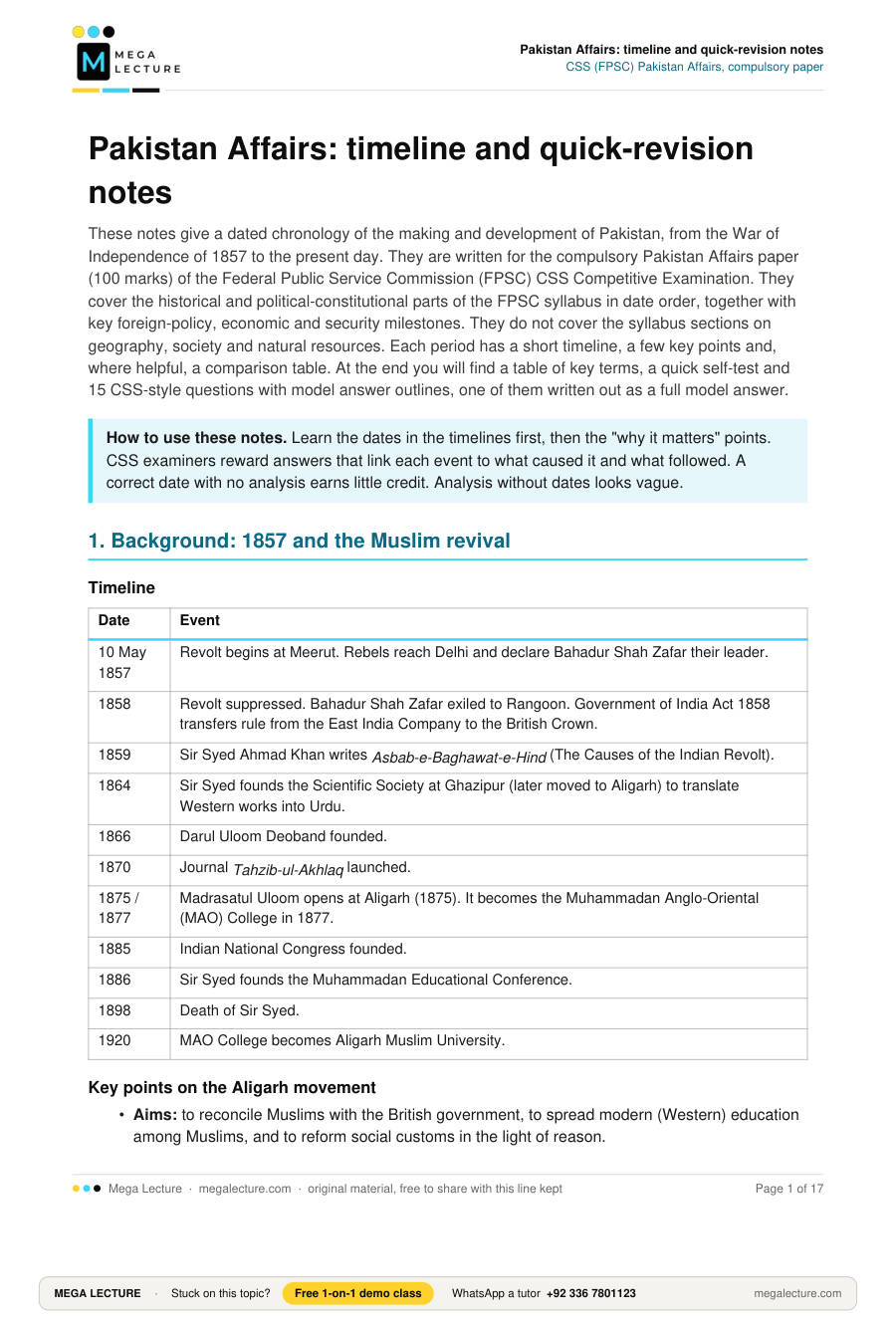
How to use these notes. Learn the dates in the timelines first, then the "why it matters" points. CSS examiners reward answers that link each event to what caused it and what followed. A correct date with no analysis earns little credit. Analysis without dates looks vague.1. Background: 1857 and the Muslim revival
Timeline
| Date | Event |
|---|---|
| 10 May 1857 | Revolt begins at Meerut. Rebels reach Delhi and declare Bahadur Shah Zafar their leader. |
| 1858 | Revolt suppressed. Bahadur Shah Zafar exiled to Rangoon. Government of India Act 1858 transfers rule from the East India Company to the British Crown. |
| 1859 | Sir Syed Ahmad Khan writes Asbab-e-Baghawat-e-Hind (The Causes of the Indian Revolt). |
| 1864 | Sir Syed founds the Scientific Society at Ghazipur (later moved to Aligarh) to translate Western works into Urdu. |
| 1866 | Darul Uloom Deoband founded. |
| 1870 | Journal Tahzib-ul-Akhlaq launched. |
| 1875 / 1877 | Madrasatul Uloom opens at Aligarh (1875). It becomes the Muhammadan Anglo-Oriental (MAO) College in 1877. |
| 1885 | Indian National Congress founded. |
| 1886 | Sir Syed founds the Muhammadan Educational Conference. |
| 1898 | Death of Sir Syed. |
| 1920 | MAO College becomes Aligarh Muslim University. |
Key points on the Aligarh movement
- Aims: to reconcile Muslims with the British government, to spread modern (Western) education among Muslims, and to reform social customs in the light of reason.
- Political stance: Sir Syed advised Muslims to keep away from the Congress. He argued that Hindus and Muslims were separate communities with different interests. Many historians describe this as an early form of the Two-Nation idea.
- Legacy: Aligarh produced the educated leadership that later ran the Muslim League. Other institutions of the same period include Anjuman Himayat-e-Islam, Lahore (1884), Sindh Madrasatul Islam, Karachi (1885), Nadwatul Ulama (founded at Kanpur in 1894, moved to Lucknow in 1898) and Islamia College, Peshawar (1913).
The Two-Nation Theory holds that the Muslims and Hindus of the subcontinent were two separate nations, each with its own religion, culture, history and way of life. Because of this, each was entitled to its own political future and, in the end, to separate homelands.
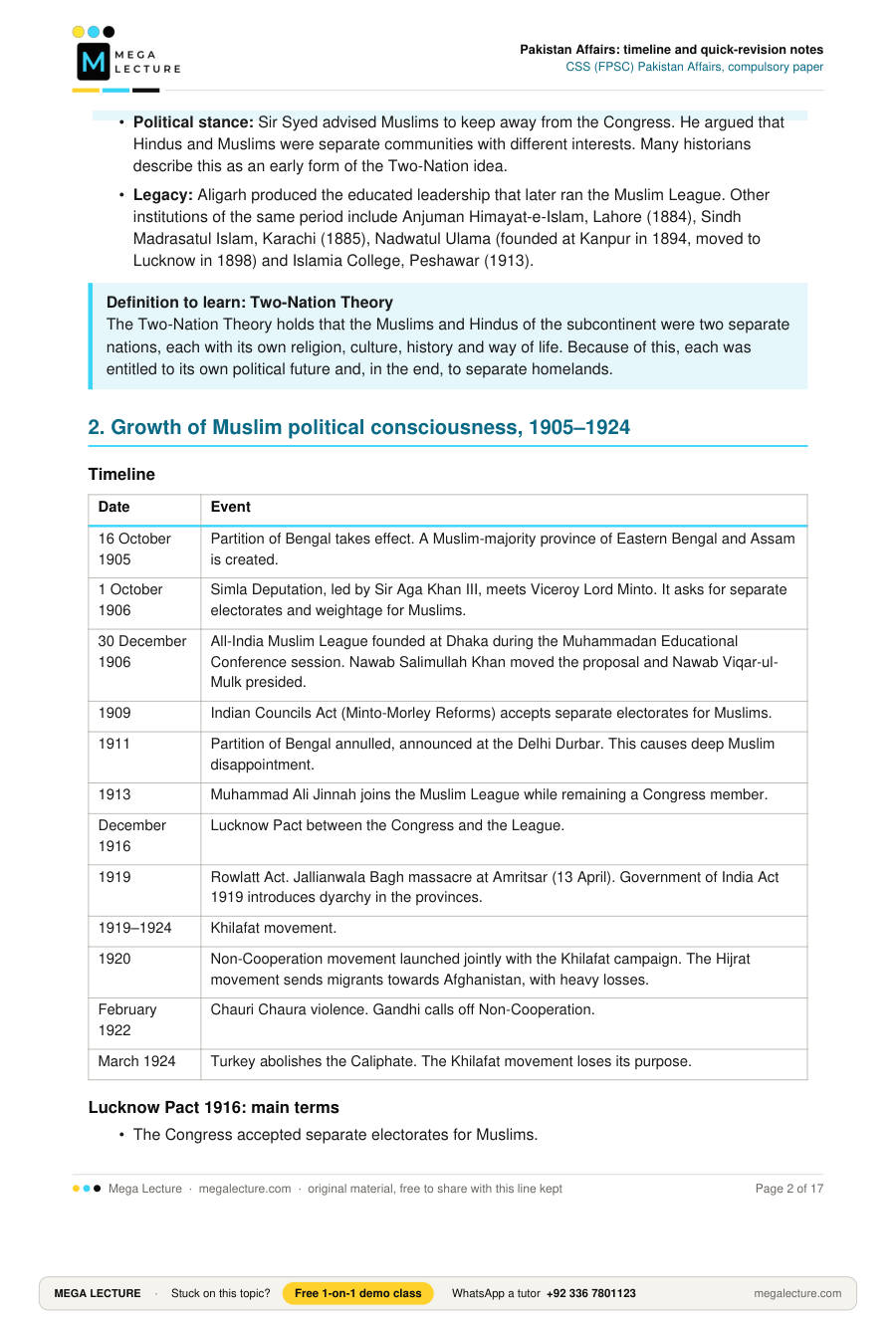
2. Growth of Muslim political consciousness, 1905–1924
Timeline
| Date | Event |
|---|---|
| 16 October 1905 | Partition of Bengal takes effect. A Muslim-majority province of Eastern Bengal and Assam is created. |
| 1 October 1906 | Simla Deputation, led by Sir Aga Khan III, meets Viceroy Lord Minto. It asks for separate electorates and weightage for Muslims. |
| 30 December 1906 | All-India Muslim League founded at Dhaka during the Muhammadan Educational Conference session. Nawab Salimullah Khan moved the proposal and Nawab Viqar-ul-Mulk presided. |
| 1909 | Indian Councils Act (Minto-Morley Reforms) accepts separate electorates for Muslims. |
| 1911 | Partition of Bengal annulled, announced at the Delhi Durbar. This causes deep Muslim disappointment. |
| 1913 | Muhammad Ali Jinnah joins the Muslim League while remaining a Congress member. |
| December 1916 | Lucknow Pact between the Congress and the League. |
| 1919 | Rowlatt Act. Jallianwala Bagh massacre at Amritsar (13 April). Government of India Act 1919 introduces dyarchy in the provinces. |
| 1919–1924 | Khilafat movement. |
| 1920 | Non-Cooperation movement launched jointly with the Khilafat campaign. The Hijrat movement sends migrants towards Afghanistan, with heavy losses. |
| February 1922 | Chauri Chaura violence. Gandhi calls off Non-Cooperation. |
| March 1924 | Turkey abolishes the Caliphate. The Khilafat movement loses its purpose. |
Lucknow Pact 1916: main terms
- The Congress accepted separate electorates for Muslims.
- Muslims were to have one-third of the elected seats in the central legislature.
- Muslims received weightage in provinces where they were a minority. In return, they accepted fewer seats than their share of the population in Punjab and Bengal.
- A bill affecting a community could not go ahead if three-quarters of that community's members in the legislature opposed it.
Significance: This was the first time the Congress formally accepted separate electorates and treated the Muslims as a separate political entity. Jinnah played a leading part and became known as an "ambassador of Hindu-Muslim unity".
Khilafat movement: key points
- Aims: to protect the Ottoman Caliphate and the holy places of Islam, and to prevent the break-up of Turkey after the First World War.
- Leaders: Maulana Muhammad Ali Jauhar and Maulana Shaukat Ali (the Ali brothers), with Maulana Abul Kalam Azad. Gandhi gave the movement Congress support.
- Outcome: It failed in its aim, but it drew ordinary Muslims into mass politics for the first time. Many Muslims were left distrustful of the Congress after Gandhi withdrew support in 1922.
3. From constitutional talks to a separate homeland, 1927–1939
Timeline
| Date | Event |
|---|---|
| March 1927 | Delhi Muslim Proposals. Muslims offer to give up separate electorates in return for certain safeguards. |
| November 1927 | Simon Commission appointed. It has no Indian members and is boycotted. |
| August 1928 | Nehru Report rejects separate electorates and weightage and proposes a unitary-leaning constitution. |
| March 1929 | Jinnah's Fourteen Points, the Muslim response to the Nehru Report. |
| 29 December 1930 | Allama Muhammad Iqbal's presidential address at the Muslim League session in Allahabad. |
| 1930–1932 | Three Round Table Conferences in London. |
| August 1932 | Communal Award keeps separate electorates. |
| 28 January 1933 | Chaudhry Rahmat Ali's pamphlet Now or Never proposes the name "Pakstan". |
| 1935 | Government of India Act 1935 grants provincial autonomy and proposes an all-India federation, which never came into being. |
| 1936–37 | Provincial elections are held under the 1935 Act. The results are announced early in 1937. |
| 1937–1939 | Congress ministries in office in most provinces. |
| 22 December 1939 | After the Congress ministries resign, the League observes a "Day of Deliverance". |
Iqbal's Allahabad Address (1930)
- Iqbal proposed that Punjab, the North-West Frontier Province, Sindh and Balochistan be joined into a single state. He saw this as the final destiny of the Muslims of North-West India, whether inside or outside the British Empire.
- He argued that Islam was a complete social and moral order, and that Western-style territorial nationalism did not fit Indian conditions.
- It was the first time a Muslim League president set out the idea of a Muslim state from the League platform.
1937 elections and Congress rule
- The Congress won a clear majority of the general seats and formed governments in most provinces (seven at first, later eight).
- The League did poorly. It won only a little over 100 of the roughly 480 Muslim seats and did not lead the government in any Muslim-majority province, although it joined Fazlul Haq's Krishak Praja Party-led coalition ministry in Bengal as a junior partner.
- The Congress refused to form coalitions with the League in the United Provinces. League complaints about Congress rule were recorded in the Pirpur Report (1938) and other reports. They cited the Wardha education scheme, the singing of Bande Mataram and discrimination in jobs.
- Significance: The League reorganised itself and grew into a mass party. Many Muslims came to believe that they could not be safe under a Congress-led centre.
4. The Pakistan Movement and independence, 1940–1947
Timeline
| Date | Event |
|---|---|
| 22–24 March 1940 | Muslim League session at Minto Park (now Iqbal Park), Lahore. A.K. Fazlul Haq moved the Lahore Resolution on 23 March and it was adopted on 24 March. Jinnah presided. |
| August 1940 | August Offer by Viceroy Linlithgow. |
| March–April 1942 | Cripps Mission. |
| August 1942 | Congress launches the Quit India movement. |
| September 1944 | Gandhi-Jinnah talks in Bombay end without agreement. |
| June–July 1945 | Simla Conference on the Wavell Plan. |
| 1945–46 | General elections. The League wins all 30 Muslim seats in the Central Legislative Assembly and the great majority of Muslim provincial seats. |
| March–June 1946 | Cabinet Mission. Its plan is published on 16 May 1946. |
| 16 August 1946 | Direct Action Day, followed by communal violence in Calcutta. |
| September–October 1946 | Interim Government formed. The League joins in October and Liaquat Ali Khan becomes Finance Member. |
| 20 February 1947 | Prime Minister Attlee announces that Britain will leave India by June 1948. |
| 3 June 1947 | Mountbatten announces the partition plan. |
| July 1947 | Referendums in NWFP and Sylhet favour Pakistan. The Indian Independence Act receives royal assent on 18 July. |
| 14 August 1947 | Pakistan comes into being. Jinnah becomes Governor-General and Liaquat Ali Khan Prime Minister. |
| 17 August 1947 | Radcliffe boundary awards made public. |
Comparison of the British plans, 1942–1946
| Plan | Main proposals | Response |
|---|---|---|
| Cripps Mission (1942) | Dominion status after the war. An elected body to draft a constitution. Any province could stay out of the new union. | Rejected by the Congress, which wanted immediate power, and by the League, which wanted Pakistan clearly accepted. |
| Simla Conference / Wavell Plan (1945) | An enlarged Executive Council made up of Indians except the Viceroy and the Commander-in-Chief, with caste Hindus and Muslims in equal numbers. | Failed. Jinnah insisted that the League alone should nominate all Muslim members, and the Congress refused. |
| Cabinet Mission (1946) | A weak union centre controlling defence, foreign affairs and communications. Provinces placed in three groups: A (Hindu-majority), B (North-West) and C (Bengal and Assam). A separate sovereign Pakistan was rejected. | The League accepted on 6 June 1946. It withdrew its acceptance in July after Nehru said the Congress would not be bound by the grouping scheme. |
3 June Plan: main terms
- The provincial assemblies of Punjab and Bengal would meet in two parts (Muslim-majority and non-Muslim-majority districts) and vote on whether to partition the province.
- The Sindh Assembly would decide which dominion to join. A referendum would be held in NWFP, and another in Sylhet district of Assam.
- For Balochistan, the choice was to be made by the Shahi Jirga and the non-official members of the Quetta Municipality.
- Boundary commissions would draw the lines (Sir Cyril Radcliffe was later appointed to chair both). Princely states were left free to join either dominion.
Question: Trace the steps by which the idea of a separate Muslim homeland became the League's official demand.
Step 1: identify the start and the end. Start with Sir Syed's view that Muslims were a separate community (from the 1860s to 1880s). End with the adoption of the Lahore Resolution on 24 March 1940.
Step 2: choose four or five turning points in date order. The Simla Deputation and separate electorates (1906–09); the Lucknow Pact (1916), where the Congress accepted Muslim separateness; the Nehru Report (1928) and the Fourteen Points (1929), which showed the gap between the parties; Iqbal's Allahabad Address (1930); and the experience of Congress rule (1937–39).
Step 3: for each point, give one cause and one effect. For example: Congress refused to share power in 1937 → Muslims feared a Congress-dominated centre → the League adopted a territorial demand in 1940.
Step 4: conclude. The demand grew step by step, from safeguards inside a united India to a separate state, and each failed compromise strengthened it.
5. Early problems of Pakistan, 1947–1951
| Problem | Key facts |
|---|---|
| Refugees | Millions of people crossed the new borders in both directions, and there was large-scale killing, especially in Punjab. Pakistan had to resettle refugees while building a government from scratch. |
| Administration | There was no ready-made capital or secretariat. Karachi became the first capital, and there were severe shortages of trained officials, offices and equipment. |
| Division of assets | Pakistan's agreed share of the cash balances was Rs 75 crore. Of this, Rs 20 crore was paid at first and the balance was delayed. Pakistan also received much less military stores than it was owed. |
| Canal water dispute | On 1 April 1948 India stopped the water in canals flowing into Pakistan from headworks that were now in India. A temporary Inter-Dominion Agreement followed in May 1948. The dispute was finally settled by the Indus Waters Treaty of 1960. |
| Princely states | Junagadh acceded to Pakistan but was occupied by India. Hyderabad was taken over by India in 1948. The Maharaja of Kashmir signed an accession to India in October 1947, which led to the first Kashmir war. A UN-arranged ceasefire took effect on 1 January 1949, and UN resolutions called for a plebiscite. |
| Constitution-making | Pakistan was governed under an adapted Government of India Act 1935 while the Constituent Assembly worked on a constitution. |
Other key dates: the State Bank of Pakistan was opened on 1 July 1948. Quaid-e-Azam Muhammad Ali Jinnah died on 11 September 1948. Liaquat Ali Khan was assassinated in Rawalpindi on 16 October 1951.
6. Constitutional development
The Objectives Resolution, 1949
Liaquat Ali Khan moved the resolution in the Constituent Assembly on 7 March 1949, and it was adopted on 12 March 1949. It set out the principles on which the future constitution would be based. It became the preamble of the 1956, 1962 and 1973 constitutions. In 1985 the Revival of the Constitution of 1973 Order (President's Order 14 of 1985) made it a substantive part of the 1973 Constitution as Article 2A. The Eighth Amendment later validated that order.
Definition to learn: Objectives Resolution (core principle)Sovereignty over the whole universe belongs to Allah alone. The authority He has delegated to the state of Pakistan is to be exercised by the people, through their chosen representatives, within the limits He has prescribed, as a sacred trust.
Other principles in the resolution were democracy, freedom, equality, tolerance and social justice as taught by Islam; a federal system; protection of minorities; fundamental rights; and an independent judiciary.
Road to the first constitution, 1949–1956
- 1949–1954: The Basic Principles Committee reports ran into disputes over representation between East and West Pakistan and over the national language.
- 21 February 1952: Police firing on Bengali language protesters in Dhaka. The day is now marked internationally as International Mother Language Day.
- 1954: The United Front defeats the Muslim League in the East Bengal provincial elections.
- 24 October 1954: Governor-General Ghulam Muhammad dissolves the first Constituent Assembly. In the Maulvi Tamizuddin Khan case (1955), the Federal Court under Chief Justice Muhammad Munir reversed the Sindh Chief Court's decision in the Speaker's favour. It held that the provision giving the Chief Court writ jurisdiction (Section 223-A) had never received the Governor-General's assent, so the Court did not rule on whether the dissolution itself was valid. In the Governor-General's Reference (Special Reference No. 1 of 1955) that followed, the Court accepted the dissolution and relied on the doctrine of necessity to validate his actions for the time being.
- 14 October 1955: One Unit merges the provinces of West Pakistan into a single province.
The doctrine of necessity is the legal principle that an act which would otherwise be unconstitutional may be treated as valid when it is needed to deal with an emergency or to preserve the state. Pakistani courts relied on it in the Governor-General's Reference of 1955 and to validate the 1977 and 1999 takeovers (Begum Nusrat Bhutto case, 1977; Zafar Ali Shah case, 2000). The 1958 coup was validated in a different way: in the Dosso case (1958) the Supreme Court applied Kelsen's theory that a successful revolution creates its own legality.
Comparison of the three constitutions
| Feature | 1956 | 1962 | 1973 |
|---|---|---|---|
| Date in force | 23 March 1956 | 8 June 1962 (announced 1 March 1962) | 14 August 1973 (passed 10 April 1973) |
| Framed by | Second Constituent Assembly | Given by President Ayub Khan | Elected National Assembly, by consensus of the parties |
| System | Parliamentary | Presidential | Parliamentary |
| Legislature | Unicameral, with parity between East and West | Unicameral | Bicameral (National Assembly and Senate) |
| Name of state | Islamic Republic of Pakistan | At first "Republic of Pakistan". "Islamic" was restored by the First Amendment in 1963. | Islamic Republic of Pakistan. Islam is the state religion. |
| Election method | Direct elections were planned but never held | Indirect, through an electoral college of Basic Democrats | Direct elections to the National Assembly. The Senate is elected by the provincial assemblies. |
| End | Abrogated 7 October 1958 | Abrogated 25 March 1969 | Still in force. It was held in abeyance in 1977, 1999 and November–December 2007, and restored each time. |
Major amendments to the 1973 Constitution
| Amendment | Year | Main effect |
|---|---|---|
| Second | 1974 | Defined who is a Muslim for the purposes of the Constitution and declared Ahmadis non-Muslims. |
| Eighth | 1985 | Validated the orders of the martial law period, including the Revival of the Constitution Order 1985, which had inserted Article 2A (Objectives Resolution made substantive). Confirmed, in modified form, Article 58(2)(b), which let the President dissolve the National Assembly. |
| Thirteenth | 1997 | Removed Article 58(2)(b). |
| Seventeenth | 2003 | Restored the President's power of dissolution, subject to review by the Supreme Court. Validated the Legal Framework Order 2002. |
| Eighteenth | 2010 | Removed Article 58(2)(b). Abolished the Concurrent Legislative List. Renamed NWFP as Khyber Pakhtunkhwa. Strengthened the Council of Common Interests. Added Article 25A (free, compulsory education for children aged 5–16). Created the Judicial Commission for appointing judges. |
| Nineteenth | 2010–11 (passed December 2010, in force January 2011) | Revised the judicial appointments procedure. |
| Twenty-first | 2015 | Allowed military courts to try terrorism cases for a limited period. |
| Twenty-fifth | 2018 | Merged the Federally Administered Tribal Areas (FATA) with Khyber Pakhtunkhwa. |
| Twenty-sixth | 2024 | Changed the process for appointing the Chief Justice of Pakistan (chosen by a special parliamentary committee from the three most senior judges, for a fixed three-year term), created constitutional benches and restructured the Judicial Commission. |
| Twenty-seventh | 2025 | Created a Federal Constitutional Court and restructured the top military command, including the post of Chief of Defence Forces. |
7. Martial law periods and political landmarks
| Period | Ruler | Key facts |
|---|---|---|
| 1958–1969 | General (later Field Marshal) Ayub Khan | President Iskander Mirza declared martial law on 7 October 1958, and Ayub removed Mirza on 27 October. Basic Democracies were introduced in 1959 and the 1962 Constitution followed. Ayub defeated Fatima Jinnah in the presidential election of January 1965. After a mass movement he resigned on 25 March 1969. |
| 1969–1971 | General Yahya Khan | Second martial law. The Legal Framework Order (30 March 1970) set the rules for the elections and the new National Assembly. One Unit was dissolved by a separate order, the Province of West Pakistan (Dissolution) Order 1970, with effect from 1 July 1970. First general elections held on 7 December 1970. Martial law continued after Yahya under Zulfikar Ali Bhutto as a civilian Chief Martial Law Administrator until 21 April 1972. |
| 1977–1985 | General Zia-ul-Haq | Martial law of 5 July 1977 (Operation Fair Play) followed protests after the March 1977 elections. Zulfikar Ali Bhutto was executed on 4 April 1979. Hudood Ordinances issued in 1979 and the Federal Shariat Court set up in 1980. Referendum held in December 1984 and non-party elections in February 1985. Martial law lifted on 30 December 1985. Zia died in an air crash on 17 August 1988. |
| 1999–2008 | General Pervez Musharraf | Took power on 12 October 1999 as Chief Executive. This was not a formal declaration of martial law. Referendum April 2002 and general elections October 2002. Emergency declared 3 November 2007. Benazir Bhutto assassinated 27 December 2007. Musharraf resigned the presidency on 18 August 2008. |
Civilian governments (outline)
- 1972–1977: Zulfikar Ali Bhutto governs as President and, from 14 August 1973, as Prime Minister under the new Constitution. The results of the elections of 7 March 1977 are disputed by the Pakistan National Alliance (PNA).
- 1988–1999: Benazir Bhutto and Nawaz Sharif each held office twice. Presidents used Article 58(2)(b) to dismiss governments in 1990, 1993 and 1996. Zia had already used it to dismiss Muhammad Khan Junejo in 1988. Nawaz Sharif's second government was ended by the military takeover of 12 October 1999.
- 2008: Elections held and Asif Ali Zardari elected President.
- 2012: The Supreme Court disqualifies Prime Minister Yousaf Raza Gilani.
- 2013: The first transfer of power from one elected government that had completed its full term to another.
- 2017: The Supreme Court disqualifies Prime Minister Nawaz Sharif in the Panama Papers case.
- 2018: Imran Khan becomes Prime Minister.
- April 2022: Imran Khan is removed by a vote of no confidence, the first prime minister removed this way. Shehbaz Sharif becomes Prime Minister.
- 8 February 2024: General elections. Shehbaz Sharif becomes Prime Minister again and Asif Ali Zardari President again (March 2024).
8. The crisis of 1971
| Date | Event |
|---|---|
| 1966 | Sheikh Mujibur Rahman announces the Awami League's Six Points, which demand wide provincial autonomy. |
| 7 December 1970 | General elections. The Awami League wins 160 of the 162 general seats in East Pakistan and so holds an overall majority. The Pakistan Peoples Party (PPP) wins 81 seats, the largest share in West Pakistan. |
| March 1971 | The National Assembly session is postponed and talks fail. A military operation begins in East Pakistan on the night of 25–26 March. |
| November–December 1971 | India intervenes militarily and war breaks out on both fronts. |
| 16 December 1971 | Pakistani forces surrender in Dhaka. East Pakistan becomes Bangladesh. |
| 20 December 1971 | Zulfikar Ali Bhutto becomes President and Chief Martial Law Administrator. |
| 2 July 1972 | Simla Agreement with India. Disputes are to be settled bilaterally, and the ceasefire line in Kashmir becomes the Line of Control. |
| February 1974 | Pakistan recognises Bangladesh at the time of the Lahore OIC summit. |
Causes usually discussed: geographical distance between the two wings; economic disparity; under-representation of Bengalis in the civil service and the army; the language dispute; long periods of centralised or military rule; the political deadlock after the 1970 election; and Indian intervention. The Hamoodur Rahman Commission was set up to inquire into the events of 1971.
9. Foreign policy milestones
| Date | Milestone |
|---|---|
| 30 September 1947 | Pakistan admitted to the United Nations. |
| 1954–1955 | Mutual Defence Assistance Agreement with the USA (May 1954). Pakistan joins SEATO (1954) and the Baghdad Pact (1955), which was renamed CENTO in 1959. |
| 19 September 1960 | Indus Waters Treaty with India, mediated by the World Bank. |
| 2 March 1963 | Boundary agreement with China. |
| 1964 | Regional Cooperation for Development (RCD) formed with Iran and Turkey. It became the Economic Cooperation Organization (ECO) in 1985. |
| September 1965 | War with India, followed by the Tashkent Declaration (January 1966). |
| 1971–1972 | Pakistan helps arrange the secret US–China contact (1971). It leaves the Commonwealth in 1972 and rejoins in 1989. |
| February 1974 | Second Islamic Summit of the OIC held in Lahore. |
| 1979 | Pakistan leaves CENTO and joins the Non-Aligned Movement. The Soviet army enters Afghanistan in December, and Pakistan hosts millions of Afghan refugees. |
| 1985 / 1988 | SAARC founded in December 1985. The Geneva Accords on Afghanistan are signed on 14 April 1988. |
| 28 and 30 May 1998 | Nuclear tests at Chagai (28 May) and Kharan (30 May), following Indian tests earlier that month. |
| 1999 | Lahore Declaration (February) and the Kargil conflict (May–July). |
| After September 2001 | Pakistan joins the US-led campaign against terrorism. |
| 2015 | China-Pakistan Economic Corridor (CPEC) formally launched during President Xi Jinping's visit in April. |
| 2017 | Full membership of the Shanghai Cooperation Organisation (SCO). |
| February 2019 | Pulwama attack (14 February), followed by an Indian airstrike at Balakot (26 February) and a Pakistani air response (27 February). |
| August 2019 | India revokes Article 370 on Jammu and Kashmir (5 August). Pakistan downgrades diplomatic ties and suspends bilateral trade. |
| November 2019 | Kartarpur Corridor opened. |
| August 2021 | The Taliban take control of Kabul (15 August). Pakistan faces a renewed rise in militant attacks, particularly in Khyber Pakhtunkhwa and Balochistan. |
| 2022 | Pakistan removed from the FATF "grey list" in October. |
| 2025 | Pakistan starts a two-year term as a non-permanent member of the UN Security Council. In May, after the Pahalgam attack of 22 April, military clashes with India end in a ceasefire on 10 May. In September, Pakistan signs a Strategic Mutual Defence Agreement with Saudi Arabia. |
10. Economic and security developments
Economy
- 1950s–1960s: The First Five-Year Plan covered 1955–60. Rapid industrial growth followed under Ayub Khan, along with the "Green Revolution" in agriculture. Mangla Dam was completed in 1967 and Tarbela Dam in 1976 under the Indus Basin works.
- 1972–1974: Bhutto nationalises major industries, banks and educational institutions.
- 1980s: Zakat and Ushr Ordinance issued (1980); Ushr collection began in 1983. Remittances from Pakistani workers in the Gulf increase.
- 1990s: Privatisation and deregulation begin in 1991. Lahore–Islamabad Motorway (M-2) opens in 1997. Economic sanctions follow the 1998 nuclear tests.
- 2009–2010: The 7th National Finance Commission (NFC) Award raises the provinces' share of divisible revenue.
- 2015 onwards: CPEC energy and road projects, with Gwadar port as its centrepiece.
- 2022: Severe monsoon floods affect about a third of the country and more than 30 million people.
- 2023–2024: A balance-of-payments crisis leads to a short-term IMF Stand-By Arrangement (2023) and then a 37-month Extended Fund Facility of about US$7 billion (approved September 2024).
Security
- Wars with India: 1947–48, 1965 and 1971, plus Kargil in 1999, the Balakot crisis of February 2019 and the clashes of May 2025.
- Afghan conflicts: the Soviet war (1979–1989) and the conflict after 2001, which brought militancy into the tribal areas. After the Taliban took Kabul in August 2021, militant attacks inside Pakistan rose again.
- Military operations: Rah-e-Rast in Swat (2009), Rah-e-Nijat in South Waziristan (October 2009), Zarb-e-Azb in North Waziristan (June 2014) and Radd-ul-Fasaad across the country (February 2017). The Azm-e-Istehkam campaign was announced in 2024.
- Army Public School attack, Peshawar (16 December 2014): This led to the National Action Plan and the 21st Amendment.
- Border management: Fencing of the Pakistan–Afghanistan border began in 2017.
Key terms
| Term | Definition |
|---|---|
| Separate electorate | A system in which voters of one community elect only candidates from their own community to reserved seats. |
| Weightage | Giving a minority community more seats than its share of the population would justify. |
| Dyarchy | The system introduced in the provinces by the 1919 Act. Some subjects were "transferred" to Indian ministers, while others were "reserved" for the Governor. |
| Provincial autonomy | Self-government by elected ministries in the provinces, introduced by the 1935 Act. |
| Parity | Equal representation of East and West Pakistan in the legislature under the 1956 Constitution. |
| One Unit | The merger of the provinces and states of West Pakistan into one province (1955–1970). |
| Basic Democracies | Ayub Khan's system of local councils. Its elected members also formed the electoral college for President and assemblies. |
| Article 58(2)(b) | The clause that allowed the President to dissolve the National Assembly at his discretion. Added in 1985, removed in 1997, restored in 2003 and removed again in 2010. |
| Concurrent List | Subjects on which both the federation and the provinces could make laws. Abolished by the 18th Amendment. |
| Council of Common Interests | A constitutional body of the federal and provincial governments that settles disputes over shared subjects and resources. |
| NFC Award | The formula, recommended by the National Finance Commission, for dividing federal tax revenue between the federation and the provinces. |
| Line of Control | The ceasefire line in Jammu and Kashmir as renamed under the Simla Agreement of 1972. |
Quick check (self-test, not CSS format)
These short questions test recall and understanding. The marks show how much detail to give. They are not in the CSS format: the CSS paper has a 20-mark MCQ section (Part I) and 20-mark essay-type questions (Part II), which are practised in the next section.
- State the year in which the All-India Muslim League was founded, and name the city. [1]
- Name the Viceroy who received the Simla Deputation. [1]
- Identify two concessions the Congress made to Muslims in the Lucknow Pact. [2]
- Name the four provinces that Iqbal proposed uniting in 1930. [2]
- Who moved the Lahore Resolution, and on what date was it moved? [2]
- Give two reasons for the breakdown of the Simla Conference (1945). [2]
- Outline the three groups of provinces proposed under the Cabinet Mission Plan (1946) and the powers of the union centre. [3]
- Explain the constitutional importance of the Objectives Resolution. [3]
- Distinguish between the systems of government in the 1962 and 1973 Constitutions. [3]
- Explain how Article 58(2)(b) changed between 1985 and 2010. [4]
- Analyse two long-term and one short-term cause of the separation of East Pakistan. [4]
- Evaluate the significance of the 18th Amendment for federalism in Pakistan. [5]
- 1906, Dhaka (30 December).
- Lord Minto.
- Any two of: acceptance of separate electorates; one-third of elected seats in the central legislature; weightage in Muslim-minority provinces; a three-quarters veto for a community over bills affecting it.
- Punjab, NWFP, Sindh and Balochistan.
- A.K. Fazlul Haq, on 23 March 1940. It was adopted on 24 March.
- Any two of: Jinnah demanded that the League alone nominate all Muslim members of the Executive Council, and would not accept a Muslim nominee of the Congress or of the Punjab Unionists; the Congress, which claimed to represent all communities, refused to give up its right to nominate Muslims; the League feared that the other members would combine to outvote the Muslim members. Wavell then ended the conference.
- The provinces were to be placed in three groups: A (Hindu-majority provinces), B (Punjab, NWFP, Sindh, Balochistan) and C (Bengal and Assam). Each group could frame its own constitution, under a union centre limited to defence, foreign affairs and communications.
- It set out the Islamic and democratic principles for future constitutions. It became the preamble to all three constitutions and, since the Revival of the Constitution Order (RCO) of 1985, a substantive part of the Constitution (Article 2A).
- The 1962 system was presidential: executive power lay with a President elected indirectly by the Basic Democrats, and the legislature was unicameral. The 1973 system is parliamentary: the Prime Minister and cabinet are answerable to a bicameral Parliament, and the President is the constitutional head.
- It was introduced in 1985 (first by the RCO, then confirmed by the 8th Amendment), letting the President dissolve the National Assembly. It was used in 1988, 1990, 1993 and 1996. It was removed by the 13th Amendment (1997), restored with Supreme Court review by the 17th Amendment (2003), and removed again by the 18th Amendment (2010).
- Long-term (two): economic disparity between the two wings; under-representation of Bengalis in the civil service and the army. Short-term (one): the deadlock after the 1970 elections, when the National Assembly session was postponed in March 1971. Other acceptable causes: long-term, the language dispute or geographical distance; short-term, the military operation of March 1971 or Indian intervention.
- It abolished the Concurrent List and transferred many subjects to the provinces, strengthened the Council of Common Interests and gave the provinces more say over natural resources. Taken with the 7th NFC Award, it moved Pakistan towards a more decentralised federation. It also raised questions about provincial capacity and about national standards in subjects such as education and health.
CSS-style questions with model answer outlines
How these questions are marked. Each is worth 20 marks. Aim for an introduction with a clear thesis, 5–7 dated points each linked to a cause or effect, and a balanced conclusion. Plan for roughly 30–35 minutes per question. The outlines below give the skeleton of each answer; Question 11 is written out as a condensed full model answer to show how an outline becomes prose.- Discuss the contribution of Sir Syed Ahmad Khan to Muslim revival. [20] Outline: the Muslim position after 1857 → his work to reconcile Muslims with the British (Asbab-e-Baghawat-e-Hind) → education (Scientific Society, MAO College, Educational Conference) → social reform through Tahzib-ul-Akhlaq → political advice to stay out of the Congress → legacy in Muslim leadership and the Two-Nation idea.
- Why was the All-India Muslim League established in 1906? [20] Outline: Muslim reaction to Hindu agitation against the partition of Bengal → the Congress seen as a Hindu body → the need to present Muslim demands (Simla Deputation) → expected constitutional reforms → the objectives of the League at its founding.
- Assess the significance of the Lucknow Pact. [20] Outline: background (Jinnah's dual membership, wartime politics) → terms → the Congress's formal recognition of separate electorates → the high point of Hindu-Muslim unity → limits (Punjab and Bengal seats given up) → short-lived unity.
- Evaluate the achievements and failures of the Khilafat movement. [20] Outline: aims → leaders and the alliance with Non-Cooperation → mass mobilisation of Muslims → failures (Hijrat, withdrawal after Chauri Chaura, abolition of the Caliphate in 1924) → lessons about relying on the Congress.
- Examine the importance of Allama Iqbal's Allahabad Address. [20] Outline: the context of 1930 → the proposal for a North-West Muslim state → the idea of Islam as a social order and the rejection of territorial nationalism → how it differed from the final Pakistan (Bengal not included) → influence on Jinnah and the 1940 Resolution.
- How did the 1937 elections and Congress rule change Muslim politics? [20] Outline: the results → the Congress's refusal of coalitions → complaints in the Pirpur Report → Day of Deliverance → reorganisation of the League → the move towards a separate state.
- Discuss the main features and significance of the Lahore Resolution. [20] Outline: the session details (March 1940, Fazlul Haq, Jinnah's address) → the demand for independent states in the Muslim-majority north-west and east → safeguards for minorities → reactions → it became the League's goal; the 1946 Delhi legislators' convention later called for "a sovereign independent state".
- Why did the Cabinet Mission Plan fail? [20] Outline: the proposals (three-tier structure, groups A/B/C) → the League accepts → the Congress's interpretation of grouping and Nehru's statement → the League withdraws and calls Direct Action → the collapse of the interim cooperation.
- Explain the terms of the 3 June Plan and how the provinces decided their future. [20] Outline: Attlee's announcement → Mountbatten's plan → votes in Punjab and Bengal → Sindh Assembly → NWFP and Sylhet referendums → Balochistan's arrangement → boundary commissions → the Independence Act.
- Describe the problems Pakistan faced in its first years. [20] Outline: refugees → administrative set-up → division of assets and military stores → the canal water dispute → the princely states and Kashmir → constitution-making → the early loss of Jinnah and Liaquat.
- Analyse the factors that delayed constitution-making in Pakistan between 1947 and 1956. [20]
Outline: disputes over East-West representation and parity → the language question → the role of Islam → weak political parties and loss of leadership → the Governor-General's dissolution of the Assembly in 1954 and the court cases → One Unit → the 1956 Constitution.
Model answer (condensed).
Introduction. Pakistan became independent on 14 August 1947, but its first constitution came into force only on 23 March 1956. India, which gained independence on the same day, had its constitution in force by January 1950. The delay in Pakistan was not caused by any single factor. It came from deep disagreements over how power should be shared between the two wings and what place Islam should have, and these were made worse by weak political leadership and by the struggle between the Governor-General and the Constituent Assembly.
1. Loss of leadership and weak parties. Jinnah died on 11 September 1948 and Liaquat Ali Khan was assassinated on 16 October 1951. No one of comparable standing replaced them. The Muslim League, which had won Pakistan, lost its organisation and popular base, and it was defeated by the United Front in East Bengal in 1954. Without a strong national party, no single group could push a constitutional settlement through.
2. The Constituent Assembly's double role. The Assembly also acted as the federal legislature, and the country was run under the adapted Government of India Act 1935. The urgent problems of refugees, administration and Kashmir took up its time, so constitution-making was pushed aside.
3. The role of Islam. The Objectives Resolution (12 March 1949) settled the broad principles, but members disagreed on how to turn them into law, for example over the role of the ulema and Islamic provisions. This slowed the work of the Basic Principles Committee.
4. Representation of East and West Pakistan. East Bengal had the majority of the population, and West Pakistani leaders feared that representation by population would let it dominate the centre. Bengali leaders objected to any formula that denied them their majority. The interim report of the Basic Principles Committee (1950) was withdrawn after criticism, and later proposals, including the Muhammad Ali Bogra formula of October 1953, did not produce lasting agreement.
5. The language question. The declaration of Urdu as the sole national language provoked protest in East Bengal, culminating in the firing on students on 21 February 1952. The Assembly accepted Bengali as a second national language only in 1954, and the issue deepened mistrust between the wings.
6. Conflict between the Governor-General and the Assembly. Governor-General Ghulam Muhammad dismissed Prime Minister Khawaja Nazimuddin in April 1953. When the Assembly tried to limit his powers in 1954, he dissolved it on 24 October 1954, just as a draft was nearly ready. The Federal Court's decision in the Tamizuddin Khan case (1955) and the Governor-General's Reference of 1955 meant that a second Constituent Assembly had to be chosen, which met in 1955 and had to start again.
7. One Unit and the final settlement. The merger of West Pakistan into One Unit (14 October 1955) made it possible to give the two wings equal representation (parity). On this basis the second Constituent Assembly passed the Constitution, which came into force on 23 March 1956.
Conclusion. The delay arose from real questions about power-sharing, language and religion, but these might have been settled sooner if strong leadership and a stable party system had existed. The early deaths of the founding leaders, the decline of the Muslim League and the growing power of the Governor-General and the bureaucracy turned difficult questions into a nine-year deadlock. The compromise finally reached, parity through One Unit, left Bengali grievances unresolved, which helps to explain why the 1956 Constitution lasted only until October 1958.
- Compare the 1956 and 1973 Constitutions. [20] Outline: both parliamentary → unicameral with parity (1956) versus bicameral with a Senate (1973) → Islamic provisions in each → how they were framed → how long each lasted → the 1973 Constitution's resilience through amendments.
- Trace the causes of martial law in Pakistan with reference to 1958 and 1977. [20] Outline: 1958 (political instability, frequent changes of government, the approaching elections) → 1977 (disputed election results, the PNA movement, deadlock) → common factors (weak institutions, a strong army role) → how the courts validated each takeover (Dosso case, 1958, on Kelsen's theory; Begum Nusrat Bhutto case, 1977, on the doctrine of necessity).
- Outline the major phases of Pakistan–China relations. [20] Outline: recognition (1950) → boundary agreement (1963) → support in 1965 and 1971 → the Karakoram Highway (1970s) → strategic and defence cooperation → CPEC (2015) and Gwadar.
- Analyse the role of the 18th Amendment in restoring parliamentary democracy. [20] Outline: the background (8th and 17th Amendments) → removal of 58(2)(b) → the Prime Minister restored as chief executive → devolution to provinces and the Council of Common Interests → Article 25A → the judicial appointments process → later amendments (19th, 26th) that built on or modified these changes.
Note for students: CSS examiners reward precise dates, logical order and balanced analysis. Where events are recent or still disputed, state the facts and avoid personal political comment.
