
CSS · Current Affairs · CSS Pakistan Affairs: economy, water and foreign relations
CSS Pakistan Affairs: economy, water and foreign relations
Opens inside this page. Prefer your own PDF app? Open the PDF.
Check yourself
5 quick questions on CSS Current Affairs
Tap an answer to see if you are right, and why. Free, no sign-up.
Start the free test9 of 10 students found these notes useful
Was this note useful?
Full text of CSS Pakistan Affairs: economy, water and foreign relations
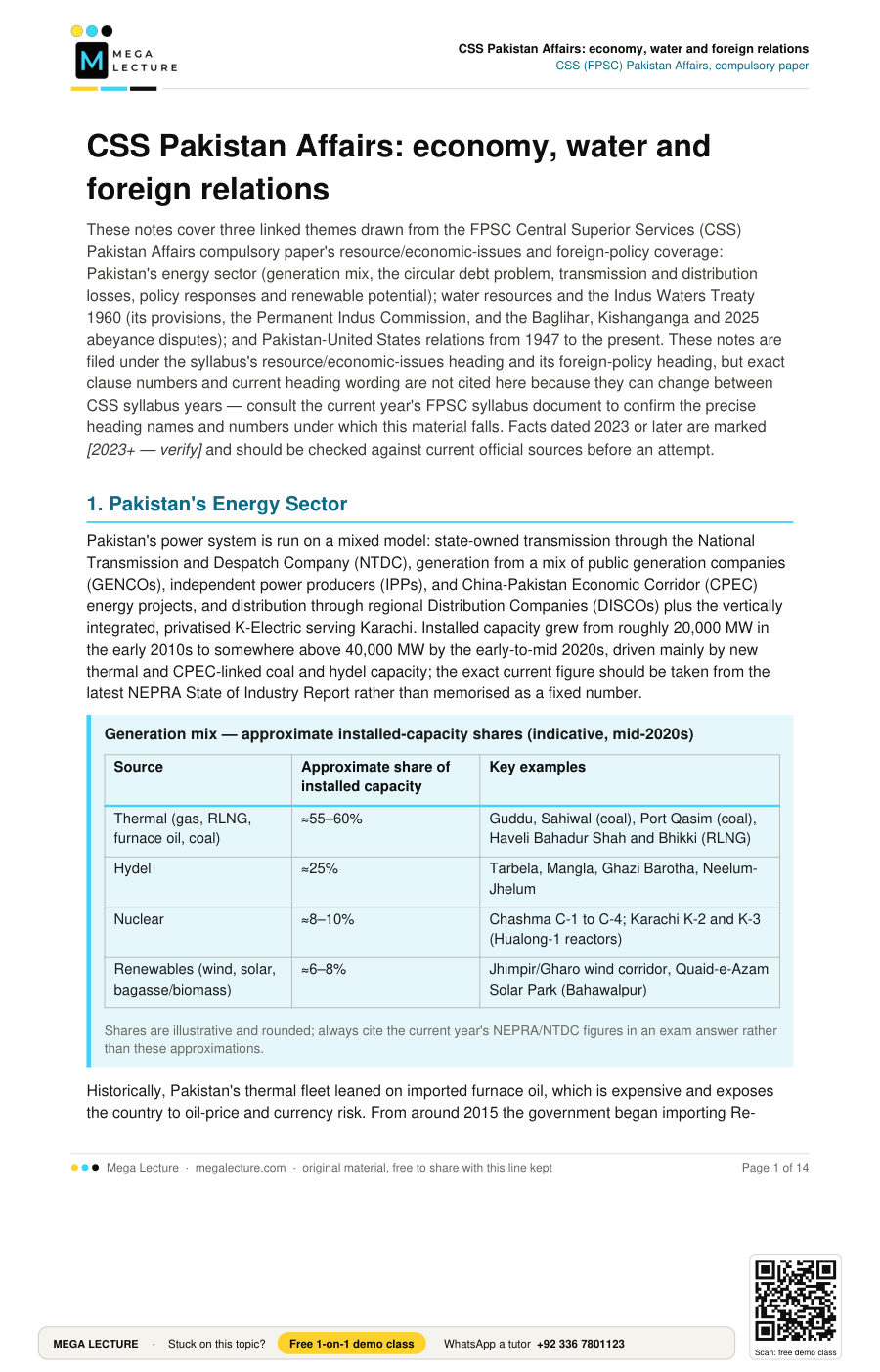
These notes cover three linked themes drawn from the FPSC Central Superior Services (CSS) Pakistan Affairs compulsory paper's resource/economic-issues and foreign-policy coverage: Pakistan's energy sector (generation mix, the circular debt problem, transmission and distribution losses, policy responses and renewable potential); water resources and the Indus Waters Treaty 1960 (its provisions, the Permanent Indus Commission, and the Baglihar, Kishanganga and 2025 abeyance disputes); and Pakistan-United States relations from 1947 to the present. These notes are filed under the syllabus's resource/economic-issues heading and its foreign-policy heading, but exact clause numbers and current heading wording are not cited here because they can change between CSS syllabus years — consult the current year's FPSC syllabus document to confirm the precise heading names and numbers under which this material falls. Facts dated 2023 or later are marked [2023+ — verify] and should be checked against current official sources before an attempt.
1. Pakistan's Energy Sector
Pakistan's power system is run on a mixed model: state-owned transmission through the National Transmission and Despatch Company (NTDC), generation from a mix of public generation companies (GENCOs), independent power producers (IPPs), and China-Pakistan Economic Corridor (CPEC) energy projects, and distribution through regional Distribution Companies (DISCOs) plus the vertically integrated, privatised K-Electric serving Karachi. Installed capacity grew from roughly 20,000 MW in the early 2010s to somewhere above 40,000 MW by the early-to-mid 2020s, driven mainly by new thermal and CPEC-linked coal and hydel capacity; the exact current figure should be taken from the latest NEPRA State of Industry Report rather than memorised as a fixed number.
Generation mix — approximate installed-capacity shares (indicative, mid-2020s)
| Source | Approximate share of installed capacity | Key examples |
|---|---|---|
| Thermal (gas, RLNG, furnace oil, coal) | ≈55–60% | Guddu, Sahiwal (coal), Port Qasim (coal), Haveli Bahadur Shah and Bhikki (RLNG) |
| Hydel | ≈25% | Tarbela, Mangla, Ghazi Barotha, Neelum-Jhelum |
| Nuclear | ≈8–10% | Chashma C-1 to C-4; Karachi K-2 and K-3 (Hualong-1 reactors) |
| Renewables (wind, solar, bagasse/biomass) | ≈6–8% | Jhimpir/Gharo wind corridor, Quaid-e-Azam Solar Park (Bahawalpur) |
Shares are illustrative and rounded; always cite the current year's NEPRA/NTDC figures in an exam answer rather than these approximations.
Historically, Pakistan's thermal fleet leaned on imported furnace oil, which is expensive and exposes the country to oil-price and currency risk. From around 2015 the government began importing Re-gasified Liquefied Natural Gas (RLNG), including through long-term supply agreements with Qatar, to convert or build gas-fired plants and reduce reliance on furnace oil. Hydel generation is anchored by Tarbela and Mangla, Pakistan's two largest reservoir dams (both built with World Bank-arranged financing that followed the Indus Waters Treaty, discussed in Section 2), plus run-of-river plants such as Ghazi Barotha on the Indus and Neelum-Jhelum, completed in 2018 on the Neelum/Kishanganga river system (Neelum-Jhelum has also experienced operational interruptions in recent years [2023+ — verify current operational status before citing it as a running plant]). Nuclear power grew from a single Canadian-supplied plant at Karachi (KANUPP-1, commissioned c. 1971–72, later decommissioned) to four Chinese-supplied units at Chashma and two further Chinese Hualong-1 units at Karachi (K-2 and K-3), commissioned in 2021 and 2022 respectively. Diamer-Bhasha and Dasu, both on the Indus in the north, are large hydel projects under construction that are intended to add both generation and storage capacity in the coming years.
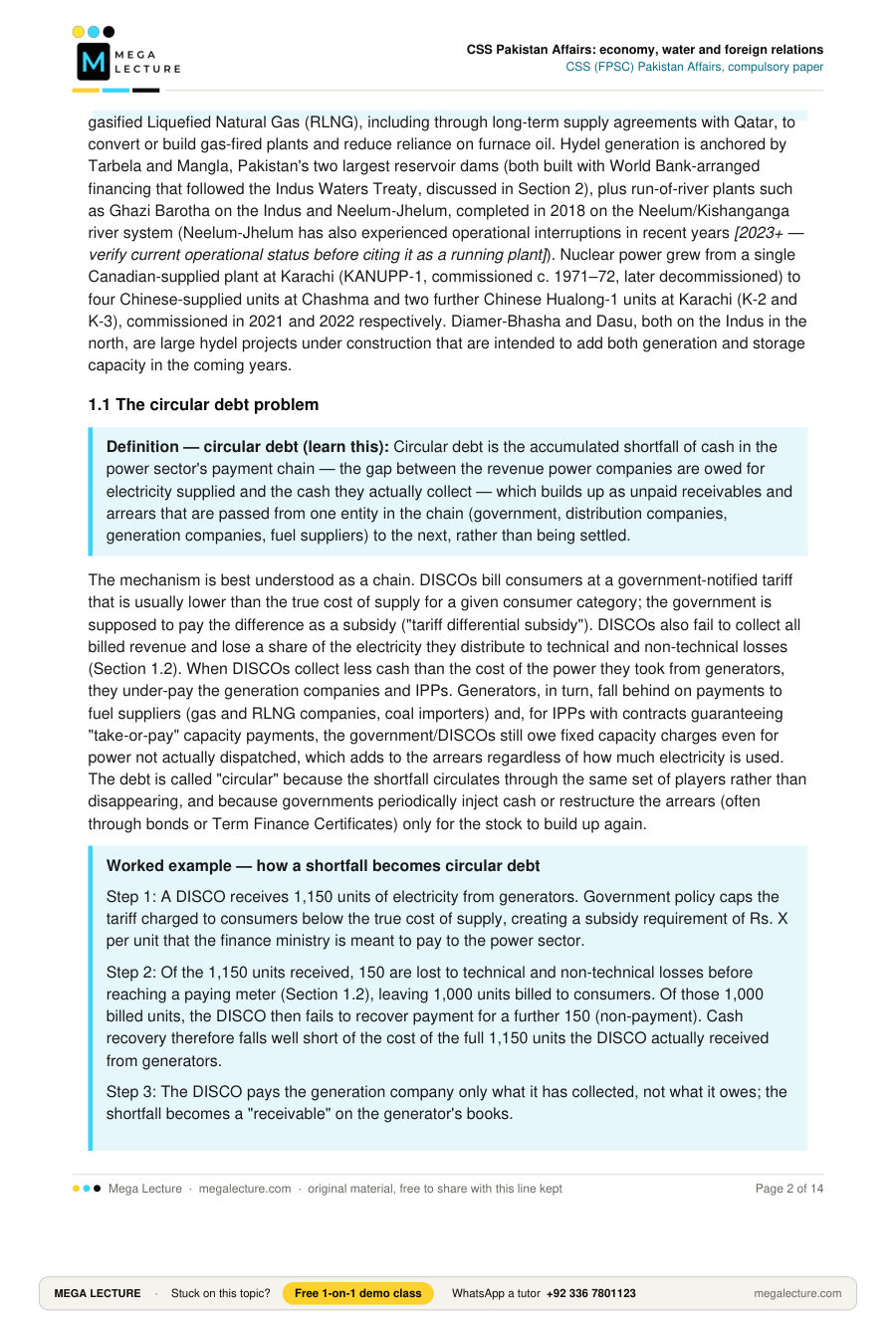
1.1 The circular debt problem
Definition — circular debt (learn this): Circular debt is the accumulated shortfall of cash in the power sector's payment chain — the gap between the revenue power companies are owed for electricity supplied and the cash they actually collect — which builds up as unpaid receivables and arrears that are passed from one entity in the chain (government, distribution companies, generation companies, fuel suppliers) to the next, rather than being settled.
The mechanism is best understood as a chain. DISCOs bill consumers at a government-notified tariff that is usually lower than the true cost of supply for a given consumer category; the government is supposed to pay the difference as a subsidy ("tariff differential subsidy"). DISCOs also fail to collect all billed revenue and lose a share of the electricity they distribute to technical and non-technical losses (Section 1.2). When DISCOs collect less cash than the cost of the power they took from generators, they under-pay the generation companies and IPPs. Generators, in turn, fall behind on payments to fuel suppliers (gas and RLNG companies, coal importers) and, for IPPs with contracts guaranteeing "take-or-pay" capacity payments, the government/DISCOs still owe fixed capacity charges even for power not actually dispatched, which adds to the arrears regardless of how much electricity is used. The debt is called "circular" because the shortfall circulates through the same set of players rather than disappearing, and because governments periodically inject cash or restructure the arrears (often through bonds or Term Finance Certificates) only for the stock to build up again.
Worked example — how a shortfall becomes circular debt
Step 1: A DISCO receives 1,150 units of electricity from generators. Government policy caps the tariff charged to consumers below the true cost of supply, creating a subsidy requirement of Rs. X per unit that the finance ministry is meant to pay to the power sector.
Step 2: Of the 1,150 units received, 150 are lost to technical and non-technical losses before reaching a paying meter (Section 1.2), leaving 1,000 units billed to consumers. Of those 1,000 billed units, the DISCO then fails to recover payment for a further 150 (non-payment). Cash recovery therefore falls well short of the cost of the full 1,150 units the DISCO actually received from generators.
Step 3: The DISCO pays the generation company only what it has collected, not what it owes; the shortfall becomes a "receivable" on the generator's books.
Step 4: The generator, short of cash, delays payment to its fuel supplier (a gas utility or an IPP's fuel provider) and to any IPP from which it purchases power; the IPP still invoices for the contracted capacity payment regardless of dispatch.
Step 5: Each unpaid invoice becomes an "arrear" that carries forward to the next billing cycle; when the government subsidy in Step 1 is also paid late or only partially, the two shortfalls add together. Repeated over months and years across the whole sector, these unpaid amounts accumulate into the stock of circular debt.
Principal causes of circular debt (list to memorise)
- Tariff differential subsidy: the gap between the cost of supply and the government-notified consumer tariff, when not reimbursed on time or in full.
- Transmission and distribution (T&D) losses above the benchmark allowed by the regulator, especially theft and non-payment in high-loss feeders (Section 1.2).
- Under-recovery: bills issued but not collected from consumers, including government departments and, in earlier decades, some public-sector bodies.
- "Take-or-pay" capacity payments owed to IPPs under long-term power purchase agreements, which are due whether or not the plant is actually dispatched — a structural cost that grows as installed capacity has expanded faster than demand.
- Delays between when NEPRA (the regulator) determines a tariff and when the government formally notifies it, during which the sector absorbs the difference.
- Periodic exchange-rate depreciation, which raises the rupee cost of imported fuel (furnace oil, RLNG, imported coal) faster than tariffs are adjusted.
The rupee value of the circular debt stock is a fast-moving figure that has repeatedly reached record levels through the 2020s; any specific figure for 2023 or later must be checked against a current Ministry of Energy, NEPRA or State Bank of Pakistan source before being used in an exam answer [2023+ — verify].
1.2 Transmission and distribution losses
T&D losses are the electricity lost between the point of generation and the point at which a consumer is billed. They have two components: technical losses (heat and resistance losses in wires and transformers, which are largely unavoidable but can be reduced by upgrading old or overloaded infrastructure) and non-technical losses (theft through illegal connections ("kunda" connections), meter tampering, and under-billing or non-billing, which are a governance and enforcement problem rather than an engineering one). Pakistan's aggregate T&D losses have generally been cited in the high-teens as a percentage of electricity sent out, well above the roughly 10–12% loss level regulators consider a reasonable technical benchmark, with the worst-performing DISCOs — typically those serving parts of Khyber Pakhtunkhwa, interior Sindh and Balochistan — showing much higher losses on individual feeders, sometimes exceeding 30–40%, largely due to theft and weak recovery rather than wiring alone. These figures vary year to year and by DISCO, so an exam answer should describe the pattern (technical vs non-technical, which regions are worst, the recovery-rate problem) rather than quote a single fixed national percentage as if it never changes.
1.3 Government responses
| Period | Response | Effect / significance |
|---|---|---|
| 1994 | Power Policy opening generation to private Independent Power Producers (IPPs) on take-or-pay contracts | Relieved an acute shortage but later identified as a structural driver of capacity-payment obligations that persist regardless of dispatch |
| 2005 | Privatisation of the Karachi Electric Supply Corporation (now K-Electric) | Removed Karachi from the NTDC/DISCO structure into a separate, vertically integrated private utility |
| 2013 | One-off circular debt settlement of roughly Rs. 480 billion via Term Finance Certificates shortly after the change of government (cited figures vary slightly, roughly Rs. 480–500 billion, depending on source) | Temporarily cleared the accumulated stock but did not address the underlying causes, so the debt began rebuilding |
| 2015–2020 | CPEC energy projects: coal plants (Sahiwal, Port Qasim, Thar-coal-based generation), wind and hydel additions | Ended chronic load-shedding by adding several thousand megawatts of capacity, but higher installed capacity relative to demand growth increased aggregate capacity-payment obligations |
| 2019 | Alternative and Renewable Energy Policy 2019 | Set indicative targets for renewable energy's share of the generation mix (excluding large hydel), and introduced competitive-bidding rules for new renewable projects |
| 2019 onward | IMF programme conditions requiring periodic tariff rebasing and agreed Circular Debt Management Plans | Linked continued IMF disbursements to regular, automatic tariff adjustments intended to keep the tariff differential subsidy from growing unchecked |
| Ongoing (2023–2025) | Further Circular Debt Management Plans, attempts to renegotiate or restructure some IPP capacity-payment terms, and review of rooftop-solar net-metering buy-back rates | Specific terms and outcomes are still developing [2023+ — verify] |
1.4 Renewable energy potential
Pakistan has substantial untapped renewable potential. The Gharo-Jhimpir wind corridor in Sindh, between the Arabian Sea and the Kirthar range, is a naturally wind-funnelled belt that already hosts a cluster of grid-connected wind farms and is generally assessed as capable of supporting several times its currently installed wind capacity. Solar potential is high across most of the country, particularly in Balochistan and southern Punjab/Sindh, given high annual solar irradiance; the Quaid-e-Azam Solar Park near Bahawalpur (commissioned from 2015) was an early flagship utility-scale solar project. Net-metering rules introduced under the 2019 renewable-energy policy allowed households and businesses to install rooftop solar and export surplus power to the grid, and rooftop solar uptake grew rapidly through the early-to-mid 2020s as grid tariffs rose, though the resulting effect on DISCO revenue has itself become a policy issue under review [2023+ — verify]. Constraints on faster renewable rollout include the intermittency of wind and solar requiring backup or storage capacity, the cost and slow pace of transmission-grid reinforcement to bring power from resource-rich but sparsely populated areas (Balochistan, coastal Sindh) to load centres, and the fact that existing thermal IPPs' take-or-pay contracts reduce the short-run financial incentive to dispatch cheaper renewable power ahead of contracted thermal capacity.
2. Water Resources and the Indus Waters Treaty 1960
Pakistan's agriculture and much of its power generation depend on the Indus river system, which rises in the disputed region of Kashmir and Tibet and is shared with India upstream. Because most of the system's headwaters lie in Indian-administered territory, the division of the Indus and its tributaries between the two countries after independence became one of the earliest and most consequential disputes between India and Pakistan, eventually resolved (at the time) by a treaty brokered by the World Bank.
2.1 The Indus Waters Treaty 1960
Key facts to learn: The Indus Waters Treaty was signed on 19 September 1960 in Karachi by President Ayub Khan of Pakistan and Prime Minister Jawaharlal Nehru of India, with the World Bank (then the International Bank for Reconstruction and Development) as broker and a signatory to the financial articles. It followed nearly a decade of World Bank-mediated negotiation after disputes over canal water flowing from India into Pakistan's Punjab canal system in the years immediately after Partition.
| Rivers | Allocation | Permitted use by the other party |
|---|---|---|
| Eastern rivers: Ravi, Beas, Sutlej | Waters allocated to India | India has essentially unrestricted use; Pakistan has no entitlement except to any residual flow |
| Western rivers: Indus, Jhelum, Chenab | Waters allocated principally to Pakistan | India may use them for domestic and non-consumptive purposes, limited agricultural irrigation in specified areas, and hydroelectric power generation from "run-of-river" plants built to design criteria set out in the treaty's technical annexures, intended to stop India from being able to store water or control the timing of flows in a way that would harm Pakistan's downstream irrigation |
To compensate Pakistan for losing the Eastern rivers, on which parts of its existing canal system had depended, the treaty provided for a transition period and an Indus Basin Development Fund, financed by the World Bank and several other countries, to help Pakistan build replacement works: new link canals moving water from the Western rivers to areas previously fed by the Eastern rivers, and the large storage dams at Tarbela (on the Indus) and Mangla (on the Jhelum), both discussed in Section 1 as pillars of Pakistan's hydel generation.
The Permanent Indus Commission
The treaty establishes a Permanent Indus Commission (PIC) with one Commissioner appointed by each government, normally a senior irrigation/water engineer. The Commission is required to meet at least once a year, alternating between India and Pakistan, to exchange hydrological and flow data, inspect works on the rivers, and try to resolve "questions" that either side raises about the treaty's implementation. It is the first and normal channel through which day-to-day and technical issues between the two countries under the treaty are meant to be settled.
Three-tier dispute resolution mechanism
| Tier | Nature of issue | Forum |
|---|---|---|
| 1 | A routine "question" about implementation | Permanent Indus Commission |
| 2 | A technical "difference" the Commission cannot resolve, of a kind listed in the treaty (e.g. specific design questions) | Neutral Expert, appointed for that dispute |
| 3 | A broader "dispute" over interpretation or application of the treaty | Court of Arbitration (a seven-member ad hoc tribunal) |
2.2 The Baglihar dispute
Baglihar is an Indian run-of-river hydroelectric project on the Chenab in Indian-administered Jammu and Kashmir. From the early 2000s Pakistan objected that its design — including the height of the dam, the level of "pondage" (short-term storage behind the dam) and the design of the spillway gates — exceeded what the treaty's technical criteria for run-of-river plants on Western rivers allowed, and could in principle let India regulate the timing of flows reaching Pakistan. Unable to resolve the technical disagreement through the Permanent Indus Commission, Pakistan invoked the Neutral Expert procedure in 2005. The World Bank appointed the Swiss engineer Professor Raymond Lafitte as Neutral Expert; he issued his determination in February 2007, broadly upholding the core of India's project design while directing some modifications, including a reduction in pondage capacity and adjustments to the height of the spillway gates and the dam's "freeboard." The outcome is generally treated as a partial validation of India's position that nonetheless conceded some of Pakistan's specific technical concerns.
2.3 The Kishanganga dispute
Kishanganga is an Indian hydroelectric project that diverts water from the Kishanganga river (called the Neelum after it crosses into Pakistan-administered territory, a tributary of the Jhelum) through a tunnel into the Wular Lake/Jhelum system for power generation, reducing the flow reaching Pakistan's own Neelum-Jhelum Hydropower Project downstream (see Section 1). Pakistan argued the inter-tributary diversion breached the treaty's restrictions on India's use of Western-river waters and initiated proceedings before a Court of Arbitration, constituted under the Permanent Court of Arbitration at The Hague, in 2010. The Court's partial award, issued in February 2013, permitted India to proceed with the diversion for power generation but established that a minimum environmental flow had to be maintained, with the exact quantum left open. The Court's final award, issued in December 2013, fixed the specific minimum flow to be released into the Neelum/Kishanganga downstream of the project, so as to protect the river's flow and Pakistan's ability to run its own downstream hydel plant.
2.4 India's 2025 decision to hold the treaty in abeyance
[2023+ — verify all details below against current, dated reporting before use in an answer.] Following the April 2025 terrorist attack at Pahalgam in Indian-administered Kashmir, India announced that it would hold the Indus Waters Treaty "in abeyance," stating it would suspend cooperation and information-sharing under the treaty, including the normal functioning of the Permanent Indus Commission, until further notice. Pakistan rejected the legality of a unilateral suspension, noting that the treaty contains no provision allowing either side to suspend it outside the amendment or termination procedures the treaty itself sets out, and treated the move as a serious escalation. As of September 2026 (the most recent point checked for these notes), the treaty's legal status and the practical extent of any change in water flows remained contested and evolving, with developments continuing since the April 2025 announcement; students should state this dispute's facts (the date, the stated Indian trigger, and Pakistan's stated legal objection) rather than adopt either government's characterisation as settled fact, and must search current reporting for any developments after September 2026 before an exam.
3. Pakistan-United States Relations, 1947 to the Present
Pakistan-US relations have moved through recognisable phases: an early Cold War alliance, a difficult decade after the 1965 and 1971 wars, a renewed alliance during the Soviet-Afghan war, sanctions after the Cold War ended, a further renewed alliance after 9/11, and a post-2011 relationship marked by recurring tension and, more recently, a narrower, less security-centred engagement.
3.1 The Cold War alliance: SEATO and CENTO
Key dates: Mutual Defense Assistance Agreement, 1954 — began formal US military aid to Pakistan. Pakistan joined the Southeast Asia Treaty Organization (SEATO) in 1954 and the Baghdad Pact in 1955 (renamed the Central Treaty Organization, CENTO, in 1959 after Iraq's withdrawal following the 1958 revolution). Both were US-backed, anti-communist collective-defence pacts; Pakistan's membership brought substantial military and economic assistance and aligned Pakistan firmly with the Western bloc for the rest of the 1950s and 1960s, a choice Pakistani policymakers of the period justified chiefly as a way of balancing India and securing external support for defence, rather than out of an ideological commitment to the Cold War contest itself.
The alliance's practical limits became clear in the 1965 India-Pakistan war, when the United States imposed an arms embargo on both India and Pakistan; because Pakistan's military was far more dependent on US equipment than India's, the embargo affected Pakistan more severely and is often cited by Pakistani commentators as an early sign that formal alliance did not guarantee US backing in an actual India-Pakistan conflict. In the 1971 war, the Nixon administration diplomatically "tilted" toward Pakistan and sent a naval task force led by the USS Enterprise toward the Bay of Bengal as a signal, but did not intervene to prevent the war's outcome or the creation of Bangladesh.
3.2 Nuclear-related strains and the Afghan-Soviet war era
After the 1971 war and India's 1974 nuclear test, Pakistan pursued its own nuclear programme, which became a recurring source of US-Pakistan tension: the 1976 Symington Amendment restricted US aid to countries acquiring unsafeguarded uranium-enrichment technology, and the 1985 Pressler Amendment required the US President to certify annually that Pakistan did not possess a nuclear explosive device before aid could continue.
Following the Soviet Union's invasion of Afghanistan in December 1979, Pakistan (under President Zia-ul-Haq) became the principal frontline state supporting Afghan resistance to Soviet occupation. The United States, Saudi Arabia and Pakistan's Inter-Services Intelligence (ISI) jointly funded, armed and trained Afghan mujahideen groups operating from Pakistani territory, and the US extended large economic and military aid packages to Pakistan through the 1980s, with Pressler Amendment nuclear certification effectively waived on strategic grounds for as long as the anti-Soviet campaign continued.
Soviet forces completed their withdrawal from Afghanistan in February 1989. In October 1990, with the strategic rationale for overlooking Pakistan's nuclear programme gone, the US President did not certify Pakistan as free of a nuclear device under the Pressler Amendment, triggering a cutoff of US military and most economic aid that strained relations through the 1990s. Pakistan's nuclear weapons tests at Chagai on 28 May 1998, carried out shortly after India's Pokhran-II tests, brought further US sanctions under the Glenn Amendment, and General Pervez Musharraf's October 1999 military coup added a further layer of democracy-related sanctions.
3.3 Post-9/11 cooperation and the War on Terror
After the 11 September 2001 attacks on the United States, the Musharraf government agreed to support the US-led campaign against Al-Qaeda and the Taliban in Afghanistan, providing air bases, overland logistics routes, and intelligence cooperation. Most outstanding US sanctions on Pakistan were waived, large-scale US economic and military assistance resumed — including reimbursements for military operations through the Coalition Support Fund — and in 2004 the US designated Pakistan a Major Non-NATO Ally, a status that eases certain categories of defence cooperation and arms transfers.
Cooperation through the 2000s was extensive but increasingly strained by disagreements over US drone strikes against militants in Pakistan's tribal areas, which Pakistani officials publicly criticised even while reportedly cooperating with aspects of the campaign privately, and by mutual suspicion over Pakistani support for, or tolerance of, militant networks operating across the Afghan border.
3.4 Periods of acute tension, 2011–2018
| Date | Event | Effect on relations |
|---|---|---|
| January 2011 | Raymond Davis incident: a CIA contractor shot two Pakistani men in Lahore | Major diplomatic crisis and public anger in Pakistan over his eventual release |
| 2 May 2011 | US Navy SEALs killed Osama bin Laden in a unilateral raid on Abbottabad, well inside Pakistani territory, without prior notice to Islamabad | Severe rift: Pakistan protested the violation of its sovereignty; in the US, questions were raised about how bin Laden had been sheltered so close to a major military garrison |
| 26 November 2011 | Salala incident: a US/NATO airstrike killed Pakistani soldiers at a border post | Pakistan closed NATO's overland supply routes into Afghanistan (the Ground Lines of Communication) for roughly seven months and demanded a formal apology |
| January 2018 | The Trump administration announced the suspension of US security assistance to Pakistan, citing insufficient action against militant safe havens | Marked a low point in security cooperation and reduced high-level engagement for several years |
3.5 The relationship's current state
Since the Afghan Taliban's return to power following the US withdrawal from Afghanistan in August 2021, US-Pakistan relations have generally moved toward a narrower, more transactional footing, with less emphasis on the security partnership that dominated the 2000s and more emphasis on economic and trade engagement, alongside periodic high-level contacts. Developments from 2023 onward — including the specific tenor of relations under the second Trump administration from January 2025, any changes in US economic or security assistance, and Pakistan's positioning between the US and China — are still unfolding and should be checked against current reporting rather than treated as fixed [2023+ — verify].
CSS-Style Questions and Model Answer Outlines
These practice questions deliberately vary in length and mark weight (15–20 marks) for teaching purposes and do not reproduce an actual FPSC paper's fixed mark scheme; a real CSS compulsory-paper question set is typically uniform in marks (candidates usually attempt 5 of 8 questions worth 20 each, totalling 100). Check the current FPSC rules and recent past papers for the exact format before an attempt.
Q1. Critically analyse the causes of Pakistan's circular debt problem and evaluate the effectiveness of government responses to it. [20]
- Introduction: define circular debt; state that it is a chronic, recurring problem rather than a one-off shortfall. [2]
- Causes: tariff differential subsidy gap, T&D losses and theft, under-recovery, take-or-pay capacity payments, delayed tariff notification, currency depreciation raising fuel import costs. [6]
- Government responses: 2013 one-off settlement, CPEC capacity additions and their side-effect on capacity payments, IMF-linked tariff rebasing and Circular Debt Management Plans. [6]
- Evaluation: one-off settlements address the symptom, not the structural causes; sustainable improvement requires reducing losses/theft and better matching capacity to demand, not just periodic bailouts. [4]
- Conclusion: circular debt will recur unless the underlying chain (subsidy timeliness, loss reduction, contract renegotiation) is fixed, not just its accumulated stock. [2]
Q2. Examine Pakistan's generation mix and assess the country's potential to expand renewable energy. [20]
- Introduction: sketch the mix — thermal, hydel, nuclear, renewables — and note the shift from furnace oil toward RLNG and coal since the mid-2010s. [3]
- Thermal and nuclear capacity: role of CPEC coal plants and Chinese-supplied nuclear units (Chashma, K-2/K-3). [4]
- Renewable potential: Sindh wind corridor, high solar irradiance in Balochistan/southern Punjab, Quaid-e-Azam Solar Park, net metering. [5]
- Constraints: intermittency, transmission-grid limits to reach load centres, take-or-pay thermal contracts reducing dispatch priority for renewables. [5]
- Conclusion: potential is significant but realising it needs grid investment and contract reform alongside new renewable capacity. [3]
Q3. Comment on the extent and causes of transmission and distribution losses in Pakistan's power sector, and suggest measures to reduce them. [15]
- Define T&D losses; distinguish technical from non-technical losses. [3]
- Extent: aggregate losses well above the regulator's technical benchmark, with the worst DISCOs concentrated in parts of Khyber Pakhtunkhwa, interior Sindh and Balochistan. [4]
- Causes: ageing infrastructure (technical), theft/illegal connections and under-billing (non-technical), weak enforcement and governance. [4]
- Measures: grid and transformer upgrades, metering and billing reform, targeted enforcement in high-loss feeders, possible DISCO privatisation or performance-based management contracts. [4]
Q4. Elucidate the main provisions of the Indus Waters Treaty 1960 and explain the role of the Permanent Indus Commission. [20]
- Background: post-Partition canal-water dispute; World Bank-mediated negotiation culminating in the treaty signed 19 September 1960 by Ayub Khan and Nehru. [3]
- Core allocation: Eastern rivers (Ravi, Beas, Sutlej) to India; Western rivers (Indus, Jhelum, Chenab) principally to Pakistan, with India's limited permitted uses on the Western rivers. [5]
- Transition arrangements: Indus Basin Development Fund, link canals, Tarbela and Mangla dams. [4]
- Permanent Indus Commission: composition, annual meetings, data exchange, and its role as the first forum for resolving "questions." [5]
- Conclusion: the treaty has survived several wars as a functioning technical framework, which is itself significant. [3]
Q5. Critically examine the Baglihar and Kishanganga disputes as tests of the Indus Waters Treaty's dispute-resolution mechanism. [20]
- Introduction: outline the treaty's three-tier mechanism (Commission, Neutral Expert, Court of Arbitration). [3]
- Baglihar: Pakistan's objections to design/pondage; referral to Neutral Expert Raymond Lafitte; 2007 determination largely upholding the design with some modifications. [6]
- Kishanganga: inter-tributary diversion issue; Court of Arbitration at The Hague; 2013 partial award allowing diversion subject to a minimum environmental flow to Pakistan. [6]
- Assessment: both cases show the mechanism can produce binding, if partially unsatisfying, outcomes for both sides, but also show recurring friction over how far India's run-of-river projects can go. [3]
- Conclusion. [2]
Q6. Discuss India's 2025 decision to hold the Indus Waters Treaty in abeyance and its implications for Pakistan. [20]
- Introduction: note this is a recent, evolving development and state the need to verify current details. [2]
- Facts as reported: the April 2025 Pahalgam attack cited by India as the trigger; India's announcement that it would hold the treaty in abeyance and suspend related cooperation, including the Permanent Indus Commission's normal functioning. [6]
- Pakistan's position: that the treaty provides no mechanism for unilateral suspension and that any change must follow its own amendment/termination provisions. [5]
- Implications: uncertainty for downstream water planning and agriculture, questions over dispute-resolution channels if the Commission does not meet, and the wider effect on bilateral relations. [5]
- Conclusion, noting the situation was still developing at the time of writing. [2]
Q7. Trace the evolution of Pakistan-United States relations from the 1950s alliance through the post-9/11 War on Terror, and evaluate whether the relationship has been consistently reliable for Pakistan. [20]
- Introduction: relationship has alternated between close alliance and estrangement depending on shared strategic interest. [2]
- 1950s alliance: Mutual Defense Assistance Agreement 1954, SEATO 1954, CENTO 1955. [3]
- Strains: 1965 arms embargo, 1971 limited US support, Pressler-era sanctions of the 1990s. [4]
- Afghan-Soviet war alliance (1979–1989) and its strategic-interest-driven nature. [3]
- Post-9/11 alliance: bases, logistics, intelligence cooperation, Major Non-NATO Ally status (2004), Coalition Support Fund. [4]
- Evaluation: many analysts (particularly the realist/strategic-interest school of Pakistani foreign-policy writing) read the pattern — cooperation tracking shared strategic need (anti-communism, anti-Soviet Afghanistan, counterterrorism) rather than a stable long-term commitment — as explaining the recurring cycle of alliance and sanctions; this should be presented as an interpretive view, not settled fact, noting the alternative view that shared institutional/military ties gave the relationship some independent durability. [3]
- Conclusion. [1]
Q8. Assess the current state of Pakistan-United States relations and the challenges facing the relationship going forward. [15]
- Introduction: since 2011 the relationship has been more transactional and less security-centred than in the 2000s. [2]
- Key turning points: Abbottabad raid (2011), Salala incident (2011), 2018 suspension of security assistance. [4]
- Post-2021 context: US withdrawal from Afghanistan and the Taliban's return complicating security cooperation; shift toward economic/trade engagement. [4]
- Challenges: rebuilding trust, balancing relations with the US against Pakistan's close ties with China, and the still-developing shape of the relationship from 2023 onward, which should be checked against current sources. [4]
- Conclusion. [1]
Key terms
| Term | Definition |
|---|---|
| Circular debt | The accumulated cash shortfall in the power sector's payment chain, arising when revenue owed for electricity is not fully collected or paid on, and passed as unpaid arrears from government/DISCOs to generators to fuel suppliers. |
| Take-or-pay contract | A power purchase agreement under which the buyer must pay a fixed capacity charge to the generator regardless of how much electricity is actually dispatched. |
| Tariff differential subsidy | The government payment meant to cover the gap between the true cost of supplying electricity and a lower, government-notified consumer tariff. |
| T&D losses | Electricity lost between generation and billed consumption, split into technical losses (resistance/heat in the network) and non-technical losses (theft, under-billing). |
| DISCO | Distribution Company — a regional, state-owned entity (outside Karachi) responsible for distributing and billing electricity to end consumers. |
| NEPRA | National Electric Power Regulatory Authority — the regulator that determines electricity tariffs and licenses power-sector entities. |
| Run-of-river plant | A hydroelectric plant that generates power mainly from the natural flow of a river with little or no water storage, as distinct from a storage dam. |
| Permanent Indus Commission | The body of one Indian and one Pakistani commissioner established by the Indus Waters Treaty to exchange data and resolve implementation questions. |
| Neutral Expert | An independent technical expert appointed, under the Indus Waters Treaty's second-tier procedure, to resolve a defined technical "difference" between the parties. |
| Court of Arbitration | The seven-member ad hoc tribunal that is the Indus Waters Treaty's third and final dispute-resolution tier, for broader disputes of interpretation or application. |
| Major Non-NATO Ally | A US designation (given to Pakistan in 2004) that eases certain forms of defence cooperation and arms transfers without amounting to a mutual-defence treaty. |
| SEATO / CENTO | US-led, anti-communist collective-defence pacts of the 1950s (Southeast Asia Treaty Organization; Central Treaty Organization, formerly the Baghdad Pact) that Pakistan joined in 1954 and 1955 respectively. |
Quick check
- Define circular debt in one sentence.
- List three causes of Pakistan's circular debt.
- Distinguish between technical and non-technical transmission and distribution losses.
- State the date and the two signatories of the Indus Waters Treaty.
- Name the three Eastern rivers and the three Western rivers under the treaty.
- Explain the role of the Permanent Indus Commission.
- Outline the treaty's three-tier dispute-resolution mechanism.
- Compare the outcomes of the Baglihar and Kishanganga disputes.
- Critically evaluate why India's 2025 decision on the Indus Waters Treaty is legally contested.
- Trace the main phases of Pakistan-US relations from 1947 to 2001.
- Explain how the Abbottabad raid and the Salala incident each affected Pakistan-US relations.
- Assess whether Pakistan-US relations have been driven more by shared values or by shared strategic interest, giving evidence.
- Circular debt is the accumulated cash shortfall in the power sector's payment chain, built up when revenue owed for electricity is not fully collected or paid on time and passed as unpaid arrears between government, DISCOs, generators and fuel suppliers.
- Any three of: unpaid/late tariff differential subsidy; T&D losses and theft; under-recovery from billed consumers; take-or-pay capacity payments; delayed tariff notification; currency depreciation raising import fuel costs.
- Technical losses are physical losses in wires/transformers (resistance and heat); non-technical losses are theft, illegal connections and under-billing — a governance/enforcement problem rather than an engineering one.
- 19 September 1960; signed by President Ayub Khan of Pakistan and Prime Minister Jawaharlal Nehru of India (with the World Bank as broker/co-signatory on financial articles).
- Eastern rivers: Ravi, Beas, Sutlej (allocated to India). Western rivers: Indus, Jhelum, Chenab (allocated principally to Pakistan).
- The Permanent Indus Commission, with one commissioner from each country, meets at least annually to exchange data, inspect works, and resolve implementation "questions" as the first channel under the treaty.
- Tier 1: Permanent Indus Commission (questions). Tier 2: Neutral Expert (technical differences). Tier 3: Court of Arbitration (broader disputes of interpretation/application).
- Baglihar: Neutral Expert (Raymond Lafitte) largely upheld India's design in 2007 with some modifications. Kishanganga: Court of Arbitration at The Hague allowed India's diversion in 2013 but required a minimum environmental flow to Pakistan — Baglihar was resolved at the technical tier, Kishanganga at the highest, judicial tier.
- Pakistan argues the treaty has no provision allowing either side to unilaterally suspend it outside its own amendment/termination procedures, so India's stated "abeyance" is contested as a matter of treaty law, even though India has cited the April 2025 Pahalgam attack as its stated reason.
- 1947–1950s: early alignment and 1954 Mutual Defense Assistance Agreement, SEATO (1954), CENTO (1955); 1965: US arms embargo on both India and Pakistan; 1971: limited US "tilt" toward Pakistan without intervention; 1970s–80s: nuclear-related sanctions (Symington, Pressler) alongside the 1979–1989 Afghan-Soviet war alliance; 1990: Pressler sanctions after Soviet withdrawal; 1998: further sanctions after Pakistan's nuclear tests; 2001: alliance renewed after 9/11.
- The May 2011 Abbottabad raid, in which US forces killed Osama bin Laden without prior notice to Pakistan, caused a severe rift over the violation of Pakistani sovereignty; the November 2011 Salala incident, a US/NATO strike killing Pakistani soldiers, led Pakistan to close NATO's Afghan supply routes for about seven months and demand an apology — both illustrate how operational incidents, not just policy disagreements, have driven periods of acute tension.
- Evidence (alliance renewed specifically around the Cold War, the Afghan-Soviet war, and the post-9/11 War on Terror, each followed by estrangement once the shared strategic interest lapsed — 1965 embargo, 1990 Pressler sanctions, 2018 aid suspension) supports the interpretation, associated with many Pakistani analysts, that the relationship has been driven primarily by convergent strategic interest rather than a stable, values-based partnership; a full answer should present this as one scholarly view rather than an uncontested conclusion.
