
AS Level · Physics 9702 · Nuclear & Particle Physics
Radioactivity
Typed from the teacher’s handwritten class notes. The original pages are one tap away.
New: small group classes for AS Level Physics are opening, at a lower fee than one-to-one. Join the waiting list
Check yourself
5 quick questions on AS Level Physics
Tap an answer to see if you are right, and why. Free, no sign-up.
Start the free test8 of 8 students found these notes useful
Was this note useful?
Full text of Radioactivity
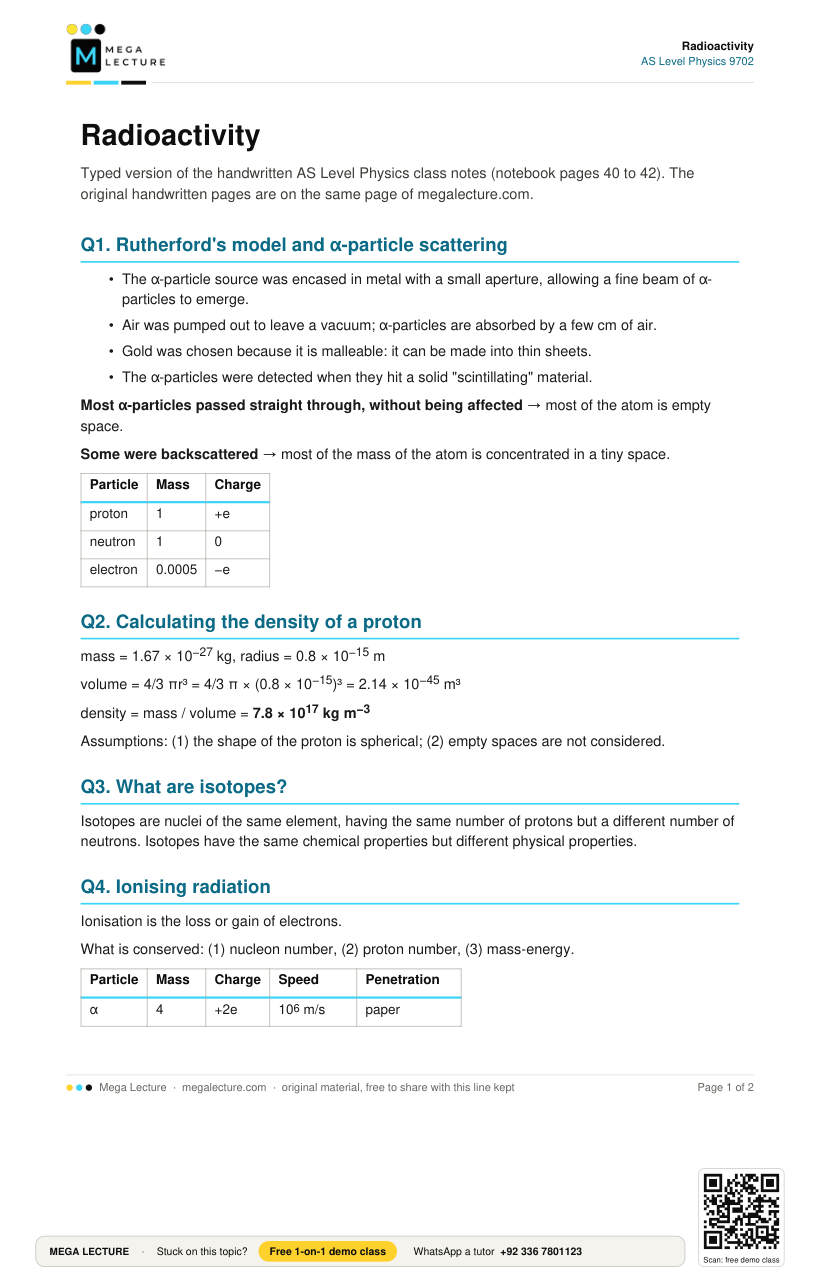
Typed version of the handwritten AS Level Physics class notes (notebook pages 40 to 42). The original handwritten pages are on the same page of megalecture.com.
Q1. Rutherford's model and α-particle scattering
- The α-particle source was encased in metal with a small aperture, allowing a fine beam of α-particles to emerge.
- Air was pumped out to leave a vacuum; α-particles are absorbed by a few cm of air.
- Gold was chosen because it is malleable: it can be made into thin sheets.
- The α-particles were detected when they hit a solid "scintillating" material.
Most α-particles passed straight through, without being affected → most of the atom is empty space.
Some were backscattered → most of the mass of the atom is concentrated in a tiny space.
| Particle | Mass | Charge |
|---|---|---|
| proton | 1 | +e |
| neutron | 1 | 0 |
| electron | 0.0005 | −e |
Q2. Calculating the density of a proton
mass = 1.67 × 10⁻²⁷ kg, radius = 0.8 × 10⁻¹⁵ m
volume = 4/3 πr³ = 4/3 π × (0.8 × 10−15)³ = 2.14 × 10−45 m³
density = mass / volume = 7.8 × 10¹⁷ kg m−3
Assumptions: (1) the shape of the proton is spherical; (2) empty spaces are not considered.
Q3. What are isotopes?
Isotopes are nuclei of the same element, having the same number of protons but a different number of neutrons. Isotopes have the same chemical properties but different physical properties.
Q4. Ionising radiation
Ionisation is the loss or gain of electrons.
What is conserved: (1) nucleon number, (2) proton number, (3) mass-energy.
| Particle | Mass | Charge | Speed | Penetration |
|---|---|---|---|---|
| α | 4 | +2e | 106 m/s | paper |
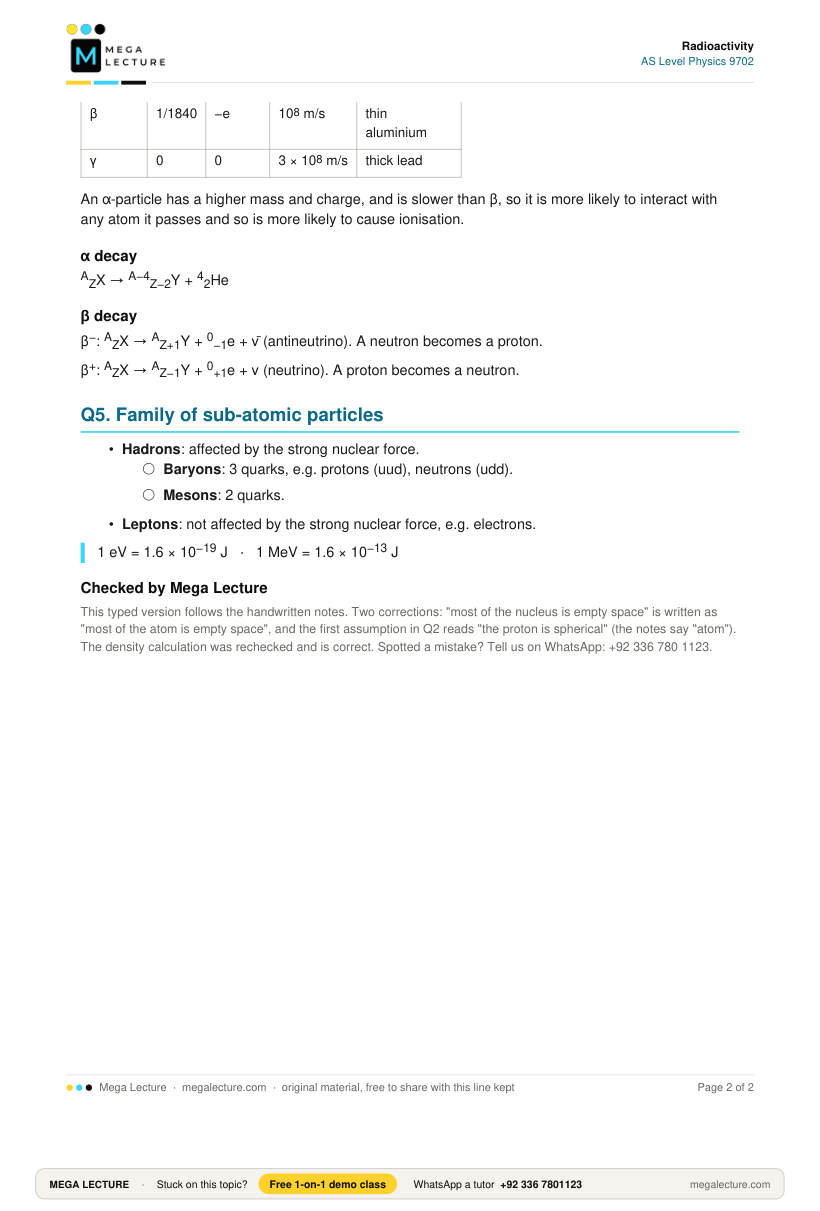
| β | 1/1840 | −e | 108 m/s | thin aluminium |
| γ | 0 | 0 | 3 × 10⁸ m/s | thick lead |
An α-particle has a higher mass and charge, and is slower than β, so it is more likely to interact with any atom it passes and so is more likely to cause ionisation.
α decay
AZX → A−4Z−2Y + 42He
β decay
β−: AZX → AZ+1Y + 0−1e + ν̄ (antineutrino). A neutron becomes a proton.
β+: AZX → AZ−1Y + 0+1e + ν (neutrino). A proton becomes a neutron.
Q5. Family of sub-atomic particles
- Hadrons: affected by the strong nuclear force.
- Baryons: 3 quarks, e.g. protons (uud), neutrons (udd).
- Mesons: 2 quarks.
- Leptons: not affected by the strong nuclear force, e.g. electrons.
1 eV = 1.6 × 10−19 J · 1 MeV = 1.6 × 10⁻¹³ J
