
A Level · Accounting 9706 · A Level Accounting: financial accounting notes
A Level Accounting: financial accounting notes
Opens inside this page. Prefer your own PDF app? Open the PDF.
Check yourself
5 quick questions on A Level Accounting
Tap an answer to see if you are right, and why. Free, no sign-up.
Start the free test15 of 17 students found these notes useful
Was this note useful?
Full text of A Level Accounting: financial accounting notes
These revision notes cover the A Level (Paper 3) financial accounting content of Cambridge International AS & A Level Accounting (9706). They broadly follow the syllabus topics: preparing financial statements, manufacturing businesses, not-for-profit organisations, limited companies, the International Accounting Standards named in the syllabus, auditing and stewardship, business purchase and merger, consignment and joint venture accounts, computerised accounting systems, and analysing and communicating accounting information. Some topics, such as limited company statements and ratio analysis, build on work you met at AS Level. Every business and figure is invented. Each worked example shows every step and balances. Negative figures appear in brackets, as they do in exam answers. The notes end with short quick-check questions and three full-length exam-style questions with model answers.
1. Preparation of financial statements: purpose and users
Financial statements summarise a business's financial performance over a period (the income statement) and its financial position at the end of that period (the statement of financial position). A limited company also prepares a statement of changes in equity and a statement of cash flows, and adds notes.
Key idea: the objective of general purpose financial reporting
The IASB Conceptual Framework sets out the purpose of financial reporting. In short, it gives investors, lenders and other creditors (both existing and potential) financial information about the entity. They use this information for two things: to decide whether to provide resources to the entity, and to judge how well management has looked after the resources it already controls (stewardship).
| User | Main interest | Statements or ratios they look at most |
|---|---|---|
| Shareholders (current and potential) | Return on investment, dividends, share price growth | Income statement, EPS, P/E ratio, dividend yield |
| Lenders (banks, debenture holders) | Whether interest and capital will be repaid | Gearing, interest cover, cash flows, security in non-current assets |
| Trade payables (suppliers) | Whether invoices will be paid on time | Current ratio, liquid (acid test) ratio, payables days |
| Employees | Job security and whether wage rises are affordable | Profit trends, cash position |
| Government and tax authorities | Assessing tax and gathering economic statistics | Profit before tax, revenue |
| Managers | Planning, control and decision making | All statements, often in more detail and more often |
Useful financial information has two fundamental qualitative characteristics: relevance (it can make a difference to decisions) and faithful representation (it is complete, neutral and free from error). Four enhancing characteristics make it more useful: comparability, verifiability, timeliness and understandability.
2. Manufacturing businesses
A manufacturer buys raw materials and turns them into finished goods. Before the income statement, it prepares a manufacturing account to work out the cost of the goods it produced in the period.
Definitions to learn
- Direct costs can be traced to each unit made: direct materials, direct labour and direct expenses such as royalties paid per unit.
- Prime cost = direct materials consumed + direct labour + direct expenses.
- Factory overheads (indirect manufacturing costs) are production costs that cannot be traced to individual units, for example the factory supervisor's wages, factory rent, factory power and depreciation of machinery.
- Work in progress (WIP) is production that has been started but not finished at the end of the period.
- Cost of production = prime cost + factory overheads + opening WIP − closing WIP.
Factory profit and unrealised profit
Some businesses transfer finished goods from the factory to the warehouse at a transfer price above cost. The mark-up is called factory profit. It lets managers compare the factory with the cost of buying the goods in from outside, and it rewards factory managers for efficiency. The business as a whole has not earned this profit until the goods are sold to customers. Any factory profit still inside closing finished goods inventory is therefore unrealised, and a provision for unrealised profit removes it.
Unrealised profit formula
Provision = finished goods inventory at transfer price × mark-up % ÷ (100 + mark-up %)
The income statement is charged only with the increase in the provision; a decrease is added back. In the statement of financial position, finished goods are shown at transfer price less the provision, which brings them back to cost as IAS 2 requires.
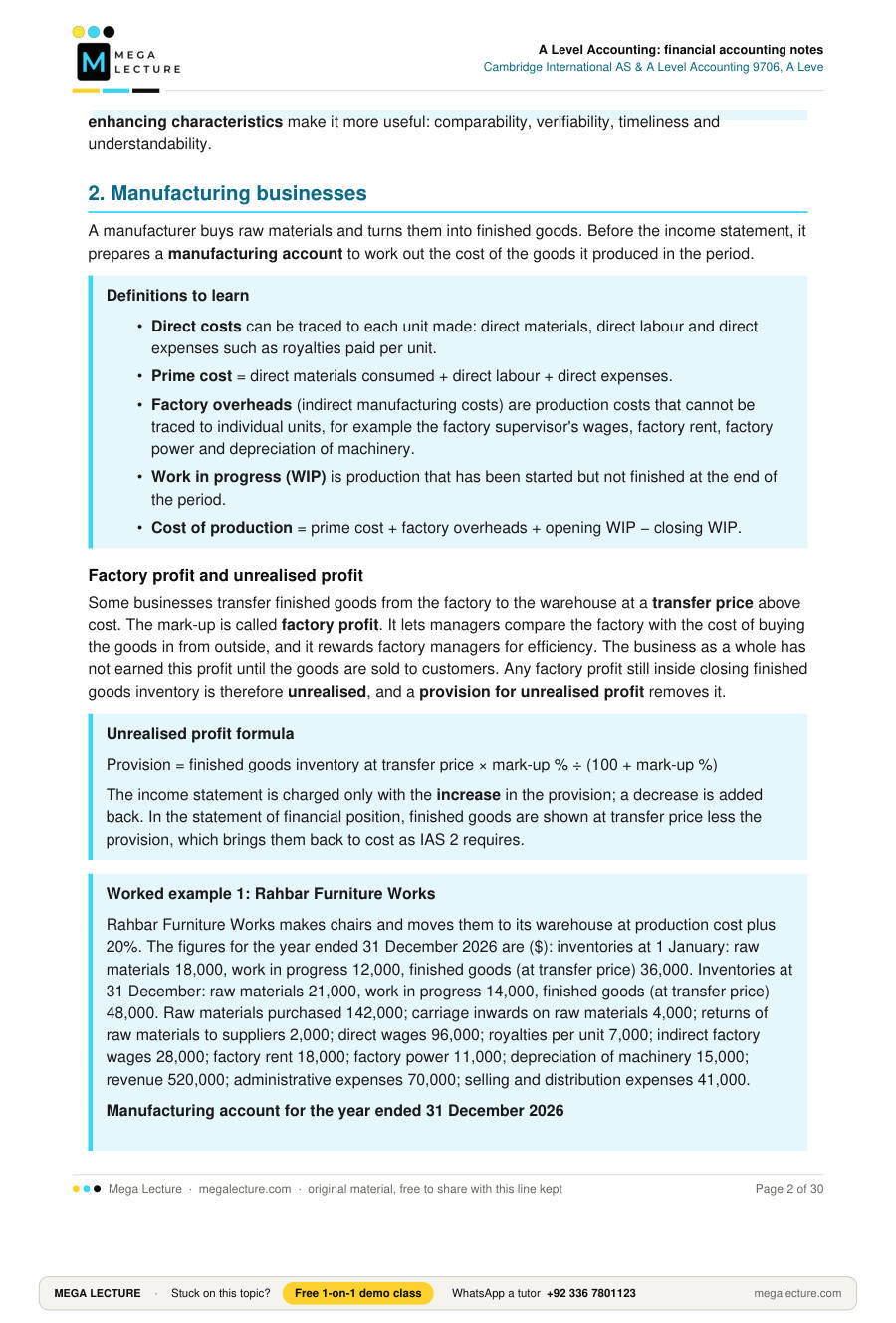
Worked example 1: Rahbar Furniture Works
Rahbar Furniture Works makes chairs and moves them to its warehouse at production cost plus 20%. The figures for the year ended 31 December 2026 are ($): inventories at 1 January: raw materials 18,000, work in progress 12,000, finished goods (at transfer price) 36,000. Inventories at 31 December: raw materials 21,000, work in progress 14,000, finished goods (at transfer price) 48,000. Raw materials purchased 142,000; carriage inwards on raw materials 4,000; returns of raw materials to suppliers 2,000; direct wages 96,000; royalties per unit 7,000; indirect factory wages 28,000; factory rent 18,000; factory power 11,000; depreciation of machinery 15,000; revenue 520,000; administrative expenses 70,000; selling and distribution expenses 41,000.
Manufacturing account for the year ended 31 December 2026
| Item | $ | $ |
|---|---|---|
| Inventory of raw materials 1 January | 18,000 | |
| Purchases of raw materials | 142,000 | |
| Carriage inwards | 4,000 | |
| Less returns outwards | (2,000) | 144,000 |
| 162,000 | ||
| Less inventory of raw materials 31 December | (21,000) | |
| Cost of raw materials consumed | 141,000 | |
| Direct labour | 96,000 | |
| Direct expenses (royalties) | 7,000 | |
| Prime cost | 244,000 | |
| Factory overheads: indirect wages | 28,000 | |
| Factory rent | 18,000 | |
| Factory power | 11,000 | |
| Depreciation of machinery | 15,000 | 72,000 |
| 316,000 | ||
| Add opening work in progress | 12,000 | |
| Less closing work in progress | (14,000) | (2,000) |
| Cost of production | 314,000 | |
| Factory profit (20% × 314,000) | 62,800 | |
| Finished goods transferred to warehouse at transfer price | 376,800 |
Unrealised profit workings
- Opening provision: 36,000 × 20/120 = 6,000
- Closing provision: 48,000 × 20/120 = 8,000
- Increase in provision: 8,000 − 6,000 = 2,000, charged to the income statement
Income statement for the year ended 31 December 2026
| Item | $ | $ |
|---|---|---|
| Revenue | 520,000 | |
| Opening inventory of finished goods | 36,000 | |
| Transferred from factory | 376,800 | |
| Less closing inventory of finished goods | (48,000) | |
| Cost of sales | (364,800) | |
| Gross profit | 155,200 | |
| Factory profit | 62,800 | |
| Less increase in provision for unrealised profit | (2,000) | 60,800 |
| 216,000 | ||
| Administrative expenses | (70,000) | |
| Selling and distribution expenses | (41,000) | (111,000) |
| Profit for the year | 105,000 |
Check: with everything valued at cost, cost of sales = 30,000 + 314,000 − 40,000 = 304,000, and 520,000 − 304,000 = 216,000. That matches the 216,000 above, so the factory profit adjustments are correct. In the statement of financial position, finished goods = 48,000 − 8,000 = $40,000.
Exam tip: put factory overheads in the manufacturing account and office or selling costs in the income statement. When a cost such as rent or insurance is shared, split it in the ratio the question gives, for example ¾ factory and ¼ office.
3. Not-for-profit organisations
Clubs, societies and charities exist to provide a service to their members, not to make profit for owners. The vocabulary therefore changes:
| Business term | Not-for-profit equivalent |
|---|---|
| Capital | Accumulated fund |
| Income statement | Income and expenditure account |
| Profit / loss | Surplus (excess of income over expenditure) / deficit |
| Cash book summary | Receipts and payments account |
| Receipts and payments account | Income and expenditure account |
|---|---|
| Summary of the cash and bank book | Similar to an income statement |
| Records only cash actually received and paid | Follows the accruals concept |
| Includes capital items (e.g. buying equipment) | Revenue items only; depreciation is included |
| Starts and ends with a cash or bank balance | Ends with a surplus or deficit for the period |
Definitions to learn
- Accumulated fund: the total of a not-for-profit organisation's assets less its liabilities. It plays the same part as capital in a business.
- Subscriptions in arrears: subscriptions due for the period that members have not yet paid. They are a current asset (an accrued income).
- Subscriptions in advance: subscriptions received for a future period. They are a current liability (deferred income).
A club that runs a bar, café or shop to make money prepares a separate trading account for that activity. The profit or loss from it goes into the income and expenditure account as one line. Smaller activities such as a dinner or a tournament are shown net (receipts less costs).
Worked example 2: Clifton Hockey Club
At 1 January 2026: equipment 24,000; bar inventory 3,200; bank 5,600; subscriptions in arrears 900; subscriptions in advance 600; amounts owed to bar suppliers 1,400.
Receipts in 2026: subscriptions 18,400; bar takings 26,000; tournament entry fees 2,500. Payments: bar purchases 14,800; groundsman's wages 9,500; pitch hire 6,000; new equipment 5,000; tournament expenses 1,700; general expenses 1,300.
At 31 December 2026: subscriptions in arrears 700; subscriptions in advance 1,100; bar inventory 2,900; owed to bar suppliers 1,800; all equipment valued at 23,500.
Step 1: opening accumulated fund
Assets 24,000 + 3,200 + 5,600 + 900 = 33,700. Liabilities 600 + 1,400 = 2,000. Accumulated fund = 33,700 − 2,000 = $31,700.
Step 2: receipts and payments account for the year ended 31 December 2026
| Receipts | $ | Payments | $ |
|---|---|---|---|
| Balance b/d (bank) | 5,600 | Bar purchases | 14,800 |
| Subscriptions | 18,400 | Groundsman's wages | 9,500 |
| Bar takings | 26,000 | Pitch hire | 6,000 |
| Tournament entry fees | 2,500 | New equipment | 5,000 |
| Tournament expenses | 1,700 | ||
| General expenses | 1,300 | ||
| Balance c/d (bank) | 14,200 | ||
| 52,500 | 52,500 |
Check: 5,600 + (18,400 + 26,000 + 2,500) − (14,800 + 9,500 + 6,000 + 5,000 + 1,700 + 1,300) = 5,600 + 46,900 − 38,300 = $14,200.
Step 3: subscriptions account
| Debit | $ | Credit | $ |
|---|---|---|---|
| Balance b/d (arrears) | 900 | Balance b/d (in advance) | 600 |
| Income and expenditure | 17,700 | Bank | 18,400 |
| Balance c/d (in advance) | 1,100 | Balance c/d (arrears) | 700 |
| 19,700 | 19,700 |
Subscriptions for the year = 18,400 − 900 + 600 + 700 − 1,100 = $17,700.
Step 4: bar trading account
Purchases = 14,800 − 1,400 + 1,800 = 15,200. Cost of sales = 3,200 + 15,200 − 2,900 = 15,500. Bar profit = 26,000 − 15,500 = $10,500.
Step 5: income and expenditure account for the year ended 31 December 2026
| Item | $ | $ |
|---|---|---|
| Subscriptions | 17,700 | |
| Profit on bar | 10,500 | |
| Tournament: fees 2,500 less expenses 1,700 | 800 | |
| 29,000 | ||
| Groundsman's wages | 9,500 | |
| Pitch hire | 6,000 | |
| General expenses | 1,300 | |
| Depreciation of equipment (24,000 + 5,000 − 23,500) | 5,500 | (22,300) |
| Surplus for the year | 6,700 |
Step 6: statement of financial position at 31 December 2026
| Item | $ | $ |
|---|---|---|
| Equipment (valuation) | 23,500 | |
| Bar inventory | 2,900 | |
| Subscriptions in arrears | 700 | |
| Bank | 14,200 | 17,800 |
| Bar payables | (1,800) | |
| Subscriptions in advance | (1,100) | (2,900) |
| Net assets | 38,400 | |
| Accumulated fund at 1 January | 31,700 | |
| Add surplus for the year | 6,700 | |
| Accumulated fund at 31 December | 38,400 |
Some clubs apply prudence and count subscriptions in arrears only when they are received, because members who leave often never pay. Follow the policy the question states. Life membership fees are usually held as deferred income and moved to the income and expenditure account in equal instalments over an agreed number of years.
4. Limited companies
Published financial statements
Under IAS 1 a company's financial statements must include a statement of financial position, a statement of profit or loss and other comprehensive income (the published income statement), a statement of changes in equity, a statement of cash flows, and notes, including a summary of accounting policies. Comparative figures for the previous period are required.
Worked example 3: Margalla Traders plc, published income statement for the year ended 31 March 2026
| Item | $ |
|---|---|
| Revenue | 1,450,000 |
| Cost of sales | (870,000) |
| Gross profit | 580,000 |
| Distribution costs | (162,000) |
| Administrative expenses | (214,000) |
| Profit from operations | 204,000 |
| Finance costs (10% loan notes, $180,000) | (18,000) |
| Profit before tax | 186,000 |
| Tax | (58,000) |
| Profit for the year | 128,000 |
Dividends paid do not appear in the income statement. They are shown in the statement of changes in equity.
Bonus issues and rights issues
| Feature | Bonus issue | Rights issue |
|---|---|---|
| What happens | Free shares go to existing shareholders in proportion to their holdings | Existing shareholders are offered new shares for cash, usually below market price |
| Cash raised | None | Yes |
| Source | Reserves are capitalised; share premium and other capital reserves are used first | New cash; any amount above nominal value goes to share premium |
| Effect on total equity | No change; only its make-up changes | Increases by the cash received |
| Double entry | Dr reserve(s), Cr share capital | Dr bank; Cr share capital (nominal); Cr share premium (excess) |
| Why a company does it | To bring reserves in line with share capital, lower the market price per share or signal confidence | To raise finance without taking on debt; control stays with existing shareholders if they take up their rights |
Reserves
- Capital reserves (not distributable as cash dividends): share premium and revaluation reserve. Share premium may be used for bonus issues and to write off share issue expenses.
- Revenue reserves (distributable): retained earnings and general reserve. The general reserve is created by a transfer out of retained earnings.
Worked example 4: Margalla Traders plc, statement of changes in equity
At 1 April 2025 equity was: ordinary shares of $1 each 400,000; share premium 60,000; general reserve 50,000; retained earnings 210,000. In the year:
- The final dividend for the previous year, $0.10 per share on 400,000 shares, was paid: $40,000.
- A 1 for 4 rights issue at $1.50 per share was fully taken up: 100,000 shares, raising $150,000 (share capital 100,000, share premium 50,000).
- A 1 for 5 bonus issue was then made on the 500,000 shares in issue: 100,000 shares, funded from share premium.
- Land was revalued upwards by $35,000.
- Profit for the year was $128,000, and $20,000 was transferred to the general reserve.
| Share capital $ | Share premium $ | Revaluation reserve $ | General reserve $ | Retained earnings $ | Total $ | |
|---|---|---|---|---|---|---|
| At 1 April 2025 | 400,000 | 60,000 | – | 50,000 | 210,000 | 720,000 |
| Dividend paid | (40,000) | (40,000) | ||||
| Rights issue | 100,000 | 50,000 | 150,000 | |||
| Bonus issue | 100,000 | (100,000) | – | |||
| Revaluation of land | 35,000 | 35,000 | ||||
| Profit for the year | 128,000 | 128,000 | ||||
| Transfer to general reserve | 20,000 | (20,000) | – | |||
| At 31 March 2026 | 600,000 | 10,000 | 35,000 | 70,000 | 278,000 | 993,000 |
Check: 600,000 + 10,000 + 35,000 + 70,000 + 278,000 = 993,000, and 720,000 − 40,000 + 150,000 + 35,000 + 128,000 = 993,000.
Statement of financial position at 31 March 2026
| Item | $ | $ |
|---|---|---|
| Non-current assets: property, plant and equipment | 1,067,000 | |
| Current assets: inventory | 96,000 | |
| Trade receivables | 84,000 | |
| Cash and cash equivalents | 35,000 | 215,000 |
| Total assets | 1,282,000 | |
| Equity: ordinary shares of $1 | 600,000 | |
| Share premium | 10,000 | |
| Revaluation reserve | 35,000 | |
| General reserve | 70,000 | |
| Retained earnings | 278,000 | |
| Total equity | 993,000 | |
| Non-current liabilities: 10% loan notes | 180,000 | |
| Current liabilities: trade payables | 51,000 | |
| Tax payable | 58,000 | 109,000 |
| Total equity and liabilities | 1,282,000 |
5. International Accounting Standards
International Accounting Standards (IAS) make financial statements more consistent and comparable between companies and countries, reduce how much managers can choose to present, and make the statements more credible to users. The table below summarises the standards named in the 9706 syllabus. Check the list against the syllabus for your examination year.
| Standard | What it requires (key points) |
|---|---|
| IAS 1 Presentation of Financial Statements | Sets out the full set of statements and their minimum content. Requires fair presentation, going concern, accruals, consistency of presentation, materiality and aggregation, no offsetting (unless a standard allows it), and comparative information. Assets and liabilities are split into current and non-current. |
| IAS 2 Inventories | Inventory is valued at the lower of cost and net realisable value. Cost includes purchase price, conversion costs and costs of bringing items to their present location and condition, but not selling costs or abnormal waste. FIFO or weighted average cost may be used; LIFO is not allowed. NRV = estimated selling price − costs to complete − costs to sell. |
| IAS 7 Statement of Cash Flows | Cash flows are classified under operating, investing and financing activities. Operating cash flow may use the direct or indirect method. Cash equivalents are short-term, highly liquid investments that are readily convertible to known amounts of cash and are subject to an insignificant risk of changes in value. |
| IAS 8 Accounting Policies, Changes in Accounting Estimates and Errors | A change in accounting policy is allowed only if a standard requires it, or if the change makes the financial statements give reliable and more relevant information. It is applied retrospectively. A change in an estimate (e.g. useful life) is applied prospectively. Material prior-period errors are corrected retrospectively. |
| IAS 10 Events after the Reporting Period | Adjusting events give evidence of conditions that already existed at the reporting date (e.g. a customer's insolvency revealing that a year-end receivable is irrecoverable); the figures are changed. Non-adjusting events arise after the date (e.g. a fire destroying a warehouse after year end); they are disclosed if material, not adjusted. Dividends declared after the reporting date are not a liability at that date. |
| IAS 16 Property, Plant and Equipment | PPE is first measured at cost (including costs to bring it into working condition). Afterwards the cost model or the revaluation model is used; revaluations must be kept up to date and cover the whole class of asset, and gains go to revaluation surplus. Depreciation spreads the depreciable amount over the useful life; residual value, useful life and method are reviewed at least each year. Land is not normally depreciated. |
| IAS 36 Impairment of Assets | An asset is impaired when its carrying amount exceeds its recoverable amount, the higher of fair value less costs of disposal and value in use. The impairment loss is recognised straight away. Goodwill must be tested for impairment every year. |
| IAS 37 Provisions, Contingent Liabilities and Contingent Assets | A provision is recognised when there is a present obligation from a past event, an outflow is probable and the amount can be reliably estimated. A contingent liability is disclosed in the notes unless the outflow is remote. A contingent asset is disclosed only when an inflow is probable, and is never recognised until virtually certain. |
| IAS 38 Intangible Assets | An intangible asset is recognised only if it is identifiable, controlled, likely to bring future economic benefits and its cost can be measured reliably. Internally generated goodwill is never recognised. Research costs are expensed. Development costs are capitalised only when all of these criteria are met: (1) completing the asset is technically feasible; (2) the entity intends to complete it and use or sell it; (3) it is able to use or sell it; (4) it can show how the asset will generate probable future economic benefits (for example, a market exists for its output, or the asset is useful internally); (5) adequate technical, financial and other resources are available to complete it; (6) the development expenditure can be measured reliably. |
The IASB sometimes renames or replaces standards. IFRS 18 Presentation and Disclosure in Financial Statements replaces IAS 1 for periods beginning on or after 1 January 2027, and IAS 8 is renamed Basis of Preparation of Financial Statements. In the exam, use the standards and titles printed in the syllabus for your examination year.
6. Statement of cash flows (indirect method)
Profit is not the same as cash. The indirect method starts from profit from operations and adjusts it for non-cash items and for changes in working capital.
Exam tip: if the question gives profit before tax instead, add back finance costs (and deduct any investment income) to reach profit from operations first. Interest paid is then shown as a separate line.
| Adjustment to profit from operations | Add or deduct? | Reason |
|---|---|---|
| Depreciation, amortisation, impairment | Add | Expense with no cash outflow |
| Loss on disposal of non-current assets | Add | Non-cash; the proceeds are shown under investing |
| Profit on disposal | Deduct | Non-cash gain; the proceeds are shown under investing |
| Increase in inventory or trade receivables | Deduct | Cash tied up |
| Decrease in inventory or trade receivables | Add | Cash released |
| Increase in trade payables | Add | Cash payment delayed |
| Decrease in trade payables | Deduct | More cash paid out |
Worked example 5: Zarak Engineering Ltd, year ended 30 June 2026
Profit from operations 96,000; finance costs 8,000 (all paid); tax charge 22,000. Depreciation 34,000. A machine costing 20,000, with accumulated depreciation of 12,000, was sold for 5,000. Inventory rose from 41,000 to 50,000; trade receivables fell from 38,000 to 34,000; trade payables rose from 27,000 to 33,000. Tax payable was 18,000 at the start and 20,000 at the end. PPE at carrying amount was 310,000 at the start and 355,000 at the end. Shares were issued for 40,000 cash; 30,000 of a bank loan was repaid; dividends of 25,000 were paid. Cash and cash equivalents at 1 July 2025 were 12,000.
Workings
- Disposal: carrying amount 20,000 − 12,000 = 8,000; proceeds 5,000; loss = 3,000.
- Tax paid = 18,000 + 22,000 − 20,000 = 20,000.
- PPE purchased = closing 355,000 + depreciation 34,000 + disposal carrying amount 8,000 − opening 310,000 = 87,000.
| Statement of cash flows for the year ended 30 June 2026 | $ | $ |
|---|---|---|
| Cash flows from operating activities | ||
| Profit from operations | 96,000 | |
| Depreciation | 34,000 | |
| Loss on disposal | 3,000 | |
| Increase in inventory | (9,000) | |
| Decrease in trade receivables | 4,000 | |
| Increase in trade payables | 6,000 | |
| Cash generated from operations | 134,000 | |
| Interest paid | (8,000) | |
| Tax paid | (20,000) | |
| Net cash from operating activities | 106,000 | |
| Cash flows from investing activities | ||
| Purchase of PPE | (87,000) | |
| Proceeds from sale of PPE | 5,000 | |
| Net cash used in investing activities | (82,000) | |
| Cash flows from financing activities | ||
| Proceeds from issue of shares | 40,000 | |
| Repayment of bank loan | (30,000) | |
| Dividends paid | (25,000) | |
| Net cash used in financing activities | (15,000) | |
| Net increase in cash and cash equivalents | 9,000 | |
| Cash and cash equivalents at 1 July 2025 | 12,000 | |
| Cash and cash equivalents at 30 June 2026 | 21,000 |
IAS 7 lets interest paid go under operating or financing activities, and dividends paid under financing or operating activities. Choose one presentation and apply it consistently.
7. Auditing and stewardship of limited companies
Shareholders own a company, but its directors run it. Stewardship is the directors' responsibility to look after the company's resources on the shareholders' behalf and to account for how they have used them. The annual financial statements are the main way directors report on their stewardship.
Directors' duties (main points)
- Keep proper accounting records that show the company's transactions and financial position at any time.
- Prepare annual financial statements that give a true and fair view and follow company law and the applicable accounting standards.
- Choose suitable accounting policies, apply them consistently, and make reasonable and prudent judgements and estimates.
- Safeguard the company's assets and take reasonable steps to prevent and detect fraud and other irregularities, for example through internal controls.
- Act in good faith in the interests of the company, avoid conflicts of interest and use reasonable skill and care.
- Prepare the financial statements on a going concern basis unless that is inappropriate.
The external auditor
The external auditor is an independent, professionally qualified accountant. The shareholders appoint the auditor, usually at the annual general meeting, and the auditor reports to them, not to the directors. The auditor examines the records and evidence and gives an opinion on whether the financial statements give a true and fair view and have been properly prepared under the applicable financial reporting framework and company law.
Key idea: the auditor gives reasonable assurance, not a guarantee
An audit is based on testing samples and on judgement about materiality, so it gives reasonable assurance that the statements contain no material misstatement. It does not certify that every figure is correct, and it does not guarantee that all fraud will be found. The directors, not the auditor, are responsible for preparing the financial statements.
| Type of audit opinion | When it is given |
|---|---|
| Unmodified (a "clean" report) | The statements give a true and fair view in all material respects |
| Qualified ("except for") | A misstatement, or a lack of evidence, is material but not pervasive |
| Adverse | Misstatements are material and pervasive, so the statements do not give a true and fair view |
| Disclaimer of opinion | The auditor could not obtain enough evidence, and the possible effects are material and pervasive |
Contents of the auditor's report include: the addressee (the members), the auditor's opinion, the basis for the opinion, a statement of the directors' responsibilities, a statement of the auditor's responsibilities, any material uncertainty about going concern, and the auditor's signature, address and date.
8. Business purchase and merger
When one business buys another, the buyer pays a purchase consideration. This may be cash, shares, debentures or a mix. The buyer records the assets and liabilities it takes over at their fair values, which are often different from the seller's book values.
Definitions to learn
- Purchased goodwill = purchase consideration − fair value of the net assets acquired.
- Purchased goodwill is a non-current intangible asset. Under IFRS it is not amortised; it is tested for impairment every year (IAS 36). Only goodwill that has been paid for is recognised; internally generated goodwill is never recognised (IAS 38).
- For awareness only: if the consideration is less than the fair value of net assets, the difference is a gain on a bargain purchase (sometimes called negative goodwill). After the fair values have been rechecked it is recognised as a gain in profit or loss. This rule comes from IFRS 3, which the syllabus does not name.
Worked example 6: Noor Ltd buys the business of Sana Traders
Sana Traders' book values: premises 120,000; equipment 30,000; inventory 22,000; trade receivables 16,000; bank 5,000; trade payables 13,000. Noor Ltd takes over every asset except the bank account, and takes over the trade payables. Agreed fair values: premises 150,000; equipment 24,000; inventory 20,000; trade receivables 15,000; trade payables 13,000. The consideration is 120,000 ordinary shares of $1 issued at $1.40, plus $50,000 in cash.
Step 1: purchase consideration: shares 120,000 × $1.40 = 168,000; cash 50,000; total $218,000.
Step 2: net assets at fair value: 150,000 + 24,000 + 20,000 + 15,000 − 13,000 = $196,000.
Step 3: goodwill: 218,000 − 196,000 = $22,000.
Step 4: journal entry in Noor Ltd's books
| Account | Dr $ | Cr $ |
|---|---|---|
| Premises | 150,000 | |
| Equipment | 24,000 | |
| Inventory | 20,000 | |
| Trade receivables | 15,000 | |
| Goodwill | 22,000 | |
| Trade payables | 13,000 | |
| Bank | 50,000 | |
| Ordinary share capital (120,000 × $1) | 120,000 | |
| Share premium (120,000 × $0.40) | 48,000 | |
| Totals | 231,000 | 231,000 |
Narrative: assets and liabilities of Sana Traders taken over at fair value, and consideration paid by share issue and cash.
Merger. Two or more businesses may combine, for example two partnerships or sole traders forming a new limited company. Each old business's assets and liabilities are revalued. The new company records them at the agreed values, issues shares to each set of former owners in proportion to the net assets (and any agreed goodwill) each contributed, and recognises goodwill only when it has been paid for (here, with shares).
Worked example 7: Amina and Bashir merge to form Crescent Ltd
Two sole traders, Amina and Bashir, merge their businesses into a new company, Crescent Ltd, on 1 July 2026. Agreed values ($):
| Item | Amina | Bashir |
|---|---|---|
| Premises | 60,000 | 90,000 |
| Equipment | – | 20,000 |
| Inventory | 15,000 | 18,000 |
| Trade receivables | 12,000 | 9,000 |
| Bank | 3,000 | 5,000 |
| Trade payables | (10,000) | (22,000) |
| Net assets at agreed values | 80,000 | 120,000 |
| Agreed goodwill | 20,000 | 10,000 |
| Total value contributed | 100,000 | 130,000 |
Crescent Ltd pays each owner in ordinary shares of $1 issued at par.
Step 1: shares issued: Amina 100,000 ÷ $1 = 100,000 shares; Bashir 130,000 ÷ $1 = 130,000 shares; total 230,000 shares. Amina holds 100/230 = 43.5% of the company and Bashir 56.5%.
Step 2: Crescent Ltd statement of financial position at 1 July 2026
| Item | $ | $ |
|---|---|---|
| Non-current assets: goodwill (20,000 + 10,000) | 30,000 | |
| Premises (60,000 + 90,000) | 150,000 | |
| Equipment | 20,000 | 200,000 |
| Current assets: inventory (15,000 + 18,000) | 33,000 | |
| Trade receivables (12,000 + 9,000) | 21,000 | |
| Bank (3,000 + 5,000) | 8,000 | 62,000 |
| Total assets | 262,000 | |
| Equity: ordinary shares of $1 (100,000 + 130,000) | 230,000 | |
| Current liabilities: trade payables (10,000 + 22,000) | 32,000 | |
| Total equity and liabilities | 262,000 |
Check: net assets 80,000 + 120,000 + goodwill 30,000 = 230,000 = share capital.
Reasons for buying another business: growth and economies of scale, removing a competitor, gaining new markets, products, skills or brands, and securing supplies. Points to evaluate: the price paid, whether profits can be kept up, the cost of integration, the effect on gearing if loans finance the purchase, and dilution of control if shares are issued.
9. Consignment and joint venture accounts
Consignment accounts
In a consignment, the consignor sends goods to an agent, the consignee, who sells them for commission. Ownership stays with the consignor until the goods are sold, so goods sent on consignment are not sales. The consignor opens a consignment account to find the profit on that consignment, and an account for the consignee.
Key idea: valuing unsold goods held by the consignee
Unsold goods = cost + a proportional share of non-recurring expenses (freight, insurance in transit, import duty, landing charges). Recurring expenses such as selling costs, advertising and commission are not included.
Worked example 8: Hunza Dry Fruits consigns to an agent in Dubai
Hunza Dry Fruits sent 500 boxes costing $40 each ($20,000) to Gulf Star Agencies. Hunza paid freight and insurance of $1,500. Gulf Star paid landing charges of $1,000 and selling expenses of $700, sold 400 boxes at $70 each, deducted 5% commission on sales, and sent the balance by bank transfer.
Workings
- Sales: 400 × 70 = 28,000. Commission: 5% × 28,000 = 1,400.
- Unsold inventory (100 boxes): cost 100 × 40 = 4,000; freight share 1,500 × 100/500 = 300; landing share 1,000 × 100/500 = 200; total 4,500.
- Remittance: 28,000 − 1,000 − 700 − 1,400 = 24,900.
Consignment to Gulf Star Agencies account
| Debit | $ | Credit | $ |
|---|---|---|---|
| Goods sent on consignment | 20,000 | Gulf Star: sales | 28,000 |
| Bank: freight and insurance | 1,500 | Inventory on consignment c/d | 4,500 |
| Gulf Star: landing charges | 1,000 | ||
| Gulf Star: selling expenses | 700 | ||
| Gulf Star: commission | 1,400 | ||
| Income statement: profit on consignment | 7,900 | ||
| 32,500 | 32,500 |
Gulf Star Agencies account (the consignee)
| Debit | $ | Credit | $ |
|---|---|---|---|
| Consignment: sales | 28,000 | Consignment: landing charges | 1,000 |
| Consignment: selling expenses | 700 | ||
| Consignment: commission | 1,400 | ||
| Bank | 24,900 | ||
| 28,000 | 28,000 |
Check: cost of boxes sold 16,000 + four-fifths of non-recurring costs (2,500 × 4/5 = 2,000) + selling 700 + commission 1,400 = 20,100; 28,000 − 20,100 = 7,900. The goods sent on consignment account (Cr 20,000) is closed to purchases or trading so that those goods are not counted as ordinary sales.
Joint venture accounts
A joint venture is a short-term partnership between two or more parties for one project, after which it ends. When each party keeps its own records, each opens a joint venture with [other party] account in its own books, and a memorandum joint venture account (outside the double entry) combines everyone's figures to find the total profit.
Worked example 9: Asif and Bilal, sharing profits equally
Asif bought goods for $12,000 and paid packing of $800. Bilal paid transport of $1,200, sold goods for $19,000, paid selling expenses of $600 and took unsold goods for his own business at an agreed value of $1,000. The venture was then settled in cash.
Memorandum joint venture account
| Debit | $ | Credit | $ |
|---|---|---|---|
| Asif: purchases | 12,000 | Bilal: sales | 19,000 |
| Asif: packing | 800 | Bilal: goods taken over | 1,000 |
| Bilal: transport | 1,200 | ||
| Bilal: selling expenses | 600 | ||
| Profit: Asif ½ | 2,700 | ||
| Profit: Bilal ½ | 2,700 | ||
| 20,000 | 20,000 |
In Asif's books: joint venture with Bilal account
| Debit | $ | Credit | $ |
|---|---|---|---|
| Bank: purchases | 12,000 | Bank: received from Bilal | 15,500 |
| Bank: packing | 800 | ||
| Income statement: share of profit | 2,700 | ||
| 15,500 | 15,500 |
In Bilal's books: joint venture with Asif account
| Debit | $ | Credit | $ |
|---|---|---|---|
| Bank: transport | 1,200 | Bank: sales | 19,000 |
| Bank: selling expenses | 600 | Purchases: goods taken over | 1,000 |
| Income statement: share of profit | 2,700 | ||
| Bank: paid to Asif | 15,500 | ||
| 20,000 | 20,000 |
| Feature | Consignment | Joint venture |
|---|---|---|
| Relationship | Principal and agent | Temporary partners |
| Who bears the risk | Consignor only | All co-venturers share it |
| Reward for the other party | Commission | A share of profit |
| Duration | Can be continuing | Ends when the project is complete |
10. Computerised accounting systems
| Advantages | Disadvantages |
|---|---|
| Fast processing of large numbers of transactions | Cost of hardware, software, licences and upgrades |
| Arithmetic is accurate; ledgers and trial balance are updated automatically | Staff need training, and some may resist the change |
| Up-to-date reports (aged receivables, inventory levels, management accounts) on demand | Risk of viruses, hacking and data loss; backups are essential |
| Integration of sales, purchases, payroll and inventory modules | Wrong inputs still give wrong outputs ("garbage in, garbage out") |
| Less paper and storage space; easier audit trail if set up properly | System failures or power cuts can stop work |
| Fewer staff may be needed over time | Errors of principle or omission are not detected automatically |
Introducing a new system: assess needs and costs; choose and test the software; train staff; transfer and check opening balances; run the old and new systems in parallel for a period; set user passwords and access levels; plan regular backups stored off-site or in the cloud; keep to data protection laws.
11. Analysis and communication of accounting information
Worked example 10: Kaghan Foods Ltd, year ended 31 December 2026
Revenue (all on credit) 800,000; cost of sales 520,000; gross profit 280,000; profit from operations 120,000; finance costs 10,000 (8% debentures of $125,000); profit before tax 110,000; tax 30,000; profit for the year 80,000.
Non-current assets 600,000; inventory 65,000 (opening inventory 55,000); trade receivables 88,000; cash 17,000; trade payables 55,000; tax payable 30,000; 8% debentures 125,000. Equity: 500,000 ordinary shares of $0.50 (250,000) plus reserves 310,000, total 560,000. Check: 600,000 + 170,000 − 85,000 − 125,000 = 560,000. Dividend paid $0.06 per share; market price $2.40 per share. There are no preference shares.
Capital employed = equity + non-current liabilities = 560,000 + 125,000 = 685,000. Purchases = 520,000 + 65,000 − 55,000 = 530,000 (all on credit).
| Ratio | Formula | Calculation | Result |
|---|---|---|---|
| Gross margin | Gross profit ÷ revenue × 100 | 280,000 ÷ 800,000 × 100 | 35.0% |
| Profit margin (operating) | Profit from operations ÷ revenue × 100 | 120,000 ÷ 800,000 × 100 | 15.0% |
| ROCE | Profit from operations ÷ capital employed × 100 | 120,000 ÷ 685,000 × 100 | 17.5% |
| Current ratio | Current assets : current liabilities | 170,000 : 85,000 | 2.00 : 1 |
| Liquid (acid test) ratio | (Current assets − inventory) : current liabilities | 105,000 : 85,000 | 1.24 : 1 |
| Inventory turnover | Cost of sales ÷ average inventory | 520,000 ÷ 60,000 | 8.67 times |
| Inventory days | Average inventory ÷ cost of sales × 365 | 60,000 ÷ 520,000 × 365 | 42.1 days |
| Trade receivables days | Trade receivables ÷ credit sales × 365 | 88,000 ÷ 800,000 × 365 | 40.2 days |
| Trade payables days | Trade payables ÷ credit purchases × 365 | 55,000 ÷ 530,000 × 365 | 37.9 days |
| Non-current asset turnover | Revenue ÷ non-current assets | 800,000 ÷ 600,000 | 1.33 times |
| Gearing | Non-current liabilities ÷ capital employed × 100 | 125,000 ÷ 685,000 × 100 | 18.2% |
| Interest cover | Profit from operations ÷ finance costs | 120,000 ÷ 10,000 | 12 times |
| Earnings per share | (Profit for the year − preference dividends) ÷ number of ordinary shares | (80,000 − 0) ÷ 500,000 | $0.16 |
| Price/earnings ratio | Market price ÷ EPS | 2.40 ÷ 0.16 | 15 times |
| Dividend yield | Dividend per share ÷ market price × 100 | 0.06 ÷ 2.40 × 100 | 2.5% |
| Dividend cover | Profit attributable to ordinary shareholders (after preference dividends) ÷ ordinary dividends paid | 80,000 ÷ 30,000 | 2.67 times |
EPS and dividend cover use profit attributable to ordinary shareholders, which is profit for the year less any preference dividends. Kaghan has no preference shares, so here it equals profit for the year.
Working capital cycle = inventory days + receivables days − payables days = 42.1 + 40.2 − 37.9 = 44.4 days.
Interpretation (sample comments): Liquidity looks comfortable. The current ratio is 2 : 1 and the liquid ratio is above 1 : 1, so the company can meet its short-term debts without selling inventory, provided receivables are collected on time. Cash itself is only $17,000, so the liquid ratio depends on collecting the $88,000 of receivables. Working capital may be higher than needed, with funds tied up in inventory and receivables rather than cash. Receivables take about 40 days to pay while Kaghan pays its suppliers in about 38 days, so it pays out slightly faster than it collects; tighter credit control would help cash flow. Gearing of 18.2% is low and interest is covered 12 times, so there is room to borrow more. A P/E of 15 suggests reasonable market confidence in future earnings. If it is above the industry average or competitors' P/E, investors expect Kaghan's earnings to grow faster than theirs, so compare it with a benchmark before concluding. The 2.5% dividend yield is modest, but the dividend is covered 2.67 times, so it looks safe.
Some textbooks and questions define gearing as debt ÷ equity, or include preference shares with debt. Use the definition the question gives, and state your formula when it is not given.
Limitations of ratio analysis
- Ratios come from historical figures and may not predict the future.
- Different accounting policies (depreciation methods, revaluation, inventory valuation) make comparisons between companies unreliable.
- The statement of financial position shows one date only; year-end figures may be unrepresentative (seasonal trade) or deliberately improved ("window dressing").
- Inflation distorts comparisons over time, and assets held at historical cost can overstate ROCE.
- Non-financial factors are left out: staff morale, product quality, the economy, competitors and the environment.
- A ratio means little without a benchmark: last year, a competitor, the industry average or a budget.
- Different companies may calculate the same ratio differently.
Key terms
| Term | Definition |
|---|---|
| Prime cost | Total of direct materials consumed, direct labour and direct expenses. |
| Cost of production | Prime cost plus factory overheads, adjusted for opening and closing work in progress. |
| Factory profit | The mark-up added to cost of production when goods move from factory to warehouse at a transfer price. |
| Unrealised profit | Factory profit included in finished goods that have not yet been sold to outside customers. |
| Accumulated fund | Net assets of a not-for-profit organisation; the equivalent of capital. |
| Surplus | Excess of income over expenditure in a not-for-profit organisation. |
| Bonus issue | Free shares issued to existing shareholders by capitalising reserves. |
| Rights issue | An offer of new shares for cash to existing shareholders in proportion to their holdings. |
| Capital reserve | A reserve that cannot be paid out as cash dividends, e.g. share premium or revaluation reserve. |
| Net realisable value | Estimated selling price less costs to complete and costs to sell. |
| Recoverable amount | The higher of an asset's fair value less costs of disposal and its value in use. |
| Provision | A liability of uncertain timing or amount. |
| Stewardship | Directors' responsibility to look after and account for the resources shareholders have entrusted to them. |
| True and fair view | Financial statements free from material misstatement that faithfully represent performance and position. |
| Purchased goodwill | Excess of the purchase consideration over the fair value of the net assets acquired. |
| Consignee | Agent who sells goods on behalf of the owner (consignor) in return for commission. |
| Joint venture | A temporary business arrangement between two or more parties for a specific project. |
| Capital employed | Equity plus non-current liabilities. |
| Working capital cycle | Inventory days plus receivables days less payables days. |
Quick check
- Define the term prime cost. [2]
- State two differences between a receipts and payments account and an income and expenditure account. [2]
- A chess club received subscriptions of $9,600 during the year. At the start of the year subscriptions of $400 were in arrears and $250 had been received in advance. At the end, $300 was in arrears and $500 had been received in advance. Calculate the subscriptions income for the income and expenditure account. [3]
- Explain why a manufacturer that uses a transfer price must make a provision for unrealised profit. [2]
- Explain the difference between the directors' responsibility and the external auditor's responsibility for a company's financial statements. [4]
- A company has 800,000 ordinary shares of $0.50 each. It makes a 1 for 5 rights issue at $0.90 per share, which is fully taken up. Calculate the increase in share capital, share premium and bank. [3]
- A company has 600,000 ordinary shares of $1, share premium of $90,000 and a general reserve of $200,000. It makes a 1 for 4 bonus issue, using reserves in the way that keeps the most distributable reserves. Prepare the journal entry. Narratives are not required. [3]
- An item of inventory cost $5,400. It can be sold for $5,000 after repairs of $350. State the value at which it should be included in inventory under IAS 2, and give your reason. [2]
- Profit from operations was $50,000. Depreciation was $12,000 and there was a profit on disposal of $2,000. Inventory fell by $3,000, trade receivables rose by $5,000 and trade payables fell by $1,000. Calculate cash generated from operations. [4]
- A company buys a business whose net assets have a fair value of $140,000. It pays by issuing 90,000 ordinary shares of $1 at $1.60 each and $20,000 in cash. Calculate the goodwill, and state how it must be treated in later years. [4]
- A consignor sent 300 units costing $25 each and paid freight of $900. The consignee paid unloading charges of $300. At the year end, 60 units were unsold. Calculate the value of inventory on consignment. [3]
- A company's year ends on 31 December 2026 and its financial statements are approved on 20 March 2027. State whether each event is adjusting or non-adjusting under IAS 10, and how it is treated. (a) On 15 February 2027 a customer who owed $6,000 at the year end was declared bankrupt. (b) On 10 February 2027 a fire destroyed inventory worth $20,000. (c) Inventory that cost $8,000 at the year end was sold in January 2027 for $6,500. [3]
- A customer is suing a company for $40,000 over a faulty product supplied last year. State how the claim is treated under IAS 37 if the company's lawyers advise that the company (a) will probably lose, (b) could possibly lose but probably will not, (c) is very unlikely to lose. [3]
- Cara and Dev enter a joint venture, sharing profits in the ratio 3 : 2. Cara buys goods for $9,000. Dev pays expenses of $1,000 and sells all the goods for $14,000. Calculate the profit on the venture and the amount Dev must pay Cara to settle. [4]
- An investor is choosing between shares in two companies. P plc: market price $3.00, EPS $0.25, dividend per share $0.15. Q plc: market price $4.80, EPS $0.30, dividend per share $0.12. Calculate the P/E ratio, dividend yield and dividend cover for each company, and advise which company the investor should choose. Justify your answer. [10]
Answers
- Prime cost is the total of all direct production costs [1]: direct materials consumed, direct labour and direct expenses [1].
- Any two: the receipts and payments account records only cash received and paid, while the income and expenditure account follows the accruals concept; the receipts and payments account includes capital items, while the income and expenditure account contains revenue items only (including depreciation); the receipts and payments account ends with a cash or bank balance, while the income and expenditure account ends with a surplus or deficit. [1 each]
- 9,600 − 400 + 250 + 300 − 500 = $9,250. [1 for adjusting the opening balances correctly, 1 for the closing balances, 1 for the answer]
- Factory profit is added when goods move to the warehouse, but the business as a whole has made no profit until the goods are sold outside it [1]. The provision removes the factory profit contained in unsold finished goods. This stops profit being overstated and values inventory at cost, as the realisation concept, prudence and IAS 2 require [1].
- The directors must keep proper records and prepare financial statements that give a true and fair view and follow company law and accounting standards [1]. As stewards they must also safeguard assets and prevent and detect fraud [1]. The external auditor is independent and prepares nothing. The auditor examines evidence and gives the shareholders an opinion on whether the statements give a true and fair view [1]. This gives reasonable, not absolute, assurance [1].
- New shares = 800,000 ÷ 5 = 160,000. Share capital + 160,000 × $0.50 = $80,000; share premium + 160,000 × $0.40 = $64,000; bank + $144,000. [3]
- Bonus shares = 600,000 ÷ 4 = 150,000 × $1 = $150,000. Dr share premium 90,000; Dr general reserve 60,000; Cr ordinary share capital 150,000. [3]
- NRV = 5,000 − 350 = $4,650, which is lower than cost of $5,400, so the item is valued at $4,650 [1]. IAS 2 requires the lower of cost and net realisable value [1].
- 50,000 + 12,000 − 2,000 + 3,000 − 5,000 − 1,000 = $57,000. [1 for depreciation and profit on disposal, 2 for the working capital changes, 1 for the answer]
- Consideration = 90,000 × 1.60 + 20,000 = 144,000 + 20,000 = 164,000 [1]. Goodwill = 164,000 − 140,000 = $24,000 [1]. It is shown as an intangible non-current asset and is not amortised [1]. It is tested for impairment every year under IAS 36, and any impairment is written off to profit or loss [1].
- Cost 60 × 25 = 1,500; freight 900 × 60/300 = 180; unloading 300 × 60/300 = 60. Inventory = $1,740. [3]
- (a) Adjusting: the bankruptcy confirms the debt was already irrecoverable at the year end, so write off the $6,000 receivable [1]. (b) Non-adjusting: the fire happened after the year end, so the figures are not changed; disclose it in the notes if material [1]. (c) Adjusting: the sale gives evidence of NRV at the year end, so write the inventory down from $8,000 to $6,500 (less any costs to sell) [1].
- (a) Recognise a provision: Dr expense, Cr provision $40,000, shown as a liability [1]. (b) Do not recognise it; disclose a contingent liability in the notes [1]. (c) The outflow is remote, so nothing is recognised or disclosed [1].
- Profit = 14,000 − 9,000 − 1,000 = $4,000 [1]. Cara's share 4,000 × 3/5 = 2,400; Dev's share 1,600 [1]. Cara is owed her outlay plus her profit: 9,000 + 2,400 = $11,400 [1]. Check from Dev's side: cash held 14,000 − expenses 1,000 − his profit 1,600 = 11,400 [1].
- See the table and evaluation below.
Answer 15
| Ratio | P plc | Q plc |
|---|---|---|
| P/E | 3.00 ÷ 0.25 = 12 times | 4.80 ÷ 0.30 = 16 times |
| Dividend yield | 0.15 ÷ 3.00 × 100 = 5.0% | 0.12 ÷ 4.80 × 100 = 2.5% |
| Dividend cover | 0.25 ÷ 0.15 = 1.67 times | 0.30 ÷ 0.12 = 2.5 times |
[6: 1 per correct ratio]
Evaluation [4]. P plc gives twice the dividend yield, so it suits an investor who wants income now. Its lower cover (1.67) means the dividend is less secure if profits fall, and it keeps less profit for growth. Q plc has a higher P/E than P plc, so the market expects its earnings to grow faster. It keeps more of its profit (cover 2.5), which may fund growth and future dividend rises, and its dividend is safer. Q's shares are relatively more expensive, though, and give less income now. Advice: an investor who needs regular income should choose P plc; one seeking long-term capital growth should choose Q plc. The investor should also compare trends over several years, gearing and industry averages, because one year's ratios are not enough to decide.
Exam-style practice (full Paper 3 length)
These three questions are the length and style of Paper 3 structured questions. Try each one under timed conditions (about 1.2 minutes per mark) before reading the model answer.
Question 1: Tarbela Pumps (manufacturing with unrealised profit) [22]
Tarbela Pumps makes water pumps and transfers them to its warehouse at cost of production plus 25%. Figures for the year ended 30 June 2026 ($):
| Item | $ |
|---|---|
| Inventory of raw materials: 1 July 2025 | 25,000 |
| Inventory of raw materials: 30 June 2026 | 30,000 |
| Work in progress: 1 July 2025 | 18,000 |
| Work in progress: 30 June 2026 | 16,000 |
| Finished goods at transfer price: 1 July 2025 | 50,000 |
| Finished goods at transfer price: 30 June 2026 | 60,000 |
| Purchases of raw materials | 210,000 |
| Carriage inwards on raw materials | 6,000 |
| Direct wages | 150,000 |
| Direct expenses | 9,000 |
| Indirect factory wages | 40,000 |
| Rent and insurance (¾ factory, ¼ office) | 36,000 |
| Electricity (⅔ factory, ⅓ office) | 24,000 |
| Factory machinery at cost (depreciate 10% per year, straight line) | 200,000 |
| Revenue | 900,000 |
| Office salaries | 85,000 |
| Selling expenses | 60,000 |
- Prepare the manufacturing account for the year ended 30 June 2026. [9]
- Prepare the income statement for the year ended 30 June 2026. [7]
- Calculate the value of finished goods in the statement of financial position at 30 June 2026. [2]
- An outside supplier offers to supply the same number of pumps for $560,000 a year. Advise the owners whether they should close the factory and buy from the supplier. Justify your answer. [4]
Model answer: Question 1
(a) Manufacturing account for the year ended 30 June 2026
| Item | $ | $ |
|---|---|---|
| Inventory of raw materials 1 July 2025 | 25,000 | |
| Purchases of raw materials | 210,000 | |
| Carriage inwards | 6,000 | 216,000 |
| 241,000 | ||
| Less inventory of raw materials 30 June 2026 | (30,000) | |
| Cost of raw materials consumed | 211,000 | |
| Direct wages | 150,000 | |
| Direct expenses | 9,000 | |
| Prime cost | 370,000 | |
| Indirect factory wages | 40,000 | |
| Rent and insurance (¾ × 36,000) | 27,000 | |
| Electricity (⅔ × 24,000) | 16,000 | |
| Depreciation of machinery (10% × 200,000) | 20,000 | 103,000 |
| 473,000 | ||
| Add opening work in progress | 18,000 | |
| Less closing work in progress | (16,000) | 2,000 |
| Cost of production | 475,000 | |
| Factory profit (25% × 475,000) | 118,750 | |
| Transferred to warehouse at transfer price | 593,750 |
Marks: raw materials consumed [2]; prime cost [1]; rent, electricity and depreciation apportioned correctly [3]; work in progress adjustment [1]; cost of production [1]; factory profit and transfer price [1].
(b) Income statement for the year ended 30 June 2026
Workings: opening provision 50,000 × 25/125 = 10,000; closing provision 60,000 × 25/125 = 12,000; increase 2,000.
| Item | $ | $ |
|---|---|---|
| Revenue | 900,000 | |
| Opening inventory of finished goods | 50,000 | |
| Transferred from factory | 593,750 | |
| Less closing inventory of finished goods | (60,000) | |
| Cost of sales | (583,750) | |
| Gross profit | 316,250 | |
| Factory profit | 118,750 | |
| Less increase in provision for unrealised profit | (2,000) | 116,750 |
| 433,000 | ||
| Office salaries | (85,000) | |
| Rent and insurance (¼ × 36,000) | (9,000) | |
| Electricity (⅓ × 24,000) | (8,000) | |
| Selling expenses | (60,000) | (162,000) |
| Profit for the year | 271,000 |
Marks: revenue and cost of sales [2]; gross profit [1]; factory profit added and increase in provision deducted [2]; office expenses with correct shares [1]; profit for the year [1]. Check at cost: cost of sales = 40,000 + 475,000 − 48,000 = 467,000; 900,000 − 467,000 = 433,000, which agrees.
(c) Finished goods = 60,000 − provision 12,000 = $48,000 (at cost). [1 for the provision, 1 for the value]
(d) The comparison should be with the factory's cost of production ($475,000), not the transfer price ($593,750), because factory profit is only an internal mark-up [1]. Making the pumps costs $85,000 less than buying them (560,000 − 475,000) [1]. Some costs, such as office rent and possibly part of the factory rent, may continue even if the factory closes, which makes buying in even less attractive [1]. Non-financial points: control over quality and delivery, redundancies and staff morale, and the risk of relying on one supplier. Advice: keep the factory. The 25% mark-up is set higher than the outside price justifies, so the owners may want to review the transfer price [1].
Question 2: Indus Textiles Ltd (statement of cash flows) [22]
Profit before tax for the year ended 31 December 2026 was $142,000, after finance costs of $12,000. The tax charge was $38,000, so profit for the year was $104,000.
| Statement of financial position at 31 December | 2026 $ | 2025 $ |
|---|---|---|
| Property, plant and equipment (carrying amount) | 699,000 | 639,000 |
| Inventory | 62,000 | 70,000 |
| Trade receivables | 67,000 | 55,000 |
| Cash and cash equivalents | 40,000 | 18,000 |
| Total assets | 868,000 | 782,000 |
| Ordinary shares of $1 | 360,000 | 300,000 |
| Share premium | 80,000 | 50,000 |
| Retained earnings | 254,000 | 210,000 |
| Loan notes | 100,000 | 150,000 |
| Trade payables | 36,000 | 40,000 |
| Interest accrued | 3,000 | 2,000 |
| Tax payable | 35,000 | 30,000 |
| Total equity and liabilities | 868,000 | 782,000 |
Additional information: depreciation for the year was $45,000. Equipment that cost $30,000, with accumulated depreciation of $21,000, was sold for $13,000. No assets were revalued. The only other movement in retained earnings was dividends paid.
- Prepare the statement of cash flows for the year ended 31 December 2026, using the indirect method. [18]
- Explain two reasons why cash rose by only $22,000 when profit for the year was $104,000. [4]
Model answer: Question 2
Workings
- Profit from operations = 142,000 + 12,000 = 154,000.
- Disposal: carrying amount 30,000 − 21,000 = 9,000; proceeds 13,000; profit 4,000.
- Interest paid = 2,000 + 12,000 − 3,000 = 11,000.
- Tax paid = 30,000 + 38,000 − 35,000 = 33,000.
- PPE purchased = 699,000 + 45,000 + 9,000 − 639,000 = 114,000.
- Share issue = (360,000 + 80,000) − (300,000 + 50,000) = 90,000.
- Dividends paid = 210,000 + 104,000 − 254,000 = 60,000.
(a) Statement of cash flows for the year ended 31 December 2026
| Item | $ | $ |
|---|---|---|
| Cash flows from operating activities | ||
| Profit from operations | 154,000 | |
| Depreciation | 45,000 | |
| Profit on disposal | (4,000) | |
| Decrease in inventory | 8,000 | |
| Increase in trade receivables | (12,000) | |
| Decrease in trade payables | (4,000) | |
| Cash generated from operations | 187,000 | |
| Interest paid | (11,000) | |
| Tax paid | (33,000) | |
| Net cash from operating activities | 143,000 | |
| Cash flows from investing activities | ||
| Purchase of PPE | (114,000) | |
| Proceeds from sale of PPE | 13,000 | |
| Net cash used in investing activities | (101,000) | |
| Cash flows from financing activities | ||
| Proceeds from issue of shares | 90,000 | |
| Repayment of loan notes | (50,000) | |
| Dividends paid | (60,000) | |
| Net cash used in financing activities | (20,000) | |
| Net increase in cash and cash equivalents | 22,000 | |
| Cash and cash equivalents at 1 January 2026 | 18,000 | |
| Cash and cash equivalents at 31 December 2026 | 40,000 |
Marks [18]: profit from operations with finance costs added back [1]; depreciation [1]; profit on disposal deducted [1]; three working capital changes [3]; interest paid [1]; tax paid [1]; net cash from operating activities [1]; PPE purchased, with working [2]; disposal proceeds [1]; share issue [1]; loan repaid [1]; dividends paid, with working [2]; net increase [1]; opening and closing cash [1].
(b) Any two, each explained [2 each]:
- The company spent $114,000 on new PPE. This is a cash outflow, but only the depreciation charge ($45,000) reduces profit.
- Dividends of $60,000 and the loan repayment of $50,000 used cash, but neither is an expense in the income statement.
- Trade receivables rose by $12,000 and payables fell by $4,000, so profit was earned faster than cash was collected, and suppliers were paid faster.
- Tax and interest are charged on an accruals basis. The amounts paid ($33,000 and $11,000) differ from the charges.
Question 3: Riverside Tennis Club (income and expenditure account and statement of financial position) [24]
At 1 January 2026 ($): clubhouse and courts (carrying amount) 180,000; equipment (valuation) 12,000; café inventory 1,500; subscriptions in arrears 600; subscriptions in advance 400; owed to café suppliers 900; bank 4,300; 5% bank loan 20,000.
Receipts and payments account for the year ended 31 December 2026
| Receipts | $ | Payments | $ |
|---|---|---|---|
| Balance b/d | 4,300 | Café purchases | 8,100 |
| Subscriptions | 24,200 | Café wages | 3,000 |
| Café takings | 15,600 | Coach's fees | 12,000 |
| Dance ticket sales | 3,200 | Court repairs | 2,700 |
| Dance expenses | 1,400 | ||
| Loan interest | 1,000 | ||
| Loan repayment | 5,000 | ||
| New equipment | 4,000 | ||
| General expenses | 2,100 | ||
| Balance c/d | 8,000 | ||
| 47,300 | 47,300 |
At 31 December 2026: subscriptions in arrears 800; subscriptions in advance 700; café inventory 1,800; owed to café suppliers 1,200. The clubhouse and courts are depreciated by $3,600 for the year. All equipment is valued at $13,000. The loan interest paid is the full charge for the year.
- Calculate the accumulated fund at 1 January 2026. [3]
- Calculate the profit on the café for the year. [4]
- Prepare the income and expenditure account for the year ended 31 December 2026. [8]
- Prepare the statement of financial position at 31 December 2026. [7]
- Explain why a club might decide not to include subscriptions in arrears as an asset. [2]
Model answer: Question 3
(a) Assets 180,000 + 12,000 + 1,500 + 600 + 4,300 = 198,400 [1]. Liabilities 400 + 900 + 20,000 = 21,300 [1]. Accumulated fund = 198,400 − 21,300 = $177,100 [1].
(b) Café purchases = 8,100 − 900 + 1,200 = 8,400 [1]. Cost of sales = 1,500 + 8,400 − 1,800 = 8,100 [1]. Gross profit = 15,600 − 8,100 = 7,500 [1]. Less café wages 3,000: café profit = $4,500 [1].
(c) Income and expenditure account for the year ended 31 December 2026
Workings: subscriptions = 24,200 − 600 + 400 + 800 − 700 = 24,100. Equipment depreciation = 12,000 + 4,000 − 13,000 = 3,000.
| Item | $ | $ |
|---|---|---|
| Subscriptions | 24,100 | |
| Profit on café | 4,500 | |
| Dance: tickets 3,200 less expenses 1,400 | 1,800 | |
| 30,400 | ||
| Coach's fees | 12,000 | |
| Court repairs | 2,700 | |
| Loan interest | 1,000 | |
| General expenses | 2,100 | |
| Depreciation: clubhouse and courts | 3,600 | |
| Depreciation: equipment | 3,000 | (24,400) |
| Surplus for the year | 6,000 |
Marks [8]: subscriptions with working [2]; café profit [1]; dance shown net [1]; equipment depreciation [1]; clubhouse depreciation [1]; other expenses, with the loan repayment and new equipment correctly left out [1]; surplus [1].
(d) Statement of financial position at 31 December 2026
| Item | $ | $ |
|---|---|---|
| Non-current assets: clubhouse and courts (180,000 − 3,600) | 176,400 | |
| Equipment (valuation) | 13,000 | 189,400 |
| Current assets: café inventory | 1,800 | |
| Subscriptions in arrears | 800 | |
| Bank | 8,000 | 10,600 |
| Current liabilities: café payables | (1,200) | |
| Subscriptions in advance | (700) | (1,900) |
| Non-current liabilities: 5% bank loan (20,000 − 5,000) | (15,000) | |
| Net assets | 183,100 | |
| Accumulated fund at 1 January 2026 | 177,100 | |
| Add surplus for the year | 6,000 | |
| Accumulated fund at 31 December 2026 | 183,100 |
Marks [7]: non-current assets [2]; current assets [2]; current liabilities [1]; loan at 15,000 [1]; accumulated fund agreeing with net assets [1].
(e) Prudence: members who owe subscriptions often leave the club and never pay, so the asset may not be recovered [1]. Leaving it out avoids overstating assets and the surplus; the income is recorded only when the cash is received [1].
