
A Level · Chemistry 9701 · Benzene and arenes: A Level Chemistry notes
Benzene and arenes: A Level Chemistry notes
Opens inside this page. Prefer your own PDF app? Open the PDF.
Chemistry batch classes: coming soon. Small live classes at a lower fee than one-to-one. Join the waiting list
Check yourself
5 quick questions on A Level Chemistry
Tap an answer to see if you are right, and why. Free, no sign-up.
Start the free test7 of 7 students found these notes useful
Was this note useful?
Full text of Benzene and arenes: A Level Chemistry notes
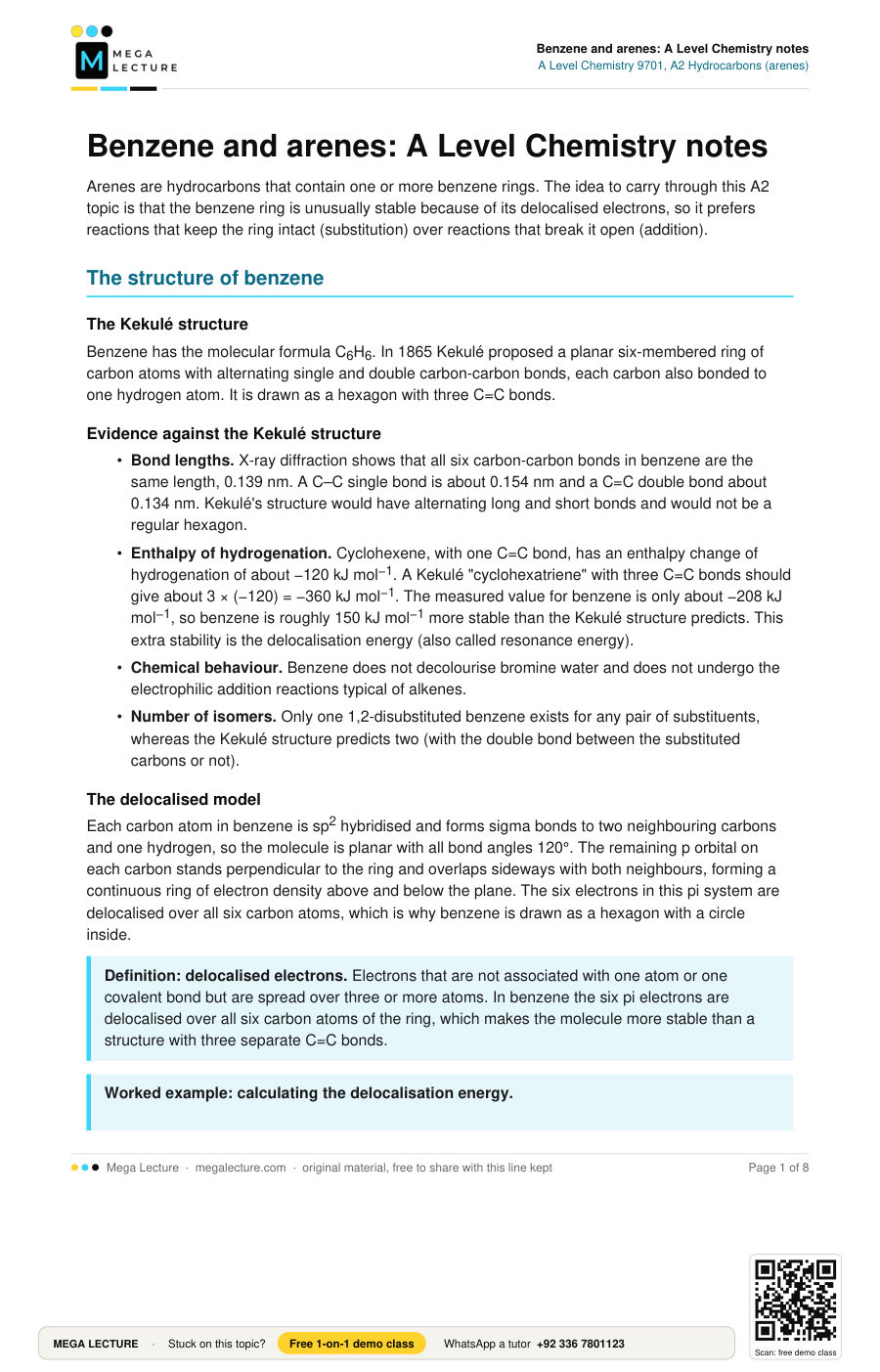
Arenes are hydrocarbons that contain one or more benzene rings. The idea to carry through this A2 topic is that the benzene ring is unusually stable because of its delocalised electrons, so it prefers reactions that keep the ring intact (substitution) over reactions that break it open (addition).
The structure of benzene
The Kekulé structure
Benzene has the molecular formula C6H6. In 1865 Kekulé proposed a planar six-membered ring of carbon atoms with alternating single and double carbon-carbon bonds, each carbon also bonded to one hydrogen atom. It is drawn as a hexagon with three C=C bonds.
Evidence against the Kekulé structure
- Bond lengths. X-ray diffraction shows that all six carbon-carbon bonds in benzene are the same length, 0.139 nm. A C–C single bond is about 0.154 nm and a C=C double bond about 0.134 nm. Kekulé's structure would have alternating long and short bonds and would not be a regular hexagon.
- Enthalpy of hydrogenation. Cyclohexene, with one C=C bond, has an enthalpy change of hydrogenation of about −120 kJ mol−1. A Kekulé "cyclohexatriene" with three C=C bonds should give about 3 × (−120) = −360 kJ mol−1. The measured value for benzene is only about −208 kJ mol−1, so benzene is roughly 150 kJ mol−1 more stable than the Kekulé structure predicts. This extra stability is the delocalisation energy (also called resonance energy).
- Chemical behaviour. Benzene does not decolourise bromine water and does not undergo the electrophilic addition reactions typical of alkenes.
- Number of isomers. Only one 1,2-disubstituted benzene exists for any pair of substituents, whereas the Kekulé structure predicts two (with the double bond between the substituted carbons or not).
The delocalised model
Each carbon atom in benzene is sp2 hybridised and forms sigma bonds to two neighbouring carbons and one hydrogen, so the molecule is planar with all bond angles 120°. The remaining p orbital on each carbon stands perpendicular to the ring and overlaps sideways with both neighbours, forming a continuous ring of electron density above and below the plane. The six electrons in this pi system are delocalised over all six carbon atoms, which is why benzene is drawn as a hexagon with a circle inside.
Definition: delocalised electrons. Electrons that are not associated with one atom or one covalent bond but are spread over three or more atoms. In benzene the six pi electrons are delocalised over all six carbon atoms of the ring, which makes the molecule more stable than a structure with three separate C=C bonds.
Worked example: calculating the delocalisation energy.
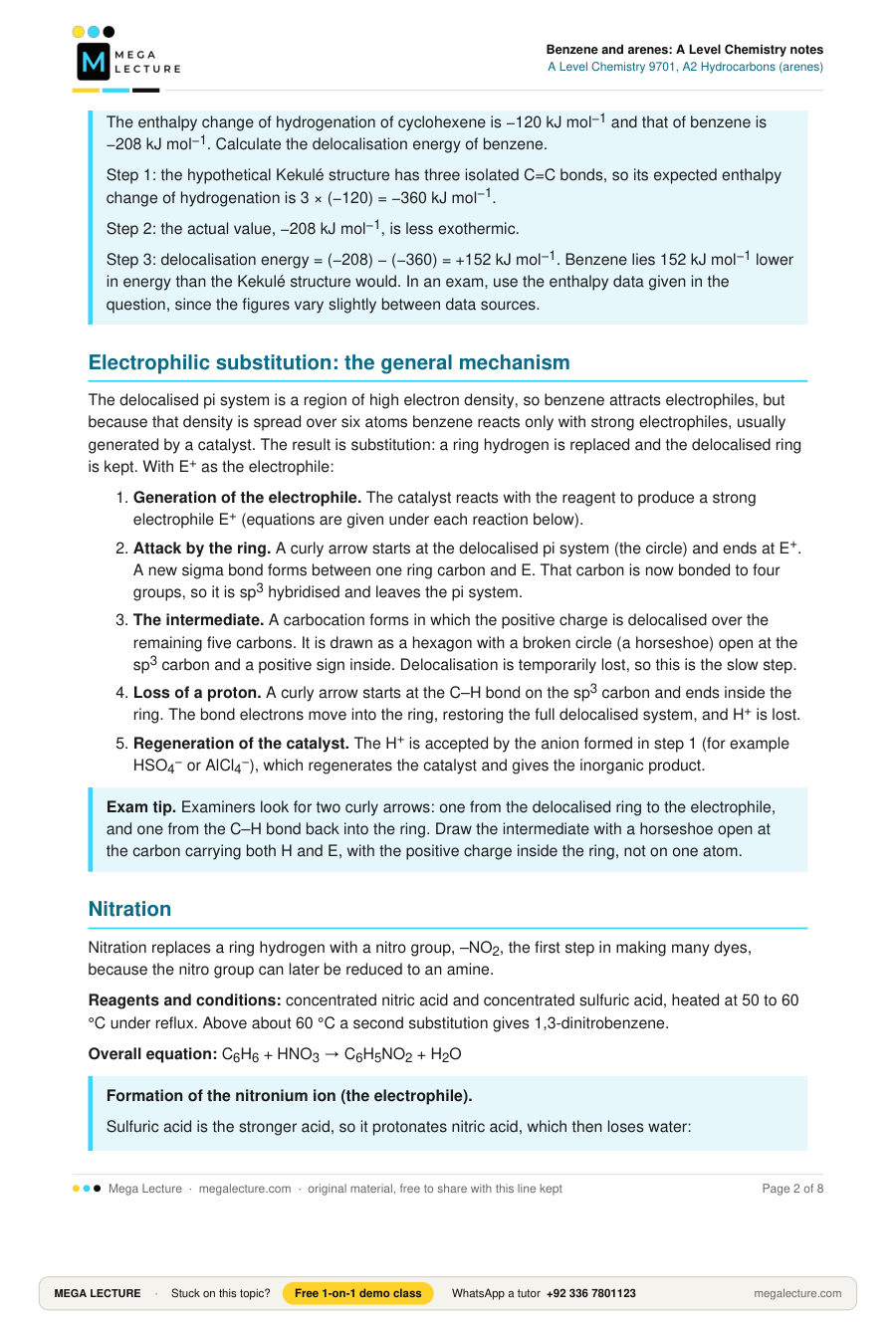
The enthalpy change of hydrogenation of cyclohexene is −120 kJ mol−1 and that of benzene is −208 kJ mol−1. Calculate the delocalisation energy of benzene.
Step 1: the hypothetical Kekulé structure has three isolated C=C bonds, so its expected enthalpy change of hydrogenation is 3 × (−120) = −360 kJ mol−1.
Step 2: the actual value, −208 kJ mol−1, is less exothermic.
Step 3: delocalisation energy = (−208) − (−360) = +152 kJ mol−1. Benzene lies 152 kJ mol−1 lower in energy than the Kekulé structure would. In an exam, use the enthalpy data given in the question, since the figures vary slightly between data sources.
Electrophilic substitution: the general mechanism
The delocalised pi system is a region of high electron density, so benzene attracts electrophiles, but because that density is spread over six atoms benzene reacts only with strong electrophiles, usually generated by a catalyst. The result is substitution: a ring hydrogen is replaced and the delocalised ring is kept. With E+ as the electrophile:
- Generation of the electrophile. The catalyst reacts with the reagent to produce a strong electrophile E+ (equations are given under each reaction below).
- Attack by the ring. A curly arrow starts at the delocalised pi system (the circle) and ends at E+. A new sigma bond forms between one ring carbon and E. That carbon is now bonded to four groups, so it is sp3 hybridised and leaves the pi system.
- The intermediate. A carbocation forms in which the positive charge is delocalised over the remaining five carbons. It is drawn as a hexagon with a broken circle (a horseshoe) open at the sp3 carbon and a positive sign inside. Delocalisation is temporarily lost, so this is the slow step.
- Loss of a proton. A curly arrow starts at the C–H bond on the sp3 carbon and ends inside the ring. The bond electrons move into the ring, restoring the full delocalised system, and H+ is lost.
- Regeneration of the catalyst. The H+ is accepted by the anion formed in step 1 (for example HSO4− or AlCl4−), which regenerates the catalyst and gives the inorganic product.
Exam tip. Examiners look for two curly arrows: one from the delocalised ring to the electrophile, and one from the C–H bond back into the ring. Draw the intermediate with a horseshoe open at the carbon carrying both H and E, with the positive charge inside the ring, not on one atom.
Nitration
Nitration replaces a ring hydrogen with a nitro group, –NO2, the first step in making many dyes, because the nitro group can later be reduced to an amine.
Reagents and conditions: concentrated nitric acid and concentrated sulfuric acid, heated at 50 to 60 °C under reflux. Above about 60 °C a second substitution gives 1,3-dinitrobenzene.
Overall equation: C6H6 + HNO3 → C6H5NO2 + H2O
Formation of the nitronium ion (the electrophile).
Sulfuric acid is the stronger acid, so it protonates nitric acid, which then loses water:
HNO3 + H2SO4 → NO2+ + HSO4− + H2O
The nitronium ion NO2+ is a strong electrophile. After substitution, the proton lost from the intermediate regenerates the catalyst:
H+ + HSO4− → H2SO4
Halogenation with a halogen carrier
Benzene does not react with chlorine or bromine on its own: the concentrated pi bond of an alkene can polarise a halogen molecule and induce a dipole, but the diffuse delocalised system of benzene cannot. A catalyst called a halogen carrier is needed.
Reagents and conditions: chlorine or bromine with anhydrous aluminium chloride, iron(III) chloride, iron(III) bromide or iron filings, at room temperature or with gentle warming, in the absence of ultraviolet light.
Generation of the electrophile: Br2 + FeBr3 → Br+ + FeBr4−
Regeneration of the catalyst: H+ + FeBr4− → FeBr3 + HBr
Overall equation: C6H6 + Br2 → C6H5Br + HBr
Br+ attacks the ring exactly as in the general mechanism, and hydrogen bromide is given off as steamy fumes. For chlorination the equations are the same with Cl in place of Br, and AlCl3 is the usual carrier: Cl2 + AlCl3 → Cl+ + AlCl4−.
Friedel-Crafts alkylation and acylation
Friedel-Crafts reactions attach a carbon-containing group to the ring. Both use anhydrous aluminium chloride as the catalyst and follow the general mechanism.
Alkylation
Reagents and conditions: a halogenoalkane (for example chloroethane) with anhydrous AlCl3, heated under reflux in anhydrous conditions.
Electrophile: CH3CH2Cl + AlCl3 → CH3CH2+ + AlCl4−
Overall: C6H6 + CH3CH2Cl → C6H5CH2CH3 + HCl
The proton lost from the intermediate reacts with AlCl4− to regenerate AlCl3 and give HCl. Because the alkyl group activates the ring, polyalkylated products also form.
Acylation
Reagents and conditions: an acyl chloride (for example ethanoyl chloride, CH3COCl) with anhydrous AlCl3, heated under reflux in anhydrous conditions.
Electrophile: CH3COCl + AlCl3 → CH3CO+ + AlCl4− (an acylium ion)
Overall: C6H6 + CH3COCl → C6H5COCH3 + HCl
The product is the ketone phenylethanone. Acylation does not give multiple substitution because the C=O group withdraws electrons from the ring and deactivates it.
Reactions of the alkyl side chain
Methylbenzene, C6H5CH3, can react at the ring or at the methyl side chain; the conditions decide which.
Free radical substitution of the side chain
With chlorine in ultraviolet light (or at high temperature) and no halogen carrier, substitution takes place on the side chain by the same free radical mechanism as for alkanes:
C6H5CH3 + Cl2 → C6H5CH2Cl + HCl
- Initiation: Cl2 → 2Cl• (homolytic fission by ultraviolet light).
- Propagation: C6H5CH3 + Cl• → C6H5CH2• + HCl, then C6H5CH2• + Cl2 → C6H5CH2Cl + Cl•.
- Termination: any two radicals combine, for example C6H5CH2• + Cl• → C6H5CH2Cl.
Excess chlorine gives C6H5CHCl2 and then C6H5CCl3. The ring is not attacked because its delocalised system is too stable to be broken by a radical. By contrast, chlorine with anhydrous AlCl3 in the dark substitutes on the ring. The rule: ultraviolet light, side chain; halogen carrier, ring.
Oxidation of the side chain to benzoic acid
The ring resists oxidation, but an alkyl side chain is oxidised by hot potassium manganate(VII).
Reagents and conditions: potassium manganate(VII) with dilute sulfuric acid (or with sodium hydroxide, then acidify), heated under reflux.
C6H5CH3 + 3[O] → C6H5COOH + H2O
Whatever the length of the side chain, the product is benzoic acid, provided the carbon attached to the ring carries at least one hydrogen; extra carbons are lost as carbon dioxide. Acidified manganate(VII) is decolourised from purple; alkaline manganate(VII) turns green and then gives a brown precipitate of manganese(IV) oxide. Benzoic acid is a white solid that precipitates on cooling and acidifying.
Directing effects of substituents
When a ring already carries one substituent, a second electrophilic substitution goes to the 2- and 4-positions (6- is equivalent to 2-) or to the 3-position (5- is equivalent), counting the carbon carrying the first group as carbon 1. The direction depends on whether the first group pushes electron density into the ring or pulls it out.
- Electron-donating groups (atoms with a lone pair, such as –OH and –NH2, or alkyl groups) raise the electron density of the ring, especially at the 2-, 4- and 6-positions, so electrophiles attack there. They make the ring more reactive than benzene (activating).
- Electron-withdrawing groups (–NO2, –COOH, –COR, –CHO, –CN, –COOR) pull electron density out, most of all from the 2-, 4- and 6-positions, so the 3- and 5-positions are attacked. They make the ring less reactive than benzene (deactivating), so harsher conditions are needed.
- Halogens (–Cl, –Br) are deactivating overall, but their lone pairs still direct to the 2- and 4-positions.
| Group already on the ring | Directs new group to | Effect on reactivity | Example |
|---|---|---|---|
| –NH2, –OH, –OR | 2- and 4-positions | Strongly activating | Phenol + bromine water → 2,4,6-tribromophenol |
| –CH3 and other alkyl groups | 2- and 4-positions | Activating | Methylbenzene nitrated → 2-nitromethylbenzene and 4-nitromethylbenzene |
| –Cl, –Br | 2- and 4-positions | Weakly deactivating | Chlorobenzene nitrated → 2- and 4-chloronitrobenzene |
| –NO2 | 3-position | Strongly deactivating | Nitrobenzene nitrated → 1,3-dinitrobenzene |
| –COOH, –COOR, –CHO, –COR | 3-position | Deactivating | Benzoic acid nitrated → 3-nitrobenzoic acid |
| –CN, –SO3H | 3-position | Deactivating | Benzonitrile nitrated → 3-nitrobenzonitrile |
Directing effects matter in synthesis because the order of steps decides the product (see question 10).
Phenol compared with benzene
Phenol, C6H5OH, has a hydroxyl group attached directly to the ring. One lone pair on the oxygen sits in a p orbital that overlaps with the delocalised pi system, so the lone pair is partly delocalised into the ring. This raises the electron density of the ring, particularly at the 2-, 4- and 6-positions, and makes phenol far more reactive towards electrophiles than benzene.
Bromination
Benzene needs pure bromine and a halogen carrier, and substitutes once. Phenol reacts with bromine water at room temperature, with no catalyst, and substitutes three times:
C6H5OH + 3Br2 → C6H2Br3OH + 3HBr
Observations: the orange-brown bromine water is decolourised and a white precipitate of 2,4,6-tribromophenol forms, with an antiseptic smell. This is used as a test for phenols.
Why no catalyst is needed: the increased electron density in the ring is enough to polarise an approaching Br2 molecule, inducing a dipole and making the nearer bromine atom electrophilic. Benzene's less concentrated electron density cannot do this. The –OH group directs to the 2-, 4- and 6-positions, and because the ring is so strongly activated all three react.
The same contrast appears in nitration: phenol reacts with dilute nitric acid at room temperature to give 2-nitrophenol and 4-nitrophenol, whereas benzene needs the concentrated nitrating mixture at 50 to 60 °C.
Exam tip. A common question compares benzene, methylbenzene and phenol towards electrophiles. The order of reactivity is phenol > methylbenzene > benzene. Explain it through electron density: the –OH lone pair is delocalised into the ring (large increase), the methyl group pushes electrons weakly into the ring (small increase), and benzene has no substituent. The greater the electron density, the milder the conditions needed.
Naming substituted arenes
- Benzene is usually the parent name and substituents are prefixes: methylbenzene, chlorobenzene, nitrobenzene, ethylbenzene.
- With two or more substituents, number the ring to give the lowest locants and list the prefixes alphabetically, ignoring di- and tri-: 1,2-dimethylbenzene, 1,3-dinitrobenzene, 1,3,5-trimethylbenzene, 1-chloro-4-nitrobenzene.
- When the ring carries a group that gives the compound its own parent name, number from that group as carbon 1: 2-nitrophenol, 4-nitrobenzoic acid, 2,4,6-tribromophenol, 2,4,6-trinitrophenol. Cambridge mark schemes also accept names such as 2-nitromethylbenzene for the methylbenzene series.
- When the ring is a substituent on a chain or functional group it is the phenyl group, C6H5–: phenylethanone C6H5COCH3, phenylamine C6H5NH2, phenylethene C6H5CH=CH2, 2-phenylethanol C6H5CH2CH2OH.
- Traditional names to recognise: phenol C6H5OH, benzoic acid C6H5COOH, benzaldehyde C6H5CHO, and (chloromethyl)benzene C6H5CH2Cl, the product of side chain chlorination.
Key terms
| Term | Meaning |
|---|---|
| Arene | A hydrocarbon containing one or more benzene rings. |
| Kekulé structure | Benzene drawn with three alternating C=C and C–C bonds in a six-membered ring. |
| Delocalised electrons | Electrons spread over three or more atoms rather than held in one bond. |
| Delocalisation energy | The extra stability of benzene compared with a Kekulé structure, about 150 kJ mol−1, found from hydrogenation data. |
| Electrophile | An electron pair acceptor, attracted to regions of high electron density. |
| Electrophilic substitution | A reaction in which an electrophile replaces a hydrogen on a benzene ring, keeping the delocalised ring intact. |
| Nitronium ion | NO2+, the electrophile in nitration, formed from concentrated nitric and sulfuric acids. |
| Halogen carrier | A catalyst such as AlCl3, FeCl3 or FeBr3 that polarises a halogen molecule to generate the electrophile. |
| Friedel-Crafts reaction | Alkylation or acylation of a benzene ring using a halogenoalkane or acyl chloride with AlCl3. |
| Acylium ion | RCO+, the electrophile in Friedel-Crafts acylation. |
| Activating group | A substituent that raises ring electron density and speeds up electrophilic substitution, such as –OH, –NH2 or –CH3. |
| Deactivating group | A substituent that lowers ring electron density and slows electrophilic substitution, such as –NO2 or –COOH. |
| 2,4-directing group | A substituent that sends a new group to the 2- and 4-positions. |
| 3-directing group | A substituent that sends a new group to the 3-position. |
Quick check
- State the shape of the benzene molecule and the H–C–C bond angle, and explain why every carbon-carbon bond in benzene has the same length.
- Describe two pieces of experimental evidence that the Kekulé structure of benzene is incorrect.
- The enthalpy change of hydrogenation of cyclohexene is −120 kJ mol−1 and the measured value for benzene is −208 kJ mol−1. Calculate the value the Kekulé structure predicts for benzene and hence the delocalisation energy. Explain what the result shows.
- State the reagents and conditions for the nitration of benzene. Write an equation for the formation of the electrophile and an equation showing how the catalyst is regenerated.
- Explain why cyclohexene decolourises bromine at room temperature but benzene reacts with bromine only in the presence of a halogen carrier such as FeBr3.
- Ethanoyl chloride reacts with benzene in the presence of anhydrous aluminium chloride. Name the product, write an equation for the formation of the electrophile, and describe the mechanism in numbered steps.
- Methylbenzene is treated with chlorine (a) in ultraviolet light, (b) with anhydrous aluminium chloride in the dark. Predict the organic products in each case and explain why they differ.
- Methylbenzene and nitrobenzene are each nitrated with concentrated nitric and sulfuric acids. Predict the main organic products, explain the difference with reference to the electron density of the ring, and state which reaction needs the harsher conditions.
- Describe what you would observe when bromine water is added to aqueous phenol. Write an equation and explain why no catalyst is needed, whereas bromination of benzene needs one.
- Devise two-step syntheses of (a) 4-nitrobenzoic acid and (b) 3-nitrobenzoic acid, each starting from methylbenzene. Give reagents and conditions for every step and explain why the order of the steps differs.
1. Benzene is a planar, regular hexagon. Each carbon is sp2 hybridised, so the bond angles are 120°. Every carbon contributes one p orbital to a delocalised pi system above and below the ring, so the pi electron density is shared equally between all six carbon-carbon bonds. Each bond is identical, intermediate between single and double, with a length of 0.139 nm.
2. Any two of: (i) X-ray diffraction shows all six C–C bonds are the same length (0.139 nm), not alternating single (0.154 nm) and double (0.134 nm); (ii) the enthalpy change of hydrogenation of benzene (about −208 kJ mol−1) is much less exothermic than the −360 kJ mol−1 predicted for three C=C bonds; (iii) benzene does not decolourise bromine water; (iv) only one isomer of each 1,2-disubstituted benzene exists, whereas Kekulé predicts two.
3. Kekulé prediction: 3 × (−120) = −360 kJ mol−1. Delocalisation energy = (−208) − (−360) = 152 kJ mol−1. Benzene releases 152 kJ mol−1 less energy on hydrogenation than expected, so it is 152 kJ mol−1 more stable than a molecule with three separate double bonds. The extra stability comes from delocalisation of the six pi electrons over the ring.
4. Concentrated nitric acid and concentrated sulfuric acid at 50 to 60 °C under reflux. Electrophile: HNO3 + H2SO4 → NO2+ + HSO4− + H2O. Regeneration: H+ + HSO4− → H2SO4, where H+ is the proton lost from the intermediate. Overall: C6H6 + HNO3 → C6H5NO2 + H2O.
5. In cyclohexene the pi electrons are localised between two carbons, giving a region of high electron density that polarises an approaching Br–Br bond and induces a dipole, so the nearer bromine becomes electrophilic and reacts without a catalyst. In benzene the six pi electrons are delocalised over six carbons, so the electron density is too spread out to polarise Br2. The halogen carrier generates a much stronger electrophile, Br2 + FeBr3 → Br+ + FeBr4−, which the ring can attack, and substitution rather than addition follows because addition would destroy the delocalised system.
6. Product: phenylethanone, C6H5COCH3 (plus HCl). Electrophile: CH3COCl + AlCl3 → CH3CO+ + AlCl4−. Mechanism: (1) a curly arrow from the delocalised ring to the carbon of CH3CO+ forms a C–C bond; (2) a carbocation intermediate forms, drawn as a horseshoe open at the carbon carrying the new group, with the positive charge delocalised over five carbons; (3) a curly arrow from the C–H bond at that carbon into the ring restores the delocalised system and releases H+; (4) H+ + AlCl4− → AlCl3 + HCl regenerates the catalyst.
7. (a) Ultraviolet light splits Cl2 homolytically into chlorine radicals, and free radical substitution occurs on the side chain: the product is (chloromethyl)benzene, C6H5CH2Cl, with C6H5CHCl2 and C6H5CCl3 if chlorine is in excess. The ring is untouched because its delocalised system is too stable to be broken by a radical. (b) With anhydrous AlCl3 in the dark no radicals form; the catalyst generates Cl+ (Cl2 + AlCl3 → Cl+ + AlCl4−), which substitutes on the ring. The methyl group is 2,4-directing, so the products are 1-chloro-2-methylbenzene and 1-chloro-4-methylbenzene (Cambridge also accepts 2-chloromethylbenzene and 4-chloromethylbenzene), with the chlorine on the ring, not on the side chain.
8. Methylbenzene gives mainly 2-nitromethylbenzene and 4-nitromethylbenzene: the methyl group donates electrons, raising the electron density at the 2-, 4- and 6-positions, where the nitronium ion attacks. Nitrobenzene gives 1,3-dinitrobenzene: the nitro group withdraws electrons, lowering the electron density most at the 2-, 4- and 6-positions, so attack occurs at the 3-position. Nitrobenzene needs the harsher conditions because its ring has a lower electron density than benzene.
9. The orange-brown bromine water is decolourised and a white precipitate of 2,4,6-tribromophenol forms, with an antiseptic smell. C6H5OH + 3Br2 → C6H2Br3OH + 3HBr. A lone pair on the oxygen of the –OH group is delocalised into the ring, greatly raising the electron density at the 2-, 4- and 6-positions, enough to polarise a Br2 molecule and induce a dipole, so no halogen carrier is needed and all three activated positions react. Benzene's electron density is too diffuse to polarise Br2, so a halogen carrier must generate Br+ first.
10. (a) 4-nitrobenzoic acid: step 1, nitrate methylbenzene with concentrated HNO3 and concentrated H2SO4 at 50 to 60 °C; the methyl group is 2,4-directing, so 4-nitromethylbenzene forms (the 2-isomer is separated off). Step 2, oxidise the side chain with hot acidified potassium manganate(VII) under reflux. (b) 3-nitrobenzoic acid: step 1, oxidise methylbenzene with hot acidified potassium manganate(VII) under reflux to benzoic acid. Step 2, nitrate with concentrated HNO3 and concentrated H2SO4 with heating; –COOH is 3-directing, so 3-nitrobenzoic acid forms. The group already on the ring decides where the second group goes: –CH3 directs to the 4-position, –COOH to the 3-position. Nitrating after oxidation needs more forcing conditions because –COOH deactivates the ring.
