
A Level · Chemistry 9701 · Transition elements: exam-style questions with full answers
Transition elements: exam-style questions with full answers
Opens inside this page. Prefer your own PDF app? Open the PDF.
Chemistry batch classes: coming soon. Small live classes at a lower fee than one-to-one. Join the waiting list
Check yourself
5 quick questions on A Level Chemistry
Tap an answer to see if you are right, and why. Free, no sign-up.
Start the free test7 of 7 students found these notes useful
Was this note useful?
Full text of Transition elements: exam-style questions with full answers
This document provides twenty original exam-style questions, with full worked answers and mark schemes, on the transition elements topic from the A2 (second-year) content of the Cambridge International AS & A Level Chemistry syllabus (9701). It covers the electron configurations of the first-row d-block elements and their ions, the definition of a transition element, variable oxidation states and redox chemistry, the formation and shapes of complex ions, colour in transition metal complexes, ligand exchange reactions, catalytic behaviour, and qualitative tests for selected transition metal ions.
Key ideas
- A transition element is a d-block element that forms at least one stable ion with a partially filled d sub-shell.
- Sc and Zn are d-block elements but are not transition elements: Sc3+ is 3d0 and Zn2+ is 3d10, so neither has a partially filled d sub-shell.
- The 4s sub-shell fills before 3d, but when a d-block atom forms a cation the 4s electrons are always removed first, then 3d electrons if further ionisation occurs.
- Cr ([Ar]3d54s1) and Cu ([Ar]3d104s1) have anomalous ground-state configurations because a half-filled or fully-filled 3d sub-shell has extra stability.
- Transition elements show variable oxidation states because the 3d and 4s electrons are close in energy, so different numbers of electrons can be lost or shared without a large energy penalty.
- A ligand is a molecule or ion that donates a lone pair of electrons to a central metal ion, forming a dative (coordinate) bond.
- The coordination number is the number of dative bonds from ligands to the central ion; it fixes the shape of the complex.
- Complexes are coloured because ligands split the five degenerate d orbitals into two energy levels; electrons absorb visible light to jump between them (a d–d transition), and the complementary colour is seen.
- Ligand exchange reactions can change the coordination number, shape and colour of a complex — or, in some cases, the colour only, with the coordination number and shape unchanged.
- Transition elements and their compounds catalyse many reactions; catalysis may be heterogeneous (catalyst in a different phase from the reactants, e.g. Fe in the Haber process) or homogeneous (same phase, e.g. Fe2+ in the S2O82−/I− reaction).
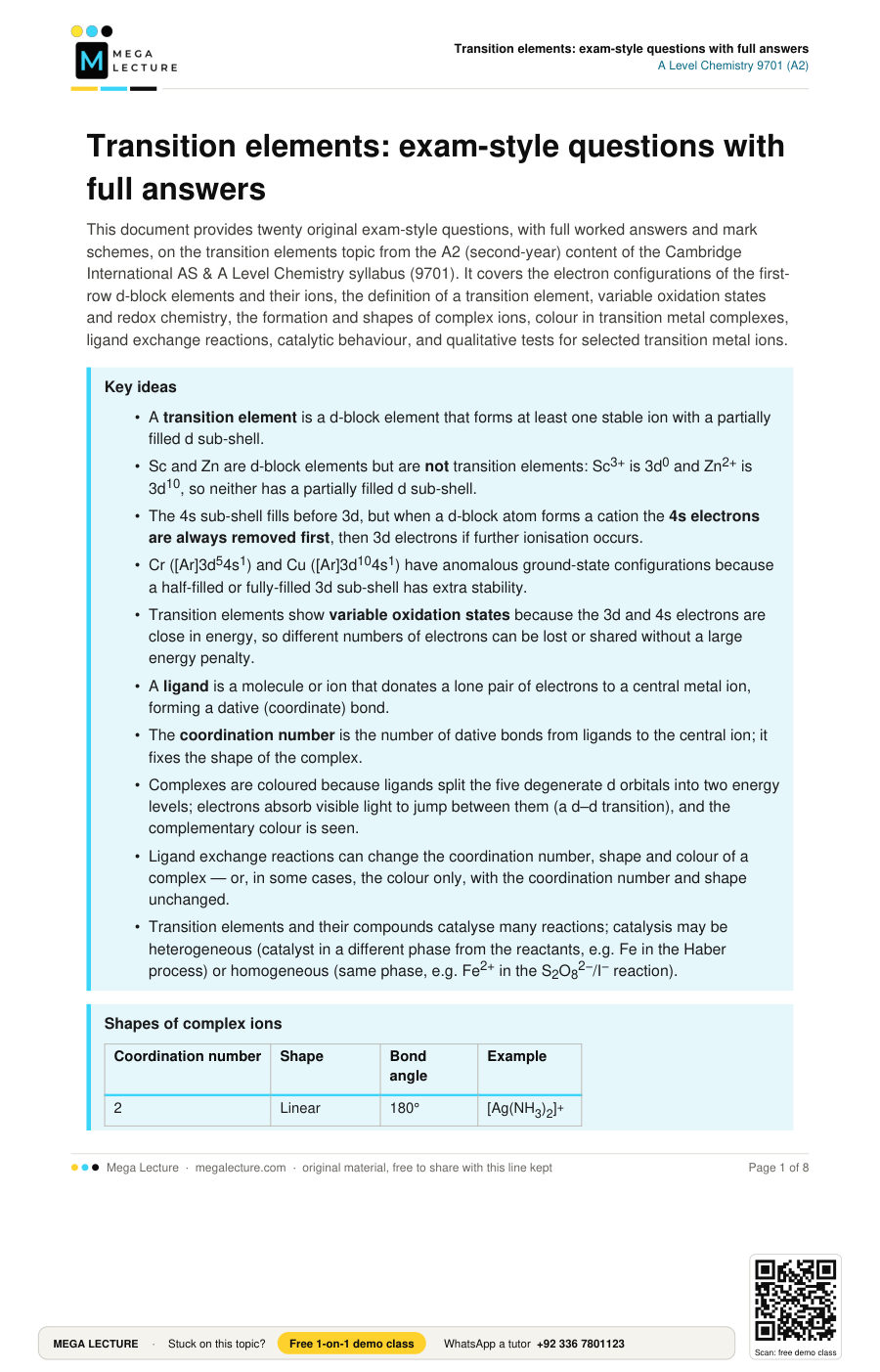
Shapes of complex ions
| Coordination number | Shape | Bond angle | Example |
|---|---|---|---|
| 2 | Linear | 180° | [Ag(NH3)2]+ |
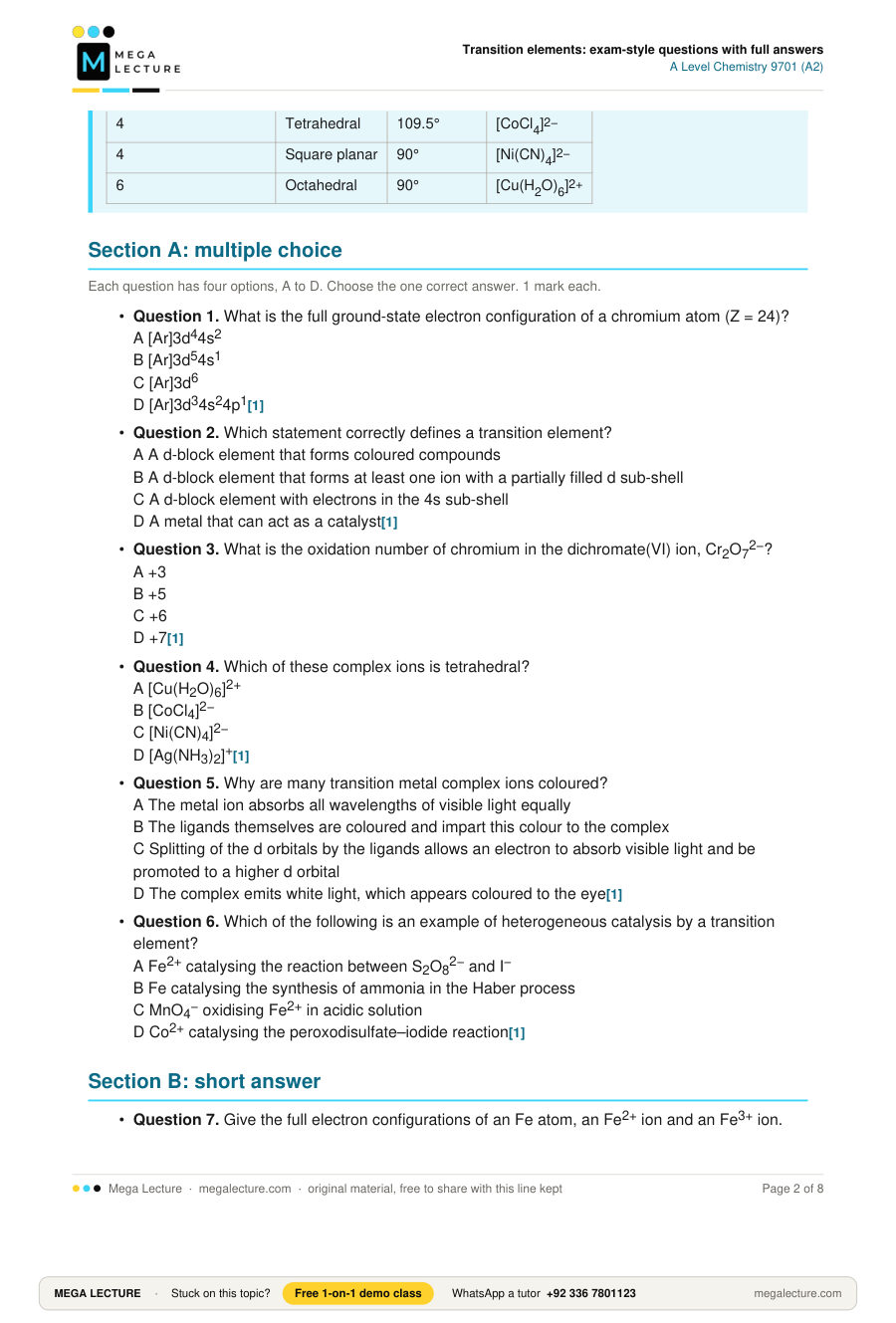
| 4 | Tetrahedral | 109.5° | [CoCl4]2− |
| 4 | Square planar | 90° | [Ni(CN)4]2− |
| 6 | Octahedral | 90° | [Cu(H2O)6]2+ |
Section A: multiple choice
Each question has four options, A to D. Choose the one correct answer. 1 mark each.
- Question 1. What is the full ground-state electron configuration of a chromium atom (Z = 24)?
A [Ar]3d44s2
B [Ar]3d54s1
C [Ar]3d6
D [Ar]3d34s24p1[1] - Question 2. Which statement correctly defines a transition element?
A A d-block element that forms coloured compounds
B A d-block element that forms at least one ion with a partially filled d sub-shell
C A d-block element with electrons in the 4s sub-shell
D A metal that can act as a catalyst[1] - Question 3. What is the oxidation number of chromium in the dichromate(VI) ion, Cr2O72−?
A +3
B +5
C +6
D +7[1] - Question 4. Which of these complex ions is tetrahedral?
A [Cu(H2O)6]2+
B [CoCl4]2−
C [Ni(CN)4]2−
D [Ag(NH3)2]+[1] - Question 5. Why are many transition metal complex ions coloured?
A The metal ion absorbs all wavelengths of visible light equally
B The ligands themselves are coloured and impart this colour to the complex
C Splitting of the d orbitals by the ligands allows an electron to absorb visible light and be promoted to a higher d orbital
D The complex emits white light, which appears coloured to the eye[1] - Question 6. Which of the following is an example of heterogeneous catalysis by a transition element?
A Fe2+ catalysing the reaction between S2O82− and I−
B Fe catalysing the synthesis of ammonia in the Haber process
C MnO4− oxidising Fe2+ in acidic solution
D Co2+ catalysing the peroxodisulfate–iodide reaction[1]
Section B: short answer
- Question 7. Give the full electron configurations of an Fe atom, an Fe2+ ion and an Fe3+ ion. Hence state which sub-shell of electrons is always removed first when a d-block atom forms a positive ion.[3]
- Question 8. Copper has the anomalous ground-state electron configuration [Ar]3d104s1 rather than the [Ar]3d94s2 predicted by the normal filling order. Explain this observation.[2]
- Question 9. Potassium manganate(VII) solution oxidises Fe2+ ions to Fe3+ ions in acidic solution and is itself reduced to Mn2+. Write (i) the half-equation for the reduction of MnO4− to Mn2+, (ii) the half-equation for the oxidation of Fe2+ to Fe3+, and (iii) the overall ionic equation for the reaction.[3]
- Question 10. Determine the oxidation number of manganese in MnO4− and the oxidation number of vanadium in the VO2+ ion.[2]
- Question 11. Define the terms ligand and coordination number. State the shape and bond angle found in a complex ion with coordination number 6.[3]
- Question 12. When excess concentrated hydrochloric acid is added to aqueous copper(II) sulfate, a ligand exchange reaction occurs. Write an ionic equation for this reaction and describe the colour change and the change in coordination number that take place.[3]
- Question 13. Distinguish between homogeneous and heterogeneous catalysis. For each type, give one transition-element example from those you have studied and briefly explain how the catalyst operates.[4]
- Question 14. State what is observed when aqueous sodium hydroxide is added, first dropwise and then in excess, to separate samples of Fe2+(aq) and Fe3+(aq), including whether each precipitate dissolves in excess; and describe what is observed when aqueous ammonia is added, first dropwise and then in excess, to Cu2+(aq).[4]
Section C: structured questions
Question 15. This question is about the electron configurations of d-block elements and ions.
- (a) Define, in terms of electron configuration, the term transition element.[1]
- (b) Give the electron configurations of the Sc3+ and Zn2+ ions, stating the number of d electrons present in each.[2]
- (c) Explain why scandium and zinc are classified as d-block elements but are not classified as transition elements.[1]
- (d) Chromium has the anomalous ground-state electron configuration [Ar]3d54s1. Write the electron configuration expected from the normal filling order, and explain why the actual configuration differs from it.[2]
Question 16. This question is about the redox chemistry of dichromate(VI) ions.
- (a) Deduce the oxidation number of chromium in the dichromate(VI) ion, Cr2O72−.[1]
- (b) Write the half-equation, including state symbols, for the reduction of Cr2O72− to Cr3+ in acidic solution.[2]
- (c) Write the half-equation for the oxidation of Fe2+ to Fe3+, and combine your two half-equations to give the overall ionic equation, with state symbols, for the reaction between acidified potassium dichromate(VI) and iron(II) ions.[2]
- (d) In a titration, 25.0 cm3 of an FeSO4 solution of unknown concentration required 22.50 cm3 of 0.0200 mol dm−3 K2Cr2O7 solution for complete oxidation. Calculate the concentration, in mol dm−3, of the FeSO4 solution.[3]
Question 17. This question is about complex ions.
- (a) Define the term ligand.[1]
- (b) For each of the complex ions [Fe(CN)6]4−, [CoCl4]2− and [Ag(NH3)2]+, state the coordination number and the shape.[3]
- (c) [Sc(H2O)6]3+ is colourless, but [Ti(H2O)6]3+ is coloured. Explain this difference in terms of the electron configurations of Sc3+ and Ti3+ and the splitting of the d orbitals by ligands.[2]
- (d) State the colour of aqueous [Ti(H2O)6]3+.[1]
Question 18. This question is about ligand exchange and catalysis.
- (a) Write an ionic equation, with state symbols, for the reaction of [Cu(H2O)6]2+(aq) with excess aqueous ammonia to form [Cu(NH3)4(H2O)2]2+(aq).[1]
- (b) State the colour change that occurs, and comment on the coordination number and shape of the copper complex ion throughout this reaction.[2]
- (c) Manganese(IV) oxide catalyses the decomposition of hydrogen peroxide. State the type of catalysis involved and explain, in terms of the mechanism, how the catalyst increases the rate of reaction.[2]
- (d) Suggest one practical reason why the iron catalyst used in the Haber process is used as small solid pellets rather than as a single large block.[1]
Question 19. This question is about qualitative tests for Cu2+(aq) and Cr3+(aq) using aqueous sodium hydroxide and aqueous ammonia.
- (a) State what is observed when aqueous sodium hydroxide is added, first dropwise and then in excess, to Cu2+(aq).[1]
- (b) State what is observed when aqueous sodium hydroxide is added, first dropwise and then in excess, to Cr3+(aq).[2]
- (c) State what is observed when aqueous ammonia is added, first dropwise and then in excess, to Cr3+(aq).[2]
Question 20. This question is about the variable oxidation states of vanadium.
- Acidified ammonium vanadate(V) solution, which contains the VO2+(aq) ion, can be reduced by zinc and dilute sulfuric acid to a solution containing the V2+(aq) ion. Deduce the oxidation number of vanadium in VO2+(aq) and in V2+(aq), state whether this change is a reduction or an oxidation, and give the role of the zinc in the reaction.[3]
Answers
Section A
1. B. Cr is anomalous: one 4s electron moves into the 3d sub-shell to give a half-filled, extra-stable 3d5 arrangement, so the configuration is [Ar]3d54s1 rather than the [Ar]3d44s2 predicted by the normal filling order.[1]
2. B. A transition element is a d-block element that forms at least one stable ion with a partially filled d sub-shell.[1]
3. C. Let the oxidation number of Cr be x. 2x + 7(−2) = −2, so 2x = +12 and x = +6.[1]
4. B. [CoCl4]2− has coordination number 4 and, with the relatively large Cl− ligand, adopts a tetrahedral shape. [Cu(H2O)6]2+ is octahedral, [Ni(CN)4]2− is square planar and [Ag(NH3)2]+ is linear.[1]
5. C. Ligands split the d orbitals into two groups of different energy; an electron absorbs a photon of visible light and is promoted from the lower to the higher set (a d–d transition). The wavelengths not absorbed are transmitted/reflected and give the observed colour.[1]
6. B. In the Haber process, solid Fe catalyst is in a different phase from the gaseous N2 and H2 reactants, so this is heterogeneous catalysis. The other options are homogeneous (all species in aqueous solution) or are not catalysis at all.[1]
Section B
7. Fe: [Ar]3d64s2 [1]; Fe2+: [Ar]3d6 and Fe3+: [Ar]3d5 [1]; when a d-block atom forms a cation, the 4s electrons are always removed before any 3d electrons, because once the 3d sub-shell is occupied it becomes lower in energy than the 4s sub-shell [1].
8. A fully-filled 3d10 sub-shell (two electrons — a full pair — occupy each of the five d orbitals) has extra stability compared with the 3d94s2 arrangement, because of the greater symmetry/exchange energy of a completely filled sub-shell [1]. It is therefore energetically favourable for one 4s electron to move into the 3d sub-shell to complete it, giving [Ar]3d104s1 [1].
9. (i) MnO4−(aq) + 8H+(aq) + 5e− → Mn2+(aq) + 4H2O(l) [1]
(ii) Fe2+(aq) → Fe3+(aq) + e− [1]
(iii) Multiplying (ii) by 5 and adding to (i): MnO4−(aq) + 8H+(aq) + 5Fe2+(aq) → Mn2+(aq) + 4H2O(l) + 5Fe3+(aq) [1].
10. In MnO4−: x + 4(−2) = −1, so x = +7 [1]. In VO2+: x + 2(−2) = +1, so x = +5 [1].
11. A ligand is a molecule or ion that donates a lone pair of electrons to a central metal ion, forming a dative (coordinate) bond [1]. The coordination number is the number of dative bonds formed from ligands to the central metal ion [1]. A coordination number of 6 gives an octahedral shape with bond angles of 90° [1].
12. [Cu(H2O)6]2+(aq) + 4Cl−(aq) → [CuCl4]2−(aq) + 6H2O(l) [1]. The colour changes from blue to yellow (the solution often appears green part-way through the change, as it contains a mixture of the blue and yellow complexes) [1]. The coordination number decreases from 6 to 4 as the complex changes shape from octahedral to tetrahedral, because the chloride ligand is larger than water so fewer can pack around the copper ion [1].
13. Homogeneous catalysis occurs when the catalyst is in the same phase as the reactants. Example: Fe2+(aq) catalyses the reaction between S2O82−(aq) and I−(aq), which is slow when uncatalysed because the two reacting ions are both negatively charged and repel each other. Fe2+ reacts first with S2O82−: S2O82−(aq) + 2Fe2+(aq) → 2SO42−(aq) + 2Fe3+(aq); the Fe3+ formed then reacts with I−: 2Fe3+(aq) + 2I−(aq) → 2Fe2+(aq) + I2(aq), regenerating Fe2+ and avoiding the repulsion problem [2]. Heterogeneous catalysis occurs when the catalyst is in a different phase from the reactants. Example: solid V2O5 catalyses the oxidation of gaseous SO2 to SO3 in the Contact process. V2O5 oxidises SO2, itself being reduced (V5+ → V4+): SO2(g) + V2O5(s) → SO3(g) + 2VO2(s); the VO2 (V4+) is then reoxidised by O2 back to V2O5: 2VO2(s) + ½O2(g) → V2O5(s), regenerating the catalyst [2].
14. With Fe2+(aq): a pale (dirty) green precipitate of Fe(OH)2 forms; it remains insoluble in excess NaOH, so there is no further change on adding excess (it slowly darkens on standing in air as it is oxidised towards Fe(OH)3) [1]. With Fe3+(aq): a red-brown precipitate of Fe(OH)3 forms and, again, remains insoluble in excess NaOH with no further change [1]. With Cu2+(aq): a small volume of aqueous ammonia gives a pale blue precipitate of Cu(OH)2 [1]; in excess ammonia this precipitate dissolves to give a deep (royal) blue solution containing [Cu(NH3)4(H2O)2]2+ [1].
Section C
15.
(a) A transition element is a d-block element that forms at least one stable ion with a partially filled d sub-shell.[1]
(b) Sc3+: [Ar], 0 d electrons; Zn2+: [Ar]3d10, 10 d electrons.[2]
(c) Sc forms only the Sc3+ ion (3d0) and Zn forms only the Zn2+ ion (3d10); neither ion has a partially filled d sub-shell, so, although both are d-block elements, neither meets the definition of a transition element.[1]
(d) Normal filling order predicts [Ar]3d44s2. A half-filled 3d sub-shell (one electron in each of the five d orbitals) is more stable than the 3d44s2 arrangement, due to the greater exchange energy/symmetry of the half-filled set, so one 4s electron moves into the 3d sub-shell to give the observed [Ar]3d54s1 configuration.[2]
16.
(a) Let oxidation number of Cr be x: 2x + 7(−2) = −2, so x = +6.[1]
(b) Cr2O72−(aq) + 14H+(aq) + 6e− → 2Cr3+(aq) + 7H2O(l).[2]
(c) Fe2+(aq) → Fe3+(aq) + e−. Multiplying this by 6 and adding to the half-equation in (b): Cr2O72−(aq) + 14H+(aq) + 6Fe2+(aq) → 2Cr3+(aq) + 7H2O(l) + 6Fe3+(aq).[2]
(d) Moles of Cr2O72− = 0.0200 × (22.50/1000) = 4.50 × 10⁻⁴ mol. From the stoichiometry in (c), 1 mol Cr2O72− reacts with 6 mol Fe2+, so moles of Fe2+ = 6 × 4.50 × 10−4 = 2.70 × 10⁻³ mol. Concentration of FeSO4 = (2.70 × 10⁻³) ÷ (25.0/1000) = 0.108 mol dm−3.[3]
17.
(a) A ligand is a molecule or ion that donates a lone pair of electrons to a central metal ion, forming a dative (coordinate) bond.[1]
(b) [Fe(CN)6]4−: coordination number 6, octahedral. [CoCl4]2−: coordination number 4, tetrahedral. [Ag(NH3)2]+: coordination number 2, linear.[3]
(c) Sc3+ has the configuration [Ar], i.e. 3d0 — there are no d electrons available to be promoted between the split d orbitals, so no visible light is absorbed and the complex is colourless. Ti3+ has the configuration [Ar]3d1; the water ligands split the d orbitals into two energy levels, and the single 3d electron can absorb a photon of visible light and be promoted from the lower to the higher set (a d–d transition), so the complex is coloured.[2]
(d) Violet/purple.[1]
18.
(a) [Cu(H2O)6]2+(aq) + 4NH3(aq) → [Cu(NH3)4(H2O)2]2+(aq) + 4H2O(l).[1]
(b) With a small volume of ammonia, a pale blue precipitate of Cu(OH)2 forms first; as excess ammonia is added, this precipitate dissolves to give a deep (royal) blue solution [1]. The coordination number remains 6 and the shape remains octahedral throughout: four of the six water ligands are exchanged for ammonia, but the total number of dative bonds to the copper ion is unchanged, so — unlike the reaction with chloride ions — only the colour changes, not the coordination number or shape [1].
(c) This is heterogeneous catalysis, since the solid MnO2 catalyst is in a different phase from the aqueous H2O2: 2H2O2(aq) → 2H2O(l) + O2(g). H2O2 molecules adsorb onto the surface of the MnO2, which weakens the O–O bond and provides an alternative reaction pathway of lower activation energy; a greater proportion of molecules then have enough energy to react at a given temperature, so the rate increases, and the products desorb to regenerate the surface.[2]
(d) Using small pellets gives a much greater total surface area (for a given mass of catalyst) than a single large block, so more reactant molecules can adsorb onto the catalyst surface at once, increasing the rate of the catalysed reaction.[1]
19.
(a) A pale blue precipitate of Cu(OH)2 forms with a small volume of NaOH; the precipitate remains insoluble in excess NaOH, so there is no further change.[1]
(b) A green precipitate of Cr(OH)3 forms with a small volume of NaOH [1]; in excess NaOH the precipitate dissolves, since Cr(OH)3 is amphoteric, to give a dark green solution containing [Cr(OH)6]3−(aq) [1].
(c) A green precipitate of Cr(OH)3 forms with a small volume of aqueous ammonia; unlike with NaOH, the precipitate remains insoluble in excess ammonia, so there is no further change.[2]
20. In VO2+: let the oxidation number of V be x; x + 2(−2) = +1, so x = +5. In V2+, the oxidation number of vanadium is +2 [1]. The change from +5 to +2 is a decrease in oxidation number, so it is a reduction [1]. Zinc acts as the reducing agent: it supplies the electrons needed to reduce vanadium from +5 to +2, and is itself oxidised to Zn2+ [1].
