
IB Diploma · Biology · SL / HL · Theme B: Form and Function
B4.1 Adaptation to Environment
Opens inside this page. Prefer your own PDF app? Open the PDF.
Full text of B4.1 Adaptation to Environment
IB DP BIOLOGY Theme B: Form and Function B4.1 Adaptation to Environment
Revision Notes · Standard and Higher Level Fahad H. Ahmad
+92 323 509 4443 | Megalecture.com
Original notes prepared for the IB Diploma Programme Biology course (2025 syllabus)
What the syllabus requires
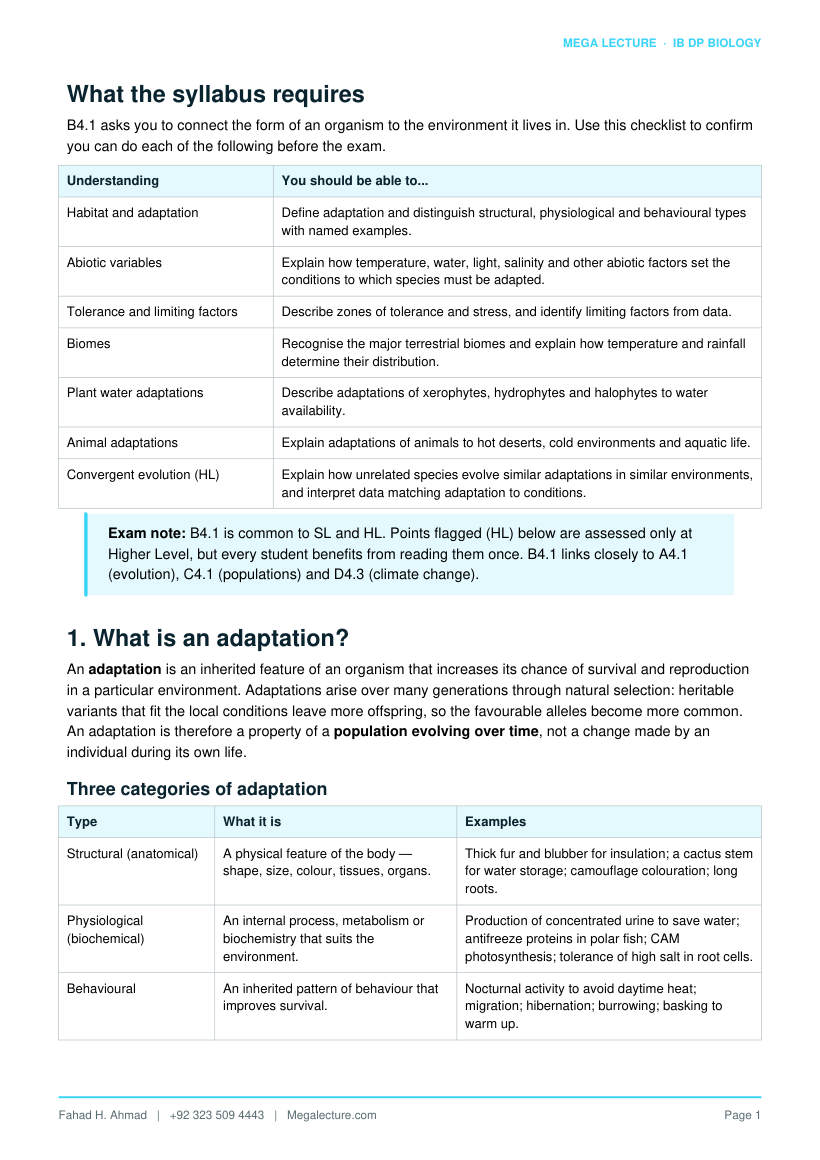
B4.1 asks you to connect the form of an organism to the environment it lives in. Use this checklist to confirm you can do each of the following before the exam.
Understanding You should be able to...
Habitat and adaptation Define adaptation and distinguish structural, physiological and behavioural types with named examples.
Abiotic variables Explain how temperature, water, light, salinity and other abiotic factors set the conditions to which species must be adapted.
Tolerance and limiting factors Describe zones of tolerance and stress, and identify limiting factors from data.
Biomes Recognise the major terrestrial biomes and explain how temperature and rainfall determine their distribution.
Plant water adaptations Describe adaptations of xerophytes, hydrophytes and halophytes to water availability.
Animal adaptations Explain adaptations of animals to hot deserts, cold environments and aquatic life.
Convergent evolution (HL) Explain how unrelated species evolve similar adaptations in similar environments, and interpret data matching adaptation to conditions.
Exam note: B4.1 is common to SL and HL. Points flagged (HL) below are assessed only at Higher Level, but every student benefits from reading them once. B4.1 links closely to A4.1 (evolution), C4.1 (populations) and D4.3 (climate change).
1. What is an adaptation?
An adaptation is an inherited feature of an organism that increases its chance of survival and reproduction in a particular environment. Adaptations arise over many generations through natural selection: heritable variants that fit the local conditions leave more offspring, so the favourable alleles become more common. An adaptation is therefore a property of a population evolving over time, not a change made by an individual during its own life.
Three categories of adaptation
Type What it is Examples
Structural (anatomical) A physical feature of the body — shape, size, colour, tissues, organs.
Thick fur and blubber for insulation; a cactus stem for water storage; camouflage colouration; long roots.
Physiological (biochemical)
An internal process, metabolism or biochemistry that suits the environment.
Production of concentrated urine to save water; antifreeze proteins in polar fish; CAM photosynthesis; tolerance of high salt in root cells.
Behavioural An inherited pattern of behaviour that improves survival.
Nocturnal activity to avoid daytime heat; migration; hibernation; burrowing; basking to warm up.
Most organisms combine all three. A desert kangaroo rat, for example, has a structural adaptation (very long loops of Henle for water reabsorption), a physiological one (producing extremely concentrated urine and metabolic water from dry seeds) and a behavioural one (staying in a cool burrow by day and feeding at night). Together these let it survive without ever drinking.
Key distinction: Adaptation (heritable, evolutionary) is not the same as acclimatisation (a reversible adjustment within one individual's lifetime, such as producing more red blood cells at altitude). Exam answers must make clear that an adaptation is passed to offspring through genes.
2. Abiotic factors and tolerance ranges
Abiotic factors are the non-living, physical and chemical features of an environment. They set the challenges that organisms must be adapted to. The main abiotic variables examined are listed below.
- Temperature — affects the rate of enzyme-controlled reactions and the risk of freezing or overheating.
- Water availability — needed for metabolism, transport and support; scarce in deserts, abundant in aquatic habitats.
- Light intensity — drives photosynthesis and sets the pattern of activity for many animals.
- Salinity — the salt concentration of soil or water; affects osmosis and water uptake.
- Soil pH and mineral nutrients — determine which plants can grow and how well roots absorb ions.
- Dissolved oxygen (in water) and wind or water flow — influence gas exchange and physical stress.
Zones of tolerance and stress
For any abiotic factor, a species performs best over a limited range of values. This is described using the concept of a tolerance range.
Zone What happens to the organism
Optimum range Conditions are ideal; growth, activity and reproduction are at a maximum.
Zones of stress On either side of the optimum, the factor becomes limiting; the organism survives but grows slowly and reproduces poorly (physiological stress).
Zones of intolerance Beyond the stress zones the factor is too extreme; the organism cannot survive and is absent.
Plotting abundance or performance against the value of a factor gives a bell-shaped tolerance curve. The two outer values at which survival becomes impossible are the limits of tolerance. A species with a wide tolerance range for a factor can live in many places; a species with a narrow range is restricted to particular habitats.
Figure 1. Relative performance/fitness against an abiotic factor (e.g. temperature). Audit: the curve's numerical peak is at 22°C, matching the set optimum of 22°C; performance falls below 5% of the maximum (limits of tolerance) at 6°C and 31°C.
Limiting factors
A limiting factor is the abiotic factor closest to its limit of tolerance — the one that restricts a process or the distribution of a species at a given time. In a cold mountain habitat, temperature may limit plant growth; in a desert, water is the limiting factor; on a shaded forest floor, light limits photosynthesis. If the limiting factor is relieved (for instance, watering a desert plot), the process speeds up until some other factor becomes limiting.
Data-skill tip: To identify a limiting factor from a graph, find the variable whose change alters the response while other variables are held constant. Where a curve plateaus, a different factor has taken over as limiting.
3. Biomes: climate shapes vegetation
A biome is a large geographical region with a characteristic climate and a distinctive community of plants and animals adapted to it. The two abiotic factors that define which biome develops in a region are average temperature and annual rainfall (with their seasonal pattern). Because these two variables vary with latitude and altitude, biomes occur in broad, predictable belts across the Earth.
Because the same climate produces the same type of vegetation wherever it occurs, ecologists can predict the biome of a region from its temperature and rainfall alone. Plotting mean annual temperature against mean annual precipitation places every location within one of the biomes shown below.
Biome Temperature Rainfall Characteristic vegetation
Tropical rainforest Hot, ~25–30 °C, little seasonal change
Very high, >2000 mm, year-round
Dense, layered evergreen broad-leaved trees; lianas and epiphytes; extremely high biodiversity.
Biome Temperature Rainfall Characteristic vegetation
Hot desert Hot days, cold nights; large daily range
Very low, <250 mm, unreliable
Sparse; drought-resistant xerophytes such as cacti and succulents; deep- or shallow-rooted shrubs.
Temperate forest Warm summers, cold winters; four seasons
Moderate, 750–1500 mm Deciduous broad-leaved trees that shed leaves in winter; understorey shrubs; herbs.
Grassland Warm summers, cool/cold winters
Moderate but seasonal, 250–750 mm
Grasses and herbaceous plants; few trees (fire and grazing limit them).
Taiga (boreal forest)
Long cold winters, short cool summers
Low–moderate, much as snow
Coniferous evergreen trees (pine, spruce, fir) with needle leaves; low diversity.
Tundra Very cold; short growing season; permafrost
Low, <250 mm (a cold desert)
No trees; low mosses, lichens, sedges and dwarf shrubs; shallow-rooted.
How climate determines distribution
Moving from the equator to the poles, mean temperature falls, and this drives a sequence of biomes: tropical rainforest → deserts (around 30° latitude) → grassland and temperate forest → taiga → tundra. At any one latitude, the amount and seasonality of rainfall decides whether the biome is forest (wet), grassland (intermediate) or desert (dry). Altitude produces the same sequence in miniature up a mountainside, because temperature also falls with height.
Exam tip: When asked why a biome occurs where it does, name the two controlling factors — temperature and rainfall — and explain how each selects for the dominant vegetation type. Do not just describe the plants.
Figure 2. Representative mean annual temperature and rainfall for six biomes, including the two regions from Worked example 4 (X: hot desert; Y: tropical rainforest), both at 27°C. Audit: computed rainfall difference between X and Y at the same temperature = 2750 mm, showing that rainfall — not temperature — separates them.
4. Plant adaptations to water availability
Water is the single most important factor shaping plant form. Plants are grouped by the water conditions they are adapted to.
Group Habitat Water challenge
Xerophytes Deserts and other dry habitats Too little water; must reduce loss and store water.
Mesophytes Typical temperate soils Balanced supply; no extreme adaptation needed.
Hydrophytes Fresh water, submerged or floating Surrounded by water; must obtain oxygen and stay buoyant.
Halophytes Salt marshes, mangroves, coasts High salinity; must take up water against a salt gradient and manage salt.
Xerophytes — adapted to conserve water
Xerophytes reduce transpiration and store water so they can survive prolonged drought.
- Reduced leaf area — leaves are small, needle-like or reduced to spines (as in cacti), lowering the surface for evaporation; the stem takes over photosynthesis.
- Thick, waxy cuticle — a waterproof layer on the epidermis cuts water loss straight through the leaf surface.
- Stomata in sunken pits and few in number — pits trap humid air, and hairs (trichomes) around them hold a moist boundary layer, so the diffusion gradient for water vapour is reduced.
- Rolled leaves — marram grass rolls its leaf so stomata face an enclosed, humid inner chamber, again lowering the gradient that drives transpiration.
- Water storage tissue — succulent stems or leaves store water in enlarged parenchyma cells for use during drought.
- Root systems — some xerophytes have very deep roots reaching the water table; others have wide, shallow roots that quickly absorb occasional rain over a large area.
- CAM photosynthesis — in crassulacean acid metabolism the stomata open only at night to take in CO2 (stored as an organic acid) and stay closed by day, so gas exchange is separated in time from the hot, dry daylight hours, greatly reducing water loss.
Hydrophytes — adapted to life in water
Hydrophytes face the opposite problem: water is everywhere, but oxygen for the roots and support are limited.
- Aerenchyma — large air-filled spaces in stems and leaves store and transport oxygen to submerged tissues and provide buoyancy.
- Thin or absent cuticle — water conservation is unnecessary, so the cuticle is very thin, allowing gas and ion exchange over the whole surface.
- Stomata on the upper surface of floating leaves (e.g. water lily), where they meet the air, rather than underneath.
- Reduced supporting and vascular tissue — the surrounding water provides support and supplies water directly, so xylem and lignified tissue are reduced.
Figure 3. Structural adaptations of a xerophyte leaf (left) versus a hydrophyte leaf (right), cross-section schematic (not to scale).
Halophytes — tolerating salt
Halophytes such as mangroves and glasswort live where salt makes water hard to absorb by osmosis. They accumulate solutes in their cells to keep water moving in, actively exclude salt at the roots, or secrete excess salt through salt glands in the leaves. Some also have succulent tissue that dilutes stored salt.
Common confusion: A rolled leaf, sunken stomata and hairs all work the same way — they trap a layer of humid air next to the stomata, reducing the water-vapour concentration gradient and so slowing transpiration. Say this mechanism, not just ‘to save water’.
5. Animal adaptations to extreme environments
Animals adapt to extremes of temperature and water through structure, physiology and behaviour together.
Hot deserts
- Behavioural — many desert animals are nocturnal or crepuscular, sheltering in burrows during the heat of the day and emerging when it is cool.
- Water conservation — concentrated urine (long loops of Henle in the kidney), dry faeces, little sweating, and reliance on metabolic water from food.
- Cooling by large surface area — features such as the large, thin, well-vascularised ears of a fennec fox or jackrabbit radiate excess heat to the surroundings.
- Light colour and reflective coats reduce absorption of solar radiation.
Cold environments
- Insulation — thick fur, feathers and a layer of fat (blubber) trap heat and reduce loss to the surroundings.
- Small surface-area-to-volume ratio — large, compact bodies (Bergmann's rule) and short extremities such as ears and limbs (Allen's rule) reduce the relative surface through which heat is lost.
- Countercurrent heat exchange — in the limbs, warm arterial blood flowing outward runs alongside cold venous blood returning from the extremities; heat passes from artery to vein so it is carried back into the body core instead of being lost, keeping the extremities cold but the core warm.
- Behavioural and physiological — hibernation lowers metabolic rate and body temperature to survive winter; huddling, migration and antifreeze compounds also help.
Aquatic animals
- Streamlined bodies reduce drag when swimming.
- Gas exchange — gills with a large surface area and countercurrent flow extract dissolved oxygen efficiently; air-breathing divers store oxygen in blood and muscle.
- Osmoregulation — marine fish drink sea water and excrete salt through gills; freshwater fish produce large volumes of dilute urine to counter water entering by osmosis.
- Buoyancy and insulation — swim bladders or oily tissue control buoyancy, while blubber insulates marine mammals in cold water.
SA:V reasoning: As a body gets larger its volume rises faster than its surface area, so the SA:V ratio falls. A low ratio means less relative surface for heat loss — an advantage in the cold. A high ratio (small body, big ears) speeds heat loss — an advantage in the heat. Use this ratio to explain body-size patterns.
6. Obtaining nutrients and avoiding predation
Adaptations are not limited to climate. Organisms are also adapted to feed and to avoid being eaten.
- Feeding structures — beak shapes matched to diet, sharp carnivore teeth versus flat herbivore molars, and the long tongues and mouthparts of nectar feeders.
- Nutrient-poor soils — carnivorous plants such as the pitcher plant trap and digest insects to obtain nitrogen where soil is deficient.
- Camouflage (crypsis) — colouring and patterning that blend an organism into its background to avoid detection by predators or prey.
- Warning colouration and mimicry — bright aposematic colours advertise that an animal is toxic; harmless mimics copy these signals for protection.
- Physical and chemical defence — spines, thorns, tough shells, stings and toxins deter predators and herbivores.
7. Convergent evolution
Convergent evolution is the independent evolution of similar features in unrelated species because they are exposed to similar environments and selection pressures. Natural selection favours whatever form best solves a shared problem, so distantly related organisms arrive at strikingly similar solutions.
The similar features that result are called analogous structures: they perform the same function and look alike but do not share a recent common ancestor or the same developmental origin. (Contrast this with homologous structures, which share ancestry but may differ in function — evidence of divergent evolution, A4.1.)
Shared environment / pressure
Unrelated organisms Convergent (analogous) feature
Fast swimming in open water Sharks (fish), dolphins (mammals), extinct ichthyosaurs (reptiles)
Streamlined, torpedo-shaped body with fins/flippers and a tail for propulsion.
Powered flight Birds, bats and insects Wings (built from very different tissues).
Hot, dry desert American cacti and African euphorbias
Succulent water-storing stems, spines, reduced leaves, CAM photosynthesis.
Capturing insects in poor soil Pitcher plants of separate families Modified leaves forming pitfall traps.
Cacti and euphorbias are the classic exam example: they belong to entirely different plant families on different continents, yet both evolved thick succulent stems, spines and CAM metabolism because both live in hot deserts where conserving water is the overriding pressure.
Exam phrasing: Convergent evolution produces analogous structures (similar function, different origin). Similar environments impose similar selection pressures, so unrelated species independently evolve similar adaptations.
8. Matching adaptations to conditions (HL)
(HL) Higher Level students are expected to interpret data that link the adaptations of a species to the abiotic conditions of its habitat, and to reason about how those conditions — and therefore biomes — are changing.
Reading adaptation from data
Given measurements such as cuticle thickness, stomatal density, root depth, body size or SA:V ratio for several species, you should be able to match each species to the environment it is adapted to and justify the match with a mechanism. For example, a plant with a thick cuticle, few sunken stomata and a shallow spreading root system is adapted to a hot desert, because each feature reduces water loss or maximises uptake of scarce rain.
Root adaptations in detail (HL)
- Deep tap roots (e.g. mesquite) reach permanent groundwater far below the surface, giving a reliable supply through drought.
- Wide, shallow, spreading roots (e.g. many cacti) sit just below the surface to absorb light rainfall quickly over a large area before it evaporates.
- Shallow roots in tundra and rainforest — in tundra, permafrost blocks deep growth; in rainforest, nutrients are concentrated in the thin surface litter, so roots are shallow and often buttressed for support.
- Aerial and prop roots in mangroves (pneumatophores) grow upward into the air to obtain oxygen from waterlogged, anoxic mud.
How biomes shift with climate change (HL)
Because biomes are defined by temperature and rainfall, changing the climate changes where each biome can exist (link to D4.3). As mean temperatures rise, the climate belts suited to each biome move toward the poles and to higher altitudes. Species able to disperse fast enough track these shifts; those that cannot — or that are blocked by mountains, coasts or cities — face shrinking ranges and possible extinction. Tundra is especially vulnerable, as warming allows taiga to advance poleward while the tundra has no colder biome to retreat into.
Link (HL): Combine B4.1 with D4.3: a warmer climate shifts the temperature and rainfall that define biomes, so biome boundaries migrate. Rate of climate change versus rate of species dispersal decides which species persist.
9. Worked examples and exam skills
Worked example 1 — classify the adaptation
Classify each of the following adaptations of a camel as structural, physiological or behavioural:
- long eyelashes, (b) tolerating a body temperature that rises during the day, (c) resting in shade at midday.
- Structural — long eyelashes are a physical feature that keeps sand from the eyes.
- Physiological — letting the body temperature rise (instead of sweating to hold it constant) is an internal, metabolic adjustment that saves water.
- Behavioural — choosing to rest in shade is an inherited pattern of behaviour that reduces heat gain.
Worked example 2 — match organism to biome
A plant has needle-shaped evergreen leaves with a thick cuticle and grows in a region with long cold winters and short cool summers. Name the biome and explain two adaptations.
Biome: taiga (boreal forest).
Needle leaves have a small surface area and thick cuticle, reducing water loss when soil water is frozen and unavailable in winter. Being evergreen lets the tree photosynthesise immediately whenever conditions allow in the short growing season, without spending energy regrowing leaves each spring.
Worked example 3 — explain a xerophyte adaptation
Explain how rolled leaves with sunken stomata reduce water loss in marram grass.
Rolling the leaf encloses the stomata in a chamber, and the sunken pits plus surrounding hairs trap a layer of water vapour next to the stomata. This raises the humidity just outside the stomata, so the concentration gradient of water vapour between the leaf interior and the surrounding air is reduced. A smaller gradient means a slower rate of diffusion of water vapour out of the leaf — that is, reduced transpiration.
Worked example 4 — interpret a climate/biome graph
On a plot of mean annual temperature against annual precipitation, region X falls at 27 °C and 50 mm of rain; region Y at 27 °C and 2800 mm. Predict the biome of each and explain the difference.
Both are hot, so temperature alone does not separate them; rainfall is the deciding factor. X (very dry) is a hot desert with sparse xerophytes; Y (very wet) is tropical rainforest with dense evergreen trees. This shows that at a fixed temperature, precipitation determines whether a region is desert, grassland or forest.
Common pitfalls
- Describing an adaptation as something an individual ‘decides’ or ‘develops’ in its lifetime. Adaptations are heritable and evolve in populations over generations.
- Confusing adaptation with acclimatisation (a reversible, non-heritable response such as tanning or altitude adjustment).
- Mislabelling types: a burrow is structural, but digging or using the burrow is behavioural; producing concentrated urine is physiological.
- Saying xerophyte features ‘store water’ when they actually reduce the transpiration gradient — name the correct mechanism.
- Forgetting that biomes are defined by both temperature and rainfall, not temperature alone.
- Calling convergent features homologous. Convergence gives analogous structures.
Quick-reference summary
Idea Key point
Adaptation Inherited feature raising survival and reproduction; evolves by natural selection.
Three types Structural (body), physiological (biochemistry), behavioural (behaviour).
Tolerance range Optimum → stress zones → intolerance; limiting factor is nearest its limit.
Biomes Defined by temperature and rainfall; occur in latitude/altitude belts.
Xerophytes Thick cuticle, reduced/rolled leaves, sunken stomata, water storage, CAM, deep or shallow roots.
Hydrophytes Aerenchyma, thin cuticle, upper stomata, reduced support tissue.
Cold animals Insulation, low SA:V, countercurrent heat exchange, hibernation.
Hot animals Nocturnal, water conservation, large SA for cooling.
Convergent evolution Similar environments → similar selection → analogous structures in unrelated species.
10. Test yourself
Attempt these without notes; full worked answers follow.
- Define adaptation and explain why it is described as heritable rather than acquired during an individual's life. [3]
- Classify each as structural, physiological or behavioural: (a) migration of birds, (b) antifreeze proteins in fish blood, (c) blubber in a seal. [3]
- Using the idea of tolerance ranges, explain what is meant by a limiting factor. [3]
- State the two abiotic factors that define a biome and explain how they determine whether a hot region is desert or rainforest. [3]
- Describe three adaptations of a xerophyte and explain how each reduces water loss. [3]
- Explain how countercurrent heat exchange helps an arctic mammal conserve body heat. [3]
- Explain, using SA:V ratio, why large mammals tend to live in cold climates and small mammals with large ears in hot ones. [3]
- Cacti and euphorbias look alike but are unrelated. Name the process responsible and explain how it produced their similar features. [4]
Answers
- An adaptation is an inherited feature that increases an organism's chance of survival and reproduction in its environment. It is heritable because it results from alleles selected over many generations by natural selection and is passed to offspring through genes; it is not something an individual develops or chooses within its own lifetime (that would be acclimatisation).
- (a) Behavioural; (b) physiological (biochemical); (c) structural.
- For each abiotic factor a species has a tolerance range with an optimum, stress zones and limits of tolerance. A limiting factor is the abiotic factor nearest its limit of tolerance, which therefore restricts a process (such as growth) or the distribution of the species; relieving it speeds the process until another factor becomes limiting.
- Temperature and rainfall. Both regions are hot, so temperature does not separate them; rainfall decides. Where rainfall is very low the biome is hot desert with sparse xerophytes; where rainfall is very high it is tropical rainforest with dense evergreen trees.
- Any three, e.g.: thick waxy cuticle reduces evaporation through the epidermis; reduced or rolled leaves and sunken stomata trap humid air and lower the water-vapour gradient, slowing transpiration; CAM photosynthesis opens stomata only at night so gas exchange avoids the hot day. (Water-storage tissue and extensive roots are adaptations to the shortage but do not directly reduce loss.)
- Warm arterial blood flowing out to a limb runs next to cold venous blood returning from the extremity. Heat passes from the artery to the vein along the whole length, so it is carried back into the warm core instead of being lost at the extremity. The extremity stays cold (reducing heat loss to the surroundings) while the core stays warm.
- As body size increases, volume rises faster than surface area, so the SA:V ratio falls. A large animal has a small SA:V, losing less heat relative to its size — an advantage in cold climates. A small animal (or one with large thin ears) has a high SA:V, losing heat quickly — an advantage in hot climates where cooling is needed.
- Convergent evolution. Cacti and euphorbias are unrelated but both live in hot deserts, where conserving water is the main selection pressure. Natural selection independently favoured the same solutions — succulent water-storing stems, spines (reduced leaves) and CAM photosynthesis — in each lineage. The resulting similar features are analogous structures: same function and appearance but different evolutionary origin.
