
IB Diploma · Chemistry · SL / HL · Worksheets
Reactivity 3 Worksheet
Need more than one subject? All-notes pass: unlimited downloads of every note for a year: unlimited downloads of every note on the site, PKR 999 a year. All packs and courses.
Opens inside this page. Prefer your own PDF app? Open the PDF.
Chemistry batch classes: coming soon. Small live classes at a lower fee than one-to-one. Join the waiting list
Check yourself
5 quick questions on Reactivity 3: What are the mechanisms of chemical change?
Tap an answer to see if you are right, and why. Free, no sign-up.
Start the free testWas this note useful?
Full text of Reactivity 3 Worksheet
IB DP CHEMISTRY Reactivity 3 · What Are the Mechanisms of Change? TOPICAL WORKSHEET
R3.1 Proton Transfer · R3.2 Electron Transfer
R3.3 Radical Substitution · R3.4 Electron Pair Sharing
Standard and Higher Level · Syllabus 2025
Fahad H. Ahmad
Original exam-style questions written for the IB Diploma Programme Chemistry course (first assessment 2025)
Free notes, practice tests and live classes Back to megalecture.com
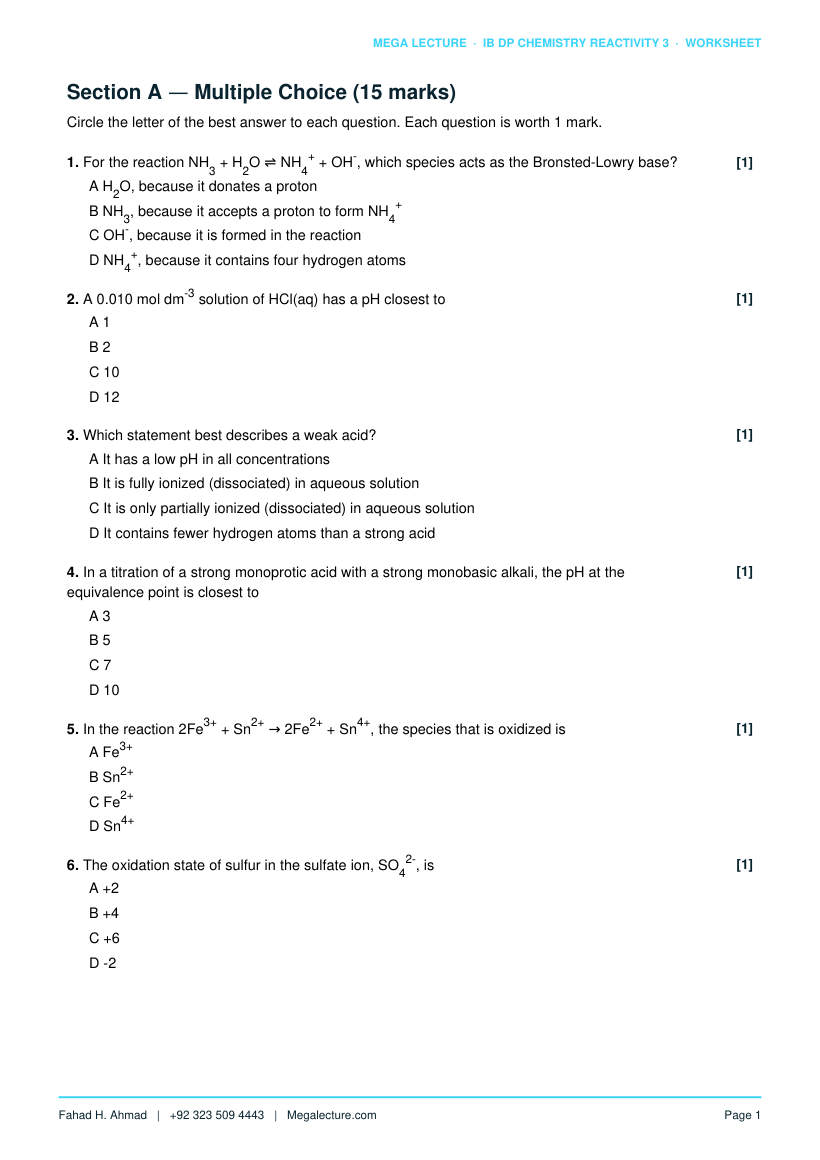
Section A — Multiple Choice (15 marks)
Circle the letter of the best answer to each question. Each question is worth 1 mark.
- For the reaction NH3 + H2O ⇌ NH4 + + OH-, which species acts as the Bronsted-Lowry base? [1]
A H2O, because it donates a proton
B NH3, because it accepts a proton to form NH4
+
C OH-, because it is formed in the reaction
D NH4
+, because it contains four hydrogen atoms
- A 0.010 mol dm-3 solution of HCl(aq) has a pH closest to [1]
A 1
B 2
C 10
D 12
- Which statement best describes a weak acid? [1]
A It has a low pH in all concentrations
B It is fully ionized (dissociated) in aqueous solution
C It is only partially ionized (dissociated) in aqueous solution
D It contains fewer hydrogen atoms than a strong acid
- In a titration of a strong monoprotic acid with a strong monobasic alkali, the pH at the equivalence point is closest to
[1]
A 3
B 5
C 7
D 10
- In the reaction 2Fe3+ + Sn2+ → 2Fe2+ + Sn4+, the species that is oxidized is [1]
A Fe3+
B Sn2+
C Fe2+
D Sn4+
- The oxidation state of sulfur in the sulfate ion, SO4 2-, is [1]
A +2
B +4
C +6
D -2
- Given the standard electrode potentials Mg2+/Mg = −2.37 V, Zn2+/Zn = −0.76 V, Cu2+/Cu = +0.34 V, and Ag+/Ag = +0.80 V, the strongest oxidizing agent is
[1]
A Mg2+
B Zn2+
C Cu2+
D Ag+
- A voltaic (galvanic) cell operates by converting [1]
A electrical energy into chemical energy
B chemical energy into electrical energy
C thermal energy into chemical energy
D electrical energy into thermal energy only
- The initiation step of the free-radical substitution of methane by chlorine requires [1]
A heat energy only, to break a C-H bond
B UV (or visible) light, to homolytically break the Cl-Cl bond
C a strong acid catalyst
D the presence of excess methane
- Homolytic fission of a covalent bond produces [1]
A two oppositely charged ions
B two neutral free radicals, each with one unpaired electron
C one cation and one free radical
D no change in the number of unpaired electrons
- The propagation steps of a free-radical substitution reaction are characterized by [1]
A two radicals combining to form a stable molecule
B a radical reacting with a stable molecule to generate a new radical and a product, sustaining the chain
C the complete consumption of all radicals present
D a decrease in the total number of radicals at each step
- The reaction of a primary halogenoalkane with aqueous OH- typically proceeds by which mechanism?
[1]
A SN1 (unimolecular nucleophilic substitution)
B SN2 (bimolecular nucleophilic substitution)
C electrophilic addition
D free-radical substitution
- In the electrophilic addition of Br2 to ethene, the Br2 molecule acts as [1]
A a nucleophile
B an electrophile, due to an induced dipole as it approaches the π bond
C a Bronsted-Lowry acid
D a free radical
- In the electrophilic addition of HBr to an alkene, the reaction proceeds via an intermediate that is a
[1]
A free radical
B carbocation
C carbanion
D cyclic ether
- A nucleophile is best described as a species that [1]
A accepts a pair of electrons to form a new covalent bond
B donates a pair of electrons to form a new covalent bond, and is attracted to electron-deficient centres
C always carries a full negative charge
D has an unpaired electron
Section B — Structured Questions (65 marks)
Answer all questions in the space provided. Working must be shown for full marks.
R3.1 Proton Transfer
Question 1 [7 marks]
25.0 cm3 of hydrochloric acid, HCl(aq), of unknown concentration was titrated with 0.100 mol dm-3 sodium hydroxide, NaOH(aq). The graph shows how the pH of the mixture changed as NaOH(aq) was added.
Titration curve: HCl(aq) titrated with 0.100 mol dm-3 NaOH(aq) (computed from the reacting quantities).
- Using the graph, state the volume of NaOH(aq) added at the equivalence point, and explain how you identified it.
[2]
- State the pH at the equivalence point for this titration, and explain why it has this value. [2]
- Given that the NaOH(aq) has a concentration of 0.100 mol dm-3, calculate the original concentration of the HCl(aq), which had an initial volume of 25.0 cm3.
[3]
Question 2 [6 marks]
Bronsted-Lowry theory describes acids and bases in terms of proton transfer.
- Define a Bronsted-Lowry acid and a Bronsted-Lowry base. [2]
- For the reaction NH3 + H2O ⇌ NH4
+ + OH-, identify the two conjugate acid-base pairs. [2]
- Explain why water can act as either an acid or a base, giving a suitable equation for each role. [2]
Question 3 [7 marks]
The bar chart compares the pH of two 0.100 mol dm-3 acid solutions at 25°C.
pH of two 0.100 mol dm-3 acids (computed from the given Ka of ethanoic acid).
- Using the graph, identify which acid is the strong acid, and explain your reasoning. [2]
- Explain, in terms of the degree of dissociation, why the weak acid has a higher pH than the strong acid at the same concentration.
[2]
- Calculate the [H+] corresponding to the pH of the weak acid, and hence show that only a small percentage of the acid molecules have dissociated.
[3]
R3.2 Electron Transfer
Question 4 [6 marks]
Oxidation and reduction can be defined and tracked using oxidation states.
- Define oxidation and reduction in terms of electron transfer. [2]
- Deduce the oxidation state of chromium in the dichromate ion, Cr2O7
2-. Show your working. [2]
- For the reaction Zn(s) + Cu2+(aq) → Zn2+(aq) + Cu(s), identify the species oxidized and the species reduced, and state the oxidation state change for each.
[2]
Question 5 [7 marks]
The graph shows standard electrode potentials, E°, for a series of half-reactions (data booklet values).
Standard electrode potentials, E° (data booklet values).
- Using the graph, identify the strongest reducing agent among the metals shown, and explain your reasoning.
[2]
- Predict, with a reason, whether a reaction would occur if solid zinc were added to aqueous copper(II) sulfate.
[2]
- Calculate the standard cell potential, E°cell, for a voltaic cell constructed from the Zn2+/Zn and Cu2+/Cu half-cells, and give the half-equation for the spontaneous cell reaction.
[3]
Question 6 [6 marks]
Redox reactions can be balanced by combining half-equations.
- Construct the balanced half-equation for the reduction of MnO4
- to Mn2+ in acidic solution. [3]
- Combine this with the half-equation Fe2+ → Fe3+ + e- to construct the overall balanced ionic equation for the reaction between acidified MnO4
- and Fe2+.
[3]
R3.3 Radical Substitution
Question 7 [7 marks]
The graph shows the bond enthalpy of the X-X bond for four halogens (data booklet values).
X-X bond enthalpies for the halogens (data booklet values).
- Using the graph, identify which halogen molecule requires the least energy to undergo homolytic fission (bond breaking).
[2]
- Write an equation for the initiation step of the reaction between methane and chlorine, and state the type of bond fission involved.
[2]
- Outline, with equations, the propagation steps that occur after initiation, and explain why this is described as a chain reaction.
[3]
Question 8 [6 marks]
Free-radical substitution reactions eventually stop when radicals are removed from the system.
- Write equations for the three possible termination steps in the free-radical substitution of methane with chlorine.
[3]
- Explain why the free-radical substitution of methane commonly produces a mixture of products, including CH2Cl2, CHCl3 and CCl4, even when methane is in excess.
[3]
R3.4 Electron Pair Sharing
Question 9 [7 marks]
The bar chart shows the time taken for a precipitate to form when equal volumes of three halogenoalkanes are each treated with excess ethanolic silver nitrate solution (given data).
Time for AgX precipitate to appear with ethanolic AgNO3 (given data).
- Using the graph, identify which halogenoalkane reacts fastest, and state the trend in reactivity shown going down group 17.
[2]
- Explain, in terms of bond enthalpy, why this trend in reactivity is observed. [3]
- State the type of mechanism occurring in this reaction, and identify the nucleophile involved. [2]
Question 10 [6 marks]
Halogenoalkanes and alkenes undergo characteristic addition and substitution reactions.
- For the reaction between bromoethane and aqueous NaOH, write the overall equation, name the mechanism, and briefly describe it.
[3]
- For the reaction between ethene and HBr, write the equation, and state the type of intermediate formed.
[3]
