
IB Diploma · Chemistry · SL / HL · Reactivity 2: How Much, How Fast and How Far?
Reactivity 2.1 How Much? The Amount of Chemical Change
Opens inside this page. Prefer your own PDF app? Open the PDF.
Full text of Reactivity 2.1 How Much? The Amount of Chemical Change
IB DP CHEMISTRY Reactivity 2: How Much, How Fast and How Far? Reactivity 2.1 How Much? The Amount of Chemical Change
Revision Notes · Standard and Higher Level Fahad H. Ahmad
+92 323 509 4443 | Megalecture.com
Original notes prepared for the IB Diploma Programme Chemistry course (2025 syllabus)
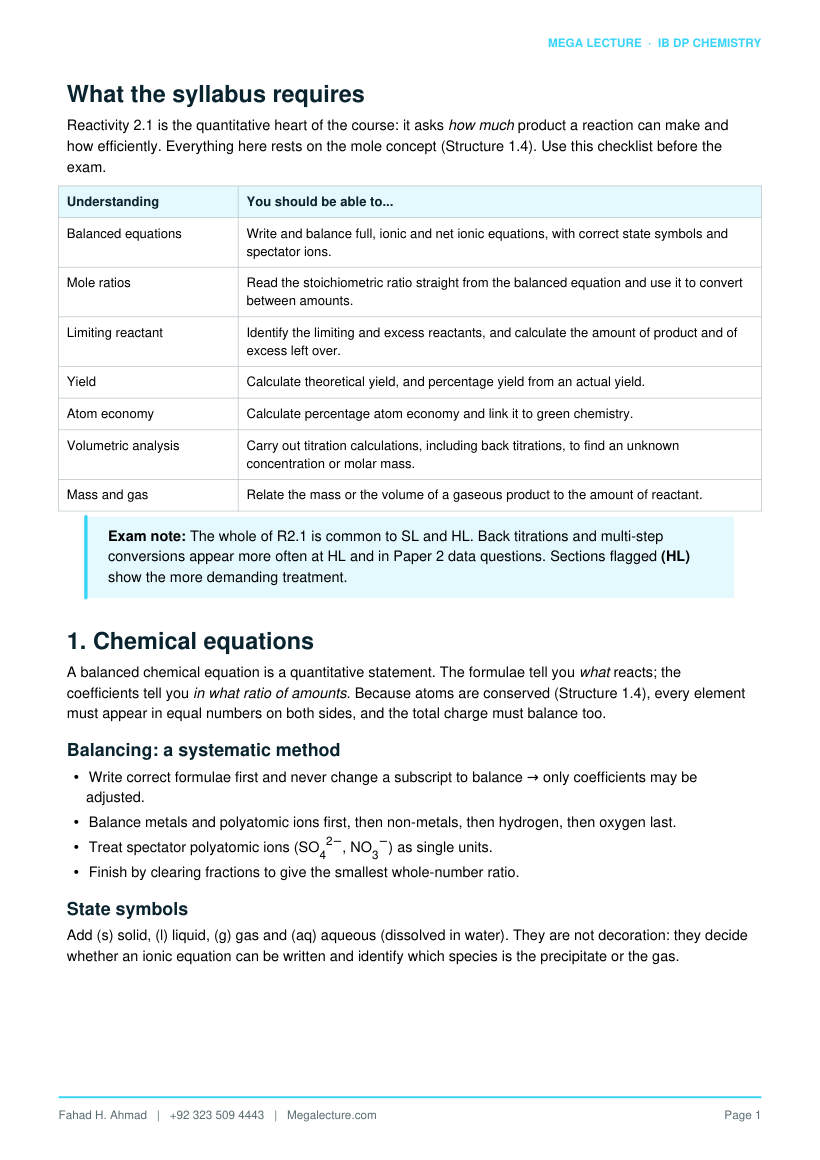
What the syllabus requires
Reactivity 2.1 is the quantitative heart of the course: it asks how much product a reaction can make and how efficiently. Everything here rests on the mole concept (Structure 1.4). Use this checklist before the exam.
Understanding You should be able to...
Balanced equations Write and balance full, ionic and net ionic equations, with correct state symbols and spectator ions.
Mole ratios Read the stoichiometric ratio straight from the balanced equation and use it to convert between amounts.
Limiting reactant Identify the limiting and excess reactants, and calculate the amount of product and of excess left over.
Yield Calculate theoretical yield, and percentage yield from an actual yield.
Atom economy Calculate percentage atom economy and link it to green chemistry.
Volumetric analysis Carry out titration calculations, including back titrations, to find an unknown concentration or molar mass.
Mass and gas Relate the mass or the volume of a gaseous product to the amount of reactant.
Exam note: The whole of R2.1 is common to SL and HL. Back titrations and multi-step conversions appear more often at HL and in Paper 2 data questions. Sections flagged (HL) show the more demanding treatment.
1. Chemical equations
A balanced chemical equation is a quantitative statement. The formulae tell you what reacts; the coefficients tell you in what ratio of amounts. Because atoms are conserved (Structure 1.4), every element must appear in equal numbers on both sides, and the total charge must balance too.
Balancing: a systematic method
- Write correct formulae first and never change a subscript to balance → only coefficients may be adjusted.
- Balance metals and polyatomic ions first, then non-metals, then hydrogen, then oxygen last.
- Treat spectator polyatomic ions (SO4 2−, NO3 −) as single units.
- Finish by clearing fractions to give the smallest whole-number ratio.
State symbols
Add (s) solid, (l) liquid, (g) gas and (aq) aqueous (dissolved in water). They are not decoration: they decide whether an ionic equation can be written and identify which species is the precipitate or the gas.
Worked example 1 − balancing a combustion equation
Balance the complete combustion of propane, C3H8.
Unbalanced: C3H8(g) + O2(g) → CO2(g) + H2O(l)
Balance C (3 → 3 CO2), then H (8 → 4 H2O). Oxygen on the right = (3×2) + (4×1) = 10, so 5 O2.
C3H8(g) + 5O2(g) → 3CO2(g) + 4H2O(l) Check: C 3=3, H 8=8, O 10=10.
Ionic and net ionic equations
When ionic compounds dissolve they dissociate into free ions. An ionic equation shows every aqueous species as separate ions. Ions that appear unchanged on both sides are spectator ions; cancelling them leaves the net ionic equation, which shows the chemical change that actually happens.
Worked example 2 − ionic and net ionic equations
Silver nitrate solution is mixed with sodium chloride solution; a white precipitate forms.
Full: AgNO3(aq) + NaCl(aq) → AgCl(s) + NaNO3(aq)
Ionic: Ag+(aq) + NO3
−(aq) + Na+(aq) + Cl−(aq) → AgCl(s) + Na+(aq) + NO3
−(aq)
Na+ and NO3
− are spectators. Net ionic:
Ag+(aq) + Cl−(aq) → AgCl(s) Charge balances: (+1) + (−1) = 0 on the left, 0 on the right.
2. Mole ratios from balanced equations
The coefficients in a balanced equation are the mole ratio (stoichiometric ratio) of the species. This single idea powers every calculation in this topic. The universal route for any quantitative problem is:
known quantity → moles of known → (× mole ratio) moles of wanted → wanted quantity
Recall the conversions that get you into and out of moles: n = m / M for mass, n = c×V for solutions, and n = V / Vm for gases (molar volume Vm = 22.7 dm3 mol−1 at STP in the 2025 data booklet).
Worked example 3 − using a mole ratio
In the Haber process, N2(g) + 3H2(g) ⇌ 2NH3(g). How many moles of hydrogen react with 0.50 mol of nitrogen, and how much ammonia forms?
Ratio N2 : H2 : NH3 = 1 : 3 : 2.
n(H2) = 0.50 × 3 = 1.5 mol. n(NH3) = 0.50 × 2 = 1.0 mol.
Watch the ratio: The mole ratio is a ratio of amounts, never of masses. Always convert masses (or volumes) to moles before applying it, then convert back at the end.
Reacting masses
The commonest version of this route converts a mass of reactant into a mass of product. The three steps are always the same: mass → moles (divide by M), apply the mole ratio, then moles → mass (multiply by M). Only the two molar masses and the ratio change from question to question.
Worked example 3b − mass of reactant to mass of product
What mass of aluminium oxide forms when 5.40 g of aluminium burns completely in oxygen? 4Al(s) + 3O2(g) → 2Al2O3(s). (Ar Al 27.0; M Al2O3 102.0) n(Al) = 5.40 / 27.0 = 0.200 mol.
Ratio Al : Al2O3 = 4 : 2 = 2 : 1, so n(Al2O3) = 0.200 / 2 = 0.100 mol.
mass = 0.100 × 102.0 = 10.2 g.
3. Limiting and excess reactants
Reactants are rarely mixed in exactly the stoichiometric ratio. The limiting reactant is the one that runs out first; it determines the maximum amount of product. The others are in excess and some is left over when the reaction stops.
How to find the limiting reactant
- Convert the amount of each reactant to moles.
- Divide each by its coefficient in the balanced equation.
- The smallest value is the limiting reactant. Base all product amounts on it.
- Excess remaining = initial moles − moles that reacted.
Worked example 4 − limiting reactant and excess
13.08 g of zinc (Ar 65.38) is added to 300 cm3 of 1.0 mol dm−3 hydrochloric acid. Zn(s) + 2HCl(aq) → ZnCl2(aq) + H2(g).
n(Zn) = 13.08 / 65.38 = 0.20 mol. n(HCl) = 1.0 × (300/1000) = 0.30 mol.
Divide by coefficients: Zn → 0.20/1 = 0.20; HCl → 0.30/2 = 0.15. HCl is smaller, so HCl is limiting.
n(H2) = 0.30 × (1/2) = 0.15 mol (volume at STP = 0.15 × 22.7 = 3.4 dm3).
Zn reacting = 0.30 × (1/2) = 0.15 mol, so Zn left over = 0.20 − 0.15 = 0.05 mol = 3.3 g.
Worked example 5 − limiting reactant from two amounts
2.0 mol of N2 is mixed with 3.0 mol of H2: N2 + 3H2 → 2NH3. Find the amount of NH3 and the excess remaining.
Divide by coefficients: N2 → 2.0/1 = 2.0; H2 → 3.0/3 = 1.0. H2 is limiting.
n(NH3) = 3.0 × (2/3) = 2.0 mol.
N2 reacting = 3.0 × (1/3) = 1.0 mol, so N2 left = 2.0 − 1.0 = 1.0 mol.
Worked example 5b − limiting reactant giving mass of product
8.10 g of zinc oxide (M 81.4) is warmed with 14.7 g of sulfuric acid (M 98.1): ZnO + H2SO4 → ZnSO4 + H2O. Find the limiting reactant and the mass of ZnSO4 formed. (M ZnSO4 161.5) n(ZnO) = 8.10 / 81.4 = 0.0995 mol. n(H2SO4) = 14.7 / 98.1 = 0.150 mol.
Ratio is 1 : 1, so ZnO (0.0995 mol) is the smaller amount and is limiting; acid is in excess.
n(ZnSO4) = 0.0995 mol; mass = 0.0995 × 161.5 = 16.1 g.
H2SO4 left over = 0.150 − 0.0995 = 0.0505 mol.
Common error: Do not decide the limiting reactant just from which mass is smaller. You must divide moles by the coefficient. A reactant present in the larger amount can still be limiting if its coefficient is large.
Figure. Reaction inventory for N2 + 3H2 → 2NH3 starting from 2.0 mol N2 and 3.0 mol H2. H2 runs out first (limiting), giving 2.0 mol NH3 and leaving 1.0 mol N2 in excess.
4. Yield and atom economy
Two different efficiency measures are examined. Percentage yield asks how much of the possible product you actually obtained; atom economy asks how much of the reactant mass ends up in the useful product.
Theoretical, actual and percentage yield
The theoretical yield is the maximum mass calculable from the limiting reactant, assuming the reaction goes to completion. The actual yield is what is measured. Real yields are lower because reactions may be incomplete or reversible, side reactions occur, and product is lost on filtering, transfer and purification.
percentage yield = (actual yield / theoretical yield) × 100%
Worked example 6 − percentage yield
25.0 g of calcium carbonate is heated: CaCO3(s) → CaO(s) + CO2(g). 12.0 g of calcium oxide is obtained. Find the percentage yield. (M: CaCO3 100.1, CaO 56.1) n(CaCO3) = 25.0 / 100.1 = 0.2498 mol, so n(CaO) theoretical = 0.2498 mol.
Theoretical mass CaO = 0.2498 × 56.1 = 14.01 g.
Percentage yield = (12.0 / 14.01) × 100 = 85.6%.
Atom economy
Atom economy measures the proportion of reactant atoms that become useful product. A high atom economy means less waste, which is a central goal of green chemistry.
% atom economy = (Mr of desired product / total Mr of all products) × 100%
Addition and combination reactions (A + B → C) have 100% atom economy because there is only one product. Reactions that also make a by-product have a lower atom economy even if the percentage yield is high → the two measures are independent.
Worked example 7 − atom economy
For CaCO3 → CaO + CO2, find the atom economy for making CaO. (M: CaO 56.1, CO2 44.0)
Total product mass (per mole) = 56.1 + 44.0 = 100.1.
Atom economy = (56.1 / 100.1) × 100 = 56.0% → the CO2 is discarded, so almost half the mass is 'wasted' atoms.
Worked example 7b − working backwards from percentage yield
A reaction that can theoretically give 6.40 g of product proceeds with a 75.0% yield. What actual mass is obtained, and what mass would be lost?
actual = (% yield / 100) × theoretical = 0.750 × 6.40 = 4.80 g.
mass 'lost' to incomplete reaction and handling = 6.40 − 4.80 = 1.60 g.
Figure. Two independent efficiency measures for CaCO3 → CaO + CO2: percentage yield = actual/theoretical × 100 = 85.6%, and atom economy = Mr(CaO) / total Mr(products) × 100 = 56.0%.
Comparing the two measures
It is worth being clear how percentage yield and atom economy differ, because exam questions often ask you to distinguish them.
Feature Percentage yield Atom economy
What it compares actual product vs maximum possible useful product mass vs total reactant mass
Depends on reaction conditions, losses, side reactions the balanced equation only
Improved by optimising conditions, reducing losses choosing a route with fewer or no by-products
Can it be 100%? only for a complete, loss-free reaction only when there is a single product
Green chemistry link: Designing a synthesis with high atom economy reduces raw material use and waste treatment. It is a property of the balanced equation itself, fixed before any practical work, whereas percentage yield depends on the conditions.
5. Volumetric analysis (titrations)
A titration measures the volume of one solution that exactly reacts with a known volume of another, so that an unknown concentration or molar mass can be found. In an acid−base titration an indicator (or a pH meter) marks the equivalence point where the acid and base have reacted in their stoichiometric ratio.
Standard solutions
A titration needs one solution of accurately known concentration, called a standard solution. It is prepared by dissolving a weighed mass of a pure solid (a primary standard) and making the solution up to a precise volume in a volumetric flask. Its concentration follows directly from c = n / V. Concentration is usually quoted in mol dm−3 (amount per unit volume); it can also be given in g dm−3, related by c(g dm−3) = c(mol dm−3) × M.
Dilution
A concentrated stock solution is often diluted to a working concentration. Because the amount of solute is unchanged on adding water, c1V1 = c2V2. Rearrange for whichever quantity is unknown, keeping the volume units consistent on both sides.
Worked example 8b − preparing a dilute solution
What volume of 2.00 mol dm−3 HCl is needed to make 250 cm3 of 0.150 mol dm−3 HCl?
c1V1 = c2V2: V1 = c2V2 / c1 = (0.150 × 250) / 2.00 = 18.75 cm3.
Measure 18.8 cm3 of stock and make up to 250 cm3 in a volumetric flask.
The titration calculation route
- From the standard (known) solution: n = c × V, with V in dm3.
- Use the mole ratio from the balanced equation to get moles of the unknown.
- Divide by the volume (or mass) of the unknown to get its concentration (or Mr).
Unit trap: Convert cm3 to dm3 by dividing by 1000 (25.0 cm3 = 0.0250 dm3). Forgetting this is the single most common titration mistake and shifts every answer by a factor of 1000.
Worked example 8 − finding an unknown concentration
25.0 cm3 of sodium hydroxide is neutralised by 22.40 cm3 of 0.100 mol dm−3 hydrochloric acid. NaOH + HCl → NaCl + H2O. Find [NaOH].
n(HCl) = 0.100 × (22.40/1000) = 2.240 ×10⁻³ mol.
Ratio 1:1, so n(NaOH) = 2.240 ×10⁻³ mol.
[NaOH] = (2.240 ×10⁻³) / (25.0/1000) = 0.0896 mol dm−3.
Worked example 9 − finding a molar mass
1.50 g of a solid diprotic acid H2X is dissolved and made up to 250 cm3. A 25.0 cm3 portion needs 24.0 cm3 of 0.100 mol dm−3 NaOH. H2X + 2NaOH → Na2X + 2H2O. Find Mr of H2X.
n(NaOH) = 0.100 × (24.0/1000) = 2.40 ×10⁻³ mol.
n(H2X in 25.0 cm3) = 2.40 ×10⁻³ / 2 = 1.20 ×10⁻³ mol.
In the whole 250 cm3: 1.20 ×10−3 × 10 = 0.0120 mol.
Mr = mass / moles = 1.50 / 0.0120 = 125 g mol−1.
Back titrations
A back titration is used when the sample is insoluble, impure, slow to react, or when a direct end point is hard to see. A known, excess amount of reagent is added to react fully with the sample; the unreacted excess is then titrated. Subtracting the excess from the original amount gives the amount that reacted with the sample.
amount reacted with sample = (initial moles added) − (moles of excess found)
A worked back titration is given in Section 7. Direct titrations can also measure the purity of a soluble sample, as in the next example.
Worked example 9b − purity from a direct titration
A 2.65 g sample of impure sodium carbonate is dissolved and made up to 250 cm3. A 25.0 cm3 portion needs 20.0 cm3 of 0.200 mol dm−3 HCl. Na2CO3 + 2HCl → 2NaCl + H2O + CO2. Find the percentage purity. (M Na2CO3 106.0) n(HCl) = 0.200 × (20.0/1000) = 4.00 ×10⁻³ mol.
Ratio Na2CO3 : HCl = 1 : 2, so n(Na2CO3 in 25.0 cm3) = 2.00 ×10⁻³ mol.
In 250 cm3: 2.00 ×10−3 × 10 = 0.0200 mol; mass = 0.0200 × 106.0 = 2.12 g.
% purity = (2.12 / 2.65) × 100 = 80.0%.
6. Reacting masses and gas volumes
The same mole-ratio route links the amount of a reactant to the mass or the gas volume of a product. In gravimetric analysis a product is isolated (often as a precipitate) and weighed; in gas-collection experiments the volume of gas evolved is measured, usually over water or in a gas syringe.
Worked example 10 − volume of gas produced
0.243 g of magnesium (Ar 24.3) reacts with excess hydrochloric acid. Mg(s) + 2HCl(aq) → MgCl2(aq) + H2(g). Find the volume of H2 at STP.
n(Mg) = 0.243 / 24.3 = 0.0100 mol.
Ratio Mg : H2 = 1 : 1, so n(H2) = 0.0100 mol.
V(H2) = n × Vm = 0.0100 × 22.7 = 0.227 dm3 = 227 cm3 at STP.
Worked example 11 − mass of precipitate (gravimetric)
Excess silver nitrate is added to a solution containing 0.0250 mol of sodium chloride. NaCl(aq) + AgNO3(aq) → AgCl(s) + NaNO3(aq). Find the mass of precipitate. (M: AgCl 143.3)
Ratio NaCl : AgCl = 1 : 1, so n(AgCl) = 0.0250 mol.
mass = n × M = 0.0250 × 143.3 = 3.58 g.
Figure. Mass of ZnSO4 formed is proportional to moles of the limiting reactant ZnO: a straight line through the origin of slope
M(ZnSO4) = 161.5 g mol−1. At 0.0995 mol the mass is 16.1 g.
Combining limiting reactant with gas volume
Many data-based questions layer two ideas: first decide the limiting reactant, then use only its amount to find the gas volume or the mass of product. Never base the product on the reactant in excess.
Worked example 11b − limiting reactant then gas volume
0.120 g of magnesium (Ar 24.3) is added to 20.0 cm3 of 0.300 mol dm−3 HCl. Mg + 2HCl → MgCl2 + H2. What volume of H2 forms at STP?
n(Mg) = 0.120 / 24.3 = 4.94 ×10⁻³ mol. n(HCl) = 0.300 × (20.0/1000) = 6.00 ×10⁻³ mol.
Divide by coefficients: Mg 4.94×10⁻³/1 = 4.94×10⁻³; HCl 6.00×10⁻³/2 = 3.00×10⁻³. HCl is limiting.
n(H2) = 6.00×10⁻³ / 2 = 3.00×10⁻³ mol.
V = 3.00×10−3 × 22.7 = 0.0681 dm3 = 68.1 cm3.
7. Multi-step and back-titration calculations (HL)
At HL the same tools are combined into longer chains: a back titration with several conversions, or two reactions run in sequence where the product of the first is the reactant of the second. Work in moles throughout and only convert to mass or volume at the very end.
Worked example 12 (HL) − back titration of impure limestone
A 2.50 g sample of crushed eggshell (mostly CaCO3) is added to 50.0 cm3 of 1.00 mol dm−3 HCl (an excess). The excess acid needs 24.0 cm3 of 0.500 mol dm−3 NaOH to neutralise. Find the percentage of CaCO3 in the shell.
Reactions: CaCO3 + 2HCl → CaCl2 + H2O + CO2; HCl + NaOH → NaCl + H2O.
Total HCl added = 1.00 × (50.0/1000) = 0.0500 mol.
Excess HCl = n(NaOH) = 0.500 × (24.0/1000) = 0.0120 mol.
HCl that reacted with the shell = 0.0500 − 0.0120 = 0.0380 mol.
n(CaCO3) = 0.0380 / 2 = 0.0190 mol; mass = 0.0190 × 100.1 = 1.902 g.
% CaCO3 = (1.902 / 2.50) × 100 = 76.1%.
Worked example 13 (HL) − two reactions in sequence
Ammonia is made and then catalytically oxidised (the first stage of nitric acid manufacture): N2 + 3H2 → 2NH3, then 4NH3 + 5O2 → 4NO + 6H2O. Starting from 84 g of N2 with excess H2 and O2, and assuming complete conversion, find the mass of NO. (M: N2 28.0, NO 30.0) n(N2) = 84 / 28.0 = 3.0 mol → n(NH3) = 3.0 × 2 = 6.0 mol.
Ratio NH3 : NO = 4 : 4 = 1 : 1, so n(NO) = 6.0 mol.
mass(NO) = 6.0 × 30.0 = 180 g.
HL tip: In a long chain, keep unrounded intermediate values in your calculator and round only the final answer. Rounding at each step accumulates error and can cost the final accuracy mark.
8. Common pitfalls
- Balancing by changing a subscript instead of a coefficient → this changes the substance itself.
- Choosing the limiting reactant from mass or moles alone, without dividing by the coefficient.
- Leaving volumes in cm3 in n = c×V → always convert to dm3 first.
- Applying the mole ratio to masses or volumes directly instead of to moles.
- Forgetting the 2 in the ratio for diprotic acids (H2SO4) or dibasic hydroxides (Ca(OH)2).
- Confusing percentage yield (depends on conditions) with atom economy (fixed by the equation).
- Using 24.0 dm3 mol−1 (old room-temperature value); the 2025 booklet uses 22.7 dm3 mol−1 at STP.
- Rounding intermediate answers too early in multi-step problems.
9. Quick reference
Quantity Relationship
Moles from mass n=m/M
Moles in solution n = c × V (V in dm3)
Moles of gas (STP) n = V / 22.7 (V in dm3) cm3 → dm3 divide by 1000
Percentage yield (actual / theoretical) × 100%
Atom economy (Mr desired product / Mr all products) × 100%
Limiting reactant smallest value of (moles / coefficient)
Back titration reacted = initial excess reagent − titrated excess
10. Test yourself
Attempt all ten without notes, then check against the full worked answers.
- Balance: Fe + O2 → Fe2O3.
- Write the net ionic equation for barium chloride solution mixed with sodium sulfate solution.
- How many moles of O2 are needed to burn 0.25 mol of butane? 2C4H10 + 13O2 → 8CO2 + 10H2O.
- 0.20 mol N2 is mixed with 0.50 mol H2. Identify the limiting reactant, the moles of NH3, and the excess remaining.
- 8.00 g NaOH reacts with 4.90 g H2SO4: 2NaOH + H2SO4 → Na2SO4 + 2H2O. Which is limiting, and what mass of Na2SO4 forms? (M: NaOH 40.0, H2SO4 98.1, Na2SO4 142.0)
- 10.0 g of N2 with excess H2 gives 8.50 g of NH3. Find the percentage yield. (M: N2 28.0, NH3 17.0)
- Iron is extracted by Fe2O3 + 3CO → 2Fe + 3CO2. Find the atom economy for iron. (M: Fe 55.8, CO2 44.0)
- 20.0 cm3 of H2SO4 is neutralised by 25.0 cm3 of 0.200 mol dm−3 KOH. H2SO4 + 2KOH → K2SO4 + 2H2O. Find [H2SO4].
- What volume of CO2 at STP forms when 5.00 g of CaCO3 decomposes fully? (M: CaCO3 100.1)
- (HL) A 2.00 g sample of impure Na2CO3 is dissolved and reacted with 50.0 cm3 of 1.00 mol dm−3 HCl (excess). Na2CO3 + 2HCl → 2NaCl + H2O + CO2. The excess HCl needs 32.0 cm3 of 0.500 mol dm−3
NaOH. Find the % of Na2CO3. (M: Na2CO3 106.0)
Answers
- 4Fe + 3O2 → 2Fe2O3 (Fe 4=4, O 6=6).
- Ba2+(aq) + SO4 2−(aq) → BaSO4(s); Na+ and Cl− are spectators.
- Ratio C4H10 : O2 = 2 : 13, so n(O2) = 0.25 × (13/2) = 1.6 mol.
- Divide by coefficients: N2 0.20/1 = 0.20; H2 0.50/3 = 0.167. H2 is limiting. n(NH3) = 0.50 × (2/3) = 0.33 mol. N2 used = 0.50 × (1/3) = 0.167 mol, so N2 excess = 0.20 − 0.167 = 0.033 mol.
- n(NaOH) = 8.00/40.0 = 0.200 mol; n(H2SO4) = 4.90/98.1 = 0.0500 mol. Divide by coefficients: NaOH 0.200/2 = 0.100; acid 0.0500/1 = 0.0500. H2SO4 is limiting. n(Na2SO4) = 0.0500 mol; mass = 0.0500 × 142.0 = 7.10 g.
- n(N2) = 10.0/28.0 = 0.357 mol → NH3 theoretical = 0.714 mol × 17.0 = 12.14 g. % yield = (8.50/12.14) × 100 = 70.0%.
- Products per equation: 2 Fe (2×55.8 = 111.6) and 3 CO2 (3×44.0 = 132.0). Atom economy = 111.6 / (111.6 + 132.0) × 100 = 45.8%.
- n(KOH) = 0.200 × (25.0/1000) = 5.00 ×10⁻³ mol. Ratio KOH : H2SO4 = 2 : 1, so n(acid) = 2.50 ×10⁻³ mol. [H2SO4] = 2.50 ×10⁻³ / (20.0/1000) = 0.125 mol dm−3.
- n(CaCO3) = 5.00/100.1 = 0.04995 mol = n(CO2). V = 0.04995 × 22.7 = 1.13 dm3 (1130 cm3).
- Total HCl = 1.00 × (50.0/1000) = 0.0500 mol. Excess HCl = n(NaOH) = 0.500 × (32.0/1000) = 0.0160 mol. Reacted with Na2CO3 = 0.0500 − 0.0160 = 0.0340 mol. n(Na2CO3) = 0.0340/2 = 0.0170 mol; mass = 0.0170 × 106.0 = 1.802 g. % = (1.802/2.00) × 100 = 90.1%.
