
IB Diploma · Chemistry · SL / HL · Reactivity 2: How Much, How Fast and How Far?
Reactivity 2.3 How Far? The Extent of Chemical Change
Need more than one subject? All-notes pass: unlimited downloads of every note for a year: unlimited downloads of every note on the site, PKR 999 a year. All packs and courses.
Opens inside this page. Prefer your own PDF app? Open the PDF.
Chemistry batch classes: coming soon. Small live classes at a lower fee than one-to-one. Join the waiting list
Check yourself
5 quick questions on Reactivity 2: How much, how fast and how far?
Tap an answer to see if you are right, and why. Free, no sign-up.
Start the free testWas this note useful?
Full text of Reactivity 2.3 How Far? The Extent of Chemical Change
IB DP CHEMISTRY Reactivity 2: How Much, How Fast and How Far? Reactivity 2.3 How Far? The Extent of Chemical Change
Revision Notes · Standard and Higher Level Fahad H. Ahmad
Original notes prepared for the IB Diploma Programme Chemistry course (2025 syllabus)
Free notes, practice tests and live classes Back to megalecture.com
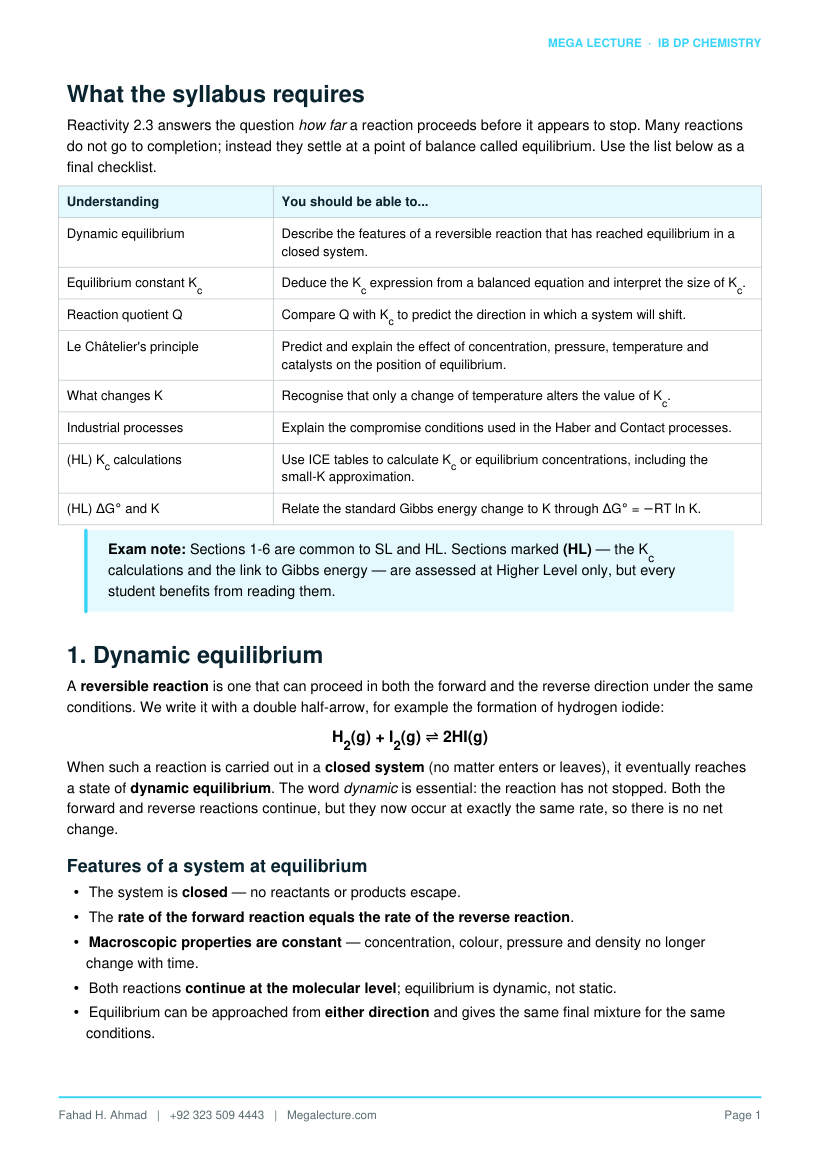
What the syllabus requires
Reactivity 2.3 answers the question how far a reaction proceeds before it appears to stop. Many reactions do not go to completion; instead they settle at a point of balance called equilibrium. Use the list below as a final checklist.
Understanding You should be able to...
Dynamic equilibrium Describe the features of a reversible reaction that has reached equilibrium in a closed system.
Equilibrium constant Kc Deduce the Kc expression from a balanced equation and interpret the size of Kc.
Reaction quotient Q Compare Q with Kc to predict the direction in which a system will shift.
Le Châtelier's principle Predict and explain the effect of concentration, pressure, temperature and catalysts on the position of equilibrium.
What changes K Recognise that only a change of temperature alters the value of Kc.
Industrial processes Explain the compromise conditions used in the Haber and Contact processes.
(HL) Kc calculations Use ICE tables to calculate Kc or equilibrium concentrations, including the small-K approximation.
(HL) ΔG° and K Relate the standard Gibbs energy change to K through ΔG° = −RT ln K.
Exam note: Sections 1-6 are common to SL and HL. Sections marked (HL) — the Kc calculations and the link to Gibbs energy — are assessed at Higher Level only, but every student benefits from reading them.
1. Dynamic equilibrium
A reversible reaction is one that can proceed in both the forward and the reverse direction under the same conditions. We write it with a double half-arrow, for example the formation of hydrogen iodide:
H2(g) + I2(g) ⇌ 2HI(g)
When such a reaction is carried out in a closed system (no matter enters or leaves), it eventually reaches a state of dynamic equilibrium. The word dynamic is essential: the reaction has not stopped. Both the forward and reverse reactions continue, but they now occur at exactly the same rate, so there is no net change.
Features of a system at equilibrium
- The system is closed — no reactants or products escape.
- The rate of the forward reaction equals the rate of the reverse reaction.
- Macroscopic properties are constant — concentration, colour, pressure and density no longer change with time.
- Both reactions continue at the molecular level; equilibrium is dynamic, not static.
- Equilibrium can be approached from either direction and gives the same final mixture for the same conditions.
Physical and chemical equilibria
Equilibrium is not confined to chemical reactions. A physical equilibrium involves a change of state or dissolving, with no new substance formed. In a sealed bottle of water, for example, molecules evaporate and condense at equal rates:
H2O(l) ⇌ H2O(g)
The dissolving of a sparingly soluble salt, or of carbon dioxide in a fizzy drink, is also a physical equilibrium. A chemical equilibrium involves the making and breaking of bonds, as in the Haber process or the dissociation of a weak acid. In both cases the same underlying idea applies: two opposing processes running at equal rates.
How the system reaches equilibrium
Picture starting with only reactants. At the very beginning the forward rate is at its maximum (reactant concentration is highest) while the reverse rate is zero (no product yet). As the reaction proceeds, reactants are used up so the forward rate falls, and product builds up so the reverse rate rises. Equilibrium is reached at the instant the two rates become equal — from then on the concentrations stay constant.
Stage Forward rate Reverse rate Concentrations
Start (reactants only) Maximum Zero Reactants high, products zero
During approach Falling Rising Reactants → down, products → up
At equilibrium Constant Equal to forward All constant (not necessarily equal)
On a graph of rate against time the two curves meet and then run together horizontally; on a graph of concentration against time the curves level off to constant plateau values. The plateau does not mean the reaction has stopped — it means the opposing rates have become equal.
Key phrase: If asked to define equilibrium, always include three ideas — closed system, equal forward and reverse rates, and constant macroscopic properties. Dropping the word “dynamic” is a common way to lose a mark.
Figure 1. Approach to equilibrium for H2 + I2 ⇌ 2HI. Left: the forward rate falls and the reverse rate rises until they are equal (dashed line). Right: the concentrations level off at constant, non−zero values, [HI] = 0.80 and [H2] = [I2] = 0.10 mol dm−3 (Kc
= 64).
2. The equilibrium constant, Kc
Although the concentrations of reactants and products are constant at equilibrium, they are not usually equal to one another. For a given temperature, however, a fixed mathematical relationship always holds between them. This is captured by the equilibrium constant, Kc.
Writing the expression
For the general reaction aA + bB ⇌ cC + dD the equilibrium constant in terms of concentration is
Kc = [C]c[D]d / [A]a[B]b
The rules are simple and worth memorising:
- Products (right-hand side) go on top; reactants go on the bottom.
- Each concentration is raised to a power equal to its coefficient in the balanced equation.
- Square brackets [ ] mean “equilibrium concentration in mol dm−3”.
- Pure solids and pure liquids are omitted — their concentration (density) is effectively constant and is absorbed into Kc.
So for the decomposition of calcium carbonate, only the gas appears:
CaCO3(s) ⇌ CaO(s) + CO2(g) Kc = [CO2]
For gaseous equilibria we may instead use partial pressures, giving Kp, written the same way but with the equilibrium partial pressure of each gas in place of its concentration. Pure solids and liquids are again left out.
The meaning of the magnitude of K
The size of K is a direct measure of how far a reaction proceeds — of the extent of reaction — at a given temperature.
Value of K Interpretation Position of equilibrium
K > 1 (large) Numerator dominates: products are favoured. A very large K (e.g. 1010) means the reaction is essentially complete.
Lies to the right (products)
K ≈ 1 Comparable amounts of reactants and products present at equilibrium.
Roughly central
K < 1 (small) Denominator dominates: reactants are favoured. A very small K (e.g. 10−10) means little reaction occurs.
Lies to the left (reactants)
Important: K tells you how far a reaction goes, not how fast. A reaction can have a huge K yet be immeasurably slow (rate is Reactivity 2.2). Extent and rate are separate ideas.
Worked example 1 — writing Kc expressions
Write the Kc expression for each equilibrium.
- N2(g) + 3H2(g) ⇌ 2NH3(g)
Kc = [NH3]2 / ([N2][H2]3) — note the power 3 on H2 from its coefficient.
- CH3COOH(aq) ⇌ CH3COO−(aq) + H+(aq)
Kc = [CH3COO−][H+] / [CH3COOH]. (This particular Kc is the acid dissociation constant, Ka.)
- C(s) + CO2(g) ⇌ 2CO(g)
Kc = [CO]2 / [CO2]. The pure solid carbon is omitted.
3. The reaction quotient, Q
The reaction quotient, Q, has exactly the same algebraic form as Kc, but it is calculated using the concentrations present at any moment, not necessarily at equilibrium. Comparing Q with K tells us which way a reaction must shift to reach equilibrium.
Comparison Meaning Which way does the reaction go?
Q < K Too few products relative to equilibrium Net forward reaction (→ products) until Q rises to K
Q = K System is already at equilibrium No net change
Q > K Too many products relative to equilibrium Net reverse reaction (→ reactants) until Q falls to K
A helpful mental picture: the reaction always shifts in the direction that brings Q closer to K. If you disturb an equilibrium (Section 4), the disturbance changes Q away from K, and the system responds by moving to restore Q = K.
Worked example 2 — predicting direction with Q
For H2(g) + I2(g) ⇌ 2HI(g), Kc = 64. A mixture is prepared with [H2] = 0.30, [I2] = 0.30 and [HI] = 0.60 mol dm−3. In which direction does the reaction proceed?
Q = [HI]2 / ([H2][I2]) = (0.60)2 / (0.30 × 0.30) = 0.36 / 0.09 = 4.0.
Q (4.0) < K (64), so there are too few products. The reaction proceeds forward (→ more HI) until Q rises to 64.
4. Le Châtelier's principle
Le Châtelier's principle states that if a system at equilibrium is subjected to a change, the position of equilibrium shifts in the direction that opposes (partially counteracts) that change. It lets us predict the direction of a shift without any calculation. We illustrate each factor with the exothermic gas-phase equilibrium
N2(g) + 3H2(g) ⇌ 2NH3(g) ΔH = −92 kJ mol−1
Changing a concentration
Increasing the concentration of a reactant makes Q < K, so the system shifts forward to consume the added reactant and make more product. Removing a product has the same effect. Conversely, adding product or removing reactant shifts the equilibrium backward. Continuously removing a product is a common industrial trick to keep pulling a reaction forward.
Changing pressure or volume (gases)
Pressure matters only when the number of moles of gas differs between the two sides. Increasing the pressure (by decreasing the volume) shifts the equilibrium towards the side with fewer moles of gas, which reduces the pressure again. In the ammonia equilibrium there are 4 mol of gas on the left and 2 mol on the right, so higher pressure favours the forward reaction and more ammonia. If the moles of gas are equal on both sides, pressure has no effect on the position.
Changing temperature
Temperature is the one factor that shifts equilibrium and changes K. Treat heat as a “reactant” or “product” using the sign of ΔH:
- For an exothermic forward reaction (ΔH negative), heat is released. Raising the temperature shifts equilibrium backward (endothermic direction), lowering the yield and decreasing K.
- Lowering the temperature of an exothermic reaction shifts it forward, raising the yield and increasing K.
- For an endothermic forward reaction (ΔH positive), the effects are reversed: heating increases yield and K.
Adding a catalyst
A catalyst speeds up the forward and reverse reactions equally. It therefore has no effect on the position of equilibrium or on the value of K; it only allows equilibrium to be reached more quickly. This is why catalysts are vital industrially — they save time and energy without changing the maximum possible yield.
Change imposed Direction of shift (N2 + 3H2 ⇌ 2NH3, exothermic) Does K change?
Add N2 or H2 Forward (makes more NH3) No
Remove NH3 Forward No
Increase pressure Forward (towards 2 mol side) No
Increase temperature Backward (endothermic direction) Yes — K decreases
Add catalyst No shift (equilibrium reached faster) No
Exam technique: Always give a reason with the direction. For pressure, state the moles of gas on each side; for temperature, quote the sign of ΔH and identify the endothermic direction.
A visible equilibrium: the cobalt complex
Colour changes make equilibrium shifts easy to observe. A classic example is the equilibrium between the pink hydrated cobalt(II) ion and the blue chloro-complex:
[Co(H2O)6]2+(aq) + 4Cl−(aq) ⇌ [CoCl4]2−(aq) + 6H2O(l) ΔH positive
The pink form is on the left, the blue form on the right. Le Châtelier predicts the colour change for each disturbance:
Change Shift Observation
Add concentrated HCl (raises [Cl−]) Forward Solution turns blue
Add water (dilutes Cl−) Backward Solution turns pink
Warm the mixture Forward (endothermic direction)
Turns blue; K increases with T
Cool the mixture Backward Turns pink; K decreases
The temperature results confirm Section 5: because this reaction is endothermic, heating shifts it towards products and increases K, while cooling does the reverse. Adding or diluting chloride ions shifts the position but leaves K unchanged.
Figure 3. Le Chatelier’s principle (concentration change). Adding H2 to the equilibrium H2 + I2 ⇌ 2HI (Kc = 64) makes Q < K, so the position shifts forward: [HI] rises from 0.80 to 0.92 mol dm−3 as I2 is consumed, yet Kc itself is unchanged.
5. What actually changes the value of K
A frequent misunderstanding is that anything which shifts the equilibrium must also change K. It does not. K depends on temperature alone.
- Changing concentration shifts the position but the system returns to the same K — concentrations rearrange so that the ratio is restored.
- Changing pressure or volume shifts the position but leaves K unchanged.
- Adding a catalyst changes neither the position nor K.
- Only a change of temperature changes K.
The reason follows from Section 4. When you raise the temperature of an exothermic reaction, the equilibrium moves back towards reactants; the new equilibrium mixture has proportionally more reactants and fewer products, so the ratio [products]/[reactants] — that is, K — is genuinely smaller. For an
Fahad H. Ahmad | +92 323 509 4443 | Megalecture.com endothermic reaction the reverse is true and K grows with temperature. Because concentration and pressure changes only rearrange the existing species, the ratio always returns to the same value once equilibrium is re-established.
6. Industrial applications
Industrial chemists must satisfy three competing demands: a high yield (favoured by equilibrium position), a fast rate (favoured by kinetics) and a low cost. The chosen conditions are always a compromise, and examiners love to ask you to justify them.
The Haber process
Ammonia is made for fertilisers by combining nitrogen and hydrogen:
N2(g) + 3H2(g) ⇌ 2NH3(g) ΔH = −92 kJ mol−1
Condition What equilibrium/rate wants Compromise chosen
Reason
Pressure High pressure raises yield (4 mol → 2 mol) and rate
≈ 200 atm Very high pressure is costly and dangerous (thick pipes, safety)
Temperature Low temperature raises yield (exothermic) but is slow
≈ 450 °C A moderate temperature gives an acceptable rate at a workable yield
Catalyst Speeds up equilibrium without changing yield
Finely divided iron Cheap catalyst gives an economic rate; no effect on position
Unreacted N2 and H2 are recycled, and ammonia is removed by cooling and liquefying it. Removing the product continually shifts the equilibrium forward, improving the overall conversion despite the modest single-pass yield.
Worked example 3 — reasoning about Haber conditions
Explain, in terms of equilibrium and rate, why the Haber process does not use a very low temperature even though this would maximise the yield of ammonia.
The forward reaction is exothermic (ΔH = −92 kJ mol−1). By Le Châtelier, lowering the temperature shifts the equilibrium forward and increases both the yield and the value of K — good for extent.
However, at a low temperature the rate is far too slow, because few molecules have enough energy to react. Ammonia would be produced too slowly to be economic.
A moderate temperature of about 450 °C is therefore chosen as a compromise: it sacrifices some equilibrium yield in return for a commercially acceptable rate. An iron catalyst and continual removal of NH3 further improve the overall output.
The Contact process
Sulfuric acid manufacture depends on the reversible oxidation of sulfur dioxide, the key equilibrium step:
2SO2(g) + O2(g) ⇌ 2SO3(g) ΔH = −196 kJ mol−1
Condition What equilibrium/rate wants Compromise chosen
Reason
Pressure High pressure raises yield (3 mol → 2 mol) ≈ 1-2 atm (near atmospheric)
Yield is already ~98%, so costly high pressure is not worth it
Temperature Low temperature raises yield (exothermic) but is slow
≈ 450 °C Balances a high yield against an acceptable rate
Catalyst Speeds up equilibrium; no effect on yield
Vanadium(V) oxide, V2O5
Provides an economic rate at moderate temperature
Compromise summary: In both processes a moderate temperature sacrifices some equilibrium yield to gain a workable rate, a catalyst speeds things up without cost to yield, and pressure is set as high as economics safely allow. Learn to state the trade-off, not just the numbers.
7. (HL) Calculations with Kc
At Higher Level you must calculate Kc from equilibrium data, and find equilibrium concentrations from a known Kc. The organising tool is the ICE table — Initial, Change, Equilibrium.
Setting up an ICE table
- I: list the initial concentration (or moles) of every species.
- C: express the change using a single unknown x, scaled by the stoichiometric coefficients (reactants −, products +).
- E: add the initial and change rows to get the equilibrium concentrations, then substitute into the Kc expression.
Units of Kc
The units follow from the expression. Each concentration carries mol dm−3, so the overall unit is (mol dm−3)Δn where Δn = (total power on top) − (total power on bottom). When the totals of the powers on top and bottom are equal, Kc is dimensionless (no units). For H2 + I2 ⇌ 2HI, top power 2 and bottom power 2 cancel, so Kc has no units.
Figure 2. Worked equilibrium constant. For the equilibrium mixture [H2] = [I2] = 0.20 and [HI] = 1.60 mol dm−3, Kc = [HI]2 /
([H2][I2]) = 64 (dimensionless, since the powers balance).
Worked example 4 (HL) — Kc from equilibrium concentrations
In the equilibrium H2(g) + I2(g) ⇌ 2HI(g), a vessel is found to contain [H2] = 0.20, [I2] = 0.20 and [HI] = 1.60 mol dm−3 at equilibrium. Calculate Kc.
Kc = [HI]2 / ([H2][I2]) = (1.60)2 / (0.20 × 0.20)
= 2.56 / 0.040 = 64 (no units, since the powers balance).
K is large, so at this temperature the equilibrium lies well to the right — HI is favoured.
Worked example 5 (HL) — building an ICE table
0.100 mol of H2 and 0.100 mol of I2 are placed in a 1.00 dm3 flask. At equilibrium 0.160 mol of HI has formed. Find Kc.
Let the change in H2 be −x. Since 0.160 mol HI forms and the ratio HI : H2 is 2 : 1, x = 0.080.
ICE (mol dm−3):
H2 I2 2HI
Initial 0.100 0.100
Change −0.080 −0.080 +0.160
Equilibrium 0.020 0.020 0.160
Kc = (0.160)2 / (0.020 × 0.020) = 0.0256 / 0.00040 = 64.
Worked example 6 (HL) — equilibrium concentration from Kc
For H2(g) + I2(g) ⇌ 2HI(g), Kc = 64 at the working temperature. If 0.500 mol of H2 and 0.500 mol of I2 are mixed in a 1.00 dm3 flask, find the equilibrium [HI].
Let x = amount of H2 reacted. Equilibrium: [H2] = [I2] = 0.500 − x, [HI] = 2x.
Kc = (2x)2 / (0.500 − x)2 = 64.
Take the square root of both sides: 2x / (0.500 − x) = 8.
2x = 8(0.500 − x) = 4.00 − 8x, so 10x = 4.00 and x = 0.400.
[HI] = 2x = 0.800 mol dm−3; and [H2] = [I2] = 0.100 mol dm−3.
Worked example 7 (HL) — the small-K approximation
For the dissociation A(g) ⇌ B(g) + C(g), Kc = 1.0 × 10⁻⁴ mol dm−3. 0.10 mol of A is placed in a 1.0 dm3 flask. Estimate [B] at equilibrium.
ICE: [A] = 0.10 − x, [B] = [C] = x. So Kc = x2 / (0.10 − x).
Because K is very small, very little A reacts, so x is much less than 0.10 and 0.10 − x ≈ 0.10.
Then x2 ≈ Kc × 0.10 = 1.0 × 10⁻⁵, so x = 3.2 × 10⁻³ mol dm−3.
Check: x is about 3% of 0.10, comfortably below the usual 5% limit, so the approximation is valid.
Approximation rule: You may write (initial − x) ≈ initial only when K is small enough that x is less than about 5% of the initial value. If it exceeds 5%, solve the full quadratic instead.
8. (HL) Gibbs energy and the equilibrium constant
Reactivity 1.4 introduced the standard Gibbs energy change, ΔG°, as the test of spontaneity. There is a direct quantitative bridge between ΔG° and the equilibrium constant K:
ΔG° = −RT ln K where R = 8.31 J K−1 mol−1 and T is in kelvin. Rearranged, K = exp(−ΔG° / RT). This single equation ties together spontaneity and extent.
Sign of ΔG° Value of ln K Value of K Meaning
ΔG° < 0 (negative) positive K > 1 Products favoured; reaction spontaneous as written
ΔG° = 0 zero K = 1 Neither side favoured; balanced
ΔG° > 0 (positive) negative K < 1 Reactants favoured; forward reaction not spontaneous
The more negative ΔG°, the larger K, and the further towards products the equilibrium lies. Qualitatively, this explains why some reactions go essentially to completion (very negative ΔG°) while others barely
How K varies with temperature
Because ΔG° = ΔH° − TΔS°, the temperature dependence of K depends on the sign of ΔH°. Combining the two relationships gives the qualitative van't Hoff result: for an endothermic reaction (ΔH° positive) K increases as temperature rises, whereas for an exothermic reaction (ΔH° negative) K decreases as temperature rises. This agrees exactly with Le Châtelier's prediction in Section 4 and confirms that temperature is the only variable that changes K.
Kc and Kp — a note
For gas equilibria, Kp (built from partial pressures) and Kc (built from concentrations) describe the same equilibrium and are related through the ideal gas law; they are equal in value only when the number of moles of gas is the same on both sides (Δn = 0). Both increase or decrease with temperature in the same qualitative way, governed by the sign of ΔH°.
Worked example 8 (HL) — ΔG° and K linked
A reaction has ΔG° = −11.4 kJ mol−1 at 298 K. Calculate K.
Rearrange: ln K = −ΔG° / (RT) = −(−11400) / (8.31 × 298).
ln K = 11400 / 2476 = 4.60, so K = e4.60 = 100 (2 s.f.).
K > 1 and ΔG° is negative — consistent: the products are favoured.
9. Common pitfalls
- Including pure solids or liquids in a K expression. Only gases and aqueous species appear.
- Forgetting that coefficients become powers. [HI] appears squared because of the 2 in 2HI.
- Claiming a concentration or pressure change alters K. Only temperature changes K.
- Confusing Q with K. Q uses the current concentrations; the comparison Q vs K predicts the shift.
- Saying a catalyst increases yield. It only speeds up attainment of the same equilibrium.
- Applying pressure effects when moles of gas are equal, or resolving pressure onto species in the condensed phase.
- Confusing extent with rate. A large K says a reaction goes far, not that it goes fast.
10. Quick reference
Idea Statement
Equilibrium Closed system; forward rate = reverse rate; macroscopic properties constant; dynamic
Kc expression Kc = [products]coeff / [reactants]coeff; omit pure solids and liquids
Magnitude of K K > 1 favours products; K < 1 favours reactants; K ≈ 1 similar amounts
Reaction quotient Q < K → shift forward; Q > K → shift back; Q = K → at equilibrium
Le Châtelier System opposes an imposed change (concentration, pressure, temperature)
Idea Statement
What changes K Temperature only; concentration, pressure and catalysts do not
Catalyst No change to position or K; equilibrium reached faster
Industry Conditions are a compromise between yield, rate and cost
(HL) Gibbs link ΔG° = −RT ln K; more negative ΔG° → larger K
11. Test yourself
Attempt all ten without notes, then check against the full answers that follow.
- Write the Kc expression for 2NO2(g) ⇌ N2O4(g).
- Write the Kc expression for Fe2O3(s) + 3CO(g) ⇌ 2Fe(s) + 3CO2(g).
- State and explain the effect on the position of equilibrium of increasing the pressure on N2(g) + 3H2(g) ⇌ 2NH3(g).
- For an endothermic reaction, state and explain the effect of raising the temperature on the yield and on K.
- A reaction has Kc = 3.5 × 10⁻⁸. Comment on the extent of reaction.
- In the Haber process, explain why a temperature of about 450 °C is used rather than a much lower temperature.
- At equilibrium a 2.0 dm3 vessel holds 0.40 mol PCl5, 0.20 mol PCl3 and 0.20 mol Cl2 for PCl5(g) ⇌ PCl3(g) + Cl2(g). Find Kc.
- 1.00 mol of N2O4 is placed in a 1.00 dm3 flask and 0.60 mol dissociates: N2O4(g) ⇌ 2NO2(g). Use an ICE table to find Kc.
- For H2 + I2 ⇌ 2HI, Kc = 49. Equal amounts, 0.300 mol each of H2 and I2, are mixed in a 1.00 dm3 flask. Find [HI] at equilibrium.
- (HL) A reaction has ΔG° = +5.7 kJ mol−1 at 298 K. Calculate K and comment.
Answers
- Kc = [N2O4] / [NO2]2. The coefficient 2 becomes the power on NO2.
- Kc = [CO2]3 / [CO]3. The solids Fe2O3 and Fe are omitted.
- The equilibrium shifts forward (to the right). There are 4 mol of gas on the left and 2 on the right, so the system moves to the side with fewer moles of gas to oppose the pressure increase; more NH3 forms. K is unchanged.
- Raising the temperature shifts an endothermic reaction forward (heat behaves like a reactant), so the yield increases and K increases. Temperature is the only factor that changes K.
- Kc is extremely small (<< 1), so the equilibrium lies far to the left; only a tiny amount of product forms — the reaction barely proceeds.
- A lower temperature would give a higher equilibrium yield (the reaction is exothermic) but the rate would be impractically slow. 450 °C is a compromise that gives an acceptable rate at a still-usable yield.
- Concentrations: [PCl5] = 0.40/2.0 = 0.20; [PCl3] = [Cl2] = 0.20/2.0 = 0.10 mol dm−3. Kc = (0.10 × 0.10) / 0.20 = 0.050 mol dm−3.
- ICE: N2O4 1.00 → 0.40; NO2 0 → 2(0.60) = 1.20. Kc = (1.20)2 / 0.40 = 1.44 / 0.40 = 3.6 mol dm−3.
- Let x react: [HI] = 2x, [H2] = [I2] = 0.300 − x. √49 = 7 = 2x/(0.300 − x), so 2x = 2.10 − 7x, 9x = 2.10, x = 0.2333. [HI] = 2x = 0.467 mol dm−3.
- ln K = −ΔG°/RT = −5700 / (8.31 × 298) = −2.30, so K = e−2.30 = 0.10. K < 1 and ΔG° is positive: reactants are favoured, the forward reaction is not spontaneous under standard conditions.
