
IB Diploma · Physics · SL / HL · Theme D: Fields
D.1 Gravitational Fields
Opens inside this page. Prefer your own PDF app? Open the PDF.
Full text of D.1 Gravitational Fields
IB DP PHYSICS Theme D: Fields D.1 Gravitational Fields
Revision Notes · Standard and Higher Level Fahad H. Ahmad
+92 323 509 4443 | Megalecture.com
Original notes prepared for the IB Diploma Programme Physics course (first assessment 2025)
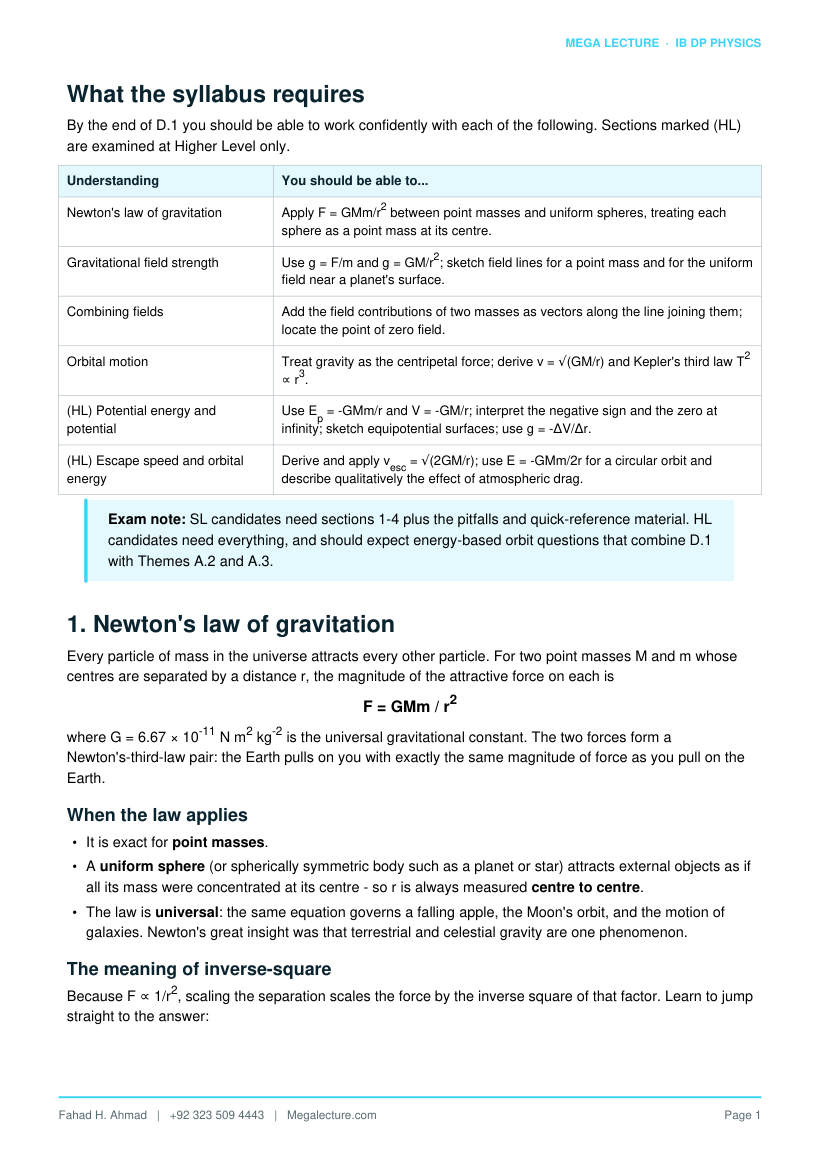
What the syllabus requires
By the end of D.1 you should be able to work confidently with each of the following. Sections marked (HL) are examined at Higher Level only.
Understanding You should be able to...
Newton's law of gravitation Apply F = GMm/r2 between point masses and uniform spheres, treating each sphere as a point mass at its centre.
Gravitational field strength Use g = F/m and g = GM/r2; sketch field lines for a point mass and for the uniform field near a planet's surface.
Combining fields Add the field contributions of two masses as vectors along the line joining them; locate the point of zero field.
Orbital motion Treat gravity as the centripetal force; derive v = √(GM/r) and Kepler's third law T2
∝ r3.
(HL) Potential energy and potential
Use Ep = -GMm/r and V = -GM/r; interpret the negative sign and the zero at infinity; sketch equipotential surfaces; use g = -ΔV/Δr.
(HL) Escape speed and orbital energy
Derive and apply vesc = √(2GM/r); use E = -GMm/2r for a circular orbit and describe qualitatively the effect of atmospheric drag.
Exam note: SL candidates need sections 1-4 plus the pitfalls and quick-reference material. HL candidates need everything, and should expect energy-based orbit questions that combine D.1 with Themes A.2 and A.3.
1. Newton's law of gravitation
Every particle of mass in the universe attracts every other particle. For two point masses M and m whose centres are separated by a distance r, the magnitude of the attractive force on each is
F = GMm / r2
where G = 6.67 × 10⁻¹¹ N m2 kg-2 is the universal gravitational constant. The two forces form a Newton's-third-law pair: the Earth pulls on you with exactly the same magnitude of force as you pull on the Earth.
When the law applies
- It is exact for point masses.
- A uniform sphere (or spherically symmetric body such as a planet or star) attracts external objects as if all its mass were concentrated at its centre - so r is always measured centre to centre.
- The law is universal: the same equation governs a falling apple, the Moon's orbit, and the motion of galaxies. Newton's great insight was that terrestrial and celestial gravity are one phenomenon.
The meaning of inverse-square
Because F ∝ 1/r2, scaling the separation scales the force by the inverse square of that factor. Learn to jump straight to the answer:
Separation changes to... Force becomes... Reasoning
2r F/4 (1/2)2 = 1/4
3r F/9 (1/3)2 = 1/9
10r F/100 (1/10)2 = 1/100 r/2 4F 22 = 4 r/3 9F 32 = 9
Worked example 1 - how weak is gravity?
Two students, each of mass 60 kg, sit 1.0 m apart. Estimate the gravitational force between them.
F = GMm/r2 = 6.67 × 10-11 × 60 × 60 / 1.02 = 2.4 × 10⁻⁷ N.
This is about the weight of a grain of dust. Gravity only dominates on planetary scales because mass is always positive: unlike electric forces, gravitational attractions can never cancel, so they accumulate.
Common pitfall: In F = GMm/r2 the r is the distance between centres, never the distance above a surface. For a satellite at height h above the Earth, r = RE + h.
2. Gravitational field strength g
Rather than thinking of masses acting on each other at a distance, we say every mass creates a gravitational field in the space around it, and any other mass placed in that field experiences a force. The gravitational field strength at a point is the force per unit mass on a small test mass placed there:
g = F / m (units: N kg-1)
Substituting Newton's law for the force exerted by a (spherical) mass M gives the field it creates at distance r from its centre:
g = GM / r2
g is a vector, directed towards the centre of the mass creating it. Note that g depends only on the source mass M and the distance r - not on the object placed in the field.
Why 9.8 N kg-1 is also 9.8 m s-2
A mass m in free fall experiences only the gravitational force F = mg, so by Newton's second law its acceleration is a = F/m = g. The field strength in N kg-1 and the free-fall acceleration in m s-2 are numerically and dimensionally identical: 1 N kg-1 = 1 kg m s-2 kg-1 = 1 m s-2. This is also why all objects fall with the same acceleration regardless of mass.
Worked example 2 - g at the Earth's surface
Verify the value of g at the Earth's surface. (ME = 5.97 × 1024 kg, RE = 6.37 × 10⁶ m.) g = GM/R2 = (6.67 × 10-11 × 5.97 × 1024) / (6.37 × 10⁶)2
= 3.98 × 10¹⁴ / 4.06 × 1013 = 9.8 N kg-1.
The product GM = 3.98 × 10¹⁴ N m2 kg-1 for the Earth is worth noting - it appears in nearly every orbit calculation.
Worked example 3 - g on Mars
Mars has mass 6.42 × 10²³ kg and radius 3.39 × 10⁶ m. Calculate the gravitational field strength at its surface, and the weight there of an astronaut whose mass is 80 kg.
g = GM/r2 = (6.67 × 10-11 × 6.42 × 1023) / (3.39 × 10⁶)2 = 4.28 × 10¹³ / 1.15 × 1013 = 3.7 N kg-1.
Weight W = mg = 80 × 3.7 = 3.0 × 10² N (compared with about 780 N on Earth). The astronaut's mass is unchanged; only the weight differs.
Field lines
A field-line diagram shows the direction of g (arrows) and its strength (line density: closer lines mean a stronger field).
- Point mass or planet seen from far away: a radial field - lines point inward towards the centre from all directions, spreading further apart with distance, showing the inverse-square weakening.
- Near a planet's surface (heights small compared with the radius): the lines are effectively parallel, equally spaced, and vertically downward - a uniform field, which is why we treat g as the constant 9.8 m s-2 in Themes A and B.
- Field lines never cross (the field has one direction at each point), and for gravity they always end on masses - gravitational field lines have no starting 'positive charge' because mass only attracts.
Check the approximation: At the top of Mt Everest (8.8 km up) r increases by only 0.14%, so g falls by under 0.3%. The 'uniform field' model is excellent for everyday heights, but fails for satellites: at ISS altitude (410 km) g is 8.7 N kg-1, noticeably below 9.8.
Figure 1. Left: the radial gravitational field of a mass M; the field lines point inward from every direction. Right: g ∝ 1/r2, an inverse-square curve, so moving from r = R out to r = 2R quarters the field (9.8 to 2.5 N kg-1).
3. Combining fields from two masses
Field strength is a vector, so where two bodies both create fields the resultant is the vector sum. On the straight line joining two masses the two contributions are (anti)parallel, so the sum reduces to simple addition or subtraction:
- Between the masses, the two fields point in opposite directions - subtract magnitudes. Somewhere between them there is a null point where the resultant field is zero.
- Outside the pair (beyond either mass), both fields point broadly the same way - add magnitudes.
- The null point always lies closer to the smaller mass, since the weaker source needs the shorter distance to match the stronger one.
At the null point: GM1/x2 = GM2/(d - x)2, which rearranges to (d - x)/x = √(M2/M1).
Worked example 4 - the Earth-Moon null point
The Moon (mass 7.35 × 10²² kg) orbits the Earth (mass 5.97 × 1024 kg) at a centre-to-centre distance of 3.84 × 10⁸ m. How far from the Earth's centre is the point where the resultant gravitational field is zero?
Let the point be x from the Earth's centre. Setting the field magnitudes equal:
ME/x2 = MM/(d - x)2 so (d - x)/x = √(MM/ME) = √(7.35 × 10²² / 5.97 × 1024) = 0.111
Hence d/x = 1.111 and x = 3.84 × 10⁸ / 1.111 = 3.46 × 10⁸ m - about 90% of the way to the Moon, as expected since the Earth is much the more massive body.
A spacecraft coasting past this point begins to 'fall' towards the Moon rather than back towards the Earth.
Exam technique: Never add the g values of two sources without first checking directions. Between two masses the fields oppose; a very common error is to add magnitudes there instead of subtracting.
4. Orbits: gravity as the centripetal force
A satellite in a circular orbit is in free fall the whole time: gravity is the only force acting, and it plays the role of the centripetal force that continually turns the velocity without changing the speed. Equating the two for a satellite of mass m orbiting a body of mass M at radius r:
GMm / r2 = mv2 / r so v = √(GM / r)
The satellite mass m cancels: orbital speed is independent of the mass of the satellite, and depends only on M and r. Higher orbits are slower.
Figure 3. A circular orbit: gravity F supplies the centripetal force, giving v = √(GM/r). For M = 5.97×1024 kg and r = 7.0×10⁶ m this gives v ≈ 7.54×10³ m s-1 and period T = 2πr/v ≈ 97 min.
Kepler's third law
The period is T = 2πr/v. Substituting v = √(GM/r):
T2 = 4π2 r3 / GM so T2 ∝ r3
For every satellite of the same central body, T2/r3 is the same constant, 4π2/GM. This lets you compare orbits without knowing G or M individually, and lets astronomers weigh a planet or star from the motion of anything orbiting it.
Worked example 5 - orbit of the International Space Station
The ISS orbits at an altitude of 410 km. Find its orbital speed and period.
r = RE + h = 6.37 × 10⁶ + 4.1 × 105 = 6.78 × 10⁶ m.
v = √(GM/r) = √(3.98 × 10¹⁴ / 6.78 × 10⁶) = √(5.87 × 10⁷) = 7.7 × 10³ m s-1.
T = 2πr/v = 2π × 6.78 × 106 / 7.7 × 10³ ≈ 5.6 × 10³ s ≈ 93 minutes.
Worked example 6 - the geostationary orbit
A geostationary satellite stays above the same point on the equator, so its period equals one day, T = 86 400 s (24 h). Find its orbital radius and altitude.
r3 = GMT2 / 4π2 = 3.98 × 1014 × (86 400)2 / 4π2
= 3.98 × 1014 × 7.46 × 109 / 39.5 = 7.53 × 10²² m3 r = (7.53 × 10²²)1/3 = 4.22 × 10⁷ m. Altitude = r - RE = 4.22 × 10⁷ - 6.37 × 10⁶ ≈ 3.6 × 10⁷ m (about 36 000 km).
Every geostationary satellite must orbit at this one radius, in the equatorial plane, moving the same way as the Earth spins - the requirements follow directly from T2 ∝ r3.
Why astronauts feel weightless
Not because gravity is absent - at ISS altitude g is still 8.7 N kg-1, almost 90% of its surface value. The astronaut, the station and everything in it are all in free fall together, accelerating towards the Earth's centre at the same rate g. The floor never pushes on the astronaut's feet, so the normal contact force is zero, and it is that supporting force which gives the sensation of weight. 'Weightlessness' is the absence of support, not of gravity.
Common pitfall: “There is no gravity in space” loses all the marks. Say instead: the astronaut and spacecraft have the same acceleration g towards the Earth, so the reaction force on the astronaut is zero.
5. (HL) Gravitational potential energy
The formula Ep = mgΔh from Theme A works only while g is constant, i.e. near a surface. For the general case we need an expression valid at any distance. The gravitational potential energy of two masses M and m separated by r is defined as the work done by an external agent in bringing m from infinity to that separation:
Ep = -GMm / r Why is it negative?
- We choose the zero of potential energy at infinite separation, where the masses no longer interact.
- Gravity is attractive, so as m falls inward from infinity the field does positive work on it; to move it back out, an external agent must supply energy. Every bound position therefore has less energy than the zero at infinity - hence negative.
- The negative sign is physical, not decorative: a negative Ep is the signature of a bound system. Energy must be added to separate the masses.
Ep increases (becomes less negative) as r increases, exactly as intuition demands: you do work to lift something. The near-surface formula is the small-height limit of the general one: for h << R the change GMm(1/R - 1/(R+h)) ≈ (GM/R2)mh = mgh.
Changes of Ep between orbits
ΔEp = GMm (1/r1 - 1/r2) when moving from radius r1 out to radius r2 - positive for an outward move, since energy must be supplied against the attraction.
Worked example 7 (HL) - lifting a satellite
How much energy is needed to raise a 1200 kg satellite from the Earth's surface to a point 1.00 × 10⁷ m from the Earth's centre (change of potential energy only)?
ΔEp = GMm (1/RE - 1/r) = 3.98 × 1014 × 1200 × (1/6.37 × 106 - 1/1.00 × 107)
= 4.78 × 1017 × (1.570 - 1.000) × 10-7 = 2.7 × 10¹⁰ J.
Using mgΔh with g = 9.8 would give 1200 × 9.8 × 3.63 × 106 = 4.3 × 10¹⁰ J - a 60% overestimate, because g weakens over such a large climb. Always use the -GMm/r form once heights are comparable to R.
6. (HL) Gravitational potential and equipotentials
Just as field strength is force per unit mass, gravitational potential V is potential energy per unit mass: the work done per kilogram in bringing a small test mass from infinity to the point.
V = Ep / m = -GM / r (units: J kg-1)
V is a scalar - a great convenience, because the potential of several masses is just the ordinary sum of the individual -GM/r terms, with no components to resolve. V is negative everywhere and rises towards zero at infinity. At the Earth's surface V = -GM/RE = -6.25 × 10⁷ J kg-1: every kilogram at the surface would need 62.5 MJ to be removed to infinity.
Figure 2. The gravitational potential well V = −GM/r: negative everywhere and rising toward zero as r increases. Here V(R) =
−6.25×10⁷ J kg-1 and V(2R) = −3.13×10⁷ J kg-1, exactly half as deep.
Equipotential surfaces
- An equipotential surface connects points of equal V. Around a spherical mass they are concentric spheres (circles on a 2-D diagram); near a flat surface they are horizontal planes.
- No work is done moving a mass along an equipotential (W = mΔV and ΔV = 0).
- Consequently field lines cross equipotentials at right angles - if g had a component along the surface, moving that way would do work, a contradiction.
- Equipotentials drawn at equal intervals of V crowd together where the field is strong and spread out where it is weak - around a planet, spheres at equal ΔV get progressively further apart with distance.
Potential gradient
Field strength is the negative gradient of potential:
g = -ΔV / Δr
The minus sign says g points from high V to low V - 'downhill' in potential, towards the mass. Graphically: the gradient of a V-r graph gives -g, and the area under a g-r graph gives the change in potential. This mirrors the electric case in D.2, with mass in place of charge.
Worked example 8 (HL) - potential above the Earth
Calculate the gravitational potential (a) at the Earth's surface and (b) at a distance of two Earth radii from the centre, and (c) the energy needed to move a 500 kg probe between the two levels.
- V1 = -GM/R = -3.98 × 10¹⁴ / 6.37 × 106 = -6.25 × 10⁷ J kg-1.
- V2 = -GM/2R = -3.13 × 10⁷ J kg-1 (half as deep in the 'well').
- W = mΔV = 500 × (-3.13 + 6.25) × 107 = 1.6 × 10¹⁰ J.
Sign discipline: Potential and potential energy are negative; changes can be positive. Substitute values with their signs and let the algebra handle the rest - never drop a minus sign 'to tidy up'.
7. (HL) Escape speed and the energy of orbits
Escape speed
The escape speed is the minimum launch speed that lets a projectile just reach infinity with nothing to spare (ignoring air resistance and any engine thrust after launch). Apply energy conservation between the surface and infinity, where both Ek and Ep are zero:
½mv2 - GMm/r = 0 so vesc = √(2GM / r)
The mass of the projectile cancels: escape speed is the same for a molecule or a spacecraft. Notice vesc = √2 × vorbit for a circular orbit at the same r.
Worked example 9 (HL) - escape speeds
Find the escape speed from (a) the Earth's surface and (b) the Moon's surface (MM = 7.35 × 10²² kg, RM = 1.74 × 10⁶ m).
- v = √(2GM/R) = √(2 × 3.98 × 1014 / 6.37 × 10⁶) = √(1.25 × 10⁸) = 1.12 × 10⁴ m s-1 (11.2 km s-1).
- v = √(2 × 6.67 × 10-11 × 7.35 × 1022 / 1.74 × 10⁶) = √(5.63 × 10⁶) = 2.4 × 10³ m s-1.
The Moon's low escape speed explains why it has kept almost no atmosphere: gas molecules readily reach 2.4 km s-1 and leak away, while 11.2 km s-1 keeps the Earth's air bound.
Energy of a circular orbit
For a satellite in a circular orbit, v2 = GM/r gives the kinetic energy, and adding the potential energy gives the total:
Ek = +GMm/2r Ep = -GMm/r E = Ek + Ep = -GMm/2r
Quantity Expression Sign As r increases...
Kinetic energy Ek +GMm/2r positive decreases towards 0 (higher orbits are slower)
Potential energy Ep -GMm/r negative increases towards 0 (less tightly bound)
Total energy E -GMm/2r negative increases towards 0
On a graph against r, all three are curves flattening towards zero: Ek from above the axis, Ep from below, with E = -GMm/2r lying exactly halfway between the Ep curve and the axis. Two relations to memorise: E = -Ek and Ep = 2E = -2Ek. The total is negative because an orbiting satellite is a bound system; E = 0 is the threshold of escape.
Worked example 10 (HL) - boosting an orbit
A 500 kg satellite is moved from a circular orbit of radius 7.0 × 10⁶ m to one of radius 8.0 × 10⁶ m. How much energy must its motors supply?
E1 = -GMm/2r1 = -3.98 × 1014 × 500 / (2 × 7.0 × 106) = -1.42 × 10¹⁰ J
E2 = -3.98 × 1014 × 500 / (2 × 8.0 × 106) = -1.24 × 10¹⁰ J
ΔE = E2 - E1 = +1.8 × 10⁹ J.
Curiously, in the higher orbit the satellite moves slower (Ek falls by 0.9 × 10⁹ J) even though energy was added: the potential energy rises by twice as much as the kinetic energy falls.
Atmospheric drag on satellites (qualitative)
A satellite in low orbit skims the outer atmosphere. Drag does negative work, so the total energy E becomes more negative - the orbit shrinks (r decreases). But since Ek = -E, decreasing E means the kinetic energy and speed increase: the satellite spirals inward, moving faster and faster as it descends into denser air, until it overheats and burns up. Drag paradoxically speeds the satellite up - a classic HL discussion question.
8. Common pitfalls
- Using distance above the surface instead of distance from the centre: always r = R + h.
- Forgetting to square r, or squaring the whole of GM/r on a calculator - bracket carefully.
- Saying satellites stay up because 'there is no gravity' or because of a 'centrifugal force balancing gravity'. Gravity is unbalanced - it is the centripetal force.
- Adding the field strengths of two masses without checking vector directions (between two masses the fields oppose).
- (HL) Writing Ep = +GMm/r, or treating a negative potential as if it were 'less than nothing'. The sign encodes the choice of zero at infinity and the attractive nature of gravity.
- (HL) Using mgΔh for changes of height comparable to the planet's radius - it assumes uniform g.
- (HL) Confusing escape speed √(2GM/r) with orbital speed √(GM/r) - the former is √2 times the latter.
- Quoting g = 9.8 on other planets, or using Earth's GM for a different central body in Kepler's law.
9. Quick reference
Result Statement
Newton's law of gravitation F = GMm/r2, attractive, centre-to-centre r; G = 6.67 × 10⁻¹¹ N m2 kg-2
Field strength g = F/m = GM/r2 (N kg-1 = m s-2), vector towards the mass
Orbital speed v = √(GM/r) - independent of satellite mass
Kepler's third law T2 = 4π2r3/GM, so T2 ∝ r3 for one central body
(HL) Potential energy Ep = -GMm/r, zero at infinity
Result Statement
(HL) Potential V = -GM/r (J kg-1), scalar; W = mΔV
(HL) Potential gradient g = -ΔV/Δr; field lines ⊥ equipotentials
(HL) Escape speed vesc = √(2GM/r) = √2 × orbital speed at r
(HL) Orbit energies Ek = GMm/2r; Ep = -GMm/r; E = -GMm/2r; drag lowers E and r but raises speed
10. Test yourself
Attempt these without notes; full answers below. Use G = 6.67 × 10⁻¹¹ N m2 kg-2, ME = 5.97 × 1024 kg, RE = 6.37 × 10⁶ m.
- The separation of two point masses is halved and one of the masses is tripled. By what factor does the gravitational force change?
- Calculate g at the surface of the Moon (M = 7.35 × 10²² kg, R = 1.74 × 10⁶ m).
- Find the field strength at a point 3 Earth radii from the Earth's centre.
- Two point masses, M and 9M, are 8.0 m apart. Where on the line joining them is the resultant field zero?
- Mars orbits the Sun at 1.52 times the Earth's orbital radius. Use Kepler's third law to find its orbital period in years.
- A planet has twice the Earth's mass and twice its radius. What is g at its surface?
- Explain why an astronaut aboard an orbiting spacecraft feels weightless even though the gravitational field strength at that altitude is far from zero.
- (HL) State why gravitational potential energy is negative, and calculate the minimum energy needed to remove a 1.0 kg mass from the Earth's surface to infinity.
- (HL) Calculate the escape speed from a neutron star of mass 4.0 × 1030 kg and radius 1.2 × 10⁴ m, and comment on the result.
- (HL) A satellite in low Earth orbit experiences slight atmospheric drag. Explain what happens to its total energy, orbital radius and speed.
Answers
- F ∝ Mm/r2: tripling one mass gives ×3; halving r gives ×4. New force = 12F.
- g = 6.67 × 10-11 × 7.35 × 1022 / (1.74 × 10⁶)2 = 4.90 × 10¹² / 3.03 × 1012 = 1.6 N kg-1 - about one sixth of the Earth's surface value.
- Inverse-square: g = 9.8 / 32 = 1.1 N kg-1.
- At distance x from M: M/x2 = 9M/(8 - x)2, so (8 - x)/x = 3 and x = 2.0 m from the smaller mass M (6.0 m from 9M) - closer to the smaller mass, as expected.
- T2 ∝ r3: T = 1.523/2 × 1 yr = √(3.51) = 1.9 years.
- g = G(2M)/(2R)2 = (2/4) × GM/R2 = 9.8/2 = 4.9 N kg-1.
- Gravity is the only force on both astronaut and craft; both are in free fall with the same acceleration g towards the Earth's centre (gravity supplies the centripetal force). The astronaut therefore experiences no normal contact force from the spacecraft, and it is the absence of this supporting force that is felt as weightlessness.
- (HL) Zero is chosen at infinite separation, and since gravity is attractive, work must be done on the mass to take it there - so every finite separation has less energy than zero. Energy required = 0 - (-GMm/R) = GM/R × 1.0 = 3.98 × 10¹⁴ / 6.37 × 106 = 6.3 × 10⁷ J.
- (HL) v = √(2GM/r) = √(2 × 6.67 × 10-11 × 4.0 × 1030 / 1.2 × 10⁴) = √(4.45 × 10¹⁶) = 2.1 × 10⁸ m s-1 - about 70% of the speed of light, showing why compact objects only slightly denser than this (black holes) allow nothing to escape at all.
- (HL) Drag does negative work, so the total energy E = -GMm/2r decreases (becomes more negative); therefore r decreases and the orbit decays inward. Since Ek = -E, the kinetic energy and hence the speed increase: the satellite falls to a lower, faster orbit, encountering ever denser air until it re-enters.
