
IB Diploma · Physics · SL / HL · Theme D: Fields
D.3 Motion in Electromagnetic Fields
Opens inside this page. Prefer your own PDF app? Open the PDF.
Full text of D.3 Motion in Electromagnetic Fields
IB DP PHYSICS Theme D: Fields D.3 Motion in Electromagnetic Fields
Revision Notes · Standard and Higher Level Fahad H. Ahmad
+92 323 509 4443 | Megalecture.com
Original notes prepared for the IB Diploma Programme Physics course (first assessment 2025)
What the syllabus requires
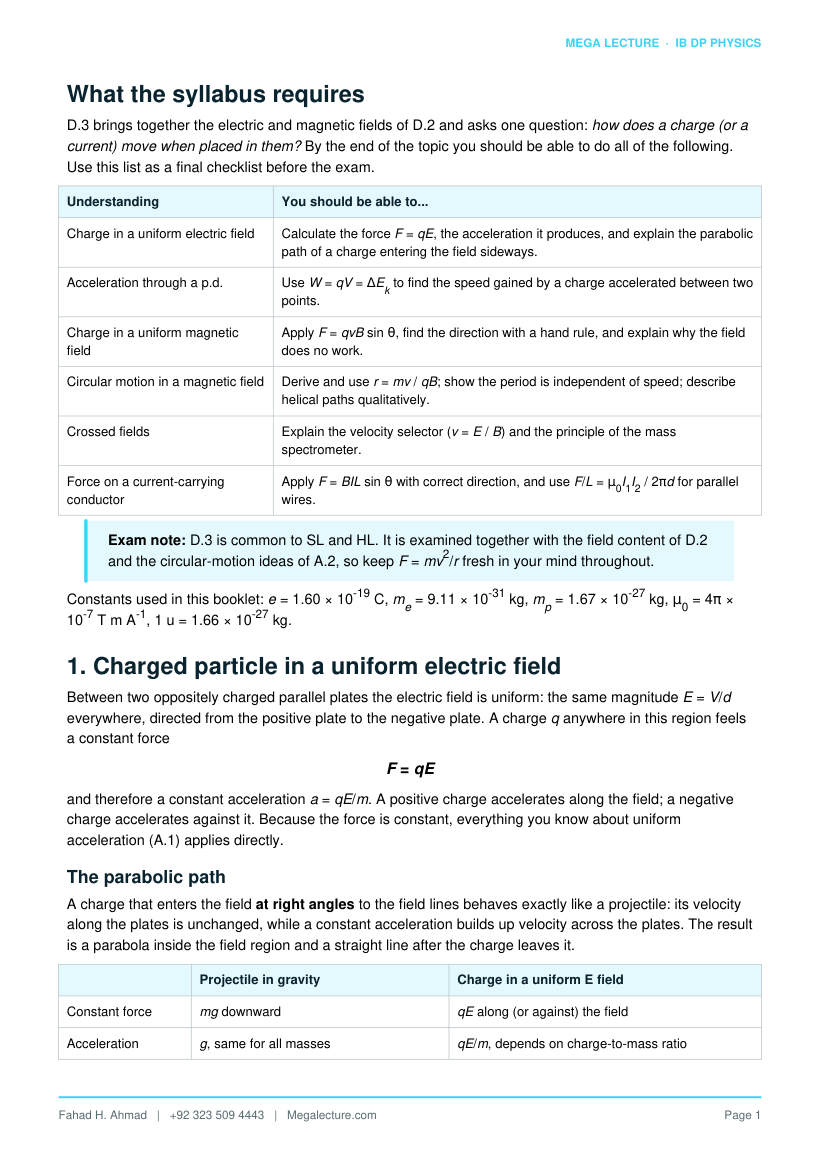
D.3 brings together the electric and magnetic fields of D.2 and asks one question: how does a charge (or a current) move when placed in them? By the end of the topic you should be able to do all of the following. Use this list as a final checklist before the exam.
Understanding You should be able to...
Charge in a uniform electric field Calculate the force F = qE, the acceleration it produces, and explain the parabolic path of a charge entering the field sideways.
Acceleration through a p.d. Use W = qV = ΔEk to find the speed gained by a charge accelerated between two points.
Charge in a uniform magnetic field
Apply F = qvB sin θ, find the direction with a hand rule, and explain why the field does no work.
Circular motion in a magnetic field Derive and use r = mv / qB; show the period is independent of speed; describe helical paths qualitatively.
Crossed fields Explain the velocity selector (v = E / B) and the principle of the mass spectrometer.
Force on a current-carrying conductor
Apply F = BIL sin θ with correct direction, and use F/L = μ0I1I2 / 2πd for parallel wires.
Exam note: D.3 is common to SL and HL. It is examined together with the field content of D.2 and the circular-motion ideas of A.2, so keep F = mv2/r fresh in your mind throughout.
Constants used in this booklet: e = 1.60 × 10⁻¹⁹ C, me = 9.11 × 10⁻³¹ kg, mp = 1.67 × 10⁻²⁷ kg, μ0 = 4π × 10-7 T m A-1, 1 u = 1.66 × 10⁻²⁷ kg.
1. Charged particle in a uniform electric field
Between two oppositely charged parallel plates the electric field is uniform: the same magnitude E = V/d everywhere, directed from the positive plate to the negative plate. A charge q anywhere in this region feels a constant force
F = qE
and therefore a constant acceleration a = qE/m. A positive charge accelerates along the field; a negative charge accelerates against it. Because the force is constant, everything you know about uniform acceleration (A.1) applies directly.
The parabolic path
A charge that enters the field at right angles to the field lines behaves exactly like a projectile: its velocity along the plates is unchanged, while a constant acceleration builds up velocity across the plates. The result is a parabola inside the field region and a straight line after the charge leaves it.
Projectile in gravity Charge in a uniform E field
Constant force mg downward qE along (or against) the field
Acceleration g, same for all masses qE/m, depends on charge-to-mass ratio
Projectile in gravity Charge in a uniform E field
Along the motion horizontal velocity constant velocity parallel to plates constant
Across the motion vy = gt; y = ½gt2 vy = (qE/m)t; y = ½(qE/m)t2
Path shape parabola parabola (inside the field region)
Sign care: Field lines show the force on a positive charge. An electron is deflected toward the positive plate, opposite to the field direction. Draw the force arrow before writing any equation.
Worked example 1 — force and acceleration between plates
Two parallel plates 2.0 cm apart have a p.d. of 500 V across them. An electron sits between them. Find (a) the field strength, (b) the force on the electron, (c) its acceleration.
- E = V/d = 500 / 0.020 = 2.5 × 10⁴ V m-1.
- F = qE = 1.60 × 10-19 × 2.5 × 104 = 4.0 × 10⁻¹⁵ N, directed toward the positive plate.
- a = F/m = 4.0 × 10⁻¹⁵ / 9.11 × 10⁻³¹ ≈ 4.4 × 10¹⁵ m s-2 — about 4 × 10¹⁴ times g, which is why gravity is always neglected for electrons in fields.
Acceleration through a potential difference
When a charge q moves through a potential difference V, the field does work W = qV on it. If the charge starts from rest and nothing else acts, all of this work becomes kinetic energy:
qV = ½mv2 so v = (2qV/m)1/2
This is the principle of the electron gun used in X-ray tubes and older oscilloscopes: electrons boiled off a hot cathode are accelerated through a p.d. toward an anode, emerging through a hole as a fast, narrow beam.
Worked example 2 — electron gun
An electron is accelerated from rest through a p.d. of 2.0 kV. Find (a) the kinetic energy gained, in J and in eV, (b) the final speed.
- W = qV = 1.60 × 10-19 × 2000 = 3.2 × 10⁻¹⁶ J = 2.0 keV (one electron through one volt gains one electronvolt — by definition).
- v = (2W/m)1/2 = (2 × 3.2 × 10-16 / 9.11 × 10⁻³¹)1/2 ≈ 2.7 × 10⁷ m s-1.
Check the scale: this is already 9% of the speed of light. Above a few kV the classical formula starts to underestimate relativistic effects (HL: A.5).
Worked example 3 — deflection of a beam (parabolic path)
An electron travelling at 2.0 × 10⁷ m s-1 enters midway between plates of length 5.0 cm where the field is 1.0 × 10⁴ N C-1, perpendicular to its velocity. Find the deflection as it leaves the plates.
Time in the field (horizontal motion unchanged): t = 0.050 / 2.0 × 107 = 2.5 × 10⁻⁹ s.
Acceleration: a = eE/m = 1.60 × 10-19 × 1.0 × 104 / 9.11 × 10⁻³¹ ≈ 1.8 × 10¹⁵ m s-2.
Deflection: y = ½at2 = 0.5 × 1.8 × 1015 × (2.5 × 10-9)2 ≈ 5.5 mm, toward the positive plate.
2. Charged particle in a uniform magnetic field
A magnetic field exerts a force only on a moving charge. The magnitude is
F = qvB sin θ where θ is the angle between the velocity and the field. Two limits matter: a charge moving parallel to the field (θ = 0) feels no force at all, and a charge moving perpendicular to the field (θ = 90°) feels the maximum force F = qvB. A stationary charge feels nothing.
Finding the direction
The force is perpendicular to both the velocity and the field. Two equivalent rules give its direction:
- Right-hand slap rule: flatten the right hand; fingers point along B, thumb along v (of a positive charge); the palm pushes in the direction of F.
- Fleming's left-hand rule: First finger = Field, seCond finger = conventional Current (direction of positive charge motion), thuMb = Motion/force. Same physics, different hand.
For a negative charge such as an electron, apply the rule as if the charge were positive, then reverse the answer — or point the current finger opposite to the electron's velocity. Pick one habit and never mix them within a question.
Drawing convention: A field into the page is drawn as × (crosses, the tail of an arrow); out of the page as dots (the tip). Most exam diagrams use these, so practise the hand rules with the field perpendicular to the paper.
No work is done
Because F is always perpendicular to v, the magnetic force has no component along the motion. It therefore does no work: the speed and kinetic energy of the particle are constant, and only the direction of the velocity changes. This single sentence is worth a mark in almost every D.3 paper.
3. Circular motion in a magnetic field
A charge moving perpendicular to a uniform field feels a force of constant magnitude qvB that is always at right angles to its velocity. That is precisely the condition for uniform circular motion: the magnetic force is the centripetal force.
qvB = mv2 / r so r = mv / qB
Read the result: fast or massive particles curve gently (large r); strong fields and large charges bend the path tightly (small r).
Figure 1. A charge moving in a field B into the page (×) follows a circle of radius r = mv/(qB); the magnetic force F = qvB stays perpendicular to v and points to the centre. Electron m = 9.11×10⁻³¹ kg, v = 1×10⁷ m s−1, B = 0.01 T → r ≈
5.69×10⁻³ m.
The period is independent of speed
T = 2πr / v = 2πmv / (qBv) = 2πm / qB
The speed cancels: a faster particle travels a proportionally bigger circle in the same time. All particles with the same charge-to-mass ratio in the same field orbit with the same period (the cyclotron period) and the same frequency f = qB / 2πm. This is the fact that makes the cyclotron (Section 5) possible.
Worked example 4 — electron in a magnetic field
An electron moves at 3.0 × 10⁶ m s-1 perpendicular to a uniform field of 0.50 mT. Find (a) the radius of its path, (b) the period of the orbit.
- r = mv/qB = 9.11 × 10-31 × 3.0 × 106 / (1.60 × 10-19 × 5.0 × 10-4) ≈ 3.4 cm.
- T = 2πm/qB = 2π × 9.11 × 10-31 / (1.60 × 10-19 × 5.0 × 10-4) ≈ 7.2 × 10⁻⁸ s — and this would be the same at any speed.
Worked example 5 — proton in a magnetic field
A proton moves at 4.0 × 10⁵ m s-1 at right angles to a 0.20 T field. Find (a) the force on it, (b) the radius of its circular path.
- F = qvB = 1.60 × 10-19 × 4.0 × 105 × 0.20 = 1.3 × 10⁻¹⁴ N.
- r = mv/qB = 1.67 × 10-27 × 4.0 × 105 / (1.60 × 10-19 × 0.20) ≈ 2.1 cm.
Compare with the electron of Example 4: for the same speed and field a proton's circle is about 1800 times larger, because r ∝ m.
Helical paths (qualitative)
If the velocity has a component along the field as well as across it, split it into the two parts. The perpendicular component drives circular motion; the parallel component is completely unaffected (sin 0 = 0) and carries the particle steadily along the field line. The combination is a helix — a spiral wound around the field direction, like a stretched spring. Charged particles from the Sun spiral along the Earth's field lines in exactly this way (Section 5).
4. Crossed fields: the velocity selector and the mass spectrometer
The velocity selector
Set up an electric field and a magnetic field at right angles to each other (crossed fields), both perpendicular to an incoming beam, arranged so the electric force and the magnetic force on a charge are in opposite directions. The two forces balance for one particular speed only:
qE = qvB so v = E / B
Particles at exactly this speed pass through undeflected; faster particles feel a larger magnetic force and bend one way, slower particles bend the other way and are stopped by slits. Notice that q and m cancel: the selector transmits any charge, of either sign, at speed E/B.
Worked example 6 — velocity selector
In a velocity selector the electric field is 2.4 × 10⁴ V m-1 and the magnetic field is 0.060 T. (a) What speed is selected? (b) What happens to an ion moving faster than this?
- v = E/B = 2.4 × 10⁴ / 0.060 = 4.0 × 10⁵ m s-1.
- The electric force qE is unchanged but the magnetic force qvB is now larger, so the ion deflects toward the side the magnetic force points and misses the exit slit.
Figure 2. Velocity selector: crossed E and B fields. The electric force qE and the magnetic force qvB oppose and balance for one speed only, v = E/B. Here E = 2.4×10⁴ V m−1, B = 0.060 T → v = 4.0×10⁵ m s−1.
The mass spectrometer
A mass spectrometer identifies ions by mass in two stages: select, then bend.
- Stage 1 (velocity selector): crossed fields pass only ions with v = E/B, so every ion enters the next stage at the same known speed.
- Stage 2 (deflection chamber): a uniform magnetic field B' alone bends each ion into a semicircle of radius r = mv / qB'.
With v, q and B' fixed, the radius is proportional to the mass (more generally r ∝ m/q): heavier ions land farther along the detector. Isotopes — chemically identical, different masses — separate cleanly, which is how isotopic abundances are measured.
Worked example 7 — identifying an ion
Singly charged positive ions leave a velocity selector at 4.0 × 10⁵ m s-1 and enter a 0.50 T field, landing after a semicircle of radius 16.6 cm. Find the mass of the ion and suggest what it is.
m = qB'r/v = 1.60 × 10-19 × 0.50 × 0.166 / 4.0 × 10⁵ ≈ 3.3 × 10⁻²⁶ kg.
In atomic mass units: 3.32 × 10⁻²⁶ / 1.66 × 10-27 = 20 u — consistent with a neon-20 ion, 20Ne+.
Its isotope neon-22 would land at r = (22/20) × 16.6 = 18.3 cm: the 1.7 cm gap between the two marks is the isotope separation.
5. The cyclotron and other applications
The cyclotron (qualitative)
A cyclotron accelerates charged particles to high energies in a compact machine. Two hollow D-shaped electrodes (“dees”) sit in a uniform magnetic field. Inside a dee the particle feels only the magnetic force, so it travels a semicircle at constant speed. Each time it crosses the gap between the dees, an alternating p.d. gives it a kick of energy qV, so it speeds up and the next semicircle is larger (r ∝ v). The particle spirals outward until it is extracted at the rim.
The design works because the period 2πm/qB is independent of speed: the alternating voltage can switch polarity at one fixed frequency and the particle always arrives at the gap in step with it. (At speeds approaching c the effective mass grows, the particle falls out of step, and synchrotrons take over — an HL relativity link.)
Where the physics shows up
- Particle accelerators: magnetic fields steer and confine beams (they change direction without changing energy); electric fields do the accelerating (they do work). Every accelerator divides labour this way.
- Medical cyclotrons produce short-lived radioisotopes for PET scans and proton beams for radiotherapy.
- The aurora: solar-wind particles spiral helically along the Earth's magnetic field lines toward the poles, where they excite atmospheric atoms that glow.
- Magnetic confinement in fusion reactors: a plasma is far too hot to touch a wall, so tokamaks use magnetic fields to keep the charged particles spiralling around closed field lines, trapped away from the walls.
Key sentence for applications: Magnetic fields can change the direction of a charged particle but never its speed; whenever energy must be added, an electric field (a p.d.) does the work.
6. Force on a current-carrying conductor
A current is a stream of moving charges, so a wire carrying a current in a magnetic field feels a force — the sum of the forces on all its charge carriers.
Deriving F = BIL sin θ from the charge carriers
Consider a wire of length L containing N carriers, each of charge q, drifting at speed v. Each carrier feels qvB sin θ, so the wire feels F = NqvB sin θ. The carriers take time t = L/v to traverse the wire, so the current is I = Nq/t = Nqv/L, giving Nqv = IL. Substituting:
F = BIL sin θ
Here θ is the angle between the wire (current direction) and the field. The force is greatest when the wire is perpendicular to the field and zero when the wire lies along it. Direction: Fleming's left-hand rule with the second finger along the conventional current; the force is perpendicular to both the wire and the field. This force drives every electric motor, loudspeaker and moving-coil meter.
Worked example 8 — force on a wire
A straight wire of length 0.40 m carries a current of 3.0 A at 30° to a uniform field of 0.25 T. Find the force on it. What does the force become if the wire is turned (a) perpendicular to the field, (b) parallel to it?
F = BIL sin θ = 0.25 × 3.0 × 0.40 × sin 30° = 0.30 × 0.5 = 0.15 N.
- sin 90° = 1: F = 0.30 N (maximum). (b) sin 0° = 0: F = 0.
Figure 3. Force on a current-carrying conductor, F = BIL sin θ, shown with the wire perpendicular to B into the page. With B =
0.25 T, I = 3.0 A, L = 0.40 m: F = 0.30 N at 90°, falling to 0.15 N at 30°.
Force between two parallel wires
A long straight wire carrying current I1 creates a field B = μ0I1 / 2πd at distance d (D.2), in circles around the wire. A second parallel wire carrying I2 sits in this field, perpendicular to it, so it feels F = BI2L per length L. Per unit length:
F / L = μ0I1I2 / 2πd
By Newton's third law each wire pulls (or pushes) the other equally. Apply the hand rules once and remember the result: parallel currents attract, antiparallel currents repel. (Beware: this is the opposite of the like-charges-repel rule for electrostatics.)
Worked example 9 — parallel wires
Two long parallel wires 5.0 cm apart carry currents of 4.0 A and 6.0 A in the same direction. Find the force per unit length between them and state its direction.
F/L = μ0I1I2/2πd = (4π × 10-7 × 4.0 × 6.0) / (2π × 0.050) = 2 × 10-7 × 24 / 0.050 = 9.6 × 10⁻⁵ N m-1.
The currents are parallel, so the wires attract. The force is tiny — magnetic forces between ordinary currents are weak, which is why this geometry was usable as a precision definition of the ampere.
7. Electric versus magnetic fields: the master comparison
Exam questions love to make you contrast the two fields acting on the same charge. This table is worth memorising line by line.
Property Uniform electric field Uniform magnetic field
Force law F = qE F = qvB sin θ
Property Uniform electric field Uniform magnetic field
Acts on a stationary charge?
Yes No — needs motion
Force direction Along the field (+q) or against it (-q) Perpendicular to both v and B
Work done on the charge Yes (unless v ⊥ E throughout) Never — F ⊥ v always
Speed / kinetic energy Changes Constant
Path (entering ⊥ to field) Parabola Circle
Path (moving along field) Straight line, accelerating Straight line, unaffected
Depends on speed? No Yes — F ∝ v
8. Common pitfalls
- Forgetting sin θ: F = qvB and F = BIL hold only at 90°. Always check the angle between v (or I) and B — and remember the force vanishes for motion along the field.
- Negative charges: hand rules give the force on a positive charge. For electrons, reverse the direction. Marks disappear here every session.
- Radius vs diameter: a particle entering and leaving a field region through the same boundary travels a semicircle — the entry and exit points are one diameter (2r) apart, not one radius.
- Claiming the magnetic force does work: it cannot; it is always perpendicular to the motion. Kinetic energy in a pure magnetic field is constant.
- Mixing up the angle: in F = BIL sin θ, θ is between the wire and the field, not between the force and anything.
- Using V = Ed outside uniform fields: it applies between parallel plates only, not to point charges (D.2 handles those).
- Assuming parallel currents repel by analogy with like charges: they attract.
9. Quick reference
Result Statement
Force on charge in E field F = qE (any speed, including at rest)
Acceleration through a p.d. W = qV = ΔEk = ½mv2 (from rest)
Force on moving charge in B field
F = qvB sin θ (zero if at rest or moving along B)
Radius of circular path r = mv / qB (from qvB = mv2/r)
Period of the circle T = 2πm / qB — independent of speed and radius
Velocity selector undeflected when qE = qvB, i.e. v = E / B
Mass spectrometer select speed, then bend: r = mv/qB', so r ∝ m/q
Force on a wire F = BIL sin θ
Result Statement
Parallel wires F/L = μ0I1I2 / 2πd; parallel currents attract
Work done by B field zero, always — speed constant, direction changes
10. Test yourself
Attempt these without notes; full answers follow.
- An electron is accelerated from rest through a p.d. of 500 V. Find its final speed.
- A proton moves at 2.0 × 10⁶ m s-1 perpendicular to a 0.15 T field. Find the force on it and the radius of its path.
- Explain, in one sentence each: (a) why a magnetic field cannot change a particle's kinetic energy; (b) why an electric field can.
- A velocity selector uses a magnetic field of 0.080 T. What electric field strength selects ions moving at 3.0 × 10⁵ m s-1?
- A 0.50 m wire carrying 2.0 A lies perpendicular to a 0.30 T field. Find the force on the wire. How would you find its direction?
- Two long parallel wires 2.0 cm apart each carry 8.0 A, in opposite directions. Find the force per unit length and state whether they attract or repel.
- An alpha particle (q = +2e, m = 6.64 × 10⁻²⁷ kg) is accelerated from rest through 1000 V. Find its final speed.
- Show that the time for one proton orbit in a 1.2 T field is about 5.5 × 10⁻⁸ s, and explain why this does not depend on the proton's speed.
- A charged particle moves exactly parallel to a uniform magnetic field. Describe its subsequent motion. What if its velocity also had a small perpendicular component?
- In a mass spectrometer two singly charged isotopes of masses 24 u and 26 u enter the deflection field at the same speed. Find the ratio of their path radii, and state which lands farther from the entry slit.
Answers
- v = (2qV/m)1/2 = (2 × 1.60 × 10-19 × 500 / 9.11 × 10⁻³¹)1/2 ≈ 1.3 × 10⁷ m s-1.
- F = qvB = 1.60 × 10-19 × 2.0 × 106 × 0.15 = 4.8 × 10⁻¹⁴ N. r = mv/qB = 1.67 × 10-27 × 2.0 × 106 / (1.60 × 10-19 × 0.15) ≈ 0.14 m.
- (a) The magnetic force is always perpendicular to the velocity, so it does no work and cannot change kinetic energy. (b) The electric force can have a component along the motion, so it does work W = qV and changes kinetic energy.
- E = vB = 3.0 × 105 × 0.080 = 2.4 × 10⁴ V m-1, arranged so the electric and magnetic forces oppose.
- F = BIL = 0.30 × 2.0 × 0.50 = 0.30 N. Direction from Fleming's left-hand rule: first finger along B, second finger along the conventional current; the thumb gives the force, perpendicular to both.
- F/L = μ0I2/2πd = 2 × 10-7 × 64 / 0.020 = 6.4 × 10⁻⁴ N m-1. Antiparallel currents repel.
- W = qV = 3.20 × 10-19 × 1000 = 3.2 × 10⁻¹⁶ J. v = (2 × 3.2 × 10-16 / 6.64 × 10⁻²⁷)1/2 ≈ 3.1 × 10⁵ m s-1.
- T = 2πm/qB = 2π × 1.67 × 10-27 / (1.60 × 10-19 × 1.2) ≈ 5.5 × 10⁻⁸ s. The speed cancels in the derivation: a faster proton moves in a proportionally larger circle (r ∝ v), so the orbit time 2πr/v is unchanged.
- Moving parallel to B, the angle θ = 0 so the force is zero: the particle continues in a straight line at constant velocity. With a small perpendicular component added, that component drives a small circle while the parallel motion continues — the path becomes a helix around the field line.
- r = mv/qB with v, q, B identical, so r26/r24 = 26/24 ≈ 1.08. The heavier isotope (26 u) follows the larger semicircle and lands farther from the slit.
