
O Level & IGCSE · Maths 0580 · Mathematics formula and quick-reference sheet
Mathematics formula and quick-reference sheet
Opens inside this page. Prefer your own PDF app? Open the PDF.
Check yourself
5 quick questions on O Level & IGCSE Maths
Tap an answer to see if you are right, and why. Free, no sign-up.
Start the free testWas this note useful?
Full text of Mathematics formula and quick-reference sheet
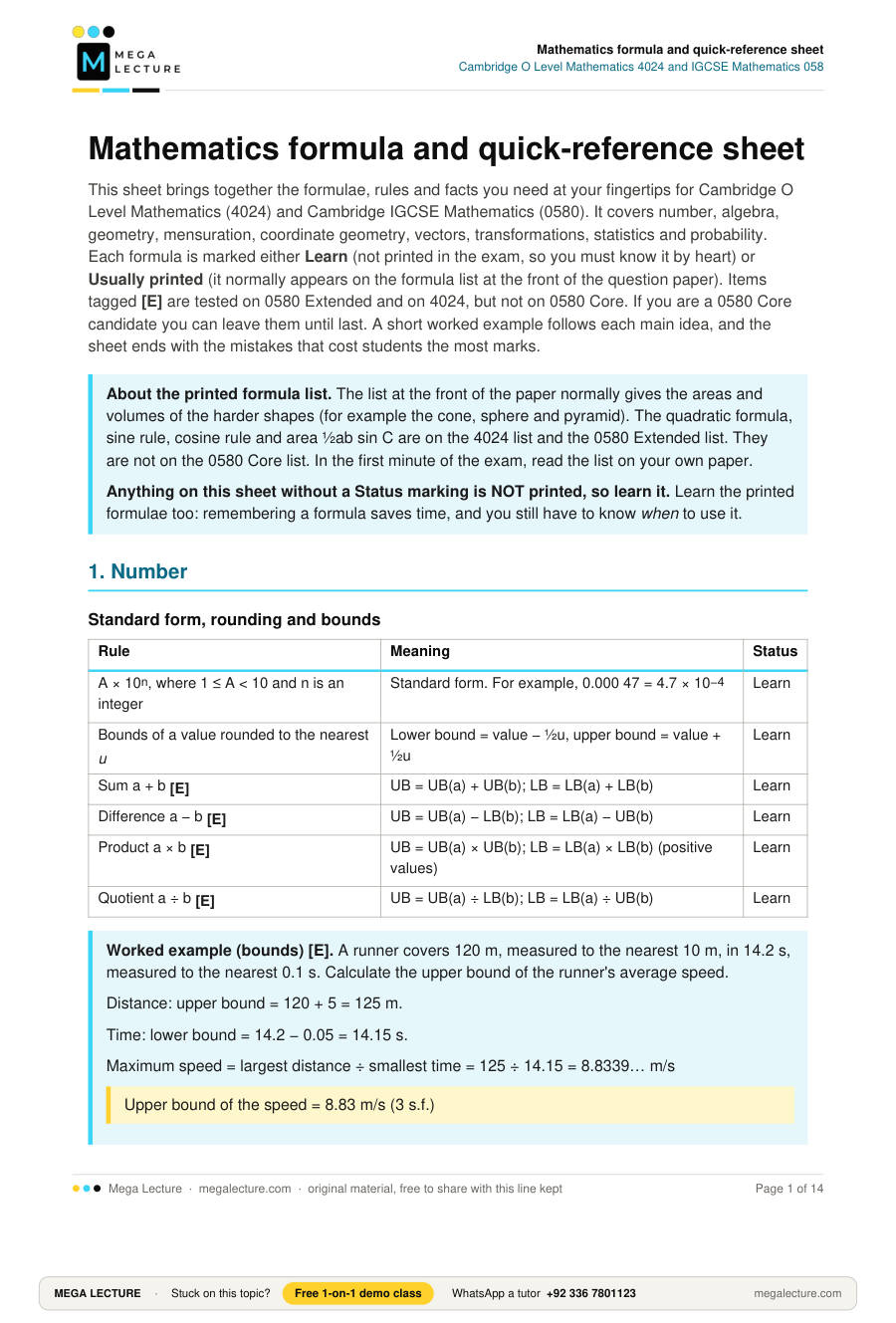
This sheet brings together the formulae, rules and facts you need at your fingertips for Cambridge O Level Mathematics (4024) and Cambridge IGCSE Mathematics (0580). It covers number, algebra, geometry, mensuration, coordinate geometry, vectors, transformations, statistics and probability. Each formula is marked either Learn (not printed in the exam, so you must know it by heart) or Usually printed (it normally appears on the formula list at the front of the question paper). Items tagged [E] are tested on 0580 Extended and on 4024, but not on 0580 Core. If you are a 0580 Core candidate you can leave them until last. A short worked example follows each main idea, and the sheet ends with the mistakes that cost students the most marks.
About the printed formula list. The list at the front of the paper normally gives the areas and volumes of the harder shapes (for example the cone, sphere and pyramid). The quadratic formula, sine rule, cosine rule and area ½ab sin C are on the 4024 list and the 0580 Extended list. They are not on the 0580 Core list. In the first minute of the exam, read the list on your own paper.
Anything on this sheet without a Status marking is NOT printed, so learn it. Learn the printed formulae too: remembering a formula saves time, and you still have to know when to use it.
1. Number
Standard form, rounding and bounds
| Rule | Meaning | Status |
|---|---|---|
| A × 10n, where 1 ≤ A < 10 and n is an integer | Standard form. For example, 0.000 47 = 4.7 × 10⁻⁴ | Learn |
| Bounds of a value rounded to the nearest u | Lower bound = value − ½u, upper bound = value + ½u | Learn |
| Sum a + b [E] | UB = UB(a) + UB(b); LB = LB(a) + LB(b) | Learn |
| Difference a − b [E] | UB = UB(a) − LB(b); LB = LB(a) − UB(b) | Learn |
| Product a × b [E] | UB = UB(a) × UB(b); LB = LB(a) × LB(b) (positive values) | Learn |
| Quotient a ÷ b [E] | UB = UB(a) ÷ LB(b); LB = LB(a) ÷ UB(b) | Learn |
Worked example (bounds) [E]. A runner covers 120 m, measured to the nearest 10 m, in 14.2 s, measured to the nearest 0.1 s. Calculate the upper bound of the runner's average speed.
Distance: upper bound = 120 + 5 = 125 m.
Time: lower bound = 14.2 − 0.05 = 14.15 s.
Maximum speed = largest distance ÷ smallest time = 125 ÷ 14.15 = 8.8339… m/s
Upper bound of the speed = 8.83 m/s (3 s.f.)
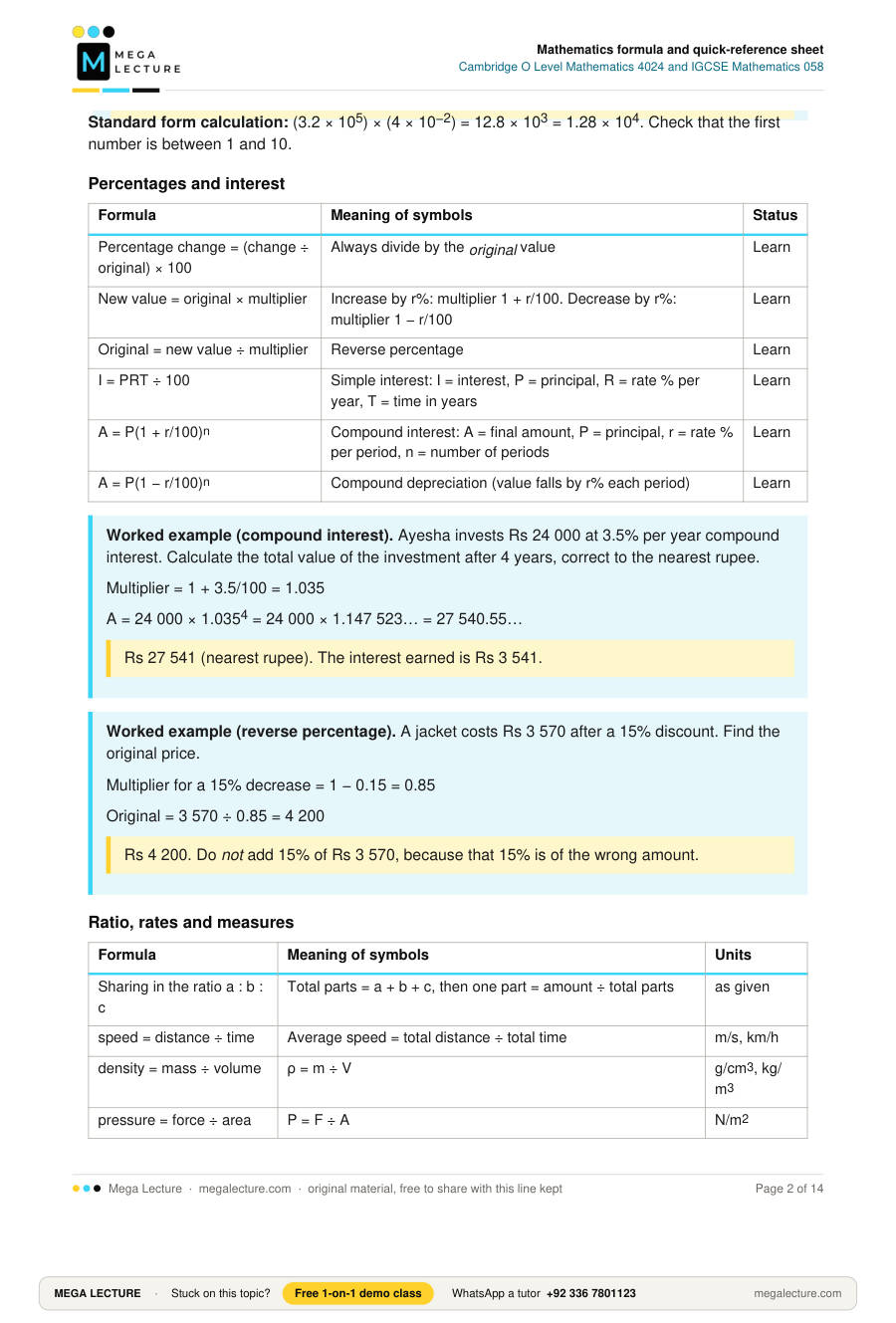
Standard form calculation: (3.2 × 105) × (4 × 10−2) = 12.8 × 103 = 1.28 × 10⁴. Check that the first number is between 1 and 10.
Percentages and interest
| Formula | Meaning of symbols | Status |
|---|---|---|
| Percentage change = (change ÷ original) × 100 | Always divide by the original value | Learn |
| New value = original × multiplier | Increase by r%: multiplier 1 + r/100. Decrease by r%: multiplier 1 − r/100 | Learn |
| Original = new value ÷ multiplier | Reverse percentage | Learn |
| I = PRT ÷ 100 | Simple interest: I = interest, P = principal, R = rate % per year, T = time in years | Learn |
| A = P(1 + r/100)n | Compound interest: A = final amount, P = principal, r = rate % per period, n = number of periods | Learn |
| A = P(1 − r/100)n | Compound depreciation (value falls by r% each period) | Learn |
Worked example (compound interest). Ayesha invests Rs 24 000 at 3.5% per year compound interest. Calculate the total value of the investment after 4 years, correct to the nearest rupee.
Multiplier = 1 + 3.5/100 = 1.035
A = 24 000 × 1.0354 = 24 000 × 1.147 523… = 27 540.55…
Rs 27 541 (nearest rupee). The interest earned is Rs 3 541.
Worked example (reverse percentage). A jacket costs Rs 3 570 after a 15% discount. Find the original price.
Multiplier for a 15% decrease = 1 − 0.15 = 0.85
Original = 3 570 ÷ 0.85 = 4 200
Rs 4 200. Do not add 15% of Rs 3 570, because that 15% is of the wrong amount.
Ratio, rates and measures
| Formula | Meaning of symbols | Units |
|---|---|---|
| Sharing in the ratio a : b : c | Total parts = a + b + c, then one part = amount ÷ total parts | as given |
| speed = distance ÷ time | Average speed = total distance ÷ total time | m/s, km/h |
| density = mass ÷ volume | ρ = m ÷ V | g/cm3, kg/m3 |
| pressure = force ÷ area | P = F ÷ A | N/m2 |
| Distance–time graph | gradient = speed | m/s |
| Speed–time graph | gradient = acceleration; area under the graph = distance travelled | m/s2; m |
All the rates above are Learn. Gradient of a curve at a point [E]: draw a tangent at that point and find the gradient of the tangent.
Example: Rs 4 500 shared in the ratio 2 : 3 : 4. Total parts = 9, one part = Rs 500, so the shares are Rs 1 000, Rs 1 500 and Rs 2 000.
Unit conversions that students forget
- 1 m = 100 cm, but 1 m2 = 10 000 cm2 and 1 m3 = 1 000 000 cm3.
- 1 litre = 1 000 cm3, and 1 m3 = 1 000 litres.
- To change km/h to m/s, divide by 3.6. To change m/s to km/h, multiply by 3.6.
- 1 g/cm3 = 1 000 kg/m3.
- Time: 2.25 hours = 2 hours 15 minutes, not 2 hours 25 minutes.
2. Algebra
Laws of indices
| Law | Example |
|---|---|
| am × an = am+n | x3 × x5 = x8 |
| am ÷ an = am−n | y7 ÷ y2 = y5 |
| (am)n = amn | (2p3)4 = 16p12 |
| a0 = 1 (a ≠ 0) | 70 = 1 |
| a−n = 1 ÷ an | 5−2 = 1/25 |
| a1/n = n√a [E] | 641/3 = 4 |
| am/n = (n√a)m [E] | 82/3 = (∛8)2 = 22 = 4 |
Combining two laws [E]: 27−2/3 = 1 ÷ 272/3 = 1 ÷ (∛27)2 = 1 ÷ 32 = 1/9.
Expanding and factorising
- (a + b)2 = a2 + 2ab + b2, which is not a2 + b2.
- (a − b)2 = a2 − 2ab + b2
- Difference of two squares: a2 − b2 = (a + b)(a − b). Example: 9x2 − 49 = (3x + 7)(3x − 7).
- Common factor first: 6x2 − 15x = 3x(2x − 5).
- Grouping: ax + ay + bx + by = a(x + y) + b(x + y) = (a + b)(x + y).
- Quadratic trinomial x2 + bx + c: find two numbers that multiply to c and add to b. Example: x2 − 2x − 15 = (x − 5)(x + 3).
- Three brackets [E]: expand two of them first, then multiply the result by the third.
Quadratic equations
| Formula | Meaning | Status |
|---|---|---|
| x = [−b ± √(b2 − 4ac)] ÷ 2a [E] | Solves ax2 + bx + c = 0 (a ≠ 0) | Usually printed: 4024 and 0580 Extended (not 0580 Core) |
| x2 + bx + c = (x + b/2)2 − (b/2)2 + c [E] | Completing the square | Learn |
| y = (x + p)2 + q has turning point (−p, q) [E] | Minimum point when the x2 coefficient is positive | Learn |
Worked example (quadratic formula) [E]. Solve 2x2 − 5x − 4 = 0, giving your answers correct to 2 decimal places.
a = 2, b = −5, c = −4
b2 − 4ac = (−5)2 − 4(2)(−4) = 25 + 32 = 57
x = [5 ± √57] ÷ 4 = (5 ± 7.5498…) ÷ 4
x = 12.5498… ÷ 4 = 3.137… or x = −2.5498… ÷ 4 = −0.637…
x = 3.14 or x = −0.64
Worked example (completing the square) [E]. Write 2x2 − 8x + 3 in the form a(x + p)2 + q.
Take out the 2 from the x terms: 2(x2 − 4x) + 3
Complete the square inside the bracket: x2 − 4x = (x − 2)2 − 4
So 2[(x − 2)2 − 4] + 3 = 2(x − 2)2 − 8 + 3
2(x − 2)2 − 5. The minimum point of y = 2x2 − 8x + 3 is (2, −5).
Sequences
| Type | nth term | How to find it |
|---|---|---|
| Linear (constant first difference d) | dn + (first term − d) | 7, 11, 15, 19, …: d = 4, so nth term = 4n + 3 |
| Quadratic (constant second difference) | an2 + bn + c | a = second difference ÷ 2. Subtract an2 from each term, then find the linear rule for what is left |
| Geometric (constant ratio r) [E] | a × rn−1 | 2, 6, 18, 54, …: nth term = 2 × 3n−1 |
| Cubic | often related to n3 | Compare with 1, 8, 27, 64, … |
Quadratic example: 3, 8, 15, 24, 35, … First differences 5, 7, 9, 11. Second difference 2, so a = 1. Terms − n2: 2, 4, 6, 8, 10, which is 2n. So the nth term = n2 + 2n.
Variation [E]
| Statement | Equation |
|---|---|
| y is proportional to x | y = kx |
| y is proportional to the square of x | y = kx2 |
| y is proportional to the cube of x | y = kx3 |
| y is proportional to the square root of x | y = k√x |
| y is inversely proportional to x | y = k ÷ x |
| y is inversely proportional to the square of x | y = k ÷ x2 |
| y is inversely proportional to the square root of x | y = k ÷ √x |
Method: write the equation with k, substitute the given pair of values to find k, then use the equation. Example: y is inversely proportional to x2, and y = 12 when x = 2. Then 12 = k ÷ 4, so k = 48 and y = 48 ÷ x2. When x = 4, y = 48 ÷ 16 = 3.
Functions [E]
- f(3) means substitute x = 3.
- fg(x) means do g first, then f: fg(x) = f(g(x)).
- Inverse f−1(x): write y = f(x), make x the subject, then replace y with x (swap the letters x and y).
- ff−1(x) = x.
Worked example (inverse function). f(x) = (3x − 2) ÷ 5. Find f−1(x).
y = (3x − 2) ÷ 5
5y = 3x − 2
5y + 2 = 3x
x = (5y + 2) ÷ 3
f−1(x) = (5x + 2) ÷ 3
3. Geometry
Angle facts (give the reason in words)
| Fact | Result |
|---|---|
| Angles on a straight line | add up to 180° |
| Angles around a point | add up to 360° |
| Vertically opposite angles | are equal |
| Alternate angles (parallel lines) | are equal |
| Corresponding angles (parallel lines) | are equal |
| Co-interior angles (parallel lines) | add up to 180° |
| Angles in a triangle | add up to 180° |
| Exterior angle of a triangle | equals the sum of the two opposite interior angles |
| Base angles of an isosceles triangle | are equal |
| Equilateral triangle | each angle is 60° |
| Angles in a quadrilateral | add up to 360° |
| Quadrilateral | Angle and diagonal properties |
|---|---|
| Parallelogram | opposite angles equal; diagonals bisect each other |
| Rectangle | all angles 90°; diagonals equal and bisect each other |
| Rhombus | opposite angles equal; diagonals bisect each other at 90° and bisect the angles |
| Kite | one pair of opposite angles equal; diagonals cross at 90° |
Polygons
| Formula | Meaning | Status |
|---|---|---|
| Sum of interior angles = (n − 2) × 180° | n = number of sides | Learn |
| Sum of exterior angles = 360° | true for any convex polygon | Learn |
| Exterior angle of a regular polygon = 360° ÷ n | number of sides n = 360° ÷ exterior angle | Learn |
| Interior angle + exterior angle = 180° | at each vertex | Learn |
Example: a regular 12-sided polygon has exterior angle 360° ÷ 12 = 30°, interior angle 180° − 30° = 150°, and interior angle sum (12 − 2) × 180° = 1 800°.
Circle theorems
- The angle in a semicircle is 90°.
- The angle at the centre is twice the angle at the circumference, when both stand on the same arc. [E]
- Angles in the same segment are equal. [E]
- Opposite angles of a cyclic quadrilateral add up to 180°. [E]
- The exterior angle of a cyclic quadrilateral equals the interior opposite angle. [E]
- A tangent is perpendicular to the radius at the point of contact.
- Two tangents from an external point are equal in length. [E]
- The perpendicular from the centre to a chord bisects the chord. [E]
- The perpendicular bisector of a chord passes through the centre. [E]
- Equal chords are equidistant from the centre. [E]
- Alternate segment theorem: the angle between a tangent and a chord equals the angle in the alternate segment. [E]
Use the standard wording above when you give a reason, for example "angle in a semicircle", "tangent ⊥ radius". An answer with no reason, or with a vague one, can lose the reasoning mark.
Similarity and congruence
| If the length scale factor is k | then |
|---|---|
| corresponding lengths | are multiplied by k |
| corresponding areas [E] | are multiplied by k2 |
| corresponding volumes (and masses of the same material) [E] | are multiplied by k3 |
| angles | stay the same |
Congruence conditions for triangles: SSS, SAS, ASA (or AAS) and RHS.
Worked example (similar solids) [E]. Two mathematically similar cones have heights 6 cm and 9 cm. The smaller cone has volume 80 cm3. Find the volume of the larger cone.
Length scale factor k = 9 ÷ 6 = 1.5
Volume scale factor k3 = 1.53 = 3.375
Volume = 80 × 3.375 = 270
270 cm3
If you are given areas or volumes and need a length, go backwards: length factor = √(area factor) = ∛(volume factor).
Pythagoras and trigonometry
| Formula | Meaning of symbols | Status |
|---|---|---|
| a2 + b2 = c2 | Right-angled triangle, c = hypotenuse (the side opposite the right angle) | Learn |
| sin θ = opp ÷ hyp | SOH. Right-angled triangles only | Learn |
| cos θ = adj ÷ hyp | CAH | Learn |
| tan θ = opp ÷ adj | TOA | Learn |
| a ÷ sin A = b ÷ sin B = c ÷ sin C [E] | Sine rule: side a is opposite angle A, and so on | Usually printed: 4024 and 0580 Extended (not 0580 Core) |
| a2 = b2 + c2 − 2bc cos A [E] | Cosine rule | Usually printed: 4024 and 0580 Extended (not 0580 Core) |
| cos A = (b2 + c2 − a2) ÷ 2bc [E] | Cosine rule rearranged to find an angle | Learn the rearrangement |
| Area = ½ab sin C [E] | Two sides and the angle between them | Usually printed: 4024 and 0580 Extended (not 0580 Core) |
Exact trigonometric values [E]
| θ | 0° | 30° | 45° | 60° | 90° |
|---|---|---|---|---|---|
| sin θ | 0 | ½ | √2/2 (= 1/√2) | √3/2 | 1 |
| cos θ | 1 | √3/2 | √2/2 (= 1/√2) | ½ | 0 |
| tan θ | 0 | √3/3 (= 1/√3) | 1 | √3 | undefined |
Status: Learn. These values are used in non-calculator questions.
Which rule?
- Right angle present: Pythagoras or SOHCAHTOA.
- No right angle, and you know a side with its opposite angle: sine rule.
- No right angle, and you know two sides with the angle between them, or all three sides: cosine rule.
- sin x = sin(180° − x). So a sine-rule angle may have a second, obtuse answer. Check whether the question says the angle is obtuse.
- Use degrees: make sure your calculator is in degree mode.
Worked example (sine rule) [E]. In triangle ABC, angle A = 48°, angle B = 67° and BC = 9.5 cm. Calculate AC.
BC = a (opposite A) and AC = b (opposite B).
b ÷ sin 67° = 9.5 ÷ sin 48°
b = 9.5 × sin 67° ÷ sin 48° = 9.5 × 0.920 50… ÷ 0.743 14… = 11.767…
AC = 11.8 cm (3 s.f.)
Worked example (cosine rule and area) [E]. A triangle has sides 7 cm, 8 cm and 10 cm. Calculate (a) the largest angle, (b) the area of the triangle.
(a) The largest angle, C, is opposite the longest side, 10 cm.
cos C = (72 + 82 − 102) ÷ (2 × 7 × 8) = (49 + 64 − 100) ÷ 112 = 13 ÷ 112 = 0.116 07…
C = cos−1(0.116 07…) = 83.33…°
(b) Area = ½ × 7 × 8 × sin 83.33…° = 28 × 0.9932… = 27.81…
(a) 83.3°; (b) 27.8 cm2 (3 s.f.). Keep the unrounded angle in your calculator for part (b).
Bearings
- A bearing is measured from north, clockwise, and written with three figures, for example 065°.
- "The bearing of A from B" means stand at B and face A.
- Back bearing: add 180° if the bearing is less than 180°, subtract 180° if it is more. If A from B is 065°, then B from A is 245°.
- Draw a north line at every point you use. Alternate and co-interior angles between north lines solve most bearing questions.
- Angle of elevation is measured up from the horizontal, angle of depression down from the horizontal.
4. Mensuration
Areas and perimeters
| Shape | Formula | Symbols | Status |
|---|---|---|---|
| Rectangle | A = lw | l = length, w = width | Learn |
| Triangle | A = ½bh | b = base, h = perpendicular height | Usually printed |
| Parallelogram | A = bh | h = perpendicular height, not the slanting side | Usually printed |
| Trapezium | A = ½(a + b)h | a, b = parallel sides, h = distance between them | Usually printed |
| Circle | A = πr2, C = 2πr = πd | r = radius, d = diameter | Usually printed |
| Arc length | (θ ÷ 360) × 2πr | θ = angle at centre in degrees | Learn |
| Sector area | (θ ÷ 360) × πr2 | θ = angle at centre in degrees | Learn |
Worked example (sector). A sector has radius 9 cm and angle 140°. Calculate (a) the arc length, (b) the area, (c) the perimeter.
(a) Arc = (140 ÷ 360) × 2 × π × 9 = (140 ÷ 360) × 18π = 7π = 21.99…
(b) Area = (140 ÷ 360) × π × 92 = (140 ÷ 360) × 81π = 31.5π = 98.96…
(c) Perimeter = arc + two radii = 7π + 9 + 9 = 39.99…
(a) 22.0 cm; (b) 99.0 cm2; (c) 40.0 cm (all 3 s.f.)
Volumes and surface areas
| Solid | Volume | Surface area | Status |
|---|---|---|---|
| Cuboid | V = lwh | 2(lw + lh + wh) | Learn |
| Prism | V = A × l (A = area of cross-section, l = length) | sum of all faces | Volume usually printed |
| Cylinder | V = πr2h | curved = 2πrh; total = 2πrh + 2πr2 | Volume and curved area usually printed; add the two ends yourself |
| Pyramid | V = ⅓ × base area × h | base + triangular faces | Volume usually printed |
| Cone | V = ⅓πr2h | curved = πrl; total = πrl + πr2 | Volume and curved area usually printed; add the base πr2 yourself |
| Sphere | V = (4/3)πr3 | 4πr2 | Usually printed |
| Hemisphere | V = (2/3)πr3 | curved = 2πr2; total solid = 3πr2 | Learn (halve the sphere) |
In a cone, h is the perpendicular height and l is the slant height, with l2 = r2 + h2 (Learn). Remember that "total surface area" of a closed solid includes the flat faces.
Worked example (cone). A solid cone has base radius 5 cm and perpendicular height 12 cm. Calculate (a) its volume, (b) its total surface area.
(a) V = ⅓ × π × 52 × 12 = ⅓ × π × 300 = 100π = 314.15…
(b) Slant height l = √(52 + 122) = √169 = 13 cm
Total surface area = πrl + πr2 = π × 5 × 13 + π × 25 = 65π + 25π = 90π = 282.74…
(a) 314 cm3; (b) 283 cm2 (3 s.f.)
5. Coordinate geometry
| Formula | Meaning | Status |
|---|---|---|
| m = (y2 − y1) ÷ (x2 − x1) | Gradient of the line through (x1, y1) and (x2, y2) | Learn |
| Midpoint = ((x1 + x2) ÷ 2, (y1 + y2) ÷ 2) | Average the coordinates | Learn |
| Length = √[(x2 − x1)2 + (y2 − y1)2] | Pythagoras on the grid | Learn |
| y = mx + c | m = gradient, c = y-intercept | Learn |
| Parallel lines | equal gradients: m1 = m2 | Learn |
| Perpendicular lines [E] | m1 × m2 = −1, so m2 = −1 ÷ m1 | Learn |
Worked example. A is (−2, 5) and B is (4, −3). Find (a) the gradient of AB, (b) the midpoint of AB, (c) the length of AB, (d) the equation of the perpendicular bisector of AB [E].
(a) m = (−3 − 5) ÷ (4 − (−2)) = −8 ÷ 6 = −4/3
(b) Midpoint = ((−2 + 4) ÷ 2, (5 + (−3)) ÷ 2) = (1, 1)
(c) Length = √(62 + (−8)2) = √(36 + 64) = √100 = 10
(d) Perpendicular gradient = −1 ÷ (−4/3) = 3/4. The line passes through the midpoint (1, 1): 1 = ¾(1) + c, so c = ¼.
(a) −4/3; (b) (1, 1); (c) 10 units; (d) y = ¾x + ¼, or 4y = 3x + 1
6. Vectors
- Column vector (x over y): x units right (left if negative), y units up (down if negative).
- Magnitude of the vector (x over y) = √(x2 + y2) [E]. Example: the vector (5 over −12) has magnitude √(25 + 144) = 13.
- Add or subtract vectors component by component. Multiplying by a scalar k multiplies each component by k.
- If OA = a and OB = b, then AB = b − a (go back along a, then along b). [E]
- If M is the midpoint of AB, then OM = a + ½(b − a) = ½(a + b). [E]
- If P divides AB in the ratio 1 : 3, then AP = ¼AB. [E]
- Parallel vectors: one is a scalar multiple of the other. If PQ = kQR as well, P, Q and R are collinear (they lie on one straight line). [E]
In written work, underline a vector (a in print is written a with a line underneath).
7. Transformations
| Transformation | To describe it fully you must state | What stays the same |
|---|---|---|
| Reflection | the mirror line, as an equation (for example y = −x or x = 3) | shape and size |
| Rotation | the centre, the angle, and the direction (clockwise or anticlockwise; not needed for 180°) | shape and size |
| Translation | the column vector | shape, size and orientation |
| Enlargement | the centre and the scale factor | shape and angles (lengths × k, area × k2) |
Enlargement facts
- Scale factor between 0 and 1: the image is smaller, but the transformation is still called an enlargement.
- Negative scale factor [E]: the image is on the opposite side of the centre and is inverted (turned through 180° about the centre). It is not a reflection.
- To find the centre, join corresponding points on the object and image and extend the lines until they meet.
- "Describe fully the single transformation": name one transformation only, with all its details. Naming two transformations scores nothing.
8. Statistics
Averages and spread
| Measure | Formula or method |
|---|---|
| Mean from a frequency table | Σfx ÷ Σf |
| Estimated mean from grouped data | Σfx ÷ Σf, where x = midpoint of each class |
| Median of n ordered values | the value in position (n + 1) ÷ 2 |
| Mode or modal class | the value or class with the highest frequency. With unequal class widths, the modal class is usually taken as the one with the highest frequency density (the tallest histogram bar); read the question, which normally makes clear which is meant |
| Range | largest value − smallest value |
| Interquartile range [E] | upper quartile − lower quartile |
Histograms and cumulative frequency [E]
| Formula or rule | Meaning |
|---|---|
| frequency density = frequency ÷ class width | Histogram bar heights. The area of each bar represents the frequency |
| frequency = frequency density × class width | Reading frequencies back from a histogram |
| Cumulative frequency: plot at the upper class boundary | Join the points with a smooth curve (or straight lines if told) |
| From a cumulative frequency curve with total n | median at n/2, lower quartile at n/4, upper quartile at 3n/4; percentiles in the same way |
Worked example (grouped data). The times, t minutes, that 30 students spent on homework are shown in the table.
| Time t (min) | Frequency f | Midpoint x | fx | Class width | Frequency density |
|---|---|---|---|---|---|
| 0 < t ≤ 10 | 4 | 5 | 20 | 10 | 0.4 |
| 10 < t ≤ 20 | 9 | 15 | 135 | 10 | 0.9 |
| 20 < t ≤ 40 | 12 | 30 | 360 | 20 | 0.6 |
| 40 < t ≤ 60 | 5 | 50 | 250 | 20 | 0.25 |
| Total | 30 | 765 |
Estimated mean = Σfx ÷ Σf = 765 ÷ 30 = 25.5
Estimated mean = 25.5 minutes. For the histogram [E], the bar heights are the frequency densities 0.4, 0.9, 0.6 and 0.25. With unequal class widths, the modal class is the one with the highest frequency density (the tallest bar), 10 < t ≤ 20, even though the 20 < t ≤ 40 class has the largest frequency.
9. Probability
| Rule | When to use it |
|---|---|
| 0 ≤ P(A) ≤ 1 | Every probability is between 0 and 1 |
| P(not A) = 1 − P(A) | Complement. Very useful for "at least one" |
| P(A or B) = P(A) + P(B) | Only for mutually exclusive events (they cannot both happen) |
| P(A and B) = P(A) × P(B) | Only for independent events |
| Expected frequency = P(A) × number of trials | Predicting outcomes |
| Relative frequency = number of successes ÷ number of trials | Experimental probability |
| P(A | B) = n(A ∩ B) ÷ n(B) [E] | Conditional probability from a Venn diagram or table |
On a tree diagram, multiply along the branches and add down between the outcomes you want. The probabilities on each set of branches from one point add up to 1.
Worked example (without replacement). A bag contains 5 red and 3 blue counters. Two counters are taken at random without replacement. Find the probability that (a) both counters are the same colour, (b) at least one counter is blue.
First pick: P(R) = 5/8, P(B) = 3/8. After a red has been taken: P(R) = 4/7, P(B) = 3/7. After a blue has been taken: P(R) = 5/7, P(B) = 2/7.
(a) P(RR) + P(BB) = (5/8 × 4/7) + (3/8 × 2/7) = 20/56 + 6/56 = 26/56 = 13/28
(b) P(at least one blue) = 1 − P(RR) = 1 − 20/56 = 36/56 = 9/14
(a) 13/28; (b) 9/14
Common mistakes
- Rounding too early. Keep full calculator values until the final answer. Give answers to 3 significant figures (angles in degrees to 1 decimal place) unless the question says otherwise.
- Finding a percentage change by dividing by the new value instead of the original.
- Answering a reverse-percentage question by adding the percentage to the reduced price.
- Using simple interest when the question says compound, or giving only the interest when it asks for the total amount (or the other way round).
- Getting the bounds wrong in a division or subtraction. The largest a − b and the largest a ÷ b both use LB(b).
- Expanding (x + 3)2 as x2 + 9.
- Sign errors in the quadratic formula when b is negative: −b becomes positive, and b2 is always positive.
- Doing fg(x) in the wrong order. g is applied first.
- Using SOHCAHTOA in a triangle with no right angle, or leaving the calculator in radians.
- Stating a circle theorem or angle fact with no reason, or a vague one ("because of the circle").
- Multiplying areas or volumes by the length scale factor instead of k2 or k3.
- Using slant height where perpendicular height is needed (cone and pyramid volume), or the reverse for curved surface area.
- Mixing units, for example cm and m in one calculation, or converting m2 to cm2 by multiplying by 100.
- Writing bearings with two figures (65° instead of 065°) or measuring them anticlockwise.
- Getting the perpendicular gradient wrong: the perpendicular to m = −4/3 is 3/4, not 4/3 or −3/4.
- Describing a transformation only partly, for example "rotation 90°" with no centre or direction, or giving two transformations.
- Drawing histogram bars with frequency, not frequency density, on the vertical axis, or plotting cumulative frequency at class midpoints instead of upper class boundaries.
- Using class limits instead of midpoints for an estimated mean, or dividing by the number of classes instead of Σf.
- In "without replacement" questions, forgetting that the second-pick fractions have a denominator one less.
