
AS Level · Mathematics 9709 · Pure Mathematics 2: revision notes
Pure Mathematics 2: revision notes
Opens inside this page. Prefer your own PDF app? Open the PDF.
New: small group classes for AS Level Maths are opening, at a lower fee than one-to-one. Join the waiting list
Check yourself
5 quick questions on AS Level Maths
Tap an answer to see if you are right, and why. Free, no sign-up.
Start the free testWas this note useful?
Full text of Pure Mathematics 2: revision notes
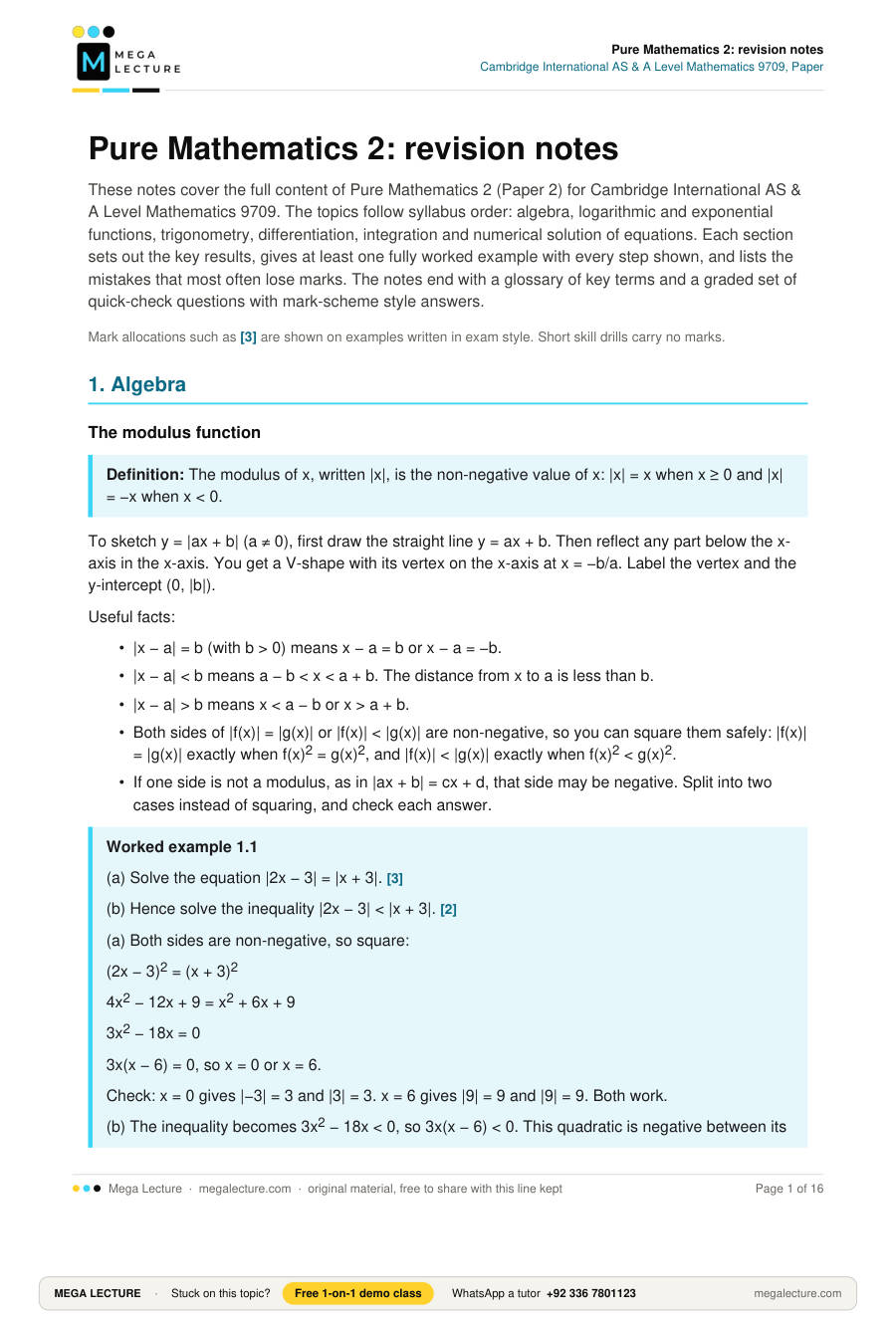
These notes cover the full content of Pure Mathematics 2 (Paper 2) for Cambridge International AS & A Level Mathematics 9709. The topics follow syllabus order: algebra, logarithmic and exponential functions, trigonometry, differentiation, integration and numerical solution of equations. Each section sets out the key results, gives at least one fully worked example with every step shown, and lists the mistakes that most often lose marks. The notes end with a glossary of key terms and a graded set of quick-check questions with mark-scheme style answers.
Mark allocations such as [3] are shown on examples written in exam style. Short skill drills carry no marks.
1. Algebra
The modulus function
Definition: The modulus of x, written |x|, is the non-negative value of x: |x| = x when x ≥ 0 and |x| = −x when x < 0.
To sketch y = |ax + b| (a ≠ 0), first draw the straight line y = ax + b. Then reflect any part below the x-axis in the x-axis. You get a V-shape with its vertex on the x-axis at x = −b/a. Label the vertex and the y-intercept (0, |b|).
Useful facts:
- |x − a| = b (with b > 0) means x − a = b or x − a = −b.
- |x − a| < b means a − b < x < a + b. The distance from x to a is less than b.
- |x − a| > b means x < a − b or x > a + b.
- Both sides of |f(x)| = |g(x)| or |f(x)| < |g(x)| are non-negative, so you can square them safely: |f(x)| = |g(x)| exactly when f(x)2 = g(x)2, and |f(x)| < |g(x)| exactly when f(x)2 < g(x)2.
- If one side is not a modulus, as in |ax + b| = cx + d, that side may be negative. Split into two cases instead of squaring, and check each answer.
Worked example 1.1
(a) Solve the equation |2x − 3| = |x + 3|. [3]
(b) Hence solve the inequality |2x − 3| < |x + 3|. [2]
(a) Both sides are non-negative, so square:
(2x − 3)2 = (x + 3)2
4x2 − 12x + 9 = x2 + 6x + 9
3x2 − 18x = 0
3x(x − 6) = 0, so x = 0 or x = 6.
Check: x = 0 gives |−3| = 3 and |3| = 3. x = 6 gives |9| = 9 and |9| = 9. Both work.
(b) The inequality becomes 3x2 − 18x < 0, so 3x(x − 6) < 0. This quadratic is negative between its roots, so 0 < x < 6.
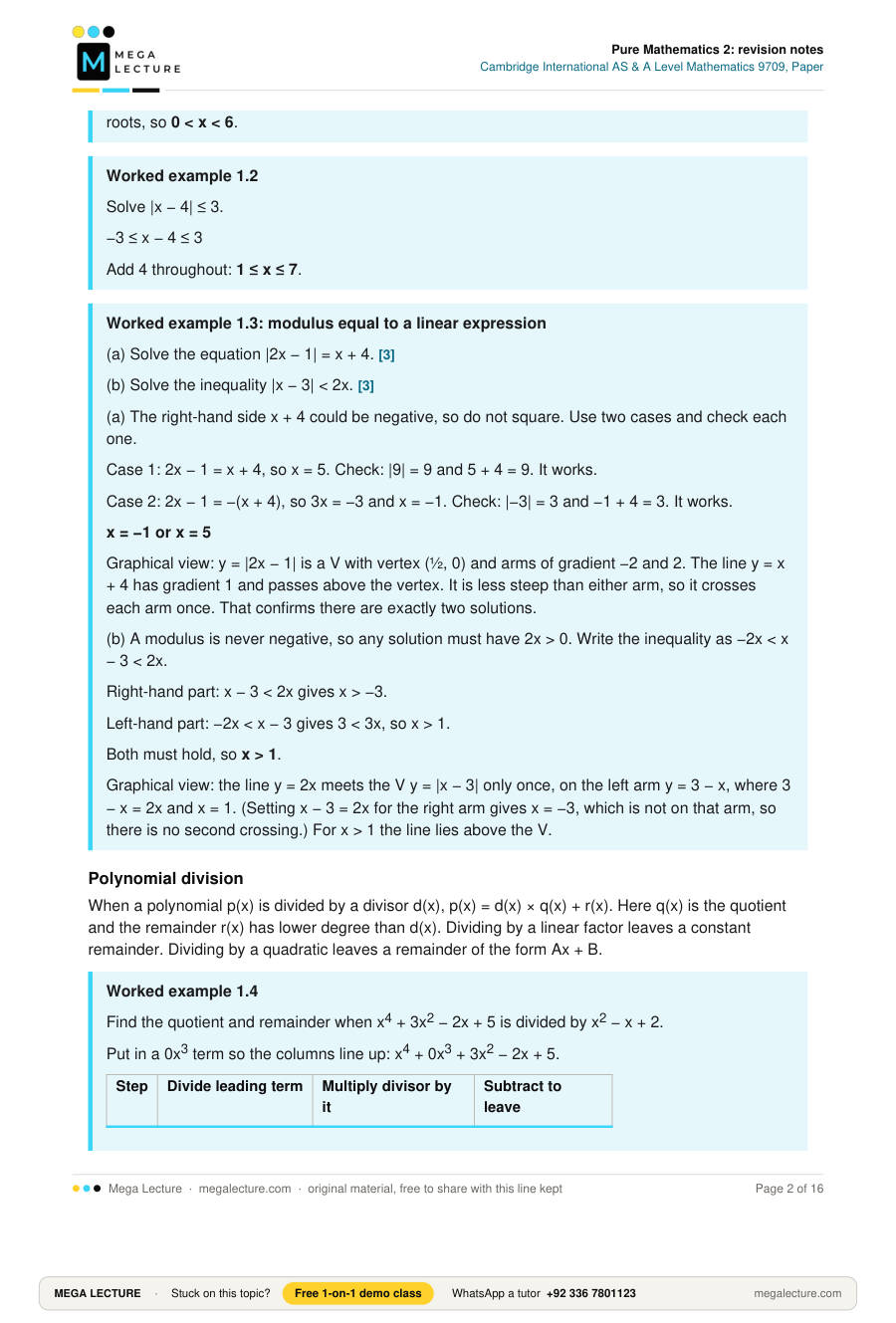
Worked example 1.2
Solve |x − 4| ≤ 3.
−3 ≤ x − 4 ≤ 3
Add 4 throughout: 1 ≤ x ≤ 7.
Worked example 1.3: modulus equal to a linear expression
(a) Solve the equation |2x − 1| = x + 4. [3]
(b) Solve the inequality |x − 3| < 2x. [3]
(a) The right-hand side x + 4 could be negative, so do not square. Use two cases and check each one.
Case 1: 2x − 1 = x + 4, so x = 5. Check: |9| = 9 and 5 + 4 = 9. It works.
Case 2: 2x − 1 = −(x + 4), so 3x = −3 and x = −1. Check: |−3| = 3 and −1 + 4 = 3. It works.
x = −1 or x = 5
Graphical view: y = |2x − 1| is a V with vertex (½, 0) and arms of gradient −2 and 2. The line y = x + 4 has gradient 1 and passes above the vertex. It is less steep than either arm, so it crosses each arm once. That confirms there are exactly two solutions.
(b) A modulus is never negative, so any solution must have 2x > 0. Write the inequality as −2x < x − 3 < 2x.
Right-hand part: x − 3 < 2x gives x > −3.
Left-hand part: −2x < x − 3 gives 3 < 3x, so x > 1.
Both must hold, so x > 1.
Graphical view: the line y = 2x meets the V y = |x − 3| only once, on the left arm y = 3 − x, where 3 − x = 2x and x = 1. (Setting x − 3 = 2x for the right arm gives x = −3, which is not on that arm, so there is no second crossing.) For x > 1 the line lies above the V.
Polynomial division
When a polynomial p(x) is divided by a divisor d(x), p(x) = d(x) × q(x) + r(x). Here q(x) is the quotient and the remainder r(x) has lower degree than d(x). Dividing by a linear factor leaves a constant remainder. Dividing by a quadratic leaves a remainder of the form Ax + B.
Worked example 1.4
Find the quotient and remainder when x4 + 3x2 − 2x + 5 is divided by x2 − x + 2.
Put in a 0x3 term so the columns line up: x4 + 0x3 + 3x2 − 2x + 5.
| Step | Divide leading term | Multiply divisor by it | Subtract to leave |
|---|---|---|---|
| 1 | x4 ÷ x2 = x2 | x4 − x3 + 2x2 | x3 + x2 − 2x + 5 |
| 2 | x3 ÷ x2 = x | x3 − x2 + 2x | 2x2 − 4x + 5 |
| 3 | 2x2 ÷ x2 = 2 | 2x2 − 2x + 4 | −2x + 1 |
The remainder −2x + 1 has degree 1, which is less than 2, so stop.
Quotient = x2 + x + 2, remainder = −2x + 1.
Check: (x2 − x + 2)(x2 + x + 2) = (x2 + 2)2 − x2 = x4 + 3x2 + 4. Adding −2x + 1 gives x4 + 3x2 − 2x + 5. Correct.
Factor and remainder theorems
Remainder theorem: When a polynomial p(x) is divided by (ax − b), the remainder is p(b/a).
Factor theorem: (ax − b) is a factor of p(x) if and only if p(b/a) = 0.
Worked example 1.5
The polynomial p(x) = 2x3 + ax2 − 7x + b, where a and b are constants, has (x − 2) as a factor. When p(x) is divided by (x + 1) the remainder is 12.
(a) Find the values of a and b. [4]
(b) Hence solve p(x) = 0, giving the non-integer roots in exact form. [4]
(a) Factor theorem: p(2) = 0.
16 + 4a − 14 + b = 0, so 4a + b = −2 ... (1)
Remainder theorem: p(−1) = 12.
−2 + a + 7 + b = 12, so a + b = 7 ... (2)
(1) − (2): 3a = −9, so a = −3, and then b = 10.
(b) p(x) = 2x3 − 3x2 − 7x + 10. Divide by (x − 2) to get the quotient 2x2 + x − 5.
Check: (x − 2)(2x2 + x − 5) = 2x3 + x2 − 5x − 4x2 − 2x + 10 = 2x3 − 3x2 − 7x + 10.
Solve 2x2 + x − 5 = 0: x = (−1 ± √(1 + 40)) / 4 = (−1 ± √41) / 4.
Roots: x = 2, x = (−1 + √41)/4, x = (−1 − √41)/4.
Common errors: leaving out a missing power when you divide, putting x = 1 instead of x = −1 for the factor (x + 1), and squaring an equation like |f(x)| = g(x) when g(x) might be negative. If you square, check every solution in the original equation.
2. Logarithmic and exponential functions
Definitions and laws
Definition: If ax = b (with a > 0, a ≠ 1), then x = logab.
The natural logarithm ln x is logex, where e ≈ 2.718. The functions ex and ln x are inverses of each other: eln x = x for x > 0 and ln(ex) = x for all x.
| Law | Statement |
|---|---|
| Product | loga(xy) = logax + logay |
| Quotient | loga(x/y) = logax − logay |
| Power | loga(xk) = k logax |
| Special values | loga1 = 0, logaa = 1 |
Graphs. The graph of y = ex passes through (0, 1), lies entirely above the x-axis and has the x-axis as an asymptote as x → −∞. The graph of y = ln x is its reflection in the line y = x. It passes through (1, 0), exists only for x > 0 and has the y-axis as an asymptote.
Worked example 2.1: solving ax = b type equations
Solve 32x+1 = 5x, giving your answer correct to 3 significant figures. [3]
Take natural logs of both sides: (2x + 1) ln 3 = x ln 5
2x ln 3 + ln 3 = x ln 5
x(2 ln 3 − ln 5) = −ln 3
x = −ln 3 / (2 ln 3 − ln 5) = −ln 3 / ln 1.8
x = −1.0986... / 0.5878... = −1.87 (3 s.f.)
Worked example 2.2: a hidden quadratic
Solve e2x − 4ex − 5 = 0, giving the exact answer.
Let u = ex. Then u2 − 4u − 5 = 0, so (u − 5)(u + 1) = 0.
u = 5 or u = −1. Since ex > 0 for every x, ex = −1 has no solution.
ex = 5, so x = ln 5.
Worked example 2.3: using the laws
Solve 2 ln x − ln(x + 2) = ln 3.
ln(x2) − ln(x + 2) = ln 3, so ln(x2/(x + 2)) = ln 3.
x2 = 3(x + 2), which gives x2 − 3x − 6 = 0.
x = (3 ± √33)/2. For ln x to exist we need x > 0, so reject the negative root.
x = (3 + √33)/2 ≈ 4.37
Reducing to linear form
Experimental data often follow y = kxn or y = kax. Taking logs changes each into a straight line Y = mX + c.
| Model | Take logs | Plot | Gradient | Vertical intercept |
|---|---|---|---|---|
| y = kxn | ln y = n ln x + ln k | ln y against ln x | n | ln k |
| y = kax | ln y = (ln a)x + ln k | ln y against x | ln a | ln k |
You can use log10 in place of ln. Then the intercept is log10k and you recover k = 10intercept.
Worked example 2.4
The variables x and y satisfy y = kxn. The graph of ln y against ln x is a straight line through (0.5, 2.3) and (2.1, 5.5). Find n and k. [4]
Gradient = (5.5 − 2.3)/(2.1 − 0.5) = 3.2/1.6 = 2, so n = 2.
Put the point (0.5, 2.3) into ln y = n ln x + ln k: 2.3 = 2(0.5) + ln k, so ln k = 1.3.
k = e1.3 = 3.67 (3 s.f.)
Worked example 2.5
The variables satisfy y = kax. The graph of ln y against x is a straight line through (1, 1.9) and (4, 3.1). Find a and k. [4]
Gradient = (3.1 − 1.9)/(4 − 1) = 0.4 = ln a, so a = e0.4 = 1.49 (3 s.f.)
Using (1, 1.9): 1.9 = 0.4(1) + ln k, so ln k = 1.5 and k = e1.5 = 4.48 (3 s.f.)
Exponential inequalities
Solve ax < b in the same way as the equation: take logs of both sides. Take care when you divide by a logarithm. If 0 < a < 1, then ln a is negative, and dividing by a negative number reverses the inequality sign.
Worked example 2.6
Find the smallest integer n such that 0.8n < 0.05. [3]
Take natural logs (ln is an increasing function, so the sign stays the same): n ln 0.8 < ln 0.05.
ln 0.8 = −0.2231... is negative, so dividing by it reverses the sign:
n > ln 0.05 / ln 0.8 = (−2.9957...)/(−0.2231...) = 13.43...
The smallest integer is n = 14.
Check: 0.813 = 0.0550 (not less than 0.05) and 0.814 = 0.0440 (less than 0.05).
Common errors: writing ln(x + y) = ln x + ln y (this is false), forgetting to reject solutions that make a logarithm undefined, giving the intercept (ln k) as the answer when the question asks for k, and forgetting to reverse the inequality when dividing by a negative logarithm such as ln 0.8.
3. Trigonometry
Reciprocal functions
sec θ = 1/cos θ, cosec θ = 1/sin θ, cot θ = 1/tan θ = cos θ/sin θ
sec2θ ≡ 1 + tan2θ and cosec2θ ≡ 1 + cot2θ
To get the first identity, divide sin2θ + cos2θ ≡ 1 by cos2θ. For the second, divide it by sin2θ.
Graphs of the reciprocal functions (0° ≤ θ ≤ 360°). Each graph has a vertical asymptote wherever the function it is the reciprocal of equals zero.
| Graph | Vertical asymptotes | Range | Period | Shape and key points |
|---|---|---|---|---|
| y = sec θ | θ = 90°, 270° | y ≤ −1 or y ≥ 1 | 360° | U-shaped branches. Local minimum points (0°, 1) and (360°, 1); local maximum point (180°, −1). |
| y = cosec θ | θ = 0°, 180°, 360° | y ≤ −1 or y ≥ 1 | 360° | U-shaped branches. Local minimum point (90°, 1); local maximum point (270°, −1). |
| y = cot θ | θ = 0°, 180°, 360° | all real values | 180° | Decreasing on each branch. Crosses the θ-axis at 90° and 270°. |
In radians the asymptotes of sec θ are at π/2 and 3π/2, and those of cosec θ and cot θ are at 0, π and 2π.
Worked example 3.1
Solve 2 tan2θ + sec θ = 1 for 0° ≤ θ ≤ 360°. [5]
Replace tan2θ with sec2θ − 1: 2(sec2θ − 1) + sec θ − 1 = 0
2 sec2θ + sec θ − 3 = 0
(2 sec θ + 3)(sec θ − 1) = 0
sec θ = 1 gives cos θ = 1, so θ = 0° or 360°.
sec θ = −3/2 gives cos θ = −2/3. The basic angle is cos−1(2/3) = 48.19°. Cosine is negative in the second and third quadrants, so θ = 180° − 48.19° = 131.8° or θ = 180° + 48.19° = 228.2°.
θ = 0°, 131.8°, 228.2°, 360°
Compound and double angle formulae
| Compound angle | Double angle |
|---|---|
| sin(A ± B) = sin A cos B ± cos A sin B | sin 2A = 2 sin A cos A |
| cos(A ± B) = cos A cos B ∓ sin A sin B | cos 2A = cos2A − sin2A = 2cos2A − 1 = 1 − 2sin2A |
| tan(A ± B) = (tan A ± tan B)/(1 ∓ tan A tan B) | tan 2A = 2 tan A/(1 − tan2A) |
Rearranging cos 2A gives two results you will need for integration: cos2A = ½(1 + cos 2A) and sin2A = ½(1 − cos 2A).
Worked example 3.2
Find the exact value of tan 15°.
tan 15° = tan(45° − 30°) = (tan 45° − tan 30°)/(1 + tan 45° tan 30°) = (1 − 1/√3)/(1 + 1/√3)
Multiply top and bottom by √3: (√3 − 1)/(√3 + 1)
Multiply top and bottom by (√3 − 1): (√3 − 1)2/(3 − 1) = (4 − 2√3)/2 = 2 − √3
Worked example 3.3
Prove the identity (1 − cos 2θ)/sin 2θ ≡ tan θ.
Use cos 2θ = 1 − 2sin2θ, because it makes the 1s cancel.
LHS = (1 − (1 − 2sin2θ))/(2 sin θ cos θ) = 2sin2θ/(2 sin θ cos θ) = sin θ/cos θ = tan θ = RHS.
Solving in radians
Many Paper 2 questions give the interval in radians, for example 0 ≤ θ ≤ 2π. Set your calculator to radians and use these rules to find the second solution from the basic angle β.
| Equation | Solutions in 0 ≤ θ ≤ 2π (degrees version) |
|---|---|
| sin θ = k (k > 0) | β and π − β (β and 180° − β) |
| cos θ = k (k > 0) | β and 2π − β (β and 360° − β) |
| tan θ = k (k > 0) | β and π + β (β and 180° + β) |
Worked example 3.5: a radian equation
Solve 3 sin 2θ = 4 sin θ for 0 ≤ θ ≤ 2π. Give non-exact answers correct to 3 significant figures. [5]
Use sin 2θ = 2 sin θ cos θ: 6 sin θ cos θ − 4 sin θ = 0.
Factorise. Do not divide by sin θ, because sin θ could be zero: 2 sin θ(3 cos θ − 2) = 0.
sin θ = 0 gives θ = 0, π, 2π.
cos θ = 2/3 gives the basic angle β = cos−1(2/3) = 0.8411 rad. Cosine is positive in the first and fourth quadrants, so θ = 0.8411 or θ = 2π − 0.8411 = 5.4421.
θ = 0, 0.841, π, 5.44, 2π
Worked example 3.5 is numbered after 3.4 in the next subsection; it sits here so the radian rules are next to it.
The R cos(θ ± α) form
An expression a cos θ + b sin θ can be written as a single term R cos(θ − α), where R = √(a2 + b2) and tan α = b/a. The same method gives R cos(θ + α), R sin(θ + α) and R sin(θ − α). Always expand the target form and compare coefficients.
Because −1 ≤ cos(θ ± α) ≤ 1, the maximum value is R and the minimum value is −R.
Worked example 3.4
(a) Express 2 cos θ − 5 sin θ in the form R cos(θ + α), where R > 0 and 0° < α < 90°. Give α to 2 decimal places. [3]
(b) State the greatest and least values of 2 cos θ − 5 sin θ and the values of θ in 0° ≤ θ ≤ 360° at which they occur. [2]
(c) Solve 2 cos θ − 5 sin θ = 3 for 0° < θ < 360°. [3]
(a) R cos(θ + α) = R cos θ cos α − R sin θ sin α. Comparing coefficients:
R cos α = 2 and R sin α = 5
R = √(4 + 25) = √29 and tan α = 5/2, so α = 68.199...° = 68.20°.
2 cos θ − 5 sin θ = √29 cos(θ + 68.20°)
(b) The greatest value is √29 (≈ 5.39). It occurs when θ + 68.20° = 360°, so θ = 291.80°.
The least value is −√29. It occurs when θ + 68.20° = 180°, so θ = 111.80°.
(c) √29 cos(θ + α) = 3, so cos(θ + α) = 3/√29 = 0.5571.
The range becomes 68.20° < θ + α < 428.20°.
The basic angle is cos−1(3/√29) = 56.145°. In this range, θ + α = 360° − 56.145° = 303.855° or θ + α = 360° + 56.145° = 416.145°.
Subtract the unrounded α = 68.199°: θ = 303.855° − 68.199° = 235.656° and θ = 416.145° − 68.199° = 347.946°.
θ = 235.7° or θ = 347.9° (1 d.p.)
The value 56.145° is not in the range, so it is not used. Always write down the new interval for θ + α before you list solutions. Keep unrounded values in your calculator until the last step: working from the rounded 416.15° − 68.20° gives 347.95°, which would round wrongly to 348.0°.
Common errors: working in degrees when the question uses radians (or the other way round), losing solutions by dividing through by a trig function that could be zero, giving α from tan α = a/b instead of b/a, and rounding α or the basic angle too early.
4. Differentiation
Standard derivatives
| y | dy/dx |
|---|---|
| xn | nxn−1 |
| ex | ex |
| eax+b | aeax+b |
| ln x | 1/x |
| ln(ax + b) | a/(ax + b) |
| sin x | cos x |
| cos x | −sin x |
| tan x | sec2x |
The trigonometric results hold only when x is in radians.
Product, quotient and chain rules
Chain rule: if y = f(u) and u = g(x), then dy/dx = (dy/du) × (du/dx).
Product rule: if y = uv, then dy/dx = u(dv/dx) + v(du/dx).
Quotient rule: if y = u/v, then dy/dx = (v(du/dx) − u(dv/dx))/v2.
Worked example 4.1: chain rule
Differentiate y = ln(3x2 + 1).
Let u = 3x2 + 1, so du/dx = 6x and y = ln u, dy/du = 1/u.
dy/dx = (1/u) × 6x = 6x/(3x2 + 1)
Worked example 4.2: product rule and stationary points
Find the x-coordinates of the stationary points of y = x2e3x.
u = x2, du/dx = 2x; v = e3x, dv/dx = 3e3x.
dy/dx = x2(3e3x) + e3x(2x) = xe3x(3x + 2)
Set dy/dx = 0. Since e3x is never zero, x = 0 or 3x + 2 = 0.
x = 0 or x = −2/3
Worked example 4.3: quotient rule
Find the coordinates of the stationary point of y = (ln x)/x.
u = ln x, du/dx = 1/x; v = x, dv/dx = 1.
dy/dx = (x × (1/x) − ln x × 1)/x2 = (1 − ln x)/x2
dy/dx = 0 when ln x = 1, so x = e and y = (ln e)/e = 1/e.
Stationary point: (e, 1/e)
Parametric differentiation
If x and y are both given in terms of a parameter t, then dy/dx = (dy/dt) ÷ (dx/dt), provided dx/dt ≠ 0.
Worked example 4.4
A curve has parametric equations x = t2 + 1, y = t3 − 2t. Find the equation of the tangent at the point where t = 2. [4]
dx/dt = 2t and dy/dt = 3t2 − 2, so dy/dx = (3t2 − 2)/(2t).
At t = 2: x = 5, y = 8 − 4 = 4, and dy/dx = (12 − 2)/4 = 5/2.
Tangent: y − 4 = (5/2)(x − 5), which simplifies to 2y = 5x − 17.
Implicit differentiation
When the equation mixes x and y, differentiate every term with respect to x. Use the chain rule for terms in y: d/dx(y2) = 2y(dy/dx). Use the product rule for terms such as xy: d/dx(xy) = x(dy/dx) + y.
Worked example 4.5
The curve C has equation x2 + 3xy − y2 = 3.
(a) Find the gradient of C at the point (1, 1). [4]
(b) Find the equation of the normal to C at (1, 1). [2]
(a) Check that the point lies on the curve: 1 + 3 − 1 = 3.
Differentiate: 2x + 3x(dy/dx) + 3y − 2y(dy/dx) = 0
(3x − 2y)(dy/dx) = −(2x + 3y)
dy/dx = (2x + 3y)/(2y − 3x)
At (1, 1): dy/dx = 5/(2 − 3) = −5
(b) The normal is perpendicular to the tangent, so its gradient is −1/(−5) = 1/5.
y − 1 = (1/5)(x − 1), which simplifies to 5y = x + 4.
Tangents parallel to the axes. A tangent is parallel to the x-axis where the numerator of dy/dx is zero, and parallel to the y-axis where the denominator is zero. Substitute the condition back into the curve's equation to find the points. For the curve in Worked example 4.5:
- Parallel to the x-axis: 2x + 3y = 0, so y = −2x/3. Substituting gives −13x2/9 = 3, which has no real solutions. So C has no tangents parallel to the x-axis.
- Parallel to the y-axis: 2y − 3x = 0, so y = 3x/2. Substituting gives 13x2/4 = 3, so x2 = 12/13. The points are (0.961, 1.44) and (−0.961, −1.44), to 3 s.f.
Common errors: forgetting the dy/dx on terms in y, treating 3xy as 3y instead of using the product rule, putting the terms of the quotient rule numerator in the wrong order, and using the tangent gradient in a normal equation instead of −1 ÷ gradient.
5. Integration
Standard integrals
| f(x) | ∫ f(x) dx |
|---|---|
| eax+b | (1/a)eax+b + c |
| 1/(ax + b) | (1/a) ln|ax + b| + c |
| sin(ax + b) | −(1/a) cos(ax + b) + c |
| cos(ax + b) | (1/a) sin(ax + b) + c |
| sec2(ax + b) | (1/a) tan(ax + b) + c |
Each result comes from reversing the chain rule. You can always check an integral by differentiating your answer.
Worked example 5.1
Find the exact value of ∫13 6/(2x − 1) dx.
∫ 6/(2x − 1) dx = 6 × ½ ln|2x − 1| = 3 ln|2x − 1|
On the interval 1 ≤ x ≤ 3, 2x − 1 is positive, so the modulus signs can be dropped.
[3 ln(2x − 1)]13 = 3 ln 5 − 3 ln 1 = 3 ln 5
Worked example 5.2
Find the exact value of ∫0ln 2 e2x dx.
[½e2x]0ln 2 = ½e2 ln 2 − ½e0 = ½(4) − ½ = 3/2
e2 ln 2 = eln 4 = 4.
Using identities
You cannot integrate sin2x, cos2x or tan2x directly. Rewrite them first:
- cos2x = ½(1 + cos 2x)
- sin2x = ½(1 − cos 2x)
- tan2x = sec2x − 1, so ∫ tan2x dx = tan x − x + c
Worked example 5.3
Find the exact value of ∫0π/2 cos2x dx.
∫ cos2x dx = ∫ ½(1 + cos 2x) dx = ½x + ¼ sin 2x
[½x + ¼ sin 2x]0π/2 = (π/4 + ¼ sin π) − (0 + 0) = π/4
The trapezium rule
With n strips of equal width h = (b − a)/n:
∫ab y dx ≈ ½h[y0 + yn + 2(y1 + y2 + ... + yn−1)]
If the curve bends upwards (is convex) across the interval, the straight tops of the trapezia lie above the curve, so the rule gives an over-estimate. If the curve bends downwards (is concave), the tops lie below it, so the rule gives an under-estimate.
Worked example 5.4
(a) Use the trapezium rule with 4 intervals to estimate ∫02 √(1 + x3) dx, giving your answer to 3 significant figures. [3]
(b) The curve y = √(1 + x3) bends upwards for 0 ≤ x ≤ 2. State, with a reason, whether your estimate is an over-estimate or an under-estimate. [1]
(a) h = (2 − 0)/4 = 0.5
| x | 0 | 0.5 | 1 | 1.5 | 2 |
|---|---|---|---|---|---|
| y | 1 | 1.06066 | 1.41421 | 2.09165 | 3 |
Area ≈ ½ × 0.5 × [1 + 3 + 2(1.06066 + 1.41421 + 2.09165)]
= 0.25 × [4 + 9.13304] = 0.25 × 13.13304 = 3.283...
≈ 3.28
(b) Over-estimate. The curve bends upwards, so the top of each trapezium lies above the curve.
Common errors: counting ordinates instead of intervals (4 intervals need 5 y-values), setting the calculator to degrees for trig integrands, and forgetting the modulus signs or the factor 1/a in ln|ax + b|.
6. Numerical solution of equations
Locating a root
By sketching graphs. Rearrange f(x) = 0 into the form g(x) = h(x), where both sides are graphs you can sketch. The number of times the graphs cross is the number of roots. If one graph is increasing everywhere and the other is decreasing everywhere, they can cross at most once.
By sign change. Suppose f is continuous on [a, b] and f(a), f(b) have opposite signs. Then the equation f(x) = 0 has at least one root between a and b.
To show that a root equals some value to a given accuracy, test the bounds of the rounding interval. For example, to show a root is 2.96 to 2 d.p., show there is a sign change between f(2.955) and f(2.965). A sign change method can fail: a discontinuity (such as an asymptote) can produce a sign change with no root, and two roots close together can produce no sign change at all.
Iteration xn+1 = F(xn)
Rearrange f(x) = 0 into the form x = F(x). Choose a starting value x1 and work out x2 = F(x1), x3 = F(x2), and so on. If the sequence converges, its limit α satisfies α = F(α) and so is a root. On a graph, α is where the line y = x meets the curve y = F(x).
Convergence: An iteration may fail to converge, or may converge to a different root. Paper 2 does not ask you to explain why, or to test a formula for convergence. Use the iterative formula you are given, and show enough iterates to justify the accuracy asked for.
Beyond the syllabus (not examined on Paper 2): whether an iteration converges depends on how steep the graph of y = F(x) is near the root. You will not be asked about this.
Worked example 6.1
(a) By sketching a suitable pair of graphs, show that the equation 2x + ln x = 7 has exactly one real root. [2]
(b) Show by calculation that this root lies between 2.5 and 3. [2]
(c) The sequence given by xn+1 = ½(7 − ln xn), with x1 = 3, converges to α. Show that α is the root of the equation in part (a). [1]
(d) Use this iterative formula to find α correct to 2 decimal places. Give each iterate to 4 decimal places. [3]
(a) Write the equation as ln x = 7 − 2x. Sketch y = ln x: it exists only for x > 0, passes through (1, 0), increases throughout and has the y-axis as an asymptote. Sketch y = 7 − 2x: a straight line through (0, 7) and (3.5, 0), decreasing throughout.
An increasing graph and a decreasing graph cross at most once. They do cross: close to x = 0 the line is above the curve, and at x = 3.5 the curve (ln 3.5 > 0) is above the line. So there is exactly one root.
(b) Let f(x) = 2x + ln x − 7.
f(2.5) = 5 + 0.9163 − 7 = −1.084 < 0 and f(3) = 6 + 1.0986 − 7 = 0.0986 > 0.
The sign changes (and f is continuous for x > 0), so the root lies between 2.5 and 3.
(c) In the limit, α = ½(7 − ln α). So 2α = 7 − ln α, which gives 2α + ln α = 7. So α is a root of the equation, and by part (a) it is the only one.
(d) Iterates:
| n | xn |
|---|---|
| 1 | 3 |
| 2 | 2.9507 |
| 3 | 2.9590 |
| 4 | 2.9576 |
| 5 | 2.9578 |
| 6 | 2.9578 |
The iterates settle down, and from x3 onwards they all round to 2.96. As a check, f(2.955) = −0.0065 < 0 and f(2.965) = 0.0169 > 0, so the sign changes.
α = 2.96 (2 d.p.)
Common errors: not giving both function values, or not writing a conclusion such as "sign change, so a root lies in (2.5, 3)" (mentioning that f is continuous is good practice); giving too few iterates or rounding them too early; and giving the answer to the wrong number of decimal places.
Key terms
| Term | Definition |
|---|---|
| Modulus | The non-negative size of a number, ignoring its sign. |
| Quotient | The polynomial q(x) in p(x) = d(x)q(x) + r(x). |
| Remainder | The polynomial r(x) left after division, with degree lower than the divisor. |
| Factor theorem | (ax − b) is a factor of p(x) exactly when p(b/a) = 0. |
| Natural logarithm | ln x = logex, the inverse of ex. |
| Linear form | A rearrangement Y = mX + c that turns a non-linear relationship into a straight-line graph. |
| Identity | An equation true for every value of the variable, written with ≡. |
| Reciprocal trig functions | sec θ, cosec θ and cot θ, the reciprocals of cos θ, sin θ and tan θ. |
| Stationary point | A point on a curve where dy/dx = 0. |
| Normal | The line through a point on a curve perpendicular to the tangent there. |
| Parameter | A third variable (often t or θ) in terms of which both x and y are given. |
| Implicit equation | An equation linking x and y that is not written in the form y = f(x). |
| Trapezium rule | A numerical method that estimates a definite integral by adding the areas of trapezia of equal width. |
| Iteration | Repeatedly using xn+1 = F(xn) to build a sequence that approaches a root. |
| Convergence | A sequence of iterates approaching a fixed limit. |
Quick check
- Solve the equation |3x − 1| = 5. [2]
- Solve the inequality |x + 2| > |x − 4|. [3]
- Find the quotient and remainder when 2x3 − x2 + 4x + 1 is divided by x2 + 1. [3]
- Find the remainder when 4x3 − x2 + 2x − 7 is divided by (2x − 1). [2]
- Solve 5x−1 = 12, giving your answer correct to 3 significant figures. [3]
- The variables x and y satisfy y = kax. The graph of ln y against x is a straight line through (0, 0.7) and (2, 1.9). Find the values of k and a, correct to 3 significant figures. [4]
- Prove the identity cot θ − tan θ ≡ 2 cot 2θ. [3]
- Solve 3 cos 2x + 7 cos x + 5 = 0 for 0° ≤ x ≤ 360°. [5]
- Express 3 sin θ + 2 cos θ in the form R sin(θ + α), where R > 0 and 0 < α < π/2, giving α in radians to 3 decimal places. Hence state the maximum value of 3 sin θ + 2 cos θ and the smallest positive value of θ at which it occurs. [4]
- Given y = e2x sin 3x, find dy/dx and hence the gradient of the curve at x = 0. [3]
- The curve y2 + xy = 6 passes through the point (1, 2). (a) Find the gradient of the curve at (1, 2). [4] (b) Find the equation of the normal at (1, 2). [2]
- A curve has parametric equations x = 2 sin t, y = cos 2t. Show that dy/dx = −x. [4]
- Find the exact value of ∫0π/6 4 sin2x dx. [4]
- Find ∫ (e1−2x + sec2 3x) dx. [2]
- Use the trapezium rule with 3 intervals to estimate ∫14 ln(x + 1) dx, giving your answer to 3 significant figures. State, with a reason, whether your answer is an over-estimate or an under-estimate. [4]
- (a) Show that x3 + 2x − 7 = 0 has a root between 1 and 2. [2] (b) Use the iterative formula xn+1 = (7 − 2xn)1/3 with x1 = 1.5 to find the root correct to 3 decimal places. Give each iterate to 4 decimal places. [3]
Answers
M = method mark, A = accuracy mark (depends on the method mark), B = independent mark.
- 3x − 1 = 5 or 3x − 1 = −5, so x = 2 or x = −4/3. (B1 each)
- M1 square both sides: x2 + 4x + 4 > x2 − 8x + 16. A1 12x > 12. A1 x > 1.
- 2x3 ÷ x2 = 2x; subtract 2x(x2 + 1) to leave −x2 + 2x + 1. Then −x2 ÷ x2 = −1; subtract −(x2 + 1) to leave 2x + 2. Quotient 2x − 1, remainder 2x + 2. (M1 division as far as the second quotient term, A1 quotient, A1 remainder.) Check: (x2 + 1)(2x − 1) + 2x + 2 = 2x3 − x2 + 4x + 1.
- p(½) = 4(1/8) − 1/4 + 1 − 7 = −23/4 (that is, −5.75). (M1 substitute x = ½, A1)
- (x − 1) ln 5 = ln 12, so x = 1 + ln 12/ln 5 = 1 + 1.544 = 2.54. (M1 take logs, M1 rearrange, A1)
- Gradient = (1.9 − 0.7)/2 = 0.6 = ln a, so a = e0.6 = 1.82. Intercept = 0.7 = ln k, so k = e0.7 = 2.01. (M1 gradient, A1 a, M1 intercept, A1 k)
- LHS = cos θ/sin θ − sin θ/cos θ = (cos2θ − sin2θ)/(sin θ cos θ) = cos 2θ/(½ sin 2θ) = 2 cos 2θ/sin 2θ = 2 cot 2θ. (M1 single fraction, M1 use double angle formulae, A1 complete proof)
- M1 use cos 2x = 2cos2x − 1: 3(2cos2x − 1) + 7 cos x + 5 = 0. A1 6cos2x + 7 cos x + 2 = 0. M1 factorise: (2 cos x + 1)(3 cos x + 2) = 0. A1 cos x = −1/2 gives x = 120°, 240°. A1 cos x = −2/3 gives x = 131.8°, 228.2°. So x = 120°, 131.8°, 228.2°, 240°.
- R sin(θ + α) = R sin θ cos α + R cos θ sin α, so R cos α = 3 and R sin α = 2. B1 R = √13. M1 tan α = 2/3, A1 α = 0.588 rad. B1 maximum √13 (≈ 3.61) when θ + α = π/2, so θ = π/2 − 0.588 = 0.983 rad.
- dy/dx = 2e2x sin 3x + 3e2x cos 3x = e2x(2 sin 3x + 3 cos 3x). At x = 0 the gradient is 1 × (0 + 3) = 3. (M1 product rule, A1 derivative, A1 gradient)
- (a) M1 differentiate implicitly, using the product rule on xy. A1 2y(dy/dx) + y + x(dy/dx) = 0. M1 rearrange: dy/dx = −y/(2y + x). A1 at (1, 2): dy/dx = −2/5. (b) M1 normal gradient = 5/2, so y − 2 = (5/2)(x − 1). A1 2y = 5x − 1.
- B1 dx/dt = 2 cos t. B1 dy/dt = −2 sin 2t. M1 dy/dx = −2 sin 2t/(2 cos t) = −4 sin t cos t/(2 cos t). A1 = −2 sin t = −x.
- M1 use the identity: 4 sin2x = 2 − 2 cos 2x. A1 integral 2x − sin 2x. M1 apply limits: [2x − sin 2x]0π/6 = π/3 − sin(π/3). A1 π/3 − √3/2.
- −½e1−2x + ⅓ tan 3x + c. (B1 each term)
- h = 1. The y-values at x = 1, 2, 3, 4 are ln 2 = 0.69315, ln 3 = 1.09861, ln 4 = 1.38629, ln 5 = 1.60944 (M1). Area ≈ ½ × 1 × [0.69315 + 1.60944 + 2(1.09861 + 1.38629)] (M1) = ½ × 7.27240 = 3.64 (A1). Under-estimate, because the curve bends downwards (y″ = −1/(x + 1)2 < 0), so the tops of the trapezia lie below it (B1).
- (a) M1 f(x) = x3 + 2x − 7: f(1) = −4 < 0 and f(2) = 5 > 0. A1 sign change, so a root lies between 1 and 2. (b) M1 iterate: x1 = 1.5, x2 = 1.5874, x3 = 1.5639, x4 = 1.5703, x5 = 1.5686, x6 = 1.5690, x7 = 1.5689, x8 = 1.5690. A1 iterates correct. A1 root = 1.569 (3 d.p.), justified by iterates that agree to 3 d.p. or by the sign-change check f(1.5685) = −0.0042 < 0 and f(1.5695) = 0.0052 > 0.
