
AS Level · Mathematics 9709 · Pure Mathematics 3: revision notes
Pure Mathematics 3: revision notes
Opens inside this page. Prefer your own PDF app? Open the PDF.
New: small group classes for AS Level Maths are opening, at a lower fee than one-to-one. Join the waiting list
Check yourself
5 quick questions on AS Level Maths
Tap an answer to see if you are right, and why. Free, no sign-up.
Start the free testWas this note useful?
Full text of Pure Mathematics 3: revision notes
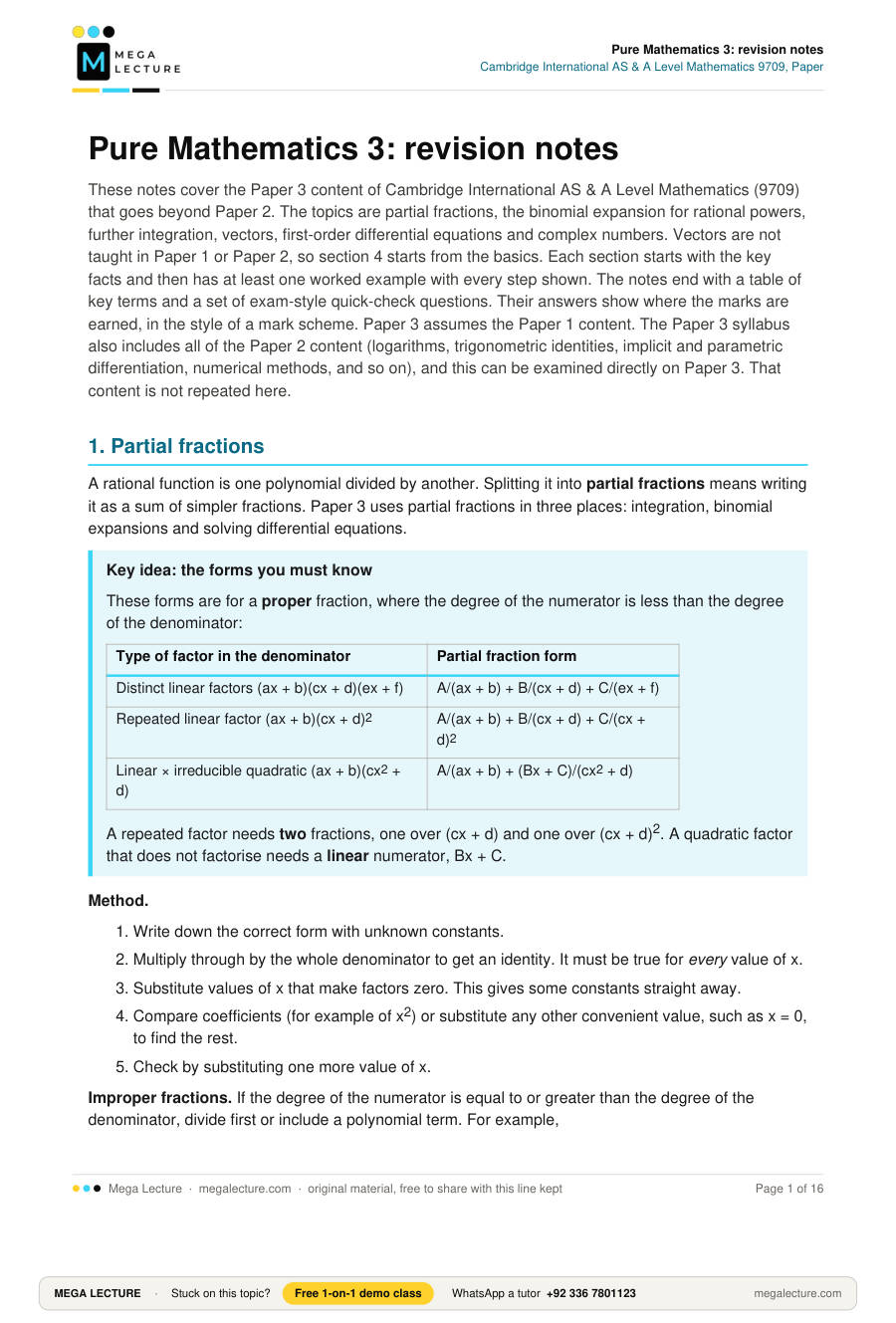
These notes cover the Paper 3 content of Cambridge International AS & A Level Mathematics (9709) that goes beyond Paper 2. The topics are partial fractions, the binomial expansion for rational powers, further integration, vectors, first-order differential equations and complex numbers. Vectors are not taught in Paper 1 or Paper 2, so section 4 starts from the basics. Each section starts with the key facts and then has at least one worked example with every step shown. The notes end with a table of key terms and a set of exam-style quick-check questions. Their answers show where the marks are earned, in the style of a mark scheme. Paper 3 assumes the Paper 1 content. The Paper 3 syllabus also includes all of the Paper 2 content (logarithms, trigonometric identities, implicit and parametric differentiation, numerical methods, and so on), and this can be examined directly on Paper 3. That content is not repeated here.
1. Partial fractions
A rational function is one polynomial divided by another. Splitting it into partial fractions means writing it as a sum of simpler fractions. Paper 3 uses partial fractions in three places: integration, binomial expansions and solving differential equations.
Key idea: the forms you must know
These forms are for a proper fraction, where the degree of the numerator is less than the degree of the denominator:
| Type of factor in the denominator | Partial fraction form |
|---|---|
| Distinct linear factors (ax + b)(cx + d)(ex + f) | A/(ax + b) + B/(cx + d) + C/(ex + f) |
| Repeated linear factor (ax + b)(cx + d)2 | A/(ax + b) + B/(cx + d) + C/(cx + d)2 |
| Linear × irreducible quadratic (ax + b)(cx2 + d) | A/(ax + b) + (Bx + C)/(cx2 + d) |
A repeated factor needs two fractions, one over (cx + d) and one over (cx + d)2. A quadratic factor that does not factorise needs a linear numerator, Bx + C.
Method.
- Write down the correct form with unknown constants.
- Multiply through by the whole denominator to get an identity. It must be true for every value of x.
- Substitute values of x that make factors zero. This gives some constants straight away.
- Compare coefficients (for example of x2) or substitute any other convenient value, such as x = 0, to find the rest.
- Check by substituting one more value of x.
Improper fractions. If the degree of the numerator is equal to or greater than the degree of the denominator, divide first or include a polynomial term. For example,
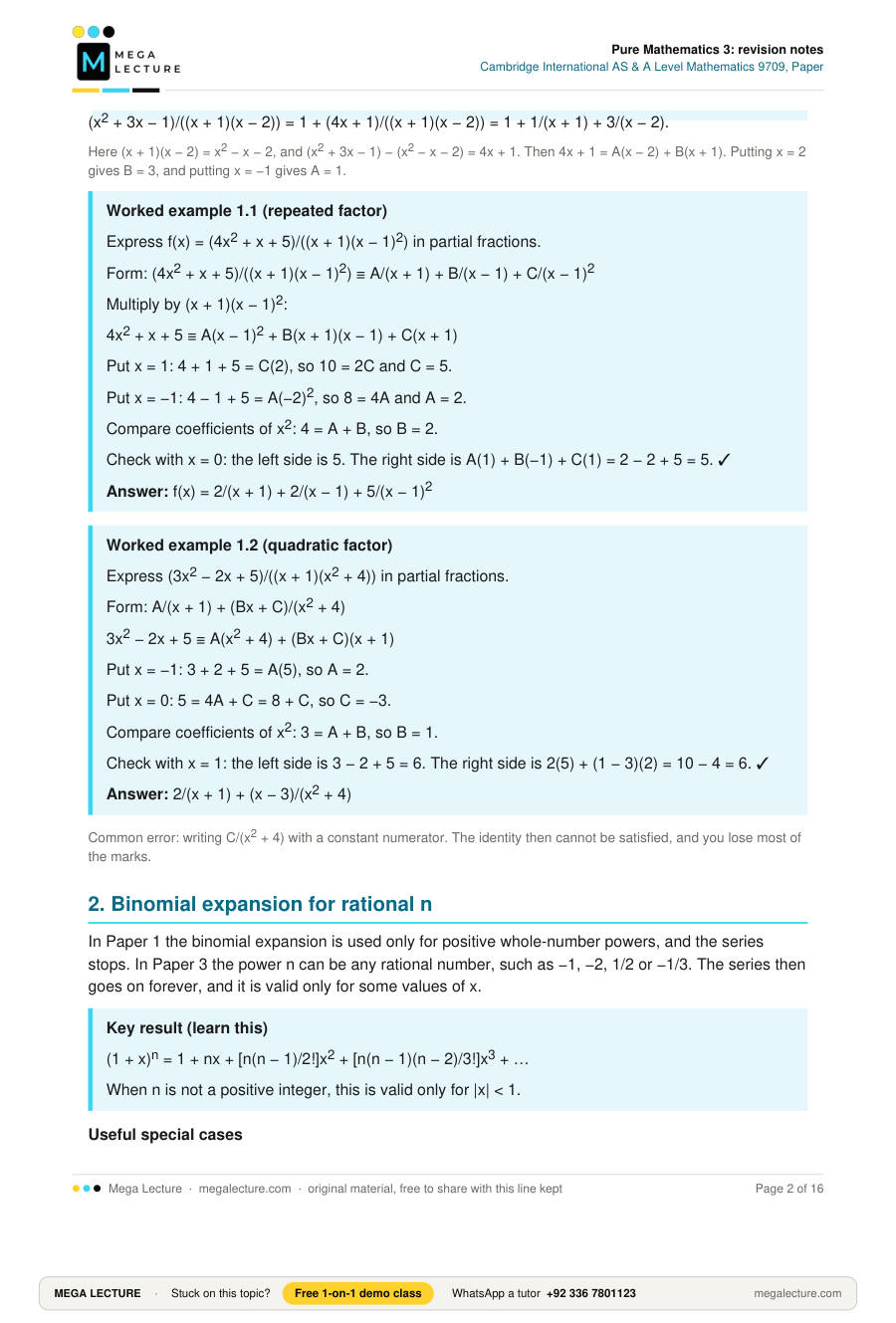
(x2 + 3x − 1)/((x + 1)(x − 2)) = 1 + (4x + 1)/((x + 1)(x − 2)) = 1 + 1/(x + 1) + 3/(x − 2).
Here (x + 1)(x − 2) = x2 − x − 2, and (x2 + 3x − 1) − (x2 − x − 2) = 4x + 1. Then 4x + 1 = A(x − 2) + B(x + 1). Putting x = 2 gives B = 3, and putting x = −1 gives A = 1.
Worked example 1.1 (repeated factor)
Express f(x) = (4x2 + x + 5)/((x + 1)(x − 1)2) in partial fractions.
Form: (4x2 + x + 5)/((x + 1)(x − 1)2) ≡ A/(x + 1) + B/(x − 1) + C/(x − 1)2
Multiply by (x + 1)(x − 1)2:
4x2 + x + 5 ≡ A(x − 1)2 + B(x + 1)(x − 1) + C(x + 1)
Put x = 1: 4 + 1 + 5 = C(2), so 10 = 2C and C = 5.
Put x = −1: 4 − 1 + 5 = A(−2)2, so 8 = 4A and A = 2.
Compare coefficients of x2: 4 = A + B, so B = 2.
Check with x = 0: the left side is 5. The right side is A(1) + B(−1) + C(1) = 2 − 2 + 5 = 5. ✓
Answer: f(x) = 2/(x + 1) + 2/(x − 1) + 5/(x − 1)2
Worked example 1.2 (quadratic factor)
Express (3x2 − 2x + 5)/((x + 1)(x2 + 4)) in partial fractions.
Form: A/(x + 1) + (Bx + C)/(x2 + 4)
3x2 − 2x + 5 ≡ A(x2 + 4) + (Bx + C)(x + 1)
Put x = −1: 3 + 2 + 5 = A(5), so A = 2.
Put x = 0: 5 = 4A + C = 8 + C, so C = −3.
Compare coefficients of x2: 3 = A + B, so B = 1.
Check with x = 1: the left side is 3 − 2 + 5 = 6. The right side is 2(5) + (1 − 3)(2) = 10 − 4 = 6. ✓
Answer: 2/(x + 1) + (x − 3)/(x2 + 4)
Common error: writing C/(x2 + 4) with a constant numerator. The identity then cannot be satisfied, and you lose most of the marks.
2. Binomial expansion for rational n
In Paper 1 the binomial expansion is used only for positive whole-number powers, and the series stops. In Paper 3 the power n can be any rational number, such as −1, −2, 1/2 or −1/3. The series then goes on forever, and it is valid only for some values of x.
Key result (learn this)
(1 + x)n = 1 + nx + [n(n − 1)/2!]x2 + [n(n − 1)(n − 2)/3!]x3 + …
When n is not a positive integer, this is valid only for |x| < 1.
Useful special cases
| Expression | First terms | Valid for |
|---|---|---|
| (1 + x)−1 | 1 − x + x2 − x3 + … | |x| < 1 |
| (1 − x)−1 | 1 + x + x2 + x3 + … | |x| < 1 |
| (1 − x)−2 | 1 + 2x + 3x2 + 4x3 + … | |x| < 1 |
| (1 + x)1/2 | 1 + (1/2)x − (1/8)x2 + (1/16)x3 − … | |x| < 1 |
When the bracket does not start with 1. Take out the constant first:
(a + bx)n = an(1 + bx/a)n, which is valid for |bx/a| < 1, that is, |x| < |a/b|.
Tips
- Put brackets round the whole term being substituted. For example, (3x/4)2 = 9x2/16, not 3x2/4.
- Watch the signs. With a negative n and a negative x-term there are many sign changes.
- If a question asks for the validity, give it as an inequality in x.
- When you add expansions, the result is valid only where every part is valid, so take the smallest range. For example, (1 + 3x)−1 needs |x| < 1/3 and (2 − x)−1 needs |x| < 2, so their sum is valid only for |x| < 1/3.
Worked example 2.1
Expand (4 + 3x)−1/2 in ascending powers of x, up to and including the term in x3, simplifying the coefficients. State the set of values of x for which the expansion is valid.
Take out the 4: (4 + 3x)−1/2 = 4−1/2(1 + 3x/4)−1/2 = (1/2)(1 + 3x/4)−1/2
Let u = 3x/4 and n = −1/2:
(1 + u)−1/2 = 1 + (−1/2)u + [(−1/2)(−3/2)/2]u2 + [(−1/2)(−3/2)(−5/2)/6]u3 + …
= 1 − (1/2)u + (3/8)u2 − (5/16)u3 + …
Substitute u = 3x/4:
−(1/2)(3x/4) = −3x/8
(3/8)(9x2/16) = 27x2/128
−(5/16)(27x3/64) = −135x3/1024
Multiply by 1/2:
(4 + 3x)−1/2 ≈ 1/2 − (3/16)x + (27/256)x2 − (135/2048)x3
Validity: |3x/4| < 1, so |x| < 4/3.
Check with x = 0.1. The exact value is 4.3−1/2 = 0.482243… The series gives 0.5 − 0.01875 + 0.001055 − 0.000066 = 0.482239. ✓
Worked example 2.2 (using partial fractions)
Using the result of worked example 1.1, expand f(x) = (4x2 + x + 5)/((x + 1)(x − 1)2) in ascending powers of x, up to and including the term in x2.
f(x) = 2/(x + 1) + 2/(x − 1) + 5/(x − 1)2
Write each term so that its bracket starts with 1:
2/(1 + x) = 2(1 + x)−1 = 2(1 − x + x2 − …) = 2 − 2x + 2x2
2/(x − 1) = −2/(1 − x) = −2(1 − x)−1 = −2(1 + x + x2 + …) = −2 − 2x − 2x2
5/(x − 1)2 = 5/(1 − x)2 = 5(1 − x)−2 = 5(1 + 2x + 3x2 + …) = 5 + 10x + 15x2
Add: f(x) ≈ 5 + 6x + 15x2. Every part is valid for |x| < 1. The smallest range is therefore |x| < 1, so the whole expansion is valid for |x| < 1.
Quick check: f(0) = 5/(1 × 1) = 5, which matches the constant term.
3. Further integration
Paper 3 adds three techniques: substitution, integration by parts and partial fractions. It also adds two new standard integrals. Every indefinite integral needs the constant of integration, + c.
3.1 Standard integrals
| f(x) | ∫ f(x) dx | Where it comes from |
|---|---|---|
| xn (n ≠ −1) | xn+1/(n + 1) + c | Revision (Paper 1) |
| 1/(ax + b) | (1/a) ln|ax + b| + c | Revision (Paper 2) |
| eax+b | (1/a)eax+b + c | Revision (Paper 2) |
| sin(ax + b) | −(1/a)cos(ax + b) + c | Revision (Paper 2) |
| cos(ax + b) | (1/a)sin(ax + b) + c | Revision (Paper 2) |
| sec2(ax + b) | (1/a)tan(ax + b) + c | Revision (Paper 2) |
| 1/(a2 + x2) | (1/a)tan−1(x/a) + c | New in Paper 3 |
| kf′(x)/f(x) | k ln|f(x)| + c | New in Paper 3 |
Angles are in radians throughout calculus. Some of these results are in the formula list (MF19), but you should know them without looking them up.
Trigonometric identities used before integrating (revision from Paper 2)
- sin2x = (1/2)(1 − cos 2x) and cos2x = (1/2)(1 + cos 2x)
- tan2x = sec2x − 1
- 2 sin x cos x = sin 2x
For example, ∫0π/4 sin2x dx = ∫0π/4 (1/2)(1 − cos 2x) dx = [x/2 − (sin 2x)/4]0π/4 = π/8 − 1/4.
3.2 Integration by substitution
Method
- Use the given substitution, u = g(x) or x = h(u).
- Differentiate to connect dx and du, for example dx = h′(u) du.
- Rewrite the whole integrand in terms of u. No x may be left.
- For a definite integral, change the limits to u-values. Then there is no need to go back to x.
- Integrate and evaluate.
Worked example 3.1
Use the substitution u = x + 1 to find the exact value of ∫03 x/√(x + 1) dx.
u = x + 1, so x = u − 1 and dx = du.
Limits: when x = 0, u = 1. When x = 3, u = 4.
∫14 (u − 1)/u1/2 du = ∫14 (u1/2 − u−1/2) du
= [(2/3)u3/2 − 2u1/2]14
At u = 4: (2/3)(8) − 2(2) = 16/3 − 4 = 4/3
At u = 1: 2/3 − 2 = −4/3
Value = 4/3 − (−4/3) = 8/3
3.3 Integration by parts
Formula (learn this)
∫ u (dv/dx) dx = uv − ∫ v (du/dx) dx
Choosing u: pick the factor that becomes simpler when you differentiate it. If ln x is present, it is almost always u, because we cannot easily integrate it. With a polynomial times ex, sin x or cos x, let u be the polynomial. You may need to apply the formula twice.
A classic case is ∫ ln x dx. Write it as ∫ (ln x)(1) dx with u = ln x and dv/dx = 1. This gives x ln x − ∫ x(1/x) dx = x ln x − x + c.
Worked example 3.2
Find the exact value of ∫14 √x ln x dx.
Let u = ln x, so du/dx = 1/x. Let dv/dx = x1/2, so v = (2/3)x3/2.
∫ √x ln x dx = (2/3)x3/2 ln x − ∫ (2/3)x3/2(1/x) dx = (2/3)x3/2 ln x − ∫ (2/3)x1/2 dx = (2/3)x3/2 ln x − (4/9)x3/2
Evaluate from 1 to 4, using 43/2 = 8 and ln 1 = 0:
At x = 4: (2/3)(8) ln 4 − (4/9)(8) = (16/3) ln 4 − 32/9
At x = 1: 0 − 4/9 = −4/9
Subtract: (16/3) ln 4 − 32/9 + 4/9 = (16/3) ln 4 − 28/9
Answer: since ln 4 = 2 ln 2, the value is (32/3) ln 2 − 28/9 (≈ 4.28).
3.4 Integration using partial fractions
Once a fraction is split up, each part is a standard integral. The possible terms are:
- A/(ax + b) → (A/a) ln|ax + b|
- C/(cx + d)2 → −C/(c(cx + d)). This is a power, not a logarithm.
- (Bx + C)/(x2 + a2). Split it into Bx/(x2 + a2), which gives (B/2) ln(x2 + a2), and C/(x2 + a2), which gives (C/a) tan−1(x/a).
Worked example 3.3
Show that ∫02 (3x2 − 2x + 5)/((x + 1)(x2 + 4)) dx = 2 ln 3 + (1/2) ln 2 − 3π/8.
From worked example 1.2, the integrand is 2/(x + 1) + x/(x2 + 4) − 3/(x2 + 4).
Integrate each term:
∫ 2/(x + 1) dx = 2 ln(x + 1). No modulus sign is needed because x + 1 > 0 on [0, 2].
∫ x/(x2 + 4) dx = (1/2) ln(x2 + 4), since the numerator is half the derivative of the denominator.
∫ 3/(x2 + 4) dx = 3 × (1/2) tan−1(x/2) = (3/2) tan−1(x/2)
So the integral = [2 ln(x + 1) + (1/2) ln(x2 + 4) − (3/2) tan−1(x/2)]02
At x = 2: 2 ln 3 + (1/2) ln 8 − (3/2)(π/4)
At x = 0: 0 + (1/2) ln 4 − 0
Subtract: 2 ln 3 + (1/2)(ln 8 − ln 4) − 3π/8 = 2 ln 3 + (1/2) ln 2 − 3π/8 (≈ 1.366)
4. Vectors
Since the 2020 syllabus, vectors are taught only in Paper 3, so this section starts from the basics. Vectors can be written in column form, which in these notes is shown as (2, −1, 3), or in the form 2i − j + 3k. Everything below also works in two dimensions, using i and j only.
4.1 Vector basics
Key facts (learn these)
- The position vector of a point A is a = OA, the vector from the origin O to A.
- The displacement vector from A to B is AB = b − a. The distance AB is |b − a|.
- To add or subtract vectors, add or subtract their components. To find ka, multiply every component by the scalar k. Then ka is parallel to a, in the same direction if k > 0 and in the opposite direction if k < 0.
- Two non-zero vectors are parallel if and only if one is a scalar multiple of the other.
- The magnitude of a = (a1, a2, a3) is |a| = √(a12 + a22 + a32).
- A unit vector has magnitude 1. The unit vector in the direction of a is â = a/|a|. For example, |2i − j + 2k| = √(4 + 1 + 4) = 3, so the unit vector in this direction is (1/3)(2i − j + 2k).
- The midpoint M of AB has position vector (1/2)(a + b).
Worked example 4.1 (basics)
The points A, B and C have coordinates (1, 2, −1), (3, 1, 2) and (7, −1, 8).
(a) Find AB, the distance AB and the unit vector in the direction of AB. (b) Find the position vector of the midpoint of AB. (c) Show that A, B and C lie on a straight line.
(a) AB = b − a = (3 − 1, 1 − 2, 2 − (−1)) = (2, −1, 3)
|AB| = √(4 + 1 + 9) = √14, so the unit vector is (1/√14)(2, −1, 3).
(b) (1/2)(a + b) = (1/2)(4, 3, 1) = (2, 3/2, 1/2)
(c) AC = c − a = (6, −3, 9) = 3(2, −1, 3) = 3AB.
So AC is parallel to AB. The two vectors also share the point A, so A, B and C are collinear. B lies between A and C, and AC is three times as long as AB.
4.2 Lines and the scalar product
Key facts (learn these)
- Scalar product: a.b = a1b1 + a2b2 + a3b3 = |a||b| cos θ, where θ is the angle between a and b.
- Two non-zero vectors a and b are perpendicular if and only if a.b = 0.
- Vector equation of the line through the point with position vector a, parallel to the direction b: r = a + tb, where t is a scalar parameter.
- Line through the points A and B: r = a + t(b − a).
4.3 How two lines can be related
| Relationship | Direction vectors | Equations |
|---|---|---|
| Parallel (distinct) | Multiples of each other | No common point |
| Intersecting | Not multiples | One solution for the two parameters that satisfies all three component equations |
| Skew | Not multiples | No solution: the three component equations are inconsistent |
Skew lines only occur in three dimensions. They are not parallel and they never meet.
If the direction vectors are multiples of each other, test whether a point of one line lies on the other line. If it does, the two equations describe the same line. If it does not, the lines are parallel and distinct.
Method for intersection. Use a different parameter for each line, say s and t. Set the x-components equal, then the y-components and the z-components. Solve any two of these equations for s and t, then check in the third. If the third equation holds, the lines meet, and substituting back gives the point. If it fails and the lines are not parallel, they are skew.
Worked example 4.2 (intersecting lines and the angle between them)
Line l: r = (1, 2, −1) + s(2, −1, 3). Line m: r = (1, −1, 4) + t(1, 1, −1).
Line l is the line through A and B from worked example 4.1.
(a) Show that l and m intersect, and find the position vector of the point of intersection.
(b) Find the acute angle between l and m.
(a) Equate components:
x: 1 + 2s = 1 + t … (1)
y: 2 − s = −1 + t … (2)
z: −1 + 3s = 4 − t … (3)
From (1), t = 2s. Substitute into (2): 2 − s = −1 + 2s, so 3s = 3, giving s = 1 and t = 2.
Check (3): the left side is −1 + 3 = 2 and the right side is 4 − 2 = 2. ✓ The equations are consistent, so the lines intersect.
Point: (1, 2, −1) + 1(2, −1, 3) = (3, 1, 2), that is, 3i + j + 2k.
(b) Use only the direction vectors, d1 = (2, −1, 3) and d2 = (1, 1, −1).
d1.d2 = 2 − 1 − 3 = −2
|d1| = √(4 + 1 + 9) = √14 and |d2| = √(1 + 1 + 1) = √3
cos θ = −2/(√14 × √3) = −2/√42. This angle is obtuse, so the acute angle has cos θ = 2/√42 ≈ 0.3086.
θ = 72.0° (1 d.p.). The obtuse angle between the lines is its supplement, 108.0°.
Worked example 4.3 (skew lines)
Line l is as in worked example 4.2. Line n: r = (3, 0, 4) + t(1, 1, −1). Determine whether l and n are parallel, intersect or are skew.
The directions (2, −1, 3) and (1, 1, −1) are not multiples of each other, so the lines are not parallel.
x: 1 + 2s = 3 + t
y: 2 − s = t
Substitute t = 2 − s into the x-equation: 1 + 2s = 5 − s, so s = 4/3 and t = 2/3.
z: on l, −1 + 3(4/3) = 3. On n, 4 − 2/3 = 10/3. Since 3 ≠ 10/3, the equations are inconsistent.
Conclusion: the lines do not intersect and are not parallel, so they are skew.
4.4 Foot of the perpendicular and perpendicular distance
To find the shortest (perpendicular) distance from a point P to the line r = a + tb:
- Write a general point N on the line in terms of t.
- Form the vector PN = n − p.
- For the perpendicular, PN.b = 0. Solve for t.
- Substitute t to get N, the foot of the perpendicular. The distance is |PN|.
Worked example 4.4
Find the position vector of the foot of the perpendicular from P(7, −2, 3) to the line l: r = (1, 2, −1) + s(2, −1, 3). Hence find the perpendicular distance from P to l.
General point on l: N = (1 + 2s, 2 − s, −1 + 3s)
PN = N − P = (2s − 6, 4 − s, 3s − 4)
PN.(2, −1, 3) = 2(2s − 6) − (4 − s) + 3(3s − 4) = 4s − 12 − 4 + s + 9s − 12 = 14s − 28
Set it equal to 0: s = 2.
N = (5, 0, 5). Its position vector is 5i + 5k.
PN = (−2, 2, 2). Check: PN.(2, −1, 3) = −4 − 2 + 6 = 0 ✓
Distance = |PN| = √(4 + 4 + 4) = √12 = 2√3 ≈ 3.46 units.
5. Differential equations
A first-order differential equation connects x, y and dy/dx. In Paper 3 the equations are separable, which means they can be written as g(y) dy/dx = f(x).
Method for separable equations
- Rearrange to get all the y terms (with dy) on one side and all the x terms (with dx) on the other: ∫ g(y) dy = ∫ f(x) dx.
- Integrate both sides and add one arbitrary constant. This gives the general solution.
- Use the initial condition to find the constant. This gives the particular solution.
- If asked, make y the subject, or give the answer in the form requested.
Forming equations from a context. "The rate of change of Q" means dQ/dt. "Proportional to" introduces a constant k. If a quantity is decreasing, either include a minus sign, dQ/dt = −kQ with k > 0, or let the data make k negative. Say clearly which you have done.
| Words | Differential equation |
|---|---|
| The rate of increase of N is proportional to N | dN/dt = kN |
| V decreases at a rate proportional to √V | dV/dt = −k√V |
| The temperature θ falls at a rate proportional to the amount by which it exceeds 20 °C | dθ/dt = −k(θ − 20) |
| The gradient of the curve at any point is proportional to the product of x and y | dy/dx = kxy |
Worked example 5.1
The variables x and y satisfy dy/dx = (1 + y2) cos x, and y = 1 when x = 0. Solve the differential equation, obtaining an expression for y in terms of x. Hence find the value of y when x = π/6, giving your answer to 3 significant figures.
Separate: ∫ 1/(1 + y2) dy = ∫ cos x dx
Integrate: tan−1 y = sin x + c
Use x = 0 and y = 1: tan−1 1 = 0 + c, so c = π/4.
tan−1 y = sin x + π/4, so y = tan(sin x + π/4)
At x = π/6: y = tan(1/2 + π/4) = tan(1.2854…) = 3.41 (3 s.f.). Your calculator must be in radian mode.
Worked example 5.2 (forming and solving)
A cup of tea cools in a room at 20 °C. Its temperature is θ °C at time t minutes, and the rate of decrease of θ is proportional to (θ − 20). Initially θ = 90, and when t = 10, θ = 55.
(a) Form and solve a differential equation to show that θ = 20 + 70 × 2−t/10.
(b) Find the time at which the temperature is 30 °C.
(a) dθ/dt = −k(θ − 20), where k is a positive constant.
Separate: ∫ 1/(θ − 20) dθ = −∫ k dt
ln(θ − 20) = −kt + c. No modulus is needed because θ > 20 throughout.
At t = 0, θ = 90: ln 70 = c
At t = 10, θ = 55: ln 35 = −10k + ln 70, so 10k = ln 70 − ln 35 = ln 2, giving k = (ln 2)/10.
So ln(θ − 20) = ln 70 − (t ln 2)/10, and
θ − 20 = 70e−(t ln 2)/10 = 70 × (eln 2)−t/10 = 70 × 2−t/10
θ = 20 + 70 × 2−t/10, as required.
(b) 30 = 20 + 70 × 2−t/10, so 2−t/10 = 1/7 and 2t/10 = 7.
t/10 = ln 7/ln 2 = 2.807…, so t = 28.1 minutes (3 s.f.).
Interpretation: as t → ∞, θ → 20. The tea approaches room temperature but never quite reaches it.
Many exam questions need partial fractions to separate the variables, for example dx/dt = kx(a − x). See quick-check question 11.
6. Complex numbers
6.1 Basics and arithmetic
Definitions (learn these)
- i is a number with i2 = −1.
- A complex number has the form z = x + iy, where x and y are real. Re z = x and Im z = y.
- The complex conjugate of z = x + iy is z* = x − iy.
- z z* = x2 + y2 = |z|2, which is always real.
- Two complex numbers are equal if and only if their real parts are equal and their imaginary parts are equal.
Division: multiply the numerator and the denominator by the conjugate of the denominator.
Worked example 6.1
Given z = 4 + 7i and w = 2 − 3i, find zw and z/w, each in the form x + iy.
zw = (4 + 7i)(2 − 3i) = 8 − 12i + 14i − 21i2 = 8 + 2i + 21 = 29 + 2i
z/w = (4 + 7i)(2 + 3i)/((2 − 3i)(2 + 3i)) = (8 + 12i + 14i + 21i2)/(4 + 9) = (−13 + 26i)/13 = −1 + 2i
Check: (−1 + 2i)(2 − 3i) = −2 + 3i + 4i − 6i2 = 4 + 7i ✓
6.2 Square roots of a complex number
To find √(a + bi), let (x + iy)2 = a + bi. Then x2 − y2 = a and 2xy = b. Solve these simultaneously, using the fact that x and y are real.
Worked example 6.2
Find the square roots of 21 − 20i.
(x + iy)2 = x2 − y2 + 2ixy = 21 − 20i
Real parts: x2 − y2 = 21. Imaginary parts: 2xy = −20, so y = −10/x.
x2 − 100/x2 = 21, so x4 − 21x2 − 100 = 0, which factorises as (x2 − 25)(x2 + 4) = 0.
x is real, so x2 = 25 and x = ±5. Then y = −10/x = ∓2.
Square roots: 5 − 2i and −5 + 2i
Check: (5 − 2i)2 = 25 − 20i + 4i2 = 21 − 20i ✓
6.3 The Argand diagram and modulus-argument form
On an Argand diagram, z = x + iy is shown as the point (x, y). The real part goes on the horizontal axis and the imaginary part on the vertical axis.
Definitions (learn these)
- Modulus: |z| = r = √(x2 + y2). This is the distance of the point from the origin.
- Argument: arg z = θ, the angle measured anticlockwise from the positive real axis to the line joining the origin to z. The principal argument satisfies −π < θ ≤ π.
- Modulus-argument (polar) form: z = r(cos θ + i sin θ).
- Exponential form: z = reiθ.
Finding the argument: always sketch or picture the quadrant first. Let α = tan−1|y/x|.
| Quadrant of z | arg z |
|---|---|
| First (x > 0, y > 0) | α |
| Second (x < 0, y > 0) | π − α |
| Third (x < 0, y < 0) | −(π − α) |
| Fourth (x > 0, y < 0) | −α |
Key rules for products and quotients
|z1z2| = |z1||z2| and arg(z1z2) = arg z1 + arg z2
|z1/z2| = |z1|/|z2| and arg(z1/z2) = arg z1 − arg z2
If necessary, add or subtract 2π so that the result lies in the principal range.
Geometric effects on an Argand diagram (learn these)
- Conjugating: z* is the reflection of z in the real axis.
- Adding w: z + w is z translated by the vector that represents w (the parallelogram rule). Subtracting w translates by the opposite vector. So z − w represents the vector from the point w to the point z, which is why |z − w| is a distance.
- Multiplying by w = Reiα: this enlarges by scale factor R about the origin and rotates anticlockwise through angle α about the origin.
- Dividing by w = Reiα: this does the inverse. It enlarges by scale factor 1/R and rotates clockwise through α.
Example: i = eiπ/2 has modulus 1, so multiplying by i is a rotation through π/2 anticlockwise about the origin. For instance, i(2 + i) = −1 + 2i, so the point (2, 1) moves to (−1, 2). The conjugate (2 + i)* = 2 − i is the point (2, −1), the reflection of (2, 1) in the real axis.
Worked example 6.3
(a) Express z = −√3 − i in the form r(cos θ + i sin θ), where r > 0 and −π < θ ≤ π. Also write it in the form reiθ.
(b) Given that u = 2(cos π/3 + i sin π/3) and v = 3(cos π/6 + i sin π/6), find uv and u/v.
(a) r = √(3 + 1) = 2. The point (−√3, −1) is in the third quadrant.
α = tan−1(1/√3) = π/6, so θ = −(π − π/6) = −5π/6.
z = 2(cos(−5π/6) + i sin(−5π/6)) = 2e−5πi/6
Two common errors: giving 7π/6, which is outside the principal range, and giving π/6 straight from the calculator without checking the quadrant. Check: 2cos(−5π/6) = −√3 and 2sin(−5π/6) = −1 ✓
(b) uv: multiply the moduli and add the arguments. 2 × 3 = 6 and π/3 + π/6 = π/2.
uv = 6(cos π/2 + i sin π/2) = 6i
u/v: divide the moduli and subtract the arguments. The modulus is 2/3, and π/3 − π/6 = π/6.
u/v = (2/3)(cos π/6 + i sin π/6), which equals (√3/3) + (1/3)i.
6.4 Roots of polynomial equations with real coefficients
Key fact
If a polynomial has real coefficients, its non-real roots occur in conjugate pairs. If a + bi is a root, then so is a − bi.
The quadratic with roots a ± bi is (z − (a + bi))(z − (a − bi)) = z2 − 2az + (a2 + b2).
Worked example 6.4
The polynomial p(z) = z3 − z2 + 3z + 5 has a root z = 1 + 2i.
(a) Verify this by substitution. (b) Find the other roots.
(a) (1 + 2i)2 = 1 + 4i − 4 = −3 + 4i
(1 + 2i)3 = (−3 + 4i)(1 + 2i) = −3 − 6i + 4i + 8i2 = −11 − 2i
p(1 + 2i) = (−11 − 2i) − (−3 + 4i) + 3(1 + 2i) + 5 = −11 − 2i + 3 − 4i + 3 + 6i + 5 = 0 + 0i = 0 ✓
(b) The coefficients are real, so 1 − 2i is also a root.
Quadratic factor: z2 − 2z + (1 + 4) = z2 − 2z + 5
The cubic has leading coefficient 1, so the remaining factor is linear with leading coefficient 1. Write p(z) = (z2 − 2z + 5)(z + c).
Compare constant terms: 5c = 5, so c = 1. (Comparing z2 terms confirms this: c − 2 = −1.)
Check by expanding: (z2 − 2z + 5)(z + 1) = z3 + z2 − 2z2 − 2z + 5z + 5 = z3 − z2 + 3z + 5 ✓
The factor z + 1 gives the root z = −1.
Other roots: 1 − 2i and −1
Algebraic long division of p(z) by z2 − 2z + 5 gives the same quotient, z + 1, with remainder 0.
6.5 Loci on an Argand diagram
The key idea is that |z − a| is the distance between the points representing z and a. Note that |z + 2 − i| = |z − (−2 + i)|, which is the distance from −2 + i.
| Locus | Description in words |
|---|---|
| |z − a| = k | A circle with centre at the point a and radius k |
| |z − a| ≤ k | The inside of that circle, including the circle itself |
| |z − a| = |z − b| | The perpendicular bisector of the line segment joining the points a and b |
| |z − a| ≤ |z − b| | The half-plane on the same side of that bisector as a, including the bisector itself |
| arg(z − a) = α | A half-line starting at the point a, not including a itself, making angle α with the direction of the positive real axis |
| α ≤ arg(z − a) ≤ β | The region between the two half-lines from a at angles α and β, including both half-lines but not the point a |
In an exam you must sketch these. Draw circles with the centre marked, show the bisector crossing the segment at right angles, and draw each half-line from an open point (a small open circle at a). Use a solid line for a boundary that is included (≤ or ≥) and a dashed line for one that is not (< or >). Shade the region the question asks for.
Worked example 6.5
The complex number z satisfies |z − 2 − 2i| ≤ 2.
(a) Describe the region on an Argand diagram. (b) Find the least value of |z|. (c) Find the greatest and least values of arg z.
(a) |z − (2 + 2i)| ≤ 2 describes all points inside or on the circle with centre (2, 2) and radius 2. The centre is 2 units from both axes, so the circle touches the real axis at (2, 0) and the imaginary axis at (0, 2).
(b) |z| is the distance from the origin. The distance from the origin to the centre is √(22 + 22) = 2√2. The nearest point of the region lies on the line joining the origin to the centre, one radius in from the centre.
Least |z| = 2√2 − 2 ≈ 0.828
(c) The region lies in the first quadrant and touches both axes. The point 2 on the real axis has argument 0, and the point 2i on the imaginary axis has argument π/2. No point of the region has an argument outside this range.
Least arg z = 0, and greatest arg z = π/2.
Key terms
| Term | Definition |
|---|---|
| Proper fraction (algebraic) | A rational function whose numerator has a lower degree than its denominator |
| Partial fractions | Simpler fractions whose sum equals a given rational function |
| Identity (≡) | An equation that holds for every value of the variable |
| Validity (of an expansion) | The set of x-values for which an infinite binomial series converges to the function |
| Integration by parts | The technique based on ∫ u (dv/dx) dx = uv − ∫ v (du/dx) dx |
| Substitution | Changing the variable of integration to turn an integral into a standard form |
| Separable differential equation | An equation that can be written as g(y) dy/dx = f(x) |
| General solution | A solution of a differential equation that contains an arbitrary constant |
| Particular solution | The solution found by using given conditions to fix the arbitrary constant |
| Position vector | The vector from the origin to a point |
| Unit vector | A vector with magnitude 1. The unit vector in the direction of a is a/|a| |
| Direction vector | A vector parallel to a line |
| Skew lines | Lines in three dimensions that are not parallel and do not intersect |
| Foot of the perpendicular | The point on a line closest to a given point. The line joining the two points is perpendicular to the line. |
| Scalar (dot) product | a.b = a1b1 + a2b2 + a3b3 = |a||b| cos θ |
| Complex conjugate | For z = x + iy, the number z* = x − iy. On an Argand diagram it is the reflection of z in the real axis. |
| Modulus | |z| = √(x2 + y2), the distance of z from the origin on an Argand diagram |
| Principal argument | The angle θ from the positive real axis to z, with −π < θ ≤ π |
| Argand diagram | A diagram showing complex numbers as points, with the real part on the horizontal axis and the imaginary part on the vertical axis |
| Locus | The set of points satisfying a given condition |
Quick check
- Express (5x + 1)/((x − 1)(x + 2)) in partial fractions. [3]
- Showing all necessary working, express (1 + 8i)/(2 + i) in the form x + iy. Hence find the modulus and the argument of this number, giving the argument in radians to 3 significant figures. [4]
- Expand (1 − 2x)−3 in ascending powers of x, up to and including the term in x3. State the set of values of x for which the expansion is valid. [4]
- Find ∫ x e2x dx. [3]
- Find the exact value of ∫03 1/(9 + x2) dx. [3]
- Solve the differential equation dy/dx = 3x2e−y, given that y = 0 when x = 1. Obtain an expression for y in terms of x, for x > 0. [4]
- Two lines have direction vectors i + 2j + 2k and 2i − j + 2k. Find the acute angle between the lines. [3]
- Given that 2 − i is a root of z3 − 5z2 + 9z − 5 = 0, find the other two roots. [5]
- Describe in words the locus of points satisfying |z − 3 + 2i| = |z + 1|, and find its Cartesian equation in the form y = mx + c. [4]
- Using the substitution u = ex, show that ∫0ln 2 ex/(1 + e2x) dx = tan−1 2 − π/4. Hence show that the value is tan−1(1/3). [5]
- In a model of how news spreads, x thousand people have heard the news t days after it breaks, and dx/dt = 0.1x(10 − x). When t = 0, x = 1.
(a) Show that x = 10et/(9 + et). [7]
(b) Find the time at which 5000 people have heard the news. [2]
(c) State what happens to x as t becomes large. [1] - The line l has equation r = (1, 0, 1) + t(1, 1, 0), and P is the point (2, 3, 5). Find the position vector of the foot of the perpendicular from P to l, and hence find the perpendicular distance from P to l in exact form. [5]
Answers
The mark annotations show where marks are typically earned. M marks are for a correct method. A marks are for accurate answers and depend on the method mark before them. B marks are independent of method. "ft" means follow through: the mark can still be earned from an earlier wrong value if it is used correctly.
1. 5x + 1 ≡ A(x + 2) + B(x − 1) [M1]. Put x = 1: 6 = 3A, so A = 2 [A1]. Put x = −2: −9 = −3B, so B = 3 [A1]. 2/(x − 1) + 3/(x + 2). Total 3.
2. (1 + 8i)(2 − i)/((2 + i)(2 − i)) [M1] = (2 − i + 16i − 8i2)/5 = (10 + 15i)/5 = 2 + 3i [A1]. The modulus is √(4 + 9) = √13 (≈ 3.61) [B1ft]. The number is in the first quadrant, so arg = tan−1(3/2) = 0.983 radians [B1ft]. Total 4.
3. (1 + u)−3 = 1 − 3u + 6u2 − 10u3 + … Put u = −2x. The first two terms are 1 + 6x [B1]. Correct method for the x2 and x3 terms, with brackets round −2x [M1], giving 24x2 + 80x3 [A1]. So the expansion is 1 + 6x + 24x2 + 80x3. It is valid for |2x| < 1, that is, |x| < 1/2 [B1]. Total 4.
4. Integrate by parts with u = x and dv/dx = e2x, so v = (1/2)e2x [M1]. This gives (1/2)x e2x − ∫ (1/2)e2x dx [A1] = (1/2)x e2x − (1/4)e2x + c [A1]. Total 3.
5. The integral has the form k tan−1(x/3) [M1], and it is [(1/3)tan−1(x/3)]03 [A1] = (1/3)(π/4) − 0 = π/12 [A1]. Total 3.
6. Separate: ∫ ey dy = ∫ 3x2 dx [B1]. Integrate: ey = x3 + c [B1]. With x = 1 and y = 0: 1 = 1 + c, so c = 0 [M1]. Then ey = x3, so y = ln(x3) = 3 ln x [A1]. Total 4.
7. The scalar product of the directions is 2 − 2 + 4 = 4 [M1]. Both magnitudes are √9 = 3, so cos θ = 4/9 [M1]. θ = 63.6° (1 d.p.) [A1]. Total 3.
8. The coefficients are real, so 2 + i is also a root [B1]. Form the quadratic factor from the pair of roots [M1]: z2 − 4z + 5 [A1]. Write z3 − 5z2 + 9z − 5 = (z2 − 4z + 5)(z + c). Comparing constant terms gives 5c = −5, so c = −1 [M1]. Check: (z2 − 4z + 5)(z − 1) = z3 − z2 − 4z2 + 4z + 5z − 5 = z3 − 5z2 + 9z − 5 ✓. So the third root is z = 1 [A1]. Total 5.
9. |z − (3 − 2i)| = |z − (−1)|. The locus is the perpendicular bisector of the line segment joining the points (3, −2) and (−1, 0) [B1]. Cartesian form: equate the squared distances, (x − 3)2 + (y + 2)2 = (x + 1)2 + y2 [M1]. Expanding gives −6x + 9 + 4y + 4 = 2x + 1 [A1], so 4y = 8x − 12 and y = 2x − 3 [A1]. Check: the midpoint (1, −1) lies on this line, and the gradient 2 is perpendicular to the segment's gradient of −1/2. Total 4.
10. u = ex, so du = ex dx and e2x = u2 [M1]. The integrand becomes 1/(1 + u2) [A1]. The limits become x = 0 → u = 1 and x = ln 2 → u = 2 [B1]. So the integral is ∫12 1/(1 + u2) du = [tan−1 u]12 = tan−1 2 − π/4 [A1]. Using tan(A − B) = (tan A − tan B)/(1 + tan A tan B) = (2 − 1)/(1 + 2) = 1/3, the value is tan−1(1/3) ≈ 0.322 [B1]. Total 5.
11. (a) Separate: ∫ 1/(x(10 − x)) dx = ∫ 0.1 dt [B1]. Partial fractions [M1]: 1/(x(10 − x)) = (1/10)(1/x + 1/(10 − x)) [A1]. Integrate: (1/10)[ln x − ln(10 − x)] = 0.1t + c [A1], which gives ln(x/(10 − x)) = t + c′. Use t = 0, x = 1: c′ = ln(1/9) [M1]. Remove the logarithms and rearrange: x/(10 − x) = et/9, so 9x = 10et − xet and x(9 + et) = 10et [M1]. Hence x = 10et/(9 + et) [A1]. Total 7.
(b) Put x = 5: 5(9 + et) = 10et, so et = 9 [M1]. t = ln 9 ≈ 2.20 days [A1]. Total 2.
(c) Write x = 10/(9e−t + 1). As t → ∞, 9e−t → 0, so x → 10. The number who have heard the news approaches 10 000 [B1]. Total 1.
12. General point N = (1 + t, t, 1), so PN = (t − 1, t − 3, −4) [B1]. PN.(1, 1, 0) = 2t − 4 = 0 [M1], so t = 2. The foot is N = (3, 2, 1), that is, 3i + 2j + k [A1]. PN = (1, −1, −4), and the distance is |PN| = √(1 + 1 + 16) [M1] = √18 = 3√2 (≈ 4.24) [A1]. Total 5.
