
IGCSE · Physics · Past papers · Paper 2 (Theory)
Worked Solutions
Need more than one subject? All-notes pass: unlimited downloads of every note for a year: unlimited downloads of every note on the site, PKR 999 a year. All packs and courses.
Opens inside this page. Prefer your own PDF app? Open the PDF.
Check yourself
5 quick questions on IGCSE Physics
Tap an answer to see if you are right, and why. Free, no sign-up.
Start the free testNew · free
O Level Physics written answers, marked like a real examiner
Answer a Paper 2 style question by typing or speaking. You get your mark point by point, what the examiner was looking for that you missed, and a model answer. 5 free answers a day with a free account.
Try a written question👍 33 students found these notes useful
Was this note useful?
Full text of Worked Solutions
www.megalecture.com · www.youtube.com/@megalecture
Fahad H. Ahmad
M.Eng NUS Singapore · B.Eng NUST · 15+ years of teaching experience in Singapore, UAE & Pakistan · 60,000+ subscribers and 20 million+ video lecture views.
IGCSEPHYSICS0625·TOPICALPASTPAPERS
The Earth & the Solar System
Worked Solutions (Theory / Structured)
Free notes, practice tests and live classes Back to megalecture.com
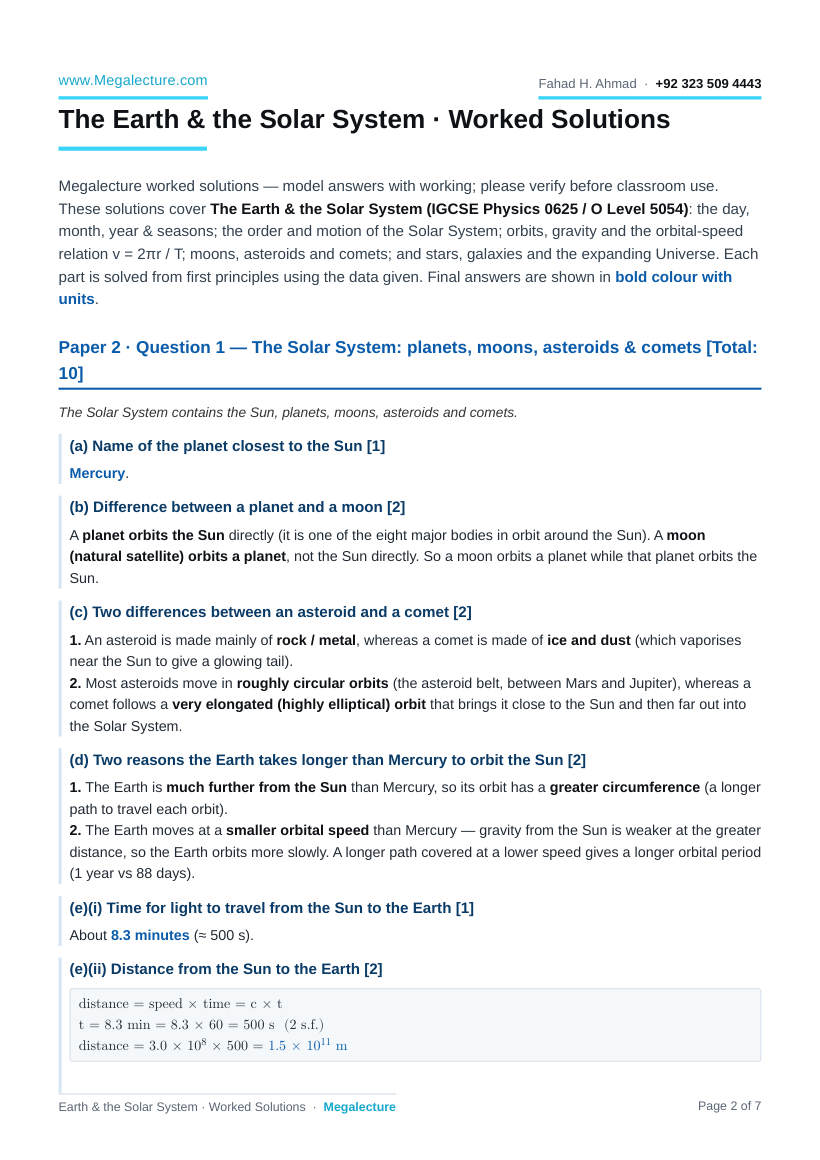
The Earth & the Solar System · Worked Solutions
Megalecture worked solutions — model answers with working; please verify before classroom use.
These solutions cover The Earth & the Solar System (IGCSE Physics 0625 / O Level 5054): the day, month, year & seasons; the order and motion of the Solar System; orbits, gravity and the orbital-speed relation v = 2πr / T; moons, asteroids and comets; and stars, galaxies and the expanding Universe. Each part is solved from first principles using the data given. Final answers are shown in bold colour with units.
Paper 2 · Question 1 — The Solar System: planets, moons, asteroids & comets [Total:
10]
The Solar System contains the Sun, planets, moons, asteroids and comets.
(a) Name of the planet closest to the Sun [1]
Mercury.
(b) Difference between a planet and a moon [2]
A planet orbits the Sun directly (it is one of the eight major bodies in orbit around the Sun). A moon
(natural satellite) orbits a planet, not the Sun directly. So a moon orbits a planet while that planet orbits the
Sun.
(c) Two differences between an asteroid and a comet [2]
- An asteroid is made mainly of rock / metal, whereas a comet is made of ice and dust (which vaporises near the Sun to give a glowing tail).
- Most asteroids move in roughly circular orbits (the asteroid belt, between Mars and Jupiter), whereas a comet follows a very elongated (highly elliptical) orbit that brings it close to the Sun and then far out into the Solar System.
- Two reasons the Earth takes longer than Mercury to orbit the Sun [2]
- The Earth is much further from the Sun than Mercury, so its orbit has a greater circumference (a longer path to travel each orbit).
- The Earth moves at a smaller orbital speed than Mercury — gravity from the Sun is weaker at the greater distance, so the Earth orbits more slowly. A longer path covered at a lower speed gives a longer orbital period
(1 year vs 88 days).
(e)(i) Time for light to travel from the Sun to the Earth [1]
About 8.3 minutes (≈ 500 s).
(e)(ii) Distance from the Sun to the Earth [2]
distance = speed × time = c × t t = 8.3 min = 8.3 × 60 = 500 s (2 s.f.) distance = 3.0 × 108 × 500 = 1.5 × 10¹¹ m www.Megalecture.com Fahad H. Ahmad · +92 323 509 4443
Earth & the Solar System · Worked Solutions · Megalecture
The Sun is about 1.5 × 10¹¹ m (150 million km, i.e. 1 astronomical unit) from the Earth. (Using the rounded 8 min → 480 s gives 1.4 × 10¹¹ m — both are accepted, since they follow correctly from the stated light-time.)
Paper 2 · Question 2 — Defining year/month/day & orbital radius of Saturn [Total: 11]
A year, a month and a day are defined from the motions of the Earth, the Moon and the Sun. Table 2.1 gives orbital data for Earth, Jupiter and Saturn.
(a)(i) A year is the time for… [1]
…the Earth to make one complete orbit around the Sun.
(a)(ii) A month is the time for… [1]
…the Moon to make one complete orbit around the Earth.
(a)(iii) A day is the time for… [1]
…the Earth to make one complete rotation (spin) on its own axis.
(b) Average radius of Saturn's orbit around the Sun [3]
For a (near-circular) orbit, orbital speed v = circumference / period = 2πr / T, so r = vT / 2π. Saturn: v = 3.5 ×
104 km/h and T = 29 years.
Convert T to hours: T = 29 × 365 × 24 = 2.54 × 10⁵ h r = vT / (2π) = (3.5 × 104 × 2.54 × 105) / (2π) r = (8.90 × 10⁹) / 6.283 = 1.4 × 10⁹ km
Saturn orbits the Sun at an average radius of about 1.4 × 10⁹ km (≈ 1.42 × 10⁹ km). This is consistent with the known value (≈ 1.43 × 10⁹ km).
(c)(i) Why Earth and Jupiter are not in line again after 29 years [2]
29 years is exactly one orbit of Saturn, so Saturn returns to its starting position. But the Earth and Jupiter have different (shorter) orbital periods, so in 29 years they complete a non-whole number of orbits.
Earth makes 29 complete orbits (29 ÷ 1.0 = 29, a whole number, so Earth does return), while Jupiter makes
29 ÷ 12 ≈ 2.4 orbits — not a whole number — so Jupiter ends up at a different point in its orbit and is no longer in line.
(c)(ii) Positions of the three planets 6 years later (Fig. 2.2) [3]
Work out the fraction of an orbit each planet completes in 6 years (orbit is anticlockwise, in the direction of the arrow), starting from the straight line on the right of the Sun:
Planet Period / years Orbits in 6 years New position after 6 years
Earth 1.0 6 (whole) Back on the original line, same side (right of Sun)
Jupiter 6/12 = ½ orbit Opposite side — on the line, to the left of the Sun
Saturn 6/29 ≈ 0.21 orbit (≈
74°)
Earth & the Solar System · Worked Solutions · Megalecture
So on Fig. 2.2 mark Earth on the right-hand line (it has come full circle), Jupiter on the left-hand line (half an orbit round), and Saturn about three-quarters of the way back to the top (about 74° round in the direction of the orbit arrow).
Paper 2 · Question 3 — Planet distances & the transit (brightness-dip) method [Total:
9]
Table 3.1 lists some planets and their average distances from the Sun. A planet then transits a distant star, dimming it as seen from Earth.
(a) Complete Table 3.1 — the two missing planets [2]
The planets are listed in order of increasing distance from the Sun (Mercury, Venus, Earth, Mars, Jupiter…).
The gaps fall between Mercury & Earth, and between Earth & Jupiter, so:
planet average distance from the Sun / km
Mercury 5.8 × 10⁷
Venus 1.1 × 10⁸
Earth 1.5 × 10⁸
Mars 2.3 × 10⁸
Jupiter 7.8 × 10⁸
(b) Smallest and largest Earth–Jupiter distance [2]
The distance is smallest when the planets are on the same side of the Sun (subtract the radii) and largest when on opposite sides (add the radii).
smallest = 7.8 × 10⁸ − 1.5 × 108 = 6.3 × 10⁸ km largest = 7.8 × 10⁸ + 1.5 × 108 = 9.3 × 10⁸ km
(c)(i) Complete the brightness–time graph (Fig. 3.2) [2]
While the planet is in front of the star (between t1 and t2), some starlight is blocked, so the brightness drops to a lower constant value; once the planet has passed (after t2) the brightness returns to its original full value. The completed graph is a flat line at full brightness, a step down at t1, a flat lower line from t1 to t2, then a step back up to the original brightness at t2 and flat after that.
(c)(ii) How the graph changes for a larger planet (same distance, same star) [2]
A larger planet blocks more of the star's light, so the dip in brightness is deeper (the brightness falls to a lower value). The width of the dip stays about the same (it depends on how fast the planet crosses, not on its size), so only the depth of the dip increases.
(c)(iii) Using brightness changes to find the orbital period [1]
The astronomer measures the time between successive (repeated) dips in brightness — each dip happens once per orbit as the planet passes in front of the star, so the time from one dip to the next equals the planet's orbital period.
Earth & the Solar System · Worked Solutions · Megalecture
Paper 2 · Question 4 — Redshift, the expanding Universe & the Big Bang [Total: 10]
Light from distant galaxies is shifted towards the red end of the spectrum. Astronomers use redshift to find the speed of recession, and estimate the time T = d / (speed of recession). Table 4.1 lists four galaxies.
(a)(i) Two types of EM wave (other than visible light) from a stable star [1]
Infrared and ultraviolet (a stable star such as the Sun emits most of its energy as infrared, visible and ultraviolet radiation).
(a)(ii) What is meant by the red end of the spectrum [1]
The end of the visible spectrum with the longest wavelength (and lowest frequency) — i.e. red light has a longer wavelength than the rest of the visible spectrum.
(b)(i) What is meant by a galaxy [2]
A galaxy is a very large collection (cluster) of stars — typically billions of stars — held together by their mutual gravitational attraction (together with gas, dust and other matter).
(b)(ii) Show that 1.0 light-year = 9.5 × 10¹⁵ m [3]
A light-year is the distance light travels in one year: distance = speed × time.
time for 1 year (in s) = 365 × 24 × 60 × 60 = 3.15 × 10⁷ s distance = c × t = 3.0 × 108 × 3.15 × 107 distance = 9.46 × 10¹⁵ ≈ 9.5 × 10¹⁵ m (shown)
(b)(iii) Relationship between a galaxy's speed of recession and its distance from Earth [1]
The speed of recession is directly proportional to the distance — the further away a galaxy is, the faster it is moving away from Earth (Hubble's law).
(b)(iv) How the values of T provide evidence for the Big Bang Theory [2]
T = d / speed of recession is an estimate of how long each galaxy has been moving away from Earth. From
Table 4.1 the four galaxies give roughly the same value of T (about 13–14 billion years), even though their distances and speeds are very different.
This means all the galaxies appear to have started moving apart from the same point at the same time, about 13–14 billion years ago. This single starting moment — when the Universe began expanding from a very small, hot, dense point — is exactly what the Big Bang Theory predicts, and the value of T gives an estimate of the age of the Universe.
Paper 2 · Question 5 — Energy in the Sun & the life cycle of a massive star [Total: 9]
The Sun produces energy from positively-charged hydrogen nuclei. The question then considers a star much more massive than the Sun, and where heavy elements are formed.
(a)(i) The process that produces the Sun's energy [2]
Nuclear fusion: hydrogen nuclei join together (fuse) to form helium nuclei. The mass of the helium nucleus is slightly less than the total mass of the hydrogen nuclei, and this lost mass is released as energy (E = mc2).
Earth & the Solar System · Worked Solutions · Megalecture
(a)(ii) Why this process needs a high temperature [2]
Hydrogen nuclei are positively charged, so they repel each other (electrostatic repulsion). A very high temperature gives the nuclei a very large kinetic energy / very high speed, so that they can overcome this repulsion and get close enough to fuse. (A high density/pressure also makes collisions frequent enough for fusion to be sustained.)
(b)(i) Life cycle of a star much more massive than the Sun (after the protostar stage) [4]
After the protostar stage the star follows this sequence:
- It becomes a stable star (main-sequence star), fusing hydrogen into helium for millions of years; the outward pressure from fusion balances the inward pull of gravity.
- When its hydrogen runs low it swells into a red supergiant, fusing helium and heavier elements.
- The core then collapses and the star explodes as a supernova.
- What remains forms a very dense neutron star, or — if massive enough — a black hole.
(b)(ii) Where the very heavy elements are formed [1]
In the supernova explosion (the explosion of a massive star). The enormous temperatures and pressures during the supernova fuse nuclei into elements heavier than iron, which are then scattered into space.
Paper 1 · Multiple-choice questions — reasoned answers (Q1–Q8)
Short reasoning for each multiple-choice item in the same booklet, so the theory is fully covered.
Q1 — galaxy / planet / star → B
The Milky Way is a galaxy, Earth is a planet, and the Sun is a star. (The Solar System is not a galaxy; the
Moon is a satellite, not a star.) Answer: B.
Q2 — comet speed greatest / smallest → D
A comet moves fastest when closest to the Sun (at perihelion, point R) and slowest when furthest (at aphelion, point P), as the Sun's gravity does work on it. Greatest at R, smallest at P. Answer: D.
Q3 — asteroid: kinetic ↔ potential energy, X→Y → A
Moving from X (close to the Sun) to Y (far from the Sun) the asteroid slows down and rises, so kinetic energy is converted to gravitational potential energy (GPE → KE is the reverse). X→Y: GPE gained, KE lost
→ KE to GPE; Y→Z (falling back in): GPE to KE. Answer: A.
Q4 — Ceres vs Vesta (Vesta orbit larger… ) → B
Ceres orbits farther from the Sun than Vesta, so Ceres moves at the smaller orbital speed and has the larger orbital period. So compared with Vesta: orbital speed smaller, orbital period greater. Answer: B.
Q5 — components of the Sun's EM emission → C
A stable star like the Sun emits mainly infrared, ultraviolet and visible light; almost all its energy is carried by these three. (It emits very little microwave radiation.) Answer: C.
Q6 — when new elements are produced in a star's life cycle → C
New (heavier) elements are produced when a red supergiant explodes as a supernova — the extreme conditions fuse nuclei into the heaviest elements. Answer: C.
Earth & the Solar System · Worked Solutions · Megalecture
Q7 — correct order of stages for a small star → A
A small (Sun-like) star: J cloud of hydrogen collapses → M hydrogen fuses to helium (stable star) → K a red giant forms → L a white dwarf forms. Order J, M, K, L. Answer: A.
Q8 — evidence for the Big Bang Theory → B
Light from distant galaxies is redshifted — its wavelength is increased — showing the galaxies are moving away and the Universe is expanding. This is evidence for the Big Bang. Answer: B.
Note from Megalecture. These are original Megalecture worked solutions prepared for revision use, written independently from first principles. Figure and table labels (e.g. "Fig. 2.1", "Table 3.1") are reproduced as printed in the source booklet and refer to the diagrams in each question. Calculated answers are quoted to a sensible number of significant figures; please verify against your specification before classroom use.
Earth & the Solar System · Worked Solutions · Megalecture
