
IGCSE · Physics · Past papers · Paper 1 (Multiple Choice)
IGCSE Physics Radioactivity: Paper 1 MCQ Answer Key
Opens inside this page. Prefer your own PDF app? Open the PDF.
Full text of IGCSE Physics Radioactivity: Paper 1 MCQ Answer Key
www.megalecture.com · www.youtube.com/@megalecture
Online tutoring for Cambridge IGCSE, O Level & A Level Physics
Fahad H. Ahmad
Contact: +92 323 509 4443
M.Eng NUS Singapore · B.Eng NUST · 15+ years of teaching experience in Singapore, UAE & Pakistan · 60,000+ subscribers and 20 million+ video lecture views.
www.Megalecture.com · +92 323 509 4443
IGCSEPHYSICS0625·TOPICALPASTPAPERS
Radioactivity — Paper 1
Worked Answer Key (Multiple Choice)
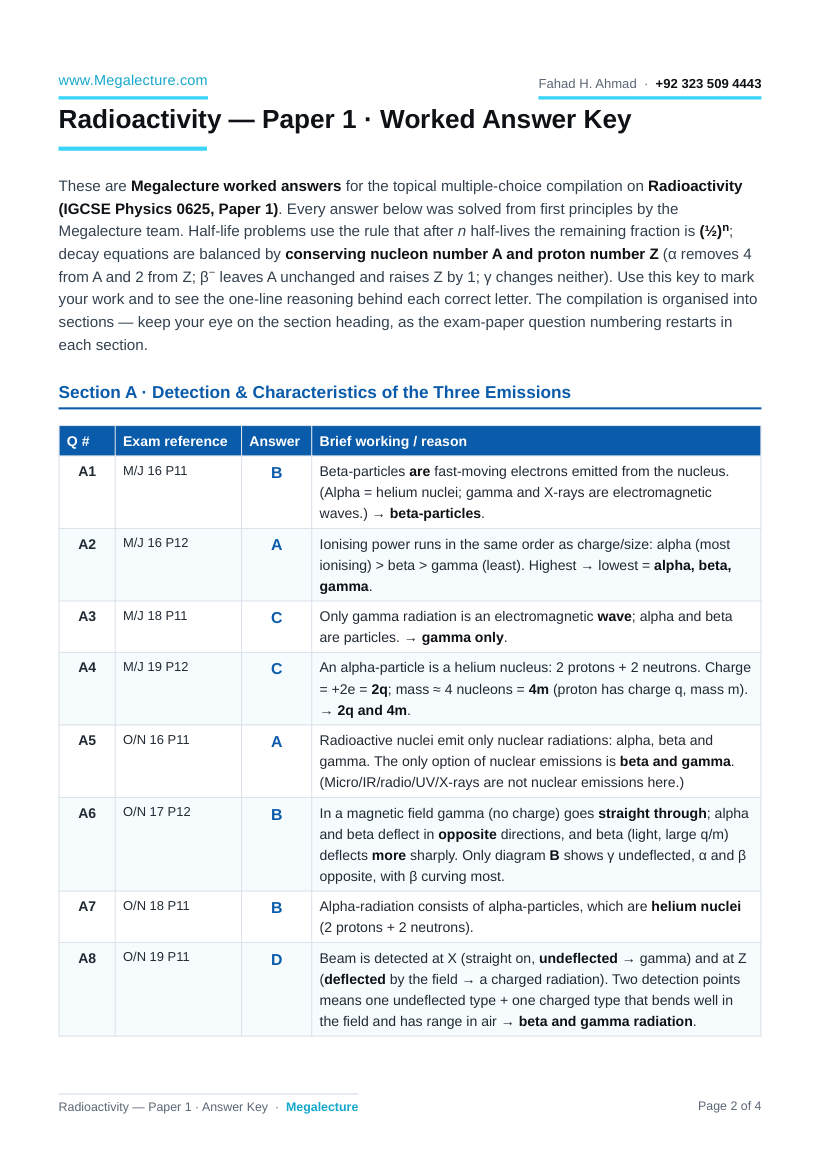
Radioactivity — Paper 1 · Worked Answer Key
These are Megalecture worked answers for the topical multiple-choice compilation on Radioactivity
(IGCSE Physics 0625, Paper 1). Every answer below was solved from first principles by the
Megalecture team. Half-life problems use the rule that after n half-lives the remaining fraction is (½)n;
decay equations are balanced by conserving nucleon number A and proton number Z (α removes 4 from A and 2 from Z; β− leaves A unchanged and raises Z by 1; γ changes neither). Use this key to mark your work and to see the one-line reasoning behind each correct letter. The compilation is organised into sections — keep your eye on the section heading, as the exam-paper question numbering restarts in each section.
Section A · Detection & Characteristics of the Three Emissions Q # Exam reference Answer Brief working / reason A1
M/J 16 P11
B
Beta-particles are fast-moving electrons emitted from the nucleus.
(Alpha = helium nuclei; gamma and X-rays are electromagnetic waves.) → beta-particles.
A2
M/J 16 P12
A
Ionising power runs in the same order as charge/size: alpha (most ionising) > beta > gamma (least). Highest → lowest = alpha, beta, gamma.
A3
M/J 18 P11
C
Only gamma radiation is an electromagnetic wave; alpha and beta are particles. → gamma only.
A4
M/J 19 P12
C
An alpha-particle is a helium nucleus: 2 protons + 2 neutrons. Charge
= +2e = 2q; mass ≈ 4 nucleons = 4m (proton has charge q, mass m).
→ 2q and 4m.
A5
O/N 16 P11
A
Radioactive nuclei emit only nuclear radiations: alpha, beta and gamma. The only option of nuclear emissions is beta and gamma.
(Micro/IR/radio/UV/X-rays are not nuclear emissions here.)
A6
O/N 17 P12
B
In a magnetic field gamma (no charge) goes straight through; alpha and beta deflect in opposite directions, and beta (light, large q/m) deflects more sharply. Only diagram B shows γ undeflected, α and β opposite, with β curving most.
A7
O/N 18 P11
B
Alpha-radiation consists of alpha-particles, which are helium nuclei
(2 protons + 2 neutrons).
A8
O/N 19 P11
D
Beam is detected at X (straight on, undeflected → gamma) and at Z
(deflected by the field → a charged radiation). Two detection points means one undeflected type + one charged type that bends well in the field and has range in air → beta and gamma radiation.
www.Megalecture.com Fahad H. Ahmad · +92 323 509 4443
Section B · Nuclear Reactions (Decay Equations, Fission & Fusion) Q # Exam reference Answer Brief working / reason B1
M/J 16 P12
A
Am-241 (241
95Am) emits an alpha (4 2He): A = 241 − 4 = 237, Z = 95 −
2 = 93. Element with Z = 93 is neptunium → 237 93Np.
B2
M/J 17 P11
C
Fission splits a large nucleus into smaller nuclei (used in power stations); fusion joins small nuclei and is the energy source of a star. Row C: "produces smaller nuclei" / "is the energy source of a star".
B3
M/J 17 P12
B
Emitting an alpha removes 2 protons, so the proton number (atomic number) decreases by two.
B4
O/N 16 P12
A
U-238 (238
92U) emits an alpha: A = 238 − 4 = 234, Z = 92 − 2 = 90 →
90Th.
B5
O/N 17 P11
D
P-32 (32
15P) emits a beta-particle (β−): nucleon number is unchanged at 32; a neutron turns into a proton, so proton number rises by 1 to
- → nucleon number 32, proton number 16.
B6
O/N 18 P11
C
Shaded circles = uncharged (neutrons), "+" circles = protons. The products are a cluster of 2 protons + 2 neutrons (a helium nucleus) and a single uncharged particle (a neutron). It is nuclei reacting, not neutral atoms. → a helium nucleus and a neutron.
B7
O/N 18 P12
C
In a fission reactor the heat boils water to make steam that drives turbines. (Fission is started by neutrons, not protons; it is fission not fusion; main waste is radioactive, not CO₂.) → statement C.
B8
O/N 19 P12
B
Pb-212 undergoes 3 decays: 2 beta (ΔA = 0 each) + 1 alpha (ΔA =
−4). New mass number = 212 − 4 = 208. (Z: −2 from alpha, +2 from the two betas → back to 82, still lead, as stated.)
Section C · Half-life Q # Exam reference Answer Brief working / reason C1
M/J 16 P11
D
Half-life = 1 day, so 2 days ago is 2 half-lives back → the count was
4× higher. 10 000 × 2² = 40 000 counts per minute.
C2
M/J 16 P12
C
Half-life is the time for half the (radioactive) nuclei to decay — i.e.
for the number of undecayed nuclei to fall to half. The exact correct statement is "half the time it takes for the number of nuclei to decrease to zero" is wrong; the right idea is "time for the number of nuclei to decrease to half." → statement C.
C3
M/J 18 P11
B
Half-life 12 yr; 24 yr = 2 half-lives. Remaining fraction = (½)² = ¼. 40 million × ¼ = 10 million atoms.
C4
M/J 20 P11 www.Megalecture.com Fahad H. Ahmad · +92 323 509 4443
Q # Exam reference Answer Brief working / reason B
Carbon now at ¼ of the living proportion = (½)² → 2 half-lives elapsed. Age = 2 × 5700 = 11 400 years.
C5
O/N 16 P11
B
Count falls 8000 → 500 in 20 days. Ratio 8000/500 = 16 = 2⁴ → 4 half-lives. Half-life = 20 ÷ 4 = 5 days.
C6
O/N 17 P12
A
Half-life is defined for the radioactive nuclei: it is the time for half of them to decay, so the quantity that halves every 7.2 years is the mass of the (radioactive) sample. (Nucleon and proton numbers of each nucleus do not change with time.)
C7
O/N 20 P11
C
Mass 0.0020 kg → 0.00025 kg. Ratio 0.0020/0.00025 = 8 = 2³ → 3 half-lives. Time = 3 × 7.0 = 21 years.
C8
O/N 20 P11
C
Half-life = the time taken for half of the atoms in a sample to decay
(a statistical average over many nuclei). → statement C.
Section D · Uses of Radioactive Isotopes & Safety Q # Exam reference Answer Brief working / reason D1
M/J 18 P11
B
For a foil-thickness gauge the source must be partly absorbed by the foil so the detector reading responds to thickness — that is beta
(alpha is stopped completely, gamma passes straight through). A long half-life keeps the count steady. → beta, 6 years.
D2
M/J 20 P11
A
Diagnosis (tracers/scans), sterilising equipment and treating cancer all use radioactivity. Cooking meals does not. → "cooking meals".
D3
O/N 19 P12
C
A medical tracer must escape the body to reach the external detector, so it must be a penetrating gamma emitter; a short half-life (few hours) limits the patient's radiation dose. → gamma ray emitter, half-life of a few hours.
Note from Megalecture. Half-life answers use fraction = (½)n; every decay equation above is balanced by conserving nucleon number (A) and proton number (Z). These are original Megalecture worked solutions prepared for revision use.
www.Megalecture.com Fahad H. Ahmad · +92 323 509 4443
