
IGCSE · Physics · Past papers · Paper 1 (Multiple Choice)
Answer Key
Need more than one subject? All-notes pass: unlimited downloads of every note for a year: unlimited downloads of every note on the site, PKR 999 a year. All packs and courses.
Opens inside this page. Prefer your own PDF app? Open the PDF.
Check yourself
5 quick questions on IGCSE Physics
Tap an answer to see if you are right, and why. Free, no sign-up.
Start the free testNew · free
O Level Physics written answers, marked like a real examiner
Answer a Paper 2 style question by typing or speaking. You get your mark point by point, what the examiner was looking for that you missed, and a model answer. 5 free answers a day with a free account.
Try a written question👍 33 students found these notes useful
Was this note useful?
Full text of Answer Key
www.megalecture.com · www.youtube.com/@megalecture
Fahad H. Ahmad
M.Eng NUS Singapore · B.Eng NUST · 15+ years of teaching experience in Singapore, UAE & Pakistan · 60,000+ subscribers and 20 million+ video lecture views.
IGCSEPHYSICS0625·TOPICALPASTPAPERS
The Nuclear Model of the Atom — Paper 1
Worked Answer Key (Multiple Choice)
Free notes, practice tests and live classes Back to megalecture.com
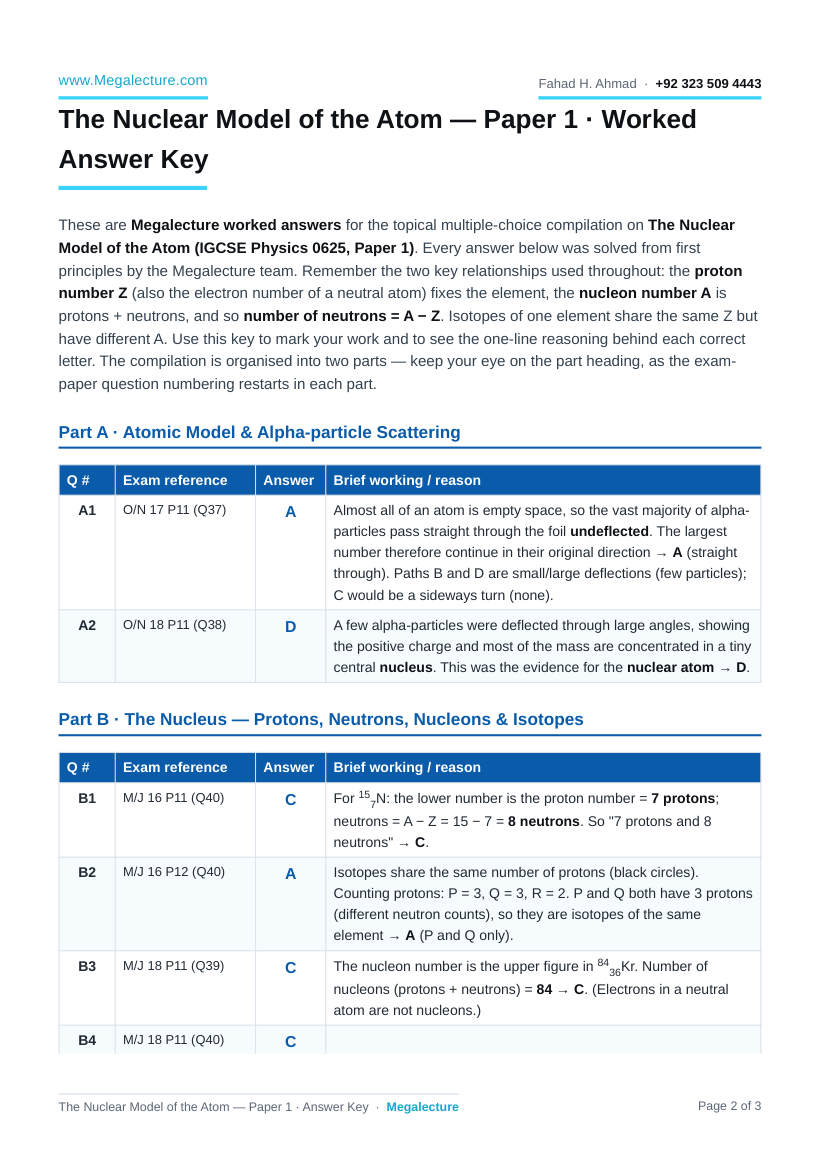
The Nuclear Model of the Atom — Paper 1 · Worked Answer Key
These are Megalecture worked answers for the topical multiple-choice compilation on The Nuclear
Model of the Atom (IGCSE Physics 0625, Paper 1). Every answer below was solved from first principles by the Megalecture team. Remember the two key relationships used throughout: the proton number Z (also the electron number of a neutral atom) fixes the element, the nucleon number A is protons + neutrons, and so number of neutrons = A − Z. Isotopes of one element share the same Z but have different A. Use this key to mark your work and to see the one-line reasoning behind each correct letter. The compilation is organised into two parts — keep your eye on the part heading, as the exam- paper question numbering restarts in each part.
Part A · Atomic Model & Alpha-particle Scattering Q # Exam reference Answer Brief working / reason A1
O/N 17 P11 (Q37)
A
Almost all of an atom is empty space, so the vast majority of alpha- particles pass straight through the foil undeflected. The largest number therefore continue in their original direction → A (straight through). Paths B and D are small/large deflections (few particles);
C would be a sideways turn (none).
A2
O/N 18 P11 (Q38)
D
A few alpha-particles were deflected through large angles, showing the positive charge and most of the mass are concentrated in a tiny central nucleus. This was the evidence for the nuclear atom → D.
Part B · The Nucleus — Protons, Neutrons, Nucleons & Isotopes Q # Exam reference Answer Brief working / reason B1
M/J 16 P11 (Q40)
C
For 15
7N: the lower number is the proton number = 7 protons;
neutrons = A − Z = 15 − 7 = 8 neutrons. So "7 protons and 8 neutrons" → C.
B2
M/J 16 P12 (Q40)
A
Isotopes share the same number of protons (black circles).
Counting protons: P = 3, Q = 3, R = 2. P and Q both have 3 protons
(different neutron counts), so they are isotopes of the same element → A (P and Q only).
B3
M/J 18 P11 (Q39)
C
The nucleon number is the upper figure in 84
36Kr. Number of nucleons (protons + neutrons) = 84 → C. (Electrons in a neutral atom are not nucleons.)
B4
M/J 18 P11 (Q40)
C
The Nuclear Model of the Atom — Paper 1 · Answer Key · Megalecture
Q # Exam reference Answer Brief working / reason
For 230
92U the element is fixed by Z = 92 protons. Another isotope must also have 92 protons. Only row C has 92 protons (with 139 neutrons) → C.
B5
M/J 19 P11 (Q40)
C
Neutrons = nucleon number − proton number = 11 − 5 = 6 → C.
(The 5 electrons just confirm Z = 5 for the neutral atom.)
B6
M/J 20 P11 (Q37)
B
In A
ZX, A = nucleons and Z = protons, so neutrons = nucleons − protons = A − Z → B.
B7
O/N 16 P11 (Q40)
A
A neutral atom has equal positive and negative charge, so the number of electrons always equals the proton number → A (the number of electrons in the atom).
B8
O/N 17 P11 (Q39)
A
Isotopes have the same protons but different neutrons. Cl-37 and
Cl-35 differ in nucleon number by 37 − 35 = 2, all due to neutrons, so chlorine-37 has two more neutrons → A.
B9
O/N 18 P11 (Q40)
A
Uranium has 92 protons, so neutrons = nucleons − 92. Checking: A
235 → 143 ✓; B 237 → 145 (147 shown ✗); C 238 → 146 (144 shown ✗); D 241 → 149 (146 shown ✗). Only row A is self- consistent (92 protons, 143 neutrons) → A.
B10
O/N 18 P12 (Q40)
B
Isotopes of one element have the same number of protons in the nucleus (hence same Z and same electrons) but different numbers of neutrons → B.
B11
O/N 18 P11 (Q40)
B
A neutral atom needs protons = electrons, and nucleon number = protons + neutrons = 9. Row B: 4 neutrons + 5 protons = 9 nucleons, with 5 electrons = 5 protons ✓ → B.
Note from Megalecture. The two "Q40" items referenced as O/N 18 P11 and O/N 18 P12 (B10 and B11) appear on the same page of the source compilation; they are distinct questions and are answered separately above. These are original Megalecture worked solutions prepared for revision use.
The Nuclear Model of the Atom — Paper 1 · Answer Key · Megalecture
