
IGCSE · Physics · Past papers · Paper 1 (Multiple Choice)
Answer Key
Need more than one subject? All-notes pass: unlimited downloads of every note for a year: unlimited downloads of every note on the site, PKR 999 a year. All packs and courses.
Opens inside this page. Prefer your own PDF app? Open the PDF.
Check yourself
5 quick questions on IGCSE Physics
Tap an answer to see if you are right, and why. Free, no sign-up.
Start the free testNew · free
O Level Physics written answers, marked like a real examiner
Answer a Paper 2 style question by typing or speaking. You get your mark point by point, what the examiner was looking for that you missed, and a model answer. 5 free answers a day with a free account.
Try a written question👍 33 students found these notes useful
Was this note useful?
Full text of Answer Key
www.megalecture.com · www.youtube.com/@megalecture
Fahad H. Ahmad
M.Eng NUS Singapore · B.Eng NUST · 15+ years of teaching experience in Singapore, UAE & Pakistan · 60,000+ subscribers and 20 million+ video lecture views.
IGCSEPHYSICS0625·TOPICALPASTPAPERS
Uses of an Oscilloscope — Paper 1
Worked Answer Key (Multiple Choice)
Free notes, practice tests and live classes Back to megalecture.com
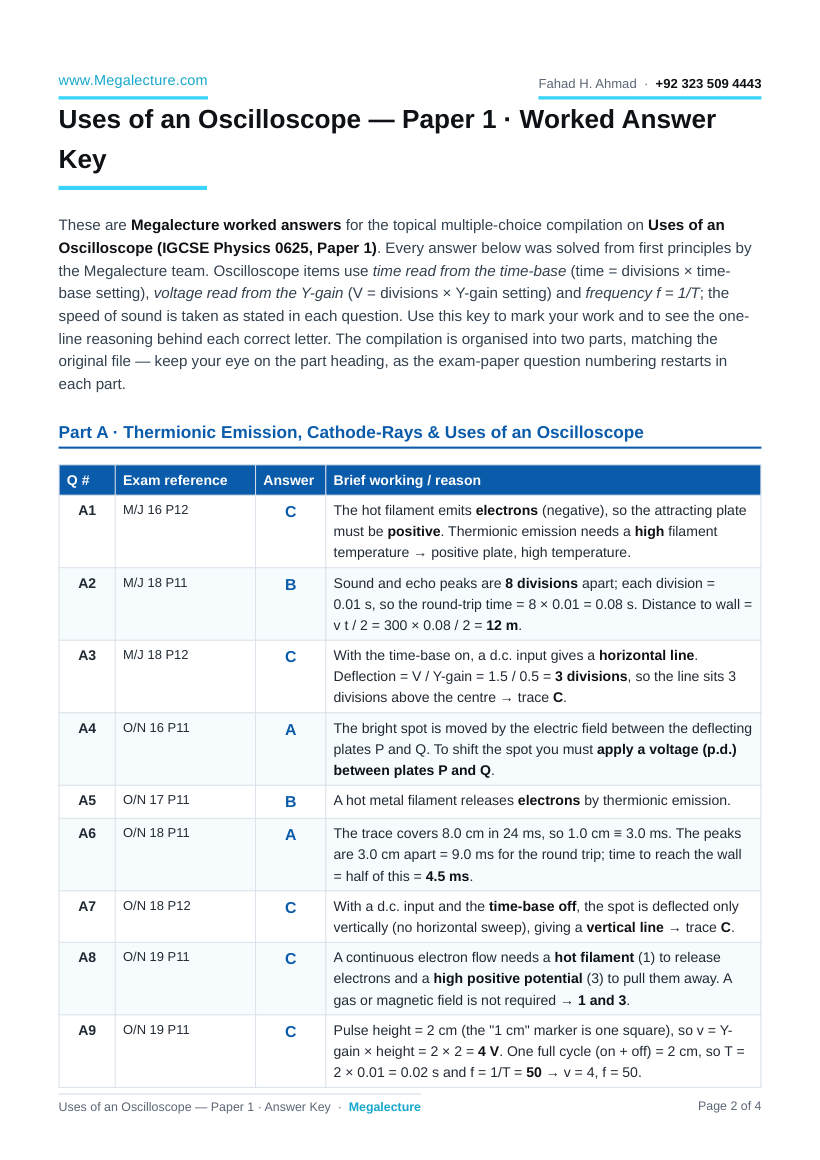
Uses of an Oscilloscope — Paper 1 · Worked Answer Key
These are Megalecture worked answers for the topical multiple-choice compilation on Uses of an
Oscilloscope (IGCSE Physics 0625, Paper 1). Every answer below was solved from first principles by the Megalecture team. Oscilloscope items use time read from the time-base (time = divisions × time- base setting), voltage read from the Y-gain (V = divisions × Y-gain setting) and frequency f = 1/T; the speed of sound is taken as stated in each question. Use this key to mark your work and to see the one- line reasoning behind each correct letter. The compilation is organised into two parts, matching the original file — keep your eye on the part heading, as the exam-paper question numbering restarts in each part.
Part A · Thermionic Emission, Cathode-Rays & Uses of an Oscilloscope Q # Exam reference Answer Brief working / reason A1
M/J 16 P12
C
The hot filament emits electrons (negative), so the attracting plate must be positive. Thermionic emission needs a high filament temperature → positive plate, high temperature.
A2
M/J 18 P11
B
Sound and echo peaks are 8 divisions apart; each division =
0.01 s, so the round-trip time = 8 × 0.01 = 0.08 s. Distance to wall = v t / 2 = 300 × 0.08 / 2 = 12 m.
A3
M/J 18 P12
C
With the time-base on, a d.c. input gives a horizontal line.
Deflection = V / Y-gain = 1.5 / 0.5 = 3 divisions, so the line sits 3 divisions above the centre → trace C.
A4
O/N 16 P11
A
The bright spot is moved by the electric field between the deflecting plates P and Q. To shift the spot you must apply a voltage (p.d.) between plates P and Q.
A5
O/N 17 P11
B
A hot metal filament releases electrons by thermionic emission.
A6
O/N 18 P11
A
The trace covers 8.0 cm in 24 ms, so 1.0 cm ≡ 3.0 ms. The peaks are 3.0 cm apart = 9.0 ms for the round trip; time to reach the wall
= half of this = 4.5 ms.
A7
O/N 18 P12
C
With a d.c. input and the time-base off, the spot is deflected only vertically (no horizontal sweep), giving a vertical line → trace C.
A8
O/N 19 P11
C
A continuous electron flow needs a hot filament (1) to release electrons and a high positive potential (3) to pull them away. A gas or magnetic field is not required → 1 and 3.
A9
O/N 19 P11
C
Pulse height = 2 cm (the "1 cm" marker is one square), so v = Y- gain × height = 2 × 2 = 4 V. One full cycle (on + off) = 2 cm, so T =
2 × 0.01 = 0.02 s and f = 1/T = 50 → v = 4, f = 50.
Uses of an Oscilloscope — Paper 1 · Answer Key · Megalecture
Q # Exam reference Answer Brief working / reason A10
O/N 20 P12
A
The trace is a sine wave swinging both sides of the centre line, so the signal is a.c. Amplitude (peak deflection) = 1.5 divisions, so amplitude = 1.5 × 2 = 3 V → a.c., 3 V.
Part B · Action and Use of Circuit Components Q # Exam reference Answer Brief working / reason B1
M/J 16 P11
A
The component that conducts in one direction only is the diode
(triangle + bar) → symbol A. (B is a lamp, C is a fuse, D is a different component.)
B2
M/J 16 P11
B
V across the LDR = 6.0 × RLDR / (Rth + RLDR). This is smallest when RLDR is small (bright/light: 500 Ω) and Rth is large (cold:
high Ω) → cold and light.
B3
M/J 16 P12
B
Series divider: V1 across the fixed 6.0 Ω, V2 across R. Raising R increases its share of 6.0 V, so V1 decreases and V2 increases.
B4
M/J 17 P11
C
VLDR = 2.0 V means RLDR is one third of the total, i.e. Rth = 2 RLDR.
This fits warm room (Rth = 1000 Ω) with bright light (RLDR = 500 Ω):
V = 6 × 500/1500 = 2.0 V → warm room, bright light.
B5
M/J 18 P11
A
Largest current needs the smallest total resistance, so both components must have low resistance: thermistor hot (high temperature) and LDR in bright light → high temperature, in bright light.
B6
M/J 18 P11
B
R is in parallel with the lower resistor. Increasing R raises the lower combined resistance, so it takes a larger share of the supply: V1 (upper) decreases and V2 (lower) increases.
B7
M/J 18 P12
D
An LDR is drawn as a resistor (rectangle) with two arrows pointing in towards it (light falling on it) → symbol D. (A is an LED; B is a thermistor; C is a variable resistor.)
B8
M/J 19 P11
D
The starter-motor circuit carries a very large current (100 A), so it needs short, thick (low-resistance) wires; the ignition-switch circuit carries only 1 A → the ignition switch circuit carries a smaller current than the starter motor circuit.
B9
M/J 19 P11
A
To recharge, current must flow into the battery's + terminal. Only a single series diode pointing towards + (as in A) lets current flow that way during the correct half-cycle; B drives current the wrong way, and C/D place the diode in parallel.
B10
O/N 16 P11
D
Bands yellow–violet–orange = 4, 7, then ×103: R = 47 × 1000 =
47 000 Ω.
Uses of an Oscilloscope — Paper 1 · Answer Key · Megalecture
Q # Exam reference Answer Brief working / reason B11 C
As temperature falls, the thermistor's resistance increases. It then takes a larger share of the supply, so the p.d. across the fixed resistor (the voltmeter reading) decreases → resistance increases, voltmeter reading decreases.
B12
O/N 17 P11
B
An LED conducts (and lights) only when forward biased — current in one direction. The triangle points to the right, so it emits light only when the current is towards the right only.
B13
O/N 17 P12
A
A thermistor's resistance rises when it gets colder (decrease in temperature); an LDR's resistance rises when it gets darker
(decrease in brightness) → decrease in temperature and decrease in brightness.
B14
O/N 18 P12
D
Least resistance needs both components at low resistance:
thermistor hot (low R) and LDR in light (low R) → hot and light.
B15
O/N 19 P11
A
A diode in series gives half-wave rectification: only one polarity passes, the blocked half is flat at the zero line. The trace is positive humps separated by flat sections → trace A.
B16
O/N 20 P11
C
(Same set-up as B4.) VLDR = 2.0 V needs Rth = 2 RLDR: warm room
(1000 Ω) with bright light (500 Ω) gives 6 × 500/1500 = 2.0 V → warm room, bright light.
B17
O/N 20 P12
C
Equal X and Y give output = 6 V across Y. Halving X makes output
= 12 × Y/(½X + Y) = 12 × 1/1.5 = 8 V. Change = 8 − 6 = +2.0 V.
Note from Megalecture. This compilation combines two syllabus areas that share the same file ("thermionic emission / cathode-rays / oscilloscope" and "action and use of circuit components"); the exam-paper question numbers restart in each part, so we have labelled them A1–A10 and B1–B17. Items B4 and B16 are the same potential-divider question repeated, and are answered consistently above. These are original Megalecture worked solutions prepared for revision use.
Uses of an Oscilloscope — Paper 1 · Answer Key · Megalecture
