
IGCSE · Physics · Past papers · Paper 1 (Multiple Choice)
Answer Key
Need more than one subject? All-notes pass: unlimited downloads of every note for a year: unlimited downloads of every note on the site, PKR 999 a year. All packs and courses.
Opens inside this page. Prefer your own PDF app? Open the PDF.
Check yourself
5 quick questions on IGCSE Physics
Tap an answer to see if you are right, and why. Free, no sign-up.
Start the free testNew · free
O Level Physics written answers, marked like a real examiner
Answer a Paper 2 style question by typing or speaking. You get your mark point by point, what the examiner was looking for that you missed, and a model answer. 5 free answers a day with a free account.
Try a written question👍 33 students found these notes useful
Was this note useful?
Full text of Answer Key
www.megalecture.com · www.youtube.com/@megalecture
Fahad H. Ahmad
M.Eng NUS Singapore · B.Eng NUST · 15+ years of teaching experience in Singapore, UAE & Pakistan · 60,000+ subscribers and 20 million+ video lecture views.
IGCSEPHYSICS0625·TOPICALPASTPAPERS
Electromagnetic Induction — Paper 1
Worked Answer Key (Multiple Choice)
Free notes, practice tests and live classes Back to megalecture.com
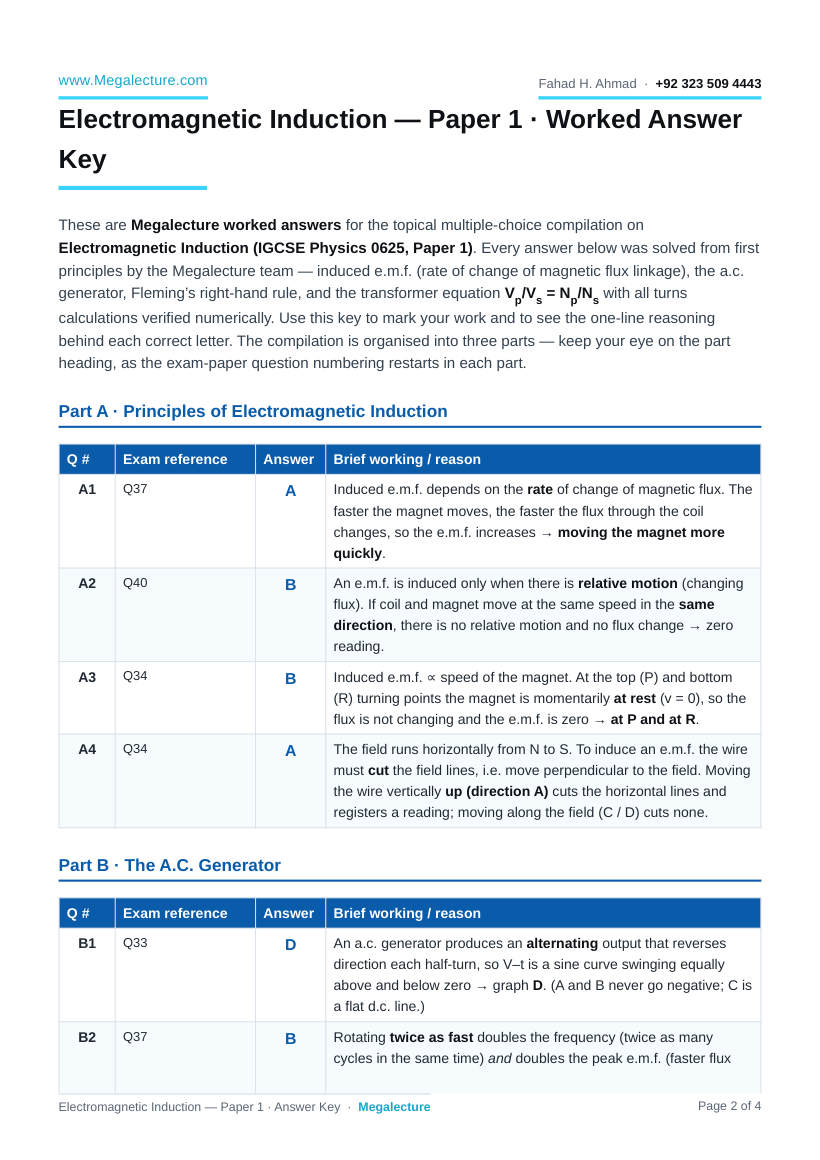
Electromagnetic Induction — Paper 1 · Worked Answer Key
These are Megalecture worked answers for the topical multiple-choice compilation on
Electromagnetic Induction (IGCSE Physics 0625, Paper 1). Every answer below was solved from first principles by the Megalecture team — induced e.m.f. (rate of change of magnetic flux linkage), the a.c.
generator, Fleming’s right-hand rule, and the transformer equation Vp/Vs = Np/Ns with all turns calculations verified numerically. Use this key to mark your work and to see the one-line reasoning behind each correct letter. The compilation is organised into three parts — keep your eye on the part heading, as the exam-paper question numbering restarts in each part.
Part A · Principles of Electromagnetic Induction Q # Exam reference Answer Brief working / reason A1
Q37
A
Induced e.m.f. depends on the rate of change of magnetic flux. The faster the magnet moves, the faster the flux through the coil changes, so the e.m.f. increases → moving the magnet more quickly.
A2
Q40
B
An e.m.f. is induced only when there is relative motion (changing flux). If coil and magnet move at the same speed in the same direction, there is no relative motion and no flux change → zero reading.
A3
Q34
B
Induced e.m.f. ∝ speed of the magnet. At the top (P) and bottom
(R) turning points the magnet is momentarily at rest (v = 0), so the flux is not changing and the e.m.f. is zero → at P and at R.
A4
Q34
A
The field runs horizontally from N to S. To induce an e.m.f. the wire must cut the field lines, i.e. move perpendicular to the field. Moving the wire vertically up (direction A) cuts the horizontal lines and registers a reading; moving along the field (C / D) cuts none.
Part B · The A.C. Generator Q # Exam reference Answer Brief working / reason B1
Q33
D
An a.c. generator produces an alternating output that reverses direction each half-turn, so V–t is a sine curve swinging equally above and below zero → graph D. (A and B never go negative; C is a flat d.c. line.)
B2
Q37
B
Electromagnetic Induction — Paper 1 · Answer Key · Megalecture
Q # Exam reference Answer Brief working / reason
change → larger amplitude). The trace with double frequency and larger amplitude is B.
B3
Q34
B
A simple a.c. generator induces an e.m.f. by spinning a coil of wire in the magnetic field, so the flux through it changes continuously → a coil of wire.
B4
Q35
D
A generator (here driven by the wind) converts kinetic energy of movement into electrical energy → a wind turbine. (A motor does the reverse; battery and fire are not kinetic→electrical.)
Part C · The Transformer Q # Exam reference Answer Brief working / reason C1
Q34
D
Transmitting at very high voltage means a very low current (P =
VI), and since power loss in the cables = I²R, low current gives low power loss → low power loss, low current.
C2
Q39
D
Step-up/down ratio: Vs = Vp × Ns/Np = 230 × 20/300 = 15.3 V. This far exceeds the lamp’s 6.0 V rating, so it lights brightly and then goes out (filament burns out).
C3
Q38
B
The core is made of soft iron: it is easily magnetised and demagnetised, concentrating the magnetic flux to link the two coils efficiently → iron.
C4
Q36
D
A transformer needs a changing flux. A steady d.c. primary current gives constant flux, so no e.m.f. is induced in the secondary → there is no output voltage.
C5
Q35
A
Core must be easily magnetised → iron; coils must conduct well with low resistance → copper → iron core, copper coils.
C6
Q34
A
Ns = Np × Vs/Vp = 200 × 12/240 = 10 turns (100% efficient, so the turns ratio equals the voltage ratio) → 10.
C7
Q35
B
Power is generated and transmitted as alternating current (only a.c. works with transformers) and stepped up to very high voltage to cut transmission losses → alternating, very high.
C8
Q37
B
Ns = Np × Vs/Vp = 720 × 6.0/24 = 180 turns → 180.
C9
Q37
D
Before transmission the voltage is stepped up; since power is conserved (P = VI), increasing the p.d. decreases the current, reducing I²R losses in the cables → increase the p.d. and decrease the current.
C10
Q36
D
A transformer changes voltage and current but never the frequency, and the output is still a.c. (4800→480 is a step-down, so current rises, but the question of how it compares is governed www.Megalecture.com Fahad H. Ahmad · +92 323 509 4443
Electromagnetic Induction — Paper 1 · Answer Key · Megalecture
Q # Exam reference Answer Brief working / reason
by it staying a.c. at the same frequency) → the same frequency a.c.
Note from Megalecture. Every transformer turns/voltage calculation in Part C was checked numerically using Vp/Vs =
Np/Ns. Remember the two golden rules of this topic: an e.m.f. appears only when the magnetic flux is changing, and a transformer works on a.c. only. These are original Megalecture worked solutions prepared for revision use.
Electromagnetic Induction — Paper 1 · Answer Key · Megalecture
