
IGCSE · Physics · Past papers · Paper 1 (Multiple Choice)
Answer Key
Need more than one subject? All-notes pass: unlimited downloads of every note for a year: unlimited downloads of every note on the site, PKR 999 a year. All packs and courses.
Opens inside this page. Prefer your own PDF app? Open the PDF.
Check yourself
5 quick questions on IGCSE Physics
Tap an answer to see if you are right, and why. Free, no sign-up.
Start the free testNew · free
O Level Physics written answers, marked like a real examiner
Answer a Paper 2 style question by typing or speaking. You get your mark point by point, what the examiner was looking for that you missed, and a model answer. 5 free answers a day with a free account.
Try a written question👍 33 students found these notes useful
Was this note useful?
Full text of Answer Key
www.megalecture.com · www.youtube.com/@megalecture
Fahad H. Ahmad
M.Eng NUS Singapore · B.Eng NUST · 15+ years of teaching experience in Singapore, UAE & Pakistan · 60,000+ subscribers and 20 million+ video lecture views.
IGCSEPHYSICS0625·TOPICALPASTPAPERS
Practical Electricity — Paper 1
Worked Answer Key (Multiple Choice)
Free notes, practice tests and live classes Back to megalecture.com
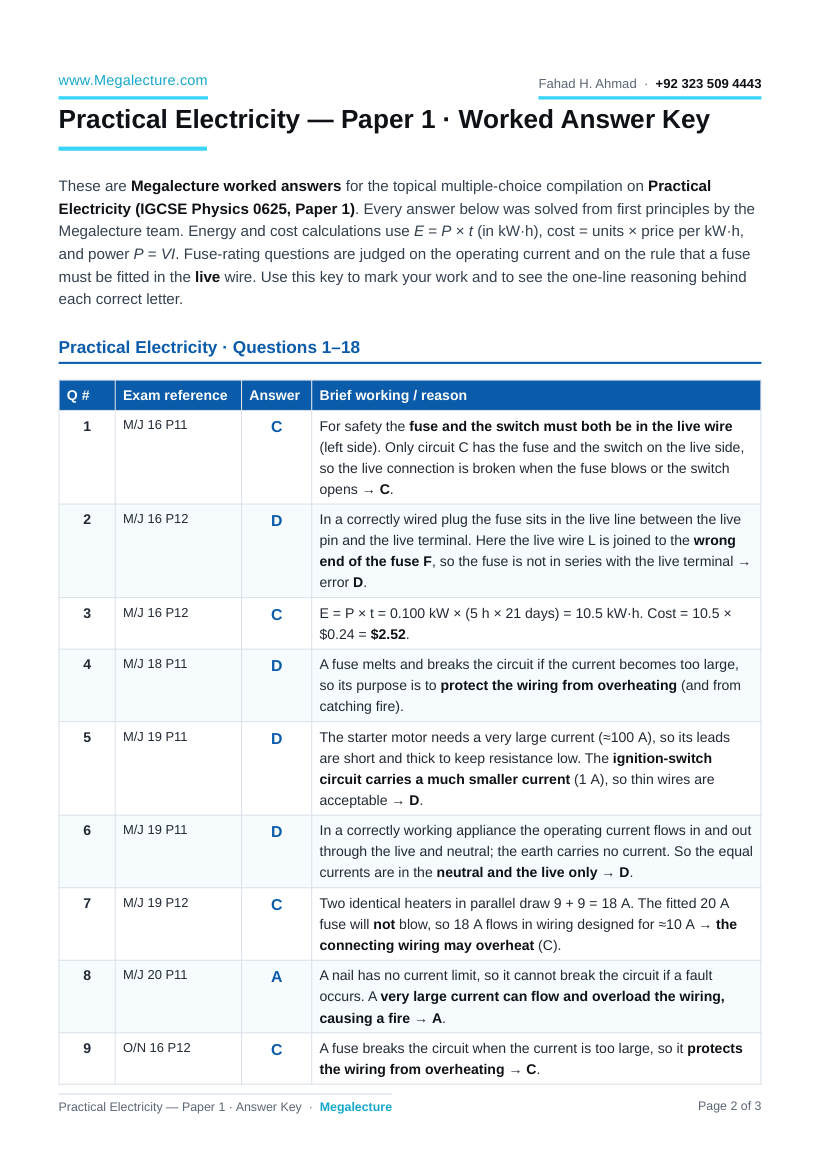
Practical Electricity — Paper 1 · Worked Answer Key
These are Megalecture worked answers for the topical multiple-choice compilation on Practical
Electricity (IGCSE Physics 0625, Paper 1). Every answer below was solved from first principles by the
Megalecture team. Energy and cost calculations use E = P × t (in kW·h), cost = units × price per kW·h, and power P = VI. Fuse-rating questions are judged on the operating current and on the rule that a fuse must be fitted in the live wire. Use this key to mark your work and to see the one-line reasoning behind each correct letter.
Practical Electricity · Questions 1–18 Q # Exam reference Answer Brief working / reason
M/J 16 P11
C
For safety the fuse and the switch must both be in the live wire
(left side). Only circuit C has the fuse and the switch on the live side, so the live connection is broken when the fuse blows or the switch opens → C.
M/J 16 P12
D
In a correctly wired plug the fuse sits in the live line between the live pin and the live terminal. Here the live wire L is joined to the wrong end of the fuse F, so the fuse is not in series with the live terminal → error D.
M/J 16 P12
C
E = P × t = 0.100 kW × (5 h × 21 days) = 10.5 kW·h. Cost = 10.5 ×
$0.24 = $2.52.
M/J 18 P11
D
A fuse melts and breaks the circuit if the current becomes too large, so its purpose is to protect the wiring from overheating (and from catching fire).
M/J 19 P11
D
The starter motor needs a very large current (≈100 A), so its leads are short and thick to keep resistance low. The ignition-switch circuit carries a much smaller current (1 A), so thin wires are acceptable → D.
M/J 19 P11
D
In a correctly working appliance the operating current flows in and out through the live and neutral; the earth carries no current. So the equal currents are in the neutral and the live only → D.
M/J 19 P12
C
Two identical heaters in parallel draw 9 + 9 = 18 A. The fitted 20 A fuse will not blow, so 18 A flows in wiring designed for ≈10 A → the connecting wiring may overheat (C).
M/J 20 P11
A
A nail has no current limit, so it cannot break the circuit if a fault occurs. A very large current can flow and overload the wiring, causing a fire → A.
O/N 16 P12
C
A fuse breaks the circuit when the current is too large, so it protects the wiring from overheating → C.
Practical Electricity — Paper 1 · Answer Key · Megalecture
Q # Exam reference Answer Brief working / reason
O/N 17 P11
D
With P and Q closed and R open: fan motor (0.10 kW) + one heater
(0.40 kW) = 0.50 kW. E = 0.50 × 2 = 1.0 kW·h. Cost = 1.0 × 8.0 =
8.0 cents → D.
O/N 17 P11
B
Earthing the metal case sends fault current safely to earth and keeps the case at 0 V, so it cannot become live: to ensure the casing is not at a dangerous voltage → B.
O/N 18 P11
A
E = P × t = 3.0 kW × 2.5 h = 7.5 kW·h, costing 120 c. So 1 kW·h costs 120 ÷ 7.5 = 16 c → A.
O/N 18 P11
A
With the switch in the live wire, opening it disconnects the live supply, so the lamp can be isolated from the supply (it is safe to handle)
→ A.
O/N 18 P12
C
Energy is sent across long distances at the highest voltage to reduce the current and the power lost in the cables → a power cable between towns (C).
O/N 19 P11
A
Both the switch and the fuse must be in the live wire so that the live conductor is broken on switch-off or fuse-blow → row A (live, live).
O/N 19 P12
B
A circuit breaker is fitted in the live wire, and when the current is too large it works by an electromagnet opening a switch (it does not melt) → row B.
O/N 20 P11
D
Energy in kW·h needs power in kW and time in hours. Power(kW) = I
× V ÷ 1000, so E = I × V × t(hour) ÷ 1000 → D.
O/N 20 P12
D
Final steady power = 8 × 60 = 480 W, so Ifinal = 480 ÷ 240 = 2.0 A.
Cold filaments give 4× this: Iinitial = 4 × 2.0 = 8.0 A → D.
Note from Megalecture. Several items test the same two ideas — a fuse and switch always belong in the live wire, and energy cost = power (kW) × time (h) × price per unit. These are original Megalecture worked solutions prepared for revision use.
Practical Electricity — Paper 1 · Answer Key · Megalecture
