
IGCSE · Physics · Past papers · Paper 2 (Theory)
IGCSE Physics Kinetic Particle Model of Matter: Paper 2 Worked Solutions

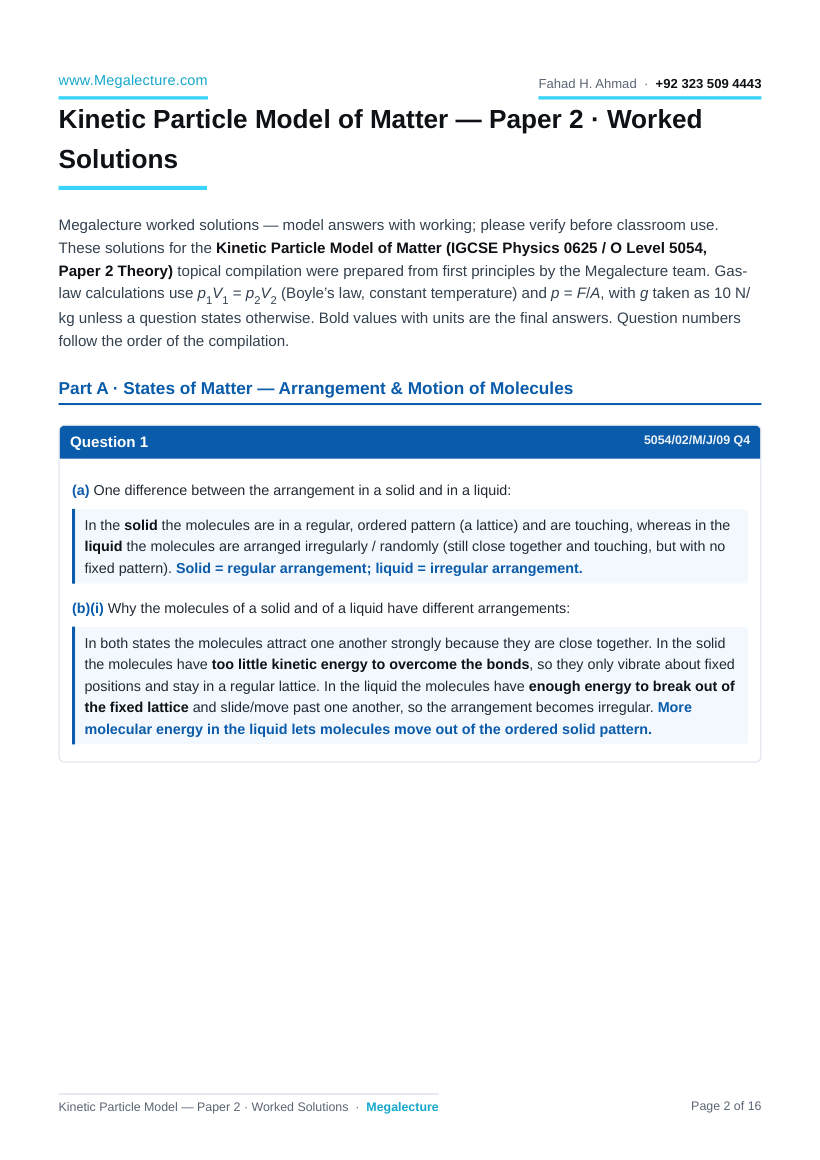
Opens inside this page. Prefer your own PDF app? Open the PDF.
Full text of IGCSE Physics Kinetic Particle Model of Matter: Paper 2 Worked Solutions
www.megalecture.com · www.youtube.com/@megalecture
Online tutoring for Cambridge IGCSE, O Level & A Level Physics
Fahad H. Ahmad
Contact: +92 323 509 4443
M.Eng NUS Singapore · B.Eng NUST · 15+ years of teaching experience in Singapore, UAE & Pakistan · 60,000+ subscribers and 20 million+ video lecture views.
www.Megalecture.com · +92 323 509 4443
IGCSEPHYSICS0625·TOPICALPASTPAPERS
Kinetic Particle Model of Matter — Paper 2
Worked Solutions (Theory / Structured)
Kinetic Particle Model of Matter — Paper 2 · Worked Solutions
Megalecture worked solutions — model answers with working; please verify before classroom use.
These solutions for the Kinetic Particle Model of Matter (IGCSE Physics 0625 / O Level 5054,
Paper 2 Theory) topical compilation were prepared from first principles by the Megalecture team. Gas- law calculations use p1V1 = p2V2 (Boyle’s law, constant temperature) and p = F/A, with g taken as 10 N/ kg unless a question states otherwise. Bold values with units are the final answers. Question numbers follow the order of the compilation.
Part A · States of Matter — Arrangement & Motion of Molecules Question 1
- One difference between the arrangement in a solid and in a liquid:
In the solid the molecules are in a regular, ordered pattern (a lattice) and are touching, whereas in the liquid the molecules are arranged irregularly / randomly (still close together and touching, but with no fixed pattern). Solid = regular arrangement; liquid = irregular arrangement.
(b)(i) Why the molecules of a solid and of a liquid have different arrangements:
In both states the molecules attract one another strongly because they are close together. In the solid the molecules have too little kinetic energy to overcome the bonds, so they only vibrate about fixed positions and stay in a regular lattice. In the liquid the molecules have enough energy to break out of the fixed lattice and slide/move past one another, so the arrangement becomes irregular. More molecular energy in the liquid lets molecules move out of the ordered solid pattern.
5054/02/M/J/09 Q4 www.Megalecture.com Fahad H. Ahmad · +92 323 509 4443
Question 2
This compilation includes only parts (b)(iii) and (b)(iv) of the original question.
(b)(iii) 1. — molecules in liquid water:
The molecules are close together and touching, arranged irregularly / randomly, and they move about freely, sliding past one another (they are not fixed in position). Close-packed but disordered; moving and able to change places.
(b)(iii) 2. — molecules in ice:
The molecules are close together in a fixed, regular (ordered) arrangement and they only vibrate about fixed positions; they cannot move from place to place. Regular lattice; vibrate about fixed points.
(b)(iv) Ice at 0 °C becoming water at 0 °C:
kinetic energy: stays the same (the temperature is unchanged, so average kinetic energy is unchanged).
potential energy: increases (the supplied latent heat does work against the intermolecular forces, separating the molecules slightly and weakening the bonds, raising their potential energy).
5054/21/M/J/13 Q10
Question 3
- Why heating the air inside the flask increases its pressure:
Heating gives the air molecules more kinetic energy, so they move faster. They therefore hit the walls of the flask harder and more often (more frequent collisions). The rate of change of momentum at the walls increases, so the average force on each unit area — the pressure — increases. Faster molecules → harder, more frequent wall collisions → greater pressure.
5054/22/M/J/13 Q9
Question 4
- Two ways the student’s diagram does not show the molecules of a liquid accurately:
- The molecules are drawn in a regular, ordered pattern (rows and columns); in a liquid the molecules are arranged irregularly / randomly.
- The molecules are drawn with large, equal gaps between them and all moving the same way; in a liquid they are close together / touching, moving in random directions at random (different) speeds.
(Either of these, plus e.g. the arrows should not all be the same length/direction, scores the marks.)
5054/21/M/J/15 Q10 www.Megalecture.com Fahad H. Ahmad · +92 323 509 4443
Part B · Pressure of a Gas & Boyle’s Law (Constant Temperature) Question 5
- Arrangement of molecules in the liquid (drawing):
Draw the circles close together and touching (about the same spacing as in the solid) but in an irregular / disordered arrangement with no fixed pattern, and roughly the same number / packing density as the solid. Close-packed but irregular — not a neat lattice, no large gaps.
- Motion of the molecules:
solid: molecules vibrate about fixed positions (do not move from place to place).
liquid: molecules move about / slide past one another (move freely throughout the liquid but stay close together).
gas: molecules move very fast in random directions, far apart, with very few collisions (free, rapid, random motion).
- Why a gas fills its container but a solid keeps a fixed shape:
In a solid the molecules are held in fixed positions by strong attractive forces, so they cannot move apart and the solid keeps a fixed shape. In a gas the molecules are far apart with negligible forces between them and move freely and rapidly in all directions, so they spread out until they fill the whole container. Strong fixed bonds (solid) vs free, fast-moving, widely-spaced molecules
(gas).
5054/22/M/J/17 Q5 www.Megalecture.com Fahad H. Ahmad · +92 323 509 4443
Question 6
- Why a liquid occupies a much smaller volume than a gas with the same number of molecules:
In a liquid the molecules are close together / touching, while in a gas the molecules are far apart with large empty spaces between them. The same number of molecules therefore takes up far less space as a liquid. Molecules are close-packed in a liquid but widely spaced in a gas.
(b)(i) Formula relating the quantities:
p1V1 = p2V2 (Boyle’s law, fixed mass of gas at constant temperature).
(b)(ii) Final pressure of the gas:
Reduction in volume = distance moved × area = 8.0 × 5.0 = 40 cm3
New volume V2 = 100 − 40 = 60 cm3 p2 = p1V1 / V2 = (1.2 × 105 × 100) / 60 p2 = 2.0 × 10⁵ Pa
(b)(iii) Why the pressure of the gas changes:
The volume is smaller, so the same number of molecules are in a smaller space. The molecules therefore hit the walls more often (more frequent collisions per second), so the average force per unit area — the pressure — increases. Smaller volume → more frequent wall collisions → higher pressure.
5054/21/M/J/19 Q4
Question 7
The syringe is heated from 20 °C to 100 °C and the piston is free to move, so the gas pressure stays equal to constant atmospheric pressure throughout (constant-pressure heating). State whether each quantity increases, decreases or stays the same.
- The average distance between gas molecules — increases (the gas expands, pushing the piston out).
- The pressure of the gas after the piston stops — the same (piston is free to move, so it stays equal to atmospheric pressure).
- The average speed of the gas molecules — increases (higher temperature → greater average kinetic energy).
- The frequency of collisions between the gas molecules and the piston — the same (faster molecules, but spread through a larger volume, so the collision rate per unit area stays the same as the pressure is unchanged).
5054/02/O/N/02 Q7 www.Megalecture.com Fahad H. Ahmad · +92 323 509 4443
Question 8
- Define pressure:
Pressure = force acting normally (perpendicular) per unit area (p = F / A).
- How the air molecules create a pressure:
The air molecules move rapidly and randomly and collide with the walls of the syringe. Each collision exerts a tiny force on the wall as the molecule’s momentum changes (it rebounds). The total force of the very many collisions, divided by the wall area, is the pressure. Fast random molecules colliding with the walls produce a force per unit area = pressure.
(c)(i) Pressure of the air after the plunger stops:
Extra pressure from the weight = F / A = 10 / (1.2 × 10⁻⁴) = 83 333 Pa ≈ 8.3 × 10⁴ Pa
New pressure = 1.0 × 10⁵ + 0.83 × 10⁵ p2 = 1.83 × 10⁵ Pa (about 1.8 × 10⁵ Pa)
(c)(ii) Volume of air after the plunger stops:
V2 = p1V1 / p2 = (1.0 × 105 × 50) / (1.83 × 10⁵)
V2 = 27 cm3 (27.3 cm3)
5054/22/M/J/22 Q3
Question 9
Nitrogen data: melting point −210 °C, boiling point −195 °C.
- State of nitrogen at −209 °C:
−209 °C is just above the melting point (−210 °C) but well below the boiling point (−195 °C), so the nitrogen has melted but not yet boiled. It is a liquid.
5054/02/O/N/02 Q6
Question 10
- Changes to arrangement and motion of the atoms as the solid block becomes a liquid:
Arrangement: changes from a regular / ordered lattice to an irregular / random arrangement; the atoms stay close together but the spacing increases only slightly. Motion: instead of only vibrating about fixed positions, the atoms now move about and slide past one another (they can change places). Regular → irregular arrangement; vibrating in fixed places → moving/sliding throughout the liquid.
5054/02/O/N/07 Q6 www.Megalecture.com Fahad H. Ahmad · +92 323 509 4443
Part C · Molecular Properties of Liquids & Gases Question 11
(c)(i) Pressure of the gas in the inflated air-bag:
p2 = p1V1 / V2 = (1.4 × 107 × 600) / 30 000 p2 = 2.8 × 10⁵ Pa
(c)(ii) Why the pressure inside the cylinder decreases as the air-bag inflates:
As the gas escapes into the air-bag, it occupies a much larger volume, so the molecules are more spread out (fewer molecules per unit volume). They therefore hit the walls less often, so the average force per unit area — the pressure — decreases. Larger volume → fewer / less frequent wall collisions → lower pressure.
5054/02/O/N/07 Q9
Question 12
- Two differences between liquids and gases at normal pressure, explained in molecular terms:
Difference 1: A gas can be compressed easily but a liquid almost cannot.
Explanation 1: In a gas the molecules are far apart with large spaces between them, so they can be pushed closer together; in a liquid the molecules are already close together / touching, so there is almost no space to reduce. Gas has spaces to compress; liquid does not.
Difference 2: A gas has a much lower density than a liquid (and a gas fills its container while a liquid keeps a fixed volume).
Explanation 2: The widely-spaced gas molecules mean far less mass per unit volume (low density), and because the forces between gas molecules are negligible they move freely and spread to fill the container; in a liquid the close-packed molecules give a high density and the stronger attractive forces keep the liquid at a fixed volume. Wide spacing & weak forces (gas) vs close packing & stronger forces (liquid).
5054/02/O/N/08 Q5 www.Megalecture.com Fahad H. Ahmad · +92 323 509 4443
Question 13
(a)(i) The driver’s weight:
W = mg = 70 × 10
W = 700 N
(a)(ii) Average increase in the pressure of the gas in the cylinders:
The weight is shared by 4 pistons: extra force on each = 700 / 4 = 175 N
Area of each piston = 35 cm2 = 35 × 10−4 m2
Δp = F / A = 175 / (35 × 10−4)
Δp = 5.0 × 10⁴ Pa (50 000 Pa)
(b)(i) How the trapped gas molecules exert a pressure on the cylinder:
The gas molecules move rapidly and randomly and collide with the cylinder walls. At each collision a molecule’s momentum changes (it rebounds), so it exerts a small force on the wall. There are very many molecules and very many collisions per second, giving a steady total force. This total force divided by the wall area is the pressure. Many fast random molecules colliding & rebounding from the walls → force per unit area = pressure.
(b)(ii) Why the pressure increases as the piston moves further in (constant temperature):
The volume becomes smaller, so the molecules are in a smaller space and hit the walls more often
(more frequent collisions) — their speed is unchanged (constant temperature) — so the pressure increases. Smaller volume → more frequent collisions → higher pressure.
(c)(i) Effect of the temperature rise on the gas molecules:
The molecules gain kinetic energy and move faster (greater average speed).
(c)(ii) Effect of the higher gas temperature on the height of the car body:
The faster molecules hit the piston harder and more often, raising the gas pressure; the gas therefore expands and pushes the pistons further out, so the car body rises higher above the road. Hotter gas → higher pressure / expansion → car body sits higher.
5054/21/O/N/10 Q8 www.Megalecture.com Fahad H. Ahmad · +92 323 509 4443
Question 14
(b)(i) Minimum value of the pressure of the gas in the cylinder:
For the piston to be in equilibrium, the gas pressure must at least balance the outside air pressure plus the pressure due to force F.
Pressure from F = F / A = 8200 / 0.0067 = 1.22 × 10⁶ Pa
Minimum gas pressure = atmospheric + F/A = 1.0 × 10⁵ + 1.22 × 10⁶ p = 1.3 × 10⁶ Pa (1.32 × 10⁶ Pa)
(b)(ii) Why, in practice, the gas pressure is greater than the value in (i):
The calculation assumes the piston is in equilibrium with no other forces. In practice there is also friction between the piston and the cylinder (and the weight of the piston/rod), which acts as well, so the gas must push harder — a higher pressure — to produce the same force F. Friction (and the piston’s weight) means a larger gas pressure is needed.
- What happens to force F as the piston moves out and the gas expands:
As the gas expands its volume increases, so (at roughly constant temperature) its pressure decreases; the force on the piston, F = pA, therefore decreases.
- Why heating a gas at constant volume increases its pressure (molecular terms):
Heating gives the molecules more kinetic energy, so they move faster. Because the volume is fixed, the faster molecules hit the walls harder and more frequently. The rate of change of momentum at the walls increases, so the average force per unit area — the pressure — increases. Higher temperature → faster molecules → harder, more frequent collisions in a fixed volume → greater pressure.
5054/21/O/N/11 Q11 www.Megalecture.com Fahad H. Ahmad · +92 323 509 4443
Question 15
(a)(i) Pressure due to 15 m of water:
p = ρgh = 1000 × 10 × 15 p = 1.5 × 10⁵ Pa
(a)(ii) Total pressure at 15 m below the surface:
total = atmospheric + ρgh = 1.0 × 10⁵ + 1.5 × 10⁵ total pressure = 2.5 × 10⁵ Pa
(b)(i) Volume of the air in the balloon at the surface (atmospheric pressure):
V2 = p1V1 / p2 = (2.5 × 105 × 0.048) / (1.0 × 10⁵)
V2 = 0.12 m3
(b)(ii) Why the air pressure in the balloon is less at the surface than at 15 m:
At the surface the balloon has expanded to a larger volume, so the same air molecules are more spread out and hit the balloon walls less often. The average force per unit area — the pressure — is therefore lower. Larger volume → less frequent wall collisions → lower pressure.
- One difference between the arrangement of the water molecules and the air molecules in the balloon:
The water (liquid) molecules are close together / touching, whereas the air (gas) molecules are far apart with large spaces between them. Liquid = close-packed; gas = widely spaced.
5054/22/O/N/12 Q9 www.Megalecture.com Fahad H. Ahmad · +92 323 509 4443
Question 16
- Advantage of painting the outside of the freezer white:
A white (shiny/light) surface is a poor absorber and good reflector of infra-red (thermal) radiation, so it absorbs less heat from the warm surroundings. Less thermal energy enters the freezer, so it stays cold more easily and uses less electricity. White reflects radiation → less heat absorbed from the surroundings.
(b)(i) What happens to the pressure of the trapped air as it cools:
The pressure decreases. As the air cools the molecules lose kinetic energy and move more slowly, so they hit the walls less hard and less often. The average force per unit area — the pressure — therefore falls. Cooling → slower molecules → weaker, less frequent collisions → lower pressure.
(b)(ii) Why the lid is harder to open at operating temperature:
The pressure of the cooled air inside is now lower than the atmospheric pressure outside, so the larger outside pressure pushes the lid down. An extra (upward) force is needed to overcome this pressure difference, making the lid harder to lift. Lower inside pressure → atmospheric pressure holds the lid shut.
5054/21/O/N/15 Q2
Question 17
- Why heating the trapped gas increases its pressure (molecules):
Heating gives the molecules more kinetic energy, so they move faster. As the volume is fixed (piston held by the rod), they hit the walls harder and more often, so the average force per unit area — the pressure — increases. Faster molecules in a fixed volume → harder, more frequent collisions → higher pressure.
- When the rod is pulled down and the piston is free to move (constant temperature):
The gas now occupies a larger volume, so its pressure decreases. The molecules keep the same speed (temperature unchanged), but being more spread out in the larger space they hit the walls less often, so the average force per unit area — the pressure — falls until it equals the outside
(atmospheric) pressure. Larger volume → less frequent collisions → pressure decreases.
5054/22/O/N/15 Q6 www.Megalecture.com Fahad H. Ahmad · +92 323 509 4443
Question 18
- How ice differs from liquid water, in terms of molecules:
In ice the molecules are in a fixed, regular (ordered) arrangement and only vibrate about fixed positions; in liquid water the molecules are arranged irregularly / randomly and can move about and slide past one another. (Also, in ice the molecules are slightly further apart on average, so ice is slightly less dense than water.) Ice = regular, fixed, vibrating; water = irregular, moving / sliding.
5054/22/O/N/15 Q9
Question 19
(a)(i) Why the density of the oil is much greater than that of a gas:
In the oil (liquid) the molecules are close together / touching, so there is much more mass packed into each unit of volume; in a gas the molecules are far apart, so there is far less mass per unit volume. Close-packed molecules (liquid) → much higher density than the widely-spaced gas.
(a)(ii) Why the oil cannot be compressed:
The oil molecules are already close together / touching, with almost no space between them, so they cannot be pushed any closer. No empty space between the molecules → the liquid cannot be compressed.
5054/21/O/N/16 Q10
Question 20
- How the gas exerts a pressure on the inside of the syringe:
The gas molecules move rapidly in random directions and collide with the inside walls of the syringe. At each collision a molecule rebounds, so its momentum changes and it exerts a small force on the wall. The combined force of the huge number of collisions per second, divided by the wall area, is the pressure. Many fast random molecules colliding with & rebounding from the walls
→ force per unit area = pressure.
- New pressure of the gas when the volume becomes 110 cm3:
p2 = p1V1 / V2 = (1.1 × 105 × 40) / 110 p2 = 4.0 × 10⁴ Pa
5054/22/O/N/16 Q5 www.Megalecture.com Fahad H. Ahmad · +92 323 509 4443
Part D · Temperature, Boiling & Mixed Molecular Questions Question 21
- Two ways the structure of gold at 1200 °C differs from at 1000 °C:
Melting point of gold = 1100 °C, so at 1000 °C the gold is a solid and at 1200 °C it is a liquid.
- Arrangement: at 1000 °C the atoms are in a regular / ordered lattice; at 1200 °C (liquid) they are arranged irregularly / randomly.
- Motion: at 1000 °C the atoms only vibrate about fixed positions; at 1200 °C they move about / slide past one another (they can change places).
5054/21/O/N/17 Q3
Question 22
(d)(i) Motion of the molecules in a liquid at uniform temperature:
The molecules move about randomly, sliding past one another, while staying close together. They move at a range of (random) speeds, with a constant average speed because the temperature is uniform. Random movement throughout the liquid; molecules slide past each other at random speeds.
(d)(ii) What happens to the motion as the liquid’s temperature decreases:
The molecules lose kinetic energy and move more slowly (their average speed decreases).
Molecules slow down / average speed decreases.
5054/21/O/N/19 Q9 www.Megalecture.com Fahad H. Ahmad · +92 323 509 4443
Question 23
(a)(i) Force exerted on the piston by the trapped air in the pump:
F = p × A = (3.8 × 105) × (6.1 × 10−4)
F = 232 N (231.8 N)
(a)(ii) Why the force exerted by the student is less than this value:
The trapped air also has atmospheric pressure acting on the other side of the piston, which pushes the piston inwards and helps the student. The student only has to provide the force needed for the pressure difference (gas pressure − atmospheric pressure), so the push needed is less than the full force calculated above. Atmospheric pressure on the outer face helps push the piston in.
- Why the pressure of a gas increases when its volume decreases at constant temperature:
When the volume is reduced, the same number of molecules are in a smaller space. Their speed is unchanged (constant temperature), but they hit the walls more often (more frequent collisions per second), so the average force per unit area — the pressure — increases. Smaller volume → more frequent wall collisions → higher pressure.
5054/22/O/N/19 Q2
Question 24
- What is meant by boiling point:
The (fixed) temperature at which a liquid changes into a gas throughout its volume (bubbles of vapour form in the bulk of the liquid) at a given pressure. The temperature at which a liquid boils / turns to vapour throughout, at constant pressure.
- Why energy must be supplied to turn a boiling liquid into a gas:
Energy (latent heat) is needed to do work against the attractive forces between the molecules, pulling them far apart to form a gas. The molecules must gain enough potential energy to break free of their neighbours; the temperature stays constant, so the energy goes entirely into separating the molecules, not into raising their speed. Energy is used to break the bonds / separate the molecules against their attractive forces.
- Does the upward force on the piston change as it moves up at constant speed?
No. The piston moves at constant speed (no acceleration), so the resultant force on it is zero; the upward force from the gas must continue to balance the constant downward forces (the piston’s weight
+ atmospheric pressure). The gas pressure therefore stays the same, so the upward force on the piston stays constant. No change — constant speed means balanced forces, so the upward force is unchanged.
5054/22/O/N/19 Q9 www.Megalecture.com Fahad H. Ahmad · +92 323 509 4443
Question 25
- What is meant by pressure:
Pressure = force per unit area (force acting normally on a surface divided by the area, p = F / A).
(b)(i) Pressure due to 25 m of water:
p = ρgh = 1000 × 10 × 25 p = 2.5 × 10⁵ Pa
(b)(ii) Atmospheric pressure:
total = atmospheric + ρgh ⇒ atmospheric = 3.5 × 10⁵ − 2.5 × 10⁵ atmospheric pressure = 1.0 × 10⁵ Pa
(c)(i) Why the piston moves into the cylinder as the gauge is lowered:
As the gauge goes deeper, the water pressure on the outer face of the piston increases (p = atmospheric + ρgh). This outside pressure becomes greater than the trapped-gas pressure, so the resultant force pushes the piston inwards, compressing the gas until the pressures balance again.
Greater depth → higher water pressure on the piston → piston pushed in.
(c)(ii) What happens to the pressure of the trapped gas (molecules):
The gas is compressed into a smaller volume, so the molecules (same speed, constant temperature) are in a smaller space and hit the walls more often; the average force per unit area — the pressure
— increases. Smaller volume → more frequent collisions → higher pressure.
(c)(iii) Sketch of volume against depth:
A smooth curve starting at V0 on the volume axis (at depth = 0) and falling as depth increases, getting less steep as it goes (a Boyle’s-law curve: V ∝ 1/total pressure, and the pressure rises steadily with depth). Downward curve from V0, decreasing and levelling off — never reaching zero.
(c)(iv) Why the needle must be re-set to zero at the surface each time:
The atmospheric pressure at the surface varies from day to day (with weather/altitude), which changes the gas volume at the surface; re-zeroing makes sure the gauge reads the true depth and is not affected by the changing surface pressure. Atmospheric pressure changes, so re-zeroing keeps the depth reading accurate.
(c)(v) Why the density of the water stays constant (molecules):
The water molecules are already close together / touching, so the increased pressure cannot push them any closer — a liquid is virtually incompressible. The volume of a fixed mass of water is
5054/21/O/N/20 Q8 www.Megalecture.com Fahad H. Ahmad · +92 323 509 4443
Note from Megalecture. Some questions in this compilation are extracts (e.g. only certain parts of a longer exam question are reproduced); only the reproduced parts are answered here. All numerical answers were checked by calculation and use g = 10 N/kg unless stated. These are original Megalecture worked solutions for revision use — please verify before classroom use.
unchanged, so its density stays the same. Liquid molecules cannot be compressed further → volume (and density) unchanged.
Question 26
- Three ways a gas differs from a liquid (molecules):
- In a gas the molecules are far apart, while in a liquid they are close together / touching.
- The gas molecules are arranged completely randomly and spread out to fill the container, whereas liquid molecules stay together with a fixed volume.
- The gas molecules move much faster, freely and randomly with few collisions, while liquid molecules move more slowly, sliding past one another.
- Why energy must be supplied to turn a boiling liquid into a gas:
The energy supplied (latent heat of vaporisation) does work against the attractive forces between the molecules, separating them to the wide spacing of a gas. The molecules need extra potential energy to break free of their neighbours; the temperature stays constant while this happens.
Energy separates the molecules / breaks the bonds against their mutual attraction.
5054/21/O/N/19 Q3
Question 27
(a)(i) Molecular structure of a liquid (drawing in the middle box):
Draw the circles close together / touching (about the same spacing as the solid) but in an irregular / random arrangement, filling the lower part of the box with no neat rows and no large gaps. Close-packed but disordered — between the regular solid and the spread-out gas.
(a)(ii) Why it is easier to compress a gas than a solid:
In a gas the molecules are far apart with large spaces between them, so they can be pushed closer together. In a solid the molecules are already touching with almost no space between them, so they cannot be pushed closer. Gas has empty space to compress; a solid has none.
(a)(iii) Two ways the liquid’s molecules are affected as the thermometer’s temperature increases:
- The molecules gain kinetic energy and move faster (greater average speed).
- The molecules move slightly further apart, so the liquid expands (its volume increases) and rises up the thermometer.
5054/21/O/N/21 Q9 www.Megalecture.com Fahad H. Ahmad · +92 323 509 4443
