
IGCSE · Physics · Past papers · Paper 1 (Multiple Choice)
Answer Key
Need more than one subject? All-notes pass: unlimited downloads of every note for a year: unlimited downloads of every note on the site, PKR 999 a year. All packs and courses.
Opens inside this page. Prefer your own PDF app? Open the PDF.
Check yourself
5 quick questions on IGCSE Physics
Tap an answer to see if you are right, and why. Free, no sign-up.
Start the free testNew · free
O Level Physics written answers, marked like a real examiner
Answer a Paper 2 style question by typing or speaking. You get your mark point by point, what the examiner was looking for that you missed, and a model answer. 5 free answers a day with a free account.
Try a written question👍 33 students found these notes useful
Was this note useful?
Full text of Answer Key
www.megalecture.com · www.youtube.com/@megalecture
Fahad H. Ahmad
M.Eng NUS Singapore · B.Eng NUST · 15+ years of teaching experience in Singapore, UAE & Pakistan · 60,000+ subscribers and 20 million+ video lecture views.
IGCSEPHYSICS0625·TOPICALPASTPAPERS
Kinetic Particle Model of Matter — Paper 1
Worked Answer Key (Multiple Choice)
Free notes, practice tests and live classes Back to megalecture.com
Kinetic Particle Model of Matter — Paper 1 · Worked Answer Key
These are Megalecture worked answers for the topical multiple-choice compilation on the Kinetic
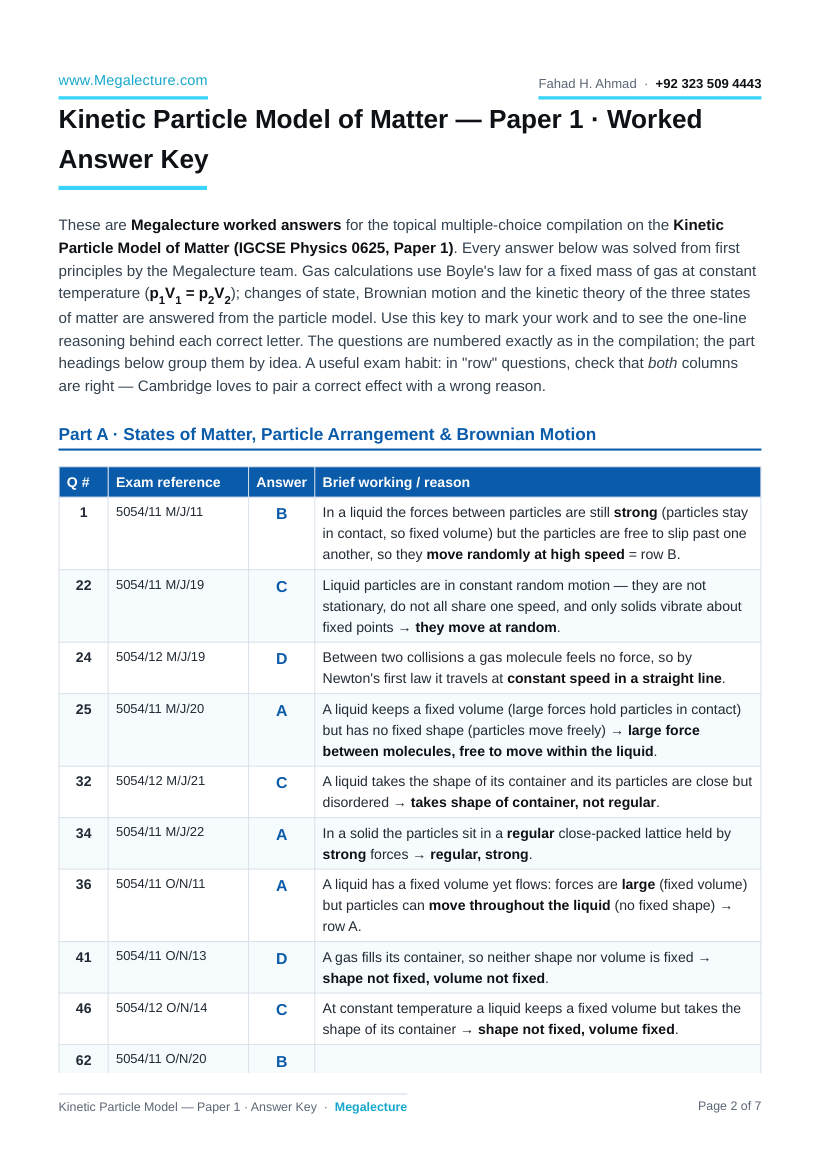
Particle Model of Matter (IGCSE Physics 0625, Paper 1). Every answer below was solved from first principles by the Megalecture team. Gas calculations use Boyle's law for a fixed mass of gas at constant temperature (p1V1 = p2V2); changes of state, Brownian motion and the kinetic theory of the three states of matter are answered from the particle model. Use this key to mark your work and to see the one-line reasoning behind each correct letter. The questions are numbered exactly as in the compilation; the part headings below group them by idea. A useful exam habit: in "row" questions, check that both columns are right — Cambridge loves to pair a correct effect with a wrong reason.
Part A · States of Matter, Particle Arrangement & Brownian Motion Q # Exam reference Answer Brief working / reason
5054/11 M/J/11
B
In a liquid the forces between particles are still strong (particles stay in contact, so fixed volume) but the particles are free to slip past one another, so they move randomly at high speed = row B.
5054/11 M/J/19
C
Liquid particles are in constant random motion — they are not stationary, do not all share one speed, and only solids vibrate about fixed points → they move at random.
5054/12 M/J/19
D
Between two collisions a gas molecule feels no force, so by
Newton's first law it travels at constant speed in a straight line.
5054/11 M/J/20
A
A liquid keeps a fixed volume (large forces hold particles in contact) but has no fixed shape (particles move freely) → large force between molecules, free to move within the liquid.
5054/12 M/J/21
C
A liquid takes the shape of its container and its particles are close but disordered → takes shape of container, not regular.
5054/11 M/J/22
A
In a solid the particles sit in a regular close-packed lattice held by strong forces → regular, strong.
5054/11 O/N/11
A
A liquid has a fixed volume yet flows: forces are large (fixed volume) but particles can move throughout the liquid (no fixed shape) → row A.
5054/11 O/N/13
D
A gas fills its container, so neither shape nor volume is fixed → shape not fixed, volume not fixed.
5054/12 O/N/14
C
At constant temperature a liquid keeps a fixed volume but takes the shape of its container → shape not fixed, volume fixed.
5054/11 O/N/20
B
Kinetic Particle Model — Paper 1 · Answer Key · Megalecture
Q # Exam reference Answer Brief working / reason
Brownian motion: the visible smoke particle Z is jostled at random by impacts from many fast, smaller air molecules → air molecules are smaller than Z.
5054/12 O/N/20
B
A liquid has a fixed volume but no fixed shape → fixed shape: no, fixed volume: yes = row B.
Part B · Boyle's Law & Pressure–Volume of a Gas (constant temperature) Q # Exam reference Answer Brief working / reason
5054/12 M/J/12
B
Air spreads from 200 cm³ into 200 + 100 = 300 cm³ at constant T.
Boyle: p2 = P × 200/300 = 2P/3.
5054/11 M/J/13
A
Correct sets obey pV = constant: B,C,D give 100×48 = 80×60 =
60×80 = 4800. A gives 120×36 = 4320 ≠ 4800, so row A is not correct.
5054/11 M/J/14
D
Boyle: p2 = p1V1/V2 = 240 × 2.0 / 0.50 = 960 kPa.
5054/12 M/J/15
D
From the graph pV = 100 × 10 = 1000 kPa·cm³. At p = 25 kPa, V =
1000/25 = 40 cm³.
5054/12 M/J/16
A
10 m of water = 1 atm, so the 20 m bottom has total = atmospheric +
20 m = 1 + 2 = 3 atm; surface = 1 atm, V = 6.0 cm³. Boyle: Vbottom =
1 × 6.0 / 3 = 2.0 cm³.
5054/11 M/J/17
D
At constant T, P ∝ 1/V (Boyle), so the P–V graph is an inverse curve falling toward both axes → graph D.
5054/12 M/J/17
C
A fixed mass at constant temperature obeys Boyle's law → p1V1 = p2V2.
5054/11 M/J/21
A
Volume doubles at constant T → pressure halves (Boyle). New pressure = ½ of original (halves).
5054/12 M/J/21
C
The piston halves the air column (volume → ½). Same mass in half the volume → density doubles: 0.0012 × 2 = 0.0024 g/cm³.
5054/12 M/J/21
B
At constant T, P ∝ 1/V, giving an inverse (rectangular-hyperbola) curve → graph B.
5054/11 O/N/12
B
Pressure scales by the volume ratio Vbefore/Vafter: A = ×5, B = ×2, C =
×16, D = ×4. The smallest factor = smallest pressure change → row
B.
5054/12 O/N/12
D
Volume reduced to ¼ at constant T → pressure increases to 4 times the original value (Boyle).
5054/12 O/N/13
D
Boyle: Vsurface = pbottomVbottom/psurface = 500 × 1.0 / 100 = 5.0 cm³.
5054/11 O/N/14
B
Kinetic Particle Model — Paper 1 · Answer Key · Megalecture
Q # Exam reference Answer Brief working / reason
Column 20 cm → 20 + 40 = 60 cm (volume ×3). Boyle: p2 = p ×
20/60 = p/3.
5054/11 O/N/15
A
Column 20 cm → 50 cm (pulled out 30 cm). Boyle: p2 = p × 20/50 =
0.40p.
5054/12 O/N/17
B
Boyle: V2 = p1V1/p2 = (5.0×10⁴ × 240) / (1.5×10⁵) = 80 cm³.
5054/12 O/N/18
B
Same set-up as Q45: column 20 cm → 60 cm (×3). Boyle: p2 = p ×
20/60 = p/3.
5054/12 O/N/16
B
At constant T, P ∝ 1/V (Boyle) → the inverse-curve P–V graph → graph B.
5054/11 O/N/21
B
Same set-up as Q45/56: column 20 cm → 60 cm (×3). Boyle: p2 = p
× 20/60 = p/3.
Part C · Kinetic Theory of Gas Pressure & Temperature Q # Exam reference Answer Brief working / reason
5054/11 M/J/11
D
Heating the air raises its temperature so it expands the balloon. The trapped air has the same mass but now a larger volume, so its density decreases → mass stays the same, density decreases.
5054/12 M/J/12
D
Heating a fixed-volume gas raises the molecules' kinetic energy → they vibrate/move with greater frequency, hitting the walls more often and harder, raising the pressure.
5054/12 M/J/12
B
Increasing the volume at constant T spreads the molecules out, so they collide with the piston less frequently → pressure decreases.
5054/11 M/J/13
D
Heating at fixed volume makes molecules move faster, so they collide with the walls more frequently → higher pressure.
5054/12 M/J/13
A
The piston moves freely, so pressure stays equal to atmospheric (no change). Heating expands the gas → volume increases → pressure no change, volume increases.
5054/11 M/J/14
A
Temperature is unchanged, so molecular speed, KE and size are unchanged; squeezing into a smaller volume means the molecules hit the piston more frequently.
5054/12 M/J/15
D
Cooling at constant volume lowers the molecules' kinetic energy → they move more slowly (number, size and spacing unchanged in a rigid container).
5054/11 M/J/16
C
Heating at fixed volume increases kinetic energy → the molecules move faster (they don't expand, multiply or spread out — the container is rigid).
Kinetic Particle Model — Paper 1 · Answer Key · Megalecture
Q # Exam reference Answer Brief working / reason
5054/12 M/J/18
D
Heating a sealed gas makes the faster molecules hit the container more frequently (and harder), raising the pressure.
5054/11 M/J/19
D
Heating at fixed volume gives molecules more kinetic energy, so they vibrate/move with greater frequency against the walls (they can't expand or move further apart in a rigid container).
5054/11 M/J/20
C
For a fixed mass, density ∝ p/T. To guarantee a density rise you need p/T to rise — that is, pressure increase together with temperature decrease → row C.
5054/12 M/J/20
A
Heating the sealed can makes molecules move faster, so they collide with the walls more frequently, raising the pressure.
5054/12 M/J/21
C
Heating at fixed volume: molecules gain KE so they move faster and hit the container more often → higher pressure.
5054/11 O/N/12
B
Rapid compression both squeezes the molecules closer and raises the temperature, so they move closer together and their average speed increases.
5054/12 O/N/12
C
Heating at fixed volume increases kinetic energy → the molecules move faster (rigid container, so no expansion or extra spacing).
5054/12 O/N/13
C
Heating a sealed fixed-volume gas: faster molecules bounce off the walls of the container more frequently (they don't expand or increase in number) → raises pressure.
5054/12 O/N/15
C
Higher temperature at fixed volume → faster molecules hit the container more frequently, increasing the wall pressure.
5054/11 O/N/16
B
Pushing the piston in reduces the volume; at constant temperature
Boyle's law gives a higher pressure → pressure increases, volume decreases.
5054/11 O/N/16
B
Gas pressure on a container is produced by molecules colliding with the walls of the container and rebounding.
5054/11 O/N/17
C
Heating at fixed volume increases kinetic energy → molecules move faster (they don't gain force without speed, expand or separate in a rigid container).
5054/12 O/N/20
D
Volume decreases while the temperature stays the same, so by
Boyle's law pressure increases; the reason it stays at constant T is that the molecular speed is unchanged → pressure increases, because the temperature of the gas is constant.
5054/11 O/N/21
B
Cooling at constant volume lowers the kinetic energy (KE decreases); slower molecules hit the walls less often/hard, so the pressure decreases → kinetic energy decreases, pressure decreases.
Kinetic Particle Model — Paper 1 · Answer Key · Megalecture
Part D · Changes of State, Thermal Expansion, Evaporation & Boiling Q # Exam reference Answer Brief working / reason
5054/12 M/J/13
A
Condensing (gas → liquid) brings molecules closer together and they lose energy to the surroundings → they move closer and lose energy.
5054/11 M/J/14
A
A fixed mass of gas at constant pressure expands uniformly as it is heated, and on the Celsius scale this gives a straight line of V against T → graph A.
5054/12 M/J/15
A
On melting, the regular solid lattice breaks into a still close-packed but disordered cluster (particles stay touching) → regular lattice → close, irregular grouping = diagram A.
5054/11 M/J/17
B
"Particles close together, moving past each other at random" describes a liquid; their rising average speed means it is being heated → a liquid being heated.
5054/11 M/J/21
A
At the boiling point the liquid and its vapour are at the same temperature, so their molecules have the same average kinetic energy → statement A is correct (evaporation also occurs below boiling; mass and KE are not lost on freezing).
5054/12 M/J/22
B
Condensation (steam → water on the surface) means molecules slow down and give out (emit) energy to the surroundings as they lose KE and bond → row B.
5054/12 O/N/13
C
A fixed mass of gas at constant pressure, heated: it expands so volume increases and, with more room, the molecules move further apart → increases, move further apart.
5054/12 O/N/16
A
"Expands slowly, temperature constant": molecules move further apart while their average speed stays the same (average KE depends only on T, which is unchanged).
5054/12 O/N/17
A
A liquid is almost incompressible because its molecules are already in close contact and repel each other very strongly when very close, so a large pressure causes only a small volume change.
5054/12 O/N/17
B
Evaporation lets the faster-moving (highest-energy) molecules escape, leaving slower ones behind, so the average KE — and hence temperature — of the remaining liquid falls → the liquid cools because faster-moving molecules escape.
5054/12 O/N/18
D
Cooling at constant volume lowers the molecules' kinetic energy → they move more slowly (they don't contract, shrink or move closer in a rigid fixed-volume container).
5054/12 O/N/18
C
Boiling (liquid → gas at constant temperature) leaves KE and molecule number/size unchanged, but the molecules spread far apart → the molecular spacing increases.
Kinetic Particle Model — Paper 1 · Answer Key · Megalecture
Q # Exam reference Answer Brief working / reason
5054/12 O/N/16
A
Heating the sealed-end syringe expands the gas, so the average distance between molecules increases and, for the same mass in a bigger volume, the density decreases → distance increases, density decreases.
5054/11 O/N/21
A
Heating a metal block (a solid) increases the kinetic energy of the vibrating particles and slightly increases their separation, raising the potential energy too → kinetic energy increase, potential energy increase.
Note from Megalecture. Several "trapped-air, 20 cm column lengthened by 40 cm" Boyle's-law questions recur (Q45,
Q56, Q65) and all give p/3; the rigid-container heating questions (Q3, Q7, Q23, Q33, Q40, Q44, Q48, Q52) all reduce to
"faster molecules collide with the walls more often." These are original Megalecture worked solutions prepared for revision use. Always read each option row in full — the examiner frequently pairs a correct effect with an incorrect reason.
Kinetic Particle Model — Paper 1 · Answer Key · Megalecture
