
IGCSE · Physics · Past papers · Paper 1 (Multiple Choice)
Answer Key
Need more than one subject? All-notes pass: unlimited downloads of every note for a year: unlimited downloads of every note on the site, PKR 999 a year. All packs and courses.
Opens inside this page. Prefer your own PDF app? Open the PDF.
Check yourself
5 quick questions on IGCSE Physics
Tap an answer to see if you are right, and why. Free, no sign-up.
Start the free testNew · free
O Level Physics written answers, marked like a real examiner
Answer a Paper 2 style question by typing or speaking. You get your mark point by point, what the examiner was looking for that you missed, and a model answer. 5 free answers a day with a free account.
Try a written question👍 33 students found these notes useful
Was this note useful?
Full text of Answer Key
www.megalecture.com · www.youtube.com/@megalecture
Fahad H. Ahmad
M.Eng NUS Singapore · B.Eng NUST · 15+ years of teaching experience in Singapore, UAE & Pakistan · 60,000+ subscribers and 20 million+ video lecture views.
IGCSEPHYSICS0625·TOPICALPASTPAPERS
Energy, Work & Power — Paper
Worked Answer Key (Multiple Choice)
Free notes, practice tests and live classes Back to megalecture.com
Energy, Work & Power — Paper 1 · Worked Answer Key
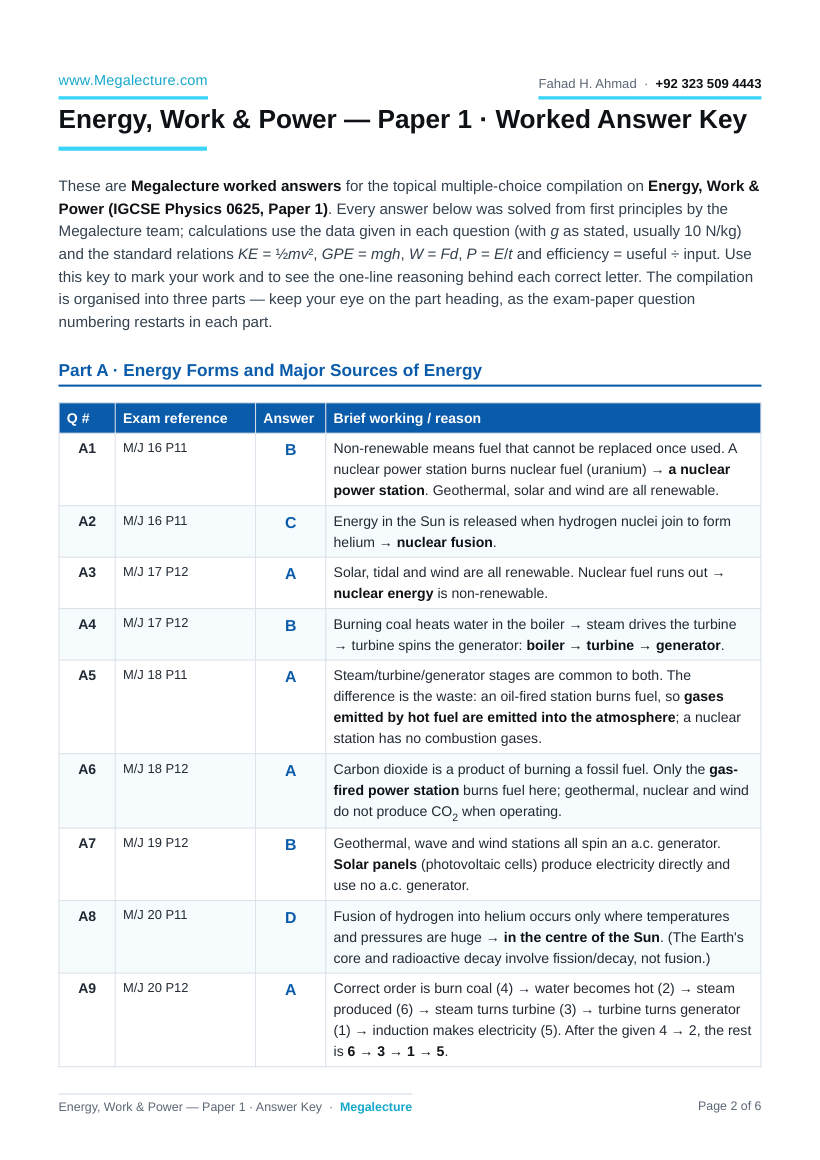
These are Megalecture worked answers for the topical multiple-choice compilation on Energy, Work &
Power (IGCSE Physics 0625, Paper 1). Every answer below was solved from first principles by the
Megalecture team; calculations use the data given in each question (with g as stated, usually 10 N/kg) and the standard relations KE = ½mv², GPE = mgh, W = Fd, P = E/t and efficiency = useful ÷ input. Use this key to mark your work and to see the one-line reasoning behind each correct letter. The compilation is organised into three parts — keep your eye on the part heading, as the exam-paper question numbering restarts in each part.
Part A · Energy Forms and Major Sources of Energy Q # Exam reference Answer Brief working / reason A1
M/J 16 P11
B
Non-renewable means fuel that cannot be replaced once used. A nuclear power station burns nuclear fuel (uranium) → a nuclear power station. Geothermal, solar and wind are all renewable.
A2
M/J 16 P11
C
Energy in the Sun is released when hydrogen nuclei join to form helium → nuclear fusion.
A3
M/J 17 P12
A
Solar, tidal and wind are all renewable. Nuclear fuel runs out → nuclear energy is non-renewable.
A4
M/J 17 P12
B
Burning coal heats water in the boiler → steam drives the turbine
→ turbine spins the generator: boiler → turbine → generator.
A5
M/J 18 P11
A
Steam/turbine/generator stages are common to both. The difference is the waste: an oil-fired station burns fuel, so gases emitted by hot fuel are emitted into the atmosphere; a nuclear station has no combustion gases.
A6
M/J 18 P12
A
Carbon dioxide is a product of burning a fossil fuel. Only the gas- fired power station burns fuel here; geothermal, nuclear and wind do not produce CO2 when operating.
A7
M/J 19 P12
B
Geothermal, wave and wind stations all spin an a.c. generator.
Solar panels (photovoltaic cells) produce electricity directly and use no a.c. generator.
A8
M/J 20 P11
D
Fusion of hydrogen into helium occurs only where temperatures and pressures are huge → in the centre of the Sun. (The Earth's core and radioactive decay involve fission/decay, not fusion.)
A9
M/J 20 P12
A
Correct order is burn coal (4) → water becomes hot (2) → steam produced (6) → steam turns turbine (3) → turbine turns generator
- → induction makes electricity (5). After the given 4 → 2, the rest is 6 → 3 → 1 → 5.
Energy, Work & Power — Paper 1 · Answer Key · Megalecture
Q # Exam reference Answer Brief working / reason A10
M/J 20 P12
B
"Heat transfer" means useful output ends up as thermal energy. A car driven at constant speed gains no KE or GPE, so all the chemical energy supplied is transferred to heat by friction/air resistance → a car moving along a horizontal road at constant speed.
A11
O/N 16 P12
B
All listed must be renewable. Hydroelectric, solar and wind are renewable; "oil-fired" is not. The only all-renewable set is hydroelectric, solar, wind power stations.
A12
O/N 18 P12
D
Compressing the ball does work on the trapped air, raising both the kinetic energy of its molecules and the temperature of the ball → both increase.
A13
O/N 18 P12
D
A geothermal station uses hot underground water (thermal energy) to drive a turbine-generator that makes electricity → thermal energy → electrical energy.
A14
O/N 19 P11
D
Hydrogen-to-helium fusion happens in the Sun's core → in the core of the Sun.
A15
O/N 20 P11
B
A current in a resistor heats it: electrical energy is converted to thermal (internal) energy → electrical → internal.
A16
O/N 20 P11
D
Solar cells, hydroelectric generators and wind turbines are renewable. Nuclear reactors use a fuel that runs out, so they are not renewable.
Part B · Work, Kinetic Energy, Potential Energy & Conservation Q # Exam reference Answer Brief working / reason B1
M/J 16 P11
A
ΔGPE = Wh = 250 × 7.0 = 1750 J. Final KE = ΔGPE − friction loss
= 1750 − 1300 = 450 J → row A.
B2
M/J 16 P11
C
Work done by the 300 N force = force × distance moved along its line of action (the 5.0 m ramp) = 300 × 5.0 = 1500 J.
B3
M/J 17 P11
B
Constant speed up a hill means KE is constant but height rises, so only gravitational potential energy is increasing (constant and greater than zero).
B4
M/J 17 P11
A
Work = force × distance moved in the direction of the force → the distance travelled in the direction of the force.
B5
M/J 17 P12
C
Work against gravity = mgh using the vertical rise = 60 × 10 × 1.5 =
900 J (the 2.0 m horizontal distance does no work against gravity).
B6
M/J 18 P12
A
GPE gained E = weight × vertical rise = 500 × 3.0 = 1500 J. Total work by the 400 N force = 400 × 5.0 = 2000 J, so work against friction W = 2000 − 1500 = 500 J → row A.
Energy, Work & Power — Paper 1 · Answer Key · Megalecture
Q # Exam reference Answer Brief working / reason B7
M/J 19 P11
A
All chairs have equal mass, so GPE = mgh depends only on height. Chair A is at the top of the wheel, the greatest height → most GPE.
B8
M/J 19 P11
B
Work against gravity = mgh using the vertical rise of 10 m: 500 ×
10 × 10 = 5.0 × 10⁴ J (the 200 m along the road is not the height).
B9
M/J 19 P12
D
GPE gained = mgh, i.e. weight (= mg) × the rise in height → weight multiplied by the increase in height.
B10
M/J 20 P12
C
KE = ½mv². The mass M is unchanged but the speed doubles, and
(2v)² = 4v², so the kinetic energy increases by a factor of four.
B11
M/J 20 P11
C
ΔGPE = mgh with the vertical rise of 50 m: 1000 × 10 × 50 =
500 000 J (the 200 m slope length is not used).
B12
M/J 20 P11
B
All GPE → KE: ½mv² = mgh → v = √(2gh) = √(2 × 10 × 2.0) = √40
= 6.3 m/s.
B13
M/J 20 P11
A
Work = force × distance moved along the force. The force F acts along the slope, whose length is r, so work = F × r.
B14
O/N 16 P11
B
Work against gravity = weight × vertical rise = 2000 × 0.80 =
1600 J (the 2.0 m plank length is not the height).
B15
O/N 16 P11
D
KE = ½mv²: P = ½(1.0)(3.0)² = 4.5 J; Q = ½(2.0)(2.0)² = 4.0 J; R =
½(5.0)(1.0)² = 2.5 J. Increasing order is R < Q < P → R → Q → P.
B16
O/N 16 P11
B
GPE = mgh → m = GPE ÷ (g × h) = 4500 ÷ (10 × 1.8) = 4500 ÷ 18
= 250 kg.
B17
O/N 16 P12
C
A force does no work when there is no movement in its direction.
For a satellite in a circular orbit the gravitational force is perpendicular to the motion, so the force that causes a satellite to move in a circular orbit does no work.
B18
O/N 17 P11
D
Landing KE = GPE lost = ½mv² → v = √(2 × KE ÷ m) = √(2 × 0.96 ÷
3.0) = √0.64 = 0.80 m/s.
B19
O/N 17 P12
A
KE = ½mv² needs SI units: m = 56 g = 0.056 kg and v = 1500 m/ min = 1500/60 = 25 m/s. So KE = ½ × 0.056 × (25)².
B20
O/N 19 P11
A
Work by weight = force × vertical distance moved in the force's direction. The weight W acts vertically, and the vertical drop is x, so work = Wx.
B21
O/N 19 P12
D
KE = ½mv². For Y, mass = 2m and speed = 2v, so KEY = ½(2m)
(2v)² = 4mv². Ratio KEY/KEX = 4mv² ÷ (½mv²) = 8.
B22
O/N 20 P11
A
With no air resistance, mechanical energy is conserved as the ball falls (GPE converts to KE), so the total energy is the same at all points.
B23
Energy, Work & Power — Paper 1 · Answer Key · Megalecture
Q # Exam reference Answer Brief working / reason B
Height jumped h = GPE ÷ weight. A: 1320/600 = 2.20 m; B:
1610/700 = 2.30 m; C: 1760/800 = 2.20 m; D: 1800/900 = 2.00 m.
Greatest height is B.
B24
O/N 20 P11
B
Work against gravity = weight × vertical rise = 2000 × 0.80 =
1600 J (the 2.0 m plank length is not the height).
B25
O/N 20 P12
A
Work done pushing horizontally = force × distance = F × d. The mass and g are distractors because no lifting occurs.
Part C · Efficiency and Power Q # Exam reference Answer Brief working / reason C1
M/J 17 P11
D
Electrical energy in = power × time = 10 × (5.0 × 60) = 10 × 300 =
3000 J.
C2
M/J 17 P12
B
Input power = mgh/t = (20 × 10 × 15) = 3000 W each second.
Useful output = efficiency × input = 0.60 × 3000 = 1800 W =
1.8 kW.
C3
M/J 18 P11
B
Power = energy ÷ time, and the energy supplied to each stair is
GPE = mgh = weight × height. So power = (height × weight) ÷ time.
C4
M/J 19 P12
B
Input per panel = 0.80 kJ in 1.0 s = 800 W, over 7.2 m² total =
5760 W. Efficiency = useful ÷ input = 1000 ÷ 5760 = 0.17 = 17%.
C5
M/J 19 P12
B
Power = energy transferred per second (1) and = rate of doing work (3), both correct. Statement 2, "force × distance moved", is the definition of work, not power. So only 1 and 3 are correct.
C6
M/J 20 P11
D
Total mass = 20 + 80 + 80 = 180 kg. GPE = mgh = 180 × 10 × 2.5
= 4500 J. Power = energy ÷ time = 4500 ÷ 0.50 = 9000 W =
9.0 kW.
C7
M/J 20 P12
B
Energy supplied = VIt = 200 × 33 × (4.0 × 3600) = 95 MJ. Usable energy stored = efficiency × input = 0.90 × 95 ≈ 86 MJ.
C8
M/J 20 P12
C
Power output = work done ÷ time = (known load weight × height lifted) ÷ time. The load is already known, so the extra measurements are the height (with a metre rule) and the time (with a stop-watch).
C9
O/N 16 P11
C
Power = work done ÷ time taken → (work done) ÷ (time taken).
C10
O/N 16 P12
C
Power = work ÷ time = 140 000 ÷ 70 = 2000 W = 2.0 kilowatts.
C11
O/N 16 P12
A
For a generator the useful output is electrical energy and the input is the total energy supplied, so efficiency = (electrical energy output) ÷ (total energy input) → row A.
Energy, Work & Power — Paper 1 · Answer Key · Megalecture
Q # Exam reference Answer Brief working / reason C12
O/N 17 P11
D
Power = work ÷ time = (force × distance) ÷ time = (1000 × 200) ÷
20 = 200 000 ÷ 20 = 10 000 W.
C13
O/N 17 P12
D
Power = energy per second = mgh/t = (4.2 × 10⁵) × 10 × 50 per second = 2.1 × 10⁸ W.
C14
O/N 18 P11
B
Efficiency rises when wasted energy falls. The fuse only protects the circuit, so the only useful change is to reduce the energy losses in the motor.
C15
O/N 18 P12
C
Useful work = weight × height = 40 × 0.50 = 20 J. At 25% efficiency, input energy = 20 ÷ 0.25 = 80 J. Time = energy ÷ power = 80 ÷ 20
= 4.0 s.
C16
O/N 19 P12
C
(F × d) is work done; dividing by time t gives work per unit time → power.
C17
O/N 20 P11
C
Efficiency = useful ÷ input = (input − wasted) ÷ input. Oil:
(500−300)/500 = 40%; nuclear: (200−160)/200 = 20%; hydro:
(10−1.0)/10 = 90%. Least efficient = nuclear, most efficient = hydroelectric → row C.
C18
O/N 20 P12
D
Power is the rate of doing work, i.e. work done per second.
Note from Megalecture. These are original Megalecture worked solutions prepared for revision use. Watch the units in every calculation — convert grams to kilograms and minutes to seconds before using KE = ½mv², and always use the vertical height (not the slope length) in GPE = mgh.
Energy, Work & Power — Paper 1 · Answer Key · Megalecture
