
IGCSE · Physics · Past papers · Paper 1 (Multiple Choice)
Answer Key
Need more than one subject? All-notes pass: unlimited downloads of every note for a year: unlimited downloads of every note on the site, PKR 999 a year. All packs and courses.
Opens inside this page. Prefer your own PDF app? Open the PDF.
Check yourself
5 quick questions on IGCSE Physics
Tap an answer to see if you are right, and why. Free, no sign-up.
Start the free testNew · free
O Level Physics written answers, marked like a real examiner
Answer a Paper 2 style question by typing or speaking. You get your mark point by point, what the examiner was looking for that you missed, and a model answer. 5 free answers a day with a free account.
Try a written question👍 33 students found these notes useful
Was this note useful?
Full text of Answer Key
www.megalecture.com · www.youtube.com/@megalecture
Fahad H. Ahmad
M.Eng NUS Singapore · B.Eng NUST · 15+ years of teaching experience in Singapore, UAE & Pakistan · 60,000+ subscribers and 20 million+ video lecture views.
IGCSEPHYSICS0625·TOPICALPASTPAPERS
Forces & Elastic Deformation — Paper 1
Worked Answer Key (Multiple Choice)
Free notes, practice tests and live classes Back to megalecture.com
Forces & Elastic Deformation — Paper 1 · Worked Answer Key
These are Megalecture worked answers for the topical multiple-choice compilation on Forces &
Elastic Deformation (IGCSE Physics 0625, Paper 1). Every answer below was solved from first principles by the Megalecture team. Numerical items use Hooke's law (force is proportional to extension,
F = kx, up to the limit of proportionality) and the data given in each question. Use this key to mark your work and to see the one-line reasoning behind each correct letter.
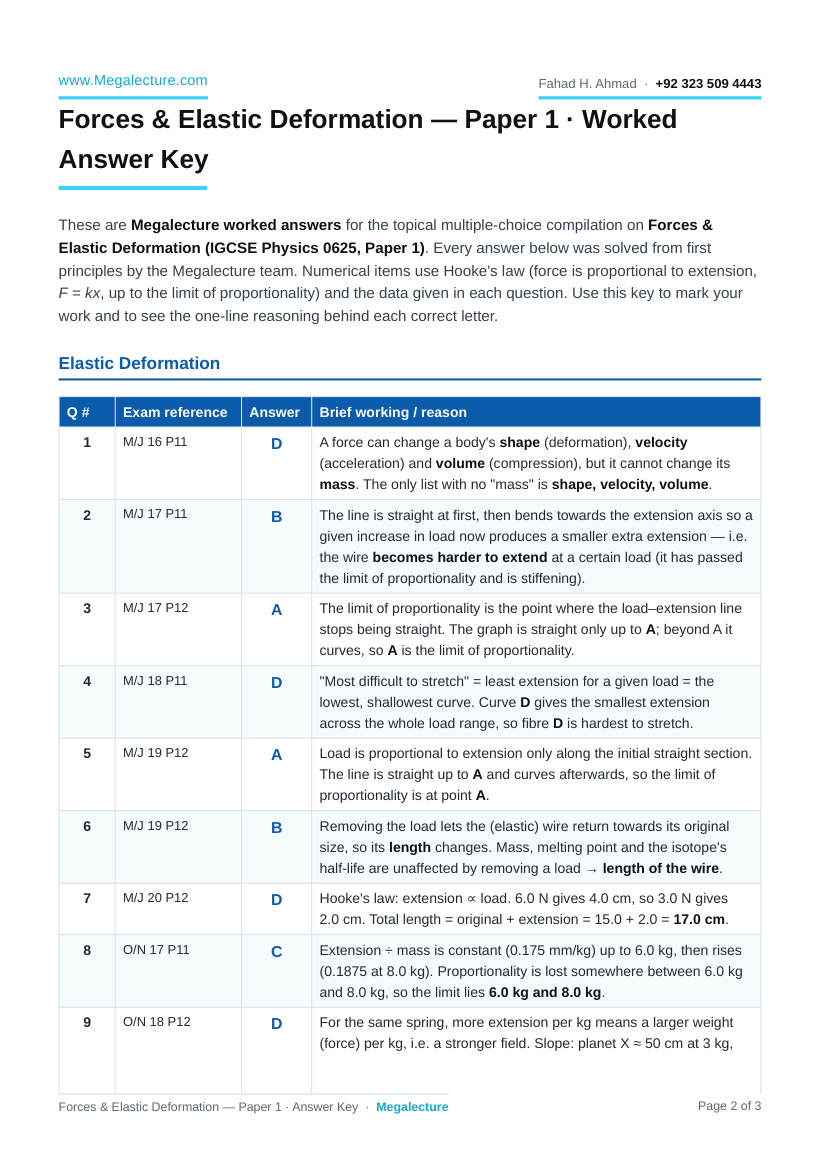
Elastic Deformation Q # Exam reference Answer Brief working / reason
M/J 16 P11
D
A force can change a body's shape (deformation), velocity
(acceleration) and volume (compression), but it cannot change its mass. The only list with no "mass" is shape, velocity, volume.
M/J 17 P11
B
The line is straight at first, then bends towards the extension axis so a given increase in load now produces a smaller extra extension — i.e.
the wire becomes harder to extend at a certain load (it has passed the limit of proportionality and is stiffening).
M/J 17 P12
A
The limit of proportionality is the point where the load–extension line stops being straight. The graph is straight only up to A; beyond A it curves, so A is the limit of proportionality.
M/J 18 P11
D
"Most difficult to stretch" = least extension for a given load = the lowest, shallowest curve. Curve D gives the smallest extension across the whole load range, so fibre D is hardest to stretch.
M/J 19 P12
A
Load is proportional to extension only along the initial straight section.
The line is straight up to A and curves afterwards, so the limit of proportionality is at point A.
M/J 19 P12
B
Removing the load lets the (elastic) wire return towards its original size, so its length changes. Mass, melting point and the isotope's half-life are unaffected by removing a load → length of the wire.
M/J 20 P12
D
Hooke's law: extension ∝ load. 6.0 N gives 4.0 cm, so 3.0 N gives
2.0 cm. Total length = original + extension = 15.0 + 2.0 = 17.0 cm.
O/N 17 P11
C
Extension ÷ mass is constant (0.175 mm/kg) up to 6.0 kg, then rises
(0.1875 at 8.0 kg). Proportionality is lost somewhere between 6.0 kg and 8.0 kg, so the limit lies 6.0 kg and 8.0 kg.
O/N 18 P12
D
For the same spring, more extension per kg means a larger weight
Forces & Elastic Deformation — Paper 1 · Answer Key · Megalecture
Q # Exam reference Answer Brief working / reason
planet Y ≈ 30 cm at 6 kg, a ratio of 3. So g on X is three times that on Y.
O/N 19 P11
D
In parallel, each spring shares the load and extends x. In series, each spring carries the full load L, so each extends 2x; two of them give a total extension of 2x + 2x = 4x.
O/N 20 P11
A
On an extension–load graph, proportionality holds while the plot is a straight line through the origin. It is straight only up to point A; beyond
A the curve steepens, so A marks the limit of proportionality.
Note from Megalecture. These are original Megalecture worked solutions prepared for revision use. Where a graph defines the limit of proportionality, look for the last point on the straight, through-the-origin section; where numbers are given, apply Hooke's law (F = kx) directly.
Forces & Elastic Deformation — Paper 1 · Answer Key · Megalecture
