
O Level & IGCSE · Physics 5054 / 0625 · Revision & Reference
Physics Summary
Typed from the teacher’s handwritten class notes. The original pages are one tap away.
Opens inside this page. Prefer your own PDF app? Open the PDF.
New: small group classes for O Level Physics are opening, at a lower fee than one-to-one. Join the waiting list
Check yourself
5 quick questions on O Level Physics
Tap an answer to see if you are right, and why. Free, no sign-up.
Start the free test5 of 6 students found these notes useful
Was this note useful?
Full text of Physics Summary
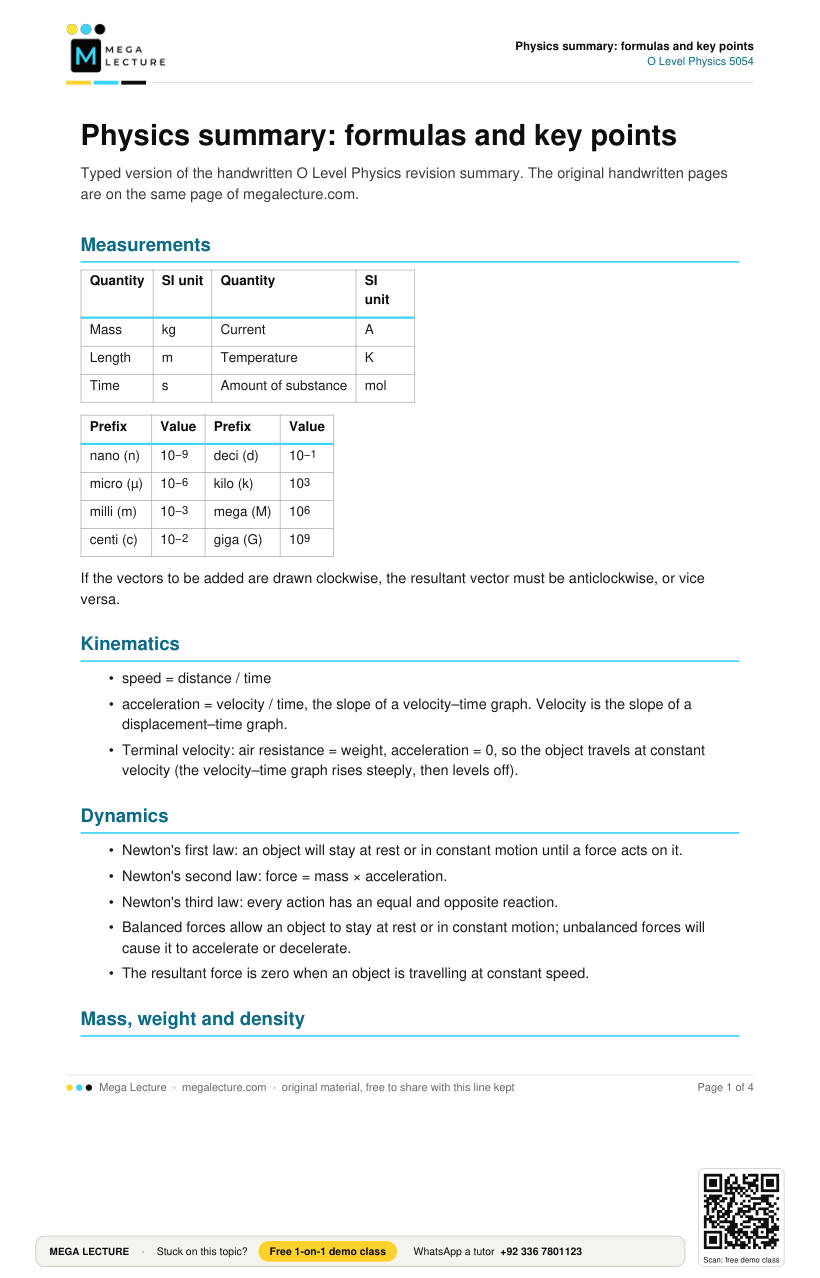
Typed version of the handwritten O Level Physics revision summary. The original handwritten pages are on the same page of megalecture.com.
Measurements
| Quantity | SI unit | Quantity | SI unit |
|---|---|---|---|
| Mass | kg | Current | A |
| Length | m | Temperature | K |
| Time | s | Amount of substance | mol |
| Prefix | Value | Prefix | Value |
|---|---|---|---|
| nano (n) | 10−9 | deci (d) | 10−1 |
| micro (µ) | 10−6 | kilo (k) | 103 |
| milli (m) | 10−3 | mega (M) | 106 |
| centi (c) | 10−2 | giga (G) | 109 |
If the vectors to be added are drawn clockwise, the resultant vector must be anticlockwise, or vice versa.
Kinematics
- speed = distance / time
- acceleration = velocity / time, the slope of a velocity–time graph. Velocity is the slope of a displacement–time graph.
- Terminal velocity: air resistance = weight, acceleration = 0, so the object travels at constant velocity (the velocity–time graph rises steeply, then levels off).
Dynamics
- Newton's first law: an object will stay at rest or in constant motion until a force acts on it.
- Newton's second law: force = mass × acceleration.
- Newton's third law: every action has an equal and opposite reaction.
- Balanced forces allow an object to stay at rest or in constant motion; unbalanced forces will cause it to accelerate or decelerate.
- The resultant force is zero when an object is travelling at constant speed.
Mass, weight and density
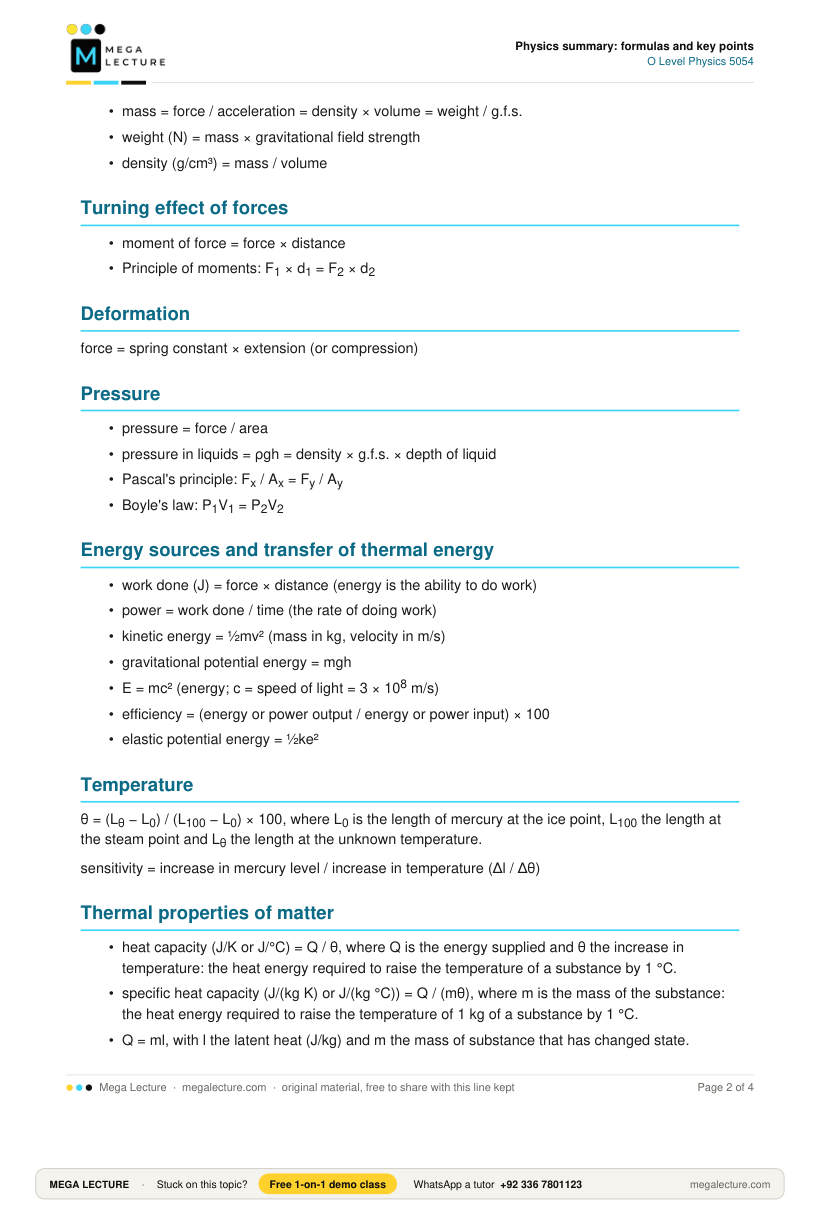
- mass = force / acceleration = density × volume = weight / g.f.s.
- weight (N) = mass × gravitational field strength
- density (g/cm³) = mass / volume
Turning effect of forces
- moment of force = force × distance
- Principle of moments: F1 × d1 = F2 × d2
Deformation
force = spring constant × extension (or compression)
Pressure
- pressure = force / area
- pressure in liquids = ρgh = density × g.f.s. × depth of liquid
- Pascal's principle: Fx / Ax = Fy / Ay
- Boyle's law: P1V1 = P2V2
Energy sources and transfer of thermal energy
- work done (J) = force × distance (energy is the ability to do work)
- power = work done / time (the rate of doing work)
- kinetic energy = ½mv² (mass in kg, velocity in m/s)
- gravitational potential energy = mgh
- E = mc² (energy; c = speed of light = 3 × 10⁸ m/s)
- efficiency = (energy or power output / energy or power input) × 100
- elastic potential energy = ½ke²
Temperature
θ = (Lθ − L0) / (L100 − L0) × 100, where L0 is the length of mercury at the ice point, L100 the length at the steam point and Lθ the length at the unknown temperature.
sensitivity = increase in mercury level / increase in temperature (Δl / Δθ)
Thermal properties of matter
- heat capacity (J/K or J/°C) = Q / θ, where Q is the energy supplied and θ the increase in temperature: the heat energy required to raise the temperature of a substance by 1 °C.
- specific heat capacity (J/(kg K) or J/(kg °C)) = Q / (mθ), where m is the mass of the substance: the heat energy required to raise the temperature of 1 kg of a substance by 1 °C.
- Q = ml, with l the latent heat (J/kg) and m the mass of substance that has changed state.
General wave properties
- velocity = frequency × wavelength: v = fλ (λ is "lambda")
- frequency = 1 / T
Light
- refractive index n = sin i / sin r = c / v (speed of light in a vacuum / speed of light in the medium) = real depth / apparent depth
- critical angle: C = sin−1(1 / n)
Electromagnetic spectrum
| Wave | Typical frequency (Hz) | Uses |
|---|---|---|
| Radio waves | 104 | television, radio |
| Microwaves | 1010 | satellites |
| Infra-red | 1013 | remote-control devices, grills and toasters |
| Visible light | 1014 | optic fibres for transmission of signals (and fluorescent tubes) |
| UV rays | 1015 | sun-beds, sterilising medical equipment |
| X-rays | 1017 | 2-dimensional images in medicine, scanners |
| Gamma rays | 1020 | killing cancerous cells and tumours, finding cracks in metals |
Sound
- Higher pitch = higher frequency; larger amplitude = louder.
- Speed of sound: solid > liquid > gas. Speed of sound in air ≈ 330 m/s.
Electromagnetism
- Right-hand grip rule gives the direction of the field around a current.
- ⊙ = current out of the page; ⊗ = current into the page.
- Two wires carrying current in the same direction attract each other; in opposite directions they repel.
- Fleming's left-hand rule: first finger = magnetic field, thumb = force, second finger = direction of current.
- Split-ring commutators are used in d.c. motors; slip rings in a.c. generators.
Current electricity
- current (amperes) = charge / time; 1 A = 1 C / 1 s
- voltage (volts) = energy / charge = work done / charge; 1 V = 1 J / 1 C
- V = IR; resistance (ohms) = voltage / current
- V–I and I–V graphs: filament lamp (curve bending over), thermistor (curve bending up), diode (no current until a forward voltage, then a straight rise).
- Series resistors: I1 = I2 = I3; V = V1 + V2 + V3; R = R1 + R2 + R3
- Parallel resistors: I = I1 + I2 + I3; V1 = V2 = V3; 1/R = 1/R1 + 1/R2 + 1/R3
- E = Pt = IVt = I²Rt (joules); power = VI (watts)
- e.m.f. and p.d. are both voltages. Cells in series: E = E1 + E2 + E3. Cells in parallel: E1 = E2 = E3; if one fails the others keep working, they last longer, lower resistance, less energy loss.
- Energy = power × time: joules = watts × seconds; kilowatt-hours = kilowatts × hours.
Electronics
Potential divider: V1 = (R1 / (R1 + R2)) × V, and V2 = (R2 / (R1 + R2)) × V, where V is the supply across R1 and R2 in series and V1, V2 are the voltages across each.
Radioactivity
Unstable nuclei emit:
- α particles (helium nuclei, 42α): higher mass, so greatest ionisation power and least penetration; stopped by paper or 8–10 cm of air; speed about 10% of c; deflected (less) in electric and magnetic fields.
- β particles (electrons, 0−1β): ionisation power less than α, penetration greater than α; stopped by a few mm of aluminium; speed about 90% of c; deflected most in electric and magnetic fields.
- γ rays (electromagnetic waves): no charge, no mass; greatest penetration, stopped by a lead block; least ionisation; not deflected because they carry no charge; c = 3 × 10⁸ m/s.
- AZX → 42α + A−4Z−2Y
- AZX → 0−1β + AZ+1Y
- AZX → γ + AZX
In every half-life, the number of atoms, the mass and the activity halve.
Still to add (from the last page's to-do list): the vertical-row / horizontal-line notation, melting point, boiling point, scale, periscope image properties, and a comparison of distance–time and speed–time graphs.
