
O Level · Pakistan Studies 2059 · Topic Notes (chronological)
Lord Wavell, the Wavell Plan and the Simla Conference 1945
Opens inside this page. Prefer your own PDF app? Open the PDF.
New: small group classes for O Level Pakistan Studies are opening, at a lower fee than one-to-one. Join the waiting list
Check yourself
5 quick questions on O Level Pakistan Studies
Tap an answer to see if you are right, and why. Free, no sign-up.
Start the free test4 of 5 students found these notes useful
Was this note useful?
Full text of Lord Wavell, the Wavell Plan and the Simla Conference 1945
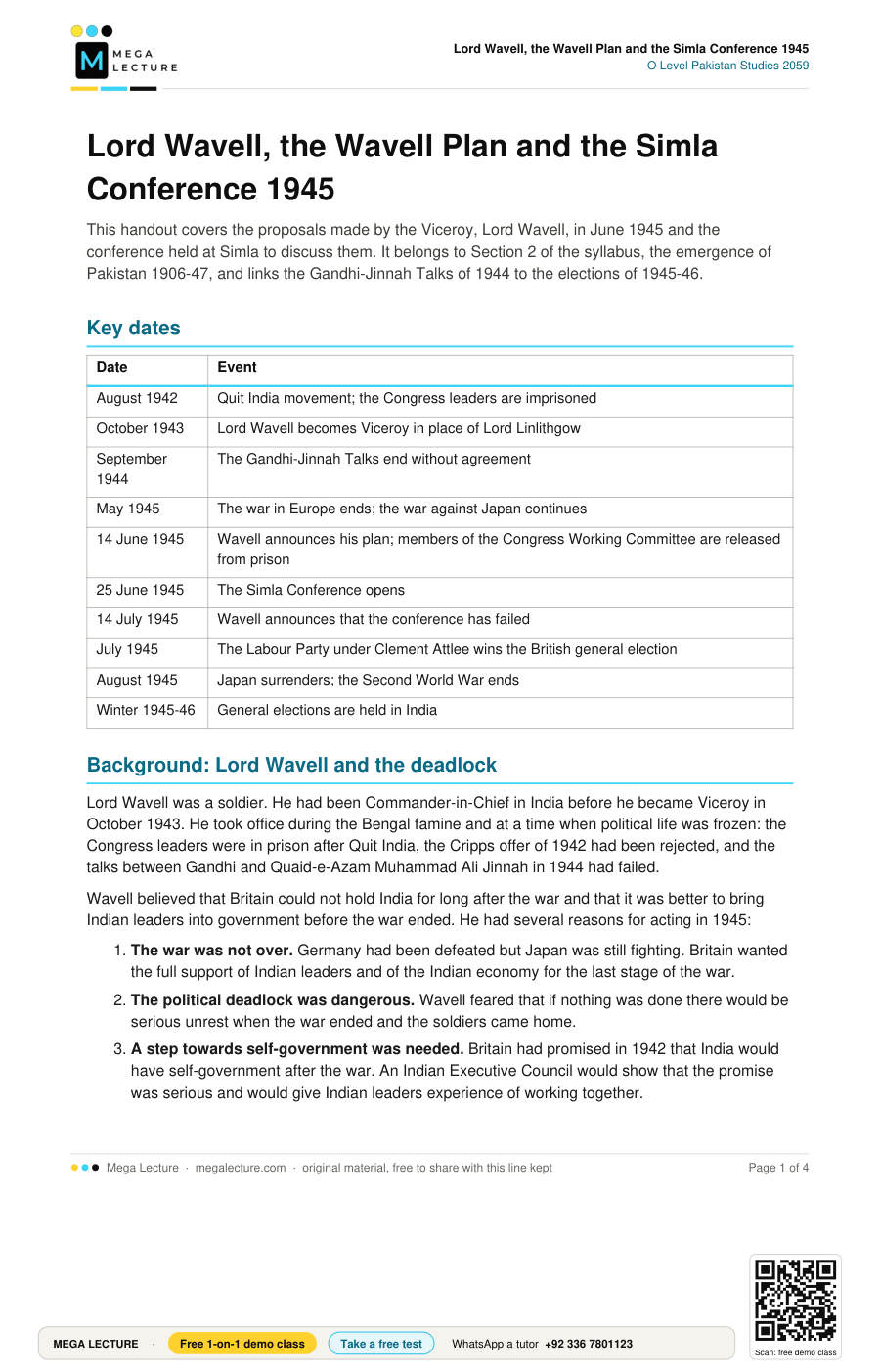
This handout covers the proposals made by the Viceroy, Lord Wavell, in June 1945 and the conference held at Simla to discuss them. It belongs to Section 2 of the syllabus, the emergence of Pakistan 1906-47, and links the Gandhi-Jinnah Talks of 1944 to the elections of 1945-46.
Key dates
| Date | Event |
|---|---|
| August 1942 | Quit India movement; the Congress leaders are imprisoned |
| October 1943 | Lord Wavell becomes Viceroy in place of Lord Linlithgow |
| September 1944 | The Gandhi-Jinnah Talks end without agreement |
| May 1945 | The war in Europe ends; the war against Japan continues |
| 14 June 1945 | Wavell announces his plan; members of the Congress Working Committee are released from prison |
| 25 June 1945 | The Simla Conference opens |
| 14 July 1945 | Wavell announces that the conference has failed |
| July 1945 | The Labour Party under Clement Attlee wins the British general election |
| August 1945 | Japan surrenders; the Second World War ends |
| Winter 1945-46 | General elections are held in India |
Background: Lord Wavell and the deadlock
Lord Wavell was a soldier. He had been Commander-in-Chief in India before he became Viceroy in October 1943. He took office during the Bengal famine and at a time when political life was frozen: the Congress leaders were in prison after Quit India, the Cripps offer of 1942 had been rejected, and the talks between Gandhi and Quaid-e-Azam Muhammad Ali Jinnah in 1944 had failed.
Wavell believed that Britain could not hold India for long after the war and that it was better to bring Indian leaders into government before the war ended. He had several reasons for acting in 1945:
- The war was not over. Germany had been defeated but Japan was still fighting. Britain wanted the full support of Indian leaders and of the Indian economy for the last stage of the war.
- The political deadlock was dangerous. Wavell feared that if nothing was done there would be serious unrest when the war ended and the soldiers came home.
- A step towards self-government was needed. Britain had promised in 1942 that India would have self-government after the war. An Indian Executive Council would show that the promise was serious and would give Indian leaders experience of working together.
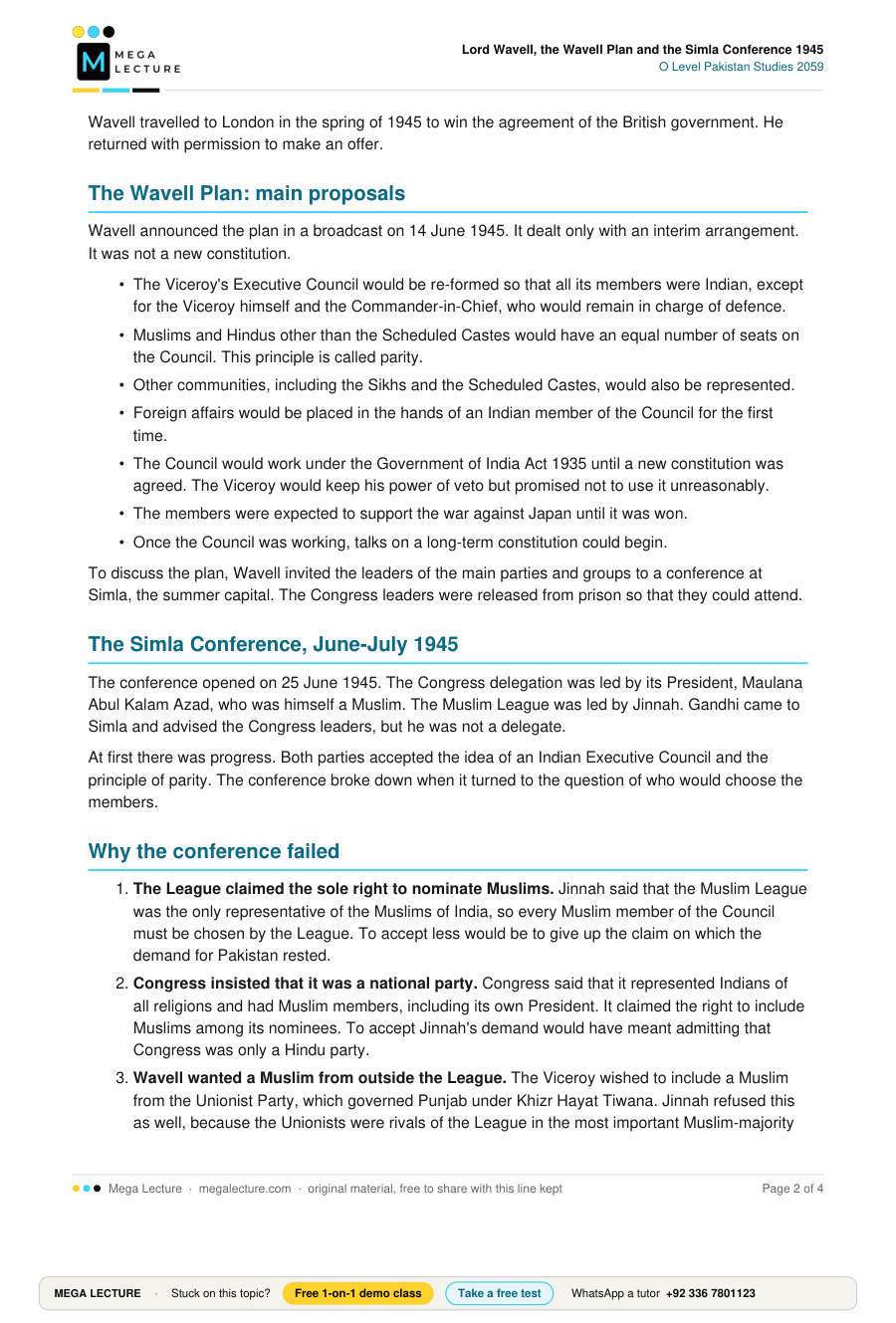
Wavell travelled to London in the spring of 1945 to win the agreement of the British government. He returned with permission to make an offer.
The Wavell Plan: main proposals
Wavell announced the plan in a broadcast on 14 June 1945. It dealt only with an interim arrangement. It was not a new constitution.
- The Viceroy's Executive Council would be re-formed so that all its members were Indian, except for the Viceroy himself and the Commander-in-Chief, who would remain in charge of defence.
- Muslims and Hindus other than the Scheduled Castes would have an equal number of seats on the Council. This principle is called parity.
- Other communities, including the Sikhs and the Scheduled Castes, would also be represented.
- Foreign affairs would be placed in the hands of an Indian member of the Council for the first time.
- The Council would work under the Government of India Act 1935 until a new constitution was agreed. The Viceroy would keep his power of veto but promised not to use it unreasonably.
- The members were expected to support the war against Japan until it was won.
- Once the Council was working, talks on a long-term constitution could begin.
To discuss the plan, Wavell invited the leaders of the main parties and groups to a conference at Simla, the summer capital. The Congress leaders were released from prison so that they could attend.
The Simla Conference, June-July 1945
The conference opened on 25 June 1945. The Congress delegation was led by its President, Maulana Abul Kalam Azad, who was himself a Muslim. The Muslim League was led by Jinnah. Gandhi came to Simla and advised the Congress leaders, but he was not a delegate.
At first there was progress. Both parties accepted the idea of an Indian Executive Council and the principle of parity. The conference broke down when it turned to the question of who would choose the members.
Why the conference failed
- The League claimed the sole right to nominate Muslims. Jinnah said that the Muslim League was the only representative of the Muslims of India, so every Muslim member of the Council must be chosen by the League. To accept less would be to give up the claim on which the demand for Pakistan rested.
- Congress insisted that it was a national party. Congress said that it represented Indians of all religions and had Muslim members, including its own President. It claimed the right to include Muslims among its nominees. To accept Jinnah's demand would have meant admitting that Congress was only a Hindu party.
- Wavell wanted a Muslim from outside the League. The Viceroy wished to include a Muslim from the Unionist Party, which governed Punjab under Khizr Hayat Tiwana. Jinnah refused this as well, because the Unionists were rivals of the League in the most important Muslim-majority province.
- The League feared being outvoted. Even with parity between Muslims and caste Hindus, the Sikh and Scheduled Caste members were expected to vote with Congress on most matters. The Muslims would then be a permanent minority in the Council. Jinnah asked for a safeguard for decisions that the Muslim members opposed, but this was not granted.
Wavell asked the parties to send him lists of names. Congress did so but the League declined. Wavell then drew up a list of his own, which Jinnah would not accept. Rather than form a Council without the League, Wavell announced on 14 July that the conference had failed, and he took the blame on himself.
How important was the Simla Conference?
Reasons to see it as important
- It showed that no settlement could be made without the agreement of the Muslim League. Wavell would not go ahead without Jinnah, so in effect the League had gained a veto over constitutional change.
- Jinnah's position among Muslims became stronger. Muslim politicians who had stayed outside the League now saw that it was the party that counted, and many joined it before the elections.
- It made clear that Congress and the League could not work together in a single government, which made the idea of a united India harder to sustain.
- It led directly to the elections of 1945-46. Since the two parties disagreed about who represented the Muslims, the only way to settle the question was to ask the voters.
Reasons to see it as limited
- It produced no agreement and no change in the way India was governed.
- The plan was only about an interim council. It did not deal with the main issue, the demand for Pakistan.
- Events outside India soon mattered more. The Labour victory in Britain in July 1945 and the end of the war in August brought to power a government that intended to leave India quickly.
- The League's claim to speak for all Muslims was still only a claim in July 1945. It was the election results that proved it.
Judgement
The Simla Conference failed in its own aim, but it mattered for the Pakistan Movement. Jinnah's refusal to allow anyone else to nominate Muslims was a risk, because it could have left the League outside the government. In practice it showed the British and Congress that the League could block any plan it did not accept. The conference was a turning point in the League's standing, although the elections that followed were needed to confirm it.
Key terms and people
- Lord Wavell: Viceroy of India from 1943 to 1947.
- Executive Council: the body that worked with the Viceroy as the central government of British India.
- Parity: equal numbers of seats for Muslims and caste Hindus.
- Veto: the power to block a decision.
- Maulana Abul Kalam Azad: President of Congress and leader of its delegation at Simla.
- Khizr Hayat Tiwana: leader of the Unionist Party and Premier of Punjab.
- Scheduled Castes: the official name for the lowest groups in the Hindu caste system, who were given separate representation.
- Interim arrangement: a temporary system of government until a permanent one is agreed.
Exam practice
- Describe the proposals of the Wavell Plan of 1945. [4]
- Why did the Simla Conference of 1945 fail? [7]
- "The Simla Conference of 1945 was more important than the Gandhi-Jinnah Talks of 1944 in the progress of the Pakistan Movement." How far do you agree? Explain your answer. [14]
Outline answers
1. Announced by the Viceroy in June 1945. A new Executive Council with all Indian members except the Viceroy and the Commander-in-Chief. Equal seats for Muslims and caste Hindus. Foreign affairs to be given to an Indian member. The Council to work under the 1935 Act and support the war against Japan.
2. Three explained reasons: (i) Jinnah insisted that the League alone should nominate all the Muslim members, because it claimed to be the sole voice of Muslims; (ii) Congress would not agree, because it saw itself as a party of all Indians and wanted to nominate Muslims such as Azad; (iii) Jinnah also refused Wavell's wish to include a Unionist Muslim, and feared that Muslims would be outvoted in the Council by Congress and the smaller groups.
3. Simla: showed that the League could block any settlement; raised Jinnah's standing; led to the elections that proved the League's claim. Talks of 1944: Gandhi dealt with Jinnah as an equal; separation was discussed by Congress for the first time; the Two Nation Theory was set out clearly. Limits of both: neither produced an agreement. Judgement: Simla was more important because the British were involved and accepted that they could not proceed without the League, and because it led straight to the elections; the 1944 talks prepared the ground.
