
O Level · Pakistan Studies 2059 · Topic Notes (chronological)
The Cripps Mission 1942 and the Quit India Movement
Opens inside this page. Prefer your own PDF app? Open the PDF.
New: small group classes for O Level Pakistan Studies are opening, at a lower fee than one-to-one. Join the waiting list
Check yourself
5 quick questions on The emergence of Pakistan: 1940 to 1947
Tap an answer to see if you are right, and why. Free, no sign-up.
Start the free test4 of 5 students found these notes useful
Was this note useful?
Full text of The Cripps Mission 1942 and the Quit India Movement
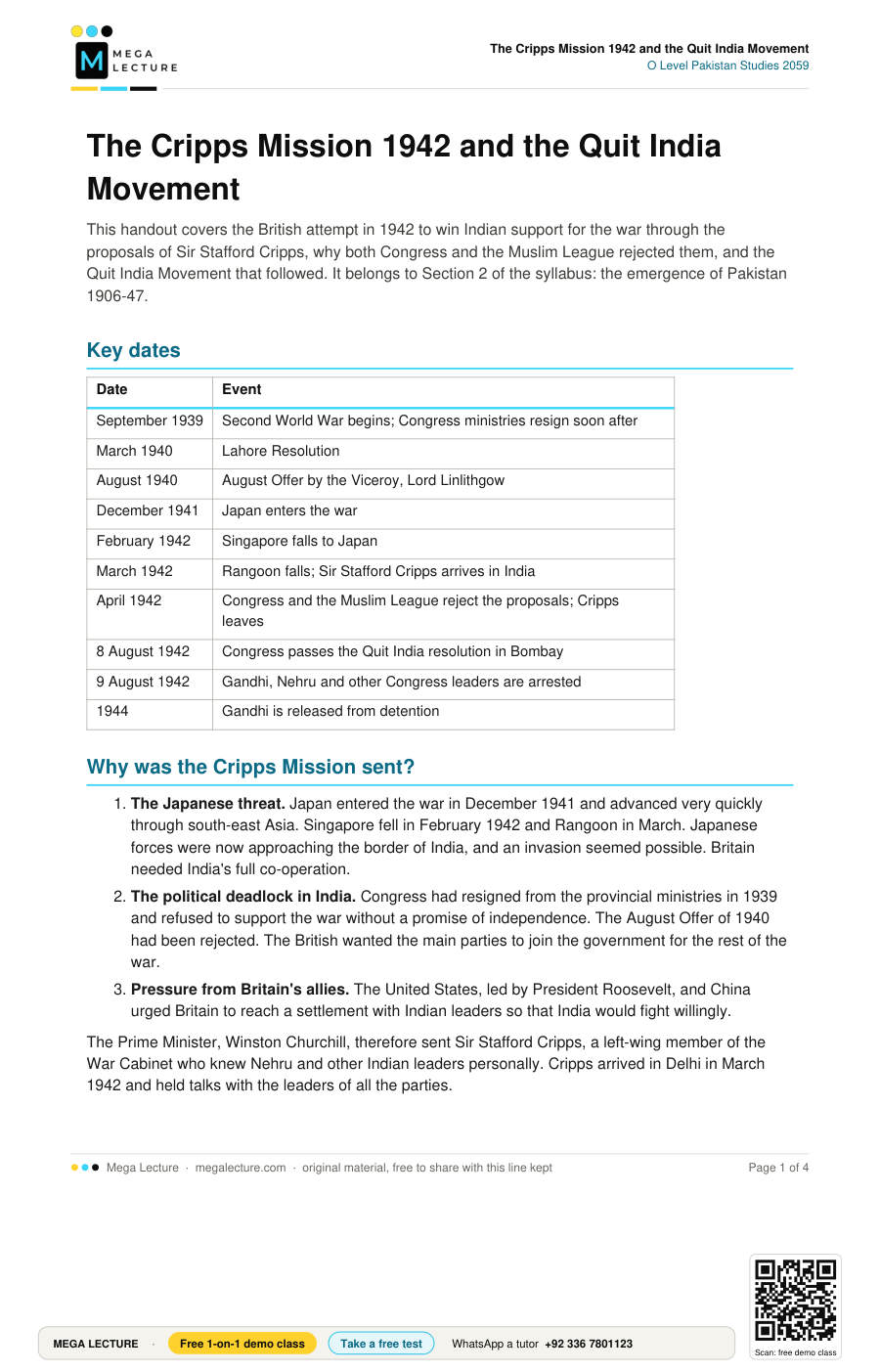
This handout covers the British attempt in 1942 to win Indian support for the war through the proposals of Sir Stafford Cripps, why both Congress and the Muslim League rejected them, and the Quit India Movement that followed. It belongs to Section 2 of the syllabus: the emergence of Pakistan 1906-47.
Key dates
| Date | Event |
|---|---|
| September 1939 | Second World War begins; Congress ministries resign soon after |
| March 1940 | Lahore Resolution |
| August 1940 | August Offer by the Viceroy, Lord Linlithgow |
| December 1941 | Japan enters the war |
| February 1942 | Singapore falls to Japan |
| March 1942 | Rangoon falls; Sir Stafford Cripps arrives in India |
| April 1942 | Congress and the Muslim League reject the proposals; Cripps leaves |
| 8 August 1942 | Congress passes the Quit India resolution in Bombay |
| 9 August 1942 | Gandhi, Nehru and other Congress leaders are arrested |
| 1944 | Gandhi is released from detention |
Why was the Cripps Mission sent?
- The Japanese threat. Japan entered the war in December 1941 and advanced very quickly through south-east Asia. Singapore fell in February 1942 and Rangoon in March. Japanese forces were now approaching the border of India, and an invasion seemed possible. Britain needed India's full co-operation.
- The political deadlock in India. Congress had resigned from the provincial ministries in 1939 and refused to support the war without a promise of independence. The August Offer of 1940 had been rejected. The British wanted the main parties to join the government for the rest of the war.
- Pressure from Britain's allies. The United States, led by President Roosevelt, and China urged Britain to reach a settlement with Indian leaders so that India would fight willingly.
The Prime Minister, Winston Churchill, therefore sent Sir Stafford Cripps, a left-wing member of the War Cabinet who knew Nehru and other Indian leaders personally. Cripps arrived in Delhi in March 1942 and held talks with the leaders of all the parties.
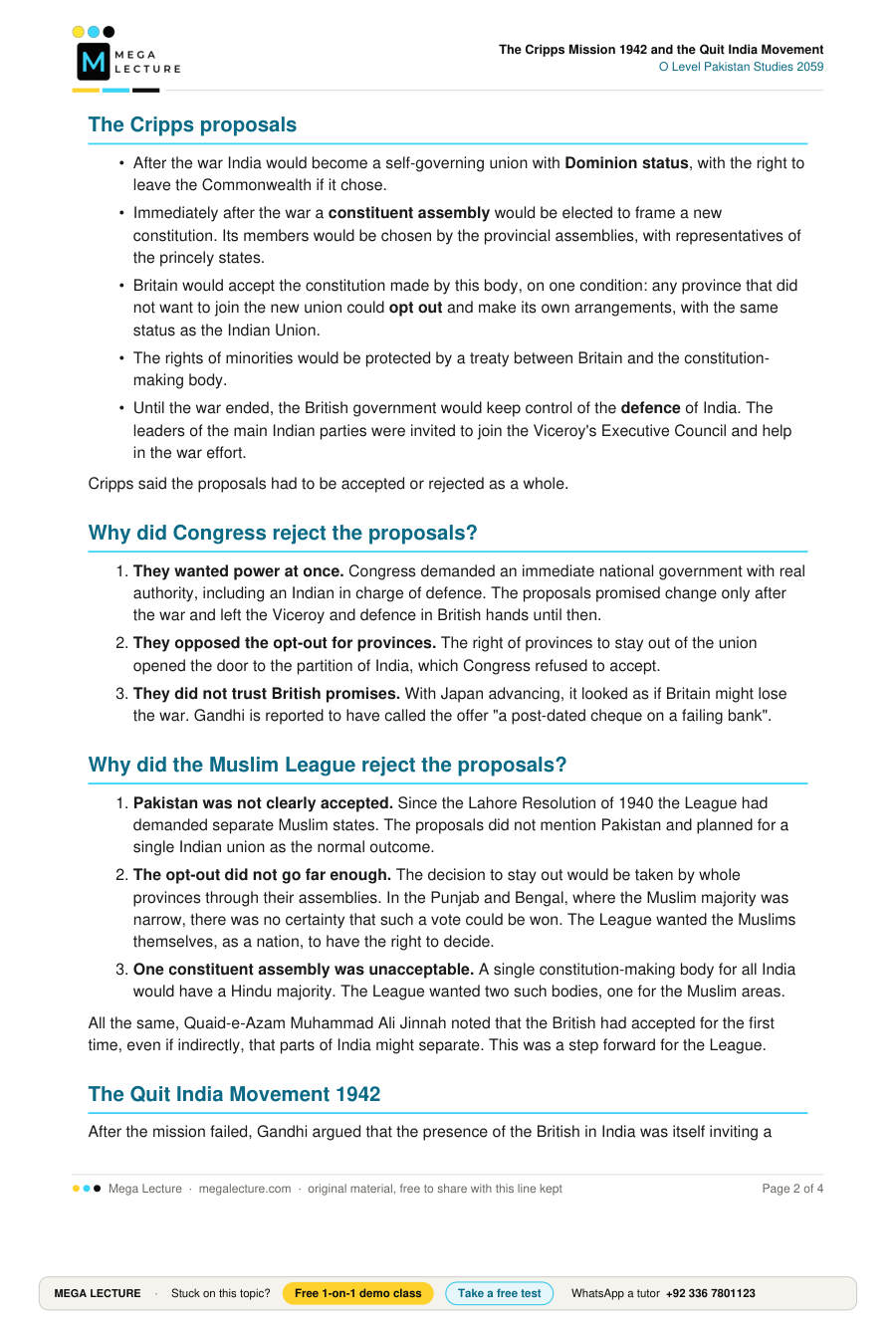
The Cripps proposals
- After the war India would become a self-governing union with Dominion status, with the right to leave the Commonwealth if it chose.
- Immediately after the war a constituent assembly would be elected to frame a new constitution. Its members would be chosen by the provincial assemblies, with representatives of the princely states.
- Britain would accept the constitution made by this body, on one condition: any province that did not want to join the new union could opt out and make its own arrangements, with the same status as the Indian Union.
- The rights of minorities would be protected by a treaty between Britain and the constitution-making body.
- Until the war ended, the British government would keep control of the defence of India. The leaders of the main Indian parties were invited to join the Viceroy's Executive Council and help in the war effort.
Cripps said the proposals had to be accepted or rejected as a whole.
Why did Congress reject the proposals?
- They wanted power at once. Congress demanded an immediate national government with real authority, including an Indian in charge of defence. The proposals promised change only after the war and left the Viceroy and defence in British hands until then.
- They opposed the opt-out for provinces. The right of provinces to stay out of the union opened the door to the partition of India, which Congress refused to accept.
- They did not trust British promises. With Japan advancing, it looked as if Britain might lose the war. Gandhi is reported to have called the offer "a post-dated cheque on a failing bank".
Why did the Muslim League reject the proposals?
- Pakistan was not clearly accepted. Since the Lahore Resolution of 1940 the League had demanded separate Muslim states. The proposals did not mention Pakistan and planned for a single Indian union as the normal outcome.
- The opt-out did not go far enough. The decision to stay out would be taken by whole provinces through their assemblies. In the Punjab and Bengal, where the Muslim majority was narrow, there was no certainty that such a vote could be won. The League wanted the Muslims themselves, as a nation, to have the right to decide.
- One constituent assembly was unacceptable. A single constitution-making body for all India would have a Hindu majority. The League wanted two such bodies, one for the Muslim areas.
All the same, Quaid-e-Azam Muhammad Ali Jinnah noted that the British had accepted for the first time, even if indirectly, that parts of India might separate. This was a step forward for the League.
The Quit India Movement 1942
After the mission failed, Gandhi argued that the presence of the British in India was itself inviting a Japanese attack, and that they should leave at once. On 8 August 1942 the All-India Congress Committee, meeting in Bombay, passed the Quit India resolution. It called for the immediate end of British rule and approved a mass non-violent struggle under Gandhi's leadership. Gandhi told his followers to "do or die".
The British acted the next day. Gandhi, Nehru and the other senior Congress leaders were arrested, and Congress was banned. With the leaders in jail, the movement had no direction and became violent. There were riots in many parts of India. Railway lines, telegraph wires and police stations were attacked. The British used the police and the army to restore order. Over a thousand people were killed and many thousands were arrested. Within a few weeks the main disturbances had been put down. Most of the Congress leaders stayed in prison until near the end of the war.
The Muslim League's response
The Muslim League did not join the movement. Jinnah criticised it as an attempt by Congress to force the British to hand power to the Hindu majority and to ignore the Muslims and their demand for Pakistan. He described it as blackmail, since it took advantage of Britain's difficulties in the war. The League answered the Congress slogan "Quit India" with its own: "Divide and Quit".
The League gained from these events.
- While the Congress leaders were in prison, the League was free to organise and spread the message of Pakistan among Muslims.
- League ministries were formed in several provinces in these years, including Bengal, Sindh and the North-West Frontier Province.
- The British came to regard the League as a responsible party whose views had to be taken into account in any settlement.
How successful was the Cripps Mission?
Points for failure
- Both major parties rejected the proposals, and Cripps left India in April 1942 with nothing agreed.
- The deadlock continued, and Congress moved to open confrontation in the Quit India Movement.
- Churchill and the Viceroy, Lord Linlithgow, gave Cripps little room to negotiate, especially on defence, so many Indians doubted that the offer was sincere.
Points for success or importance
- For the first time the British promised that Indians would write their own constitution after the war, with the right to leave the Commonwealth. This promise could not be taken back and was the starting point of later talks.
- The right of provinces to opt out showed that the British were prepared to consider a divided India. This encouraged the Muslim League.
Judgement. The mission failed in its immediate purpose of bringing Congress and the League into the wartime government. Its lasting importance was that Britain had now publicly accepted that India would be independent after the war, and had accepted in principle that not all of India need stay in one union. The Quit India Movement that followed weakened Congress for three years and left the Muslim League stronger.
Key terms and people
- Sir Stafford Cripps: member of the British War Cabinet who brought the proposals to India.
- Constituent assembly: a body elected to write a constitution.
- Opt-out clause: the right of a province to stay out of the proposed Indian union.
- Quit India resolution: the Congress demand of August 1942 that the British leave India at once.
- "Divide and Quit": the Muslim League's reply to the Quit India slogan.
Exam practice
- Describe the Quit India Movement of 1942. [4]
- Why did the Cripps Mission of 1942 fail? [7]
- "The Cripps Mission was more important to the Muslim League than the Quit India Movement in the years 1942 to 1945." How far do you agree? Explain your answer. [14]
Outline answers
1. Congress passed the Quit India resolution in Bombay in August 1942, demanding that the British leave at once. Gandhi called for a mass struggle with the words "do or die". The British arrested Gandhi, Nehru and other leaders and banned Congress. Riots and attacks on railways and government buildings followed and were put down by force. The Muslim League did not take part.
2. (i) Congress rejected it because it wanted immediate self-government and control of defence, while the proposals offered Dominion status only after the war; Gandhi saw it as a promise from a power that might lose the war. (ii) Congress also objected to the right of provinces to opt out, which could break up India. (iii) The Muslim League rejected it because it did not clearly grant Pakistan: there would be one constituent assembly, and the opt-out depended on votes of whole provinces which Muslims might not win. Since the proposals could not be altered, there was no room for compromise.
3. Cripps Mission: the British accepted that provinces could stay out of the union, an indirect recognition of the Pakistan demand; the League was consulted as an equal party; but the League rejected the offer and gained nothing definite. Quit India: Congress leaders were jailed for most of the war, leaving the field open; the League organised, spread its message and held office in several provinces; the British saw it as responsible; the "Divide and Quit" slogan made its aim clear. Judgement: the Cripps offer mattered in principle, but the absence of Congress after Quit India gave the League the practical chance to grow into the mass party that won the 1945-46 elections, so Quit India probably helped it more.
